The collapse of the Assad regime in Syria is rapidly changing the geopolitics of the Middle East. The Assad family had ruled in Syria for 50 years, but its collapse only took a few weeks. At this time, I would not hazard a guess about who will rule Syria in the future, or even whether Syria will remain a nation-state or devolve into mini-states ruled by different factions.
In reality, Syria fell apart 13 years ago as a popular movement known as the “Arab Spring” swept through many states in the Middle East in 2011. The Assad regime barely survived that movement and has been propped up by both Russia and Iran since that time. Russia, weakened by its war against Ukraine, and Iran, weakened by the Israeli attacks against its proxies, Hamas and Hezbollah, were unable to maintain that support as a rebel group in Syria, Hayat Tahrir al-Sham, seized control of Damascus. But there are many groups within Syria, as described by the BBC:
“Among these groups – some now in Damascus – are rebel factions that once operated under the banner of the Free Syrian Army from southern towns and cities that had been dormant for years, but where the spark of rebellion had never entirely been sniffed out.
“Over to the east, Kurdish-led forces have benefited from the collapse of the Syrian army to take full control of the main city, Deir El-Zour. In the vast Syrian desert, remnants of the so-called Islamic State could also look to take advantage of the situation. And in the far north along the Turkish border, the Syrian National Army – backed by Ankara – could also prove to be a significant player in what happens next.”
In terms of the geopolitics of the region, the big losers are Russia and Iran. The big winners are Turkey and Israel. Turkish ambitions might be stymied by the strong Kurdish community in Syria. But the Israelis have taken advantage of the power vacuum in Syria by launching military assaults against virtually every Syrian military installation. Mondoweiss reports:
“Even as Bashar al-Assad was scrambling to get out of Syria, Israel was mobilizing its military to take advantage of the power vacuum that Assad’s ouster had created. After five decades of a low-level conflict between the two countries, Israel saw an opportunity to change the calculus, and it seized it.
“As of Wednesday, Israel had struck Syria nearly 500 times. Their goal with these attacks has been to essentially destroy Syria’s military capability, and they have already succeeded. Reports by Israeli media claim that well over 80% of Syria’s weaponry, ships, missiles, aircraft, and other military supplies have been damaged or destroyed.
“In essence, Israel has rendered Syria completely defenseless. “
Moreover, Israeli Defense Forces have seized territory in Syria which includes Mount Hermon, which offers Israel a critically important strategic location giving it the ability to monitor activities in Lebanon and Syria with great accuracy. The map of Israeli occupation is striking.
Israel has ordered the IDF to maintain its control of Mount Hermon throughout the winter and has suggested that its occupation is temporary. But, given its strategic significance, it is unlikely that Israel will return control of the mountain to Syria. Indeed, some in Israel have proposed that Israel should annex the terriroty, as reported by the Middle East Monitor:
“Israeli Diaspora Affairs Minister Amichai Chikli yesterday called for Israel to occupy the summit of Mount Hermon in Syria.
“Chikli said: ‘The events in Syria are far from a cause for celebration. Although Hay’at Tahrir Al-Sham and its leader, Ahmed Al-Sharaa, portray themselves as a new product, ultimately most of Syria is now under the control of affiliate organisations of Al-Qaeda.’
“’The good news is the growing strength of the Kurds and the expansion of their control in the northeast of the country,’ the Likud Party member said, noting that ‘Israel must operationally renew its control at Mount Hermon [in the occupied Golan Heights] and establish a new line of defence based on the ceasefire line of 1974 [with Syria].’
“Chikli’s statements come despite a call by the office Israeli Prime Minister, Benjamin Netanyahu, not to make statements about developments in Syria, while the Likud Party asked its members in the Knesset not to conduct interviews about Syria without the approval of Netanyahu’s office, according to reports by the Israeli public radio yesterday.”
Israel has now seized territory in the Gaza Strip, Lebanon, and Syria. This is unquestionably a war of conquest.
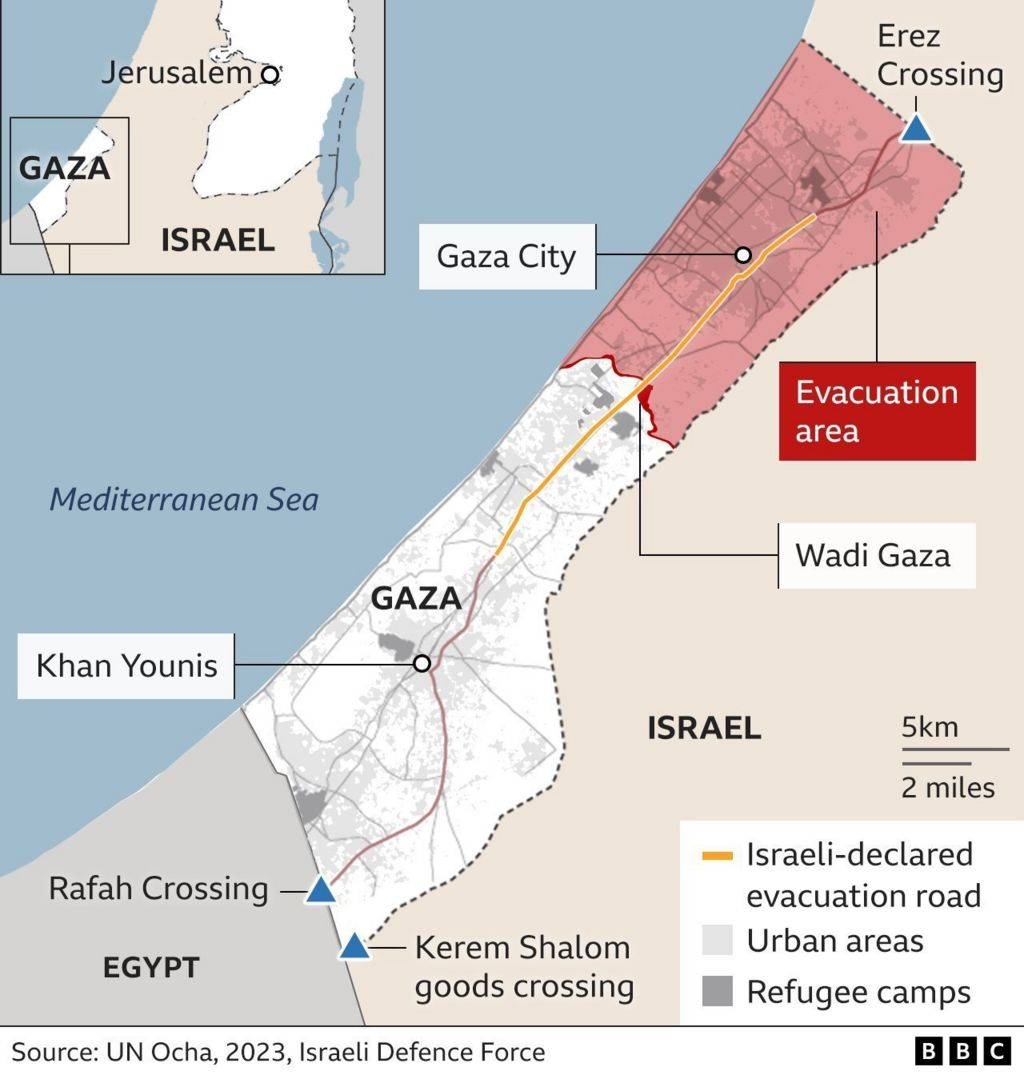
Last Tuesday, the Israeli Defense Force announced that its current plan is for the complete evacuation of Palestinians from north Gaza. The Guardian summarized the announcement:
“Israeli ground forces are getting closer to ‘the complete evacuation’ of northern Gaza and residents will not be allowed to return home, the Israel Defense Forces (IDF) has said, in what appears to be the first official acknowledgment from Israel it is systematically removing Palestinians from the area.
“In a media briefing on Tuesday night, the IDF Brig Gen Itzik Cohen told Israeli reporters that since troops had been forced to enter some areas twice, such as Jabaliya camp, ‘there is no intention of allowing the residents of the northern Gaza Strip to return to their homes’.
“He added that humanitarian aid would be allowed to ‘regularly’ enter the south of the territory but not the north, since there are ‘no more civilians left’.”
With that announcement, it is clear that Israeli military actions against the Gaza Strip, Syria, Lebanon, and Iran no longer qualify as “self-defense” unless we decide to include ethnic cleansing as an act of self-defense. Indeed, the IDF tactic is similar to the horrific acts committed by the Serbs and Croats in Bosnia in the early 1990s. The US Holocaust Memorial Museum characterized these acts as war crimes:
“On April 5, 1992, the government of Bosnia declared its independence from Yugoslavia. The creation of an independent Bosnian nation that would have a Bosniak majority was opposed by Bosnian Serbs, who launched a military campaign to secure coveted territory and “cleanse” Bosnia of its Muslim civilian population. The Serbs targeted Bosniak and Croatian civilians in areas under their control, in what has become known as “ethnic cleansing.”
“During the subsequent civil war that lasted from 1992 to 1995, an estimated 100,000 people were killed, 80 percent of whom were Bosniaks. In July 1995, Bosnian Serb forces killed as many as 8,000 Bosniak men and boys from the town of Srebrenica. It was the largest massacre in Europe since the Holocaust.”
There is little question that the act clearly qualifies as a war crime. The Fourth Convention of the Geneva Accords is explicit on the movement of civilian populations in an occupied territory:
ART. 49. — Individual or mass forcible transfers, as well as deportations of protected persons from occupied territory to the territory of the Occupying Power or to that of any other country, occupied or not, are prohibited, regardless of their motive. Nevertheless, the Occupying Power may undertake total or partial evacuation of a given area if the security of the population or imperative military reasons so demand. Such evacuations may not involve the displacement of protected persons outside the bounds of the occupied territory except when for material reasons it is impossible to avoid such displacement. Persons thus evacuated shall be transferred back to their homes as soon as hostilities in the area in question have ceased.
There is little chance that there is any amount of pressure that will change Israel’s behavior, as Prime Minister Netanyahu has openly refused to accept most guidance from its allies. And now that former President Trump has been elected, it appears that US policy will be guided by the blank check suggested by Trump: “do what you have to do”. Netanyahu also seems to be preparing the US government for expanded actions against Palestinians in the West Bank by appointing Yechiel Leiter as the next Israeli Ambassador to the US. Leiter has been an advocate for annexing the West Bank. According to Middle East Eye:
“Leiter was a member of the Jewish Defence League, which was founded in the US by the far-right rabbi Meir Kahane. The group was later designated as a terrorist organisation by the US, although the designation was lifted in 2022 due to inactivity.
“Leiter’s son was killed last year in Gaza while serving with the Israeli military.
“Leiter’s appointment came just three days after Donald Trump’s election as US president. During his first term, Trump reversed decades of US policy that considered Israeli settlements in the West Bank a violation of international law.
“Under Trump, Israel aggressively expanded its settlement building, pushing deeper into the West Bank and constructing thousands of settler homes on Palestinian land.
“Trump also recognised Israel’s control over the Golan Heights, a Syrian territory that Israel annexed in 1981 in a move the international community has never recognised.
“Israel’s settler leaders and far-right figures welcomed Trump’s victory, particularly after the Biden administration imposed sanctions and asset freezes on settler groups and individuals involved in violence against Palestinians in the occupied West Bank.
“Leiter’s appointment suggests that Netanyahu plans to advance policies in line with the settler movement’s agenda, which includes the annexation of the West Bank.”
I expect that Netanyahu will take advantage of President Biden’s lame-duck status and move forward aggressively to resettle the Gaza and the West Bank. Israel’s behavvior is comparable to the atrocities in Bosnia, in Rwanda in 1994, and the ongoing war against the Royingha in Myanmar. The critical difference is that Israel would not be able to accomplish any of its goals without the support of the US, and the American complicity in the atrocity breaks my heart. But we can dispense with the idea that Israel is conducting a war of self-defense. It is quite clearly a war of conquest.
Israel continues to force Palestinians to leave northern Gaza. Mondoweiss reports:
“Israel’s siege and offensive on northern Gaza have been ongoing for 20 days, as part of what has been described as the implementation of Israel’s ‘Generals’ Plan,’ which aims to forcibly depopulate northern Gaza through deliberate starvation and extermination. Although the Generals’ Plan doesn’t include plans for settler colonization of the area after its ethnic cleansing, far-right Israeli politicians and settler groups have been advocating for settling Gaza since December of last year.
“On Monday, Israelis rallied at Kibbutz Be’eri 3 kilometers away from Gaza’s fence demanding to be allowed to settle in the Strip. The rally was attended by several Israeli ministers, according to Israeli media. Reports indicated that some 700 Israeli families at the event had signed up to move to the prospective Israeli settlements in Gaza.
“Northern Gaza was home to some 700,000 Palestinians before October 7, 2023. According to estimates, some 200,000 Palestinians continue to live in the area, which includes Jabalia, Beit Lahia, Twam, Sheikh Zayed, and Beit Hanoun.”
The “Generals’ Plan refers to a plan devised by Israeli Major General Giora Eiland, although parts of the plan have always been part of Netanyahu’s overall strategy in the Gaza. The plan, however, is most explicit on the forced relocation of Palestinians to southern Gaza. Middle East Eye reports:
“Once Palestinians have been removed from northern Gaza, which the plan anticipates will take a week, the second phase can proceed: the transformation of northern Gaza into a closed military zone.
“The area will, says the plan, be subject to a ‘full and tight blockade, which includes preventing movement to and from it, and preventing the entry of supplies, including food, fuel and water’.
“Anyone remaining will be treated as a combatant. The plan’s YouTube video states that the Hamas operatives who remain can choose to ‘surrender or die of starvation’. After that, ‘it will be possible to enter and cleanse the area of Gaza City with almost no enemy’.”
Middle East Eye interviewed Abdullah al-Muqayid, a resident of Northern Gaza, who eventually left for the south. The report is chilling:
“After an interrogation that lasted until sunset, the Israeli army ordered the residents to evacuate to the southern Gaza Strip. However, reluctant to leave northern Gaza entirely, they moved to the adjacent Gaza City instead.
“‘One of the phrases the soldiers told us was, ‘Go south; you will never return to the north. The north will be ours, and we will build settlements there,'” he said.
‘There were martyrs and wounded people whom no one could help along the way’
“But we came to Gaza City. Along the way, there was a massive number of soldiers and tanks as far as the eye could see, as if they were invading a country, not merely civilians and unarmed individuals. We saw the bodies of martyrs on the ground, with dogs mauling them.”
“Muqayid managed to leave Gaza City, but he had to leave his elderly mother behind.
“She remained in Jabalia; she cannot leave, she cannot walk such a long distance and face the humiliation and insults we faced.”
The “Generals’ Plan” is not official policy of the Israeli government at this point, but The Times of Israel reports that in a recent meeting between US Secretary of State Blinken and Israeli Prime Minister Netanyahu, the Prime Minister refused to rule it out publicly:
Prime Minister Benjamin Netanyahu and his top aides sidestepped US Secretary of State Anthony Blinken’s request during a meeting Tuesday to publicly clarify that Israel is not seeking to lay siege to northern Gaza, a US official tells The Times of Israel.
Netanyahu and Strategic Affairs Minister Ron Dermer insisted during the meeting that Israel is not implementing the so-called General’s Plan aimed at isolating northern Gaza and argued that claims to the contrary have been detrimental to Israel’s public image, the US official says.
Blinken urged Netanyahu to clarify this publicly, but he and his aides demurred, the official adds.”
The Generals’ Plan is a clear violation of the Geneva Accords which forbids the forcible displacement of civilians in any occupied area. It is also completely inconsistent with US foreign policy which still calls for a “two-state” solution to the dispute between Israel and the Palestinians. But Netanyahu likely sees the coming months as a window of opportunity: Americans are transfixed by the upcoming presidential election and the period between election day and the inauguration is a very difficult time to make significant foreign policy changes. Further, Netanyahu probably thinks that, if Israel quickly makes the annexation of northern Gaza a fait accompli, a President Trump would approve and a President Harris would be powerless to dislodge Israel until after inauguration, at which point US opposition would be moot.
The Generals’ Plan is not possible without US continued support. That support has two components: massive military and financial assistance; and the US missile interceptor systems which prevents Hamas, Hezbollah, and Iran from inflicting heavy civilian casualties in Israel. Both are indispensable to the Generals’ Plan, but the US protective shield gives Netanyahu the freedom to do whatever he, or his right- wing cabinet members, Ben-Givr and Smotrich, want.
The US is a clear accomplice in this crime. If Netanyahu had to worry about significant civilian casualties (on the scale of the near 43,000 identified Palestinians bodies, not to mention the bodies buried under the rubble in Gaza), I doubt that he would currently be bombing the Gaza, Lebanon, Syria, Yemen, and Iran with such abandon.
This circumstance places the US in a very delicate moral dilemma. In order to restrain Netanyahu, the US should lift its protective missile shield and allow civilian casualties at a scale necessary to change Netanyahu’s calculations. But that tactic is morally indefensible: innocent civilians cannot be used as a diplomatic tool. The US needs to continue to shield Israeli civilians.
The alternative is to use the military and financial support as a bludgeon. Netanyahu would then have to calculate how long he could continue the military operations without the infusion of weapons and wealth. That course of action lacks the immediacy of the costs of civilian casualties, but Netanyahu has got to start worrying about the long-term capabilities of Israel without US support.
In order to implement this tactic, US President Biden should immediately announce the suspension of US support unless Netanyahu publicly commits to no annexations of land in the Gaza and in the West Bank and the establishment of a viable Palestinian state. It is long past time for the US to indulge Netanyahu’s political survival which is dependent on Ben-Givr and Smotrich. And the US needs to more vigorously pursue its own foreign policy interest which is a peace based on the two-state solution.
As we approach the one-year anniversary of the brutal Hamas attack on Israel, the conflict is also nearing a critical point in the escalation cycle. After the Iranian missile attack last Tuesday, Israeli Prime Minister Netanyahu declared that:
“This evening, Iran again attacked Israel with hundreds of missiles. This attack failed. It was thwarted thanks to Israel’s air defense array, which is the most advanced in the world. I commend the IDF for the impressive achievement. It was also thwarted thanks to your alertness and responsibility, citizens of Israel. I also thank the US for its support in our defensive effort.
“This evening, Iran made a big mistake – and it will pay for it. The regime in Tehran does not understand our determination to defend ourselves and to exact a price from our enemies…
“We will keep to the rule we have determined: Whoever attacks us – we attack them.
“This is true wherever we fight the axis of evil. It is true in Judea and Samaria. It is true in Gaza, Lebanon, Yemen and Syria – and it is also true in Iran. We are fighting the axis of evil everywhere, including in southern Lebanon and Gaza, where our heroic soldiers are active.
“Today, more than ever, the forces of light in the world must unite and work together against the ayatollahs’ dark regime, which is the source of terror and evil in our region. They must stand alongside Israel. The choice has never been more clear, between tyranny and freedom, between the blessing and the curse.”
Both Israel and Iran face a very serious problem–their efforts to deter each other have failed. Iran thought that by arming Hamas and Hezbollah, Israel would not take actions to endanger their citizens. Further, Iran believed that its missile forces would deter Israeli action against Iran. Israel proved these assumptions to be incorrect. Israel believed that its anti-missile systems, buttressed by US forces in the region, would lead Iran to believe that a missile attack on Israel would fail. That assumption is less certain now than it was before 7 October.
Both Hamas and Israel miscalculated. Many observers, including me, were shocked by the intensity of the Israeli response to the 7 October atrocity. And many, including me, believe that the Israeli response in the Gaza (and now in Lebanon) to be wildly disproportionate. After the Iranian missile attack last April, which consisted of about 300 missiles most of which were intercepted by the Israeli and US forces, Israel determined that its civilian population was sufficiently protected to permit extensive Israeli military actions, including the missile attack on Tehran which killed the leader of Hamas, Haniyeh. But that assumption now looks to be problematic.
The Iranian missile attack last Tuesday consisted of 200 missiles, but about 20 of those missiles actually hit Israeli military bases., suggesting that the Israelil missile defense was not as robust as was assumed. The Israeli Defense Force first announced that the Iranian attack had been unsuccessful and that damage was minimal. But National Public Radio quotes Jeffrey Lewis, a professor at the Middlebury Institute of International Studies at Monterey:
“Lewis notes that although over 30 missiles landed inside the base perimeter, the damage caused was still somewhat limited. That’s notable because Iran is believed to have used some of its most advanced Fattah missiles.
“‘Even these missiles, which look substantially more accurate, still struggled to do damage,’ he says.
“Still, he thinks the attack has shown that Iran can strike at targets well inside Israel. ‘They can definitely get missiles through,’ he says.”
If Iranian missiles can penetrate the Israeli missile defense system, then the Israeli civilian population is at risk. The missiles on Tuesday struck Israeli military bases. Iran clearly made a decision not to target civilian population centers. One such missile hitting a city like Tel Aviv or Haifa could be damaging (but not catastrophic), and would change the calculations of acceptable losses for Israel.
There are, however, questions to be raised before the expected Israeli counterattack. The Iranians launched 300 missiles last April, but only around 200 on Tuesday. That difference is significant. It could signal that Iran’s response to the assassination of Nasrallah was not so important and that the Iranians felt they could be restrained. Or it could be that Iran was trying to preserve as much of their missile force as possible for future asttacks. Or it could mean that Iran was only trying to get a better read on the effectiveness of Israeli missile defenses. I personally believe thats Iran’s decision to avoid population centers was a clear signal that Iran did not wish to provoke a major escalation, even though it was bound to retaliate for the assassination of Nasrallah.
Now Israel has to send some messages as well. Interestingly, US President Biden indicated to journalists that he did not think the Israelis should attack the nuclear facilities in Iran, nor should it attack the oil production centers in Iran. An attack on Iranian population centers would be roundly condemned by most in the world. So Israel has to think about what message it wishes to send to both Tehran and Washington.
There are other considerations as well. The Israeli missile defense system is mostly effective, but it is truly expensive. Offensive missiles are reltively cheap; defensive missiles require a great deal of infrastructure,, including extensive radar systems and very sophisticated targeting mechanisms. Offensive missiles can be used for a variety of targets. Defensive interceptor missiles have only one objective, but an objective that has to be perfectly targeted to be considered a “success”. The drain on the Israeli economy will be substantial and Israel’s economy is already suffering from the costs of the war. The Economist reports:
“Stronger economic growth would ease the pain. Although reservists have returned to work and consumption has returned to pre-war levels, Israel’s economy remains smaller than it was on the eve of war. Mr Smotrich has cushioned the least productive parts of society and starved industry of resources. The labour market remains ultra-tight, with the unemployment rate at just 2.7%. Firms are struggling to fill vacancies and Israel’s small high-tech companies are under strain. They are losing out on funding owing to the war, warns Startup Nation, a local think-tank.
“Some 80,000 Palestinian workers were denied permits after October 7th, and have never been replaced. As a consequence, the construction industry is 40% smaller than it was this time last year, greatly impeding housebuilding and repairs. For now, the biggest impact has been on inflation, which hit an annual rate of 3.6% in August, having accelerated over the summer. Should the scale of Hizbullah attacks increase, the lack of construction workers will become an even bigger problem….
“Then there is the nightmare scenario. Few investors are preparing for a war that would engulf all of Israel, including Jerusalem or Tel Aviv—even though Hizbullah may be capable of launching such an attack. In these circumstances economic growth would be hit hard, perhaps even harder than after October 7th. Army outgoings would soar. Fleeing investors would probably topple banks and send the shekel plummeting, forcing the Bank of Israel to intervene and spend its reserves.
“Whatever happens, Israeli economists are resigned to things getting worse. Even Mr Smotrich, generally a bullish type, now emits an air of exhaustion: ‘We are in the longest and most expensive war in Israel’s history.’ Previous conflicts have come at a heavy cost to Israel. Do not be surprised if this one does, too.”
Israel is also free to ignore President Biden’s caution, but the price of that tactic could be substantial. Prime Minister Netanyahu has already ignored several US proposals for a cease-fire, and the cumulative effect of indifference to US preferences could lead many in the US to consider Israel to be an unreliable ally–a problem that could get very difficult for Netanyahu if Kamala Harris wins the Presidential election. In many places in the world, Israel is already becoming a pariah nation.
Finally, a massive Israeli counterattack would send a clear message to Iran that its reliance on conventional weapons is dangerous. A unfortunate paradox of Israeli miltary prowess is that it may lead Iran to the decision that its only effective defense is to build a nuclear weapon–exactly the most troubling scenario nettling the Israeli defense establishment.
Deterrence has failed for both sides. Re-establishing deterrence is a very tricky business, fraught with the possibility of serious misreadings of intentions or inaccurate calculation of risks and costs. Israel’s response to Iran will determine the course of this wretched conflict.
Israel bombed a school being used as a shelter for displaced Palestinians in Gaza today, killing as many as 100 civilians according to the Gaza Healthy Ministry. The Israelis claimed that the school was being used by Hamas as a command center and asserted that 20 terrorists were killed in the strike and disputed the number of civilians killed. The Israelis have destroyed most of the schools in Gaza: “The U.N. previously said that as of July 6, 477 out of 564 schools in Gaza had been directly hit or damaged in the war, adding that Israel has a duty under international law to provide safe shelter for the displaced.” Moreover, the Israelis claimed to have used precision weapons which may have included weapons supplied by the US: “Unverified reporting indicated that at least one of the missiles dropped on the al-Tabin school overnight may have been a U.S.-made MK-84 bomb weighing 2,000 pounds.”
“The White House is ‘deeply concerned’ about reports of civilian deaths in Gaza related to Israel striking a school in Gaza City that killed at least 80 people, saying the strike “underscores the urgency of a ceasefire.”
“’We are deeply concerned about reports of civilian casualties in Gaza following a strike by the Israel Defense Forces on a compound that included a school,’ NSC spokesperson Sean Savett wrote in a statement to The Hill. ‘We are in touch with our Israeli counterparts, who have said they targeted senior Hamas officials, and we are asking for further details.’
“’This underscores the urgency of a ceasefire and hostage deal, which we continue to work tirelessly to achieve,’ Savett added.”
The US position is indefensible. On the same day that the attack occurred, the US sent $3.5 billion in military assistance to Israel without any assurances that “precision” bombs would be used with more precision (the idea that a 2000-lb bomb can be “precise” in a densely populated area is malicious doublespeak). Israel’s procedures which permit the killing of civilians as long as there are Hamas militants in the general area is completely at odds with the laws of war. There have been 40,000 deaths in Gaza since the war started last October. The US has a law (the Leahy Law) which prohibits “the U.S. Government from using funds for assistance to units of foreign security forces where there is credible information implicating that unit in the commission of gross violations of human rights.” The US has sent about $310 billion in military aid to Israel since its sounding–by far the most supported country in the world despite the fact that its per capita GDP ranks 14th in the world.
The US-led alliance that thwarted Iran’s mille attack last April undoubtedly contributed to Prime Minister Netanyahu’s sense of immunity to attacks in the future, and the subsequent killing of Hamas leader, Haniyeh in Tehran. Because of the US missile shield, the Prime Minister has pursued policies aptly described as rogue. He appears to ignore international condemnation and any pressures from the US to move toward a cease-fire. Indeed, the Prime Minister appears willing to risk a war with Iran, believing that the US would defend Israel. The US should announce an arms embargo on Israel until a cease-fire is reached and to withold future military assistance to Israel until an agreement between Israel and the Palestinian people is reached on the future of the Occupied Territories.
The chances of a wider regional war in the Middle East have increased over the last few days. Up until recently, the main military activity has been the Israeli invasion of the Gaza Strip, while there have been sporadic military operations between the Israelis and Houthi and Hezbollah forces. Israel has escalated its attacks in Lebanon, attacking a site in Beirut to target a Hezbollah operative, and today it targeted a Hamas leader, Ismail Haniyeh , in Teheran, Iran. According to the Associated Press:
“Iranian U.N. Ambassador Amir Saeid Iravani in a letter on Wednesday blamed both strikes on Israel. He and said they ‘suggest an intention to escalate conflict and expand the war through the entire region.’ He called on the international community for ‘decisive action to address these violations and hold the perpetrators accountable.’”
Israel has taken responsibility for the strike in Beirut, saying it killed a top Hezbollah commander. But Israel has been silent about the strike that killed Haniyeh, though it had vowed to kill him and other Hamas leaders over the group’s Oct. 7 attack that sparked the war in Gaza.
Israel has not claimed responsibility for the assassination of Haniyeh, but has in the case of senior Hezbollah commander Fouad Shukur in Lebanon. Israel, however, has a long list of targeted assassinations in the region. It is difficult to overstate the significance of the more recent assassinations. To be clear, bombing another country is always regarded as an act of war, and Israel has now bombed targets in Lebanon, Syria, and Iran. Israel believes that its actions are simply a logical extension of its war against Hamas, but that narrow perspective is not justified: no state can ignore the consequences of such attacks on its sovereignty.
The attacks confirm my suspicions that Israeli Prime Minister Netanyahu is trying to escalate the conflict. First, Haniyeh was killed while he was attending the inauguration of the new Iranian President, Masoud Pezeshkian. Pezeshkian is considered a moderate, breaking away from the hardline views of his two predecessors. But the attack will only strengthen the hands of the hardliners in Iran, particularly since the attack was an embarassment to the Iranian defense forces–the attack was done by a precision-guided missile against a target in the capital city of Tehran. Moreover, Haniyeh was a guest in Tehran and the protection of guests is a sacred obligation in Islam.
Second, Haniyeh was a principal negotiator in the current negotiations for a cease-fire in Gaza. There is probably no greater way to sabotage negotiations than to actually kill one of the interlocutors. Moreover, Israel has recently attached more preconditions to a ceasefire that was described by an Israeli official in these terms in an article in Axios: “Netanyahu wants a deal that is impossible to get. At the moment he isn’t willing to move and therefore we might be headed for a crisis in the negotiations rather than a deal”.
There is little question but that Iran and its proxies, Hezbollah, Hamas, and the Houthis, will respond to the Israeli attacks. The last time Israel provoked Iran back in April by killing senior Hezbollah officials in Damascus, the Iranians chose a relatively calibrated response. According to The Economist:
“Iran has struck Israel directly once before: it launched more than 300 missiles and drones at Israel in April, retaliation for an Israeli strike that killed several high-ranking officers at Iran’s embassy compound in Damascus. Israel hit back with a pinpoint strike on an Iranian anti-aircraft radar, and the round was over.
“This time, Iran will have to decide whether it can risk a bigger conflagration. It is going through a sensitive political moment. Mr Haniyeh was killed hours after he attended the inauguration of Masoud Pezeshkian, the new Iranian president, who was elected after his predecessor was killed in a helicopter crash in May. This was probably not how he envisioned his first day on the job.”
The calibrated Iranian response was also blunted by a coalition of forces in the region to shoot down most of the missiles fired from Iran. The Center for Strategic and International Studies assessed the missile defense effort:
“This episode represents an outstanding success story for air and missile defense. Despite the over 300 ballistic missiles, drones, and cruise missiles launched, there appears to have been minimal damage to Israeli infrastructure and military assets, and the attack resulted in only one Israeli casualty.
It was also a joint effort. The coalition was led by the United States and featured the United Kingdom, France, and Jordan, in addition to Israel. Coordination took place at the Combined Air Operations Center at Al Udeid Air Base in Qatar, which helped to prevent any friendly fire incidents. Although Saudi Arabia has denied direct involvement, the kingdom at least allowed U.S. aircraft stationed in the country to engage Iranian air threats. Israel’s Arab neighbors also may have contributed intelligence and sensor assets to detect and track Iranian air threats, although the extent of this cooperation remains unclear. U.S. policymakers have long advocated for an integrated missile defense in the region, and this joint operation helps illustrate why.”
The Iranian government thus has to decide what an “appropriate” response should be, but it needs to take into account the lessons of the earlier April attack and try to overwhelm the missile defense capabilities of Israel and the US-led coalition. I do not have the technical expertise to speculate on what that number of missiles might be, and I suspect that the US will try to shoot down as many of those missiles as it can which is also a number I do not know.
But there is a more important insight to gain from the April attack. The US and the coalition of allies offering missile defenses are providing a shield which insulates Israel from any real consequences to its actions. That course if action is unwise since it allows the Netanyahu government to take actions which have negatively affected the US, Israel, and the Palestinian people.
The US vetoed a resolution in the UN Security Council which would have enabled the Palestinians to secure a seat in the United Nations. There were two abstentions (the UK and Switzerland) and all the other members of the Security Council voted in favor of the resolution. At the daily Press Briefing at the State Department, Vedant Patel, the spokesperson at the State Department, explained the US decision in a Question and Answer exchange:
“MR PATEL: So Matt, since October 7th, we have been pretty clear that sustainable peace in the region can only be achieved through a two-state solution, with Israel’s security guaranteed. And it remains our view that the most expeditious path towards statehood for the Palestinian people is through direct negotiations between Israel and the Palestinian Authority with the support of the United States and other partners who share this goal. We believe this approach can tangibly advance Palestinian goals in a meaningful and enduring way.
We also have been very clear consistently that premature actions in New York, even with the best intentions, will not achieve statehood for the Palestinian people. Additionally, as reflected in the report of the admission committee, there was not unanimity among the committee members as to whether the applicant met the criteria of membership set forth in Article 4 of the UN Charter. Specifically, there are unresolved questions as to whether the applicant can meet criteria to be considered as a state.
And Matt, as you also know, we’ve long called on the Palestinian Authority to undertake necessary reforms to establish the attributes of readiness for statehood and note that Hamas, which is – as you all know – a terrorist organization, is currently exerting power and influence in Gaza, which would be an integral part of the envisioned state in this resolution. And for that reason, the United States is voting no on this proposed Security Council resolution….
QUESTION: All right. And then you said the most – you believe, the U.S. believes that the most expeditious way to statehood is through direct negotiations. So just to make sure, I just kind of – I just googled “expeditious”: “Marked by or acting with prompt efficiency.” How many years has it been since Oslo?
MR PATEL: It’s been —
QUESTION: Isn’t the most expeditious way to Palestinian statehood to have a – have some kind of an announcement or a determination by the UN? Unless you’re not —
MR PATEL: We don’t think so.
QUESTION: Unless you don’t really mean expeditious, because expeditious means fast.
MR PATEL: We do mean expeditious, and we do not believe that the pathway through New York and the United Nations is the best path forward. And as I so noted, such action through the United Nations would statutorily require the United States to cease its funding to the UN. That’s certainly not something we’re interested in doing either.
I take your point on the number of years it has been Oslo, but this is something that we will continue to pursue, because we so firmly believe that it is in – not just in the interest of the Palestinian people, but it is a key tenet of establishing peace and security for the people of Israel as well.
QUESTION: Thanks.
MR PATEL: Humeyra, go ahead.
QUESTION: Vedant, so what is the U.S. alternative and the expeditious path to two-state solution, then, if you guys have blocked this?
MR PATEL: You’ve heard us talk about this pretty clearly, Humeyra. We’re continuing to press for a ceasefire, one that is coupled with the release of hostages, one that is coupled with the influx of additional humanitarian aid, and one that we hope can create additional conditions for broader diplomatic conversations that we think can lead to greater peace and stability in the region. This is a process. I will note that “expeditious” does not mean easy, but it is a process, and we’re going to —
QUESTION: Yeah, but it does mean fast.
MR PATEL: But it is one that we’re going to continue to work at.
This tortured exchange reflects the reality that the US has no coherent plan for the fate of the Palestinian people. The US veto was ill-advised and short-sighted.. After asserting the two-state solution was the only possible solution to the conflict in the Gaza Strip, the US is now on record as opposing the move unless that outcome was determined by negotiations between Israel and the Palestinians. But successful negotiations have been stalled for thirty years, due to the emergence of a settler movement which holds that all the lands occupied by Israel in the 1967 war belong to Israel and Israel alone. The US offered no substantive reason to believe that negotiations now will lead to a Palestinian state.
The Oslo Accords, signed by the Palestinians and Israel in 1994, called for the creation of a Palestinian State. That initative was derailed by the assassination of Prime Minister Yitzhak Rabin in November 1995 by ” Yigal Amir, an Israeli law student and ultranationalist who radically opposed Prime Minister Yitzhak Rabin‘s peace initiative, particularly the signing of the Oslo Accords.” Since that time, Israel has exercised almost complete control over the lives of the people living in the West Bank and the Gaza Strip. The settler movement has now placed about 700,00 Israelis in the West Bank (all the settlers were forcibly removed from the Gaza Strip by Israeli Prime Minister Ariel Sharon in 2005). And the current violence against Palestinians in the West Bank surpasses all previous levels.
The irony is that the state of Israel was created by a vote in the United Nations General Assembly in 1947. The vote was 33-13 in favor partitioning the British Mandate called Palestine into three zones: a Jewish zone, an Arab zone, and an internationalized city of Jerusalem (no state could claim sovereignty over the city). The six Arab states walked out of the vote in protest. The UN made the state of Israel possible; there is no reason why it could not create a Palestinian state. But that possibility cannot occur as long as those in Israel who believe that all the lands were reserved for Jews have such power in Israeli politics. And we wait for the US to take some effective action to foster the two-state solution.
On 1 April 2024 Israel attacked the Iranian Consulate in Damascus, Syria. The attack killed seven members of the Islamic Revolutinary Guard, including two senior members. The Vienna Convention on Diplomatic Relations (1961) governs the status of such missions. Article 22 of the Convention spells out some of the protections for diplomatic sites:
Article 22 1.The premises of the mission shall be inviolable. The agents of the receiving State may not enter them, except with the consent of the head of the mission. 2.The receiving State is under a special duty to take all appropriate steps to protect the premises of the mission against any intrusion or damage and to prevent any disturbance of the peace of the mission or impairment of its dignity. 3.The premises of the mission, their furnishings and other property thereon and the means of transport of the mission shall be immune from search, requisition, attachment or execution.
Defense Secretary Lloyd Austin spoke with Gallant on Monday and again on Thursday to discuss the current situation and “reaffirm the U.S. ironclad commitment to Israel’s security against threats from Iran and its proxies,” Ryder said.
Secretary of State Antony Blinken also spoke with Gallant on Wednesday to reiterate that same message, State Department spokesperson Matthew Miller said at the time.
And President Biden publicly warned Tehran on Wednesday during a White House Rose Garden press conference with Japanese Prime Minister Fumio Kishida.
“We also want to address the Iranian threat to launch a … significant attack on Israel. As I told [Israeli Prime Minister Benjamin Netanyahu], our commitment to Israel’s security against these threats from Iran and its proxies is ironclad,” Biden said.
I hope that these words are merely diplomatic fluff. Prime Minister Netanyahu committed an act of war against Iran with US-supplied weapons but without US knowledge or support. If he thinks that provoking Iran into an open conflict advances the interests of Israel, he is profoundly and criminally mistaken. The US should not allow itself to be manipulated into a larger, and unwinnable, war.
For the third time, the US has vetoed a UN Security Council resolution demanding an immediate cease-fire in the conflict in the Gaza Strip. Instead, the US proposed a resolution that asked for “a temporary humanitarian cease-fire as soon as practical” and for the release of hostages. The more stringent resolution was proposed by Algeria and received 13 affirmative votes (Great Britain abstained). The US stands alone with Israel in opposition to an immediate cease-fire.
There is absolutely no justification for the US obstruction. It claimed that the Algerian resolution would jeopardize the current negotiations on the release of the hostages, but there is no credible evidence that those negotiations are making any progress whatsoever. Curiously, the US alternative resolution (which has not yet been submitted, but The Guardian claims to have seen a draft copy) “determines that under current circumstances a major ground offensive into Rafah would result in further harm to civilians and their further displacement including potentially into neighbouring countries, which would have serious implications for regional peace and security, and therefore underscores that such a major ground offensive should not proceed under current circumstances”. It seems that the US is at least calling for an immediate cease-fire with respect to the situation in Rafah.
Israel has said that it will conduct a military operation into Rafah by the beginning of Ramadan (in early March) if the hostages are not released. There are about 1.4 million Palestinians in Rafah and they have literally no place to go if the Israeli assault occurs. There are indications that Egypt is building a protected area in its Sinai territory which suggests that there is some sort of arrangement to push the Palestinians into this area when an assualt happens. According to Le Monde:
“According to the Sinai Foundation for Human Rights NGO, which revealed the existence of this construction site on February 12, the location is intended to accommodate Palestinian refugees, should Egypt face a mass exodus from Gaza. Local contractors told the NGO that they had been commissioned to carry out the work by the company Sons of Sinai, owned by businessman Ibrahim El-Argani, who is close to the Egyptian army. The 7-meter-high walls are to be built under the supervision of military engineers and a heavy security presence.
“Egyptian sources have confirmed on condition of anonymity to The Wall Street Journal that a walled enclosure with the capacity for more than 100,000 people has been set up. An Egyptian source told Le Monde that the fear of facing an influx of displaced persons in the event of an Israeli offensive on the town of Rafah was behind this decision. However, Diaa Rashwan, head of the government’s communications department, denied the existence of such a project. He pointed out that Egypt is opposed to any forced displacement of Gazans on its territory due to the war between Israel and Hamas in the Palestinian enclave.””Egyptian sources have confirmed on condition of anonymity to The Wall Street Journal that a walled enclosure with the capacity for more than 100,000 people has been set up. An Egyptian source told Le Monde that the fear of facing an influx of displaced persons in the event of an Israeli offensive on the town of Rafah was behind this decision. However, Diaa Rashwan, head of the government’s communications department, denied the existence of such a project. He pointed out that Egypt is opposed to any forced displacement of Gazans on its territory due to the war between Israel and Hamas in the Palestinian enclave.”
The Sinai Foundation for Human Rights has published a photo which outlines the areas that are being built up to handle refugees. The white area of the photo is where there is current construction; the green area is the total area under consideration for holding refugees.
There is no hard information about Israeli plans for those currently in Rafah, but the Egyptian construction suggests that there is consideration for pushing the refugees onto Egyptian territory. Such displacement is perilous: there is no guarantee that the Palestinians will be allowed back into the Gaza, opeing the possibility that the Netanyahu government may be considering settlements in the Strip. The Associated Press describes the history of previous displacements in the history of the region:
“Displacement has been a major theme of Palestinian history. In the 1948 war around Israel’s creation, an estimated 700,000 Palestinians were expelled or fled from what is now Israel. Palestinians refer to the event as the Nakba, Arabic for “catastrophe.”
“In the 1967 Mideast war, when Israel seized the West Bank and Gaza Strip, 300,000 more Palestinians fled, mostly into Jordan.
“The refugees and their descendants now number nearly 6 million, most living in camps and communities in the West Bank, Gaza, Lebanon, Syria and Jordan. The diaspora has spread further, with many refugees building lives in Gulf Arab countries or the West.
“After fighting stopped in the 1948 war, Israel refused to allow refugees to return to their homes. Since then, Israel has rejected Palestinian demands for a return of refugees as part of a peace deal, arguing that it would threaten the country’s Jewish majority.”
Representatives Pressley and Raskin sent a letter to the Biden Administration on 18 January 2024 asking for the US government to reiterate its opposition to forced displacement of Palestinians. It reads, in part:
“We write to support the Biden administration’s continued strong opposition to any consideration of the idea of forced transfer of Palestinians out of Gaza. We appreciate President Biden’s clear commitment, in calls with Egyptian President Abdel Fattah Al-Sisi and Jordanian King Abdullah II, to ensure that Palestinians in Gaza will not be displaced to any other nation. We also welcome Vice President Harris’ assurance that ‘under no circumstances will the United States permit the forced relocation of Palestinians from Gaza or the West Bank, the besiegement of Gaza, or the redrawing of the borders of Gaza.’ Additionally, we were glad to see you reiterate the administration’s firm opposition to the forcible displacement of Palestinians during a recent press conference in Doha.”
The US is abdicating its responsibility to uphold international law and its moral obligation to protect the lives of innocents. Further, it is relinquishing its already limited influence on the countries in the Middle East. There is also little evidence to support the idea that the US has a reliable ally in an Israeli government ruled by Netanyahu. The US is pursuing a policy that leaves it with no dependable friends in the region.
“Total victory requires eliminating the terrorist leaders and destroying Hamas’s military and governing capabilities. Total victory requires returning our hostages home. Total victory requires that Gaza be demilitarized, under Israel’s full security control, with Israeli control over everything that enters Gaza. These are also the fundamental conditions for ‘the day after’.”
“The decades of Israeli-Palestinian conflict, he declared during the primetime appearance at the Kirya military base in Tel Aviv, are ‘not about the absence of a state, a Palestinian state, but rather about the existence of a state, a Jewish state.’
“’All territory we evacuate, we get terror, terrible terror against us,’ he said, citing Gaza, southern Lebanon and parts of Judea and Samaria (the West Bank). Therefore, ‘in any future arrangement, or in the absence of an arrangement,’ he said, Israel must maintain ‘security control’ of all territory west of the Jordan River — meaning, Israel, the West Bank and Gaza. ‘That is a vital condition.’
“He acknowledged that this ‘contradicts the idea of sovereignty [for the Palestinians]. What can you do? I tell this truth to our American friends.’”
That sounds an awful lot like “from the River to the Sea”. It is also in near total opposition to the possibility of a two-state solution, which remains the official US position on what should occur on the ‘day after’. I think that the Prime Minister has made it clear that he will do whatever he thinks is necessary for Israeli security, regardless of what the US or other allies think. That position is the essence of sovereignty. But it is exactly the position that Netanyahu thinks should be denied to a Palestinian state.
The US and the EU should state publicly that if Israel does not recommit to the Oslo Accords, including the 5 year limit for the creation of a Palestinian state, that they will no longer grant any more financial aid. If the Israeli government believes that its security requires the subordination of 7 million Palestinians, then it should be prepared to pay the price for that security from its own revenues.


 World Politics News