Paul Pillar has written an essay on the perils of the Trump Administration’s plan for a settlement in the Israeli-Palestinian conflict. As I have written before, the plan really does not offer a basis for a lasting settlement to the dispute–it rather poses new problems for both the Israelis and Palestinians. Pillar writes:
“But dreams can only support a position so far, especially when a dream runs up against the full ugliness of formal subjugation of one nation by another nation. Palestinian nationalism will not go away. It will not be bought off with enticements in glossy brochures about economic development. Support for it will not be abandoned by other Arabs—as demonstrated by the firm position on the subject that Saudi King Salman bin Abdulaziz Al Saud has repeatedly expressed. Regardless of what is done in future years by whatever passes for the Palestinian leadership, terrorists and other extremists will continue to exploit for their own purposes an unresolved Israeli-Palestinian conflict.
“Another element of Israeli strategy—also underlying the Kushner plan—is still intact, which is to use the inevitable Palestinian rejection of the plan as an opportunity to add to the mythology about the Palestinians, and not Israel, supposedly always being responsible for missing opportunities for peace. Many who are not familiar with the long and tragic history of this conflict will continue to believe the mythology. Those who are familiar with that history know that it is a myth. (To cite just one chapter in that history, when the two sides, nineteen years ago, were last close to reaching a comprehensive peace agreement, it was the Israelis, not the Palestinians, who walked away from the negotiating table, never to return.)
“Whatever the remaining power of the mythology, by making the apparent death of the two-state solution more visible, the Kushner plan will encourage people, both inside and outside Palestine, to think and act less in terms of two states and more in terms of advocating for the rights of Palestinian Arabs within a binational state. That shift will make it harder than ever to avoid comparisons between the Israeli version of apartheid and the earlier South African one, and to the sorts of international pressures that helped to end the latter injustice.”
Israelis and many others find the comparison to Apartheid to be very offensive, but the Kushner plan, with its emphasis on a fragmented Palestinian entity whose existence only comes into play if and only if the Israelis decide that the Palestinians have “earned” a state, makes the comparison inevitable. Seraj Assi writes for The Foreign Policy Journal:
“The irony is that the idea of evoking the term “apartheid” to describe Israel’s treatment of Palestinians was not invented by Israel’s enemies, let alone Arabs and Palestinians, but by Israel itself. For decades, Israeli officials have employed the Hebrew term Hafrada (“Separation” or “Segregation”) to describe Israel’s governing policy in the West Bank and Gaza, and its attempts to separate the Palestinian population from both the Israeli population and the Jewish settlers population in the occupied Palestinian territories. The so-called Israeli West Bank Barrier, known in Hebrew as “Gader Ha-Hafrada” (“Separation Fence”), was built on this Hafrada vision.
“But the magic has apparently turned over the magician: By citing the term “apartheid” to describe Israel’s official policy towards Palestinians, Israel’s critics are simply using Israel’s own terminology against it. They have at their disposal a long series of official declarations, platforms and plans predicated on Israel’s commitment to the principle of Hafrada.”
“(c) Any legislative measures and other measures calculated to prevent a racial group or groups from participation in the political, social, economic and cultural life of the country and the deliberate creation of conditions preventing the full development of such a group or groups, in particular by denying to members of a racial group or groups basic human rights and freedoms, including the right to work, the right to form recognized trade unions, the right to education, the right to leave and to return to their country, the right to a nationality, the right to freedom of movement and residence, the right to freedom of opinion and expression, and the right to freedom of peaceful assembly and association;
“d) Any measures including legislative measures, designed to divide the population along racial lines by the creation of separate reserves and ghettos for the members of a racial group or groups, the prohibition of mixed marriages among members of various racial groups, the expropriation of landed property belonging to a racial group or groups or to members thereof;”
The separations between Israelis and Palestinians is certainly not based upon racial distinctions and in this respect using the term apartheid is not justified. But the political, economic, social, and legal distinctions are clear in the Kushner program. By giving Israel the right to determine whether the Palestinians have “satisfied” the interests of Israel and thereby have earned the right to a state, the plan clearly places the Palestinians in a position of subjugation. Hafrada means “separation”; Apartheid means “apartness”. I am not sure how to differentiate the two concepts.
In a breathtaking act of hypocrisy, the Trump Administration has decided to defund its contribution to a State Department program created to honor the memory of Ambassador Christopher Stevens who was killed in an attack on the US consulate in Benghazi, Libya in 2012. The current US Secretary of State, Mike Pompeo, made headlines at the time by his relentless attacks on the then-Secretary of State, Hillary Clinton, for what Pompeo described as putting “political expediency and politics ahead of the men and women on the ground”. The US House of Representative conducted three sets of hearings on the Benghazi tragedy and, at one point, subjected Secretary Clinton to an 11 hour grilling. Talk–grandstanding–is cheap.
Congressman Mike Pompeo and Secretary of State Hillary Clinton
The Munich Security Conference is an annual event where analysts, governmental officials, and journalists get together and hold discussions about the state of security in various parts of the world. The topic this year was “Westlessness” and the question posed to the conference was whether the multilateral institutions created by liberal democracies after World War II are still relevant and useful. The report defines the “West” in these terms:
“Despite its widespread use as a shorthand for a community of mostly North American and European liberal democracies as well as a normative project, the ‘West’ is a concept that is not always easy to pin down. The ‘West’ has never been a monolithic concept but rather an amalgam of different traditions, the mix of which changed over time. Yet, for the past decades, the answer to the question what it was that kept the West together was straightforward: a commitment to liberal democracy and human rights, to a market-based economy, and to international cooperation in international institutions. Today, the meaning of the West is increasingly contested again. We are witnessing ‘the decay of ‘the West’ as a relatively cohesive geopolitical configuration anchoring a normative model of global order in which commitments to human rights, democracy, and the rule of law are central.'”
The report does an excellent job of framing the debate, quoting statespeople like Vladimir Putin and Viktor Orban, who have both argued that the liberal idea is no longer valid. On the other side, US Secretary of State, Mike Pompeo, delivered a speech entitled “The West is Winning”. It is fair to say that the speech was not well-received by many in the audience, particularly by French President Macron who warned of a “weakening of the West.” Secretary Pompeo also displayed extraordinary chutzpah when he remarked:
“You know, just 15 days ago I was in Kyiv, Ukraine. I visited a hospital where Ukrainian service members who had been injured in the conflict, who had been wounded in the fight against Russian-backed aggression, were being convalesced. There was a young, brave warrior there – we had a conversation – who had sustained a serious injury and he was in significant pain. We spoke for a few moments. He, through the translator, told me that he was a captain. I reminded him that several decades ago I, too, was a captain.
“And as we were getting ready to leave, he got up. He grabbed his crutches. He moved across the room and he went to his wall locker, grabbed his uniform, pulled off his patch, and he handed me his unit logo. He told me to keep it; he wanted me to have it.
“That moment hit home for me. It reminded me that sovereignty is worth fighting for and that it’s real, that we’re all in this fight together.”
It is hard to believe that Pompeo would use the example of aid to Ukraine to prove the unshakable commitment of the US to freedom after the revelations about how the aid was used as a political weapon.
Marie Yovanovich, the former US Ambassador to Ukraine, received the Trainor Award from Georgetown University. The award is given annually to “an outstanding American or foreigner for distinction in the conduct of diplomacy.” Her speech, an excerpt from which is below, gave a frank and sober analysis of the difficulties facing the US State Department in the Trump Administration. The full speech is on You Tube and can be accessed here. She is a disciplined and thoughtful analyst and her words resonate strongly with those of us who wish that the US would pursue its interests in line with a vision of a more just and more peaceful world: “At a certain point, it is harder to do the wrong thing than the right thing”. President Trump’s proposed federal budget also weakens the State Department. The New York Times reports: “Funding for the State Department and international aid programs would be cut by $3.7 billion, or nearly 8 percent, from current spending levels. It would dramatically reduce or eliminate aid to international organizations, including the United Nations. The hollowing out of the State Department is mirrored by the dramatic changes to the National Security Council staff which has lost almost 70 people, many of whom have been replaced by political appointees. National Security Adviser, Robert O’Brien, has managed that change and MSN reports:
“O’Brien had dismissed or transferred about 70 people, or about one-third of those employed by or temporarily assigned to the NSC, according to senior administration officials.
“O’Brien told a Washington think tank Tuesday that his efforts to trim the staff would conclude this week, and aides said the final cuts would involve only a few more employees. O’Brien denied that his downsizing of the NSC was an effort to dismantle what Trump has called the ‘deep state.’
“O’Brien said his primary aim isn’t to remove career government employees and other professionals in favor of Trump loyalists. But he conceded that the realignment has increased the proportion of politically appointed staffers.”
In the absence of a strong diplomatic corps, the military options begin to take on a much larger role. That type of default policy option is dangerous and short-sighted.
As required by law, the White House sent in a report, called a 1264 notification, to justify the use of force against Iranian general, Qassem Soleimani. There are two interesting aspects to the report. First, the report legitimizes the use of force on the inherent powers of the President as Commander in Chief as specified in Article II of the Constitution. The Commander in Chief rationale only works in the case of an “imminent” attack, and that word appears nowhere in the 1264 report. The Trump Administration is no longer using that justification.
Second, the report invokes the 2002 Authorization for the Use of Military Force (AUMF) that the Congress passed to justify the use of force against al Qaeda and its affiliates.The AUMF argument also lacks legal force since General Suleimani was not an agent of al Qaeda, and was in fact an avowed enemy of al Qaeda. Interestingly, the State Department had argued in 2019 that the decision to kill Suleimani was not based upon the AUMF: “State Department officials repeatedly assured lawmakers last year that ‘the administration has not, to date, interpreted either the 2001 or 2002 AUMF as authorizing military force against Iran, except as may be necessary to defend US or partner forces as they pursue missions authorized under either AUMF.'”
Neither of these justifications has any validity in the strike against Suleimani which leaves us in a very difficult situation. The Congress has passed a War Powers Resolution that requires the President to seek the approval of Congress for any further strikes against Iran. National Puclic Radio reports: “The vote was 55-45 — with eight Republicans joining all Democrats to pass the measure. The tally fell far short of the two-thirds needed to override a presidential veto.” President Trump will likely veto the resolution so it will not have the force of law. But the vote does send a strong signal that any military action against Iran will be scrutinized carefully. It is also a significant act, as described by The Washington Post:
“This is only the third time ever that the full Senate has used its authority under the 1973 War Powers Resolution to block a president from using military force abroad. All three efforts were against Trump — with a Republican-led Senate.
“The first such vote came in late 2018 when the GOP-led Senate ordered an end to U.S. military operations abroad in Saudi Arabia’s war in Yemen. The second took place last year, when both the Democratic House and Republican Senate agreed to a measure — vetoed by the president — to curtail U.S. military involvement in Yemen.”
It seems as if Congress is finally getting the message about defending Congress’s rights on the issue of war and peace. Perhaps, if the Senate changes its composition in the 2020 election, we can expect a more enduring statement on those rights.
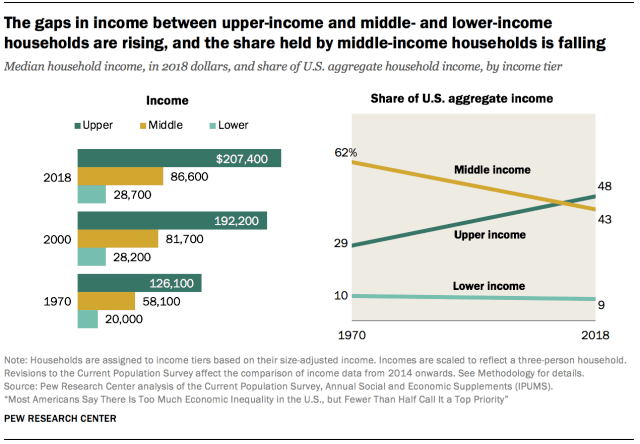
The UN Department of Economic and Social Affairs has published its annual report entitled “World Social Report 2020: Inequality in a rapidly changing world”. The report analyzes the effects of inequality on four major trends in global affairs: technological innovation, climate change, urbanization and international migration. The report notes that inequality in most countries in the world appears to be getting more severe:
“Despite progress in some countries, income and wealth are increasingly concentrated at the top. The share of income going to the richest 1 per cent of the population increased in 59 out of 100 countries with data from 1990 to 2015.1 Meanwhile, the poorest 40 per cent earned less than 25 per cent of income in all 92 countries with data.”
The report also notes that all current trends that inequality will only become more serious in the future: “Under a scenario where inequality trends within countries observed since 1980 continue, the income share of the top 1 per cent would rise from 20 per cent in 2016 to 24 per cent in 2050, while the share of the bottom 50 per cent would remain unchanged (ibid., p. 252). That is, global inequality would increase further”. The report points out that inequality is a serious moral concern: “High inequality is an ethical and moral concern across cultures around the world. Promoting equality is a common ideal, a principle that should be upheld and actively pursued.” But the report also stresses that reducing inequality is in the self-interest of most societies. Inequality 1) reduces economic growth possibilities; 2) limits social mobility; and 3) decreases the legitimacy of political institutions.
The report is filled with data and examples from specific countries. It is a rich source of information for those who are concerned about the future of the global economy. It is also clear-eyed about the political difficulties in trying to reverse the trend toward greater inequality: “People in positions of power tend to capture political processes, particularly in contexts of high and growing inequality….Efforts to reduce inequality will inevitably challenge the interests of certain individuals and groups. At their core, they affect the balance of power.”
“The party’s success can be attributed to the same forces that have propelled other populist groupings around the world: namely, a rejection of the status quo and a desire for real change. According to Eoin O’Malley, a political-science professor at Dublin City University, voters essentially said, ‘Well, if we really want change, this is the party that is most radical.’ Still, he noted that this result doesn’t necessarily represent an endorsement of Sinn Féin’s most radical goal: to seek a referendum on Irish unification. ‘I don’t think it’s huge on people’s agendas,’ O’Malley said. The nativist rhetoric that has accompanied the rise of populist parties in countries such as the U.S. and Italy barely features in Ireland, where the public are more concerned with issues such as health care and housing.
“Yet this doesn’t mean that nationalist sentiment in Ireland is weak. Indeed, the country has witnessed an uptick in nationalism in recent years, buoyed in large part by the threat Brexit has posed to the land border separating the Republic of Ireland from Northern Ireland. Leo Varadkar, Ireland’s current leader, emerged as a central character in the Brexit saga. His ability to maintain the EU’s backing and achieve an agreement with his British counterpart, Boris Johnson, on the issue of the border earned him the support not just of the country, but of his political rivals too.”
Indeed, Brexit probably played an important role in the outcome. Voters in Northern Ireland voted to remain in the European Union, unlike the voters in England who voted to leave the EU. The status of Northern Ireland remains an unresolved issue in the British decision to leave the EU, and there probably is some sentiment in Northern Ireland that reunification with the Republic of Ireland (which is a member of the EU) could be more important that the traditional connection with Great Britain.
It remains to be seen whether Sinn Fein will be able to create a majority coalition. According to TRT World: “the current government’s Fine Gael party only managed 20.9 percent of the vote and its partner Fianna Fail, 22 percent”. Both those parties have stated that they will not join in a coalition with Sinn Fein. But we shall see if the allure of power changes that point of view.
Turkey and Syria have again exchanged fire near the town of Idlib in Northwest Syria. Five Turkish soldiers were killed and five were wounded in the continuing violence. The Turkish army responded with fierce rhetoric:
“The Turkish army responded to the targets determined in the region, said the statement.
“’The necessary response was given, the targets were destroyed and the blood of our martyrs was not left on the ground. The developments are being closely monitored and necessary measures are being taken,’ said the statement.
“’A heinous attack occurred today in Idlib, where our military serves, pursuant to our rights under international law, to end the violence and mitigate the humanitarian crisis. I pray for our sons, who perished in the said attack and wish a speedy recovery to our wounded,’ Fahrettin Altun, the presidential communications director, said on his Twitter account.
“Turkey retaliated against the attack to destroy all enemy targets and avenge the fallen troops, he said. ‘The war criminal, who ordered today’s heinous attack, targeted the entire international community, not just Turkey.’
“’The Turkish Armed Forces, who tirelessly serve the cause of peace and stability around the world, will continue to crush anyone who dares to target our flag, to reassure our friends, and to strike fear into the hearts of our enemies,’ Altun noted.”
The Turks also made clear that it expected European support in the fight, threatening to release thousands of refugees if the support was not forthcoming. The fighting occurred even as a Russian delegation was trying to broker a cease-fire between the two sides. But the Turks know that Russia supports the Syrian side, and they are unlikely to trust any agreement. Meanwhile, the civilians in Idlib are facing a catastrophic humanitarian crisis. The Turkish media outlet, TRT, produced the video below.
Spiegel published an article on how globalization has affected, and been affected by, the coronavirus that originated in China. The virus has been given a temporary official name, Novel Coronavirus Pneumonia, or NCP. It is very difficult to write about the new virus without engendering panic and it is important to stress that there is no need to panic at this time. But there is so much we do not yet know about the virus and it is impossible to assess its likely overall impact on humans. Today, the death total from the NCP has exceeded the death toll from the Severe Acute Respiratory Syndrome (SARS) virus that killed many in 2003. The death toll from NCP reached 813, and 86 of those victims died yesterday in China–the highest daily total so far. We do know, however, that the virus has had a strong and deleterious effect on the economy of China and that it will likely have knock-on effects on the global economy even if it is contained in China. The Norwegian media outlet, CNN, reported:
“The overly optimistic U.S markets are in for a rude awakening. America’s economy has become intertwined with China, and an economic shock in one nation will harm the other. If the crisis continues to worsen, a global recession is a real possibility.
“China’s economy accounts for a staggering 16% of the global economy. And when it coughs, the world gets sick.
“According to a study from the World Bank, a major global pandemic could delete up to 5% of the world’s GDP – a sum that is over $3 trillion. They rate the potential impact alongside a global war.”
China has implemented quite severe containment procedures, but it is not clear that they will be effective. Much of the Chinese work force has been on the Lunar New Year holiday (which was extended by 10 days) and are scheduled to return to work tomorrow. We shall see whether the movement of larger numbers of people will have any effects on the spread of NCP.
WUHAN, CHINA – FEBRUARY 07: A resident rides a motorbike across an empty track on February 7, 2020 in Wuhan, Hubei province, China. Photo by Getty Images
One hundred and sixty-four countries (but not the US, Russia, China, or Iran) have signed the UN’s Convention on the Prohibition of the Use, Stockpiling, Production and Transfer of Anti-Personnel Mines and on their Destruction, more commonly known as the Ottawa Treaty. The Convention recognizes that land mines often remain after a conflict is over and pose serious threats to civilians and animals. Moreover, the Convention acknowledges that land mines are not particularly useful military weapons. Even though the US did not sign the convention, President Obama made clear in 2014 that “we’re going to continue to work to find ways that would allow us to ultimately comply fully and accede to the Ottawa Convention.” The Trump Administration, however, has changed the policy and has given military commanders the right to use landmines under circumstances on the Korean peninsula. The Land Mine Monitor reports that casualties from land mines continues to be a serious global problem:
“In 2018, the Monitor recorded 6,897 people were killed or injured by mines/ERW (Explosive remnants of war)—3,059 people were killed, 3,837 people were injured, and for one casualty the survival status was unknown.
“The continuing high total was influenced by casualties recorded in countries facing armed conflict and large-scale violence, particularly Afghanistan, Mali, Myanmar, Nigeria, Syria, and Ukraine. Accurate data gathering for active conflicts, however, remains challenging.
“Although the 2018 total was less than those of the three previous years, it was still almost double the lowest determined annual number of 3,457 casualties in 2013.
“For the third consecutive year, in 2018, the highest number of annual casualties was caused by improvised mines (3,789). This was also the year with the most improvised mine casualties recorded to date.
“Casualties in 2018 were identified in 50 states and other areas, of which 32 are States Parties to the Mine Ban Treaty, and in three other areas.
“The vast majority of recorded landmine/ERW casualties were civilians (71%) where their status was known, a slight decrease in the ratio over recent years.
“In 2018, children accounted for 54% of all civilian casualties where the age was known, an increase of seven percentage points from the 2017 annual total, and 12 percentage points in 2016.
“As in previous years, in 2018, the vast majority of child casualties where the sex was known were boys (84%).
“The Monitor has recorded more than 130,000 mine/ERW casualties since its global tracking began in 1999, including some 90,000 survivors.”
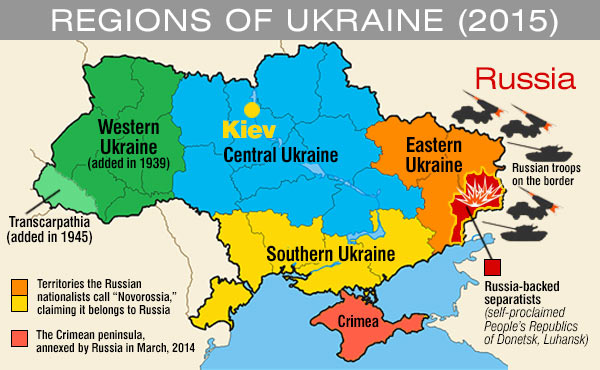
Jonathan Masters has written a very good background on the conflict in Ukraine. Ukraine became an independent (and nuclear) state in 1991 after the dissolution of the Union of Soviet Socialist Republics. In 1994 Ukraine gave up its nuclear weapons and returned them to Russia after the signing of the Budapest Memorandum. That document stipulated that Ukraine, a nuclear power at that time, would give up its nuclear weapons in exchange for security guarantees. “The US, Great Britain and Russia welcomed the decision of the Kyiv regime to accede to the non-proliferation agreement and pledged, among other things, to respect the independence and “existing borders” of Ukraine.” That agreement was violated by Russia in 2014 when it invaded Crimea and started a rebellion in the Donbas region of Ukraine. That action precipitated the sanctions against Russia by the European Union and the US, which has not altered Russian behavior at all. It is also the reason why the arms shipments to Ukraine highlighted in the recent impeachment proceedings against US President Trump.
Martin Gurri has written an exceptionally insightful essay on the rise of populism in the world over the last decade. It is, in some respects, a development that can be easily explained by the dramatic growth in income and wealth inequality in the world. But that explanation could also suggest a rise in leftist political activity, something which has been far less vibrant than the rise of right-wing politics. Gurri’s conclusion is clear: “The great political divide of our time is between the public and elites: and what matters to the public is to strike a blow at the elites.” He goes further to describe the rise of populism:
“The populism Trump represented has contributed mightily to the instability of the last decade. The public has elected outlandish characters to high office across the world: Johnson in Britain, Orbán in Hungary, Duterte in the Philippines, Salvini in Italy, Modi in India, Obrador in Mexico, Bolsonaro—whose statements make Trump, by comparison, sound like Miss Manners—in Brazil. In France, Germany, and the Netherlands, populist figures have gained ground. These are disruptors and system-smashers. If they aren’t exactly Mussolinis-in-waiting, neither are they overly concerned with the rituals and rhetoric of democracy. The populist, like the public, aims to stand against. A fundamental question, if we are to understand our moment, is whether these off-key politicians are the cause of the public’s surly mood or merely a symptom of it.”
Gurri’s answer to the question is the same as mine: populism is the result of widespread dissatisfaction by ordinary people and the elite’s inability to offer meaningful political choices:
“Whether the current crop of populists tell more or better lies than their elite predecessors can be left an open question. But that they are the prime movers in a decade of revolt may be safely doubted. The arrow of causation points in the opposite direction. From Tunisia in 2011 to Hong Kong today, the majority of protests have been leaderless—quite consciously so. These spontaneous outbursts have developed out of the same set of symptoms as populism: the decline of traditional political parties, for one. Both share the same digital vectors of communication, the same rhetoric of rage. The far spread of populism, rightly considered, should be viewed as an argument against the notion that it is personality driven. Structural and global factors appear to be at work.”
Unfortunately, Gurri does not suggest a way out.
“The public has voted bizarre characters into office for a very simple reason: democratic political institutions, and the elites who manage them, have refused to offer meaningful alternatives. The populists in all their strangeness are a message from the public that this narrow status quo cannot stand. In the age of post-truth, however, nearly the opposite message has been received by those at the top of the hierarchy.”
It is hard to believe that the world’s elites will respond in a meaningful way to the inequities that have become far too obvious to most since the Great Recession of 2008-09. Whether the populist movements can articulate a coherent world order as an alternative is also open to great doubt, particularity since the movements seem to be leaderless and not at all ideological. This is an essay worth reading.

 World Politics News