Johnathan Swan of Axios held an interview with US President Trump and, in it, he asked Mr. Trump if he had discussed the New York Times report on 26 June that Russia was paying bounties to the Taliban for killing US soldiers in Afghanistan. Mr. Trump has had eight telephone conversations with Russian President Putin since the Times report was published but in the interview Mr. Trump confessed: “I have never discussed it with him.” Mr. Trump has defended his unwillingness to confront Mr. Putin by asserting that the intelligence report was not “definitive”.
The inability to be “definitive” is often the case with intelligence, particularly intelligence about the relationship between Russia and the Taliban. But Zach Dorfman makes these points about such intelligence:
“While there were indeed ‘rumblings’ of GRU (the Russian counterpart to the CIA) support for the Taliban toward the end of the Obama years, says a third former official, it was very different than ‘specific threat information.’
“Threat information, such as bounties, is considered so important that it is shared more widely even when not fully verified due to the potential harm to human life, say former officials.
“During the last few years of the Obama administration, no reporting on potential GRU bounties in Afghanistan appeared in the President’s Daily Brief, a written document provided every day to the president and select senior U.S. officials that summarizes key intelligence and analysis from U.S. spy agencies, recalls a former U.S. national security official. This points to a lack of such knowledge within the U.S. intelligence community at the time, says this person — especially because of the lowered bar for disseminating threat data.
“According to the Associated Press, by 2019, however, some U.S. intelligence officials had concluded that Russia had transitioned from merely providing support to the Taliban to actually paying them to kill U.S. soldiers.”
There was disagreement among the US intelligence agencies about how solid the evidence actually is. According to another story in the New York Times:
“Based on intelligence that included accounts from interrogated detainees and electronic intercepts of data showing payments from a bank account linked to Russia’s military intelligence agency, the G.R.U., to the Taliban, the C.I.A. concluded that Russia had escalated its support to the Taliban to include financial incentives for killing Americans and other coalition troops.
“The C.I.A. — as well as analysts at the National Counterterrorism Center — expressed medium or moderate confidence in that conclusion. The National Security Agency, which puts greater stock in surveillance intercepts, was more skeptical, officials have said.
“The White House initially denied that Mr. Trump had been briefed, but did not deny a subsequent Times report that the intelligence was included in his written daily briefing in late February. But Mr. Trump often chooses not to read his written briefing, and White House aides later stressed to lawmakers that a C.I.A. official who delivers his oral briefings did not bring it up.”
The episode is just another episode of Mr. Trump’s unwillingness to confront Mr. Putin. The most infamous example was when, in Helsinki, Mr. Trump said that he believed Mr. Putin’s denial of interference in the 2016 national election over the unanimous agreement of US intelligence agencies that Russia had in fact interfered: “My people came to me, Dan Coats came to me and some others and said they think it’s Russia…I have President Putin. He just said it’s not Russia. I will say this. I don’t see any reason why it would be…” The fact that Mr. Trump has not even questioned Mr. Putin about the bounties is extraordinary and is a clear dereliction of duty by the ostensible Commander in Chief.
Katherine E. McKinney, Scott D. Sagan, and Allen S. Weiner have written an essay for the Bulletin of the Atomic Scientists entitled “Why the atomic bombing of Hiroshima would be illegal today”. The atomic bombing of Hiroshima and Nagasaki is a highly contested event in international relations, but the title of the essay is misleading. In my opinion, the use of the atomic bomb in 1945 violated pre-existing laws of war, notably the prohibition against killing civilians. But the fact that the bombing was illegal is not really the issue. The discussions conducted by US officials at the time centered almost exclusively on the question of how to end the war against Japan, the terms of Japan’s surrender was almost exclusively a political question.
The laws of war had been extensively by all sides during World War II. The carpet bombings of Dresden and Hamburg, the fire-bombing of Tokyo, the Japanese treatment of US and allied prisoners of war, and the German V-2 bombing of London were all violations of the Geneva and Hague Conventions. And the war was conducted against the backdrop of extraordinary violations of human rights in the Holocaust, the Rape of Nanjing, and the Italian invasion of Ethiopia.
There are essentially three political considerations that are relevant to the analysis presented in the article. First, was the US demand for unconditional surrender by the Japanese an impediment to an earlier conclusion of the war without either an invasion or the use of the atomic bomb? There is considerable evidence that the Japanese were seeking an end to the war that did not involve the abdication of the Emperor or his trial as a war criminal. Ultimately, the US did accept the continuation of Hirohito’s rule, but with massive restrictions on his role in political and military affairs. After dropping the bomb, there was little question about the ability of the US and its allies to demand these restrictions, but there is room to doubt that such a course of action would have been possible absent the shock of the bomb. It is perhaps more useful to discuss why the US and the allies decided to issue such a stark demand on an adversary. The demand for unconditional surrender was tied to the outrage against the sneak attack on Pearl Harbor, anger at Japanese conduct with respect to allied prisoners of war, and the ingrained racism in the US against non-white populations. US officials should not have succumbed to these non-strategic matters.
The second consideration is the possibility of an allied invasion of Japan. In the absence of the atomic bomb, such an invasion would have involved both American and Soviet troops (Stalin had promised in Yalta to send troops six months after the end of the war in Europe). The evidence from the American amphibious assaults on the islands of Saipan, Iwo Jima, and other islands suggested to military analysts that the deaths involved in the homeland of Japan would have been comparable (Iwo Jima had witnessed 21,000 Japanese deaths and almost 7,000 American deaths–the size of Iwo Jima was only 8 square miles). The estimates of the likely losses in an invasion of the Japanese homeland were all over the place. The US had two strategic plans for the invasion, Operations Olympic and Coronet:
“The main concern for the Americans was the potential for huge casualty rates. Nearly every senior officer involved in the planning did his own research regarding American casualties – this was based on the experience America had fighting the Japanese since PearlHarbour.
“The Joint Chiefs of Staff estimated that Olympic alone would cost 456,000 men, including 109,000 killed. Including Coronet, it was estimated that America would experience 1.2 million casualties, with 267,000 deaths.”
“Staff working for Chester Nimitz, calculated that the first 30 days of Olympic alone would cost 49,000 men. MacArthur’s staff concluded that America would suffer 125,000 casualties after 120 days, a figure that was later reduced to 105,000 casualties after his staff subtracted the men who when wounded could return to battle.
“General Marshall, in conference with President Truman, estimated 31,000 in 30 days after landing in Kyushu. Admiral Leahy estimated that the invasion would cost 268,000 casualties. Personnel at the Navy Department estimated that the total losses to America would be between 1.7 and 4 million with 400,000 to 800,000 deaths. The same department estimated that there would be up to 10 million Japanese casualties. The ‘Los Angeles Times’ estimated that America would suffer up to 1 million casualties.”
Again, the issue is whether the allied demand for unconditional surrender was reasonable. Faced with these losses, it may have been the case that the allies would have accepted some conditions rather than invade. Unfortunately, we will never know the answer to this counterfactual.
Third, and finally, the decision to use the atomic bomb was based on a number of considerations: the desire to limit further US casualties, the desire to end the war quickly, the perceived need to send a message to the Soviet Union and to avoid it from being a party to the Japanese surrender (which ultimately failed–the Soviets took control of North Korea and the Kurile Islands in the northern part of Japan, issues which continue to fester today. There was a concerted effort by some of the nuclear scientists, led by Leo Szilard, to not use the bomb because of the potential civilian losses.
Ultimately, the decision to drop the bomb was rushed and not really subject to careful study. The first test of the bomb (“Trinity“) occurred on 16 July 1945 and the bomb was dropped on 6 August 1945. The decision was made by a President who had only been in office since the death of Franklin Roosevelt on 12 April 1945 and who had little or no foreign policy experience and was unaware of the existence of the bomb until 25 April 1945. Truman later claimed that he did not lose a moment’s sleep after making the decision: “For his part, Truman never regretted his decision—nor did he ever gloat, even in the face of decades of second-guessing by those who disagreed with him. Truman made the decision, and, as he was fond of saying, ‘that’s all there was to it.’”
The real question is not whether dropping the bomb was legal. It is whether the future use of an atomic bomb could ever be justified. For me, the answer is an emphatic no. But I doubt that anyone in power would ever ask me for my advice.
Reading newspapers from other countries is always a very useful exercise. The US media has a number of ideological blinders that make self-examination nearly impossible. Crispin Hull has written an opinion piece from the Canberra Times in Australia, one of the US’s closest allies. His analysis of the US is searing:
“Look at the US now. Its president is so psychiatrically disordered with narcissism that he is incapable of dealing with the COVID-19 crisis in a coherent, empathetic way. Everything he says and does is through a prism of himself. He has now turned his whole re-election campaign into one of race hate, law and order and a bizarre invention of a threat from ‘left-wing fascists’.
“But worse, the US seems to have a national self-delusion that once Trump loses and is gone, everything will return to normal. The delusion extends to a belief that the COVID-19-stricken economy will bounce back to normal in a V shape.
“Trump is as much just a symptom of the underlying rottenness as an integral part of it, even if his sucking up to authoritarian leaders in Russia, China and North Korea is unprecedented….
“Tragically, American exceptionalism – ‘we are the first and best democracy on Earth’ – contributes to the self-delusion of indestructibility. There is nothing automatically self-correcting in US democracy. Even the so-called checks and balances are not working – they are causing gridlock, rather than adding a bit of mild caution to a system that is overall supposed to be geared to problem-solving, not political point-scoring.
“The system has become so warped that those disenfranchised, disempowered and disenchanted are taking to the streets, questioning the legitimacy of the whole system.
“The only question is whether the taking to the streets can break these vicious circles, or whether it is just another step in the decline and fall of a great power.”
Hull is unquestionably correct that the damage to the political institutions of the US over the last three and a half years will last long after Trump leaves the scene. We should avoid thinking that a different President will be able to restore the Republic quickly and easily.
Adam Tooze has written an intelligent and cogent analysis of US-China relations for the London Review of Books. One should compare this analysis with the shrill and insipid analysis of US Secretary of State, Mike Pompeo, who delivered a Cold War-like view of China in a speech entitled “Communist China and the Free World’s Future”. There is probably no more complex problem in international relations than the need for dominant powers to adjust to a rising power that previously been considered not central to the equilibrium of the international system. Britain, France, and Russia failed miserably in addressing the rise of Germany (the Franco-Prussian War, 1870, World War I, and World War II). After 1945, the US decided to integrate Germany into the international system, for largely self-interested reasons.
The Clinton and Obama Administrations tried to welcome China into the international system, but President Trump has decided instead to isolate China and the rising tensions between the two states has been destabilizing and unsettling. Richard Haass has written a very powerful critique of Trump’s strategy for the Washington Post. And Tooze does an excellent job of putting the Trump Administration China policy in context:
“On the American side the reassessment of US-China relations began nearly ten years ago, during Obama’s first term, when Hillary Clinton was secretary of state. Clinton had taken a close interest in Chinese affairs as far back as the 1990s, when she was first lady. In 2011, as secretary of state, she initiated the pivot to Asia of the navy’s carrier groups, the most conspicuous weapons in the US strategic arsenal. The Trans-Pacific Partnership (TPP), an obscure trade pact in which America had until then shown little interest, was refashioned as a tool for containing China. If Clinton had been elected president in 2016, the relationship with China would doubtless have been at the heart of her foreign policy. She would have personified continuity in the US position, but under any administration the remarkable growth of China’s economy would have warranted a new strategic response, as would President Xi’s regime, which since 2012 has promoted the pre-eminence of the Chinese Communist Party, an intolerance of ideological pluralism, a forceful assertion of Chinese sovereignty and a capacious new vision of China’s role in the world.
“Donald Trump’s unexpected election victory changed the debate by putting the spotlight back on the US. The Trump presidency is a Rorschach blot onto which analysts project their diagnosis of a crisis that is as much American as Sino-American. Self-critical American liberals see the Trump presidency as the result of the derailment of US globalisation policy, above all in relation to China: blue-collar resentment, stoked by unbalanced trade, put Trump in office. Meanwhile, Trump and his team put the blame for the China crisis on their predecessors in the Obama, Bush and Clinton administrations. For hawks, such as the US trade representative Robert Lighthizer and Trump’s favourite economic adviser, Peter Navarro, the question is why the effort to enrol China in the world economy was undertaken in the first place, and who benefited from an experiment that has gone so badly wrong.
“The crude Trumpian take, which is perhaps also the kindest, is that the US negotiators of the 1990s and early 2000s were chumps, suckered by the Chinese. The more sophisticated version is that Bill Clinton’s team were too committed to the kind of modernisation theory Frances Fukuyama spun in his ‘end of history’ essay in 1989. They believed the liberal story that as China’s economy matured it would inevitably develop a need for the rule of law and representative democracy. If the Communist regime refused this logic and clung to its old ways, the laws of social science would condemn it to economic stagnation. Either way America had nothing to fear.”
Tooze does a good job of putting the Clinton-Obama policies in a good light. There is little question that many US jobs were exported to China, and that economic pain was enough to stimulate the surge of populism that placed Trump in the White House via the archaic Electoral College. But there were other ways the US could have address that economic pain.
“Thanks to the painstaking work of labour economists we can trace, county by county, the impact of Chinese imports and the loss of factory jobs across the US. The evidence of the shock is clear enough, but so too are its modest proportions. High-side estimates put the total number of jobs lost in the US because of Chinese imports at 2.5 million, which is little more than 2 per cent of the workforce. To describe this as ‘American carnage’ is a dramatic rhetorical inflation. The significant fact, though, is that 2.5 million amounts to 20 per cent of the manufacturing labour force. These were the fabled well-paid manual jobs that stand for the vanished American dream of blue-collar prosperity.
“Given the resources of American government, a shock on this scale could have been cushioned through spending on welfare, education, reinvestment and relocation. But that would have required creative politics, which is precisely what has been obstructed by the Republicans. Instead the problem wasn’t addressed, unleashing a pervasive status anxiety among lower-middle-class and working-class white Americans, especially men. It was in the counties where the highest number of jobs were lost because of the China shock that Trump scored best in the 2016 election. There wasn’t a huge national swing in electoral terms, any more than the China shock was a huge national labour market crisis. But thanks to the rickety construction of America’s 18th-century constitution, all that Trump needed to do to win the presidency was exploit a series of concentrated local crises.”
The danger of the Trump China policy is that it has raised military tensions in the South China Sea, over Taiwan, over the products of Huawei, and the human rights of people in Hong Kong, Tibet, and Xinjiang. If President Trump is not re-elected in November, then the first order of business for the Biden Administration is to return to the process of encouraging the Chinese to support the multilateral institutions of the post-1945 world.
“To the extent the Trump administration is condoning, turning a blind eye toward, or even colluding with Israeli attacks on Iran, this is bad news for U.S. interests. U.S. interests are different from those of Israel, and even more different from those of the current Benjamin Netanyahu-led government.
“That government has an interest in perpetuating high tension with Iran to keep Iran as a bête noire blamable for all the ills of the Middle East, to preclude any rapprochement between Washington and Tehran, to promote Israeli relations with the Gulf Arab states, and to distract attention from issues that bring international scrutiny and criticism on Israel. At the moment, Netanyahu’s incentives in this regard are stronger than ever, which may help to explain the timing of the recent wave of attacks. The distraction value of stoking the conflict with Iran has increased as Netanyahu contemplates formal annexation of parts of the West Bank and the international condemnation that will come with it.
“Netanyahu also, like the Iranians, is aware of the U.S. electoral calendar and American opinion polls. He may see the next few months as an optimum and limited time for stirring the regional pot even more than Israel has in the past, while his friend Donald Trump is still in power. To the extent the stirring helps his friend’s re-election chances, so much the better from his point of view.
“Netanyahu is unlikely to be worrying about escalation into a bigger war, which would serve his purposes even more dramatically. Goading Iran into retaliating in a way that would spark such a war may have been one of the objectives of the recent attacks. And it would not be Netanyahu’s job to count the ensuing American casualties. “
It is unlikely that US President Trump is aware of the divergent interests of Israel and the US. But it also seems clear that both Netanyahu and Trump are motivated more by personal, rather than national interests. The challenges to Iran are continuing: the press is reporting that Israeli or US jets harassed an Iranian passenger plane over Syria today. Over the last few months, Iran has significantly increased its contacts with both Russia and China. And Iran is far closer to building a nuclear weapon than it was when the Iranian nuclear agreement was being observed. US policy toward Iran has been nothing short of a disaster.
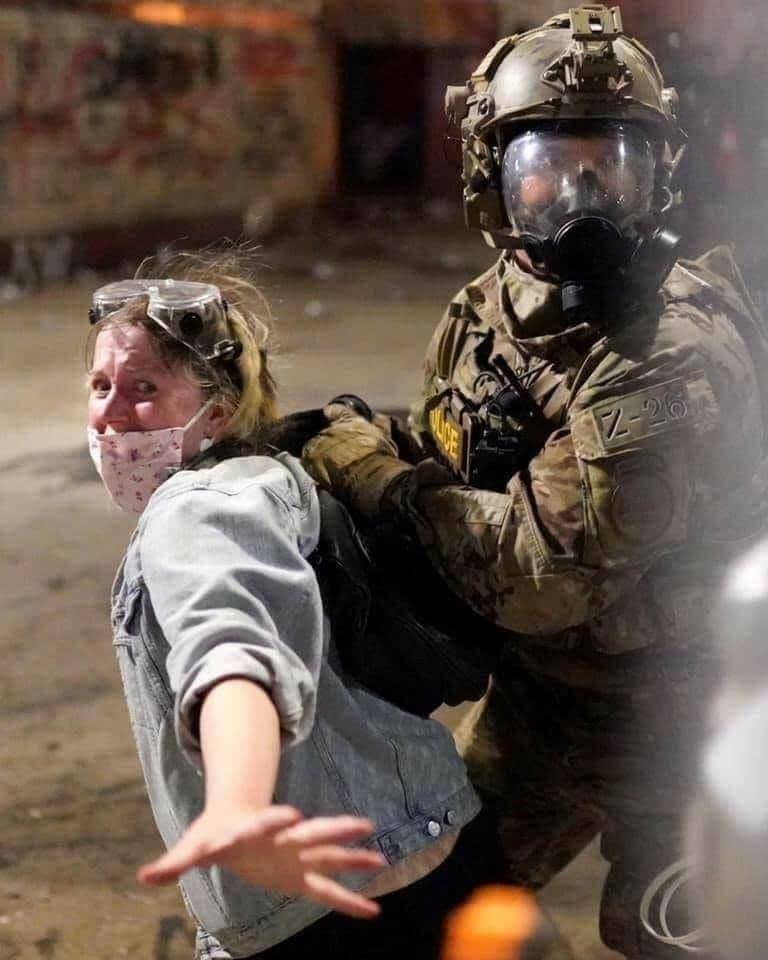
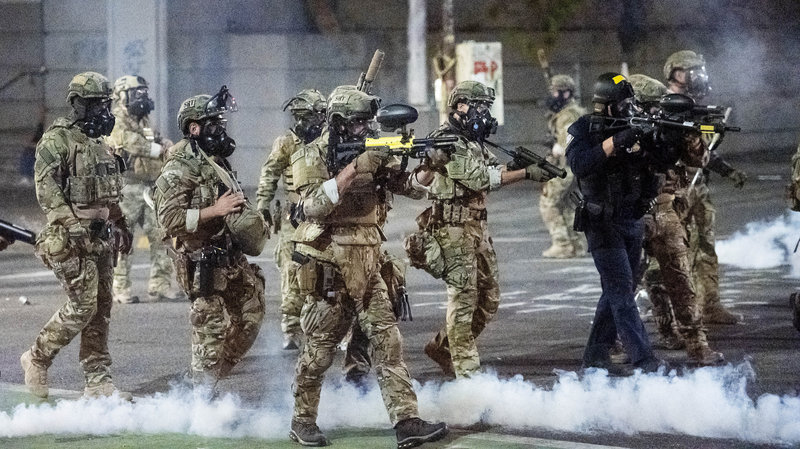
Like many others, I have been deeply disturbed by the deployment of security officials from the Department of Homeland Security dressed in camouflage, with no identifying insignia other than the simple word “police”, driving unmarked rental cars, and arresting people in Portland, Oregon. These individuals are dressed to look like combat troops, designed to intimidate protesters. The protests in Portland have been going on for almost two months and are focused on the Multnomah County Justice Center which serves as the Portland Police Bureau center.
As is the case with most protests, there is no central organizing group directing the protesters activities. The absence of such a group means that the protests have been relatively unorganized and there is no single spokesperson who can speak for the thousands of protesters. The protest narrative is therefore fragmented and partial. There is no question, however, how the Federal Government views the protests and US President Trump labels the protesters as “anarchists” who hate America. Free lance journalists are among the few sources of information that does not come from official sources.
Robert Evans, writing in his blog, has constructed a meticulous narrative of what has happened in Portland, poking holes in the official narrative that conjures up the specter of mass violence. It is a long post, with many video disturbing video excerpts of police misbehavior. But the conclusion is that the protesters have unquestionably defaced the Federal building and have hurled firecrackers and bottles at the security forces. But there is little evidence that the protests have become a major threat to life in Portland.
The Federal actions are dangerous and counterproductive. James Comey, the former Director of the FBI, writes in The Washington Post:
“With some protesters itching for street confrontations with officers in full tactical gear, federal officials are giving a small group of violent people what they want. And they are giving the citizens of Portland — and the rest of us, no matter our politics — what we don’t want: the specter of unconstrained and anonymous force from a central government authority. It has been the stuff of American nightmares since 1776.
“Fairly or unfairly, visions of Department of Homeland Security officers in camo without apparent identifying insignia dragging people into unmarked vans are now seared into the collective memory. Federal law enforcement, like all parts of the justice system, depends upon the faith and confidence of the American people, a credibility now being spent, recklessly, by the Trump administration. And the Department of Homeland Security, a key element of this administration’s chaotic and often immoral immigration enforcement, had precious little credibility left to spend in the first place. Thanks to Portland, its cupboard is now empty.
“And even if it weren’t behavior inconsistent with American values and self-defeating for the agencies involved, it is also just plain dumb to give protesters another sinister embodiment of the feds to rail against.”
Mr. Trump has indicated that he will be sending additional Federal forces to other cities, including Chicago which has experienced a dramatic increase in gun-related violence. These deployments will only fuel greater resentment, and it is interesting that the right-wing supporters of Mr. Trump fail to see the danger of Federal overreach. The scenes and actions of the Federal forces in Portland augurs ill for the future of democracy in the US. Militarizing local security is a step toward a totalitarian state.
Federal agents use crowd control munitions to disperse Black Lives Matter protesters at the Mark O. Hatfield United States Courthouse in Portland, Ore. on July 20, 2020. Officers used teargas and projectiles to move the crowd after some protesters tore down a fence fronting the courthouse. (AP Photo/Noah Berger)
“In the early 2000s, Israeli spy chiefs hatched a plan to assassinate Iranian nuclear scientists, a campaign Jerusalem has never formally acknowledged. In 2012, a top official at Natanz — Mostafa Ahmadi Roshan — was killed in a mysterious explosion. His death followed two other suspected killings over the previous two years.
“But that wasn’t all: In 2009, Israel joined the US in using a cyber weapon, known as Stuxnet, to destroy about 1,000 of Iran’s 6,000 centrifuges.
“Why would Israel resort to such bold methods? Simply put, officials in Jerusalem worry Iran could more credibly threaten Israel’s existence if it had a nuclear weapon. There’s real justification for that concern: Just last year, for example, a top Iranian general told local reporters, ‘Our strategy is to erase Israel from the global political map.’”
Iran has slowly been shedding the constraints of the nuclear agreement that US President Trump abrogated two years ago, and these attacks will certainly slow down the nuclear program. But the attacks also confirm that developing a nuclear weapon may be the only way for Iran to deter a more open attack on Iran by either Israel or the US–lessons learned from Saddam Hussein of Iraq and Muammar Gaddaffi of Libya. However, Iran is greatly suffering from the economic turmoil unleashed by the US sanctions as well as by the COVID-19 pandemic which has taken hold in Iran. I sincerely doubt that Iran wishes to be involved in any armed confrontation with either the US or Israel.
There are, however, limits to the insults to sovereignty the attacks pose. Prime Minister Netanyahu wishes Iran to react so that Israel and the US would have a legitimate casus belli. US President Trump was a willing ally to forcing a confrontation, and his recent slide in the polls is a genuine cause for concern. It is unlikely that a President Biden would be so willing to provoke Iran. We can expect these attacks on Iran to escalate as the US election comes nearer.
The New York Times is reporting that the US and Israel have decided upon low-level attacks on the Iranian nuclear infrastructure as a way to slow down a possible path toward nuclear weapons capability. There have been a number of attacks on such facilities and the level of sophistication of these attacks seem far beyond the capabilities of a domestic opposition group. The possibility of attacks by either Israel or the US raises problems for any Iranian response. So far, the Iranians have been quite restrained in the face of similar attacks, focusing on missile attacks against US forces in Iraq. But the safest course of action by Iran would be to wait for the results of the US election in November. If President Trump is not re-elected, the US stance may soften slightly which would further weaken the Israeli position given the vulnerabilities of Prime Minister Netanyahu. But there is a limit to the degree of damage the Iranians may be willing to suffer. Borzou Daragahi assesses the conundrum for Iran:
“So far, the Iranians appear to be biding their time. In addition to the November elections, Iran is nervously awaiting the October expiration of a decade-long United Nations arms embargo. Washington is attempting desperately to get the rest of the Security Council to extend the ban while Iran is trying to be on its best behavior.
“’Staying patient is what we’ve been saying to the Iranians for years,’ said the Western diplomat. ‘They could have chosen to react in various ways. They have been pretty calm and restrained. My gut tells me they don’t want to be sucked into anything in the run-up to September and October.’
“While losing the Natanz facility, which was only made operational in 2018, was a loss, the Iranians will likely choose to hold off on any response for now. Even the perpetrators of the alleged bombing appear to have refrained from taking credit in a likely attempt to discourage reprisal. If a response comes, it will likely come after the elections—perhaps, in the weeks before inauguration day.”
“’They need first of all to make up their minds [on] what caused this,’ the former Israeli Defense Force military intelligence chief General Yossi Kuperwasser said in an interview. ‘They would probably rather wait until Trump is over to respond. The major goal they have in their mind is to see Trump disappear. Natanz is one of the problems out of many Iran has to face, the main problem is the ‘maximum pressure’ campaign from the Americans. It causes them much more problems.'”
Let’s hope that there is no major escalation in this particular crisis.
I won’t be posting this coming week. I am off to see my beautiful granddaughters. I will return to posting next Saturday.

 World Politics News