Archive for the ‘World Politics’ Category
US President Trump has announced that the US will withdraw from the Joint Comprehensive Program of Action (JCPOA–the Iran Nuclear Agreement). Here is a transcript of his speech with my annotations to the President’s comments.
My overview: One can believe everything that President Trump said about Iran that threatens US and global security. Yesterday, all those concerns were valid BUT Iran was constrained from developing nuclear weapons until at least 2025. And all US intelligence verified that Iran was adhering to those constraints. Tomorrow, all those concerns may be valid BUT Iran is free to develop nuclear weapons without any constraints whatsoever. There was nothing in President Trump’s speech that suggested a plan to either tame Iranian behavior or to prevent its immediate pursuit of nuclear weapons. Is the world better off tomorrow than it was yesterday?
We should also be aware that it is the US that is breaking the agreement, not Iran. Since the US cannot identify any breach of the agreement by Iran, then the US withdrawal without a good reason is itself a breach. The credibility of the US is now open to question. What does its signature on an agreement really mean?
PRESIDENT TRUMP: My fellow Americans, Today, I want to update the world on our efforts to prevent Iran from acquiring a nuclear weapon.
The Iranian regime is the leading state sponsor of terror. It exports dangerous missiles, fuels conflicts across the Middle East, and supports terrorist proxies and militias such as Hezbollah, Hamas, the Taliban and Al Qaeda.
President Trump does not acknowledge that it was US action that gave Iran a decisive role in Middle East politics. The overthrow of Saddam Hussein, who was an ardent foe of Iran and fought a disastrous war against Iran from 1980-88, in 2003 created an opportunity for Iran to increase its influence in the predominantly Shia population of Iraq. Hussein was a bulwark of Sunni interests in the Middle East, protecting Saudi Arabia and, coincidentally, Israel.
Iran is a sworn enemy of the Taliban and al Qaeda. They support Sunni regimes. Iran supports Shia regimes.
Over the years, Iran and its proxies have bombed American Embassies and military installations, murdered hundreds of American service members, and kidnapped, imprisoned, and tortured American citizens.
The 1998 United States embassy bombings in Uganda and Kenya were committed by Egyptian terrorists. Egypt is an ally of the US. A pro-Iranian group calling itself the Islamic Jihad Organization took responsibility for the bombing of the US Embassy in Lebanon in 1983. It was never established that the Iranian government was involved in that attack.
The Iranian regime has funded its long reign of chaos and terror by plundering the wealth of its own people.
No action taken by the regime has been more dangerous than its pursuit of nuclear weapons — and the means of delivering them.
In 2015, the previous administration joined with other nations in a deal regarding Iran’s nuclear program. This agreement was known as the Joint Comprehensive Plan of Action, or J.C.P.O.A.
In theory, the so-called “Iran deal” was supposed to protect the United States and our allies from the lunacy of an Iranian nuclear bomb, a weapon that will only endanger the survival of the Iranian regime.
In fact, the deal allowed Iran to continue enriching uranium and — over time —reach the brink of a nuclear breakout.
The key phrase is “over time”. Iranian enrichment has verifiably stopped but those constraints will begin to end in 2025. That gives the world 7 years to work on persuading Iran to continue to adhere to the Non-Proliferation Treaty. After President Trump’s announcement toady, those 7 years could be lost. As of yet, we do not know if Iran will begin to enrich Uranium again because of the US action. It may, however, continue to adhere to the agreement in order to persuade Europe, China, and Russia to not follow the US lead. We will soon find out.
The deal lifted crippling economic sanctions on Iran in exchange for very weak limits on the regime’s nuclear activity — and no limits at all on its other malign behavior, including its sinister activities in Syria, Yemen, and other places all around the world.
It is not clear that any agreement could ever have been reached that prevented Iran from aiding its allies or working on ballistic missiles capable of carrying conventionally armed warheads. Today, it remains unclear if those objectives are achievable. President Trump gave no indication of a plan to achieve those objectives.
In other words, at the point when the United States had maximum leverage, this disastrous deal gave this regime — and it’s a regime of great terror — many billions of dollars, some of it in actual cash — a great embarrassment to me as a citizen and to all citizens of the United States.
President Trump neglected to note that these billions of dollars were Iranian money that been frozen in US banks. The US did not “give” the money to Iran; it returned the money to Iran.
A constructive deal could easily have been struck at the time, but it wasn’t.
Again, it is easy to say that a deal could “easily” have been struck. Details of a plan are necessary to be persuaded.
At the heart of the Iran deal was a giant fiction: that a murderous regime desired only a peaceful nuclear energy program.
Today, we have definitive proof that this Iranian promise was a lie.
Note the use of the present tense.
Last week, Israel published intelligence documents — long concealed by Iran — conclusively showing the Iranian regime and its history of pursuing nuclear weapons.
Israeli Prime Minister Netanyahu’s presentation used documents that were all written before 2007. The world was well aware of Iranian plans after 2003 but Iran decided not to develop nuclear bombs although it continued to develop the technology and resource base for nuclear bombs. One should not look at the Iranian program in isolation, however. Iran was surrounded by nuclear armed powers: Russia, China, Pakistan, India, and Israel. In addition, US forces were on Iranian borders in Afghanistan, Iraq, and Pakistan and all US forces had access to nuclear weapons. In that context, the pursuit of a nuclear capability does not necessarily indicate offensive intentions.
More importantly, all US intelligence agencies were in agreement that Iran had adhered to the agreement on enrichment. The US officials that have testified publicly about that assessment include Secretary of Defense Jim Mattis, General Joseph Dunford, Chairman of the Joint Chiefs of Staff, General John Hyten, Commander of U.S. Strategic Command, General Paul Selva, Vice Chairman of the Joint Chiefs of Staff, Director of National Intelligence Dan Coats and Lieutenant General Vincent R. Stewart, Director of the Defense Intelligence Agency, former Secretary of State Rex Tillerson, and current Secretary of State, Mike Pompeo.
The fact is, this was a horrible, one-sided deal that should have never, ever been made. It didn’t bring calm, it didn’t bring peace, and it never will.
In the years since the deal was reached, Iran’s military budget has grown by almost 40 percent — while its economy is doing very badly. After the sanctions were lifted, the dictatorship used its new funds to build its nuclear-capable missiles, support terrorism, and cause havoc throughout the Middle East and beyond.
The agreement was so poorly negotiated that even if Iran fully complies, the regime can still be on the verge of a nuclear breakout in just a short period of time.
The deal’s sunset provisions are totally unacceptable.
Probably better than zero days.
If I allowed this deal to stand, there would soon be a nuclear arms race in the Middle East. Everyone would want their weapons ready by the time Iran had theirs.
Making matters worse, the deal’s inspection provisions lack adequate mechanisms to prevent, detect, and punish cheating and don’t even have the unqualified right to inspect many important locations, including military facilities.
The inability to inspect military facilities is a feature of the Non-Proliferation Treaty. No signatory to the NPT ever gave rights to the International Atomic Energy Agency to inspect military sites. That exclusion was demanded by the US in 1968 as a condition for its signature. Why should Iran be the only country required to open up its military bases to outsiders?
Not only does the deal fail to halt Iran’s nuclear ambitions, but it also fails to address the regime’s development of ballistic missiles that could deliver nuclear warheads.
Finally, the deal does nothing to constrain Iran’s destabilizing activities, including its support for terrorism.
Since the agreement, Iran’s bloody ambitions have grown only more brazen. In light of these glaring flaws, I announced last October that the Iran deal must either be renegotiated or terminated.
Three months later, on January 12th, I repeated these conditions. I made clear that if the deal could not be fixed, the United States would no longer be a party to the agreement.
Over the past few months, we have engaged extensively with our allies and partners around the world, including France, Germany, and the United Kingdom.
This history, if accurate suggests that no amount of negotiation will ever attain the objectives that President Trump desires. If previous negotiations have been sincerely pursued and failed, then if President still wants to attain those objectives, then the only alternative is war.
We have also consulted with our friends from across the Middle East. We are unified in our understanding of the threat and in our conviction that Iran must never acquire a nuclear weapon.
After these consultations, it is clear to me that we cannot prevent an Iranian nuclear bomb under the decaying and rotten structure of the current agreement. The Iran deal is defective at its core. If we do nothing, we know exactly what will happen.
Which may be the same thing that will now happen.
In just a short period of time, the world’s leading state sponsor of terror will be on the cusp of acquiring the world’s most dangerous weapons.
Therefore, I am announcing today that the United States will withdraw from the Iran nuclear deal.
In a few moments, I will sign a presidential memorandum to begin reinstating U.S. nuclear sanctions on the Iranian regime. We will be instituting the highest level of economic sanction. Any nation that helps Iran in its quest for nuclear weapons could also be strongly sanctioned by the United States.
We do not know exactly what this means. All of the partners to the JCPOA have signed oil contracts with Iran. Does this mean that the US will penalize Germany, France, and Great Britain for buying Iranian oil? Switzerland, China, Pakistan, India, and Italy have also bought oil from Iran. Will they be punished? Does Trump’s threat include the exclusion of Iran from The Society for Worldwide Interbank Financial Telecommunication (SWIFT) which would prevent Iranian banks from engaging in international financial transactions? Iranian banks were invited back into SWIFT in February 2016 after the JCPOA was signed. Will SWIFT, which is based in Belgium, follow an American demand to exclude Iranian banks in the absence of a clear violation by Iran of the JCPOA?
America will not be held hostage to nuclear blackmail. We will not allow American cities to be threatened with destruction. And we will not allow a regime that chants “Death to America” to gain access to the most deadly weapons on Earth.
Today’s action sends a critical message. The United States no longer makes empty threats. When I make promises, I keep them. In fact, at this very moment, Secretary Pompeo is on his way to North Korea in preparation for my upcoming meeting with Kim Jong-un. Plans are being made, relationships are building.
A very interesting pivot. We will see how the US decision affects the upcoming summit between the US and North Korea. As I posted on 27 April, I am quite skeptical of any agreement on denuclearization.
Hopefully, a deal will happen, and with the help of China, South Korea, and Japan, a future of great prosperity and security can be achieved for everyone.
As we exit the Iran deal, we will be working with our allies to find a real, comprehensive, and lasting solution to the Iranian nuclear threat. This will include efforts to eliminate the threat of Iran’s ballistic missile program, to stop its terroristactivities worldwide, and to block its menacing activity across the Middle East.
In the meantime, powerful sanction also go into full effect. If the regime continues its its nuclear aspirations, it will have bigger problems than it has ever had before. Finally, I want to deliver a message to the long-suffering people of Iran.
The people of America stand with you.
The people of Iran remember that the US helped to overthrow the Iranian government in 1953. And that the US invaded Iran to rescue American hostages in in 1980.
It has now been almost 40 years since this dictatorship seized power and took a proud nation hostage. Most of Iran’s 80 million citizens have sadly never known an Iran that prospered in peace with its neighbors and commanded the admiration of the world.
But the future of Iran belongs to its people. They are the rightful heirs to a rich culture and an ancient land, and they deserve a nation that does justice to their dreams, honor to their history and glory to God.
Iran’s leaders will naturally say that they refuse to negotiate a new deal. They refuse, and that’s fine. I’d probably say the same thing if I was in their position. But the fact is, they are going to want to make a new and lasting deal, one that benefitsall of Iran and the Iranian people.
When they do, I am ready, willing, and able. Great things can happen for Iran.
And great things can happen for the peace and stability that we all want in the Middle East. There has been enough suffering, death, and destruction. Let it end now. Thank you. God bless you. Thank you.
Spiegel has published an article on US President Trump’s strategy in pursuing what looks like a trade war with both the European Union and China. The article uses game theory to reveal the US strategy prior to Mr. Trump’s election and how he wishes to undermine this strategy with bilateral trade agreements.
“This development isn’t without irony. It was largely the United States that initiated the General Agreement on Tariffs and Trade (GATT) after World War II and later the WTO. It enabled the U.S. and other countries to escape a dilemma they were facing. ‘It’s the prisoner dilemma that explains the existence of the WTO,’ says Gabriel Felbermayr, director of the ifo Center for International Economics in Munich.
“Under this game theory model, two prisoners who have been accused of a crime committed jointly are interrogated separately. If neither says anything, then they are both convicted and sentenced to shorter jail sentences for smaller, provable offenses. If only one confesses, then that prisoner is freed and the other receives the stiffest sentence. If both confess, then both get stiff sentences, but not the stiffest. The dilemma for the prisoners is that they are unable to coordinate their responses. That’s why the rational decision is for both to confess to avoid the maximum penalty. But the two would be in a better position if they had been able to cooperate with each other.
“It may also be just as rational for two countries to protect their own economies through tariffs, but if both of those countries make the same decision, then both will fare worse economically than they would have if they had cooperated in ways that could have benefited both.”
Mr. Trump prefers the game of chicken to the prisoner’s dilemma game. In chicken, one eschews the possibility of cooperation with any others other than the principal target. In chicken, one either chooses to concede or die. In such a game, then bluster becomes an essential tactic to intimidate the possible trading partner.
Prisoner’s Dilemma

The trade talks with China did not go very well. Had they gone well, many analysts had expected that Chinese President Xi would meet with the US negotiators. No meeting took place–the Americans simply left Beijing with little fanfare. The US negotiator, Robert Lighthizer, is a well-known hardliner on the issue of trade, and the US position reflected that hardline. According to The Economist:
“The American demand that made the most headlines was that China should cut its massive bilateral trade surplus by $200bn by the end of 2020. That would amount to a roughly 60% reduction in China’s surplus within three years, which is far from credible. But numbers are at least negotiable. More troubling from China’s perspective were demands focused on its economic policy. The Americans asked China to stop providing subsidies to a range of sectors that the Chinese government has deemed strategic, from robotics to electric vehicles. They demanded that Chinese tariffs on American products be no higher than American tariffs on Chinese products. And they told China to open its market much more widely to foreign investors, setting July 1st as a deadline.”
These demands are non-starters, and it is not unusual for opening negotiating positions to be extreme. But, given that the meeting was in Beijing and that Lighthizer led the delegation, the Chinese likely did not interpret the US position as a bargaining gambit. More likely, they interpreted it as an insult. The judgement of The Economist was: “Taken in its entirety, though, the American position amounts to a demand for a new economic model in China.”
Diplomacy is often a matter of paying excruciating attention to the specific culture of the interacting parties. There have been some stunning faux pas in recent history/ In 2000 German Chancellor Gerhard Schröder visited the Yad Vashem Holocaust Memorial, guided by Israeli PM Ehud Barak. There is an eternal flame burning at the memorial in honor of the millions killed in the Holocaust. Schröder turned the switch in order to make the flame higher. Unfortunately, he turned it the wrong way and extinguished the flame. Efforts to relight the flame failed until someone came with a cigarette lighter. The tables were turned in the recent visit by the Japanese Prime Minister, Shinzo Abe, to Israel. He was hosted by Israeli Prime Minister Netanyahu at a dinner that was, by all accounts, fabulous. Until dessert. The dessert was put into a shoe designed by renowned artist Tom Dixon. Unfortunately, anyone who knows Japanese culture knows that shoes are forbidden in the house and putting a shoe on the dinner table was a gross insult. It is time for Netanyahu to get a new protocol officer.
As we move close to 12 May, the deadline for US President Trump to certify the Iranian nuclear agreement (The Joint Comprehensive Program of Action–JCPOA), we should ponder the alternatives available toMr. Trump. Philip Gordon has an excellent article in The Atlantic which outlines why preserving the agreement does not prevent Mr. Trump from pursuing his other goals vis-a-vis Iran: “Trump has three grievances with the deal. They include sunsets for several provisions, restrictions on which military sites inspectors can demand to see and the deal’s failure to cover other Iranian activities like its ballistic missile program or support for terrorist groups.”
What will Trump do on 12 May?
Trump is trying to damage the people who negotiated the agreement. The Guardian reports that “Aides to Donald Trump, the US president, hired an Israeli private intelligence agency to orchestrate a “dirty ops” campaign against key individuals from the Obama administration who helped negotiate the Iran nuclear deal, the Observer can reveal….People in the Trump camp contacted private investigators in May last year to “get dirt” on Ben Rhodes, who had been one of Barack Obama’s top national security advisers, and Colin Kahl, deputy assistant to Obama, as part of an elaborate attempt to discredit the deal.”
If he fails to certify that Iran is in full compliance with the JCPOA.
Option 1. Do nothing
Then the question is what will Iran do? The other parties will likely maintain current positions and if they openly support the continuation of the agreement then Iran will continue to comply. That situation might satisfy Mr. Trump’s domestic political base, but will have no practical effect on the status quo.
Option 2. Renegotiate the Agreement
Iran says that it will not renegotiate the agreement. According to the BBC: “In remarks carried live on Iranian state television on Sunday, President Rouhani said: “If America leaves the nuclear deal, this will entail historic regret for it.” He warned Iran had “a plan to counter any decision Trump may take and we will confront it”.
For the Europeans a safe option. It allows them to agree with the US without serious consequences. That proposal would take years. Even if Iran refuses to negotiate, as long as no new sanctions are imposed, the status quo would rest in limbo.
Option 3. Reimpose sanctions
National Public Radio describes the very unusual sanctions framework for the JCPOA: “If U.S. officials believe Iran is violating the deal, they would bring the allegation to the Security Council. At that point, sanctions would be imposed automatically — the first unusual twist in the deal. If members of the security council — Russia, China or others — rise to Iran’s defense, they can block the new sanctions only by passing a new resolution….That could be stopped by a U.S. veto. The U.S. is one of five permanent council members — including Great Britain, France, Russia and China — with veto power….In other words, instead of making sanctions vulnerable to a veto by the five permanent Security Council members, the deal flips that around, and gives the U.S. (or others) power to stop any attempt to block the imposition of sanctions.”
What will the US do? That likely depends on the British, French, and the Germans who oppose breaking the agreement. Russia and China will not wish to reimpose sanctions and will probably ignore any call to do so. Neither do the Europeans, but the US is leaning on them. Mr Trump may dangle trade deals in front of them to secure their cooperation. Such a move would be very tempting for the Germans and the British, but the Swiss and the Italians have already re-established strong economic links with Iran, so the issue would be Europe-wide discussion (Switzerland is not part of the European Union. Reimposing the sanctions will take a long time and much depends on which ones would be reimposed and how strictly they will be enforced.
There will also be collateral damage to such a move as the North Korea negotiations would be affected. The credibility of the US would be damaged and the most significant rule of the liberal world order–the Non-Proliferation Regime–would come under serious stress.
Option 4. Provoke Iran
This is the spookiest alternative. It already been foreshadowed by Israeli actions in Syria which have sharply escalated military conflict with Iranian units. Additionally, Netanyahu’s speech about Iranian duplicity on nuclear weapons, although consisting largely of old and already-known news, suggests the very hard line of Israel toward the agreement. Furthermore, most of Mr. Trump’s advisers–Bolton, Pompeo, Guiliani–are fiercely opposed to the agreement and have replaced the advisers, McMaster and TIllerson, who favored keeping the agreement. The three new advisers are notorious hard-liners on the JCPOA. Guiliani also has strong contacts with the MEK –the People’s Mujahedin of Iran–which is a well-heeled anti Iranian cleric group once listed as a terrorist organization supported by Saddam Hussein. The MEK could be the tip of the spear in any military conflict with Iran. It has some support within Iran, but I sincerely doubt that that support is significant. But the belief that an exiled group was a profound motivating rationalization in both the Bay of Pigs fiasco in 1961 in Cuba as well as in the failed invasion of Iraq in 2003.
The objective would be to create some sort of confrontation with Iran which would arouse nationalist sentiment in the US to support military action in support of an Israeli attack on Iran. It is unclear how closely the US public has been following the Iranian issue, but there remains significant anti-Iranian sentiment in the US from the hostage crisis which persisted between 1979 and 1981. But the Iraq and Afghanistan Wars have taken place in the mean-time and there may not be much support for another war in the Middle East. But a nationalist inspired crisis would certainly divert attention away from the Russian meddling/Stormy Daniels stories currently dominating the media.
But a war with Iran suffers from the same problem with scrapping the JCPOA: there is no vision of what comes after either event. Getting rid of something bad is only the right move when it can be replaced by something better. I personally do not believe the JCPOA is not a “bad” agreement–it has accomplished its very crafted objectives and given the world plenty of time to work out a better relationship with Iran. That the world has not taken advantage of that opportunity is not a failure of the agreement.
There were widespread protests against the inauguration of Vladimir Putin for his fourth term as President of Russia. He was elected last March in an election that lacked effective opposition and the protests targeted his consolidation of power over the Russian state. Over 1600 people were detained in the protests, including Alexei Navalny who has emerged as the leader of the opposition to Putin. There were protests in over 60 cities, from Yakutsk to St. Petersburg to Kalinigrad, under the banner “He is not our Czar”.
Alexei Navalny Being Detained

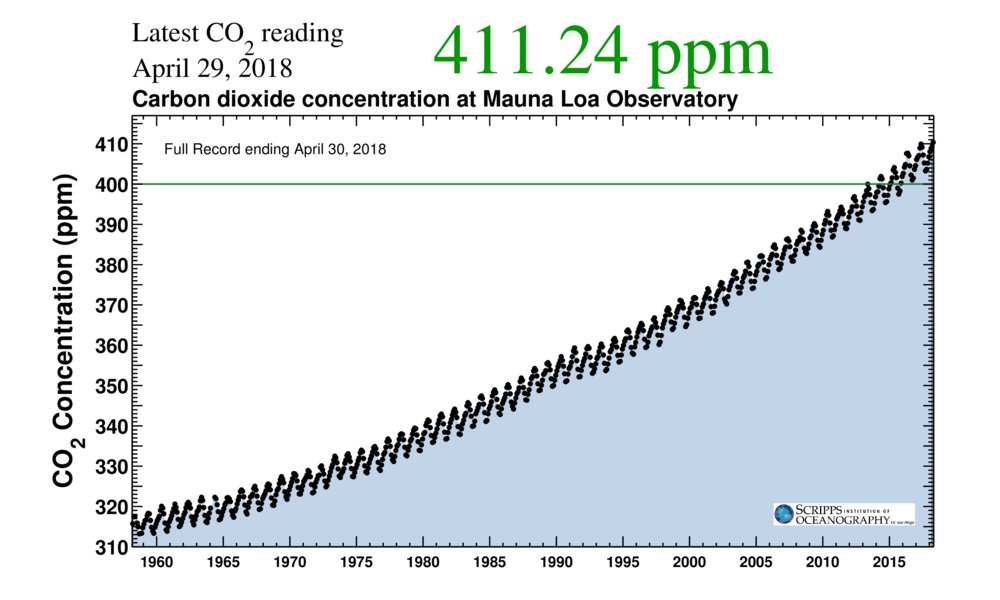
Concentrations of Carbon Dioxide (CO2) at the measurement station at Mauna Loa in Hawaii for the month of April reached 410 parts per million for the first time in over 800,000 years. According to the Scripps Institution of Oceanography at UC San Diego:
“This marks the first time in the history of the Mauna Loa record that a monthly average has exceeded 410 parts per million. This also represents a 30-percent increase in carbon dioxide concentration in the global atmosphere since the Keeling Curve began in 1958. In March, Scripps Institution of Oceanography at the University of California San Diego observed the 60th anniversary of the data series, the first measurements of which were 315 ppm.
“The Keeling Curve draws its name from its creator and the shape of its dataset, a seasonally seesawing trend of steadily rising CO2 readings that exceeded 400 ppm in air for the first time in human history in 2013. Prior to the onset of the Industrial Revolution, CO2 levels had fluctuated over the millennia but had never exceeded 300 ppm at any point in the last 800,000 years.”
In does not appear as if the world has made any progress in reducing emissions of CO2 which, according to the World Meteorological Organization, makes “the planet more dangerous and inhospitable for future generations.”
Lebanon is holding a national election tomorrow and it is unlikely that the election will determine anything. Lebanon has long been governed under a system of “confessionals” which allocate political power on the basis of presumed religious representation. According to the International Foundation for Electoral Systems:
“Lebanon’s internal politics seek to balance the interests of its numerous religious groups, or ‘confessions,’ until the ‘basic national goal,’ as enumerated in the Constitution, of the abolition of political confessionalism can be achieved. Although not included in the Constitution, by long-standing agreement the president is a Maronite Christian, the prime minister is a Sunni Muslim, and Parliament’s speaker is a Shi’a Muslim. As will be discussed in more detail below, following the Taif Accord in 1989, the Constitution requires that Muslims and Christians have equal numbers of seats in Parliament, and the election law distributes seats in constituencies among the various confessions.”
The Washington Post has a very nice article describing the different parties competing in the elections. Stratfor gives a detailed description of the structure of the Lebanese government which outlines its extraordinary complexity and its intent of avoiding sectarian conflict. Al-Arabiyah examines the outsized influence of Hezbollah in Lebanese politics which frightens the Saudis and emboldens the Iranians. The elegant proportionality of the system is undermined by the fact that the ratios are determined by a census conducted in 1932–a new census has never been held out of fear of disrupting the balance agreed upon over 70 years ago.

I always want to make sure that the readers of this blog are always up to date on the latest acronyms in world politics. Everyone should remember “CVID”. This gem comes to us from the US State Department Briefing on 3 May 2018:
QUESTION: Secretary Pompeo yesterday during swearing-in ceremony said that he seeks permanent, verifiable, irreversible dismantlement of North Korea’s WMD. He actually said this several times during his nomination hearing, when he was in Jordan with the Japanese foreign minister. So this is quite different from the complete, verifiable, and irreversible dismantlement, so is this a higher bar for North Korea, or is it essentially the same?
MS NAUERT: We’re calling it CVID now. So because the State Department, the government likes acronyms so much, we’ve got a new one: CVID – complete, verifiable, irreversible denuclearization. That is our policy and that is the policy of Secretary Pompeo.
Okay. Let’s —
QUESTION: Wouldn’t that be PVID? You add another addition of PVID.
MS NAUERT: Yeah, I don’t have anything on that for you. I don’t have anything on that for you today.
QUESTION: You don’t have – what’s the difference, CVID and PVID? Permanently —
MS NAUERT: I think our government policy has been very well known and explained a lot of times on how we are approaching negotiations with North Korea, the importance of that. Look, we would not be at this place where we are today without the maximum pressure campaign. If anything, if there’s – I’ve spoken more about our maximum pressure campaign than anything else in the past year-plus since I’ve been doing this job.
QUESTION: PVID means permanently —
MS NAUERT: We are seeing tremendous progress. We’ve gotten to this point where we can sit down and have conversations – we certainly hope and are looking forward to it – between the President of the United States and Kim Jong-un. And we are looking forward to what they have pledged, which is exactly that, denuclearization. Let’s move on to something else.
No matter what the acronym, the idea that North Korea would agree to CVID/PVID absent a complete disengagement of American troops and alliances in the Korea peninsula is lunacy.
But President Trump has often talked about removing US troops from South Korea, even before he ran for office. He is not the first US President to think about the matter: President Carter make reductions in the troop levels and President George W. Bush removed some troops to use them in the invasion of Iraq. Mr. Trump believes that the troops are not necessary to maintain the peace on the peninsula and that South Korea and Japan should pay for the troops if they wish an American presence. The New York Times is reporting that Mr. Trump has ordered the Pentagon to conduct a study on possibly removing some of the troops. The South Korean government is sending mixed signals about such as move. Moon Chung-in, a special adviser to the South Korean President for unification, foreign affairs and national security remarked that if a peace treaty were signed between North and South Korea, US troops would no longer be necessary. Later, another official, Cheong Wa Dae, made this statement: “The government’s position is that the U.S. Forces Korea (USFK) is playing the role of a mediator between major powers surrounding the country, such as China and Japan. It is the government’s stance that the USFK is needed.”
US National Security Adviser, John Bolton, said on Friday that Mr. Trump is not considering a draw down of troops. The New York Post is quoting Bolton on the matter: ““The New York Times story is utter nonsense. The President has not asked the Pentagon to provide options for reducing American forces stationed in South Korea.” The Military Times is reporting that Chief of Staff, John Kelly, is also opposed to troop reductions in South Korea. Troops reductions are only one of the contentious issues likely to come up in the summit between Trump and Kim. There are also matters of a potential peace treaty between North and South as well as the status of the current sanctions against North Korea. It is difficult to believe that all these issues could be resolved simultaneously. They are likely only to be conducted in a series of iterated steps over a very long period of time. That process might have a high chance of success but whether it is something that could be politically sustained without a certain outcome for an extended period seems unlikely to work in the US political system.
US Bases in South Korea US Military Bases Near North Korea


Maj. Danny Sjursen (US Army) has written a critique of the legislation being proposed by Senators Corker (R-TN) and Kaine (D-VA) to replace the current hodgepodge of Authorizations to Use Military Force (AUMF) that have been passed to legitimate US troops engaged in combat missions in what was once called the “War on Terror”. These AUMFs are ersatz versions of the constitutional requirement of a Declaration of War which needs to be passed by both Houses of Congress and subject to a veto by the President. Sjursen describes the legislation:
“It would essentially rubber stamp the president’s authority, for instance, to continue the ongoing shooting wars in at least seven countries where the U.S. is currently dropping bombs or firing off other munitions. Worse yet, it provides a mechanism for the president to declare nearly any future group an “associated force” or “successor force” linked to one of America’s current foes and so ensure that Washington’s nearly 17-year-old set of forever wars can go on into eternity without further congressional approval.”
Moreover, the language of the legislation is especially terrifying for civil liberties in the US. Jon Schwarz, writing for The Intercept, examines the loophole which may allow the President to designate at will any group he or she decides is “associated” with terror groups:
“Here’s how it works: The Corker-Kaine AUMF codifies an expanded list of entities against whom the president is authorized to use force. They are “the Taliban, al Qaeda, the Islamic State in Iraq and Syria, and designated associated forces.” The associated forces designated by the bill are Al Qaeda in the Arabian Peninsula; Shabab; Al Qaeda in Syria; the Haqqani Network; and Al Qaeda in the Islamic Maghreb.
“Then when the bill is passed, the president is invited to designate additional “associated forces” to the list. And going forward, the president can add more at any time. All he needs to do is inform “the appropriate congressional committees and leadership” that he’s doing so.

There apparently is no way for Congress to restrict the power of the President to designate an “associated” group. This legislation should be soundly defeated.
On this day in 1994, Israeli Prime Minister Yitzhak Rabin and PLO Chairman Yasser Arafat signed an agreement implementing the first step of Palestinian self-rule as articulated in the
Oslo Accords of 1993. The incredible hopes raised by that event no longer exist. Both sides accuse each other of bad faith and lack of adherence to the Accords. Today, 24 years later, the idea of peaceful coexistence between two states–one Israeli and the other Palestinian–is impossible under current conditions and the trajectory of relations between the two sides is becomingly increasingly hostile.
The Meeting in Cairo hosted by Hosni Mubarak
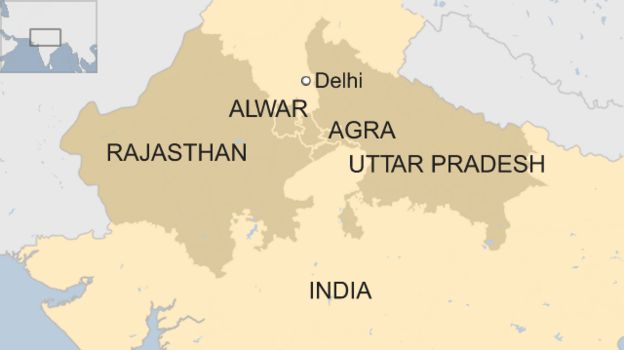
A dust storm hit the northern states of Uttar Pradesh and Rajasthan in India, killing more than 100 people. Dust storms are not unusual at this time of year, but the high death toll is striking and suggests that the storm was intense. There was widespread destruction caused by the storm with power outages and disrupted travel. The Washington Post quoted Hemant Gera, secretary for disaster management and relief in Rajasthan: ““I’ve been in office for 20 years, and this is the worst I’ve seen.”
Saeed Kamali Dehghan has written a very insightful article for The Guardian on the likely effects of a US pull-out from the Iranian nuclear deal. He provides a history of Israeli Prime Minister Netanyahu’s alarms over the likelihood of Iranian nuclear weapons:
“Others find it hard to take Netanyahu seriously: he has been warning that Iran is close to acquiring nuclear weapons for more than 20 years. In 1992, he said the country would have a nuclear bomb in three to five years. In 1993, he predicted it would happen by 1999. He made similar remarks in 1996, 2002, and many times since, as the Israeli newspaper Haaretz has pointed out. Not only are his warnings repetitive, they are hypocritical. Ordinary people I talk to are shocked when they realise Iran does not have a single bomb and has been a party to the treaty on the nonproliferation of nuclear weapons since 1970. Israel, in contrast, has never signed it (meaning that the International Atomic Energy Agency has no inspection authority there) and is estimated to have more than 200 nuclear warheads. Let’s be clear: Netanyahu’s files did not show that Iran has violated the agreement. The IAEA has verified 10 times, most recently in February, that Tehran has fully complied with its terms.”
Dehghan points out that if the US does pull out of the agreement, the move would likely embolden the hardliners in Tehran who would unquestionably argue that no detente with the US is possible and that Iran should simply forge its own course in the Middle East.
CNBCis reporting that over the last 30 days China has installed anti-ship cruise missiles and surface-to-air missile systems on three of its artificial islands in the South China Sea. The report, if true, comes on the heels of reports that China has also placed communications jamming equipment on those artificial islands. Such islands are not recognized as soveriegn territory under international law and the US, as well as many Southeast Asian nations, have lodged protests about the militarization of the South China Sea. China, however, has claimed that recent map discoveries prove Chinese control over the entire South China Sea. Chinese Foreign Ministry spokesperson Hua Chunying responded to the reports:
“China has indisputable sovereignty over the Nansha Islands [the Chinese name for the artificial islands] and its nearby waters. It is needed to protect the sovereignty and security of China, and justified for China as a sovereign nation to carry out peaceful development activities and necessary defense constructions. The related deployment is not directed at any country.”
The spokesperson for the US White House, Sarah Sanders, made this statement in response to the reports:
“We’re well aware of China’s militarization of the South China Sea. We’ve raised concerns directly with the Chinese about this and there will be near-term and long-term consequences.”
Ms Sanders did not specify what those consequences might be, but US B-52 bombers are on patrol in the South China Sea.
The “New Map of the People’s Republic of China” Made in 1951

One of Mount Holyoke’s finest, Jenna Ruddock, has written an article on the Venezuelan refugees that are taxing the resources of many of Venezuela’s neighbors. The refugees are fleeing an economic system that has totally collapsed, leaving many on the brink of starvation and without sufficient medical supplies. Ruddock describes the crisis:
“A crippled health care system, critical food shortages, and hyperinflation are driving Venezuelans across their country’s borders en masse, many bearing only what they can carry on foot. According to recent reports from the International Organization for Migration (IOM), nearly one million people have fled Venezuela in the past two years. Venezuela’s immediate neighbors are now facing a migration crisis comparable in scale to the flight of Syrians to western Europe. Nearly 600,000 Venezuelans have sought refuge in neighboring Colombia alone.”
Unfortunately, the US response to the refugee crisis has been non-existent: “For the first time in 2017, more Venezuelans sought asylum in the United States than citizens from any other country. Yet the Trump administration’s message to migrants seeking refuge in the United States has consistently been a hostile one.” The international community needs to take note of this humanitarian crisis, one which is incomprehensible given the potential richness of Venezuela.
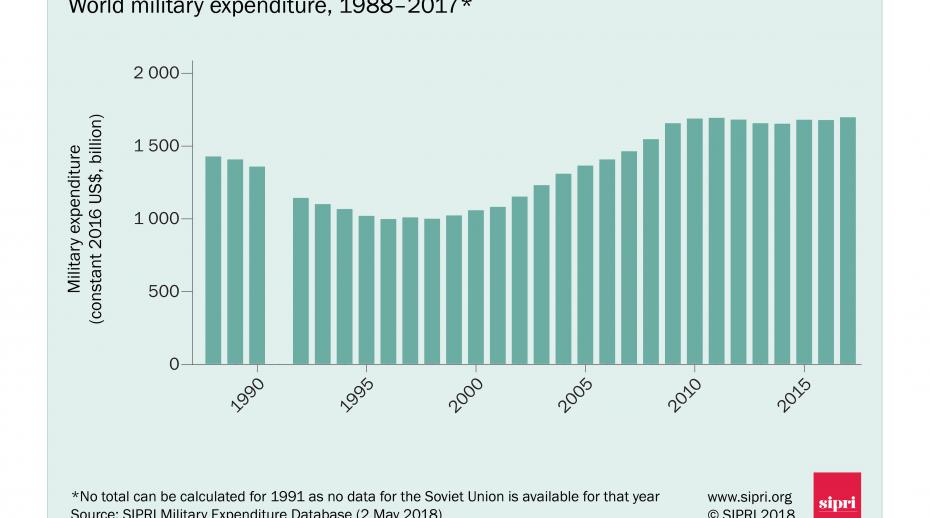
The Stockholm International Peace Research Institute (SIPRI) has released its annual report on global military spending. According to the press release:
“Total world military expenditure rose to $1739 billion in 2017, a marginal increase of 1.1 per cent in real terms from 2016, according to new figures from the Stockholm International Peace Research Institute (SIPRI). China’s military expenditure rose again in 2017, continuing an upward trend in spending that has lasted for more than two decades. Russia’s military spending fell for the first time since 1998, while spending by the United States remained constant for the second successive year.”
Some of the developments in 2017 are quite revealing.
- China made the largest absolute increase in spending ($12 billion) in 2017 (in constant 2016 prices), while Russia made the largest decrease (–$13.9 billion).
- Military expenditure in South America rose by 4.1 per cent in 2017, mainly as a result of notable increases by the two largest spenders in the subregion: Argentina (up by 15 per cent) and Brazil (up by 6.3 per cent).
- Military spending in Central America and the Caribbean fell by 6.6 per cent in 2017, largely due to lower spending by Mexico (down by 8.1 per cent from 2016).
- Military expenditure in Africa decreased by 0.5 per cent in 2017, the third consecutive annual decrease since the peak in spending in 2014. Algeria’s military spending fell for the first time in over a decade (down by 5.2 per cent from 2016).
- Seven of the 10 countries with the highest military burden are in the Middle East: Oman (12 per cent of GDP), Saudi Arabia (10 per cent of GDP), Kuwait (5.8 per cent of GDP), Jordan (4.8 per cent of GDP), Israel (4.7 per cent of GDP), Lebanon (4.5 per cent of GDP) and Bahrain (4.1 per cent of GDP).
The Pakistani city of Nawabshah recorded a high of 50.2ºC (122ºF) on Monday. That temperature is the highest temperature ever recorded in the month of April anywhere in the world, and suggests that this coming summer could be brutal in Pakistan. The record joins a number of record-setting high temperature events in the last few years. According to The Nation:
“The record-setting 122.4 degree reading in Nawabshah adds to a long list of international hot weather extremes since 2017, which includes Spain’s and Iran’s highest temperatures ever recorded last summer. In May 2017, the western town of Turbat in Pakistan hit 128.3 degrees, tying the all-time highest temperature in that country and the world-record temperature for that month, Weather Underground’s Jeff Masters reported.”
Recent research suggests that poor countries will experience a disproportionately high number of such events if climate change is not addressed. The Washington Post ran a graphic on the temperatures in South Asia yesterday.

Happy First of May (Labor Day for most of the world)!!!! The Wobblies Live! If you do not know who the Wobblies were, you should!

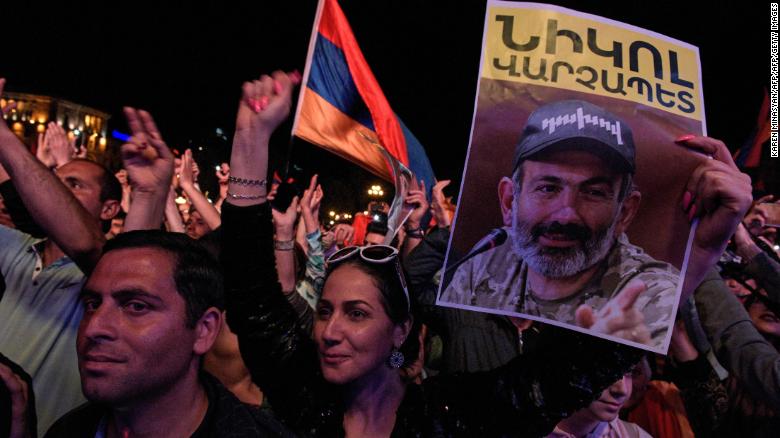
The Armenian Parliament has rejected the bid by Nikol Pashinyan to become the country’s next Prime Minister, even though Pashinyan ran unopposed. Pashinyan was defiant as he called for a general strike to oppose the Parliament’s decision:
“We will block the streets, the airports, the metro, the railway, everything that can be blocked….If everyone participates in a total act of civil disobedience, this will be a total victory of the people of Armenia. Our struggle is a struggle of non-violence, it is a peaceful act of civil disobedience.”
Pashinyan’s party, Yelk (“Way Out”), only has nine seats in the Parliament of 105 seats, so he is bargaining from a weak technical position. But sentiment in the streets of Armenia seem to favor him overwhelmingly. We will see if the dominant Republican Party (which has 58 seats in the Parliament) will cede power. If not, then a snap election must be called in seven days according to the Armenian constitution.
Protests in Armenia
There have been many visits by military advisers from Israel to the US in recent weeks, and last week Gen. Joseph Votel, Commander of US Central Command, made a visit to Israel and met with Israel’s General Chief of Staff, Lt. Gen. Gadi Eizenkot. It was a curious visit since Israel falls into the US European Command, not US Central Command. But Votel went on to visit Syria and unquestionably he met with Israel’s military commanders to assess Iran’s growing influence in Syria and Iraq. The visits, coupled with Israeli attacks on Iranian military bases in Syria and Prime Minister Netanyahu’s speech on the Iranian nuclear program, suggest that something is brewing. The Iranians have stated that they will respond to any Israeli “aggression” against Iranian interests in Syria.
Israeli Prime Minister Benjamin Netanyahu made a Powerpoint presentation outlining what he termed were Iranian “lies” about it nuclear program. The Prime Minister claimed that Israeli agents raided a warehouse in Tehran last January which contained “55,000 printed pages and 183 compact discs” dating back to 2003. We do know that Iran had an active nuclear weapons program from 2003-2007 even though it was a signatory to the Non-Proliferation Treaty (NPT). The NPT does not, however, ban research on nuclear weapons, merely the possession of nuclear weapons, and the Iranian weapons program was stimulated by the US invasions of Afghanistan in 2001 and Iraq in 2003. Prime Minister Netanyahu did not produce any evidence that Iran had violated the Joint Comprehensive Plan of Action (JCPOA) which committed Iran to end its enrichment program in 2015. All evidence, including the assessments of the US Departments of State and Defense, as well as the International Atomic Energy Agency, have certified that Iran has been in full compliance with the JCPOA. The presentation was clearly an attempt by the Prime Minister to influence US President Trump’s decision whether to de-certify the JCPOA on 12 May. Netanyahu’s presentation followed an air strike against Syria on Sunday that actually registered as a 2.6 magnitude earthquake. The strike was against a munitions depot and a number of Iranians and Iraqis were killed. No state has claimed responsibility for the strike, but most analysts believe that Israel conducted the attack.
Thirty days ago, US President Trump announced tariffs on imported aluminum and steel but gave affected countries 30 days to negotiate better terms on their trade with the US. That deadline expires at midnight tonight (I hope to be fast asleep at that time). South Korea agreed to renegotiate, but all other countries rejected the US demand, including important US allies in Europe. So tomorrow morning I will wake up to find out whether a trade war has begun. Europe has been quite emphatic that it will retaliate if the tariffs are imposed, and their threatened tariffs are carefully selected to affect politically sensitive products exported from key US states. Late News: The Washington Post has published an article stating that Trump will defer his decision until 1 June. No trade war tomorrow.
Jeff Tollefson has written a remarkable review of current climate change policies for the journal Nature. He examines a variety of different policies with respect to energy alternatives and acknowledges that the world has been making remarkable strides toward the development of renewable energies. But economic growth in many emerging economies is still dependent on fossil fuels and Tollefson notes that
“So it was in 2017, when, after staying relatively flat from 2014 to 2016, carbon emissions grew by about 1.5% (see ‘A brief lull’). All it took to create that spike was a small rise in economic growth across the developing world, according to a final estimate released in March by the Global Carbon Project, an international research consortium that monitors carbon emissions and climate trends.”
The trade-off between economic growth and climate change still seems to be weighted in favor of increased carbon emissions since it is unlikely that states will forego economic growth voluntarily. That relationship has to change if the world is to avoid serious climate change.
/cdn.vox-cdn.com/uploads/chorus_asset/file/10748751/jz_climate_scenarios.png)
The Republican Party of Armenia (RPA) has announced that it will not nominate a candidate for Prime Minister, leaving the post open for Nikol Pashinyan who led the protest movement against a bid to keep the RPA’s candidate, Serzh Sargsyan, in power for an illegal third term. Russia, which is always a factor in Armenian politics (Armenia was once part of the former Soviet Union), was favored by Sargsyan and, even though Pashinyan has tried to remain neutral on relations with Russia, it is highly likely that Russia fears a significant loss of influence in the country. Pashinyan has called for Parliamentary elections on 1 May to form a new government.
Protests in Armenia

North Korean leader Kim Jong-un has invited outside inspectors to visit the Punggye-ri test site to verify that it will be closed down. Kim announced that the testing facility would be closed down prior to a formal agreement with South Korea and the US, a rather astonishing move. The Punggye-ri site was used for all six of North Korea’s nuclear bomb tests, but it is widely believed that the site is seriously damaged and may no longer be usable. But there have been reports of activity at the site which suggests that the government may be trying to rehabilitate the site. It is very difficult to tell what the significance of the North Korean announcement may be.

Peter Beinart has written an interesting article for The Atlantic which argues that even though Iran has not violated the Joint Comprehensive Plan of Action (JCPOA), the US has more than likely violated it. The agreement calls on all parties to facilitate the reintegration of Iran into the global economy as the earlier sanctions against the country are lifted. Beinart gives evidence that the US has not complied with these clauses and that the Trump Administration has in fact made it more difficult for Iran to interact with its trading partners for such commodities as aircraft parts. Iran has always complained about US adherence to the agreement, but few countries have taken it seriously.
 World Politics News