US President Trump took the US signature off the joint communique issued by the G7 after he departed for Singapore to meet with Korean leader Kim Jong-un. Mr. Trump’s reason for the act was that he considered the statement by Canadian Prime Minister Justin Trudeau to be “dishonest” and a “betrayal”. Here is the statement made by Prime Minister Trudeau:
JUSTIN TRUDEAU, CANADIAN PRIME MINISTER: We move forward with retaliatory measures on July 1st, applying equivalent tariffs to the ones that the Americans have unjustly applied to us. Canadians, we’re polite, we’re reasonable, but we also will not be pushed around.
WALLACE: Well, President Trump responded with this tweet while flying here on Air Force One to Singapore. Trudeau of Canada acted as meek — so meek and mild during our G-7 meetings only to give a news conference after I left. Very dishonest and weak.
Question, Mr. Navarro, is that really how we want to deal with our second biggest trading partner?
PETER NAVARRO, WHITE HOUSE TRADE ADVISER: Chris, there’s a special place in hell for any foreign leader that engages in bad faith diplomacy with President Donald J. Trump and then tries to stab him in the back on the way out the door. And that’s what bad faith Justin Trudeau did with that stunt press conference. That’s what week, dishonest Justin Trudeau did. And that comes right from Air Force One.
And I’ll tell you this, to my friends in Canada, that was one of the worst political miscalculations of a Canadian leader in modern Canadian history. All Justin Trudeau had to do was take the win. President Trump did the courtesy to Justin Trudeau to travel up to Quebec for that summit. He had other things, bigger things on his plate in Singapore, where you are now, Chris. He did him a favor and he was even willing to sign that socialist communique. And what did Trudeau did — do as soon as — as soon as the plane took off from Canadian airspace, Trudeau stuck our president in the back. That will not stand.
We need to appreciate Canada’s position. Under the rules of the World Trade Organization, there are criteria used to define “national security” exceptions which are included in Article XXI of the Charter. Those exceptions are as follows:
(b) to prevent any contracting party from taking any action which it considers necessary for the protection
of its essential security interests
(i) relating to fissionable materials or the materials from which they are derived;
(ii) relating to the traffic in arms, ammunition and implements of war and to such traffic in other
goods and materials as is carried on directly or indirectly for the purpose of supplying a military
establishment;
(iii) taken in time of war or other emergency in international relations
One would be hard pressed to argue that the US-Canada relationship falls under any of these conditions. Thus, Canada does believe that the aluminum and steel tariffs imposed on it under the “national security” exception is “insulting”.
US Economic Adviser Larry Kudlow on Trudeau’s Statement
Mr. Trump’s advisers justified the harsh language by asserting that Trudeau made Mr. Trump look “weak” before his meeting with North Korean leader Kim. There might be merit in a show of solidarity before allies confront a mutual enemy. But that argument is considerably weakened by Mr. Trump’s earlier request that Russia be allowed back into the G7 even without demanding any concessions from Russia on the Ukrainian invasion. “Being tough” is often a good negotiating tactic, but only if one is consistently regarded as tough.
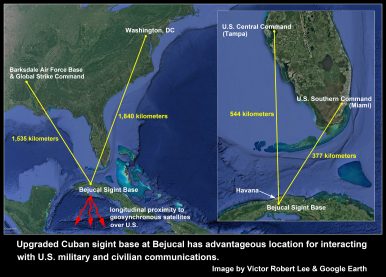
Satellite images have revealed the construction of a new radome (steerable parabolic antenna and its spherical enclosure) in Cuba. There are other radar stations in the area and they are used to eavesdrop on electronic transmissions in the US. The new tracking station is ideal for listening in on the US Central Command, the main operations station for US forces in the Middle East. We do not know who built the new station but both Russia and China have been investing in Cuba, and the Cubans have been known to sell captured information to states interested in US military activities. It is most likely that the US has known about the ongoing construction for some time, but it has not issued an official statement on whether it regards the new station as a threat. But the US has been historically sensitive about military activities in Cuba and now that the news is out, the US will probably issue some statement.
US President Trump has left the G7 meeting, but not before he issued what seems to be a threat to the main trading partners of the US. Reuters describes his comment:
“‘We’re like the piggy bank that everybody is robbing,’ he said at a press conference before making an early exit from the two-day summit in La Malbaie, Quebec, where he met with leaders of Canada, Britain, France, Italy, Germany and Japan.
“’This isn’t just G7. I mean, we have India, where some of the tariffs are 100 percent … And we charge nothing,’ he said. ‘And it’s going to stop. Or we’ll stop trading with them.’”
Trade currently accounts for about 30 percent of the US Gross Domestic Product (GDP) so it is unlikely that anyone takes the threat of ending trade seriously. But Mr. Trump also suggested that all tariffs, quotas, and subsidies should be abolished, a proposal that no one–least of all the US–will find credible. It is difficult to imagine what the other 6 world leaders are thinking about the US role in the world economy right now. French President Macron decided to test Mr. Trump’s mettle in a contest of handshakes. Mr. Trump is famous for pulling on a handshake to demonstrate dominance. President Macron refused to be pulled toward Mr. Trump and grasped Trump’s hand so tightly that photographs captured Macron’s thumbprint on Mr. Trump’s hand. Diplomatic games.
Karen DeYoung has written an op-ed for The Washington Post on the aftermath of the G7 meeting. DeYoung quotes the President of the European Council, Donald Tusk:
“‘What worries me most . . . is the fact that the rules-based international order is being challenged. What is surprising is that the challenge is driven not by the usual suspects, but by its main architect and guarantor, the U.S.
“‘Trump’s actions’, he said, ‘play into the hands of those who seek a new post-West order where liberal democracy and fundamental freedoms would cease to exist.’ Tusk’s usual suspects certainly include China and Russia, the latter suspended from the group after its 2014 annexation of Crimea. As Trump left Washington early Friday, he said Russia should be invited ‘back in’ to the club.”
The world order fashioned by liberal states after World War II is not self-regulating–there are constant challenges to it by a number of states who seek advantages by breaking the rules. When the strongest power in the system chooses to break the rules, the system has little chance of surviving.
Before taking off for the G7 meeting in Canada, US President Trump suggested that Russia should be asked to rejoin the group. Russia was excluded from the G8 after the Russian invasion of Ukraine and its annexation of Crimea. Because of that hostile act, the leaders of the states in the group (the US President was Obama at the time) decided that Russia betrayed the values underlying the group’s commitments to liberal values. There was no support for the suggestion by any of the other six states. Trump also alienated some of the leaders by tweeting the night before the meeting:
“Please tell Prime Minister Trudeau and President Macron that they are charging the U.S. massive tariffs and create non-monetary barriers….The EU trade surplus with the U.S. is $151 Billion, and Canada keeps our farmers and others out. Look forward to seeing them tomorrow.”
Mexico has a national election on 1 July and the current front-runner is Andrés Manuel López Obrador who ran unsuccessfully for the office of President in 2006 and 2012. Mexico has been plagued by violence and charges of corruption recently and the trade uncertainties associated with the renegotiation of NAFTA have unsettled the economy. López Obrador, if elected, will complicate those negotiations since he is generally hostile to the US. But the polls indicate that the Mexican people are generally in favor of a significant change from previous politics.
In retaliation for US tariffs on imported steel and aluminum, a number of countries have announced that they will impose tariffs on a number of US exports. Notably, the countries have singled out bourbon whiskey which is made primarily in the US state of Kentucky, home state of the Senate Republican Majority Leader, Mitch McConnell. So far, Senator McConnell has yet to break with President Trump on the issue of trade, but I suspect that many of his constituents are not pleased with the new US trade policy. Perhaps the tariffs may induce a change to other kinds of whiskey. The tariffs are likely to be a top agenda item at the G7 summit meeting, where the US will stand alone on the issue of tariffs.
Miranda Carter has written an essay comparing Donald Trump to Kaiser Wilhelm II, the German leader who famously told German soldiers in August 1914: “You will be home before the leaves have fallen from the trees.” The comparison is spookily accurate:
“The general staff of the German Army agreed that the Kaiser couldn’t ‘lead three soldiers over a gutter.’ He had neither the attention span nor the ability. ‘Distractions, whether they are little games with his army or navy, travelling or hunting—are everything to him,’ a disillusioned former mentor wrote. ‘He reads very little apart from newspaper cuttings, hardly writes anything himself apart from marginalia on reports and considers those talks best which are quickly over and done with.’ The Kaiser’s entourage compiled press cuttings for him, mostly about himself, which he read as obsessively as Trump watches television. A critical story would send him into paroxysms of fury.”
Let’s hope that the comparison does not include a tragic world war.
Kaiser WIlhelm II
At one point, US President Trump claimed that French President Macron was “perfect”. During their meetings in Paris and Washington, DC, it appeared as if the two had a good relationship. The French, however, did not think too highly of the relationship.
“A new poll from Odoxa shows that 55 percent of French people disapprove of Macron’s relationship with Trump. The firm also found ‘that the words ‘sycophantic,’ ‘painful’ and ‘failure’ were among the most frequently used on social media to describe the Macron-Trump relationship.’”
However, the Macron-Trump relationship appears to have crumbled in the wake of Trump’s trade decisions. The Hill quotes President Macron in a joint press conference with Canadian Prime Minister Trudeau prior to the beginning of the G7 meeting in Canada:
“The six countries of the G-7 without the United States, are a bigger market taken together than the American market…..There will be no world hegemony if we know how to organize ourselves. And we don’t want there to be one…..Maybe the American president doesn’t care about being isolated today, but we don’t mind being six, if needs be.”
“We are all engaged in conflicts in Syria, in Iraq, in the Sahel, in different places in the world. We are allies. Our soldiers stand shoulder to shoulder to defend liberty and our values……You can’t, among allies in this international context, start a trade war. For me it’s a question of principle.”
This G7 meeting will be more interesting than usual. We will see how President Trump is received.
Further evidence of the loss of expertise in the State Department. At the Press Briefing yesterday, the State Department Spokesperson, Heather Nauert was asked a question about the controversial statements made by the US Ambassador to Germany, Rick Grenell, which seemed to indicate that he would actively support conservatives in Germany. In her response, Ms. Nauert made an interesting comment about the strong relationship between the US and Germany:
“When you talk about Germany, we have a very strong relationship with the Government of Germany. Looking back in the history books, today is the 71st anniversary of the speech that announced the Marshall Plan. Tomorrow is the anniversary of the D-Day invasion. We obviously have a very long history with the Government of Germany, and we have a strong relationship with the government, and so we want to reaffirm the strength of our relationship with Germany.”
Ms. Nauert should be reminded that the D-Day invasion was a US and British invasion of France to fight Germany. The US and Germany were at war on D-Day.
On another issue, Canadian Prime Minister Justin Trudeau called US President Trump to find out the “national security” justification for the tariffs imposed on Canadian steel. In response, President Trump asked: “Didn’t you guys burn down the White House?” The British burned down the White House in the War of 1812 (the British troops were deployed from Bermuda, not Canada, and the British noted the act in 2014). Canada did not become self-governing until 1 July 1867. And, by the way, more than 40,000 Canadians troops have served along side US troops in Afghanistan between 2001 and 2014–I think we can rely upon the Canadians if there was a genuine national security problem.
Despite the best efforts of veterinarians, a pilot whale, which washed up on a beach in Thailand, has died. An autopsy was performed and 17 pounds of plastic were found in the whale’s stomach. The findings highlight the extraordinary contamination left by discarded plastic. Last year, scientists found that the highest density of plastic waste anywhere in the planet was on a remote, uninhabited island in the Pacific. According to the report:
“The density of debris was the highest reported anywhere in the world….An estimated 37.7 million debris items weighing a total of 17.6 tons are currently present on Henderson, with up to 26.8 new items/m accumulating daily. Rarely visited by humans, Henderson Island and other remote islands may be sinks for some of the world’s increasing volume of waste.”
And scientists have found plastic contamination in Antarctica although there is also a massive campaign to declare the world’s largest wildlife sanctuary in and around the continent. Plastic does not degrade–it simply breaks down into tiny parts and enters the food system as animals feed.
Brazil has endured a 10-day trucking strike which essentially brought the economy to a complete standstill. The strike was partially in response to the setting of gasoline prices by the state-owned oil company, Petrobrás, but there are a vast number of unsettled issues in Brazil today. The strike was ultimately resolved by offering economic subsidies to pay for gasoline, but the resolution simply opened up other economic questions. According to The Guardian:
“Amid a growing sense that Brazil is adrift, a poll by the Datafolha polling institute found that 87% of Brazilians supported the strike – but rejected tax rises or spending cuts to pay for the fuel subsidies that eventually resolved it.
“The cash-strapped conservative government of Michel Temer found the money by cutting investment elsewhere, including for health and education – a move likely to increase social tension in a country where poverty is on the rise.”
The lefty journal, Jacobin, has a very good analysis of the turmoil in Brazil. Although the strike has come to an end, the economic discontent remains.
There are signs that the alliance of convenience between Russia and Iran in Syria seems to be fraying now that their common enemy of ISIS seems to have been defeated. The division between the two countries seems to be caused by the different interests each side has in the perpetuation of the Assad regime. Iran wants Assad to remain in power so that its ally, Hezbollah, can receive its support. Russia wants Assad to remain in power so that it can maintain a presence in the Middle East. But Russia has been quietly courted by Israel, which wants Iran to have no influence in Syria, and Russia is well aware of the US resistance to an Iranian presence. Moreover, Russia wishes to court Saudi Arabia, which is also opposed to the Iranian presence in Syria, and Russia wants Saudi cooperation in propping up oil prices. Iran has some support from Qatar and from Iraq, but the balance of power seems to be against it. We will see how Iran uses its oil power to redress the imbalance.
Mexico has imposed tariffs on a wide list of goods in retaliation for the US tariffs imposed on its steel and aluminum. The move follows a comment made by one of President Trump’s advisers that there was a chance that the negotiations on the North American Free Trade Association (NAFTA) would be changed from one among the US, Canada, and Mexico into two bilateral negotiations between the US and Canada and the US and Mexico. Mexico has targeted products produced in crucial congressional districts. According to Reuters:
“Mexico’s trade negotiators designed the list, in part, to include products exported by top Republican leaders’ states, including Indiana, where Vice President Mike Pence was formerly governor, according to a trade source familiar with the matter. Bourbon-producing Kentucky is the home state of Senate Majority Leader Mitch McConnell, a Republican.
“The new tariffs could also have political implications in some hotly contested races as the Republicans seek to maintain control of both chambers in Congress in November’s election, illustrating the potential perils of Trump’s aggressive efforts to set right what he sees as unfair trade balances with allies and rivals.”
The Republican Party has traditionally been strongly in favor of free trade. President Trump’s tariff decisions represents a serious challenge to the identity of the Party.
Richard Grenell is the US Ambassador to Germany who was interviewed by Breitbart and made the following statement:
“I absolutely want to empower other conservatives throughout Europe, other leaders. I think there is a groundswell of conservative policies that are taking hold because of the failed policies of the left.”
The quote was greeted with disbelief by many in diplomatic circles since trying to influence the domestic politics of a state is considered taboo. But this is not Grenell’s first misstep. After US President Trump’s decertification pf the Iranian nuclear agreement, Grenell tweeted: “German companies doing business in Iran should wind down operations immediately”. Ambassadors do not make good friends by threatening business executives in the country with which they are supposed to be cultivating good relations. Grenell is sabotaging relations with one of America’s most important allies.
Today marks the 29th anniversary of the clampdown of the Tiananmen Square protests in China in 1989. The year was a heady one as the Berlin Wall fell in the same year and there was a sense that the movement for more democracy in the world was inexorable. There was an especially gripping moment in the protests as a single man stood in front of the advancing tanks that were sent to repress the protests, preventing them from taking up positions. The protests were remembered in Hong Kong, but not in China as a whole. Similar protests now in China seem impossible, but they were also highly unlikely in 1989. Next year should be an important anniversary–we will see if there still is a pro-democracy in the age of Xi Jinping.
Philip Alston is the United Nations Special Rapporteur on Extreme Poverty, an initiative undertaken by the United Nations as a mandate consistent with its responsibilities governing human rights. He has been conducting an investigation into the problem of poverty in the US, focusing particularly on the status of children in the US. His most recent report outlines the grim statistics on the US:
18% of American children – some 13.3 million – were living in poverty in 2016, making up almost a third of the total poor;
more than one in five homeless people are children, including 1.3 million school students who were without a home during the academic year;
infant mortality, at 5.8 deaths per 1,000 live births, is almost 50% higher than other advanced nations;
the US ranks 25th out of 29 industrialised countries in terms of the amount it invests in young children.
These findings are consistent with a recent report by Save the Children. Save the Children does an annual ranking of 175 countries, measuring many indicators of child welfare such as mortality, nutrition, and education. In its most recent ranking, Singapore, Slovenia, Norway, Sweden and Finland are the five countries with the highest ranks and “The U.S. ranks 36th, between Belarus and Russia, and well behind other developed nations, including the United Kingdom and Canada.”
The Slovenia Democratic party (SDS) has won the Parliamentary elections with about 25% of the vote, a percentage that will require a coalition government. The party is led by Janez Janša, a former Prime Minister, and its platform is populist and anti-immigrant. Janša was supported by Viktor Orban of neighboring Hungary and the election is consistent with others in Europe, including the most recent one in Italy, as populist parties become more popular. Slovenia was a transit point for many refugees fleeing the violence in Syria, and the vote signals a backlash against that movement of people. The sentiment is also reflected in the recent statement by Alexander Gauland, the co-leader of the far-right Alternative for Germany (AfD) Party in Germany who was quoted as saying: ““We have a glorious history and it, dear friends, lasted longer than those blasted 12 years. Hitler and the Nazis are just a speck of bird poop in more than 1,000 years of successful German history.”
US Secretary of Defense, General Jim Mattis, gave a speech at the annual Shangri-La Dialogue, a security summit held in China. The speech gave a very straightforward assessment of the US view of Chinese military activities in the South China Sea:
“Yet China’s Policy in the South China Sea (SCS) stands in stark contrast to the openness our strategy promotes; It calls into questions China’s broader goals.
“China’s militarization of artificial features in the SCS includes the deployment of anti-ship missiles, surface-to-air missiles, electronic jammers and, more recently, the landing of bomber aircraft at Woody Island.
“Despite China’s claims to the contrary, the placement of these weapon systems is tied directly to military use for the purposes of intimidation and coercion.
“China’s militarization of the Spratleys is also in direct contradiction to President Xi’s 2015 public assurances in the White House Rose Garden. “
Secretary Mattis’s Speech at the Shangri-La Conference
The US vetoed a Kuwaiti Resolution at the UN Security Council that “urged the Council to consider ‘measures to guarantee the safety and protection” of Palestinian civilians and requests a report from the UN Secretary-General on a possible “international protection mechanism.’” The resolution received 10 affirmative votes and four abstentions, but the US veto was based on its view that the resolution was “one-sided” and did not condemn the violence of the Palestinians at the Gaza-Israeli border. The US then offered a resolution that “called on Hamas and Islamic Jihad to ‘cease all violent activity and provocative actions, including along the boundary fence.’” That resolution had 3 negative votes and 11 abstentions with only the US voting in favor of its resolution. The vote is an index of the US isolation on the Israeli-Palestinian issue.
North Korea invited news correspondents, but not arms control experts, to witness its “destruction” of its nuclear test site at Punggye-ri. However, arms control experts are raising serious questions about whether the explosions were sufficiently large to actually destroy the facility. 38North, which is the most reliable source of information about North Korea, has published a number of before and after satellite photographs of the site and pointed out specific inconsistencies in the story that the facility was irreversibly destroyed. The photo opportunity may simply be a sleight of hand designed to persuade the world to reduce some of the sanctions against North Korea.
President Trump announced that he will be meeting with North Korean leader, Kim Jong-un, on 12 June in Singapore. He met with Kim’s advisor, General Kim Yong-chol, at the White House and General Kim hand-delivered a letter from Leader Kim. President Trump said the letter was “interesting” but admitted he had not yet read the letter. President Trump indicated that the summit might lead to a series of negotiations, suggesting that the US goal of immediate denuclearization is no longer the US objective. I am not sure whether to believe that the meeting will still take place, but I continue to be certain that the two sides will not be able to agree on the meaning of the word “denuclearization”. If the meeting does take place, two things should be kept in mind. First, a lot depends on how Mr. Trump engages South Korea, Japan, China, and Russia in the negotiations. None of those parties will take being excluded very kindly, and they may decide that sabotaging the meeting is better than being left out. Second, we need to keep a close eye on the specific details of the meeting–small signs will tell us a lot.
Autoweek is reporting that US President Trump wants to place a tariff on imported German luxury automobiles essentially to price them out of the US market. The move would affect Volkswagen, Mercedes-Benz, BMW, Porsche, and Audi. According to the report:”Reuters cites Germany’s auto industry association figure of 657,000 vehicles having been exported to the U.S. in 2017, versus 804,000 vehicles produced by German automakers in the U.S.” It is not clear why Mr. Trump has singled out German automakers, but the move against one of the US’s most important allies would be nothing short of bizarre.