Canada and Saudi Arabia are engaged in a serious dispute. To its credit, Canada criticized the arrests of two human rights activists, Samar Badawi and Nassima al-Sadah, by the Saudi Government. Since May about a dozen women have been arrested because of their activism. According to the Irish Times, they were arrested for campaigning “for the right to drive and an end to the country’s male guardianship system, which requires women to obtain the consent of a male relative for major decisions.” The Canadian statement was simply that it was gravely concerned and that “We urge the Saudi authorities to immediately release them and all other peaceful human rights activists.” In response, the Saudi government told the Canadians that this matter was an internal affair.
“But that was just the beginning. Saudi Arabia proceeded to order the expulsion of Canada’s ambassador, suspend flights to Toronto, and cut off “all new businesses transactions and investments linked with Canada.” On Monday, the country announced that it would relocate about 16,000 Saudi scholarship recipients studying in Canada.
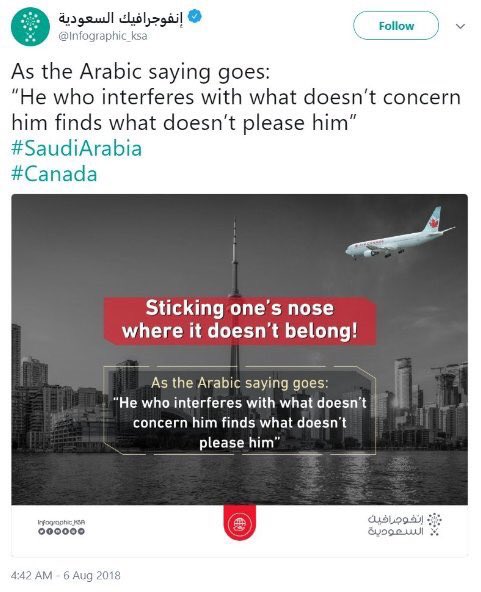
Finally, a Saudi group tweeted the graphic below in what can only be described as a callow and brutal threat to Canada (the Tweet was subsequently removed). Apparently reprehensible rhetoric is not confined to the US.
There is a petition circulating in Israel to change or repeal the new “nation-state” law which declares Israel as the nation-state of the Jewish people alone and elevates the status of Hebrew over Arabic. The petition is supported by minority communities within Israel, notably the Druze and Bedouin peoples, who believe that the law institutionalizes them as second-class citizens. The law is also opposed by Jews in Israel and abroad as well.
“The United States has lived up to the Singapore declaration….It’s just North Korea that has not taken the steps we feel are necessary to denuclearize.”
“The idea that we’re going to relax the sanctions just on North Korea’s say-so, I think, is something that just isn’t under consideration. We’re going to continue to apply maximum pressure to North Korea until they denuclearize, just as we are to Iran. The president feels very strongly about it.”
At midnight tonight the US will reimpose sanctions on Iran. US President Trump abrogated the Joint Comprehensive Plan of Action (JCPOA), otherwise known as the Iran nuclear deal, last May. In so doing, the US violated the agreement since it did not claim that Iran had violated the agreement. Rather, the US claimed that the agreement was flawed because it did not cover Iranian relations with Hamas and Hezbollah, which it regards as terrorist organizations, it did not limit Iranian ballistic missile development, and it did not permanently prevent Iran from developing nuclear weapons. None of these three conditions was ever part of the agreement, and the UN has certified that Iran had complied fully with the specified terms of the agreement.
President Trump’s Executive Order is extensive, covering all the legal aspects of imposing sanctions on a state that has not attacked the US. The Fact Sheet produced by the White House is explicit about the scope of the sanctions which will be imposed in two steps–today and 4 November:
“On August 7, sanctions will be reimposed on:
The purchase or acquisition of United States bank notes by the Government of Iran.
Iran’s trade in gold and other precious metals.
Graphite, aluminum, steel, coal, and software used in industrial processes.
Transactions related to the Iranian rial.
Activities relating to Iran’s issuance of sovereign debt
Iran’s automotive sector.
“The remaining sanctions will be reimposed on November 5, including sanctions on:
Iran’s port operators and energy, shipping, and shipbuilding sectors.
Iran’s petroleum-related transactions.
Transactions by foreign financial institutions with the Central Bank of Iran.
“The Administration will also relist hundreds of individuals, entities, vessels, and aircraft that were previously included on sanctions lists.
ENSURING FULL ENFORCEMENT: President Trump will continue to stand up to the Iranian regime’s aggression, and the United States will fully enforce the reimposed sanctions.
“The Iranian regime has exploited the global financial system to fund its malign activities.
The regime has used this funding to support terrorism, promote ruthless regimes, destabilize the region, and abuse the human rights of its own people.
“The Trump Administration intends to fully enforce the sanctions reimposed against Iran, and those who fail to wind down activities with Iran risk severe consequences.”
It is not clear that these sanctions will be effective. The European Commission has passed a “blocking statute” which exempts European firms from the effects of “extra-territorial legislation” which harms their interests. It published its own Fact Sheet on the new legislation which reads:
How does the Blocking Statute work?
The Blocking Statute applies with regard to the extra-territorial legislation mentioned in its Annex (“listed extra-territorial legislation”).
It forbids EU residents and companies (“operators”) from complying with the listed extra-territorial legislation unless they are exceptionally authorised to do so by the Commission; allows EU operators to recover damages arising from such legislation from the persons or entities causing them; and nullifies the effect in the EU of any foreign court rulings based on it.
EU operators should inform the European Commission – within 30 days since they obtain the information – of any events arising from listed extra-territorial legislation that would affect their economic or financial interests.
Why was the Blocking Statute updated?
The update was triggered by the US’ unilateral decision on 8 May 2018 to re-impose sanctions against Iran (after wind-down periods of 90 and 180 days, i.e. after 6 August 2018 and 4 November 2018) simultaneously with its withdrawal from the Joint Comprehensive Plan of Action (JCPOA) agreed in 2015 between Iran on the one hand, and China, France, Germany, the European Union, Russia, the United Kingdom, and the US, on the other. Some of the re-imposed sanctions have extra-territorial effects and could potentially affect EU operators doing legitimate business with Iran.
How is the Blocking Statute amended?
The EU has amended the annex to the Blocking Statute by adding within its scope the list of extra-territorial US sanctions on Iran that the United States is re-imposing.
The amendment is made through a Commission Delegated Regulation, which was adopted by the Commission on 6 June 2018 and to which neither the Council, nor the European Parliament have objected in the 2 months’ scrutiny period that was foreseen for this purpose. The Delegated Regulation will be published and enter into force on 7 August.
What kind of damages can EU operators ask compensation for?
According to the Blocking Statute, EU operators can recover “any damages, including legal costs, caused by the application of the laws specified in its Annex or by actions based thereon or resulting therefrom”.
From whom can EU operators claim compensation for those damages?
According to the Blocking Statute, EU operators can recover damages, namely from “the natural or legal person or any other entity causing the damages or from any person acting on its behalf or intermediary”.
How can EU operators claim compensation?
The action can be brought before the courts of the Member States and the recovery can take the form of seizure and sale of the assets of the person causing the damage, its representatives or intermediaries. As in any litigation for damages, it will be for the judge to assess the merits of the case, or the causal link.
Additionally, it is not at all clear that European states are sympathetic to US interests, given the trade disputes that have emerged over the last few months. Moreover, it is not at all clear what the Europeans would be cooperating with. The sanctions can be reimposed and they were partially responsible for the JCPOA itself. But what is the objective of new sanctions? What would be the criteria of success? What outcome would bring about the end of sanctions?
It is also highly likely that Russia and China, the other partners to the JCPOA, will go along with reimposed sanctions. Russia is already being sanctioned by the US, and I am not sure that President Trump would be willing to add more sanctions on Russia given his reluctance to impose sanctions for Russian interference with the 2016 elections. Moreover, the US needs Russian cooperation in order to come to a settlement in Syria. China has also indicated that it is not willing to stop buying Iranian oil. According to Bloomberg:
“China — the world’s top crude buyer and Iran’s No. 1 customer — has said previously that it opposed unilateral sanctions and lifted monthly oil imports from the country by 26 percent in July. It accounted for 35 percent the Iranian exports last month, according to ship-tracking data compiled by Bloomberg.”
Turkey and India will also continue to trade with Iran–both are adept at disguising trade deals in order to evade penalties from the US sanctions.
Finally, it is not at all clear that the US has any national interest in stopping the purchases of Iranian oil. Iran currently contributes about 2 million barrels a day to the world energy system. Shutting that flow down, particularly just before the November elections is not in Mr. Trump’s interest, since successful sanctions will undoubtedly raise oil prices in the US.
The U.N. Relief and Works Agency for Palestine Refugees in the Near East (UNRWA) was created in 1949 to address the issue of Palestinian refugees who fled the state of Israel after its creation in 1948. At that time there were about 750,000 refugees. UNRWA considers all the descendants of the original refugees to be refugees as well, and the total number of refugees is now around 5 million. The agency that was created to address a serious humanitarian crisis is now an agency that supports what many regard as a permanent situation. The refugees insist upon a “right of return” and Israel refuses to consider any possibility of the refugees returning. The US has been one of the largest contributors to the UNRWA budget, but it is now reducing money for the Palestinians and recently released documents suggest that it is now official policy of the US to see UNRWA ended. Jared Kushner is the US official responsible for Middle East peace and last January he wrote an email to various US officials, including President Trump’s Middle East peace envoy, Jason Greenblatt. The email read, in part:
“It is important to have an honest and sincere effort to disrupt UNRWA.
“This [agency] perpetuates a status quo, is corrupt, inefficient and doesn’t help peace….
“Our goal can’t be to keep things stable and as they are. … Sometimes you have to strategically risk breaking things in order to get there.”
There is not, however, any indication of a substitute for UNRWA. Some believe that ending UNRWA is exactly the right thing to do. But few have any suggestions for protecting the 5 million people who will be at risk if that happens.
There is a very confused situation in Venezuela right now with two story lines. First, there are reports that there was an assassination attempt against Nicolas Maduro, President of Venezuela. The reports suggest that the attempt used explosives attached to two drones and was unsuccessful. It happened while Maduro was giving a speech in Caracas. The story is that the attempt was made by resistance groups opposed to Maduro and the attempt will likely lead to a serious crackdown on what limited protests are currently allowed in Venezuela. Maduro blamed Colombian President Juan Manuel Santos but offered little evidence at the time for the accusation. The attack indicates how close Venezuela is to collapse.Turkey and Russia offered words of support for Maduro, and US National Security Adviser John Bolton denied that the US was in any way involved in the attack.
The alternative explanation for the events is that there was a gas line explosion while Maduro was giving a speech and that the reported story is simply a false flag designed to legitimate the final crushing of the opposition to Maduro. We will have to wait to see which explanation is correct.
Europe is currently going through a heat wave that threatens to set all time records for high temperatures in a number of places. The hot air is coming from North Africa and Spain and Portugal are the main sufferers of the torrid heat right now. The heat in France is so high that nuclear power plants have been temporarily shut down because the water they release is making the rivers too hot, killing off fish. Most Europeans don’t have air conditioning since such high temperatures are unusual, so the effects of the high heat are serious for vulnerable populations such as the elderly. Many people are interpreting the heat wave as a sign of global warming and that explanation becomes more plausible every day this summer.
A board of experts has submitted a report to the UN Security Council after a six-month review of North Korea’s nuclear program. According to Reuters:
“(North Korea) has not stopped its nuclear and missile programs and continued to defy Security Council resolutions through a massive increase in illicit ship-to-ship transfers of petroleum products, as well as through transfers of coal at sea during 2018.”
The report clearly indicates that the UN sanctions program against North Korea is not being implemented by several nations and that North Korea has found several techniques to evade them. The report was submitted on Friday and the US has not responded to the critique.
Robert Fisk has published a story in The Independent in which he traces the serial numbers of weapons used in the Syrian civil war. Not surprisingly, many of these serial numbers can be traced back to US corporations which sold them to the US or its allies. Weapons sales need to have an End User Certificate (EUC) which certifies that the weapons are being sold only to users who are trusted to use the weapons in a manner consistent with US national security. But many of these weapons have been used by actors in the Syrian civil war who are hostile to US interests. Perhaps they are weapons that were “captured” by enemy forces from friendly allies. But Fisk raises a number of questions which undermine that possibility. Someone is making a lot of money selling American weapons to attack American interests.
Stephen Walt is one of the most rigorous realist thinkers in the field of international relations. In this blog, I have posted many articles raising questions about the wisdom of letting the US-back liberal international order degrade in the absence of a viable alternative. My position has always been that even a bad world order is better than no world order (think of what driving a car would be like without rules of the road and police to enforce those rules). But Walt raises very strong questions about whether it makes sense to maintain the liberal world order and his essay has made me think more seriously about my position.
As the word war between the US and Iran continues, Iran has announced that it will hold its annual naval exercises in the Strait of Hormuz. These exercises are designed to make credible Iranian threats to close the Straits in the event of an attack against Iran. But Business Insider notes that this year’s exercises will be larger–including up to 100 naval vessels, although none that seriously threaten the US Navy)–and earlier in the year than usual. Oil producers who rely on the Strait of Hormuz, such as Kuwait, are getting prepared for a potential blockade of the Strait.
The various conflicts in the Middle East are placing increased attention on one of the reasons why the region is so central to the great powers–its role as a primary supplier of petroleum and natural gas. The region, however, is far from the economic centers that are the primary consumers of those resources. The transportation infrastructure–primarily oil tankers and pipelines–to move the resources from the producers to the consumers is the most vulnerable part of the world energy system. The primary sea routes from the Middle East to Europe, Asia, and North America must pass through two small straits at the end of the Arabian peninsula, the Strait of Hormuz and the Bab el-Mandeb Strait. The Council on Foreign Relations has published a blog post on the strategic significance of those straits. It is incredible that so much of the global economy depends on such a small number of choke points.
Violence erupted in Zimbabwe as protesters filled the streets charging election fraud. Supporters of Nelson Chamisa, who heads the Movement for Democratic Change (MDC), believe that the national election results were manipulated. Official election results have not been posted yet and are not expected until Thursday, but many in the country believe that incumbent President Emmerson Mnangagwa will be the beneficiary of corrupted results. At this point it is impossible to know what the truth actually is, but the protests suggest that the level of popular suspicion in the country about the integrity of the process is very high.
This will be the last blog post that will also be posted on Facebook. Facebook has changed its policy about re-posting and its new terms are not acceptable to me. So if Facebook readers wish to continue reading these posts, they will have to subscribe to the WordPress Site (https://vferraro1971.wordpress.com/)
“Despite several setbacks in U.S.-North Korea relations since the summit, Trump remains satisfied with the results. “You haven’t had a missile fired off in nine months,” he boasted at a press conference with Italy’s prime minister on Monday. “We got our prisoners back. So many things happened. So positive.” Yet even as he brags about his “great meeting” with Kim, reality is setting in. Citing officials familiar with the intelligence, The Washington Postreports that work is advancing on at least one, if not two, liquid-fueled intercontinental missiles at a research facility in Sanumdong, the same factory where the Kim regime produced the first such missile capable of reaching the U.S. Meanwhile, there are also reports that uranium enrichment continues at another North Korean facility, Kangson. During his testimony before the Senate Foreign Relations Committee last week, Secretary of State Mike Pompeo confirmed that the Kim regime continues to produce fissile material, but declined to say whether missile production is ongoing.
President Trump’s announcement that he is willing to meet with Iranian President Rouhani, just 8 days after tweeting a very hostile threat to Iran, suggests that he regards summit meetings as more important than substantive agreements.
Marwan Kabalan, the Director of Policy Analysis at the Arab Centre for Research and Policy Studies in Qatar, has written a very interesting op-ed for Al Jazeera arguing that Putin and Trump may have worked out a deal on Syria at their Helsinki meeting. Essentially, Kabalan argues that the US agreed to bow out of Syria, leaving the Kurds in the lurch, and Russia agreed to contain Iranian influence in Syria in order to protect Israel. The Russians have denied that they intend to kick Iran out of Syria, but according to al-Arabiya: “Last Monday at a Jerusalem meeting between Netanyahu and Russian Foreign Minister Sergei Lavrov, Russia offered to keep Iranian forces 100 kilometers (62 miles) from Syria’s border with the Israeli-occupied Golan Heights, according to an Israeli official.” For their part, the Kurds seem to have decided that their dreams of autonomy within Syria cannot be realized, and have decided to work with the Assad government in Syria. If this scenario works out, the clear winners are Assad, who will emerge as an uncontested leader of Syria, and Russia, who appears to be the dominant force in Middle East politics. The clear loser: the US which will apparently slink out of Syria with virtually no influence in the region. Even its main regional ally, Israel, will now rely on Russia for its protection.
For the first time as an independent nation-state, Zimbabwe held an election without the possibility of Robert Mugabe being elected. Mugabe led an independence movement in the British colony once know as Southern Rhodesia and succeeded after a 15-year war of national independence in 1980. He was overthrown in a coup d’etat in November of 2017, leaving the country much the poorer because of corruption and miserable economic policies. The election held today was between Mugabe’s successor, Emmerson Mnangagwa, and Nelson Chamisa. Turnout for the national election was about 75% and electoral observers have suggested that the election was run smoothly. We should know the results in 5 days.
India has issued a National Register of Citizens (NRC) for the state of Assam and the list does not contain the names of about 4 million residents who are believed to be illegal immigrants from Bangladesh. All the unregistered people are Muslim and those whose names have been omitted do not know what the next steps may be. Human rights activist Suhas Chakma described the situation:
“The National Register of Citizens is the biggest exercise for disenfranchisement in human history. This NRC has few parallels such as expulsion of 300,000 Indian origins persons by General Ne Win of Myanmar in 1960s, expulsion of over 80,000 Indian origin people by Idi Amin of Uganda, the denial of citizenship to over 500,000 Indian origin Tamils by successive governments of Sri Lanka and in the last three decades, the expulsions of the Rohingyas by Myanmar.”
The uncertainty has created a security problem. Assam has invoked tighter security measures after the publication of the list: “Security has been put on high alert, with section 144 of the Criminal Procedure Code imposed in seven of the state’s 33 districts. Under section 144, the assembly of more than four people is prohibited.” The move is consistent with other moves against “foreigners” made by the government of Prime Minister Narendra Modi.
Europe does a better job of addressing income and wealth inequality than the US. The International Monetary Fund (IMF) has evidence that income and wealth inequality cannot be addressed through normal market mechanisms but only through direct fiscal intervention by the state. In all states, however, inequality of both metrics is increasing, not decreasing. In the US, inequality is worse now than in 1928, the year before the economic collapse that brought on the Great Depression.
One of the more important determinants of the stability of a political system is the belief among citizens that the system offers a better life if one plays by the rules. In the US, that belief is often referred to as the “American Dream” but other societies, notably in China, have similar visions. And, generally speaking–with the notable exception of African-Americans–Americans did experience upward mobility: children often did better than their parents. Researchers have found, however, that this phenomenon no longer appears to be true in the US:
“We find that rates of absolute mobility have fallen from approximately 90% for children born in 1940 to 50% for children born in the 1980s. The result that absolute mobility has fallen sharply over the past half century is robust….we find that increasing GDP growth rates alone cannot restore absolute mobility to the rates experienced by children born in the 1940s. In contrast, changing the distribution of growth across income groups to the more equal distribution experienced by the 1940 birth cohort would reverse more than 70% of the decline in mobility. These results imply that reviving the ‘American Dream’ of high rates of absolute mobility would require economic growth that is spread more broadly across the income distribution.”
The last sentence is important because it indicates that simple economic growth will not change this declining mobility. To increase income mobility will require an explicit effort to redistribute income.
The Johns Hopkins Center for Health Security ran a simulation of a pandemic to determine how prepared current institutions are for an outbreak of a serious new virus. The exercise is pretty straightforward:
“The scenario begins with an outbreak of novel parainfluenza virus that is moderately contagious and moderately lethal and for which there are no effective medical countermeasures. The virus is called “parainfluenza clade X.” Outbreaks of disease first appear in Frankfurt, Germany, and Caracas, Venezuela, and are spreading person-to-person. The disease is spread primarily by coughing and causes severe symptoms requiring hospitalization and intensive care in about half of the people infected. Overall, 20% of the severely ill patients die.
“As the narrative continues, the disease spreads within countries and internationally at an accelerating rate, overwhelming medical facilities. Outbreaks overseas start to infect US soldiers. The first US cases occur on a small college campus in New England after the return of a foreign exchange student. As the pandemic becomes increasingly severe, the EXCOMM must deal with a variety of diverse issues that have policy, political, and ethical dimensions.”
One hundred years ago, the world experienced a global pandemic called the Spanish Flu and estimates are that between 1918-19 somewhere between 20 and 40 million people died from the disease. That outbreak is regarded by many as “the most devastating epidemic in recorded world history. More people died of influenza in a single year than in four-years of the Black Death Bubonic Plague from 1347 to 1351.” The Johns Hopkins exercise, therefore, was, in some important aspects, not far-fetched. Indeed, the US Center for Disease Control (CDC) has itself conducted two such simulations, called Dark Winter and Atlantic Storm.
“The Clade-X adversary is a non-state actor called “A Brighter Dawn” (ABD). This fictitious organization was modeled in part on Aum Shinrikyo, the Japanese doomsday cult that developed and used chemical and biological weapons in the 1990s in Japan.”
“Yet by the day’s end, representing 20 months after the start of the outbreak, there were 150 million dead around the globe, and 15 to 20 million deaths in the US alone. With no vaccine for the illness yet ready, that death toll would have been expected to climb.
“‘I think we learned that even very knowledgeable, experienced, devoted senior public officials who have lived through many crises still have trouble dealing with something like this,’ Dr. Eric Toner, a senior scholar at the Johns Hopkins Center for Global Health Security and the designer of the Clade X simulation, told Business Insider. ‘And it’s not because they are not good or smart or dedicated, it’s because we don’t have the systems we need to enable the kind of response we’d want to see.’
“If efforts to develop a vaccine continued to fail, Toner said a disease like this could kill 900 million people, or more than 10% of the world’s population.”
The exercise was broadcast over Facebook and one can view it on YouTube.
The Uighurs are a Muslim minority ethnic group living in northwest China. They are culturally more closely related to Central Asians they they are to the Han Chinese who are the dominant ethnic group in China. In recent years there has been a great deal of unrest among the Uighurs who believe that central control from Beijing threatens their cultural identity. The rise of terrorism has also raised concern within the Beijing government because some Uighurs have been involved with the rise of the Islamic State (ISIS) in Syria and Iraq. As the protests have continued, the Chinese government has placed the Xinjiang Province of China under heavy surveillance, the likes of which have rarely been seen before. Digital technology has made the intense surveillance possible.
We know precious little about the decision-making process in North Korea. The Council on Foreign Relations has published a very good summary of what little we do know and it offers a good insight into what we can expect as the US continues to try to persuade North Korea to denuclearize. The North Koreans have just returned some of the remains of US military personnel who died in the Korean War, fulfilling a promise he made to US President Trump at the SIngapore Summit. But many analysts believe that North Korean has no intention of ever denuclearizing.


 World Politics News