We are all still trying to determine why “populism” seems to be on the rise globally. We do not use the word with precision because the movement we are trying to describe is inchoate. But the word roughly means a popular movement, independent of traditional political institutions such as parties, and which expresses deep economic and political dissatisfaction of a group that considers itself excluded from decision-making. In my own view, the rise of populism in the US and Europe is related to the economic dislocations caused by globalization. But Francis Fukuyama believes that the politics of identity are the more important determinant of the movement. Fukuyama is a prodigious intellect whose work is worthy of careful attention even if one disagrees with his conclusions, as I did in his earlier work, “The End of History”.
Fukuyama gave a speech to the Carnegie Council for Ethics in International Affairs in which he elaborates his views. Fukuyama is blunt and to the point in his explanation for the success of Donald Trump:
“I hate to say this, but I think he’s basically a racist, and he has been perfectly happy to be racially divisive. He really got his start in politics by suggesting that President Obama was not born in the United States. He has been somewhat careful in making overtly racist statements, but I think it’s pretty clear that he’s perfectly happy to capitalize on the racial feelings that other Americans have toward each other, and that has been very bad. You now have an alt-right and a set of white nationalist groups that had been marginalized over the period since the civil rights movement that are now coming back.
“This is not a good situation if both the left and the right see themselves in these increasingly biologized identity categories. My own view is that we need to get back to the 20th century. We have to go back to class because actually sociologically class is the single most important dividing line between Americans right now.”
There is plenty to disagree with in this speech, but it will unquestionably make one think seriously and more deeply about the meaning of populism.
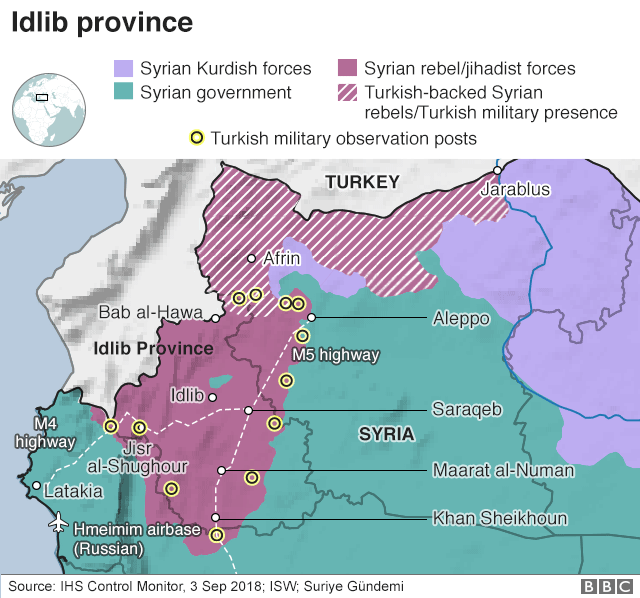
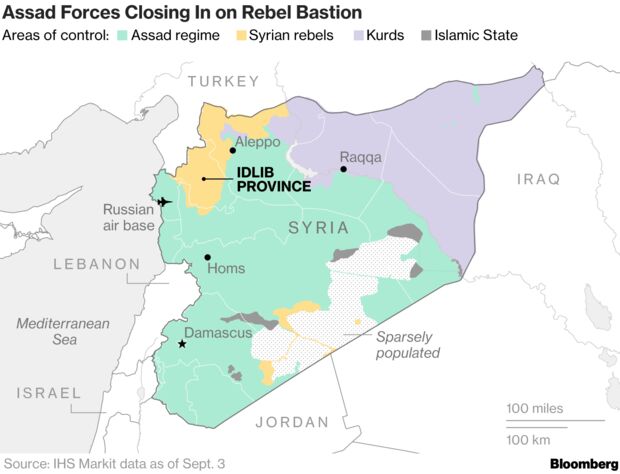
The Turkish press is reporting that Russia and Turkey have come up with a proposal to avoid an assault on rebels in Idlib, Syria. Like most of the agreements about fighting in Syria, one should be careful about how meaningful these agreements actually are. But the two sides have apparently agreed upon a demilitarized zone of 15-20 kilometers around the city. That zone will be policed by Turkish military and Russian military police and heavy weaponry will be withdrawn by 15 October. The rebels will be allowed to move out of the city but there is no agreement about where they would go. It seems clear that Turkey, which supports some of the rebels and is opposed to Syrian President Assad (who is supported by Russia and Iran), is afraid of being overwhelmed by Refugees from Idlib. If the agreement does hold, the world will be spared a humanitarian catastrophe caused by an all-out military assault.
The US-China trade war ratcheted up today as the US announced additional tariffs on Chinese imports. According to Bloomberg:
“The Trump administration will slap a 10 percent tariff on about $200 billion in Chinese goods next week and more than double the rate in 2019, deepening what’s shaping up to be a prolonged trade war between the world’s two biggest economies.
“If Beijing retaliates against U.S. farmers and industry — as it has previously vowed — the U.S. will immediately pursue further tariffs on about $267 billion of Chinese imports, President Donald Trump said in a statement Monday evening, repeating a threat he made earlier this month.”
The Chinese have indicated that they will retaliate with higher tariffs on US imports. But the Chinese do not view the trade war as primarily an economic war. They view it as an attempt by the US to sabotage research and development in China to prevent Chinese technological superiority:
“For the logic behind Trump’s aggressive trade policies is not really about trade, but about trying to break global supply chains and pushing investment back into US industry. Some have argued that the intent is less about more equitable trade than economic disengagement.
“Trump disdains globalism and fails to understand the economic forces driving globalization. Tariffs are raising costs, disrupting supply chains and reducing exports. The 25 percent tariffs on auto exports, for example, are raising costs and reducing exports of US automakers in China as well as US and foreign automakers in the US. Projections say that continued tariff wars will shrink US GDP by 1 percent and China’s by 0.6 percent.”
The Chinese and American divergence on the objectives of the trade disputes makes a reconciliation very difficult: backing down has become impossible for both sides.
It is always difficult to know what news to trust. I have long since accepted the fact that all media outlets have biases and always try to cross reference my information with an array of news articles in order to have a better chance of figuring out what actually happened in the world. But recent court documents in the Paul Manafort prosecution sheds light on a whole different dimension of bias in the media. It appears as if Paul Manafort paid a number of highly reputable public relations firms to portray one of the more prominent politicians in Ukraine as anti-Semitic. According to the Financial Times:
He [Paul Manafort] hired a host of top-tier lobbying and law firms, including Mercury Public Affairs, the Podesta Group, which is now defunct, and Skadden Arps, Slate, Meagher & Flom. Mr Manafort paid half a dozen firms $11m as he promoted Mr Yanukovich by lobbying politicians, seeding articles in newspapers and discrediting his opponents.
This level of misinformation far exceeds normal bias. These firms are among some of the most reputable firms in the world. Behavior of this sort is criminal.
A well-known political activist in Russia, Pyotr Verzilov, was apparently poisoned and lost the ability to see, to talk, and to walk. Verzilov was the publisher of “Mediazona, a Russian online news outlet which focuses on human rights violations inside Russia’s penal system” and was affiliated with the rock group Pussy Zone. Verzilov has both Russian and Canadian citizenship and he was flown to Berlin, Germany for treatment. Poisoning seems to be the preferred way for Russian authorities to eliminate political dissent, probably because it is so difficult to prove.
In the World Politics course we will be discussing the ideology of liberalism extensively. We will spend a great deal of time defining the ideology but The Economist, which is probably the most authentic expression of liberalism in the contemporary world, has published an editorial on the state of liberalism in the world today. Perhaps the most important part of the editorial makes this point:
Liberals have forgotten that their founding idea is civic respect for all. Our centenary editorial, written in 1943 as the war against fascism raged, set this out in two complementary principles. The first is freedom: that it is “not only just and wise but also profitable…to let people do what they want.” The second is the common interest: that “human society…can be an association for the welfare of all.
“Today’s liberal meritocracy sits uncomfortably with that inclusive definition of freedom. The ruling class live in a bubble. They go to the same colleges, marry each other, live in the same streets and work in the same offices. Remote from power, most people are expected to be content with growing material prosperity instead. Yet, amid stagnating productivity and the fiscal austerity that followed the financial crisis of 2008, even this promise has often been broken.”
The most important part of the excerpt is the attention to “the welfare of all”. That aspect of liberalism needs to be retrieved.
It is not at all clear that the US and China are going to engage in an all-out trade war, but the signs right now are not looking good. US President Trump has expressed views that suggest he believes that, in this game of chicken, China will concede first. My personal view is that he does not fully understand the extent to which the current Chinese leadership is committed to restoring China to great power status, an aspiration that makes backing down to the US highly unlikely. Additionally, President Trump seems to underestimate US vulnerability to trade disruptions, particularly in the agricultural sector.
The Hampshire Gazette has published an essay I wrote as a letter to my granddaughter, Emilia. If you wish to see it, you can click here.
Anthony H. Cordesman is one of the more astute analysts of strategic policy. His views tend to be more conservative than mine, but his research is meticulous and his analysis is always clear. He has written a critique of the US war in Afghanistan which has been going on since October 2001. The critique is sobering and raises questions which should have been answered years ago. Specifically, Cordesman questions the recent reports by US military commanders who argue that the US is making good progress in the war:
While it is difficult to fully assess the overall progress under the strategy, this report explores key developments during this quarter. Commanders in Afghanistan stated this quarter that the strategy is working, Afghan forces showed improvement, and the Taliban was largely unsuccessful in seizing district centers. In June, the Afghan government and the Taliban implemented ceasefires. At the time, Afghans and members of the international community expressed hope that the ceasefires would be first steps toward reconciliation.
However, fighting resumed after the ceasefires ended. The Taliban maintained its hold on rural parts of the country and launched attacks on Afghan forces and population centers. During this quarter, civilian deaths reached historically high levels, and violence displaced tens of thousands of Afghans. In addition, despite operational successes against the Islamic State in Iraq and Syria-Khorasan, the terrorist organization continued to recruit and carry out high-profile attacks across Afghanistan that killed hundreds of civilians.
It is doubtful that many Americans pay any attention to what is going on in Afghanistan now which is singularly unfortunate. Many are still dying and there is little evidence to suggest that stability will come to Afghanistan soon.
The Israel-Palestine dispute is unquestionably one of the most complicated and contested disputes in the world today. Getting up to speed on the conflict is very hard, but The New York Times has published a very readable article which outlines the basic history of the dispute. I have no doubts that partisans on both sides of the conflict will quarrel with some of the interpretations of events, but I found the article to be very faithful to my own understanding of what has happened since the Oslo Accords 25 years ago. For those who wish a quick primer on the dispute, I recommend this article. Much more needs to be said on the dispute, but this article is a good place to start.
Some time ago Anne Applebaum published a remarkable essay on political polarization in Europe. I re-read the article today, and was struck again by her perceptiveness and her ability to articulate clearly a very complicated argument. It is a very long and dense article which takes some time to read well, but the essay is well worth the effort. It gives an extraordinary context to what we are witnessing in Hungary, France, Italy, Germany, and Switzerland.
John Cassidy has written an excellent essay on the linkage between economics and politics for the New Yorker. It is a review of a book by Adam Tooze, Crashed: How a Decade of Financial Crises Changed the World, which looks at the financial crisis of 2008-09 and how it led to the populist movements we now see in the US, Europe, and elsewhere. The Great Recession led to austerity policies designed to address the massive debts that were run up prior to the crisis, and those austerity policies led to widespread disaffection with the political systems that allowed the financial excesses to occur. Cassidy quotes parts of the book to make a very simple point:
“Austerity policies, especially in Europe, added another dark twist to the process of political polarization. As a result, Tooze writes, the ‘financial and economic crisis of 2007-2012 morphed between 2013 and 2017 into a comprehensive political and geopolitical crisis of the post–cold war order’—one that helped put Donald Trump in the White House and brought right-wing nationalist parties to positions of power in many parts of Europe. ‘Things could be worse, of course,’ Tooze notes. ‘A ten-year anniversary of 1929 would have been published in 1939. We are not there, at least not yet. But this is undoubtedly a moment more uncomfortable and disconcerting than could have been imagined before the crisis began.’”
The European Parliament has voted to censure Hungary for its violations of European Union norms regarding the treatment of the media, refugees, and minorities. The measure passed 448-197 just barely above the two-thirds majority required. Significantly, many members of Hungarian Prime Minister Viktor Orban’s party broke with him and voted in favor of the measure. The vote is only the beginning of the censure process and several more steps need to be taken, but it seems clear that the European Parliament has decided to take a stand against the growing power of right-wing parties in Europe. Needless to say, Prime Minister Orban rejected the move and claimed that it was a plot against Hungary led by liberals and socialists. Orban said:
“We do have contentious issues and we will have in the future. We have a different picture of the nature of Christianity in Europe, about the role of nations and national culture. We think differently about the essence and purpose of the family and we do endorse radically different views on migration.
“If we mean that we want Europe to be united in diversity then these differences cannot be a reason to brand any other countries and for it to be excluded from joint decisions. We would never go as far as silencing those who do not agree with us.”
Some governments, such as Italy, supported Orban, but we will have to see how the process unfolds.
Human Rights Watch is a highly respected human rights non-governmental organization (NGO) and yesterday it released a report on the treatment of Uigher Muslims in the Xinjiang Province of China. The report is consistent with other reports we have received about the treatment of this minority group. Human Rights Watch describes the situation in Xinjiang:
“In May 2014, China launched its “Strike Hard Campaign against Violent Terrorism” (严厉打击暴力恐怖活动专项行动) in Xinjiang. Since then, the number of people formally arrested has leaped three-fold compared to the previous five-year period, according to official figures and estimates by the nongovernmental organization Chinese Human Rights Defenders. The government has held people in pretrial detention centers (看守所) and prisons (监狱), both of which are formal facilities, and in political education camps, which have no basis under Chinese law. Those detained have been denied due process rights and suffered torture and other ill-treatment.”
There may as many as 1 million Uighers being held in these internment camps being subjected to indoctrination to assure their loyalty to Beijing. US President Trump is reportedly considering imposing sanctions on China for its policies. If the reports are true, sanctions will undoubtedly complicate the current US-Chinese negotiations on North Korea, trade, Iran, and the South China Sea.
United Nations Secretary General António Guterres has given a speech warning that “the world is facing ‘a direct existential threat’ and must rapidly shift from dependence on fossil fuels by 2020 to prevent ‘runaway climate change’”. In the speech Guterres gave several examples of how climate change is already affecting the planet:
“As examples, Guterres pointed to Kerala, India’s worst monsoon flooding in recent history, almost 3,000 deaths from Hurricane Maria in Puerto Rico last year, disappearing Arctic sea ice, some wildfires so big that they send ash around the world, oceans becoming more acidic threatening food chains, and high carbon dioxide levels in the atmosphere threatening food security for billions of people.
“Guterres said scientists have been warning about global warming for decades, but ‘far too many leaders have refused to listen, far too few have acted with the vision the science demands’”.
The speech comes as evidence begins to mount that climate change is also responsible for bigger and wetter hurricanes like Hurricane Florence which is currently bearing down on the US Mid-Atlantic.
Hurricane Florence
Yesterday I posted some thoughts about the National Security Advisor’s comments on the International Criminal Court. Today, the State Department’s spokesperson, Heather Nauert, was asked questions about Bolton’s threat to prosecute those who cooperate with the ICC. The exchange with the press was quite revealing:
QUESTION: When Ambassador Bolton said that countries who would cooperate with the ICC on inquiries on Americans or Israel or other allies, and then today countries like Germany and France said that they will continue to cooperate with the ICC, would that mean that those countries, close allies of the United States, would face consequences for cooperating?
MS NAUERT: I’m not going to get ahead of any decisions or any steps that the United States Government may take. But one of the key principles of this administration – and it’s laid out in our National Security Strategy as well – is sovereignty and that each country has its own sovereign rights, including our own. And encompassed in our own sovereign right is the fact that we have a fair and independent judiciary. We feel that that fair and independent judiciary more than backs up and takes care of any judicial issues that would confront – that would be in front of U.S. citizens and also U.S. service members. Okay.
QUESTION: Would you say that even close allies of the United States that would cooperate with the ICC would face consequences, sanctions, or —
MS NAUERT: Again, you’re asking me to forecast sanctions, and I’ll say —
QUESTION: He did this yesterday.
MS NAUERT: — I think this is the fourth or fifth time – if Ambassador Bolton wants to say that, that’s certainly his right to do so. I don’t speak for Ambassador Bolton, and we’re in obviously very different positions. Very different positions in government.
QUESTION: The impression that you’re leaving, Heather, is that the State Department doesn’t know what Ambassador Bolton’s talking about.
QUESTION: Well, then you should be able to explain it.
QUESTION: Can I —
MS NAUERT: Okay, I don’t need – I don’t need you —
QUESTION: With respect, Heather, you should be —
MS NAUERT: — yelling at me today.
QUESTION: You should be able to explain what exactly his threats and warnings were about and what they’re based in.
MS NAUERT: And I think that’s why I say – and I will say this one last time – we are not going to forecast actions, activities, sanctions, and other steps. And I will leave it at that. Said, go right ahead.
In virtually every country on the planet, economic inequality is getting worse. For some, like the US, the trend has been going on since the 1980s. For others, like Brazil and China, the divergence between rich and poor is more recent, reversing difficult attempts to even out economic disparities. Walter Scheidel of Stanford University has written a book (The Great Leveler: Violence and the History of Inequality from the Stone Age to the Twenty-First Century) on the historic points where economic inequality was reversed. In an interview with the Economist, which summarizes his argument–“throughout history, economic inequality has only been rectified by one of the “Four Horsemen of Leveling”: warfare, revolution, state collapse and plague”–Scheidel expands on his evidence. The Economist quotes from the book:
“There was always one Big Reason behind every known episode of substantial leveling. There was one Big Reason why John D. Rockefeller was an entire order of magnitude richer in real terms than his richest compatriots one and two generations later, why the Britain of Downton Abbey gave way to a society known for universal free healthcare and powerful labor unions, why in industrialized nations around the globe the gap between rich and poor was so much smaller in the third quarter of the twentieth century than it had been at its beginning – and, indeed, why a hundred generations earlier ancient Spartans and Athenians had embraced ideals of equality and sought to put them into practice. There was one Big Reason why by the 1950s the Chinese village of Zhangghuangcun had come to boast a perfectly egalitarian distribution of farmland; one Big Reason why the high and mighty of Lower Egypt 3,000 years ago had to bury their dead with hand-me-downs or in shoddily manufactured coffins, why the remnants of the Roman aristocracy lined up for handouts from the pope and the successors of Maya chiefs subsisted on the same diet as hoi polloi; and one Big Reason why humble farmhands in Byzantine and early Islamic Egypt and carpenters in late medieval England and hired workers in early modern Mexico earned more and ate better than their peers before or after. These Big Reasons were not all the same, but they shared one common root: massive and violent disruptions of the established order. Across recorded history, the periodic compressions of inequality brought about by mass mobilization warfare, transformative revolution, state failure, and pandemics have invariably dwarfed any known instances of equalization by entirely peaceful means.”
The argument is huge and difficult to sustain over the time period Scheidel uses. Nonetheless, I found the book to be engaging and it carried an intuitive ring of truth. As I read it, I kept telling myself that history is not a sure guide to the future, but it certainly does make us think.
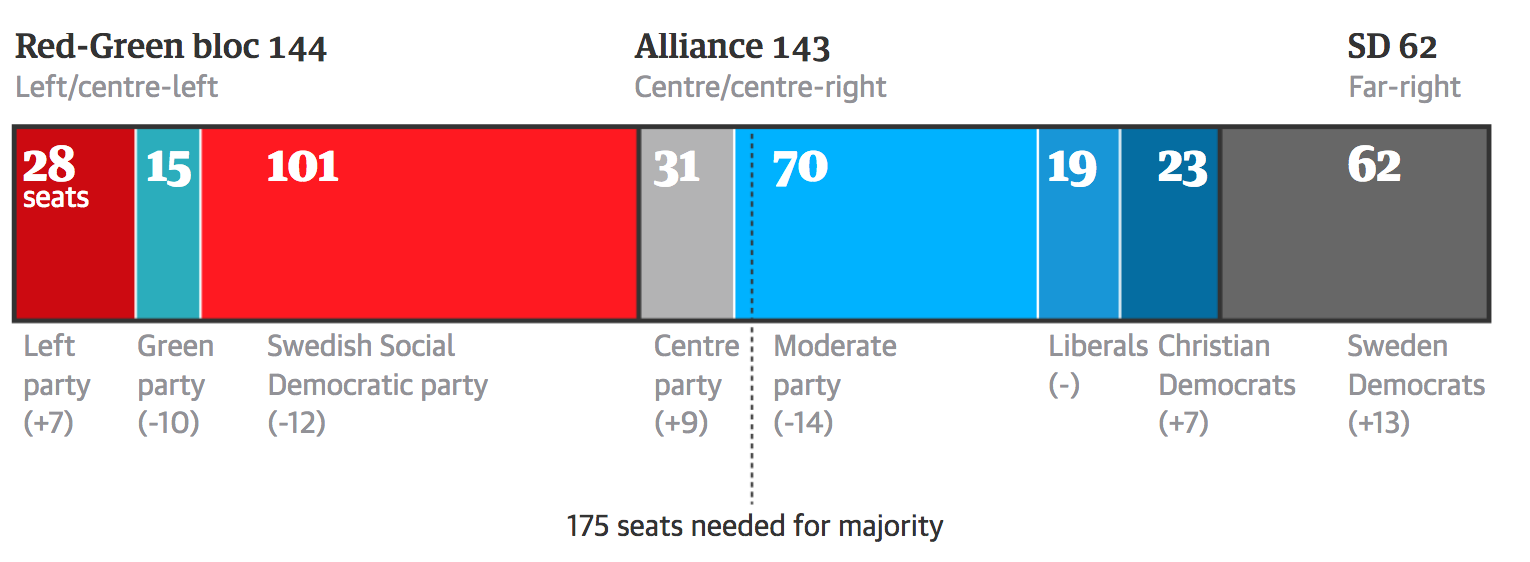
The Sweden Democrats did not do as well as many had feared in the national election. Instead of breaking the 20% barrier, the party only won 17.6%, not a huge percentage but better than the 12.9% it garnered last year. The final composition of the Swedish Government remains unclear as none of the political alliances achieved 50% of the seats. But the business of governance will be significantly more complicated because of the power of the right-wing. Moreover, the results do not really shed light on the cause of the popularity of the right wing parties which we simply label as “populist”. The popularity could be economic stagnation among certain groups or a backlash against immigration and refugees. The analysis of the Swedish election is quite intricate and complicated.
Results of the Swedish Election
National Security Advisor John Bolton gave an address to the Federalist Society in Washington, DC today (the video of the address is below). The speech was entitled “Protecting American Constitutionalism and Sovereignty from International Threats” and it was in response to a request by the International Criminal Court (ICC) to launch an investigation into “alleged war crimes committed by the US military and intelligence officials in Afghanistan, especially over the abuse of detainees.” The ICC was finally created in July 2002 but the US signed the Treaty (The Rome Statute) establishing it in 2000. The US Senate never ratified the Treaty and in July 2002 US President Bush ordered that the US revoke its signature to the Treaty, The US objections to the ICC are well-known and they center over the issue of sovereignty. The US White House issued a statement on the ICC which stated, in part:
If the ICC formally proceeds with opening an investigation, the Trump Administration will consider the following steps:
We will negotiate even more binding, bilateral agreements to prohibit nations from surrendering United States persons to the ICC.
To the extent permitted by United States law, we will ban ICC judges and prosecutors from entering the United States, sanction their funds in the United States financial system, and, prosecute them in the United States criminal system.
We will consider taking steps in the United Nations Security Council to constrain the Court’s sweeping powers, including to ensure that the ICC does not exercise jurisdiction over Americans and the nationals of our allies that have not ratified the Rome Statute.
This Administration will fight back to protect American constitutionalism, our sovereignty, and our citizens. As always, in every decision we make, we will put the interests of the American People first.
The White House position, echoed by Bolton in his speech, goes too far by raising the issue of banning judges and lawyers simply because they work with or for the ICC. Ambassador David Scheffer (retired) critiques the US position:
“John Bolton’s speech today isolates the United States from international criminal justice and severely undermines our leadership in bringing perpetrators of atrocity crimes to justice elsewhere in the world. The double standard set forth in his speech will likely play well with authoritarian regimes, which will resist accountability for atrocity crimes and ignore international efforts to advance the rule of law. This was a speech soaked in fear and Bolton sounded the message, once again, that the United States is intimidated by international law and multilateral organizations. I saw not strength but weakness conveyed today by the Trump Administration.”
The speech and the statement are just additional evidence that the US continues to move away from a rules-based international system, back into the balance of power system of the 19th century.
The New York Times reported on Saturday that US officials met with members of the Venezuelan military and the the discussion was about a possible military coup against Venezuelan President Nicolas Maduro. According to New York Magazine:
“After overcoming skepticism that the Venezuelans were setting them up, the American officials agreed to send a diplomat to meet with the plotters several times in strict “listening mode” between fall 2017 and early 2018. But according to that official, the Venezuelans did not have a real, concrete plan to take down Maduro; instead, they mostly sought advice from the Americans on how to go about it.”
It is indeed fortunate that the US did not act upon the plan, there is probably no way any US support for a coup against Maduro could have served US interests. It is extraordinary that the Trump Administration even tolerated several meetings on such a ridiculous proposition. There is no question that Venezuela is ripe for a change of government and, unfortunately, military coups are not highly unusual in Latin America (though they have become much less frequent than in the past). But any hint of US involvement in a change of government would immediately spark anti-US sentiments.
We do not yet have election results from Sweden, but exit polls suggests that the right-wing Sweden Democrats are polling quite strongly in the national election. The polls suggest that the Sweden Democrats might receive 20 percent of the vote which would give them a very strong voice in the government. Such a result would also be higher than their counterpart in Germany, the Alternative for Germany. The right-wing, populist movements in Europe continue to gain strength. The sentiment continues to be a repudiation of the traditional parties and typical politics, more than an embrace of a right-wing ideology. The Guardian has a revealing quotation from a Swedish voter:
“‘I want to stir up the stew,’ said Fredrik Sigleifs, 23, casting his ballot for the anti-immigration Sweden Democrats in the town art gallery in Sjöbo, just over 30 miles (50km) west of the southern city of Malmö, in a constituency where the populist party won 30% of the vote in the 2014 elections. ‘It’s been the same shit now for as long as you can think.’”
It remains a question whether the left-wing can articulate a similar anti-establishment sentiment.
In a sign of the increased tension between the US and Russia in Syria, the US has conducted live-fire aerial exercises in a remote base in Syria. The US has also sent an additional 100 marines to the military base in Tanf, Syria. Tanf is an important border crossing, but is far from the expected battle in Idlib. It is hard to figure out what this posturing is all about. Russia warned the US last Thursday that it is preparing to attack in the area of Tanf. In addition, Russia has conducted large military exercises in the eastern Mediterranean. I wish I could properly interpret these moves, but it seems dangerous given the current atmosphere in Syria.
Visual Capitalist is a web site that publishes beautiful graphics to demonstrate economic facts. It has published a stunning graphic of the world’s rich (those with wealth above $50 million) which shows where the global economic elite live. The distribution of that elite is not surprising, but the rate of growth of that elite in each area reveals a great deal. Of particular interest is the fact that in two countries, Great Britain and Turkey, the number of the very rich is declining: the effects of Brexit and Erdogan are obvious. Some conclusions are important:
“North America still reigns supreme, but Asia is fast catching up and has already surpassed Europe in this measure of wealth. It’s worth noting that in the one-year span between 2016 (Q4) and 2017 (Q4), the ultra-wealthy population for Asia grew a solid 15%….
“The U.S. holds about 30% of the world’s ultra-wealthy population, while China adds up to nearly 11% when including both Mainland China and Hong Kong in the calculations.
“Switzerland (8.4 million people) punches above its weight class, hitting the #9 spot globally, while Canada takes the #5 spot despite having fewer people (36 million) than the majority of the countries on the list.”
The Trump Administration continues to cut funding for the Palestinian people. It has cut virtually all financial assistance to the Palestinians, including critical funding for the United Nations Relief and Works Agency (UNRWA). This time, the US has cut $25 million earmarked for the East Jerusalem Hospital Network. According to the World Health Organization:
“The six East Jerusalem hospitals have had an historic role in the development of the Palestinian health care system and training of health professionals. They have been the main providers of tertiary referral care for Palestinians in the West Bank and Gaza Strip for health services for which the Ministry of Health is unable to provide, such as cancer care, cardiac and eye surgeries, neonatal intensive care, children’s dialysis and physical rehabilitation of children.”
The cuts are an attempt to pressure the Palestinian Authority to accept the still-unveiled peace plan being formulated by the Trump Administration. On 6 September, President Trump made this comment in response to a question from Alan Dershowitz:
“And the other thing I did, Alan, I will tell you, is I stopped massive amounts of money that we were paying to the Palestinians and the Palestinian leaders. We were — the United States was paying them tremendous amounts of money. And I’d say, you’ll get money, but we’re not paying you until we make a deal. If we don’t make a deal, we’re not paying. And that’s going to have a little impact.”
Political pressure to force a deal is entirely legitimate, but this money was the last part of the money the US has historically given to the Palestinian people. So there are two points to ponder. First, the US no longer has any financial leverage over the Palestinian Authority. When the peace deal is made public, there will no longer be any way to exert financial pressure toward its acceptance. Second, putting pressure on sick people does not put pressure on the political authorities. Indeed, the move smacks of collective punishment on the most vulnerable, and it makes the US seem completely unfeeling.
China is consolidating its control over the South China Sea. China claims the South China Sea to be part of its national territory, using what it calls the “Nine-Dash Line” to outline its sovereignty. The international law of the sea does not recognize the Chinese claims and instead uses the more traditional techniques of measuring the seas from the coastline of the states that abut the sea. The map below shows the difference in the two claims: the Chinese claim is the line in red; the international law basis for territory is outlined in blue. In order to buttress its claim, China has been building up reefs and shoals in the South China Sea and building military installations on those artificial islands (international law does not recognize artificial islands as a basis for sovereignty). Because the Chinese consider the artificial islands to be sovereign territory, it believes that it has a 12-mile buffer from international waters. The US and Great Britain have challenged that belief by sailing their naval vessels within the 12-mile limit asserting their rights to sail through international waters. At some point, push will come to shove in this diplomatic tussle.
There was a summit meeting today of representatives from Turkey, Iran, and Russia over the next steps to address the last rebel stronghold in Syria in the province of Idlib. Turkey has proposed a peace agreement, but Russia and Iran decided to support Syrian President Assad in his efforts to put down the rebellion. The decision likely means a military assault which will mean significant loss of life. An Islamic Relief worker in Idlib published an impassioned op-ed in the Guardian:
“Even as we stare death in the face, however, I fear the international community will once again fail to act and allow one of the worst humanitarian crises in living memory to go unchallenged.
“For seven years we have seen hospitals, markets, schools, mosques, people’s homes, whole cities turned to dust, and people’s bodies and minds broken beyond repair. While we bleed, world leaders respond with meek platitudes and statements of “concern”.
“Where were they when whole families suffocated to death in chemical attacks, when barrages of barrel bombs killed thousands and turned ancient cities to dust? Where are they now that one “de-escalation” zone after another is turned into a bloody battleground?
“This collective inaction and inability to bring the warring parties to the table in any kind of meaningful way will haunt the public conscience for generations to come. Despite growing efforts to sweep this tragedy under the carpet and pretend things are getting back to normal, these atrocities cannot be erased or forgotten.”
Today marked the end of the 60 day comment period for US President Trump’s decision to put tariffs on $200 billion of imports from China. We will have to see if he implements them, but he now has the authority to do so. He also threatened today to put tariffs on another $267 billion of Chinese imports. Reuters quotes Larry Kudlow, one of President Trump’s economic advisers about the purpose of the tariffs:
“Specifically, Kudlow said, the United States was seeking ‘zero tariffs, zero non-tariff barriers, zero subsidies, stop the IP theft, stop the technology transfer, allow Americans to own their own companies.’
“’Those have been our asks for many months and so far those asks have not been satisfied,’ he said. ‘However, hope springs eternal.’”
The tariff war seems to be about economics. It is not. It is primarily about technological innovation and supremacy. Kudlow’s comments clearly indicate US concern about preserving control over intellectual property and its ownership.




 World Politics News