Oxfam, a development charity based in Great Britain, has published a report entitled “Public Good or Private Wealth” which uses data from the Swiss Bank, Credit Suisse, to measure trends in global wealth over time. This year’s report determined that the world’s 26 richest people held as much wealth as the poorest 50% of the global population–3.8 billion. The report finds that “The number of billionaires has doubled since the financial crisis and their fortunes grow by $2.5bn a day, yet the super-rich and corporations are paying lower rates of tax than they have in decades.” The Guardian summarizes some of the findings:
“It said the widening gap was hindering the fight against poverty, adding that a 1% wealth tax would raise an estimated $418bn (£325bn) a year – enough to educate every child not in school and provide healthcare that would prevent 3 million deaths.
“Oxfam said the wealth of more than 2,200 billionaires across the globe had increased by $900bn in 2018 – or $2.5bn a day. The 12% increase in the wealth of the very richest contrasted with a fall of 11% in the wealth of the poorest half of the world’s population.
“As a result, the report concluded, the number of billionaires owning as much wealth as half the world’s population fell from 43 in 2017 to 26 last year. In 2016 the number was 61.”
The trend toward concentration of wealth is unmistakable and will unquestionably lead to political dissatisfaction, such as the “yellow vest” protests in France, and economic slowdowns due to lower levels of consumption.
For the first time, Israel has publicly admitted to an attack on Iranian forces in Syria. Israel made a daylight aerial attack outside of Damascus after a missile was fired toward Israeli positions in the Golan Heights. Israeli attacks against targets in Syria are not unusual–there have probably been more than a hundred in recent years–but the public admission is highly unusual and probably quite provocative to Iran which will now feel obliged to respond in kind. The threat of escalation between Israel and Iran remains quite serious, and there does not seem to be any outside state that is willing to step in and mediate the crisis.
Today is Martin Luther King, Jr. Day in the United States. We are closer to his dream than we were when he delivered this speech but further away from his dream since 2016. We should use this day to redouble our efforts to ensure that his vision of an America in which all are treated equally with the dignity and respect that every human deserves is fully realized.
The “yellow vest” protests have continued in France, raising serious questions about the viability of President Macron’s government. In response to this expression of discontent with the economic situation in France, Macron has initiated what he calls the “grand débat, a series of town hall meetings mediated by mayors in France. Rachel Donadio outlines some of the issues being raised which suggest that the French citizenry is deeply dissatisfied with the status quo:
“As part of the national debate, citizens can register their concerns in cahiers de doléances, or grievance logs, a practice first put into use during the French Revolution. An online forum that polled citizens’ concerns showed a vast range of issues: Some wanted to change unemployment compensation, or increase taxes for the rich and on second homes, or proposed the elimination of bank fees; others were upset that the government had reduced the speed limit to 80 km an hour. For his part, Macron asked his constituents to consider which public services they wouldn’t mind reducing. That’s something of a taboo in France, where citizens of every political persuasion rely on the state for all manner of support—the exact opposite of American-style mistrust of government.”
Apparently there will be a second summit meeting between US President Trump and North Korean leader Kim in Vietnam sometime next month. The reasons for the meeting are not clear to me–there has been little to suggest that the two sides have really bridged any of their disagreements over the meaning of the word “denuclearization”. Additionally, the US is currently embroiled in discussions with South Korea over sharing the costs of the US military presence in South Korea. The US is probably eager to re-establish contact with Kim after Kim’s recent visit to China, fearing that the Chinese will continue to reduce pressure on North Korea. There is a great deal of evidence that, except for its testing program, North Korea has continued to build up its nuclear arsenal since thee first summit meeting. Kim Jong-un has proven to be a very intelligent strategist.
Daniel Dell has written a very insightful book review of three books on “The Many Lives of Liberalism” for the New York Review of Books. Bell’s review examines the history of the idea of liberalism and many of the misconceptions associated with the ideology. Bell addresses one of the great mysteries of 20th century liberalism: its transformation into an ideology emphasizing individual freedom in market capitalism to a degree that diminished its original objective of the idea of freedom serving the public good. Bell writes “All three authors clearly believe that this narrower tradition has concerned itself too heavily with individual rights—above all, economic rights—as opposed to the common good. It has not paid enough attention to moral values and moral education, and it has not done enough to encourage broad democratic participation.” This perspective underpins the dominance of the “neoliberal” perspective that defends slashing any government programs that attempt to alleviate the suffering of the poor. Bell’s explanation for this “narrower” perspective is compelling:
“If this is the true (“lost”) history of liberalism, then where did the idea of liberalism as an individualistic ideology tied to laissez-faire capitalism come from? In a fascinating epilogue, Rosenblatt argues that historians only established this misleading intellectual genealogy very late, in the mid-twentieth century. Critics had long tried to discredit liberalism by associating it with narrow material self-interest, but after World War II liberals themselves, seeking to distinguish their beliefs as sharply as possible from Communist totalitarianism, came close to agreeing with their detractors. Only a strong emphasis on individual rights, argued political philosophers like Isaiah Berlin, could save liberal states from sliding into totalitarian extremism. For the same reason these thinkers downplayed the contributions of French and German liberals, who had shown such a distressing inability to halt extremism in their own countries. Soon, “genealogies based on a canon of great thinkers were constructed and anthologies published. Founding fathers of liberalism were discovered.” And the true, complex history was forgotten.”
The collapse of the Soviet Union and the subsequent rethinking of socialist economics in China and other countries may allow the reassertion of the idea of freedom serving the public good and not narrow self-interest without the fear of compromising democratic ideals. Bell’s review is not easy reading, but it is well worth the effort.
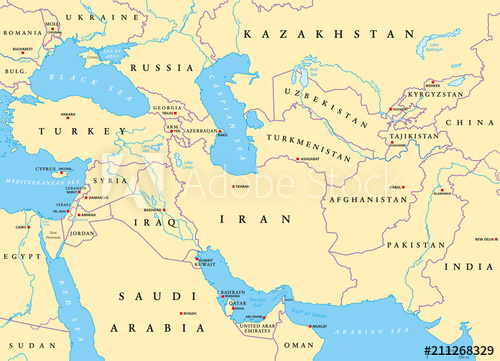
Emil Avdaliani has written an essay on the common foreign policy interests of Russia and Iran that extend beyond their alliance of convenience in Syria. Russian-Iranian cooperation is difficult since the two states once shared a long common border (which changed dramatically after the dissolution of the Soviet Union in 1991) that engendered a great deal of suspicion as well as a history of intrigue and duplicity. But the two states share a desire to shape a world order that rests far less on American power, an outcome that seems to be well within their reach in Syria. It would be premature to think that Russia and Iran will be long-term allies, but their interests seem to mesh well with the objectives of other states in central, south, and east Asia.
Extremists in northern Nigeria have attacked a town populated by thousands of displaced persons and forced them to flee to neighboring Cameroon. The attacks were mounted by a group calling itself the Islamic State West Africa (ISWA), a group that split off from, but is still loosely allied to, Boko Haram, an Islamic group that has pledged loyalty to the Islamic State in Iraq and Syria (ISIS). These extremists have waged an intense guerrilla war in northern Nigeria for many years and the Nigerian government has yet to wrest back control of the territory. The crisis is becoming quite serious because Cameroon is refusing to accept more refugees and is forcing many back into Nigeria.
“My work investigates a period in 1942, referred to as Operation Reinhard, when the Nazis efficiently shuttled about 1.7 million victims—often whole Jewish communities—across the European railway network in train carriages to Treblinka, Belzec and Sobibor. Almost all of those who arrived at these death camps were murdered, usually within hours in the gas chambers. Because the Nazis destroyed nearly all records of the massacre, it is important to try to uncover what actually happened at the time.
My study looks at the “kill rate,” or murders per day. My graph of the kill rate reveals a sudden massive slaughter after Hitler “ordered all action speeded up,” as one SS officer put it, on July 23, 1942. Approximately 1.5 million Jews were murdered in only 100 days, including shootings outside the death camps. On average, 450,000 victims were killed each month during August, September and October of that year. That’s approximately 15,000 murders every day.
These figures describe a single mindedness as well as a ruthlessness that I find difficult to fathom. As anti-semitism continues to rise around the world, often with the approval and encouragement of authoritative leaders, we would do well not to believe that these horrors are a thing of the past.
British Prime Minster Teresa May suffered a resounding defeat as Parliament voted 432-202 to reject her agreement with the European Commission for a Brexit deal. Both those who supported and opposed Brexit opposed the compromise deal and it is likely the Prime Minister will face a vote of no confidence fairly soon. May promised to deliver a “Plan B” soon, but it is highly unlikely that she can forge a coalition to support any compromise. Britain has until 29 March to reach a deal with the European Union, although that date could perhaps be fudged. But the prospect of a “hard” exit (one with no agreement on the terms) has become more likely. That outcome would inflict great economic costs on both Britain and the EU.
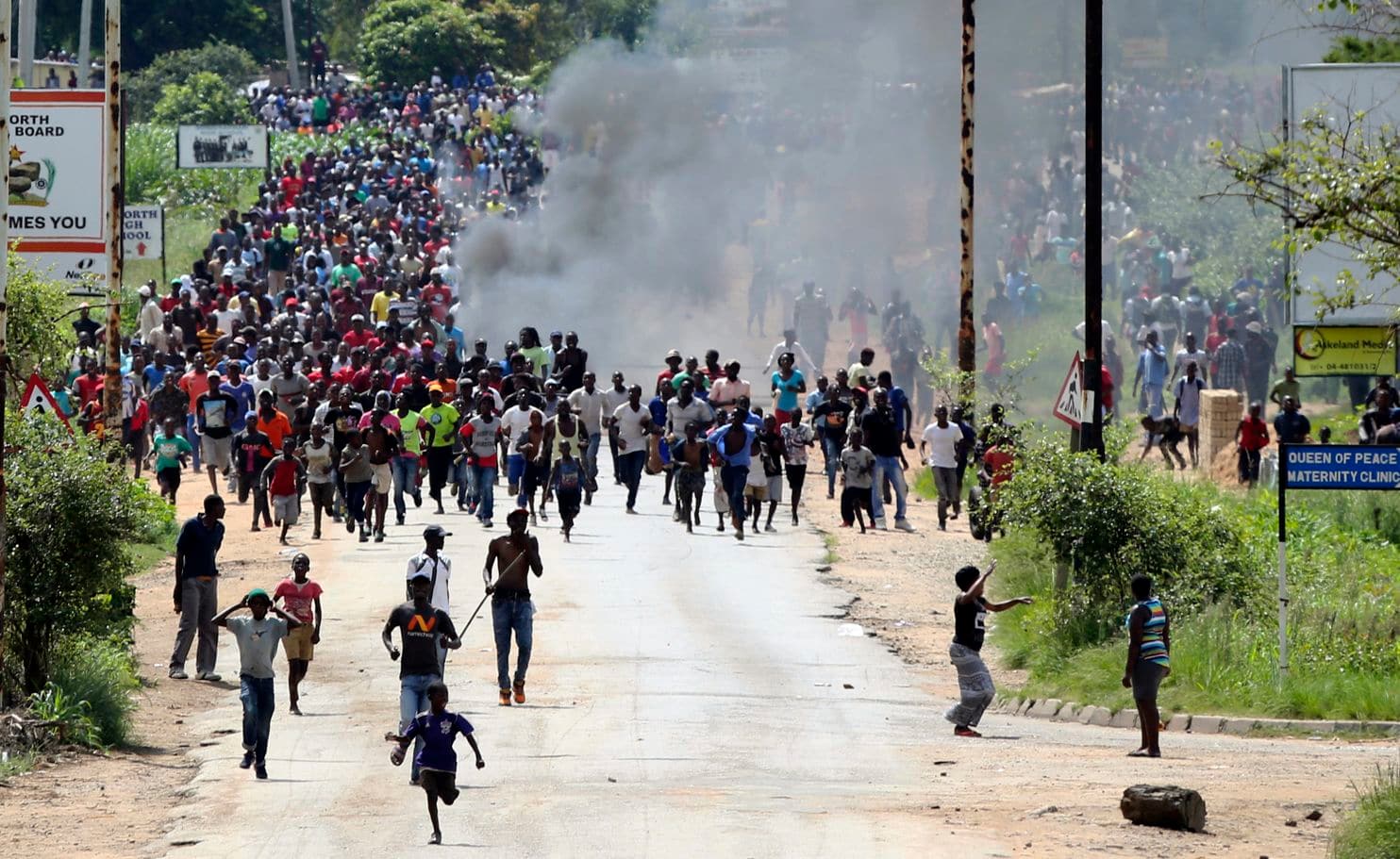
Zimbabwe is suffering through some violent protests as President Emmerson Mnangagwa raised fuel prices to try to stabilize the economy. Zimbabwe now has the most expensive gasoline in the world at $3.31 per liter (that’s about $12 a gallon). Mnangagwa took office only five months ago as the hopelessly corrupt regime of Robert Mugabe collapsed. But it seems clear that the new government has not inspired confidence among the people of Zimbabwe.
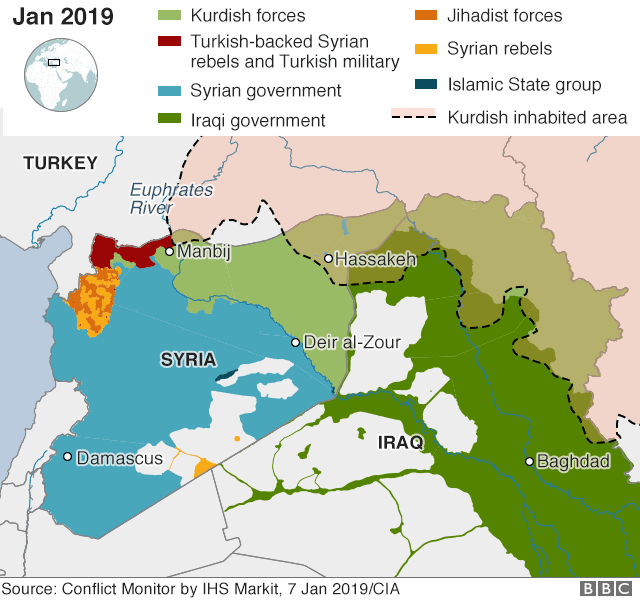
US President Trump threatened to “devastate” the Turkish economy if Turkey takes advantage of the US withdrawal from Syria and attacks the Syrian Kurds. It is not clear why President Trump had to make such a threat given that Turkey is a NATO ally and that normal diplomatic channels are presumably open between the US and Turkey. Turkish Foreign Minister Mevlut Cavusoglu flatly rejected the threat saying “We have repeatedly said that we are never afraid of threats. Threatening Turkey economically will get you nowhere.” Turkey believes that the Kurdish forces are aligned with terrorist forces fighting the Turkish state. According to the Daily Sabah:
“Turkey’s conviction is that the YPG is a militia that works alongside other terrorist organizations created by the PKK. It must also be noted that the PKK is a terrorist group that has been outlawed as early as 1984. Moreover, this same group was placed on the terrorist blacklist by the likes of the the U.S., EU and Turkey.”
US National Security Adviser John Bolton has asked the Pentagon to draw up “far-reaching” plans to attack Iran. The request apparently rattled officials in the Defense and State Departments. According to Newsweek:
“‘It definitely rattled people,’ a former senior U.S. administration official told the newspaper. ‘People were shocked. It was mind-boggling how cavalier they were about hitting Iran.’”
Contingency plans are always being developed but Bolton has a long history of advocating an attack on Iran. In August 2018 the Australian Broadcasting Corporation reported that “senior figures in the Turnbull Government have told the ABC they believe the United States is prepared to bomb Iran’s nuclear capability, perhaps as early as next month.” It is hard to assess this rather dramatic claim. It is true that the rhetoric between the US and Iran has been quite inflammatory since the US pulled out of the nuclear agreement. President Trump’s all-capitalized tweet to Iran in July 2018 was highly unusual:
To Iranian President Rouhani: NEVER, EVER THREATEN THE UNITED STATES AGAIN OR YOU WILL SUFFER CONSEQUENCES THE LIKES OF WHICH FEW THROUGHOUT HISTORY HAVE EVER SUFFERED BEFORE. WE ARE NO LONGER A COUNTRY THAT WILL STAND FOR YOUR DEMENTED WORDS OF VIOLENCE & DEATH. BE CAUTIOUS!
The New York Times and the Washington Post both have very disquieting stories about the relationship between US President Trump and Russian President Putin. The Times article was published on Friday evening and was titled “F.B.I. Opened Inquiry Into Whether Trump Was Secretly Working on Behalf of Russia”. It is very difficult to describe how unusual such a title is and I would consider it unparalleled in the history of US foreign relations. The article describes the concern of the FBI over the firing of former FBI Director James Comey and the two times Mr. Trump explained the dismissal of Comey over concern with the investigation into his relationship with Russia. The article points out that these concerns had been evident prior to the firing of Comey, but that the FBI had refused to investigate those concerns over a fear of appearing partisan during the campaign.
Mr. Trump has vigorously denied the story, but the Times outlines the factual bases for the concerns:
“Mr. Trump had caught the attention of F.B.I. counterintelligence agents when he called on Russia during a campaign news conference in July 2016 to hack into the emails of his opponent, Hillary Clinton. Mr. Trump had refused to criticize Russia on the campaign trail, praising President Vladimir V. Putin. And investigators had watched with alarm as the Republican Party softened its convention platform on the Ukraine crisis in a way that seemed to benefit Russia.
“Other factors fueled the F.B.I.’s concerns, according to the people familiar with the inquiry. Christopher Steele, a former British spy who worked as an F.B.I. informant, had compiled memos in mid-2016 containing unsubstantiated claims that Russian officials tried to obtain influence over Mr. Trump by preparing to blackmail and bribe him.”
The article in the Washington Postis similarly disturbing and it is titled “Trump has concealed details of his face-to-face encounters with Putin from senior officials in administration.” The Post indicates that there are no official records from any of the five face-to-face meetings President Trump has had with President Putin and that, in at least one case, President Trump has confiscated the notes of the meeting taken by the US translator.
“As a result, U.S. officials said there is no detailed record, even in classified files, of Trump’s face-to-face interactions with the Russian leader at five locations over the past two years. Such a gap would be unusual in any presidency, let alone one that Russia sought to install through what U.S. intelligence agencies have described as an unprecedented campaign of election interference.
It is more than unusual to not have any records of discussions between two heads of state. Samantha Vinograd served on Obama’s National Security Council from 2009-2013 and at the Treasury Department under President George W. Bush and is currently an analyst for CNN. She outlines the concerns over Mr. Trump’s behavior:
“Even worse, giving the Russian government sensitive information that US officials do not have — information on what was discussed in meetings between Putin and Trump — also represents a major operational risk. The Russian government likely has more knowledge than our own administration does on key bilateral policy discussions, including Israel, which Trump acknowledged that they discussed.
“It’s also an intelligence win for Putin. Russian officials’ access to this sensitive information represents a potential bribery point the Putin can use against Trump at a later date. Russia can threaten to release parts of presidential conversations if, for example, Trump threatens to do something that they don’t like. In short, by concealing the contents of his meetings, the President is opening the door for Putin to manipulate him and use him as an asset.”
New research suggests that the planet’s oceans are absorbing heat from global warming at a far faster rate than the sparse evidence had suggested. New techniques for measuring ocean temperatures show a much faster rate of warming. According to Scientific American:
“Taken together, the research suggests that the oceans are heating up about 40 percent faster than previously estimated by the IPCC (the Intergovernmental Panel on Climate Change). Since the 1950s, studies generally suggest that the oceans have been absorbing at least 10 times as much energy annually, measured in joules, as humans consume worldwide in a year.”
“Data due for publication next week will show ‘2018 was the warmest year on record for the global ocean, surpassing 2017,’ said lead author Lijing Cheng, of the Institute of Atmospheric Physics at the Chinese Academy of Sciences.
“He told Reuters that records for ocean warming had been broken almost yearly since 2000.
“Overall, temperatures in the ocean down to 2,000 metres rose about 0.1 degree Celsius (0.18F) from 1971-2010, he said. The 2013 U.N. assessment estimated slower rates of heat uptake but did not give a single comparable number. “
The new estimates are four times larger than the ones used in the last IPCC report model.
US Secretary of State Mike Pompeo gave a speech in which he blasted former US President Obama of “abandoning” the Middle East in a speech Obama gave in Cairo on 4 June 2009. President Obama tried to maintain a conciliatory tone to the Muslim world given the suspicions of many Muslims after the US invasion of Iraq in 2003:
“I’ve come here to Cairo to seek a new beginning between the United States and Muslims around the world, one based on mutual interest and mutual respect, and one based upon the truth that America and Islam are not exclusive and need not be in competition. Instead, they overlap, and share common principles — principles of justice and progress; tolerance and the dignity of all human beings.
“I do so recognizing that change cannot happen overnight. I know there’s been a lot of publicity about this speech, but no single speech can eradicate years of mistrust, nor can I answer in the time that I have this afternoon all the complex questions that brought us to this point. But I am convinced that in order to move forward, we must say openly to each other the things we hold in our hearts and that too often are said only behind closed doors. There must be a sustained effort to listen to each other; to learn from each other; to respect one another; and to seek common ground. As the Holy Koran tells us, “Be conscious of God and speak always the truth.” (Applause.) That is what I will try to do today — to speak the truth as best I can, humbled by the task before us, and firm in my belief that the interests we share as human beings are far more powerful than the forces that drive us apart.”
Mr. Pompeo’s speech was entitled “A Force for Good: America Reinvigorated in the Middle East.” Mr. Pompeo did not refer to President Obama by name, but rather indirectly as “another American” who addressed an audience in Cairo. And he castigated Mr Obama in these terms: ” So today, what did we learn from all of this? We learned that when America retreats, chaos often follows. When we neglect our friends, resentment builds. And when we partner with enemies, they advance.” The irony of this statement after President Trump has called for a withdrawal of US troops from Syria and Afghanistan is truly remarkable. As Uri Friedman notes in The Atlantic:
“Or, as Trump might put it: The Wall, The Wall, The Wall, and maybe China, too. ‘I don’t want to be in Syria forever. It’s sand and it’s death,’ Trump stated shortly before Pompeo jetted off to the Middle East, as the president boasted of how he had decimated ISIS and could now let Iran and Russia finish the battle. ‘I want to spend money in our country.’”
US National Security Adviser, John Bolton, said that there is no “timetable” for the withdrawal of US troops from Syria, seemingly contradicting his boss, US President Trump. Bolton insisted that the Syrian Kurds, who fought with the US troops against ISIS, should not be put into “jeopardy” by a US withdrawal. The fear was that Turkey, who regard the Kurds as terrorists, would take advantage of the US withdrawal and attack the US ally. Bolton also noted that ISIS was still a danger, even though President Trump said on 19 December: “Our boys, our young women, our men, they’re all coming back and they’re coming back now. We won”. It is impossible to determine what US strategy in Syria currently is since the pronouncements from Trump and his aides on the matter have been largely inconsistent. Bolton made his comments on a trip to Israel, a close US ally which was rattled by the earlier statements by President Trump. Israel also asked Mr. Bolton to request that the US recognize Israeli sovereignty over the Golan Heights, territory that was occupied by Israel in the 1967 War against Syria.
The internet was blocked today in the Democratic Republic of Congo as the government warned that election results would be delayed. Many in Congo suspect that the move indicates that the election results are being manipulated. There were many candidates for the national election, but most attention was focused on Emmanuel Ramazani Shadary, the hand-picked successor to President Joseph Kabila (who has been in power for many years) and Martin Fayulu. Indeed, last Sunday the Catholic bishops in Congo announced that Mr. Fayulu had won the election after they had conducted their own polling of released results. Official results were suupposed to have been released on Sunday, and there are fears that violence may break out. The US has deployed troops to neighboring Gabon in case US citizens need to be evacuated from Congo.
I will be on vacation for the next two weeks, so posting will be sporadic during that time. But I will be back, I hope refreshed.
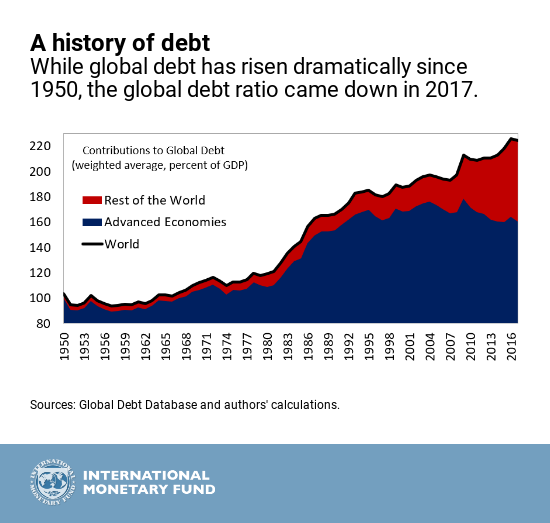
Global debt has always been difficult to measure. Many states do not publish data on the issue since it is embarrassing; some do not because they simply do not know; and many states use different metrics to measure debt. The International Monetary Fund (IMF) has just published its Global Debt Database to address some of these issues. Some of its insights include:
“Global debt has reached an all-time high of $184 trillion in nominal terms, the equivalent of 225 percent of GDP in 2017. On average, the world’s debt now exceeds $86,000 in per capita terms, which is more than 2½ times the average income per-capita.
“The most indebted economies in the world are also the richer ones…. The top three borrowers in the world—the United States, China, and Japan—account for more than half of global debt, exceeding their share of global output.”
“The private sector’s debt has tripled since 1950. This makes it the driving force behind global debt. Another change since the global financial crisis has been the rise in private debt in emerging markets, led by China, overtaking advanced economies. At the other end of the spectrum, private debt has remained very low in low-income developing countries.
“Global public debt, on the other hand, has experienced a reversal of sorts. After a steady decline up to the mid-1970s, public debt has gone up since, with advanced economies at the helm and, of late, followed by emerging and low-income developing countries.”
These rising levels of debt are worrisome since interest rates seem to be rising across the globe, making the debt more expensive to service, and global economic growth seems to be slowing. We will have to keep our eyes on this issue.
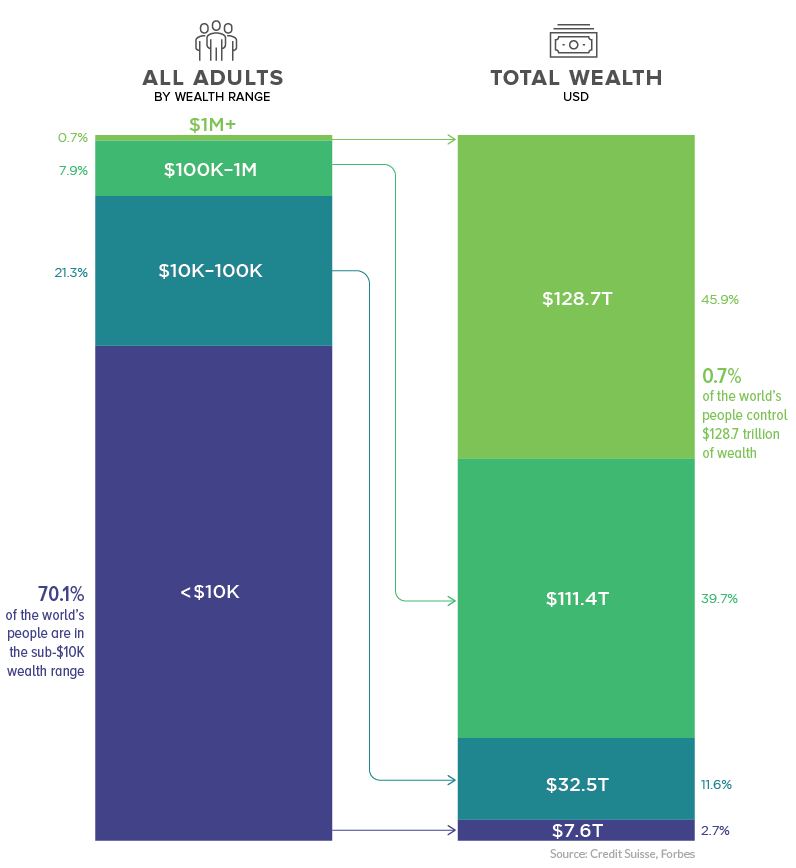
As global debt increases, the distribution of wealth in the world continues to become more concentrated. Visual Capitalist characterizes the situation in these terms: “Today, slightly less than 1% of the world’s adult population occupies the $1M+ wealth range. Despite their small numbers, this elite group collectively controls 46% of the world’s wealth, valued at approximately $129 trillion.” The visual representation of this skewed distribution is striking.
“An alarming projection produced by the House of Commons library suggests that if trends seen since the 2008 financial crash were to continue, then the top 1% will hold 64% of the world’s wealth by 2030. Even taking the financial crash into account, and measuring their assets over a longer period, they would still hold more than half of all wealth.”
Inequality has serious social and political consequences, many of which are separate from the equally urgent issue of poverty. Inequality is more destabilizing to society than poverty and often leads to depressed demand in an expensive economy.
Eric Levitz has written a very good essay for the New Yorker on the dangers of thinking about the United States as an “exceptional” country. The word “exceptional” is used by many in the US to describe a distinctive role for the US in world affairs. It is an interesting term since there are some aspects of the US that do, in fact, make the US different from many other countries: its relative isolation from other countries (the Atlantic and the Pacific are impressive moats) as well as the extraordinary abundance of resources available within the territorial limits of the state (think about how resource-poor countries like Great Britain and Japan are). But the ideological aspects of “exceptionalism” are highly problematic since they are often used to justify both moral and pragmatic superiority. Levitz catalogs a number of ways the term is abused, and one of this insights is quite revealing:
“The exceptionalist narrative is most dangerous for the way it implies that assertions of American power on the world stage should be presumed well-intentioned, until proven otherwise. If the consensus view among liberal elites circa 2003 had been that American foreign policy is typically shaped by the mercenary interests of corporations (not least, arms manufacturers), they would likely have treated George W. Bush’s plans for Iraq with less credulity. Instead, in that instance (and many others), liberals championed a just, humanitarian intervention — only to find, to their shock and awe, that those prosecuting the war did not, in fact, have the purest of hearts. So long as progressive forces do not have a firm grip on the national security state, progressives mustn’t presume that the worst thing that state can do in the face of injustice overseas is nothing.”
US foreign policy in the Trump Administration is a strange combination of the varieties of American exceptionalism. President Trump’s desire to pull troops out of Syria and Afghanistan suggests limits to military power which sit uneasily with his desire to spend significantly greater sums on the military budget.

 World Politics News