The US has announced that it will revoke and not issue any new visas to any agent of the International Criminal Court (ICC) investigating war crimes committed by US and allied forces in Afghanistan. The US is not a signatory to the ICC charter, but the Court has the right to investigate war crimes committed by any state. The Court was asked by prosecutors to investigate charges “into alleged war crimes and crimes against humanity committed by Afghan national security forces, Taliban and Haqqani network fighters, as well as US forces and intelligence officials in Afghanistan since May 2003.” The ICC cannot undertake such investigations unless it can be proven that national authorities did not first investigate incidents according to domestic law. The US has consistently argued that its own national laws are being applied whenever war crimes are suspected. There are some in the international human rights community who believe that the US should allow its behavior to be examined by international tribunals.
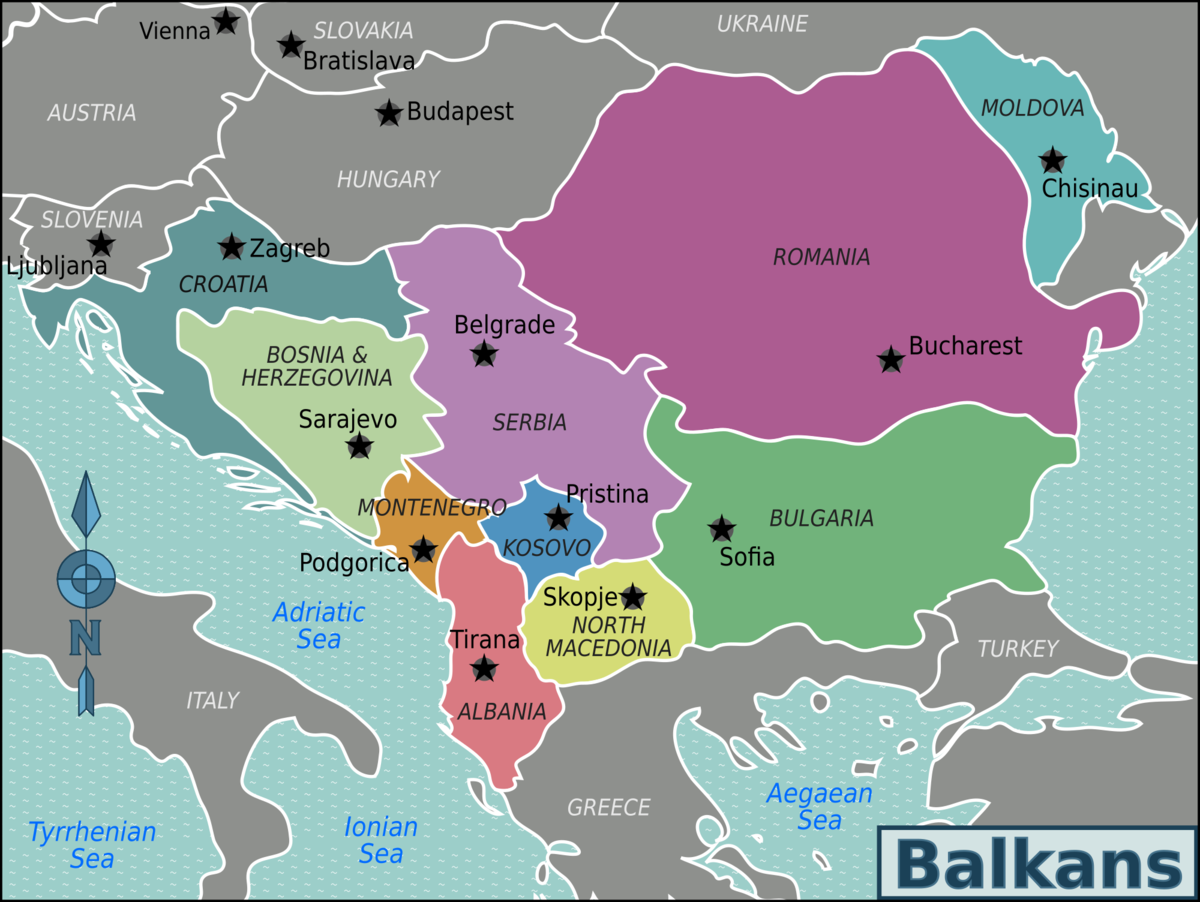
Demonstrations have broken out across the Balkans. Anti-government protesters occupied the offices of the state television, demanding that opposition politicians be allowed to broadcast their platforms in upcoming elections. In Montenegro protesters are dmanding the resignation of the President, Milo Đukanović, because of allegations of corruption. And in Albania, there have been demonstrations demanding the ouster of the Prime Minister, Edi Rama, also because of corruption charges. These protests have been building for several months, and they seem to be organized by civil, not political, groups. These are good signs for democratic values. We shall see how the governments respond.
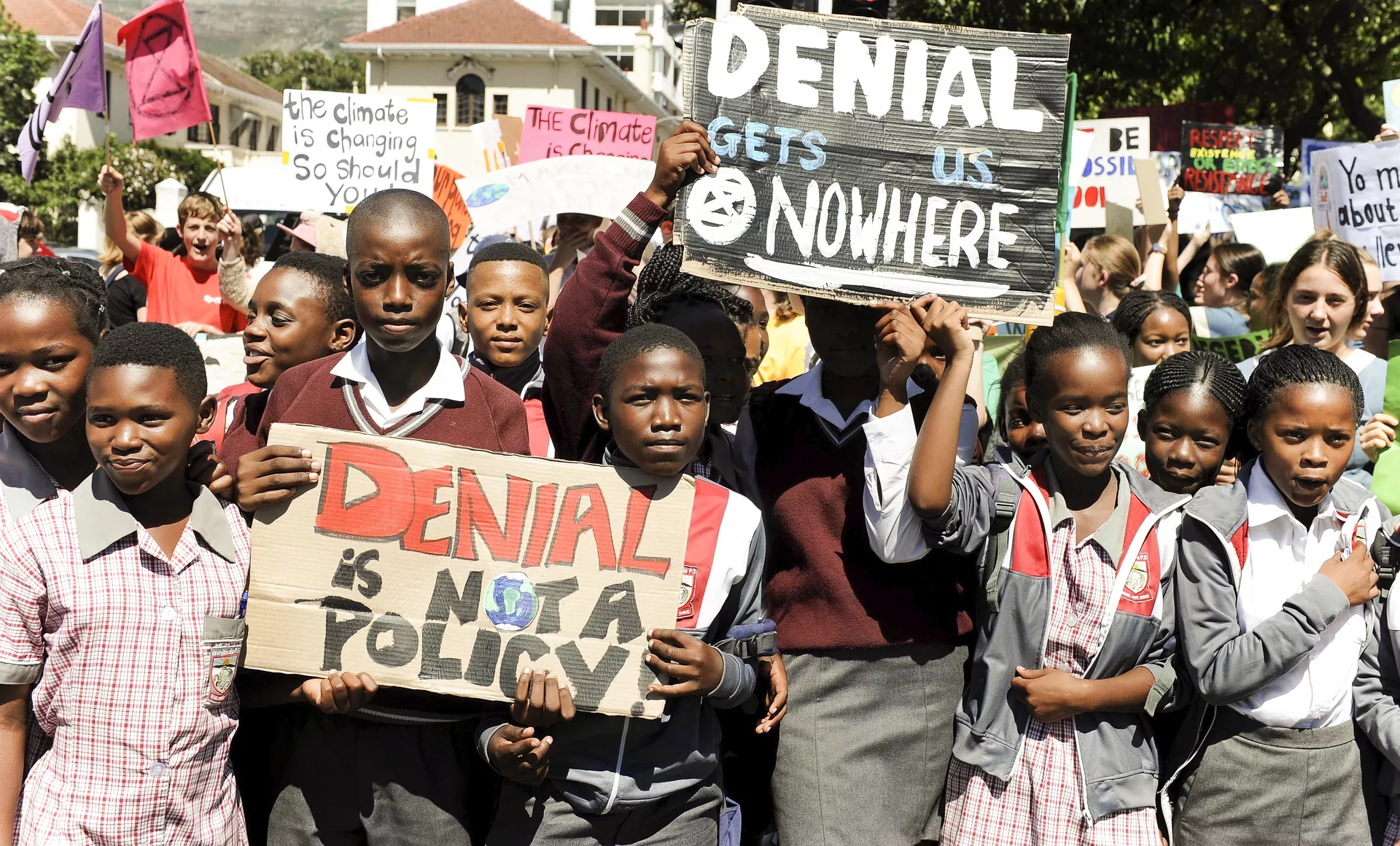
Students all over the world demonstrated in favor of more effective policies to stop climate change. Rolling Stone has photographs from many of these demonstrations which seemed to be largest in European states. The protests follow the example of Greta Thunberg, a 16 year-old Swedish youth, who protested last fall outside the Swedish Parliament for the world’s inaction on this most pressing issue. There were estimates of over a million participants in the class walk-outs. Many of the protests targeted politicians who have refused to acknowledge the seriousness of the problem.
Climate Protest in South Africa
North Korea has signaled that it is losing confidence in the negotiating process with the US and that it may restart its testing program. It is difficult to gauge the seriousness of the threat: it may be real dissatisfaction or merely a bargaining tactic. The North Koreans identified US Secretary of State Pompeo and National Security Adviser Bolton as obstacles to an agreement. The charge is likely accurate as both men have been adamantly opposed to any agreement with North Korea in the past. It is not clear what the US response would be if North Korea restarts its testing program, but there is little reason to believe that the two sides have made much progress in the two summit meetings.
For the 18th straight weekend, protesters wearing yellow vests demonstrated in the streets of Paris. The protesters ransacked upscale shops and banks as the protests have taken a decidedly populist turn. The protests are not as large as they were when they began last November, but dedicated protesters have rebuffed President Macron’s request for dialogues. There were many arrests, but the authorities seem to be helpless in addressing the anger of the protesters.
“Humans do not yearn only for freedom. They also seek security — not only physical security against attack but also the security that comes from family, tribe, race and culture. Often, people welcome a strong, charismatic leader who can provide that kind of protection.
“Liberalism has no particular answer to these needs. Though liberal nations have at times produced strong, charismatic leaders, liberalism’s main purpose was never to provide the kind of security that people find in tribe or family. It has been concerned with the security of the individual and with treating all individuals equally regardless of where they come from, what gods they worship, or who their parents are. And, to some extent, this has come at the expense of the traditional bonds that family, ethnicity and religion provide.
“To exalt the rights of the individual is to weaken the authority of the church and other authorities that presume to tell individuals what they must believe and how they must behave. It weakens the traditional hierarchies of birth and class, and even those of family and gender. Liberalism, therefore, cannot help but threaten ‘traditional values’ and cultures. Those are maintained either by the power of traditional authorities or by the pressures of the community and majority opinion. But in a liberal state, the rights of the few, once recognized, supersede the preferences of the many.
“In Europe and the United States, this has meant the breakdown of white, Christian cultural ascendancy as liberalism has progressively recognized the rights of people of color; of Jews and Muslims; of gays and others with sexual orientations frowned upon, if not forbidden, by the major religions; and, more recently, of refugees and migrants. Liberalism is a trade-off, and many have often been unhappy at what was lost and unappreciative of what was gained.”
The tension between the need for freedom and the need for security is not easily resolved in a liberal democracy, particularly when the economic situation is difficult. When the pie shrinks, people often look to scapegoats to explain their desperation.
Unfortunately, many of the pressures on liberal democracy stem from a sense of insecurity that can be stimulated by a fear of the “other”. We had a brutal manifestation of that fear today in New Zealand as a white supremacist killed 49 people praying in a mosque. I find our inability to treat this ideology as a serious threat incomprehensible. Far more people in the US have been killed by white supremacists than by Islamist-inspired extremists. US President Trump was asked by the threat today and The Washington Post reported his response:
“President Trump said Friday he does not believe white nationalism is a rising global danger after a gunman who espoused that ideology massacred 49 Muslims in New Zealand.
“When asked at the White House whether white nationalists were a growing threat around the world, Trump replied: ‘I don’t really. I think it’s a small group of people that have very, very serious problems. It’s certainly a terrible thing.’”
The British Parliament has voted 413 to 202 to request a delay from the European Union on a agreement for Great Britain’s exit from the Union. Having voted yesterday no to have a “no-deal”Brexit, there was really no alternative. But more than half of the Conservative Members of Parliament voted against the government’s motion–a clear sign of discontent with Prime Minister May. The Parliament also voted against holding a second referendum on Brexit. The request for a delay must be unanimously approved by all 27 member states of the Union, something which is likely but not at all assured. European Council President Donald Tusk has signaled that he would prefer an extended delay, but it is not at all clear that there is any basis for believing that the British will do better than they have over the last two years.
The United Nations Environment Programme has published a very good overview of the threats facing the Arctic environment entitled “Global Linkages: A graphic look at the changing Arctic”. The report has graphics which are informative and easy to understand. The conclusion, however, is sobering; “Unless humanity makes very rapid and deep pollution cuts, Arctic winter temperatures will rise 5.4° to 9.0°F (3° to 5°C) by 2050 — and will reach an astounding 9° to 16°F (5° to 8.8°C) by 2080”. Even if the temperature targets of the Paris Accords are met, it seems as if the rise in Arctic temperatures is already locked in. The report contains useful information about pollution in the Arctic–such as the extent to which mercury has invaded the Arctic environment–which is not easily accessible.
The US Senate voted 54-46 to withdraw US support for the Saudi-led military campaign in Yemen. The resolution will likely pass easily in the House of Representatives but will probably be vetoed by President Trump, and the veto will not be overridden. But the vote is quite a rebuke to President Trump and his alliance with Saudi Arabia. The vote reflects resentment over the way the Saudis have handled the murder of Jamal Khashoggi and the brutal ways the war in Yemen has been conducted. According to Business Insider:
“The UN estimates that between the start of the conflict in March 2015 and August 2018 there were roughly 17,062 civilian casualties, 6,592 dead and 10,470 injured. The majority of those casualties, approximately 10,471, were a consequence of airstrikes conducted by the Saudi-led coalition the US supports.”
Unfortunately, the vote will probably do little to alter Saudi conduct in Yemen. It will also do little to change the US policy toward Saudi Arabia which increasingly appears to be based on personal, not strategic, relationships.
The British Parliament voted today to reject the possibility of an exit from the European Union without a formal agreement. The motion was passed by 321 votes to 278, a clear and stable majority. Great Britain is supposed to leave the Union on 29 March and it is extremely unlikely that any agreement with the Union could be reached by then. That situation means that the next step for Great Britain is to ask for an extension beyond 29 March. It is not clear that the Union will easily agree to an extension: after two years of fruitless discussion and debate, the Union can legitimately ask whether more time will make any difference at all. The vote on an extension is scheduled for Thursday, but the larger issue is whether Theresa May can hang on as Prime Minister. The likelihood of a British government strong enough to navigate Brexit seems remote and the EU can legitimately ask whether there will be anyone with whom to negotiate.
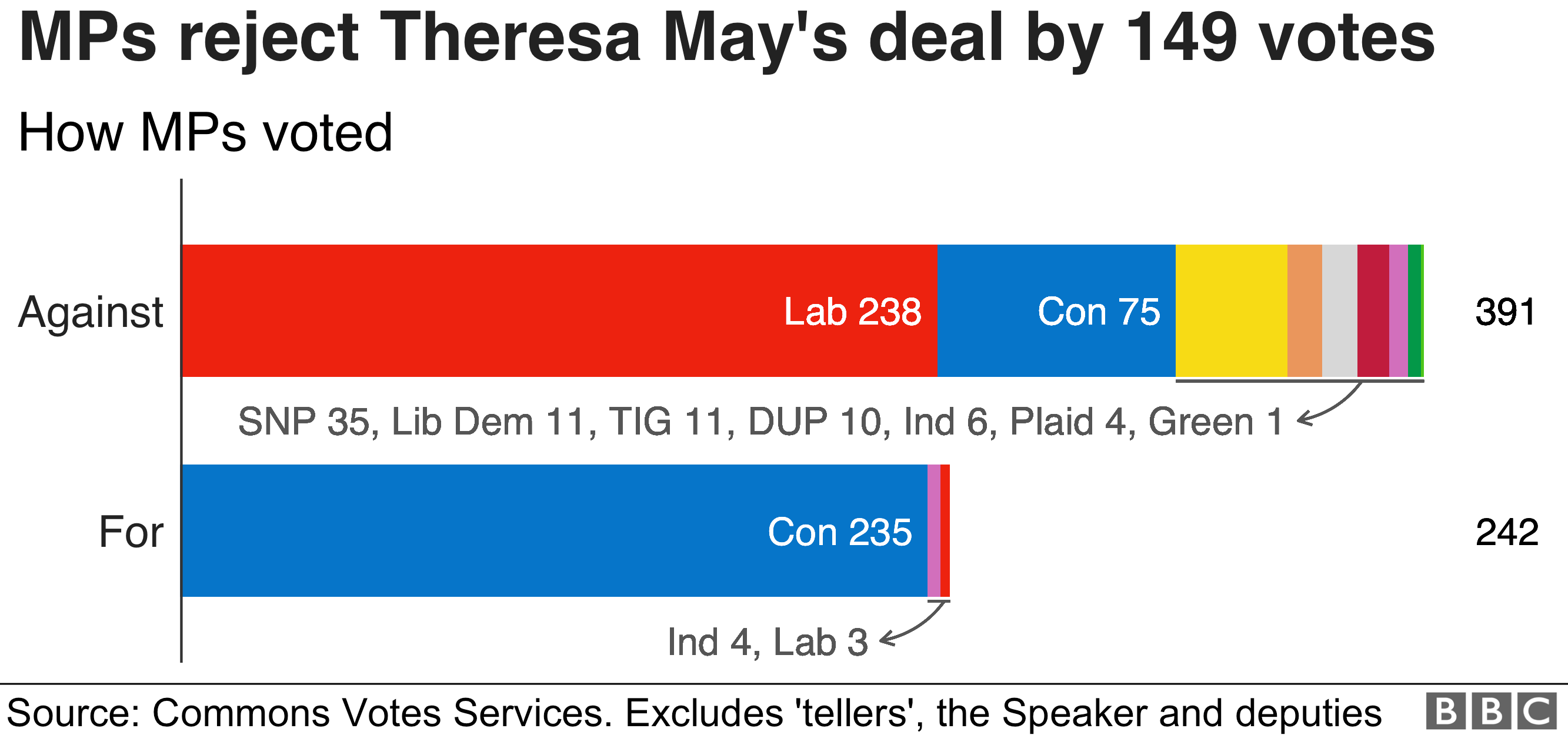
For the second time, the British Parliament has rejected Prime Minister May’s agreement with the European Union for the British withdrawal from the Union. The vote was overwhelmingly against, although by a smaller margin than the earlier defeat. Significantly, the Democratic Unionist Party, the Irish party that allows May to retain a majority, voted against the proposal perhaps signaling the end of May’s ability to lead. The BBC describes how Prime Minister May outlined the next step:
“In a statement after the defeat, Mrs May said: “I continue to believe that by far the best outcome is the UK leaves the European Union in an orderly fashion with a deal.
“‘And that the deal we have negotiated is the best and indeed only deal available.'”
“Setting out the next steps, she said MPs will vote on Wednesday on whether the UK should leave the EU without a deal or not.
“If they vote against a no-deal Brexit, they will vote the following day on whether Article 50 – the legal mechanism taking the UK out of the EU on 29 March – should be extended.
“Mrs May said MPs would have to decide whether they want to delay Brexit, hold another referendum, or whether they ‘want to leave with a deal but not this deal’.
“She said that the choices facing the UK were ‘unenviable’, but because of the rejection of her deal, ‘they are choices that must be faced'”.
The press reports of the defeat were uniformly pessimistic as the deadline for a decision is 29 March. It is unclear the Prime Minister May can survive two resounding defeats in Parliament, but there do not seem to be any alternatives waiting in the wings. The Labor Party has not distinguished itself with helpful contributions to the policy debate. The European Union has been more supportive than I would have predicted, but it seems clear that the Union is in no position to offer a more generous deal. Great Britain has not proven to be a reliable negotiating partner and the Union really cannot make additional concessions without the certainty of a deal.
Caitlin Talmadge has written an essay for the Brookings Institution on the question of whether nuclear weapons have prevented India and Pakistan from escalating their conflict over Kashmir. The world has had nuclear powers since 1949 (the US and the Soviet Union) and there are now nine nuclear powers. None of the nuclear powers has gone to an open conflict even though the ideological divides among them are similar to those in the past which have spawned brutal wars. She describes the underlying logic that supports deterrence:
“The traditional school of thought is that once two countries establish secure nuclear arsenals that can withstand attack and still hit back, they enter a state of mutually assured destruction, or MAD. Even the loser in a war can devastate the other’s civilians, making military victory and relative military power all but meaningless.
“The result, according to this logic, is that nuclear-armed adversaries will behave quite differently from countries without nuclear weapons. Afraid of nuclear escalation, such rivals will avoid arms races, stay out of wars, deescalate crises, refrain from threatening one another’s core interests, and generally maintain the status quo. “
India and Pakistan fought three wars before both developed nuclear weapons (in 1947, 1965, and 1971) but they also fought a brief war in Kargil in Indian controlled Kashmir in 1999. The logic of deterrence does not rule out war–it only suggests that war may not yield preferred results. Bur preferences are ambiguous and rationality is not always guaranteed.
William Burns served in the US State Department in many US Administrations and has a deep understanding of US-Russia relations both before and after the dissolution of the Soviet Union. He has written an essay for The Atlanticthat outlines the many missteps that US Administrations made in not understanding how the collapse of the Soviet Union affected the Russian worldview. The perspective is important because some Americans tend to blame Russia for the current nasty state of relations. Burns summarizes that perspective:
“Who lost Russia? It’s an old argument, and it misses the point. Russia was never ours to lose. Russians lost trust and confidence in themselves after the Cold War, and only they could remake their state and their economy. In the 1990s, the country was in the midst of three simultaneous historical transformations: the collapse of Communism and the transition to a market economy and democracy; the collapse of the Soviet bloc and the security it had provided to historically insecure Russia; and the collapse of the Soviet Union itself, and with it an empire built over several centuries. None of that could be resolved in a single generation, let alone a few years. And none of it could be fixed by outsiders; greater American involvement would not have been tolerated.
“The sense of loss and indignity that came with defeat in the Cold War was unavoidable, no matter how many times we and the Russians had told each other that the outcome had no losers, only winners. From that humiliation, and from the disorder of Yeltsin’s Russia, grew the deep distrust and smoldering aggressiveness of Putin’s.”
There is no way the US and Russia can repair their relations unless the US appreciates the sense of loss that Russians feel. I highly recommend this essay to those who wish to understand Russian foreign policy.
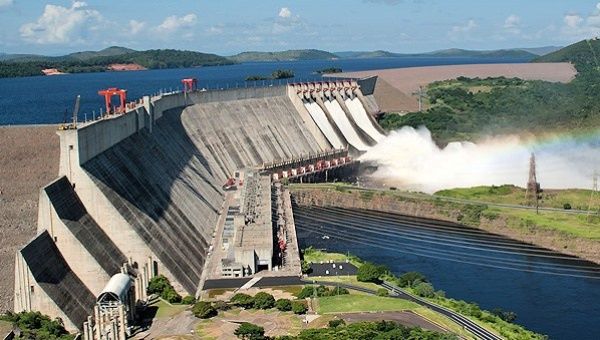
Venezuela has entered the fourth day of a nation-wide electrical blackout and food is rotting, water is scarce, hospitals cannot keep their patients alive, and gasoline is only sporadically available. It is hard to imagine what the situation is given our dependence upon reliable electricity. The blackout stems from failures at the Guri hydroelectric power plant which President Maduro blames on sabotage and his critics blame on governmental incompetence. If the blackout does stem from a cyberattack on the electrical system, it would represent an unprecedented escalation in warfare and unquestionably a crime against humanity. It would also break an incredibly important taboo which the most developed countries in the world would regret.
Guri Hydroelectric Plant
Israel is holding national elections on 9 April and the campaigning is fierce. Prime Minister Benjamin Netanyahu is facing a significant challenge. He has served as Prime Minister 4 times and has held that position since 2009 as head of the right-wing Likud Party. This time, however, is is facing possible indictment on corruption charges and a robust challenge from a centrist political party led by Benny Gantz, a former military chief of staff, and Yair Lapid, an ex-finance minister. In media exchanges with a prominent Israeli actress, Rotem Sela, Netanyahu made some rather extraordinary comments. According to The Jerusalem Post:
“The prime minister was responding to an Instagram post from Sela, a prolific and popular TV host and star of The Baker and the Beauty. Sela took to Instagram Saturday night to criticize Culture Minister Miri Regev and a journalist who interviewed her that evening.
“’Miri Regev is sitting and explaining to [Channel 12 news anchor) Rina Matsliah that the public needs to beware, because if Benny Gantz is elected he will have to create a government with the Arabs,’ Sela wrote on Instagram, alongside a photo of the culture minister. ‘Rina Matsliah is silent. And I ask myself: why doesn’t Rina ask her in shock: ‘And what’s the problem with the Arabs???’ Dear God, there are also Arab citizens in this country.’
“Sela continued and asked: ‘When will anyone in this government tell the public that this is a country of all its citizens, and all people are born equal.’ The actress said that ‘the Arabs are also human beings. And also the Druze, and the gays, and the lesbians and… gasp… leftists.’”
Netanyahu’s response is difficult to interpret within a traditional understanding of democracy.
“‘First of all,’ Netanyahu wrote in a Facebook message Sunday morning addressed to actress Rotem Sela, ‘an important correction: Israel is not a country of all its citizens. According to the Nation-State Law that we passed, Israel is the nation-state of the Jewish nation – and its alone. As you wrote, there is no problem with Arab citizens – they have equal rights like everybody and the Likud government has invested in the Arab sector more than any other government…..’
“After telling Sela that Israel is the nation-state of the Jewish people alone, Netanyahu then launched into his campaign motto: ‘It’s either a strong right-wing government led by me, or a weak left-wing government led by Yair Lapid and [Benny] Gantz, with the support of the Arab parties.’”
US President Trump has long complained about the cost of stationing troops abroad and has apparently come up with a plan to get US allies to pay more for US troops. Bloomberg describes the proposed plan:
“Under White House direction, the administration is drawing up demands that Germany, Japan and eventually any other country hosting U.S. troops pay the full price of American soldiers deployed on their soil — plus 50 percent or more for the privilege of hosting them, according to a dozen administration officials and people briefed on the matter.
“In some cases, nations hosting American forces could be asked to pay five to six times as much as they do now under the ‘Cost Plus 50’ formula.”
It is hard to determine how serious this proposal actually is. A member of Trump’s National Security Council articulated the logic of the idea:
“‘Getting allies to increase their investment in our collective defense and ensure fairer burden-sharing has been a long-standing U.S. goal,’ said National Security Council spokesman Garrett Marquis. ‘The administration has prioritized this issue: for example the president has pushed NATO allies to meet the Alliance’s 2 percent of GDP on defense spending guideline, which is resulting in a total of $100 billion in new defense spending. The administration is committed to getting the best deal for the American people elsewhere too, but will not comment on any ongoing deliberations regarding specific ideas.’”
The proposal sounds an awful like a protection racket, oblivious to the national interests served by stationing troops abroad. One needs to be sensitive to the geographic location of the US–it is very far away from the most economically dynamic areas in the world. It is also hard to imagine American soldiers being comfortable in the role of mercenaries. Niccolò Machiavelli rendered the most appropriate judgment on the value of mercenaries:
“Mercenaries and auxiliaries are useless and dangerous; and if one holds his state based on these arms, he will stand neither firm nor safe; for they are disunited, ambitious and without discipline, unfaithful, valiant before friends, cowardly before enemies; they have neither the fear of God nor fidelity to men, and destruction is deferred only so long as the attack is; for in peace one is robbed by them, and in war by the enemy. The fact is, they have no other attraction or reason for keeping the field than a trifle of stipend, which is not sufficient to make them willing to die for you. They are ready enough to be your soldiers whilst you do not make war, but if war comes they take themselves off or run from the foe; which I should have little trouble to prove, for the ruin of Italy has been caused by nothing else than by resting all her hopes for many years on mercenaries, and although they formerly made some display and appeared valiant amongst themselves, yet when the foreigners came they showed what they were.”
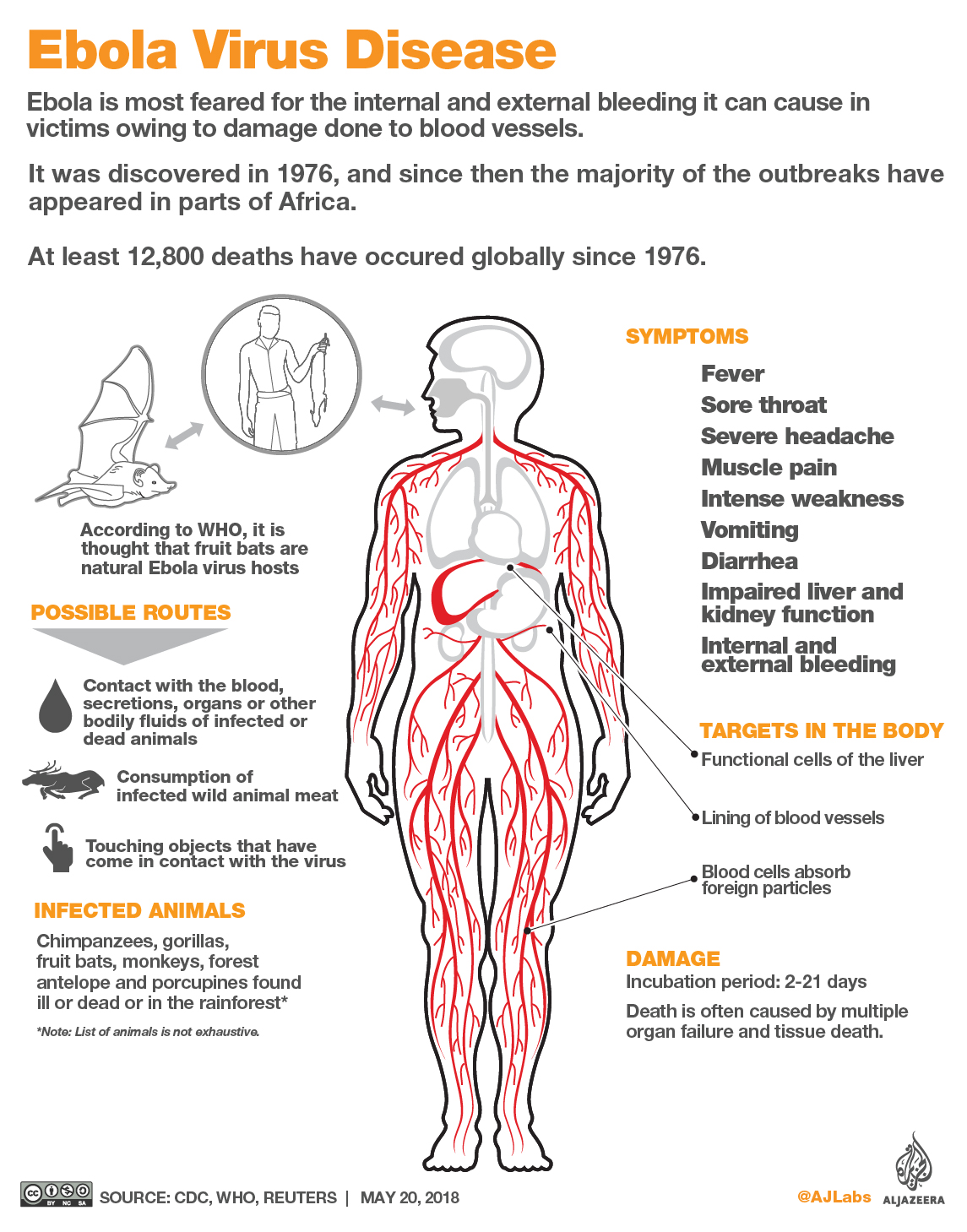
“Just as worrisome, epidemiologists say, are recent data from the World Health Organization (WHO) that suggest the virus is spreading undetected. During the last three weeks of February, 43% of the people who died from Ebola in Katwa and Butembo were found dead in their communities — not isolated in hospitals in the late stages of the illness, when the disease is most infectious. And three-quarters of those diagnosed with Ebola had not previously been identified as contacts of people who had contracted the virus.
“Taken together, the statistics suggest that the virus is spreading outside known chains of transmission, making it harder to contain and driving up the mortality rate compared to previous outbreaks. The current death rate of about 60% is higher than it was during the much larger 2014–16 Ebola crisis in West Africa, despite improvements since then in how people with Ebola are cared for, including the introduction of several experimental drugs.”
“The first ban refers to “blatant disrespect” of the state, its officials and Russian society, and repeat offenders face up to 15 days in jail.
“The second bill prohibits sharing “false information of public interest, shared under the guise of fake news,” the TASS state news agency reported.
“Both new crimes carry heavy fines.”
The bills complement the recent efforts of the Russian state to create a Russian internet that would require all web traffic to be routed through points controlled by the Russian state. The moves indicate that Russia is becoming a state where all information will be controlled and monitored.
 World Politics News