Archive for the ‘World Politics’ Category
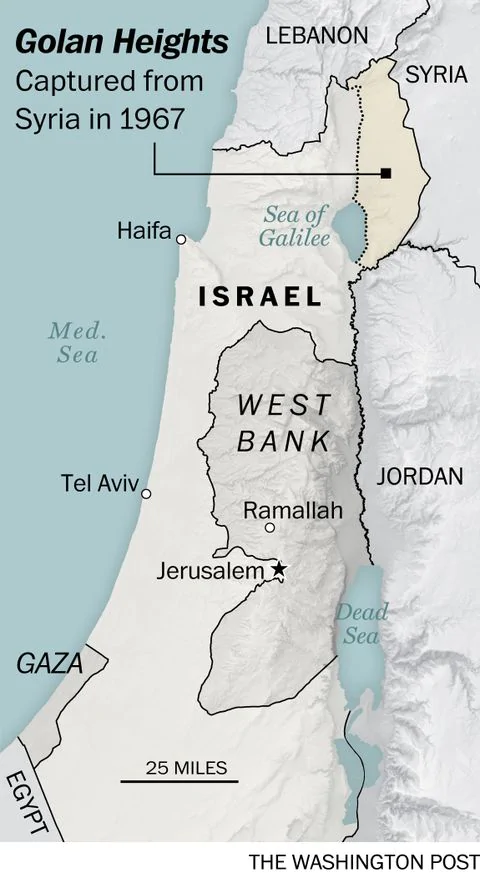
The Trump Administration has recognized Israeli control over the Golan Heights, territory Israel seized from Syria in the 1967 war. The formal recognition came via a Tweet from President Trump (it is hard for me to accept that such consequential decisions are communicated to the world through such informal channels): ““After 52 years it is time for the United States to fully recognize Israel’s Sovereignty over the Golan Heights, which is of critical strategic and security importance to the State of Israel and Regional Stability!” The Golan Heights was one of three territories seized by Israel in 1967: the West Bank from Jordan and the Gaza Strip from Egypt are the other two. The status of the three territories was decided by the UN Security Council on 22 November 1967 in Resolution 242:
“The Security Council,
Expressing its continuing concern with the grave situation in the Middle East,
Emphasizing the inadmissibility of the acquisition of territory by war and the need to work for a just and lasting peace in which every State in the area can live in security,
Emphasizing further that all Member States in their acceptance of the Charter of the United Nations have undertaken a commitment to act in accordance with Article 2 of the Charter,
1. Affirms that the fulfilment of Charter principles requires the establishment of a just and lasting peace in the Middle East which should include the application of both the following principles:
(i) Withdrawal of Israel armed forces from territories occupied in the recent conflict;
(ii) Termination of all claims or states of belligerency and respect for and acknowledgment of the sovereignty, territorial integrity and political independence of every State in the area and their right to live in peace within secure and recognized boundaries free from threats or acts of force;
2. Affirms further the necessity
(a) For guaranteeing freedom of navigation through international waterways in the area;
(b) For achieving a just settlement of the refugee problem;
(c) For guaranteeing the territorial inviolability and political independence of every State in the area, through measures including the establishment of demilitarized zones;
3. Requests the Secretary-General to designate a Special Representative to proceed to the Middle East to establish and maintain contacts with the States concerned in order to promote agreement and assist efforts to achieve a peaceful and accepted settlement in accordance with the provisions and principles in this resolution;
4. Requests the Secretary-General to report to the Security Council on the progress of the efforts of the Special Representative as soon as possible.
Since 1967, most of the world has interpreted 1 (1) [“Withdrawal of Israel armed forces from territories occupied in the recent conflict”] as meaning that the three territories were “Occupied Territories” in the meaning of the 4th Geneva Convention, Article 47:
” ART. 47. — Protected persons who are in occupied territory shall not be deprived, in any case or in any manner whatsoever, of the benefits of the present Convention by any change introduced, as the result of the occupation of a territory, into the institutions or government of the said territory, nor by any agreement concluded between the authorities of the occupied territories and the Occupying Power, nor by any annexation by the latter of the whole or part of the occupied territory.
Israel has never accepted the responsibilities as defined by the Geneva Convention and it now appears that the US does not accept Article 47 either, even though it is a signatory to the convention.
The United Nations made its position on the Occupied Territories even more explicit in 1981. Alex Ward describes the attitude toward territorial acquisition by conquest:
“UN Security Council Resolution 497, adopted in December 1981, which notes that ‘the acquisition of territory by force is inadmissible’ and, more to the point, ‘the Israeli decision to impose its laws, jurisdiction, and administration in the occupied Syrian Golan Heights is null and void.’”
The US decision will undoubtedly help Israeli Prime Minister Netanyahu in his bid for another term in the election scheduled for 9 April. But the decision diminishes the possibility of a peace agreement between Israel and the Palestinians. This decision is yet another one that makes peace in the Middle East less likely.
The Secretary-General of the Arab League Ahmed Aboul Gheit issued a statement that the League continues to support Syrian sovereignty over the Golan Heights. We will have to wait to see what the reactions of Syria, Russia, and Iran are to the US decision. From the Syrian perspective, the annexation is a sufficient justification for war.
The question is whether this decision emboldens parts of the Israeli citizenry that wishes to fully annex the West Bank as well. The US already moved its Embassy to Jerusalem, recognizing Israeli control over the entire city. And US Secretary of State Pompeo visited the Western Wall (the Kotel) accompanied by Israeli Prime Minister Netanyahu. Up to this point, US diplomats had approached the wall alone in order to avoid implicitly recognizing Israeli sovereignty over the wall. It appears as if the US is fully prepared to sanction Israeli sovereignty over the West Bank as well.
Golan Heights
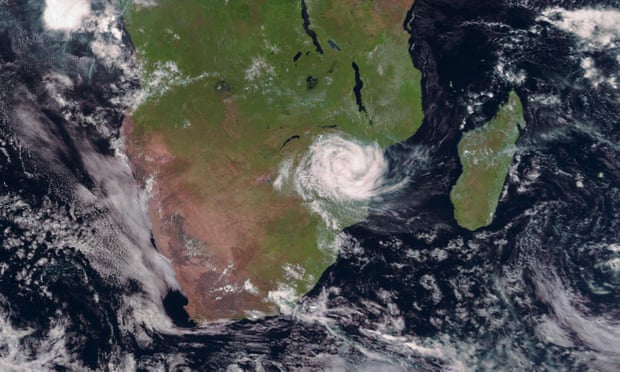
Mozambique suffered serious destruction from Cyclone Idai last Thursday, and we are just now beginning to appreciate the extent to which the country has been affected. The coastal city of Beira was almost totally destroyed by the cyclone and hundreds of thousands of people have been left homeless. The damage also extended into Malawi and Zimbabwe. The damage to social infrastructure will likely increase:
“Paul Spiegel, director of the Center for Humanitarian Health at Johns Hopkins Bloomberg School of Public Health, says he expects to see an increase in cases of dysentery and cholera, since clean water, soap, and functioning latrines are scarce. Especially for children under five, diarrhea can quickly turn life-threatening. Rain is still falling; the damp conditions are associated with a higher risk of contracting pneumonia and other respiratory diseases, which can then spread easily in crowded shelters, he says. At the same time, people who suffer from non-communicable diseases like epilepsy and diabetes may lose access to their medication, he says.
There is no way to tell at this time whether the destructiveness of Idai was associated with climate change, but many experts believe that further analysis will suggest a strong link.
Destruction in Beira, Mozambique
Satellite Image of Cyclone Idai
Philip H. Gordon of the Council on Foreign Relations has written an essay criticizing US President Trump’s moves toward the Palestinian Authority. The moves include moving the US Embassy to Jerusalem, cut off financial support for the Palestinian Authority, cutting off humanitarian aid to Palestinian hospitals, cutting off aid to the refugee program, UNRWA, and closing the Palestinian office in Washington, DC. Gordon describes current US policy in these terms:
“According to the Trump administration, these moves are designed to make clear to Palestinians that they need to accept new realities and agree to the U.S. peace plan. As the president’s top advisor on the issue, Jared Kushner, explains, ‘All we’re doing is dealing with things as we see them and not being scared out of doing the right thing. I think, as a result, you have a much higher chance of actually achieving a real peace.’ Kushner has also said that he believes the Palestinian leadership is refusing talks with the United States about the peace plan because ‘they are scared we will release our peace plan and that the Palestinian people will actually like it,’ apparently assuming that the Palestinian people are more ready for compromise with Israel than their leadership. Trump has himself been even blunter about using U.S. humanitarian aid as leverage, telling the Palestinians publicly that ‘we’re not paying until you make a deal. If you don’t make a deal we’re not paying.
Gordon then makes the case that this tougher line is likely to be ineffective and even counterproductive.
“Instead of compelling Palestinians to accept a deal, however, the new measures are having the opposite effect. With the end of U.S. assistance and with U.S. alignment with Israeli positions on crucial political issues, Palestinian leaders have cut off political contact with Trump officials. Two-thirds of Palestinians now oppose the resumption of contact with U.S. negotiators and 88 percent view the United States as biased toward Israel. The clearest product of the administration’s approach has not been Palestinians bowing to U.S. demands but seeking—and to a degree gaining—support for greater international recognition of Palestinian statehood and for diplomatic and economic pressure on Israel.”
Gordon then outlines some policies that he believes would be more conducive to a lasting peace between Israel and the Palestinians. The essay is worth a close read.
The speaker of Britain’s House of Commons, John Bercow, threw a monkey wrench into Prime Minister May’s plan for a third vote on her agreement with the European Union on the terms of Britain’s exit from the Union. Bercow ruled that the agreement, which has been defeated twice in the Parliament, cannot be resubmitted unless it is “substantially” changed. It is high;ly unlikely that May could secure substantial revisions before the deadline date of 29 March. The options for May now seem to be: 1) terminate the current Parliament and call for a new Parliament, in which case the EU agreement would be new business; 2) accept the deadline and endure a “no-deal” Brexit; 3) try to pass an deadline extension without any clear sense of when another agreement can be forged, an outcome that would give the 27 members of the EU heartburn. Stay tuned.
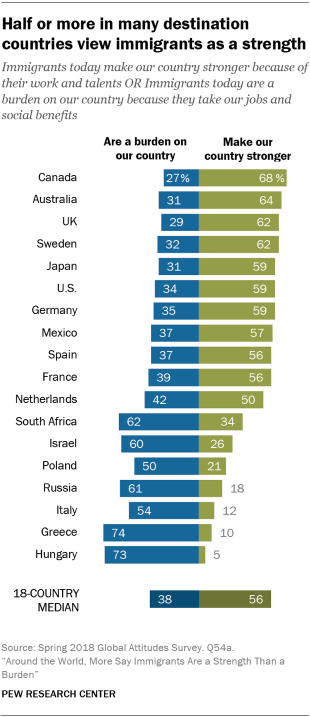
The Pew Research Center has conducted a survey in the 18 countries which are the top destinations for migrants to determine sentiments toward immigration. In the majority of cases, most citizens view migrants favorably, believing that immigration strengthens the country. According to the report:
“In 10 of the countries surveyed, majorities view immigrants as a strength rather than a burden. Among them are some of the largest migrant receiving countries in the world: the United States, Germany, the United Kingdom, France, Canada and Australia (each hosting more than 7 million immigrants in 2017).
By contrast, majorities in five countries surveyed – Hungary, Greece, South Africa, Russia and Israel – see immigrants as a burden to their countries. With the exception of Russia, these countries each have fewer than 5 million immigrants.
Meanwhile, public opinion on the impact of immigrants is divided in the Netherlands. In Italy and Poland, more say immigrants are a burden, while substantial shares in these countries do not lean one way or the other (31% and 20% respectively).
The US admits about 18% of the world’s migrants, followed by Germany and Russia, each with 5% of the world’s migrants.
The US has announced that it will revoke and not issue any new visas to any agent of the International Criminal Court (ICC) investigating war crimes committed by US and allied forces in Afghanistan. The US is not a signatory to the ICC charter, but the Court has the right to investigate war crimes committed by any state. The Court was asked by prosecutors to investigate charges “into alleged war crimes and crimes against humanity committed by Afghan national security forces, Taliban and Haqqani network fighters, as well as US forces and intelligence officials in Afghanistan since May 2003.” The ICC cannot undertake such investigations unless it can be proven that national authorities did not first investigate incidents according to domestic law. The US has consistently argued that its own national laws are being applied whenever war crimes are suspected. There are some in the international human rights community who believe that the US should allow its behavior to be examined by international tribunals.
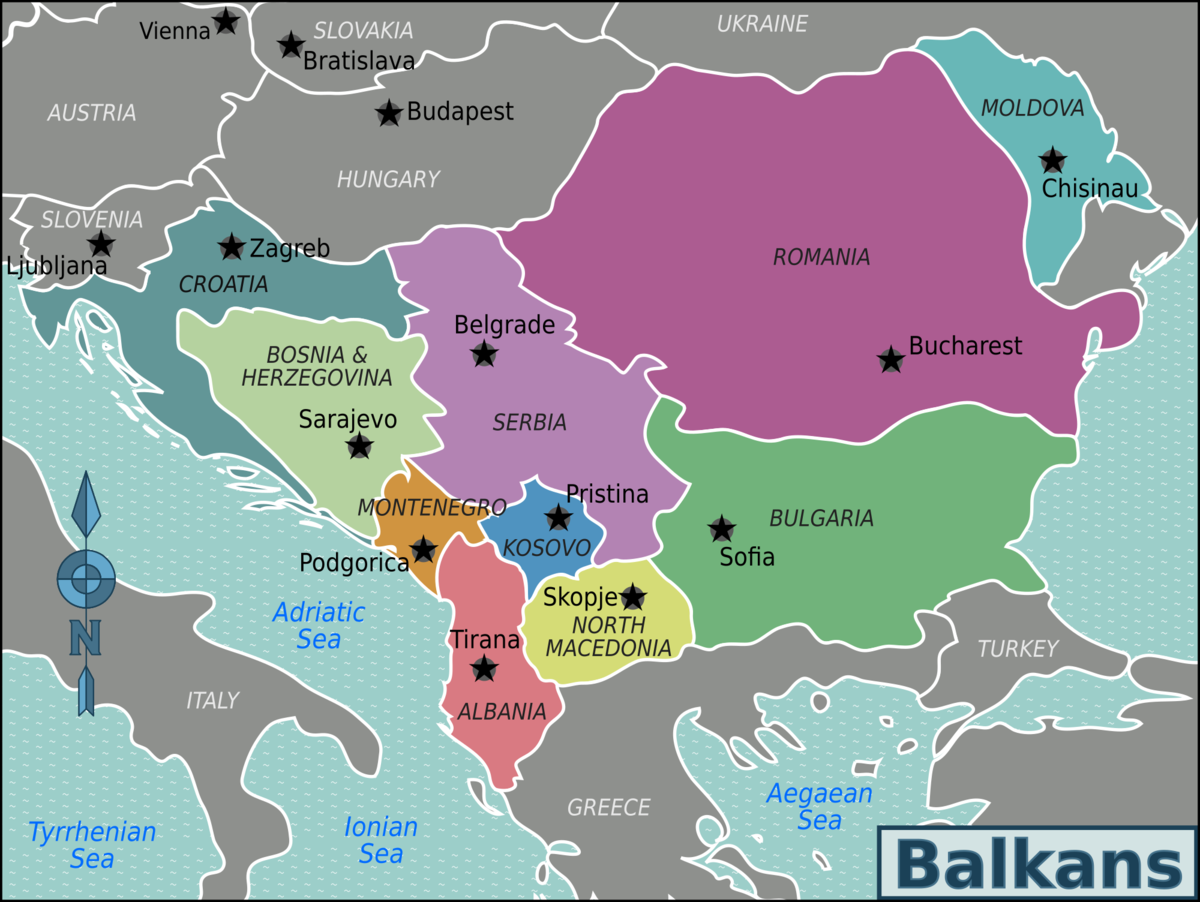
Demonstrations have broken out across the Balkans. Anti-government protesters occupied the offices of the state television, demanding that opposition politicians be allowed to broadcast their platforms in upcoming elections. In Montenegro protesters are dmanding the resignation of the President, Milo Đukanović, because of allegations of corruption. And in Albania, there have been demonstrations demanding the ouster of the
Prime Minister, Edi Rama, also because of corruption charges. These protests have been building for several months, and they seem to be organized by civil, not political, groups. These are good signs for democratic values. We shall see how the governments respond.
The Balkans
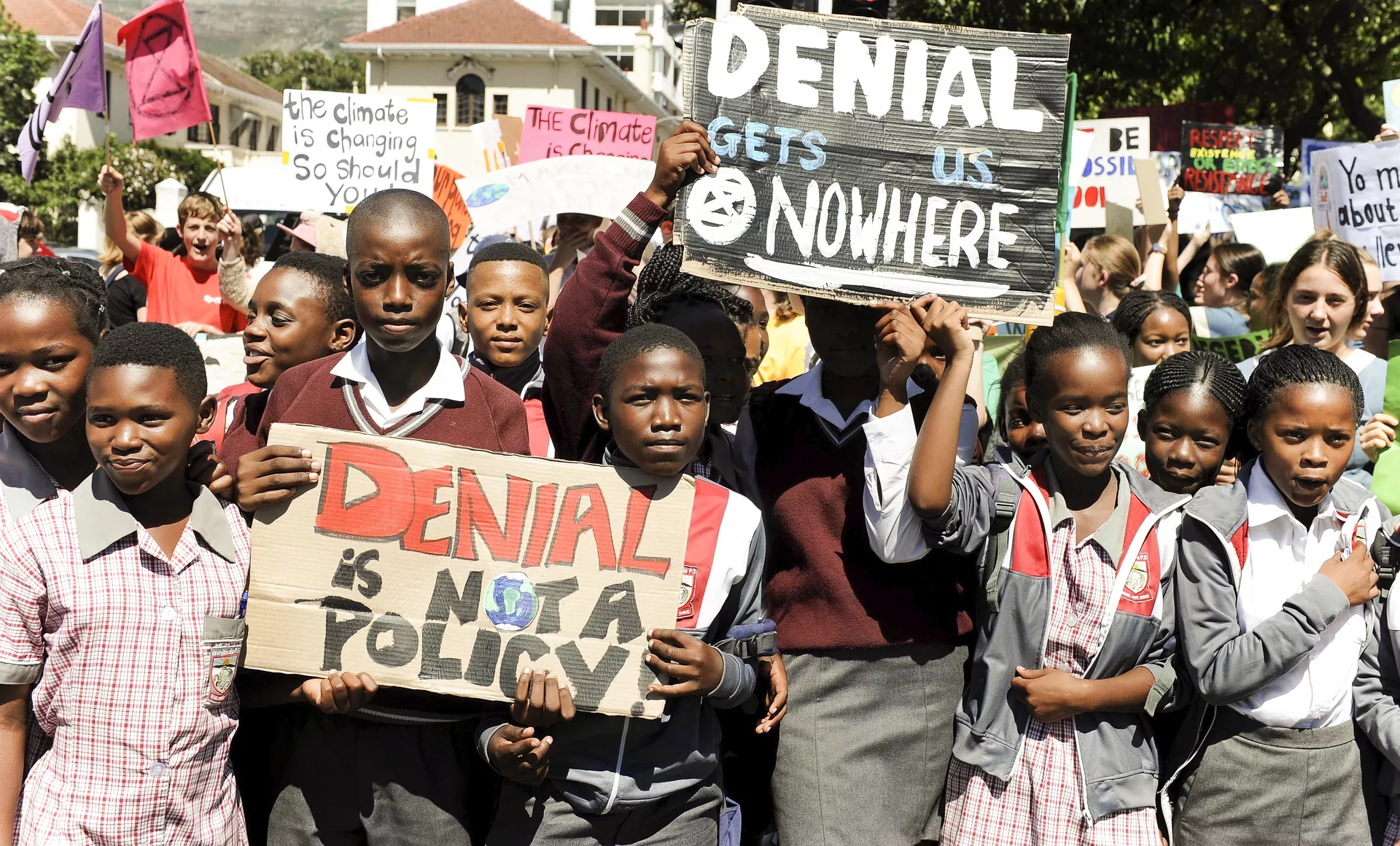
Students all over the world demonstrated in favor of more effective policies to stop climate change. Rolling Stone has photographs from many of these demonstrations which seemed to be largest in European states. The protests follow the example of Greta Thunberg, a 16 year-old Swedish youth, who protested last fall outside the Swedish Parliament for the world’s inaction on this most pressing issue. There were estimates of over a million participants in the class walk-outs. Many of the protests targeted politicians who have refused to acknowledge the seriousness of the problem.
Climate Protest in South Africa
North Korea has signaled that it is losing confidence in the negotiating process with the US and that it may restart its testing program. It is difficult to gauge the seriousness of the threat: it may be real dissatisfaction or merely a bargaining tactic. The North Koreans identified US Secretary of State Pompeo and National Security Adviser Bolton as obstacles to an agreement. The charge is likely accurate as both men have been adamantly opposed to any agreement with North Korea in the past. It is not clear what the US response would be if North Korea restarts its testing program, but there is little reason to believe that the two sides have made much progress in the two summit meetings.
For the 18th straight weekend, protesters wearing yellow vests demonstrated in the streets of Paris. The protesters ransacked upscale shops and banks as the protests have taken a decidedly populist turn. The protests are not as large as they were when they began last November, but dedicated protesters have rebuffed President Macron’s request for dialogues. There were many arrests, but the authorities seem to be helpless in addressing the anger of the protesters.
I do not often agree with Robert Kagan, but he has written an essay for The Washington Post that deserves a close read. The essay tries to explain the rise of authoritarianism in the world today, and the challenge it poses to liberal democracies. His analysis is pretty straightforward:
“Humans do not yearn only for freedom. They also seek security — not only physical security against attack but also the security that comes from family, tribe, race and culture. Often, people welcome a strong, charismatic leader who can provide that kind of protection.
“Liberalism has no particular answer to these needs. Though liberal nations have at times produced strong, charismatic leaders, liberalism’s main purpose was never to provide the kind of security that people find in tribe or family. It has been concerned with the security of the individual and with treating all individuals equally regardless of where they come from, what gods they worship, or who their parents are. And, to some extent, this has come at the expense of the traditional bonds that family, ethnicity and religion provide.
“To exalt the rights of the individual is to weaken the authority of the church and other authorities that presume to tell individuals what they must believe and how they must behave. It weakens the traditional hierarchies of birth and class, and even those of family and gender. Liberalism, therefore, cannot help but threaten ‘traditional values’ and cultures. Those are maintained either by the power of traditional authorities or by the pressures of the community and majority opinion. But in a liberal state, the rights of the few, once recognized, supersede the preferences of the many.
“In Europe and the United States, this has meant the breakdown of white, Christian cultural ascendancy as liberalism has progressively recognized the rights of people of color; of Jews and Muslims; of gays and others with sexual orientations frowned upon, if not forbidden, by the major religions; and, more recently, of refugees and migrants. Liberalism is a trade-off, and many have often been unhappy at what was lost and unappreciative of what was gained.”
The tension between the need for freedom and the need for security is not easily resolved in a liberal democracy, particularly when the economic situation is difficult. When the pie shrinks, people often look to scapegoats to explain their desperation.
Unfortunately, many of the pressures on liberal democracy stem from a sense of insecurity that can be stimulated by a fear of the “other”. We had a brutal manifestation of that fear today in New Zealand as a white supremacist killed 49 people praying in a mosque. I find our inability to treat this ideology as a serious threat incomprehensible. Far more people in the US have been killed by white supremacists than by Islamist-inspired extremists. US President Trump was asked by the threat today and The Washington Post reported his response:
“President Trump said Friday he does not believe white nationalism is a rising global danger after a gunman who espoused that ideology massacred 49 Muslims in New Zealand.
“When asked at the White House whether white nationalists were a growing threat around the world, Trump replied: ‘I don’t really. I think it’s a small group of people that have very, very serious problems. It’s certainly a terrible thing.’”
We need to focus on real, not imagined, threats.
The British Parliament has voted 413 to 202 to request a delay from the European Union on a agreement for Great Britain’s exit from the Union. Having voted yesterday no to have a “no-deal”Brexit, there was really no alternative. But more than half of the Conservative Members of Parliament voted against the government’s motion–a clear sign of discontent with Prime Minister May. The Parliament also voted against holding a second referendum on Brexit. The request for a delay must be unanimously approved by all 27 member states of the Union, something which is likely but not at all assured. European Council President Donald Tusk has signaled that he would prefer an extended delay, but it is not at all clear that there is any basis for believing that the British will do better than they have over the last two years.
The United Nations Environment Programme has published a very good overview of the threats facing the Arctic environment entitled “Global Linkages: A graphic look at the changing Arctic”. The report has graphics which are informative and easy to understand. The conclusion, however, is sobering; “Unless humanity makes very rapid and deep pollution cuts, Arctic winter temperatures will rise 5.4° to 9.0°F (3° to 5°C) by 2050 — and will reach an astounding 9° to 16°F (5° to 8.8°C) by 2080”. Even if the temperature targets of the Paris Accords are met, it seems as if the rise in Arctic temperatures is already locked in. The report contains useful information about pollution in the Arctic–such as the extent to which mercury has invaded the Arctic environment–which is not easily accessible.
The US Senate voted 54-46 to withdraw US support for the Saudi-led military campaign in Yemen. The resolution will likely pass easily in the House of Representatives but will probably be vetoed by President Trump, and the veto will not be overridden. But the vote is quite a rebuke to President Trump and his alliance with Saudi Arabia. The vote reflects resentment over the way the Saudis have handled the murder of Jamal Khashoggi and the brutal ways the war in Yemen has been conducted. According to Business Insider:
“The UN estimates that between the start of the conflict in March 2015 and August 2018 there were roughly 17,062 civilian casualties, 6,592 dead and 10,470 injured. The majority of those casualties, approximately 10,471, were a consequence of airstrikes conducted by the Saudi-led coalition the US supports.”
Unfortunately, the vote will probably do little to alter Saudi conduct in Yemen. It will also do little to change the US policy toward Saudi Arabia which increasingly appears to be based on personal, not strategic, relationships.
The British Parliament voted today to reject the possibility of an exit from the European Union without a formal agreement. The motion was passed by 321 votes to 278, a clear and stable majority. Great Britain is supposed to leave the Union on 29 March and it is extremely unlikely that any agreement with the Union could be reached by then. That situation means that the next step for Great Britain is to ask for an extension beyond 29 March. It is not clear that the Union will easily agree to an extension: after two years of fruitless discussion and debate, the Union can legitimately ask whether more time will make any difference at all. The vote on an extension is scheduled for Thursday, but the larger issue is whether Theresa May can hang on as Prime Minister. The likelihood of a British government strong enough to navigate Brexit seems remote and the EU can legitimately ask whether there will be anyone with whom to negotiate.
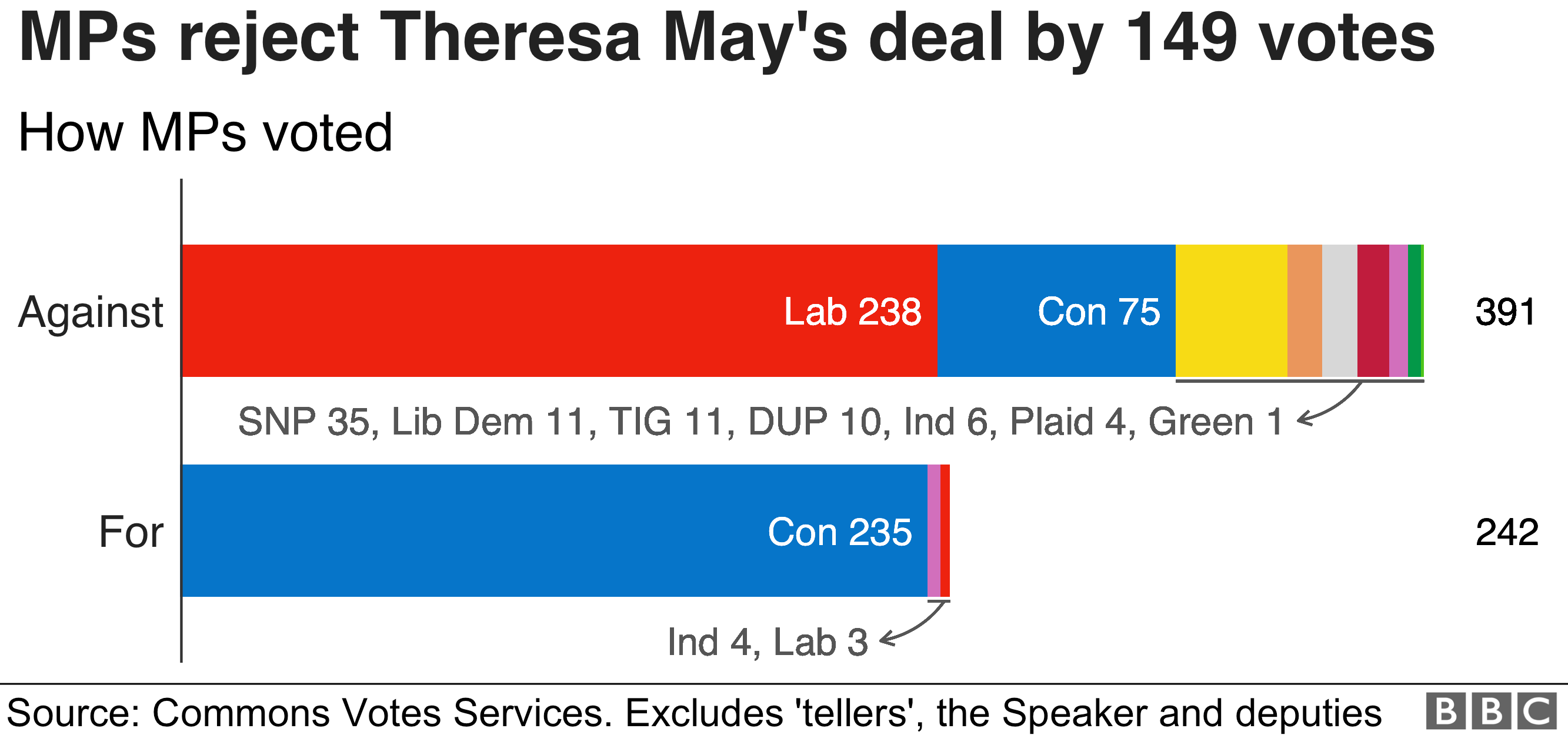
For the second time, the British Parliament has rejected Prime Minister May’s agreement with the European Union for the British withdrawal from the Union. The vote was overwhelmingly against, although by a smaller margin than the earlier defeat. Significantly, the Democratic Unionist Party, the Irish party that allows May to retain a majority, voted against the proposal perhaps signaling the end of May’s ability to lead. The BBC describes how Prime Minister May outlined the next step:
“In a statement after the defeat, Mrs May said: “I continue to believe that by far the best outcome is the UK leaves the European Union in an orderly fashion with a deal.
“‘And that the deal we have negotiated is the best and indeed only deal available.'”
“Setting out the next steps, she said MPs will vote on Wednesday on whether the UK should leave the EU without a deal or not.
“If they vote against a no-deal Brexit, they will vote the following day on whether Article 50 – the legal mechanism taking the UK out of the EU on 29 March – should be extended.
“Mrs May said MPs would have to decide whether they want to delay Brexit, hold another referendum, or whether they ‘want to leave with a deal but not this deal’.
“She said that the choices facing the UK were ‘unenviable’, but because of the rejection of her deal, ‘they are choices that must be faced'”.
The press reports of the defeat were uniformly pessimistic as the deadline for a decision is 29 March. It is unclear the Prime Minister May can survive two resounding defeats in Parliament, but there do not seem to be any alternatives waiting in the wings. The Labor Party has not distinguished itself with helpful contributions to the policy debate. The European Union has been more supportive than I would have predicted, but it seems clear that the Union is in no position to offer a more generous deal. Great Britain has not proven to be a reliable negotiating partner and the Union really cannot make additional concessions without the certainty of a deal.
The Vote in Parliament
Caitlin Talmadge has written an essay for the Brookings Institution on the question of whether nuclear weapons have prevented India and Pakistan from escalating their conflict over Kashmir. The world has had nuclear powers since 1949 (the US and the Soviet Union) and there are now nine nuclear powers. None of the nuclear powers has gone to an open conflict even though the ideological divides among them are similar to those in the past which have spawned brutal wars. She describes the underlying logic that supports deterrence:
“The traditional school of thought is that once two countries establish secure nuclear arsenals that can withstand attack and still hit back, they enter a state of mutually assured destruction, or MAD. Even the loser in a war can devastate the other’s civilians, making military victory and relative military power all but meaningless.
“The result, according to this logic, is that nuclear-armed adversaries will behave quite differently from countries without nuclear weapons. Afraid of nuclear escalation, such rivals will avoid arms races, stay out of wars, deescalate crises, refrain from threatening one another’s core interests, and generally maintain the status quo. “
India and Pakistan fought three wars before both developed nuclear weapons (in 1947, 1965, and 1971) but they also fought a brief war in Kargil in Indian controlled Kashmir in 1999. The logic of deterrence does not rule out war–it only suggests that war may not yield preferred results. Bur preferences are ambiguous and rationality is not always guaranteed.
William Burns served in the US State Department in many US Administrations and has a deep understanding of US-Russia relations both before and after the dissolution of the Soviet Union. He has written an essay for The Atlantic that outlines the many missteps that US Administrations made in not understanding how the collapse of the Soviet Union affected the Russian worldview. The perspective is important because some Americans tend to blame Russia for the current nasty state of relations. Burns summarizes that perspective:
“Who lost Russia? It’s an old argument, and it misses the point. Russia was never ours to lose. Russians lost trust and confidence in themselves after the Cold War, and only they could remake their state and their economy. In the 1990s, the country was in the midst of three simultaneous historical transformations: the collapse of Communism and the transition to a market economy and democracy; the collapse of the Soviet bloc and the security it had provided to historically insecure Russia; and the collapse of the Soviet Union itself, and with it an empire built over several centuries. None of that could be resolved in a single generation, let alone a few years. And none of it could be fixed by outsiders; greater American involvement would not have been tolerated.
“The sense of loss and indignity that came with defeat in the Cold War was unavoidable, no matter how many times we and the Russians had told each other that the outcome had no losers, only winners. From that humiliation, and from the disorder of Yeltsin’s Russia, grew the deep distrust and smoldering aggressiveness of Putin’s.”
There is no way the US and Russia can repair their relations unless the US appreciates the sense of loss that Russians feel. I highly recommend this essay to those who wish to understand Russian foreign policy.

 World Politics News