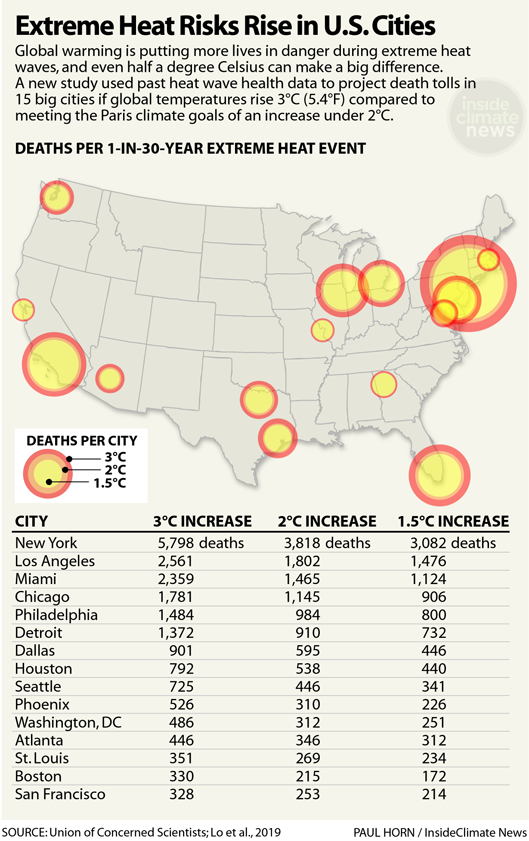
“In the years leading up to 2050, policy makers fail to cut greenhouse gas emissions. The case for the global climate-emergency mobilization necessary to keep temperatures from rising is ‘politely ignored.’ Global greenhouse gas emissions peak in 2030 and begin to fall due to a drop in fossil fuel use, but damage has been done and warming reaches 3 degrees Celsius.
“By 2050, sea levels have risen 1.6 feet and are projected to increase by as much as 10 feet by 2100.
“Globally, 55% of the population lives in areas subject to more than 20 days of lethal heat a year, beyond the human threshold of survivability.
“North America suffers from devastating weather extremes, including wildfires, heatwaves, droughts and flooding. China’s summer monsoons fail and water in Asia’s great rivers are severely reduced from the loss of more than one-third of the Himalayan ice sheet.”
Chinese President Xi and Russian President Putin chose not attend any of the ceremonies surrounding the anniversary of the D-Day invasion, even though both were allied with the US, France, and Great Britain during World War II (the Russians regard the invasion as less important than the Russian stand against the Nazis in Stalingrad which many consider the turning point in the war). But they spent time together in Moscow in a manner designed to make Western powers look less important. Xi said “[I]n the past six years, we have met nearly 30 times. Russia is the country that I have visited the most times, and President Putin is my best friend and colleague” and Putin stated that “bilateral ties had ‘reached an unprecedented level’ and described the relationship between the two countries as ‘a global partnership and strategic cooperation.'”
” The potential sale included 108 General Dynamics Corp M1A2 Abrams tanks worth around $2 billion as well as anti-tank and anti-aircraft munitions, three of the sources said. Taiwan has been interested in refreshing its existing U.S.-made battle tank inventory which includes M60 Patton tanks….
” The congressional notifications included a variety of anti-tank munitions including 409 Raytheon Co and Lockheed Martin Corp-made Javelin missiles worth as much as $129 million, two of the sources said.
“In addition, the notifications included 1,240 TOW anti-tank missiles worth as much as $299 million, one of the sources said adding that there were also 250 stinger missiles worth as much as $223 million in the notification.”
The sale will be a big boost to the companies that produce these weapons, but it is hard to square the move in the context of a trade war with China. The Chinese are unlikely to reward the action with significant concessions on trade policy. In a very strange comment, US President Trump indicated that higher military spending was his recompense for avoiding serving during the Vietnam War. The Washington Post notes:
“However, Trump added, he has increased the Pentagon’s budget during his tenure, which he said should be considered as an amends to avoiding service.
“‘I think I make up for it right now,’ Trump said, describing a proposed defense budget that will approach $750 billion in 2020. ‘I think I am making up for it rapidly.’”
I doubt that those who served in Vietnam buy the argument.
Gary W. Yohe is the Huffington Foundation Professor of Economics and Environmental Studies at Wesleyan University and he has written essay on the possible economic costs of disasters caused by climate change. His analysis is dispiriting:
“Late last year, the media blared that these and other consequences of climate change could cut U.S. GDP by 10% by the end of the century – “more than double the losses of the Great Depression,” as The New York Times intoned. That figure was drawn from a single figure in the U.S. government’s Fourth National Climate Assessment. (Disclosure: I reviewed that report and was the vice chair on the third one, released in 2014.)
“If that sounds scary, I have good news and bad news. The good news is that that figure was drawn incorrectly from a significant misreading of the report – which actually offered a range of a loss of GDP from as low as 6% to as high as 14% by 2090.
“The bad news, however, is that a more meaningful assessment of the costs of climate change – using basic economic principles I teach to undergrads – is a hell of a lot scarier.”
The concern is that spending on disaster recovery crowds out investment that could possibly go for future productivity. Spending money to replace an investment is not the same as making a new investment for future growth. With this perspective, the costs of climate change disasters is also a cost to future economic growth.
One of the weirdest aspects of the US-China trade war is the insistence by the US Administration that China is paying the tariffs. It is true that the prices of Chinese exports to the US have gone up, but the importers of those products (usually corporations) can either increase their prices for the products (which means that consumers pay for the tariffs) or they can keep the prices of their products the same and reduce their profits by the amount of the tariffs. In neither of those circumstances does China pay the tariff.
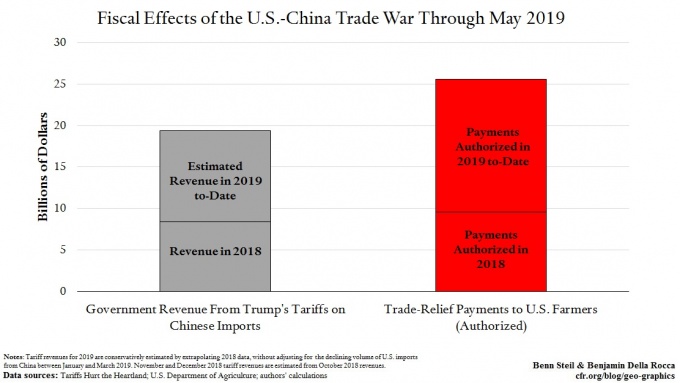
But the US has increased payments to US farmers who have lost business because the Chinese have reduced their purchases of US agriculture because of the tariffs. Those payments have increased dramatically. The Council of Foreign Relations notes:
” After just ten months of a trade war with China, subsidies to farmers are set to drain over $25 billion from “U.S. coffers” for damage done to date. China tariffs, meanwhile, have so far brought in just over $19 billion in tax payments from U.S. importers—$6 billion less than authorized farmer payments.”
So not only are US consumers paying higher prices for Chinese products, their tax burden has also increased to support farmers hurt by the trade war. The trade war thus far has been a losing proposition for the US.
Tuesday marks the 30th anniversary of the suppression of the protests in Tiananmen Square, China. The protests in 1989 were for greater political freedoms and they went on for several days, and protests were held in many other cities in China. But on 4 June, military units were sent in to disperse the protesters and in the end many were killed, although the Chinese government has never provided any final details. Virtually all reports about the protests are heavily censored and most Chinese born since that time know very little about the protests. But on Sunday, the Chinese defense minister, Wei Fenghe, made a rare public comment about the protests:
“‘Throughout the 30 years, China under the Communist Party has undergone many changes — do you think the government was wrong with the handling of June 4? There was a conclusion to that incident. The government was decisive in stopping the turbulence.’
“He added that China’s development since 1989 showed that the government’s actions were justified.
“The Tiananmen protests were ‘political turmoil that the central government needed to quell, which was the correct policy,’ he said.
“‘Due to this, China has enjoyed stability, and if you visit China you can understand that part of history.'”
“Thirty years ago, a short-lived movement catapulted me into the public eye, turning me from a shy, bookish student of history into a passionate and idealistic leader of several million protesters. For that, I paid a hefty price. In addition to spending a better part of my youth in prison, I am not allowed to return to my native country, where my ailing parents live. Yet, as painful as this is, I don’t regret my choices.”
I have no doubts that at some point in the future, the protests wil prove to have been prophetic.
China has introduced a new weapon in the trade war with the US. Instead of using broad-based measures such as tariffs that affect the entire economy, it will now target specific companies. According to the New York Times:
“The Chinese government said on Friday that it was putting together an ‘unreliable entities list’ of foreign companies and people, an apparent first step toward retaliating against the United States for denying vital American technology to Chinese companies.
China’s Ministry of Commerce said the list would contain foreign companies, individuals and organizations that ‘do not follow market rules, violate the spirit of contracts, blockade and stop supplying Chinese companies for noncommercial reasons, and seriously damage the legitimate rights and interests of Chinese companies.’”
The move will put pressure on specific companies (and there are many US companies that operate in China). Those companies will then place pressure on their representatives in Congress and on different agencies in the Federal government. This tactic will put direct pressure on decision-makers instead of the more diffuse pressure caused by consumers complaining about price increases caused by tariffs. The Chinese government has a very good understanding of how the US government makes decisions.
The Chinese move is also a response to the US ban on the products of the Huawei corporation which the US believes distributes products that allow the Chinese government to conduct surreptitious surveillance. Global Times, a Chinese media outlet with strong ties to the Chinese government outlines the framework of the new policy:
“The US recently put Huawei on its entity list and threatened to blacklist more Chinese high-tech companies. Meanwhile, some US companies have taken part in cutting supplies to and blocking Chinese companies. China’s non-reliable entity list comes out under this background.
“The first signal of this move is that China will never yield to US pressure and China will take active countermeasures instead of reacting passively under US suppression.
“The move also shows that China is improving laws and regulations in its contention with the US, and China can take precautions ahead of any US crackdown against Chinese enterprises.”
The move also signals that the Chinese government is looking at the trade war as something that may last a very long time. That possibility is definitely unsettling.
US President Trump has threatened to raise tariffs on all goods coming from Mexico unless illegal immigration to the US is stopped. According to the Washington Post:
“Effective June 10, the president intends to impose a 5 percent tariff on every good coming from Mexico, White House officials said. The tariffs would then increase by 5 percent on the first day of each month, starting on July 1.”
In addition, President Trump is considering changing the US asylum policy, effectively ending chances of asylum in the US to all Central American citizens who transit through Mexico to the US.
It is very difficult for me to believe that this threat is serious and I doubt that Mr. Trump has the authority to impose such tariffs. Mexico has been trying to address the flow of refugees and it is hard to imagine how it could be more effective. The US is also economically dependent on Mexican exports and many US companies reliant on that trade will make it difficult for the tariffs to be imposed. The proposal is more foolishness passing as policy; I suspect that it will be forgotten by tomorrow.
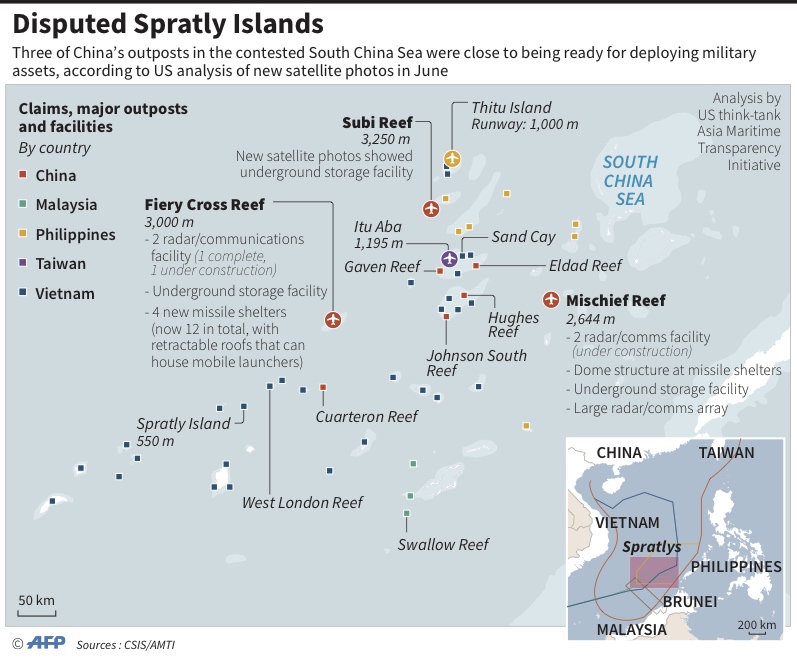
The US and other allied countries, such as Great Britain and France, continue to conduct freedom of navigation operations (FONOP) in the South China Sea. Many of the Southeast Asian states are supportive of the US moves, but are leery of a direct conflict between the US and China. Even the Philippines, which initially moved closer to China’s position (despite its legal position being supported by an international tribunal), has begun to cooperate with US activities. The rhetoric of both the US and China concerning the status of various reefs in the Sea has slowly ratcheted up, but, at this point, it does not appear as if either side wants a direct confrontation.
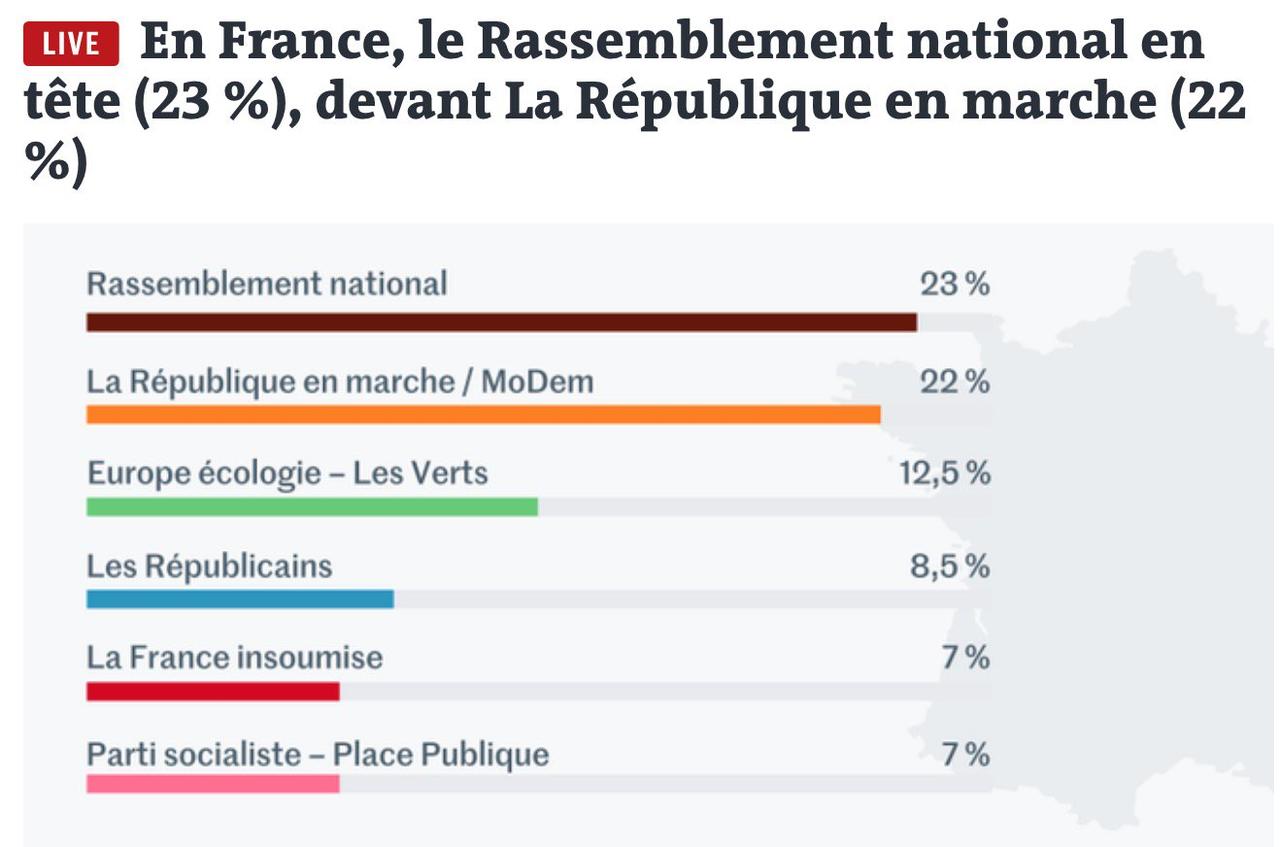
“The European Parliament’s two largest political groups, the centre-right European People’s Party (EPP) and the centre-left Progressive Alliance of Socialists and Democrats (S&D) are both on course to lose 39 and 38 seats respectively according to an aggregation of 14 national estimates and voting intentions where these were not available – unsettling their dominance and making this parliament the most fragmented so far.”
The Parliament has never been an effective law-making institution, but it serves as a good bellwether for the tenor of European politics.
Voting for the European Parliament starts this week. The Parliament is the only continent wide institution elected by all citizens of European countries and 400 million people from 28 countries will be able to participate. Many are concerned that the eurosceptic parties will do very well in the elections, potentially weakening the European Union even more than the current strife over Brexit. Overall, however, interest in the Parliament is low in most European countries and the turnout is likely to be very low. But the fear of nationalist parties may boost turnout. Deutsche Welle suggests:
“Pollsters believe that things will be different this time. They have noted a distinctively higher mobilization of voters across the European Union and determined a fairly obvious reason for this: Members of the public are increasingly flocking to polling stations because they want to stop a massive swing toward nationalism.”
“North Korea fired off some small weapons, which disturbed some of my people, and others, but not me. I have confidence that Chairman Kim will keep his promise to me, & also smiled when he called Swampman Joe Bidan a low IQ individual, & worse. Perhaps that’s sending me a signal?”
I have no memory of a US President siding with a foreign adversary by insulting a former Vice-President of the US. Trump takes great pleasure in being unorthodox, but propriety demands that Americans should support each other when one is attacked by an enemy. And Trump should at least know how to spell Biden’s name.
British Prime Minister announced that she will resign from her office on 7 June, acknowledging that her efforts to lead the country out of the European Union have failed. She thus became the second Prime Minister, after David Cameron, to suffer defeat within her party because of Brexit. In bith cases, the damage was self-inflicted. Cameron called a referendum that he believed would fail and May called a snap election that she thought would solidify her position but which rather weakened her position. There are several members of the Conservative Party that will vie for her position, but it seems like Boris Johnson has an inside track. Brexit dominated May’s tenure and it seems unlikely that her successor will be able to square that circle as well. The Brexit issue has damaged the Conservative Party, perhaps irrevocably.
US President Trump announced that he will send an additional 1,500 troops to the Middle East. The troop deployment comes amid increased tensions with Iran, and will likely be viewed by Iran as a provocation. Even though Mr. Trump has made it clear several times that he wishes to withdraw troops from the Middle east, he finds himself–like both Presidents Bush and Obama–sending more troops to the volatile region. Additionally, President Trump has indicated that he will use a loophole in the Arms Export Control Act which was passed in 2018 to send weapons to Saudi Arabia and the United Arab Emirates. Alex Ward describes the loophole:
“There is a provision in a weapons export law allowing the executive branch to sell arms without congressional sign-off if “an emergency exists which requires the proposed sale in the national security interest of the United States.” Administrations rarely invoke it, experts say, mainly because of how controversial it is and the high bar required to claim a dire situation exists.
If Mr. Trump uses the loophole, he could send $7 billion worth of arms to the two countries to wage war in Yemen, even though the Congress explicitly voted to end US cooperation with them because of the humanitarian crisis in Yemen.
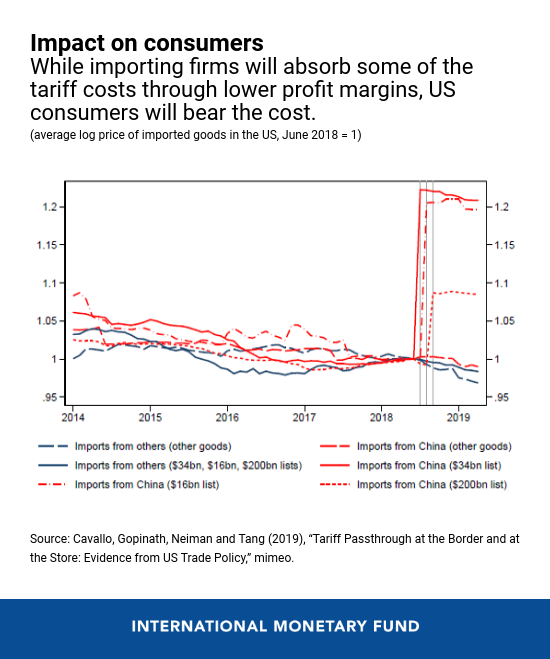
“Consumers in the US and China are unequivocally the losers from trade tensions. Research by Cavallo, Gopinath, Neiman and Tang, using price data from the Bureau of Labor Statistics on imports from China, finds that tariff revenue collected has been borne almost entirely by US importers. There was almost no change in the (ex-tariff) border prices of imports from China, and a sharp jump in the post-tariff import prices matching the magnitude of the tariff…
“Some of these tariffs have been passed on to US consumers, like those on washing machines, while others have been absorbed by importing firms through lower profit margins. A further increase in tariffs will likely be similarly passed through to consumers. While the direct effect on inflation may be small, it could lead to broader effects through an increase in the prices of domestic competitors.”
The effects were almost immediate as the graph below suggests:
 World Politics News