“I have instructed my Secretary of Commerce to add an ADDITIONAL 25% Tariff, to 50%, on all STEEL and ALUMINUM COMING INTO THE UNITED STATES FROM CANADA, ONE OF THE HIGHEST TARIFFING NATIONS ANYWHERE IN THE WORLD…The only thing that makes sense is for Canada to become our cherished Fifty First State…This would make all Tariffs, and everything else, totally disappear.”
These justifications are ridiculous. One needs to remember that it was Trump himself who negotiated the trade agreement between the US, Mexico, and Canada in July 2020, and at that time he posted this celebratory message: “BIGGEST TRADE DEAL EVER MADE, the USMCA, was signed yesterday and the Fake News Media barely mentioned it. They never thought it could be done. They have zero credibility!” Canada made no changes to its tariffs between 2020 and the recent struggle over tariffs rates. Moreover the flow of fentanyl over the US Canadian border is miniscule. According to Newsweek:
“According to U.S. Customs and Border Protection (CBP) data, around 43 pounds of fentanyl were intercepted coming from Canada into the U.S. last year, whereas Canadian authorities intercepted about 11 pounds going the opposite way during the same period.
“The Canada Border Services Agency (CBSA) reported six fentanyl seizures last month alone, all originating from the U.S. In one of the seizures, 56.1 grams of fentanyl were discovered by agents at the Windsor-Detroit Tunnel port of entry, including 20 fentanyl pills and 23 grams of a substance suspected to be fentanyl, all brought in by a pair U.S. citizens.
“Taken together, these seizures represent a tiny fraction compared to the more than 21,000 pounds seized at the U.S.-Mexico border over the course of 2024.”
All these justifications for the tariffs are spurious. But that begs the question. Trump has advisers that unquestionably have told him that American consumers will be paying higher prices for these products. Trump persists, however. Why?
Trump has announced the creation of something he calls the External Revenue Service to collect the tariff revenues. Such a new agency would require an act of Congress, so it is still a pipe dream. Right now, the tariff revenues are collected by the US Commerce Department and US Border and Customs Protection. Trump wants this revenue to offset the budget deficits that he will unquestionably aggravate with his proposed tax cuts for upper-income citizens.
The proposed tariffs will cost US families significantly more. Estimates range from $2,600 to $4000 increases per family. This is actually a tax increase on US families, and it is a tax increase not approved by Congress. Trump’s authority to raise tariffs comes from Congressional legislation that authorizes such power in case of an emergency. I actually see no emergency warranting these tariff increases–the closest “emergency” may be fentanyl, but the amounts from Canada do not warrant emergency status. So Trump has effectively managed a “stealth tax”, sidestepping the Constitutional power granted exclusively to Congress.
At some point in the future, Trump will announce the tariff revenues as part of his budget package. But he cannot admit that reality right now because it would expose his duplicity. But Congress should be aware of the extraordinary erosion of one of its central powers.
The New York Times has published a list of words that have been flagged by agencies within the Federal Government as ones to not use or avoid. For an Administration that proclaims its commitment to freedom of speech, the list can only be appreciated after reading George Orwell’s novel, 1984. The list is as follows:
accessible
activism
activists
advocacy
advocate
advocates
affirming care
all-inclusive
allyship
anti-racism
antiracist
assigned at birth
assigned female at birth
assigned male at birth
at risk
barrier
barriers
belong
bias
biased
biased toward
biases
biases towards
biologically female
biologically male
BIPOC
Black
breastfeed + people
breastfeed + person
chestfeed + people
chestfeed + person
clean energy
climate crisis
climate science
commercial sex worker
community diversity
community equity
confirmation bias
cultural competence
cultural differences
cultural heritage
cultural sensitivity
culturally appropriate
culturally responsive
DEI
DEIA
DEIAB
DEIJ
disabilities
disability
discriminated
discrimination
discriminatory
disparity
diverse
diverse backgrounds
diverse communities
diverse community
diverse group
diverse groups
diversified
diversify
diversifying
diversity
enhance the diversity
enhancing diversity
environmental quality
equal opportunity
equality
equitable
equitableness
equity
ethnicity
excluded
exclusion
expression
female
females
feminism
fostering inclusivity
GBV
gender
gender based
gender based violence
gender diversity
gender identity
gender ideology
gender-affirming care
genders
Gulf of Mexico
hate speech
health disparity
health equity
hispanic minority
historically
identity
immigrants
implicit bias
implicit biases
inclusion
inclusive
inclusive leadership
inclusiveness
inclusivity
increase diversity
increase the diversity
indigenous community
inequalities
inequality
inequitable
inequities
inequity
injustice
institutional
intersectional
intersectionality
key groups
key people
key populations
Latinx
LGBT
LGBTQ
marginalize
marginalized
men who have sex with men
mental health
minorities
minority
most risk
MSM
multicultural
Mx
Native American
non-binary
nonbinary
oppression
oppressive
orientation
people + uterus
people-centered care
person-centered
person-centered care
polarization
political
pollution
pregnant people
pregnant person
pregnant persons
prejudice
privilege
privileges
promote diversity
promoting diversity
pronoun
pronouns
prostitute
race
race and ethnicity
racial
racial diversity
racial identity
racial inequality
racial justice
racially
racism
segregation
sense of belonging
sex
sexual preferences
sexuality
social justice
sociocultural
socioeconomic
status
stereotype
stereotypes
systemic
systemically
they/them
trans
transgender
transsexual
trauma
traumatic
tribal
unconscious bias
underappreciated
underprivileged
underrepresentation
underrepresented
underserved
undervalued
victim
victims
vulnerable populations
women
women and underrepresented
Notes: Some terms listed with a plus sign represent combinations of words that, when used together, acknowledge transgender people, which is not in keeping with the current federal government’s position that there are only two, immutable sexes. Any term collected above was included on at least one agency’s list, which does not necessarily imply that other agencies are also discouraged from using it.
The list is the functional equivalent of a lobotomy. Apparently the Federal Government wants us to forget that there are females, advocates, bias, climate science, disabilities, environmental quality, equal opportunity, equality, ethnicity, females, feminism, genders, hate speech, immigrants, inequity, injustice, mental health, Native Americans, oppression, pollution, pronouns, prostitutes, prejudice, privilege, race, sex, social justice, victims, and women. The Trump Administration does not need Elon Musk–it needs the Red Queen.
“On June 9, 1954, McCarthy again became agitated at Welch’s steady destruction of each of his arguments and witnesses. In response, McCarthy charged that Frederick G. Fisher, a young associate in Welch’s law firm, had been a long-time member of an organization that was a ‘legal arm of the Communist Party.’ Welch was stunned. As he struggled to maintain his composure, he looked at McCarthy and declared, ‘Until this moment, Senator, I think I never really gauged your cruelty or your recklessness.’ It was then McCarthy’s turn to be stunned into silence, as Welch asked, ‘Have you no sense of decency, sir, at long last?’”
“The audience of citizens and newspaper and television reporters burst into wild applause. Just a week later, the hearings into the Army came to a close. McCarthy, exposed as a reckless bully, was officially condemned by the U.S. Senate for contempt against his colleagues in December 1954. During the next two-and-a-half years McCarthy spiraled into alcoholism. Still in office, he died in 1957.”
I downloaded this video from Donald Trump’s Truth Social page (I am not a subscriber to that service, but I was able to download it directly). The video is unbelievably grotesque and could easily qualify as the most vulgar and despicable act ever committed by a US President. I have no other words.
In one of the most shameful episodes in diplomatic history, the US announced it is prepared to vote against a resolution in the UN General Assembly condemning Russian aggression against Ukraine. For the last two years, the US has voted in favor of such a resolution, but this year is supporting a watered-down version simply calling for an end to the conflict. Ukraine is going ahead with the stronger resolution which will undoubtedly pass, but the US will be left with the small number of states who have decided that aggression is permissible despite the plain language of the UN Charter. Among the other states that opposed the Ukrainian resolution were Russia, North Korea, Belarus, and Sudan. Astonishing bedfellows in such a dramatically brief period of time.
This decision represents the clearest example of the US repudiation of the world order it helped to create after World War II. That world order was based on rules and norms that reflected the commitment of several states in 1945 to an alternative to the traditional practices of world politics: imperialism and the balance of power. It was never completely successful (and failed most dramatically in 2003 when the US invaded Iraq despite the UN Security Council’s decision not to authorize the use of force against Iraq). But one does not have to believe in the aspirations for a more stable world order to hold that clear aggression across national borders should be readily condemned. The US position on the Ukrainian resolution holds that clear aggression across national borders is acceptable behavior.
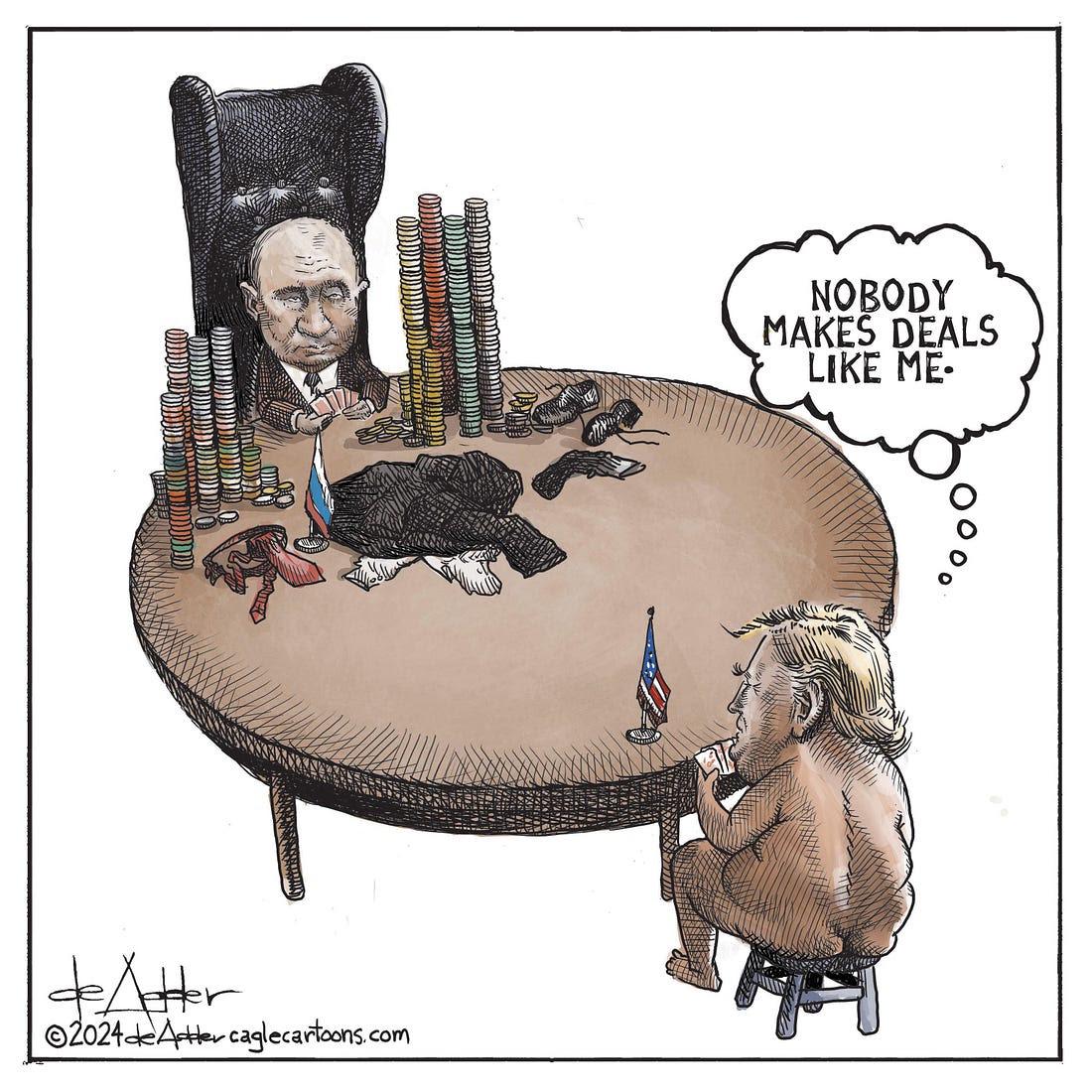
There is a second conclusion to the change in US policy toward Ukraine–it represents a significant political victory for Putin that should put to rest all the speculation as to whether Putin has something on Trump. That question is irrelevant. Trump could not be more supportive of Putin and his foreign policy objectives, so whether he is paid to do so or is coerced to do so does not change the outcome. When asked today at his meeting with President Macron of France by a reporter whether he thought Putin was a dictator (a word Trump regularly uses to describe Ukrainian President Zelensky), Trump declined to use the word. I remember the Presidential election of 1976 when President Ford asserted that the East European states under Soviet control were “free”: “There is no Soviet domination of Eastern Europe, and there never will be under a Ford administration.” The firestorm that followed effectively doomed Ford in the election. Today, however, few in the Republican Party were willing to condemn Trump for his sugarcoating of Putin.
I have been trying to find out what kind of “deal” Trump is offering Ukraine. It apparently has to do with dangling some kind of security assurances in return for a specified percentage of the profits Ukraine could make mining rare-earth minerals. When I heard about some of the possible configurations of a deal, I found them to be totally ridiculous and grotesque. But I found it difficult to ascertain exactly the terms of the deal.
In my research, however, I came across the blog written by Timothy Snyder on the topic. His analysis, as is always the case, was superb. His post is well worth a close read and there is little more that I could add with the information available right now.
In 1917, US President Wilson asked the US Congress to declare war against Germany. There were many incidents that provoked Wilson to seek the declaration. His Presidential Campaign of 1916 was adamantly opposed to US participation in the war that had raged in Europe since August 1914. But Wilson’s justification for this change was more deeply rooted in his belief that wars were initiated by leaders who felt little constraints on their ability to use war for spurious reasons:
“We have no quarrel with the German people. We have no feeling towards them but one of sympathy and friendship. It was not upon their impulse that their government acted in entering this war. It was not with their previous knowledge or approval. It was a war determined upon as wars used to be determined upon in the old, unhappy days when peoples were nowhere consulted by their rulers and wars were provoked and waged in the interest of dynasties or of little groups of ambitious men who were accustomed to use their fellow men as pawns and tools.”
It is not at all clear that Wilson’s diagnosis for the causes of war were accurate but they were based on a long-standing tradition in political thought stimulated by Immanual Kant’s pamphlet, Perpetual Peace, which was published in 1795. Kant’s argument was straightforward. Kant believed that the leaders of a country reaped all the benefits of war, such as the expansion of territory, without paying the real price of war. Ordinary people bear the real costs of war (through taxes, conscription, and destruction of property) and would therefore oppose going to war if they were given an effective voice in making decisions. To Wilson, expanding democracy was the most effective way to secure peace.
The meeting yesterday between leaders of the US and Russia in Saudi Arabia was exactly the type of scenario that both Kant and Wilson found compelling. There were no members of the Ukrainian government, nor were there any representatives of other European states. Moreover, the discussion centered on several issues which were decidedly peripheral to the conflict that has been ongoing for three years. According to the Associated Press:
“In an interview with The Associated Press, Secretary of State Marco Rubio said that the two sides agreed broadly to pursue three goals: to restore staffing at their respective embassies in Washington and Moscow, to create a high-level team to support Ukraine peace talks, and to explore closer relations and economic cooperation.”
Two of these three goals are broad issues that relate exclusively to the US-Russian relationship. Both the US and Russia are more interested in normalizing relations, and Ukraine in that context is nothing more than an impediment. But Ukraine and Europe do not view Ukraine in that context. Their context is that Russia ruthlessly invaded Ukraine with no real provocation and has waged a brutal war against the civilian population in Ukraine. At the press conference in Saudi Arabia, both Secretary of State Rubio and National Security Adviser Waltz gave lip service to the idea that there is a need to involve Ukraine and Europe in the negotiations but there was no indication whatsoever whether Trump was concerned about those issues.
As I indicated in my previous post, Trump has yet to extract any concessions from Putin. Instead, he has already conceded on the two principal issues for Putin: control over wide swathes of Ukrainian territory and a promise that Ukraine would not be allowed to join NATO. These concessions are profound and are on the scale that is usually made by a side that has been routed in war. But Russia has fared dismally in proving its military prowess. The Economist reports:
“Any assessment of Russia’s negotiating position should start with the military situation. Its army has performed dismally. The pace of advance is excruciatingly slow: since last July it has struggled to take the town of Pokrovsk, where current losses are staggering. Most of its gains were in the first weeks of the war. In April 2022, following Russia’s retreat from the north of Ukraine, it controlled 19.6% of Ukrainian territory, and its casualties (dead and wounded) were perhaps 20,000. Today Russia occupies 19.2% and its casualties are 800,000, reckon British sources.”
Trump has declared Ukraine’s unconditional surrender without securing any guarantees that Ukraine’s future sovereignty will be protected, and that condition will only weaken US credibility in the future. Inevitably, those states–not only in Europe but also in Asia, Southeast Asia, Africa, and Latin America–who rely upon US power to keep stability will lose faith in the US and will either resort to self-reliance in defense (most likely, the possession of a nuclear weapon) or will find other protectors (China and Russia are eager to fill a US vacuum).
Trump’s abject surrender to Putin, however, is a greater tragedy. He has seriously damaged US relations with its European allies, and all other states now have legitimate doubts about the integrity of US promises. The world is significantly less safe because of his foolish infatuation with Putin.
President Trump’s comments about Ukraine in the last few days (echoed by the Secretary of Defense, Hegseth, who had, quite ironically, spoke earlier at the Munich Security Conference) spoke volumes about the emerging Trump Doctrine. We have witnessed one of the most inept diplomatic episodes in the history of American foreign policy. The BBC reports:
“The phone call between Putin and Trump lasted nearly an hour-and-a-half, during which the Russian president extended an invitation to visit Moscow, Peskov said.
“Trump also told reporters at the White House that it was unlikely Ukraine would return to its pre-2014 borders but, in response to a question from the BBC, he said ‘some of that land will come back’.
“The president said he agreed with Hegseth, who told a Nato summit earlier on Wednesday that there was no likelihood of Ukraine joining the military alliance.”
With these pronouncements, Trump essentially ended whatever negotiations might ensue. What else is there to offer the Russians? Trump gave away the land the Russians took by force and gave Putin the prize: a promise to keep Ukraine out of NATO. Incredibly, no European state was involved in any of these discussions and President Zelensky was only informed after the fact. The statements brought to my mind the way Churchill and Stalin divided up Eastern Europe after World War II in the Yalta Conference in February 1945. Trump handled the issue in the manner that European states employed in the 19th Century–decisions were made on the basis of what the Great Powers wanted with little or no consideration for the welfare of the citizens most directly involved.
The degree to which Ukraine was ignored is actually quite stunning. The Washington Post reports:
“President Donald Trump’s phone call to Russian President Vladimir Putin has deeply rattled Kyiv and its European partners, intensifying long-held fears that Ukraine could be excluded from peace talks determining its own future and security — as well as that of the rest of the continent.
“Trump, who spoke to Putin on Wednesday and then phoned Ukrainian President Volodymyr Zelensky to inform him of the call, said he and his Russian counterpart will try to meet soon in Saudi Arabia, without the Ukrainian leader. Trump clarified Thursday afternoon that the meeting in Saudi Arabia would involve officials from the United States, Russia and Ukraine. ‘Not with myself or with President Putin, but with top officials,’ Trump told reporters.
“The announcement of the Trump-Putin call, which made no mention of Europe, plays into the fears of European leaders that their defense interests will fall by the wayside if Trump sidelines them in talks with Russia. Kremlin spokesman Dmitry Peskov said Thursday that it was ‘premature’ to discuss a role for Europe in any talks.”
The fiasco will reverberate in all sorts of ways. The credibility of the US has been seriously damaged since Trump ignored all US allies leaving them with the distinct impression that US interests have become brutally narrow. Members of NATO can rightly ask, given Trump’s skepticism of NATO, whether the US will honor its commitments to the alliance in a dispute with Russia. Non-NATO states have witnessed the abject abandonment of a state that has valiantly resisted blatant aggression at considerable cost.
The capitulation of the US brings to mind the decision of British Prime Minister Neville Chamberlain to capitulate to Hitler’s decision to invade Czechslovakia in 1938. Timothy Synder, one of the most astute analysts of European politics today, makes a compelling comparison:
“As American and Russian negotiators converge today in Munich for a major security conference, carrying in their briefcases various plans about Ukraine without Ukraine, the temptation is to recall another meeting in that city. Appeasement of the aggressor seems to be the plan now, as it was with Germany in 1938.
“But the resemblances between that moment and this go deeper, and it worth pausing to consider them. The symmetry between Germany-Czechoslovakia in 1938 and Russia-Ukraine in 2022 is uncanny, and pausing for a moment on the resemblances might help us to take a broader view of today. We are prisoners, now more than ever, of the rumors and disinformation and emotions of the moment. History can give us at least a calmer perspective. And so consider:
“Hitler denied the legitimacy of the Czechoslovak state. As German chancellor, he systematically denied that it had a right to exist. Although its leaders were democratically elected, he claimed that they had no right to rule. Because its people spoke various languages, he claimed that there was no such thing as a body of Czechoslovak citizens. Hitler argued that Czechoslovakia itself was artificial, the result of a historical turning point that never should have happened, the settlement after the First World War. He claimed that the existence of national minority gave him the right to intervene in Czechoslovak politics. In May 1938, he ordered his army to make preparations for a quick strike on Czechoslovakia. He also activiated his agents inside the country. On September 12th Hitler gave a rousing speech to Germans about the entirely fictional extermination of the German minority in Czechoslovakia. We know what comes next: Britain and France, together with Germany and Italy, decided in Munich on September 30th that Czechoslovakia should cede crucial border territories to Germany. These were the most defensible parts of the country. Czechoslovakia’s leaders, although they were not consulted, chose to accept the partition of their country.”
The Munich analogy is dangerous, since it is often used to justify actions whenever there seems to be a breach of international norms. The most common mistake is to regard initial acts of aggression as part of a larger plan to dominate other states. The example was often invoked in the Vietnam War: “We should resist North Vietnamese agression in Southeast Asia or we will be fighting them in San Francisco”.
“It was not until the advent of the Johnson administration, however, that the Munich analogy came into its own. President Lyndon B. Johnson and his secretary of state, Dean Rusk, considered Munich to be the most important historical lesson of their time. Remembering Munich, they saw weakness overseas as leading to World War III. Johnson explained, “Everything I knew about history told me that if I got out of Vietnam and let Ho Chi Minh run through the streets of Saigon, then I’d be doing exactly what Chamberlain did in World War II. I’d be giving a big fat reward to aggression.” Rusk was equally attuned to the lessons of the 1930s, which he described as the realization that “aggression must be dealt with wherever it occurs and no matter what mask it may wear…. The rearmament of the Rhineland was regarded as regrettable but not worth a shooting war. Yet after that came Austria, and after Austria came Czechoslovakia. Then Poland. Then the Second World War.”
“This belief in the applicability of the Munich analogy to his situation led Johnson to increase troop levels, first to 300,000 and then to 500,000 by 1968. At a National Security Council meeting in July 1965 to discuss an increase in troops, an exchange occurred between Undersecretary of State George Ball, who was opposed to committing more men, and the U.S. ambassador to Vietnam, Henry Cabot Lodge. Lodge rebutted Ball’s arguments, explaining that ‘I feel there is a greater threat to start World War III if we don’t go in. Can’t we see the similarity to our own indolence at Munich?’ No one present at the meeting questioned this statement. Even McGeorge Bundy, the national security adviser who often criticized others for using inaccurate analogies, did not comment. The administration’s policymakers were convinced of the appropriateness of the analogy to their own situation in Vietnam, and often reminded one another of this fact. Even former president Eisenhower resorted to the analogy in advising Johnson in 1965. He warned the president not to be convinced by Britain’s arguments for negotiation. Prime Minister Harold Wilson, he said, ‘has not had experience with this kind of problem. We, however, have learned that Munichs win nothing.'”
The Munich analogy was inappropriate in Vietnam because there was no evidence that North Vietnam was interested in taking over the world. But there is conisderable evidence that Putin does have larger global ambitions, not the least of which is the restoration of the empire of the Soviet Union. For this reason, the Baltic states and Poland desperately wanted to join NATO after the collapse of the Soviet Union. Indeed, NATO expanded, not because the US wanted to include the East European countries, but because those states feared the resurgence of the Russian Empire, a point that became even more persuasive after the Russian invasion of Ukraine in 2014.
The incompetence of the Trump foreign policy with respect to Ukraine will haunt the US as long as Trump is in power. We will see how China regards Trump on the matter of Taiwan or on the relations between North and South Korea. In the absence of US support for countries resisting aggression, many states will look for other allies or perhaps even to develop their own nuclear weapons. Fortune assesses the feelings of US allies:
“The track Trump is taking also has rocked Europe, much as his dismissive comments about France and Germany did during his first term.
‘French Deputy Foreign Minister Benjamin Haddad described Europe as being at a turning point, with the ground shifting rapidly under its feet, and said Europe must wean itself off its reliance on the United States for its security. He warned that handing a victory to Russia in Ukraine could have repercussions in Asia, too.
“’I think we’re not sufficiently grasping the extent to which our world is changing. Both our competitors and our allies are busy accelerating,’ Haddad told broadcaster France Info on Thursday.”
Trump is not pursuing an “America First” policy; rather, he is pursuing a policy of “America Alone”.
We are witnessing a very strange event in political history. Under the pretext of eliminating “waste, fraud, and abuse”, the Trump Administration is attempting to deconstruct most parts of the government, leaving the Executive Branch the sole repository of power in the US. The strategy is to completely erase any institutional support for the process of checks and balances that the Constitution requires to work properly.
The maneuver clearly intends to reduce the power of the Congress and the Courts. I suspect that the courts will try to preserve their power, but courts lack enforcement powers. Trump’s behavior in courts during 2020-24 suggests that he is more than willing to exploit that weakness through delay and manipulation of the legal process. If push comes to shove in the courts, it is only the Congress that can levy penalties to induce changed behavior.
Which raises an interesting question: why are Republican Congresspeople and Senators willing to give away their principal authority which is to allocate money to keep the government going? It is rare to witness the voluntary forfeiture of power. The immediate answer to this question is that these Republicans fear the power of Trump to oust them through primaries. But this begs the question. If the Federal government is eviscerated, then many of the constituents of these Congresspeople will suffer badly and are likely to take out their anger in an election. This outcome is highly probably if the cuts to the Federal government diminish the benefits of Medicare, Medicaid, Social Security, and other social programs. Why is the fear of Trump greater than the fear of angry voters?
I will put my money on the people if the cuts happen quickly, before Trump can defang Federal enforcement of the Constitution. There is a reason Trump went after USAID first–most Americans have little idea of what USAID does. But going after USAID will not fund the tax cuts that the President wants–it is a small amount of money relative to the overall budget.. The budget deal being contemplated by the Republican caucus must go through a process called reconciliation which has strict rules permitting a budget to pass with only 51 votes and not the 60 votes in a Senate with a filibuster rule. Once the American people feel the pain of what it means to lose the Federal government, they may have second thoughts about supporting Trump and those in the Congress who support him.
We will have to see. The budget must be submitted by 14 March and there are still large divisions within the Republican Party about how the budget should be structured. The deficit hawks in the House of Representatives will demand spending cuts that would require cuts in the most important programs affecting the well-being of Americans, such as Social Security and Medicaid. A month is not enough time to work out these fundamental disagreements since the main members of the Freedom Caucus live in gerrymandered districts and have little to fear from Trump’s threats of being primaried. We will see how this works out.
The Trump Administration refuses to accept climate change as real. Its ignorance of the facts is breathtaking as is its determination to make sure that no agency of the Federal Government even hints that climate change is occurring. The Guardian reports:
“Donald Trump’s administration has started to remove or downgrade mentions of the climate crisis across the US government, with the websites of several major departments pulling down references to anything related to the climate crisis. Climate scientists said they were braced ‘for the worst’.
“A major climate portal on the Department of Defense’s website has been scrapped, as has the main climate change section on the site of the Department of State. A climate change page on the White House’s website no longer exists, nor does climate content provided by the US agriculture department, including information that provides vulnerability assessments for wildfires.”
“An entire section on ‘climate and sustainability’ hosted by the Department of Transportation has now vanished, with the department’s new leadership also ordering the elimination of any policy positions, directives or funding ‘which reference or relate in any way to climate change, ‘greenhouse gas’ [sic] emissions, racial equity, gender identity, ‘diversity, equity and inclusion’ goals, environmental justice or the Justice40 initiative’.”
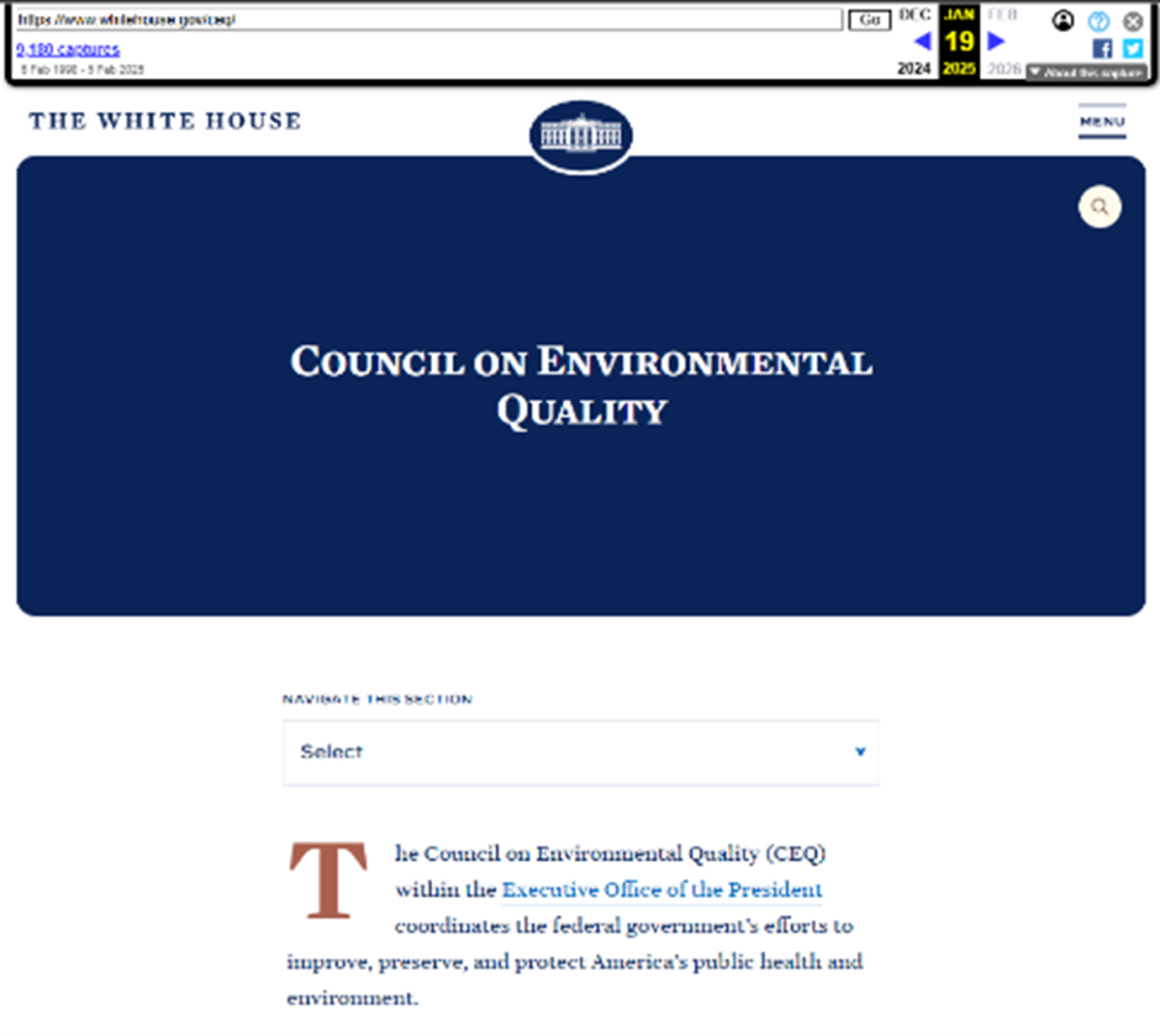
The purging of information is truly extraordinary. The White House pages on the Environment were changed in a matter of days. Trump is practicing an ancient practice of the Roman Empire known as damnatio memoriae in which the names of hated enemies were erased all over the Empire.
White House Page on the Environment after Trump’s Election
19 January 2025 and 5 February 2025
The facts, however, are hard to deny. Last January was the hottest month ever recorded, inexplicably far hotter than predicted by climate models (although 2025 is likely to be cooler than 2024 due to the influence of the La Nina emerging in the Pacific). The data about warming temperatures are compelling.
As much as the Trump Administration would like people to forget about climate change, it is doubtful that degree of amnesia is possible given the dramatic changes in weather over the last few years. Perhaps the most conccrete example of how formidable that reality is can be found in the insurance industry’s reaction to climate change. First Street, a climate risk financial modeling company, estimates that “human-driven climate change could result in $1.47 trillion in net property value losses from rising insurance costs and shifting consumer demand”. Additionally, the US now joins Iran, Libya. and Yemen as the only countries that are not part of the Paris Accords.



 World Politics News