Iran has been experiencing violent protests since the government announced fuel price increases on 15 November. For the first time, the Iranian government has admitted that protesters have been killed although it has been obvious for some time now that the government efforts have been violent. According to the AP:
“The demonstrations began Nov. 15 after the government raised minimum gasoline prices by 50% to 15,000 Iranian rials per liter. That’s 12 cents a liter, or about 50 cents a gallon. After a monthly 60-liter quota, it costs 30,000 rials a liter. That’s nearly 24 cents a liter or 90 cents a gallon. An average gallon of regular gas in the U.S. costs $2.58 by comparison, according to AAA.
“Cheap gasoline is practically considered a birthright in Iran, home to the world’s fourth-largest crude oil reserves despite decades of economic woes. That disparity, especially given its oil wealth, fueled the anger felt by demonstrators.
“Iranians have seen their savings chewed away by the rial’s collapse from 32,000 to $1 at the time of the 2015 nuclear accord to 127,000 to $1 today under the renewed U.S. sanctions. The cost of daily staples also has risen.
Iran has been under severe economic pressure from sanctions imposed on it after US President Trump pulled the US out of the Iranian nuclear agreement (the JCPOA). The protests may signal the success of the sanctions by undermining the Iranian government. But the protests may also harden the position of the Iranian government to ratchet up the pressure on the former buyers of Iranian oil. The Middle East Institute published an essay on what a hardline strategy could entail:
“Under these circumstances, the outcome of the protests could be twofold: on the one hand, Tehran will definitely be concerned about an escalation in the uprising and try to speed up the launch of negotiations with the U.S. to ease the economic pressure. On the other hand, however, the Iranian leadership likely still believes it has time to prepare by raising the stakes to secure a stronger starting position in the talks and enable it to demand an immediate lifting of secondary sanctions.
“To achieve these twin goals, Iran can intensify the tactics it has used for the past 10 months, alternately destabilizing regional security and using the gradual buildup of its nuclear program to raise the value of a possible deal and also warn the Americans about the potential consequences of further increasing economic pressure. In between of the use of these levers, the international community has usually been given time to reconsider its support for U.S. sanctions before Iran repeats the actions.”
The critical actors in this standoff is not either Iran or the US–they are more or less obliged to maintain their current policies since backing down will be seen by the polities as a capitulation. Indeed, there are reports that the Trump Administration is considering sending 14,000 additional troops to the Middle East to counter Iran. The actors we should watch closely are the European states, Russia, and China since they have powerful interests in stabilizing the situation.
The North Atlantic Treaty Organization (NATO) celebrated its 70th anniversary, and there was a great deal of controversy at the event. There was a videotape of several leaders of NATO states mocking US President Trump. Mr. Trump had a very contentious press meeting with French President Macron in which the two leaders disagreed openly about a variety of issues. Mr. Trump also answered questions for 40 minutes while Canadian Prime Minister sat next to him without being questioned. But the most contentious matter was President Trump’s decision to meet with Turkish President Erdogan who has violated NATO’s unwritten rule that members should not purchase sophisticated weaponry from Russia. President Trump cancelled his scheduled press conference at the end of the meeting and left abruptly. NATO has been adrift since the dissolution of the USSR in 1991 but it continues to serve as a focal point for strategic planning and coordination among an important group of states.
In world politics we often talk about rich and poor countries and use economic data to sort out the two. I am not sure why we fell into that trap, but economic data actually tells us very little about the quality of life in different countries. One of the features of living in a “rich” country is longer life. A long life expectancy has been one of the lodestars of the idea of progress. And it is true that as a general rule, greater wealth allows better living conditions, greater access to improvements in medical care, and more control over threats from the environment.
But the US has now joined some other countries, such as Russia, that are experiencing a decline in life expectancy.National Public Radio conducted an interview with Dr. Steven Woolf who was the lead author of the study conducted by the American Medical Association. Excerpts from the interview are disturbing.
WOOLF: Well, what we found is that since 2010, all-cause mortality – that means the chances of dying before age 65 – have been increasing in the United States. And for the past three years, life expectancy has been decreasing. It’s a quite alarming recent trend. But our study shows that it’s been decades in the making, starting back in the 1980s.
GREENE: Is this happening in other wealthy countries, or is this a distinctly U.S. thing?
WOOLF: That’s the thing. This does appear to be a distinctly American phenomenon. There is some element of this happening a little bit in the U.K. and Canada but nothing on the scale of the United States. Life expectancy continues to climb in other wealthy nations.
GREENE: So what are the factors here? What do you think is happening?
WOOLF: Well, we did a pretty detailed analysis to peel back the onion and try to understand this. The trend in life expectancy is being caused, as you said, by increased mortality in working-age Americans from age 25 to 64. And the leading contributors to that is the drug addiction problem. Drug overdoses are a major factor in explaining this trend. However, we also found increases in deaths from alcoholism, from suicides and from dozens of organ diseases – all told, 35 causes of death where mortality rates had increased in this age group.
“In regard to regional impact, the largest relative increases in midlife mortality rates were observed in New England (New Hampshire, 23.3%; Maine, 20.7%; Vermont, 19.9%) and the Ohio Valley (West Virginia, 23.0%; Ohio, 21.6%; Indiana, 14.8%; Kentucky, 14.7%). Additionally, analyses revealed the increase in midlife mortality from 2010 through 2017 was associated with an estimated 33,307 excess deaths and 32.8% of these were attributable to the Ohio Valley.
“When examining cause, analyses revealed the midlife mortality from drug overdoses increased by 386.5% from 1999 to 2017 from 6.7 deaths per 100,000 to 32.5 deaths per 100,000. While age-specific increases were significant among those aged between 25 and 34 years (531.4% increase) the largest relative increase occurred in those aged 55 to 64 years (909.2%).
We need to rethink what we mean by “rich”. The data indicates that US society is in real trouble and indices such as the GDP should not leave us sanguine about the quality of life.
“However, not all FDI brings capital in service of productivity gains. In practice, FDI is defined as cross-border financial investments between firms belonging to the same multinational group, and much of it is phantom in nature—investments that pass through empty corporate shells. These shells, also called special purpose entities, have no real business activities. Rather, they carry out holding activities, conduct intrafirm financing, or manage intangible assets—often to minimize multinationals’ global tax bill. Such financial and tax engineering blurs traditional FDI statistics and makes it difficult to understand genuine economic integration.”
The study indicates that about $15 trillion is hidden in these shell companies, effectively reducing the tax revenues for every state in the world. That $15 trillion represents about 40% of all the money identified as Foreign Direct Investment. Economic orthodoxy would have us believe that investments stimulate job creation. The money hidden in shell companies does not stimulate any additional economic activity–it just sits in bank accounts in any number of tax havens such as Luxembourg or the Cayman Islands. To get an idea of how distorting this practice is the IMF uses Luxembourg as an example: ” According to official statistics, Luxembourg, a country of 600,000 people, hosts as much foreign direct investment (FDI) as the United States and much more than China. Luxembourg’s $4 trillion in FDI comes out to $6.6 million a person. FDI of this size hardly reflects brick-and-mortar investments in the minuscule Luxembourg economy.” One would think that governments would seize the opportunity to tax all these revenues. That they do not is testimony to the power of great wealth in political decisions.
Globalization has transformed the nature of work. For most of human history, work, and its corollary, income, was local, and most workers sold their products within a very small geographic range (before the emergence of industrial capitalism, the range of economic activity in Europe was mostly within a 10 mile range). With industrial capitalism, the world witness the creation of factories and technological changes–such as railroads and steamships–expanded the scope of possible markets. Now the entire world is a single market, albeit one with lots of roadblocks. The name of the game now is avoiding those roadblocks with seamless supply chains. When US President Trump imposed tariffs–a quintessential roadblock–on Chinese products, US firms that used Chinese products set up operations, often with Chinese help, in countries like Vietnam and Bangladesh.
But in domestic economies, we have also witnessed the growth of what is known as a “gig” economy, where workers are nominally independent but still subject to the rules of a larger corporate entity, such as Uber. Katrina Forrester has written a fascinating book review on the nature of the gig economy and what it means for modern capitalism:
” What is new about the gig economy isn’t that it gives workers flexibility and independence, but that it gives employers something they have otherwise found difficult to attain: workers who are not, technically, their employees but who are nonetheless subject to their discipline and subordinate to their authority. The dystopian promise of the gig economy is that it will create an army of precarious workers for whose welfare employers take no responsibility. Its emergence has been welcomed by neoliberal thinkers, policymakers and firms who see it as progress in their efforts to transform the way work is organised.
The fundamental issue is obscured by the gig economy. We have developed a system in which “income” can only be earned by working for an entity that honors private profit. There is much work to be done that does not yield a private profit–think of people working to ease the lives of disabled people, people working to protect the environment, and people who teach poor students in poor areas. We need to break the link between income and profit. There is much more to human life than the accumulation of private capital.
The German Social Democrat Party (SPD) has elected Norbert Walter-Borjans and Saskia Esken as the new leaders of the party. These two individuals are closer to the original idea of the SPD and far from the SPD that has worked as a coalition partner to Angela Merkel. The question now raised is whether Walter-Borjans and Esken will keep the SPD in the government. Angela Merkel has undoubtedly been a constant in European politics over her four terms and she has held the line defending liberal values in a continent that has a number of political parties that repudiate liberal values. But she has been weakened over time and has announced that she will withdraw from politics soon. It is likely that Germany will soon lose its singular role in European politics and, aside from French President Macron, it is unlikely that any country can take its place. This is a bad time for Europe to drift apart any further. With Brexit and the emergence of China as an economic counterweight and the desire of Russia to become a dominant force in Europe, Europe can ill-afford to lose its legacy as a protector of liberal values and institutions in the world. The US has decided to abdicate its role as the main protector of those values.
This note has little to do with world politics, but I am fascinated by the reports of a new study that suggests that the essential elements of music seem to be universal and not solely culturally determined (a position I must admit I believed with no evidence). According to Reuters:
“The study, published on Thursday, focused on musical recordings and ethnographic records from 60 societies around the world including such diverse cultures as the Highland Scots in Scotland, Nyangatom nomads in Ethiopia, Mentawai rain forest dwellers in Indonesia, the Saramaka descendants of African slaves in Suriname and Aranda hunter-gatherers in Australia.
“Music was broadly found to be associated with behaviors including infant care, dance, love, healing, weddings, funerals, warfare, processions and religious rituals.
“The researchers detected strong similarities in musical features across the various cultures, according to Samuel Mehr, a Harvard University research associate in psychology and the lead author of the study published in the journal Science.
“’The study gives credence to the idea that there is some sort of set of governing rules for how human minds produce music worldwide. And that’s something we could not really test until we had a lot of data about music from many different cultures,’ Mehr said.”
I will wait until the study is more broadly confirmed by other researchers before I abandon my uninformed position.
After two months of increasingly violent protests, Iraq’s Prime Minister Adel Abdul Mahdi has announced that he will resign. The resignation comes after two prominent Shia clerics, Ayatollah Ali al-Sistani and Moqtada al-Sadr, called for a change of leadership in the country. The change comes despite the strong support for Mahdi by Iran and the Iraqi Kurds. The protests have been sparked by concerns over corruption as well as the influence of Iran over Iraqi politics. But the laws governing succession after a Prime Minster leaves in Iraq are murky and it is not clear that the resignation will address the underlying causes of unrest.The Guardian looks at the unrest:
“Ever since 2003, Iraq’s governance had been apportioned along sectarian lines and its institutions used as fiefdoms by ministers whose allegiance to political groupings has often transcended fealty to the state.
“One result has been endemic corruption and nepotism throughout the country’s public sector, which has plundered the country’s oil wealth and left many Iraqis without opportunities. Looting of state revenues has been the main driver of the protest movement that has been led by a disenfranchised youth but joined by other sectors of society, and has on some days seen up to 200,000 people demonstrating peacefully in Baghdad and other cities.”
“North Korea responded with a blistering statement from an unnamed deputy foreign minister in charge of Japanese affairs, saying Abe didn’t know what he was talking about when it comes to military hardware.
“‘Abe is the only one idiot in the world and the most stupid man ever known in history as he fails to distinguish a missile from multiple launch rocket system,'” said the statement, which was carried by the state-run Korean Central News Agency.
“‘The wretched sight of Abe makes us regard him as a dog seized with fear or a puppy fawning over its master like the U.S.,’ the statement continued, adding, ‘he is none other than a perfect imbecile and a political dwarf without parallel in the world.’
“It concluded with a blunt warning that the Japanese leader ‘may see what a real ballistic missile is in the not distant future and under his nose.'”
North Korea has given the US a deadline of the end of the year to restart meaningful negotiations. The rhetoric coming out of Pyongang suggests that leader Kim is becoming quite disgruntled with the slow pace.
North Korea, for the 13th time this year, has tested two nuclear-capable missiles. The launches come on the second anniversary of the launch of its Hwasong-13 intercontinental ballistic missile. The tests are viewed by many analysts as warnings to US President Trump to restart the denuclearization talks that have been stalled for months. North Korea has given Mr. Trump a deadline of the end of this year, but it is unclear what the consequences of inaction might be. But at the same time, North Korea has started military exercises along the North-South maritime border. The Washington Post gives one interpretation of the tests:
“Kim has called for relief from the international sanctions that hobble his economy, but the United States says North Korea has not taken sufficient disarmament steps to justify easing the pressure.
“’The deadlock in nuclear talks with the United States is pushing North Korea to ramp up the level of provocation,’ said Shin Beomchul, a researcher at Asan Institute for Policy Studies in Seoul.
“North Korea has previously used U.S. holidays to send messages to Washington. It launched its first intercontinental ballistic missile on July 4, 2017.”
“The Chinese Foreign Ministry threatened to take ‘firm counter measures’ in response to the move and said the U.S. should consider the consequences of China’s retaliation if it continued to ‘act arbitrarily.’
“Chinese Vice Foreign Minister Le Yucheng also summoned U.S. Ambassador to China Terry Branstad to demand that Washington stop meddling in Beijing’s domestic affairs.
“‘The Chinese government and people firmly oppose such stark hegemonic acts. We have made stern representations and strong protests to the US side,’ Chinese Foreign Ministry spokesman Geng Shuang said during a press conference.
“The foreign ministry spokesman called the move ‘a severe interference in Hong Kong affairs’ and ‘in serious violation of international law and basic norms governing international relations.'”
The Chinese government was likely not pleased to see the pro-US sentiments expressed by the protesters after the passage of the bills. Al Jazeera produced a video that shows the feelings of the protesters.
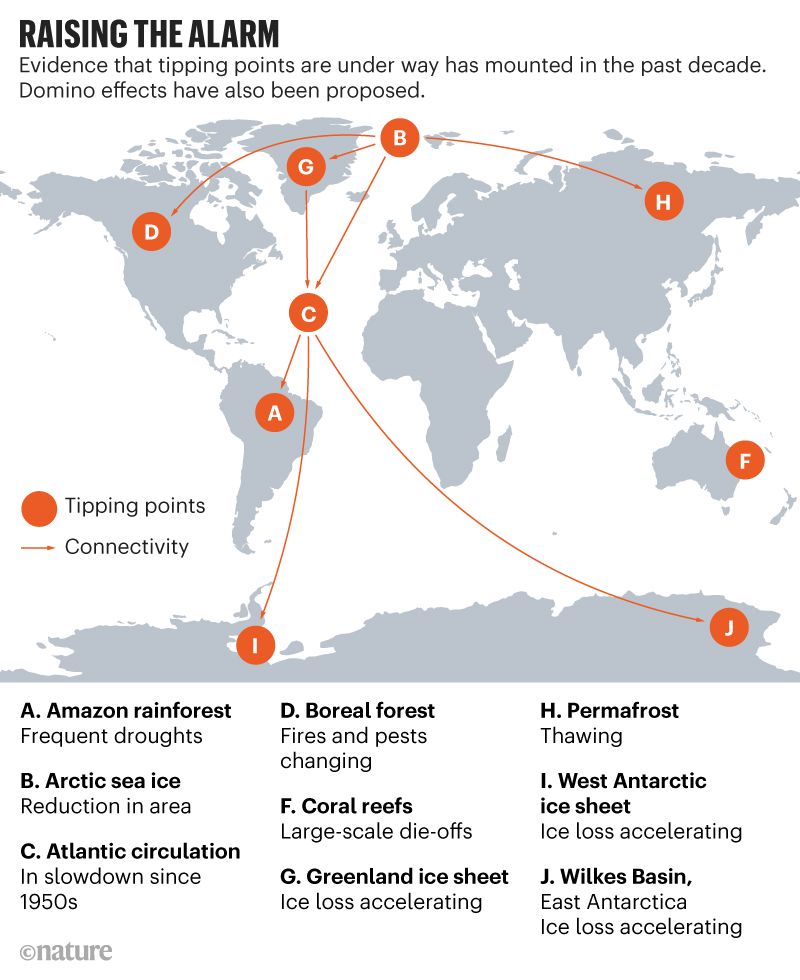
Researchers have published a comment in the science journal, Nature, on the cascading effects of climate change. We tends to think about global warming in terms of discrete issues such as sea ice loss or deforestation. The researchers point out that these issues are interrelated and that there is therefore a danger that the process of climate change could accelerate because of positive feedback loops among these “separate” issues. An analysis of the reports from the Intergovernmental Panel on Climate Change (IPCC) which have been published every five years since 2001 all indicate that each report has underestimated the extent of climate change (See the chart below). The report identifies 9 “tipping points” that the world might have already crossed. The Guardian quotes oneof the researchers:
“Prof Tim Lenton at the University of Exeter, the lead author of the article, said: ‘We might already have crossed the threshold for a cascade of interrelated tipping points. The simple version is the schoolkids [striking for climate action] are right: we are seeing potentially irreversible changes in the climate system under way, or very close.’
‘As a scientist, I just want to tell it how it is,’ he said. ‘It is not trying to be alarmist, but trying to treat the whole climate change problem as a risk management problem. It is what I consider the common sense way.’
Phil Williamson at the University of East Anglia, who did not contribute to the article, said: ‘The prognosis by Tim Lenton and colleagues is, unfortunately, fully plausible: that we might have already lost control of the Earth’s climate.’”
Much to my surprise, US President Trump has signed two bills that give support to the protesters in Hong Kong. CNBC describes the laws:
“The first bill would require the State Department to certify once a year that Hong Kong is sufficiently autonomous to retain its special U.S. trading consideration — a status that helps its economy. Under that designation, the city is not subject to the tariffs that have been levied on China. The bill also sets up the potential for sanctions on people responsible for human rights abuse in Hong Kong.
“The second measure would bar the sale of munitions such as tear gas and rubber bullets to Hong Kong police.”
I admit that I was surprised because I had assumed that Mr. Trump would not want to jeopardize the trade talks that are going on between the US and China. Both bills were passed with almost unanimous support in the Congress (only one negative vote in the House and no negative votes in the Senate) and Mr. Trump may have wished to avoid an override vote in the Congress if he vetoed the bills). But it could also be the case that Mr. Trump may simply decide not to enforce the bills (they require the State Department to monitor human rights in Hong Kong and the State Department has often overlooked human rights abuses in states that are critical to US interests, such as Saudi Arabia). We will have to wait to see how China responds to the legislation.
“The WMO Greenhouse Gas Bulletin showed that globally averaged concentrations of carbon dioxide (CO2) reached 407.8 parts per million in 2018, up from 405.5 parts per million (ppm) in 2017.
“The increase in CO2 from 2017 to 2018 was very close to that observed from 2016 to 2017 and just above the average over the last decade. Global levels of CO2 crossed the symbolic and significant 400 parts per million benchmark in 2015.
“CO2 remains in the atmosphere for centuries and in the oceans for even longer.”
The report goes on to indicate that the rate of growth of carbon dioxide continues to accelerate:
“The increase in CO2 from 2017 to 2018 was above the average growth rate over the last decade. The growth rate of CO2 averaged over three consecutive decades (1985–1995, 1995–2005 and 2005–2015) increased from 1.42 ppm/yr to 1.86 ppm/yr and to 2.06 ppm/yr with the highest annual growth rates observed during El Niño events.
“The National Oceanic and Atmospheric Administration (NOAA) Annual Greenhouse Gas Index shows that from 1990 to 2018 radiative forcing by long-lived greenhouse gases (LLGHGs) increased by 43%, with CO2 accounting for about 80% of this increase.”
It does not appear as if the world is making any progress at all in curbing greenhouse gas emissions despite the overwhelming evidence that the pattern will be very disruptive. The last time the planet had such elevated levels “the temperature was 2-3 [degrees Celsius] warmer, sea level was 10-20 meters higher than now.”
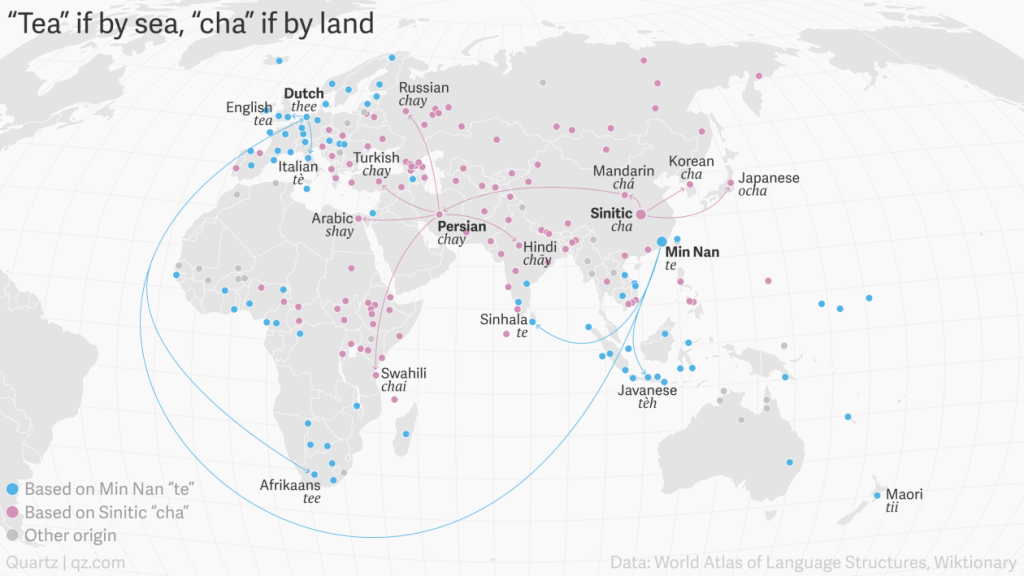
We tend to think about globalization as a recent phenomenon, but, in reality, it is a process that has been going on ever since some of our ancestors left the African continent. Modern globalization just occurs at a much faster rate. But there are some distinctive features of early globalization, which can be highlighted by the words we use to identify the beverage we know in the West as “tea”.
“With a few minor exceptions, there are really only two ways to say “tea” in the world. One is like the English term—té in Spanish and tee in Afrikaans are two examples. The other is some variation of cha, like chay in Hindi.
“Both versions come from China. How they spread around the world offers a clear picture of how globalization worked before ‘globalization’ was a term anybody used. The words that sound like ‘cha’ spread across land, along the Silk Road. The ‘tea’-like phrasings spread over water, by Dutch traders bringing the novel leaves back to Europe.”
Hong Kong held elections for 452 elected district councilor seats, the local government for the city. Turnout was exceptionally high, with 2.9 million people voting, a turnout of 71% of registered voters. The district council does not have a great deal of power, and candidates who advocated for Hong Kong “self-determination” were not allowed to run. But the vote was symbolic, as described by National Public Radio:
“Hong Kong’s 452 elected councilors normally concern themselves with more mundane tasks, such as overseeing garbage disposal policies and street lighting. They have advisory functions and control over how some of the city’s finances are disbursed locally, but possess no lawmaking abilities.
“‘They do not listen to our opinions actually. They can do whatever they want, and we cannot monitor them,’ said Philip Wong, 40, who was preparing to cast his ballot Sunday morning for first-time candidate Isaac Ho, a founding member of the pan-democratic group Community March.
“But this year, Wong says, his vote mattered more: ‘Whether or not [this election] makes a change, it is a reflection of the Hong Kong people’s voice. We can use the vote to express our discontent and dissatisfaction with the current government and the police brutality.’
“And district councilors are not entirely powerless.About a quarter of them, 117, also sit on the 1,200-member council that elects the city’s chief executive. District councilors also are allocated six seats on the city’s 70-person Legislative Council, which sets policy. Pan-democrats are hoping that by electing a majority in the district councils, they may be able to tip Hong Kong’s historically pro-Beijing lawmaking bodies in their favor.”
The final results of the election are not available right now but the preliminary results show the pro-democracy candidates winning a majority. According to Reuters: “Pro-democracy candidates had secured a clear majority by 8.00 a.m. (midnight GMT Sunday) with 333 of 452 seats, compared with 52 for the pro-establishment camp, according to media estimates.” But the turnout alone shows that the people of Hong Kong have been mobilized by the protests.
Arundhati Roy is no fan of the Modi government in India and she has written a beautifully written essay on why she is opposed to the policies of the Bharatiya Janata Party (BJP). It is a full-throated defense of secular government and does a wonderful job of tying the situation in India to the larger crisis of climate change.
” The violence of inclusion and the violence of exclusion are precursors of a convulsion that could alter the foundations of India, and rearrange its meaning and its place in the world. The Constitution calls India a secular, socialist republic. We use the word “secular” in a slightly different sense from the rest of the world—for us, it’s code for a society in which all religions have equal standing in the eyes of the law. In practice, India has been neither secular nor socialist. In effect, it has always functioned as an upper-caste Hindu state. But the conceit of secularism, hypocritical though it may be, is the only shard of coherence that makes India possible. That hypocrisy was the best thing we had. Without it, India will end….
“India is not really a country. It is a continent. More complex and diverse, with more languages—780 at last count, excluding dialects—more nationalities and sub-nationalities, more indigenous tribes and religions than all of Europe. Imagine this vast ocean, this fragile, fractious, social ecosystem, suddenly being commandeered by a Hindu supremacist organisation that believes in a doctrine of One Nation, One Language, One Religion, One Constitution….”
The essay is quite long but it is well worth a careful read. Her analysis applies to many countries in the world that are currently experiencing the power of nationalism.
Colombia should be added to the list of states this year that have been rocked by protests. Protesters have taken to the streets of Bogotá demanding the resignation of President Iván Duque. Duque is a right-wing populist who was elected last year and began to revise the terms of the peace treaty the state had signed with guerrillas who had been actively opposed to the government over a long period of time. The BBC outlines the issues raised by the protesters.
“Colombians have taken to the streets over possible changes to the minimum wage, pension and tax reforms, and the privatisation of state companies. The government insists there are no planned pension or labour reforms and that any changes would take place in consultation with labour groups.
The US Navy has indicated that it may proceed with the expulsion of Edward Gallagher from the SEAL program despite US President Trump’s decision that he should not be expelled. Gallagher was convicted of war crimes during his deployment in Iraq in 2017. According to Reuters:
“On Thursday, Trump lashed out at the proceedings, declaring on Twitter: ‘The Navy will NOT be taking away Warfighter and Navy Seal Eddie Gallagher’s Trident Pin. This case was handled very badly from the beginning. Get back to business!’
“The Navy responded with a statement saying it would follow ‘lawful orders’ from the president to halt the review but was awaiting further guidance, suggesting his Twitter post was not considered a formal directive.”
“Navy SEAL Chief Eddie Gallagher was charged with killing a wounded ISIS captive and shooting civilians during his time in Iraq in 2017. At the end of his court-martial, a jury acquitted him of the most serious allegations and convicted him of the offense of posing for photos with the body of the deceased fighter.
“A military jury sentenced Gallagher to four months’ confinement, which he served before trial, and reduced his rank to petty officer 1st class, or E-6.
“On Nov. 15, President Donald Trump restored Gallagher’s rank to E-7, or chief petty officer. The same day, Trump pardoned two Army service members accused of war crimes. His action on Gallagher’s behalf was not a pardon or an exoneration.”
The matter should not be controversial. Gallagher was convicted in a lawful court martial and maintaining discipline within the ranks is of critical importance to the US military. The idea that military discipline should be undermined by political considerations is anathema to the US military, and that standard should be rigorously supported by civilian authorities.
The Chinese have blasted the US at the meeting of the G20 being held in Japan. According to Reuters:
“…Chinese State Councillor Wang Yi did not hold back in his criticism of the United States.
“’The United States is broadly engaged in unilateralism and protectionism, and is damaging multilateralism and the multilateral trading system. It has already become the world’s biggest destabilizing factor,’ China’s Foreign Ministry cited Wang as saying.
“The United States has, for political purposes, used the machine of state to suppress legitimate Chinese businesses and has groundlessly laid charges against them, which is an act of bullying, he added.
“’Certain U.S. politicians have smeared China everywhere in the world, but have not produced any evidence.’
“The United States has also used its domestic law to ‘crudely interfere’ in China’s internal affairs, trying to damage ‘one country, two systems’ and Hong Kong’s stability and prosperity, he added.”
The statement reflects growing tensions over the trade war between the US and China, as well as Chinese anger over the US Congress’s passage of a law requiring the US to monitor human rights violations in Hong Kong. The statement reflects Chinese anger over a bizarre statement by US President Trump on Hong Kong as related by the South China Morning Post:
“‘If it weren’t for me, Hong Kong would have been obliterated within 14 minutes,’ Trump boasted in a phone interview on Fox & Friends, his audiovisual Wikipedia of world news. Chinese President Xi Jinping ‘has got a million soldiers standing outside of Hong Kong that aren’t going in only because I asked him, please don’t do that’. “
We will see whether Trump vetoes the Hong Kong Democracy and Human Rights Act in order to curry favor with President Xi. The votes in both houses of Congress were overwhelming and large enough to override such a veto.

 World Politics News