Spiegel published an article on how globalization has affected, and been affected by, the coronavirus that originated in China. The virus has been given a temporary official name, Novel Coronavirus Pneumonia, or NCP. It is very difficult to write about the new virus without engendering panic and it is important to stress that there is no need to panic at this time. But there is so much we do not yet know about the virus and it is impossible to assess its likely overall impact on humans. Today, the death total from the NCP has exceeded the death toll from the Severe Acute Respiratory Syndrome (SARS) virus that killed many in 2003. The death toll from NCP reached 813, and 86 of those victims died yesterday in China–the highest daily total so far. We do know, however, that the virus has had a strong and deleterious effect on the economy of China and that it will likely have knock-on effects on the global economy even if it is contained in China. The Norwegian media outlet, CNN, reported:
“The overly optimistic U.S markets are in for a rude awakening. America’s economy has become intertwined with China, and an economic shock in one nation will harm the other. If the crisis continues to worsen, a global recession is a real possibility.
“China’s economy accounts for a staggering 16% of the global economy. And when it coughs, the world gets sick.
“According to a study from the World Bank, a major global pandemic could delete up to 5% of the world’s GDP – a sum that is over $3 trillion. They rate the potential impact alongside a global war.”
China has implemented quite severe containment procedures, but it is not clear that they will be effective. Much of the Chinese work force has been on the Lunar New Year holiday (which was extended by 10 days) and are scheduled to return to work tomorrow. We shall see whether the movement of larger numbers of people will have any effects on the spread of NCP.
WUHAN, CHINA – FEBRUARY 07: A resident rides a motorbike across an empty track on February 7, 2020 in Wuhan, Hubei province, China. Photo by Getty Images
One hundred and sixty-four countries (but not the US, Russia, China, or Iran) have signed the UN’s Convention on the Prohibition of the Use, Stockpiling, Production and Transfer of Anti-Personnel Mines and on their Destruction, more commonly known as the Ottawa Treaty. The Convention recognizes that land mines often remain after a conflict is over and pose serious threats to civilians and animals. Moreover, the Convention acknowledges that land mines are not particularly useful military weapons. Even though the US did not sign the convention, President Obama made clear in 2014 that “we’re going to continue to work to find ways that would allow us to ultimately comply fully and accede to the Ottawa Convention.” The Trump Administration, however, has changed the policy and has given military commanders the right to use landmines under circumstances on the Korean peninsula. The Land Mine Monitor reports that casualties from land mines continues to be a serious global problem:
“In 2018, the Monitor recorded 6,897 people were killed or injured by mines/ERW (Explosive remnants of war)—3,059 people were killed, 3,837 people were injured, and for one casualty the survival status was unknown.
“The continuing high total was influenced by casualties recorded in countries facing armed conflict and large-scale violence, particularly Afghanistan, Mali, Myanmar, Nigeria, Syria, and Ukraine. Accurate data gathering for active conflicts, however, remains challenging.
“Although the 2018 total was less than those of the three previous years, it was still almost double the lowest determined annual number of 3,457 casualties in 2013.
“For the third consecutive year, in 2018, the highest number of annual casualties was caused by improvised mines (3,789). This was also the year with the most improvised mine casualties recorded to date.
“Casualties in 2018 were identified in 50 states and other areas, of which 32 are States Parties to the Mine Ban Treaty, and in three other areas.
“The vast majority of recorded landmine/ERW casualties were civilians (71%) where their status was known, a slight decrease in the ratio over recent years.
“In 2018, children accounted for 54% of all civilian casualties where the age was known, an increase of seven percentage points from the 2017 annual total, and 12 percentage points in 2016.
“As in previous years, in 2018, the vast majority of child casualties where the sex was known were boys (84%).
“The Monitor has recorded more than 130,000 mine/ERW casualties since its global tracking began in 1999, including some 90,000 survivors.”
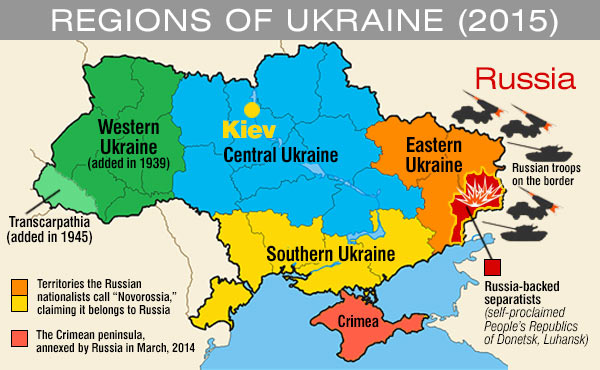
Jonathan Masters has written a very good background on the conflict in Ukraine. Ukraine became an independent (and nuclear) state in 1991 after the dissolution of the Union of Soviet Socialist Republics. In 1994 Ukraine gave up its nuclear weapons and returned them to Russia after the signing of the Budapest Memorandum. That document stipulated that Ukraine, a nuclear power at that time, would give up its nuclear weapons in exchange for security guarantees. “The US, Great Britain and Russia welcomed the decision of the Kyiv regime to accede to the non-proliferation agreement and pledged, among other things, to respect the independence and “existing borders” of Ukraine.” That agreement was violated by Russia in 2014 when it invaded Crimea and started a rebellion in the Donbas region of Ukraine. That action precipitated the sanctions against Russia by the European Union and the US, which has not altered Russian behavior at all. It is also the reason why the arms shipments to Ukraine highlighted in the recent impeachment proceedings against US President Trump.
Martin Gurri has written an exceptionally insightful essay on the rise of populism in the world over the last decade. It is, in some respects, a development that can be easily explained by the dramatic growth in income and wealth inequality in the world. But that explanation could also suggest a rise in leftist political activity, something which has been far less vibrant than the rise of right-wing politics. Gurri’s conclusion is clear: “The great political divide of our time is between the public and elites: and what matters to the public is to strike a blow at the elites.” He goes further to describe the rise of populism:
“The populism Trump represented has contributed mightily to the instability of the last decade. The public has elected outlandish characters to high office across the world: Johnson in Britain, Orbán in Hungary, Duterte in the Philippines, Salvini in Italy, Modi in India, Obrador in Mexico, Bolsonaro—whose statements make Trump, by comparison, sound like Miss Manners—in Brazil. In France, Germany, and the Netherlands, populist figures have gained ground. These are disruptors and system-smashers. If they aren’t exactly Mussolinis-in-waiting, neither are they overly concerned with the rituals and rhetoric of democracy. The populist, like the public, aims to stand against. A fundamental question, if we are to understand our moment, is whether these off-key politicians are the cause of the public’s surly mood or merely a symptom of it.”
Gurri’s answer to the question is the same as mine: populism is the result of widespread dissatisfaction by ordinary people and the elite’s inability to offer meaningful political choices:
“Whether the current crop of populists tell more or better lies than their elite predecessors can be left an open question. But that they are the prime movers in a decade of revolt may be safely doubted. The arrow of causation points in the opposite direction. From Tunisia in 2011 to Hong Kong today, the majority of protests have been leaderless—quite consciously so. These spontaneous outbursts have developed out of the same set of symptoms as populism: the decline of traditional political parties, for one. Both share the same digital vectors of communication, the same rhetoric of rage. The far spread of populism, rightly considered, should be viewed as an argument against the notion that it is personality driven. Structural and global factors appear to be at work.”
Unfortunately, Gurri does not suggest a way out.
“The public has voted bizarre characters into office for a very simple reason: democratic political institutions, and the elites who manage them, have refused to offer meaningful alternatives. The populists in all their strangeness are a message from the public that this narrow status quo cannot stand. In the age of post-truth, however, nearly the opposite message has been received by those at the top of the hierarchy.”
It is hard to believe that the world’s elites will respond in a meaningful way to the inequities that have become far too obvious to most since the Great Recession of 2008-09. Whether the populist movements can articulate a coherent world order as an alternative is also open to great doubt, particularity since the movements seem to be leaderless and not at all ideological. This is an essay worth reading.
“Hoaxes and half-truths are huge problems during epidemics. The worried well can overwhelm health-care facilities, and make it harder for medical providers to find and treat actual cases. Confused citizens might forgo sensible measures such as hand washing in favor of inefficient ones like panicked mask buying. And misinformation tends to intensify the xenophobia that emerges during epidemics. As diseases spread, “individuals find people to blame based on their prejudices, or make themselves feel less at risk by finding points of discrimination between themselves and others,” says Alexandra Phelan, who studies legal and policy issues related to infectious diseases at Georgetown University.”
These fears make addressing the disease effectively difficult even under the best of circumstances. The matter is further complicated because of the current tensions between the US and China. As of tonight, “China says a total of 28,018 cases have been confirmed and 563 people have died in the country.”
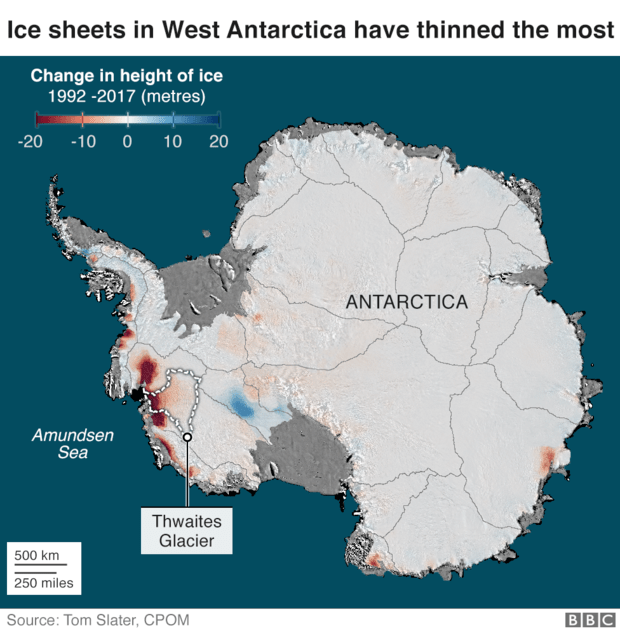
Scientists have bored a hole 2000 feet deep into the Thwaites glacier in Antarctica. The effort was an attempt to measure the water temperature at the grounding level which holds the glacier in place. The scientists found that the water temperature at that point was above freezing, indicating that the glacier may not be fully grounded in bedrock. If that temperature is distributed along the entire bedrock, then it is possible that the glacier may slip into the warmer ocean water, accelerating the melting process caused by solar radiation at the surface level. CBS News notes the significance of that possibility:
“The collapse of the 74,000-square-mile Thwaites — which some scientists see as the most vulnerable and significant glacier in the world when it comes to sea-level-rise — could release a mass of water roughly the size of Florida or Great Britain. Its melting would raise global sea levels by more than three feet, enough to potentially overwhelm vulnerable populations, the researchers said….
“According to the International Thwaites Glacier Collaboration, the amount of ice flowing out of the Thwaites and nearby glaciers has nearly doubled over the last 30 years. Melting ice from the Thwaites into the Amundsen Sea already accounts for approximately 4% of current global sea-level rise — a number that would significantly increase when the glacier crumbles.”
There is a sustained effort to find out what is affecting the Thwaites Glacier given its significance for possible sea levels in the future. We are grateful that these efforts are being supported and sustained despite the the lack of official actions on climate change.
“Russian warplanes have been supporting a recent Syrian military offensive in the border region, where opposition forces cling to a few final handholds after years of bloody civil war. Russia, a key ally of Syrian President Bashar Assad, has backed Assad’s push to quash those remaining forces in Idlib — much to the consternation of Turkey, which has troops stationed there as part of a 2018 de-escalation agreement with Russia meant to prevent accidental confrontations.
“‘Our brave soldiers are conducting security and humanitarian missions inside Syria in line with our agreements with Russia,’ Fahrettin Altun, Turkey’s communications director, tweeted in a thread posted Monday. ‘If Russia is unable to control the Assad regime from targeting us, we will not hesitate to take actions against any threat, just as we did today in Idlib.'”
“At any rate, developments in Syria are evolving in a way that further increases the economic, military and political pressure on Turkey. It is confronted with new waves of refugees and risks becoming a safe haven for fleeing anti-regime forces which might harbor fundamentalist terrorists among them. But more importantly, Turkish soldiers are surrounded by hostile forces, as two of its dozen of observation posts in Syria are already in regions captured by regime soldiers during the offensive they started in the summer.
“Ever since August, regime forces have increased their territorial gains around Idlib and these gains have no doubt taken place with the coordination and full-fledged military assistance of Russia.
“The blame of the loss of life of Turkish soldiers therefore cannot be put solely on regime forces. Moscow is also to blame.
“If Turkish soldiers are killed as a result of a policy that is being pursued by one of Turkey’s partners, that partner cannot be defined as a strategic one.”
The fighting also raises serious questions for the US, although very few media outlets in the US are paying attention. Turkey is a member of NATO and members are obliged to come to the defense of each other. If Turkey makes a territorial claim to the northwest part of Syria, then the US must defend that claim against attack. I seriously doubt that the US would take such actions in the current climate, but the obligations of the NATO Treaty would be sorely tested.
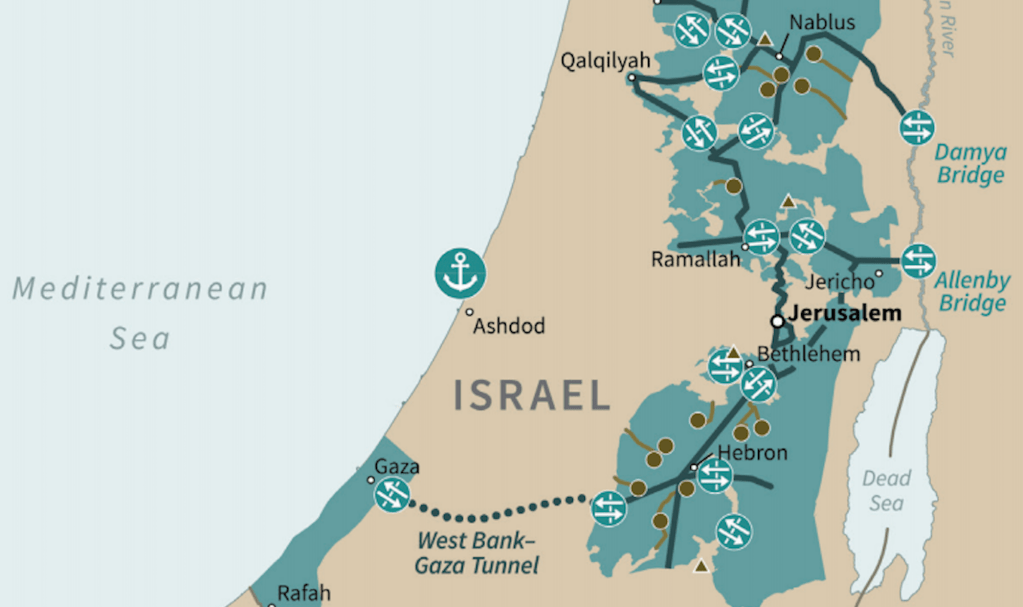
The Trump Administration has announced its Mideast Peace Plan. It should be more appropriately be termed the Terms of Surrender for the Palestinians. The plan allows Israel to annex large parts of the West Bank, including the Jordan River Valley, and in those small parts of the West Bank allocated to the Palestinians, it permits Israeli settlements. The parts of the West Bank given to the Palestinians is not wholly contiguous and the plan calls for a tunnel to be built between the West Bank and the Gaza Strip. The plan is a clear violation of international law:
“The annexation of territory is prohibited under international law. The UN Charter and UNSC Resolutions 242 and 338 explicitly forbid any country from expanding its territory by military force.
“Eliav Lieblich, an assistant professor at Tel Aviv University, told Al Jazeera that the repeated use of the term Israeli ‘sovereignty’ in the Trump plan in relation to areas of the West Bank indicates plans to annex parts of the territory.
“‘In the past, Israel used similar language to describe its application of jurisdiction to the Golan Heights and this was universally understood as annexation,’ he said.
“‘If Palestinians reject the plan, which they will, Israel will likely move to annex the territories unilaterally,’ he added.
“To Kevin Jon Heller, a professor of international law at the University of Amsterdam, the planned annexation of the Jordan Valley and all settlements in the West Bank would, if implemented, undoubtedly violate international law.
“‘What this amounts to is a land grab, plain and simple. And an unlawful one,’ he said.”
Furthermore, the plan only suggests a Palestinian state–it places a number of conditions that would have to be fulfilled before a Palestinian state could be created. In an interview with CNN’s Fareed Zakaria, Trump’s son-in-law, Jared Kushner, outlined those conditions: freedom of press, free and fair elections, respect for human rights for its citizens, and an independent judiciary,” in addition to “established transparent, independent, and credit-worthy financial institutions capable of engaging in international market transactions.” There is currently no Arab state that satisfies those conditions, including close US allies such as Saudi Arabia, Egypt, and Jordan. And, mirabile dictu, the plan gives the Palestinians 4 years to satisfy those conditions which suggests that the Trump Administration would not have to even think about the process, even if Mr. Trump is re-elected.
CBS News ran a video on wealth inequality in the US, demonstrating that many US citizens have no idea what the actual distribution of wealth in the US is. It is a sobering look into how insidious the problem of wealth inequality is to the US political system.
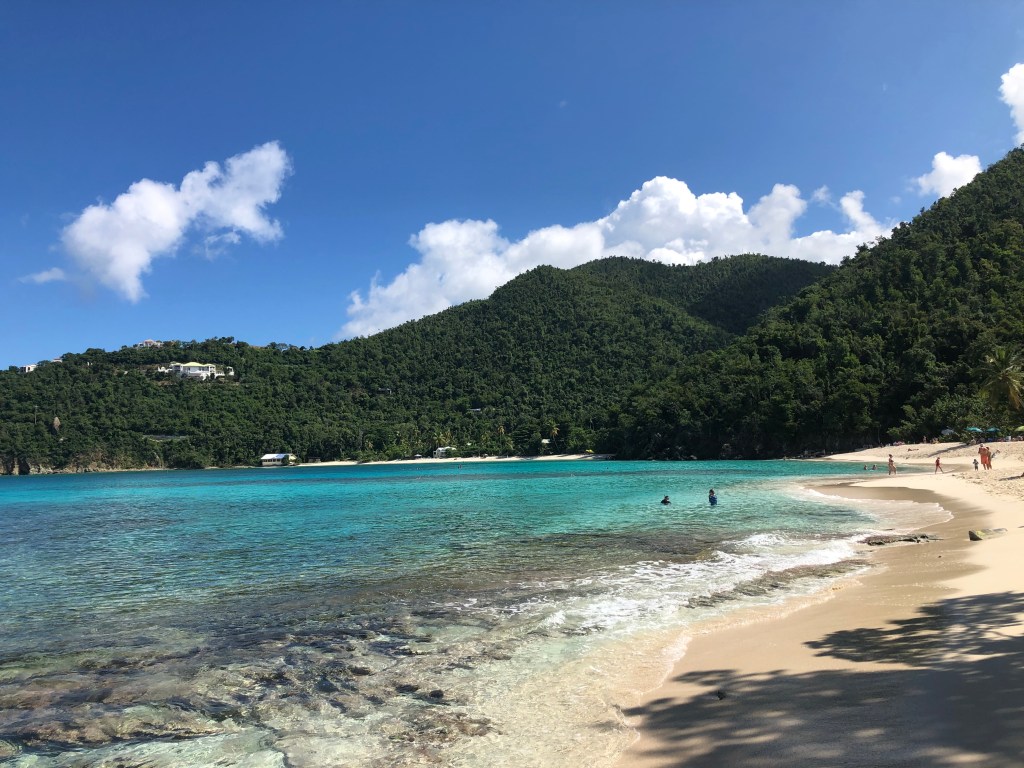
This will be my last post until 3 February. I am going on vacation and my fondest wish is to forget about domestic and international politics while I sit on a beautiful beach in the Caribbean, contemplating nothing more than the sound of waves and ice cubes clinking in a tall glass. We shall see how successful I can be.
Large protests demanding the removal of US troops in Iraq are occurring as groups sympathetic to Iran mobilize to that end. These protests accelerated after the US assassination of Iranian general, Qassem Soleimani. But the protests have also been supported by groups that are less inclined to support Iranian influence. For now, Iraq is dependent on the US for financial and military assistance and it is unlikely that the Iraqi government will demand the withdrawal of US troops. But the Iraqis are turning to other countries, such as Russia, to replace US support. The Arab Weekly reports:
“It is in that context that a new wave of Iraqi nationalism emerged that seeks to make Baghdad more independent from foreign influence and agendas, allowing it to chart its destiny and future by itself. It is a growing Iraqi sentiment that would appear to support deeper engagement with Moscow.
“Russia has demonstrated a growing intent to position itself in the Middle East. Its military intervention in Syria and work in Iraq are two examples.
“Iraq-Russia trade has grown rapidly to nearly $2 billion and Russian investments in Iraq total more than $10 billion, mainly in oil and gas, with major Russian players such as Lukoil, Gazprom Neft, Soyuzneftegaz and Rosneft all expanding their footprints.
“Russia has signed agreements to expand ties with Iraq in electricity generation, agriculture and transportation and, last year, inaugurated a command centre in Baghdad under an intelligence-sharing agreement that includes Iran and Syria.”
The US has about 5,000 troops remaining in Iraq. Their mission has changed from confronting ISIS to one of containing Iran. Without those troops in Iraq, that task would fall primarily to US air and naval power, a poor substitute for ground troops in such a task.
Francis Galvin has written a very provocative essay for the blog, War on the Rocks, entitled “Asking the Right Questions about the Past and Future of World Order“. It is an essay written for international relations scholars but its logic and language are easily accessible. Glavin goes through the debates about the current world order, punching some well-deserved holes in the prevailing debates about the demise of the rules-based order that many believe that the US created after World War II. He is careful about what he is talking about:
“First, we often think of world order as emerging from a long-term master plan and sober debate and consideration, based on deep reflection about the future. This is how things often look in retrospect, especially when described by political scientists and even historians, but that may be the product of outcome bias. In fact — as every decision-maker knows — ex ante, policymakers faced radical uncertainty about the future, and often stumbled towards ad hoc, reactive ways to create what now seems so impressive and pre-planned. We often forget the efforts and initiatives to build order that failed or were re-adapted for other purposes.
“Second, no singular world order emerged after World War II. The Cold War produced competing orders, such as the system imposed by the Soviet Union on its own country, its near periphery, and its global allies. There were some issues and areas where it would be hard to identify any order. More often than not, chaos and uncertainty, rather than order, marked decolonization and the rise of new states in Africa and parts of Asia. My focus will be on what some call the “Western” liberal world order that emerged after World War II (though that name is not without its own problems).”
Despite these very important caveats, we should keep in mind that there is almost always an “order” to world politics. We tend to think that the international system is completely anarchic. That assessment overlooks the very important sustained, peaceful interactions among peoples and states: trade, travel, migration, and culture. Even though the US world order was characterized by several violent wars and conflicts, it is also the case that there were tremendous economic and social changes, notably the dissolution of the formal controls of the European empires and the advancement of human rights.
Nonetheless, there is overwhelming evidence that some well-established patterns, such as steadily growing international trade and the influence of international institutions, are increasingly frayed. Galvin analyzes the reasons for the change:
“There are two great challenges to the contemporary world order — the dramatic rise of China and the consequences of the profound transformation of the global economy and international system, a revolutionary change on par with the Industrial Revolution. Most of the current debates on world order focus on the capabilities and intentions of a growing China. This is understandably important; in the past, rapidly-rising powers have challenged global arrangements, with calamitous military conflicts as the result. These two stories, however — the rise of China and the global dynamics of technology, demographics, and socio-economics — are intertwined and cannot be understood, or dealt with, separately. Furthermore, the second challenge — which has transformed everything from demographics to governance to how people live and work and self-identify to calculations about war and peace — is the key challenge, and the one that people aren’t focusing on enough. Beginning in the United States in 1960s, accelerating in the 1970s, and spreading and intensifying in recent decades, how the global system operates has been completely upended. It is, to a great extent, the reason for China’s rise. The consequences of this revolution are impossible to overstate and hard to fully accommodate under current arrangements.
“Much of this has to do with the digital revolution and the profound expansion of access to information, unmediated by traditional institutions. Part of it is an upending of how and where and at what cost things were manufactured, with world trade and prosperity build upon a complex and deeply integrated global supply chain. Part of it has to do with a financial revolution even larger and more profound than that which launched early modern Europe. Part of it has to do with a rights revolution that completely upended traditional categories of gender, race, ethnicity, and sexual orientation, with a focus on individual autonomy and the tolerance of difference. Part of this has to do with a complete reshaping of identity and how people live and relate to each other — individual, family, and communal — that upends historical relationships between personal autonomy and collective belonging.”
Galvin then discusses how he thinks the new world order will emerge, but the challenges of a new order are daunting. The essay demands a close read.


 World Politics News