Riots have broken out in the French northern city of Amiens. They seem to similar to the riots that occurred in 2005–young people protesting the lack of jobs and opportunities in France. There is a strong racial and anti-immigrant sentiment which has fed this discontent and it will be interesting to see how the new President, Hollande, responds to this challenge.
Stephen Walt has a great realist take on terrorism–essentially that it should not be considered so seriously given the expenditure of resources devoted to addressing it. This perspective is rock-solid realism, devoid of an emotional response the assault on values that terrorism poses.
The European economy ground to a standstill in the last quarter. France and Germany registered economic growth rates between 0.1 and 0.2 percent. Spain, Italy, and Greece all saw drops in the economic activity. The extended recession is taking a real toll on the mental health of Europeans, leading to a new category of disease, “economic suicides.” The recent data, however, suggest that the economic downturn will only get worse next year.
Ambrose Evans-Pritchard is one of the smartest financial analysts around, and he has written a short essay on the health of the global economy. Unfortunately, his analysis is pretty gloomy, suggesting that the global economy will not grow substantially for an extended period of time. His analysis of the role of debt and the concentration of wealth that accompanied that process is spot on and worth reading carefully.
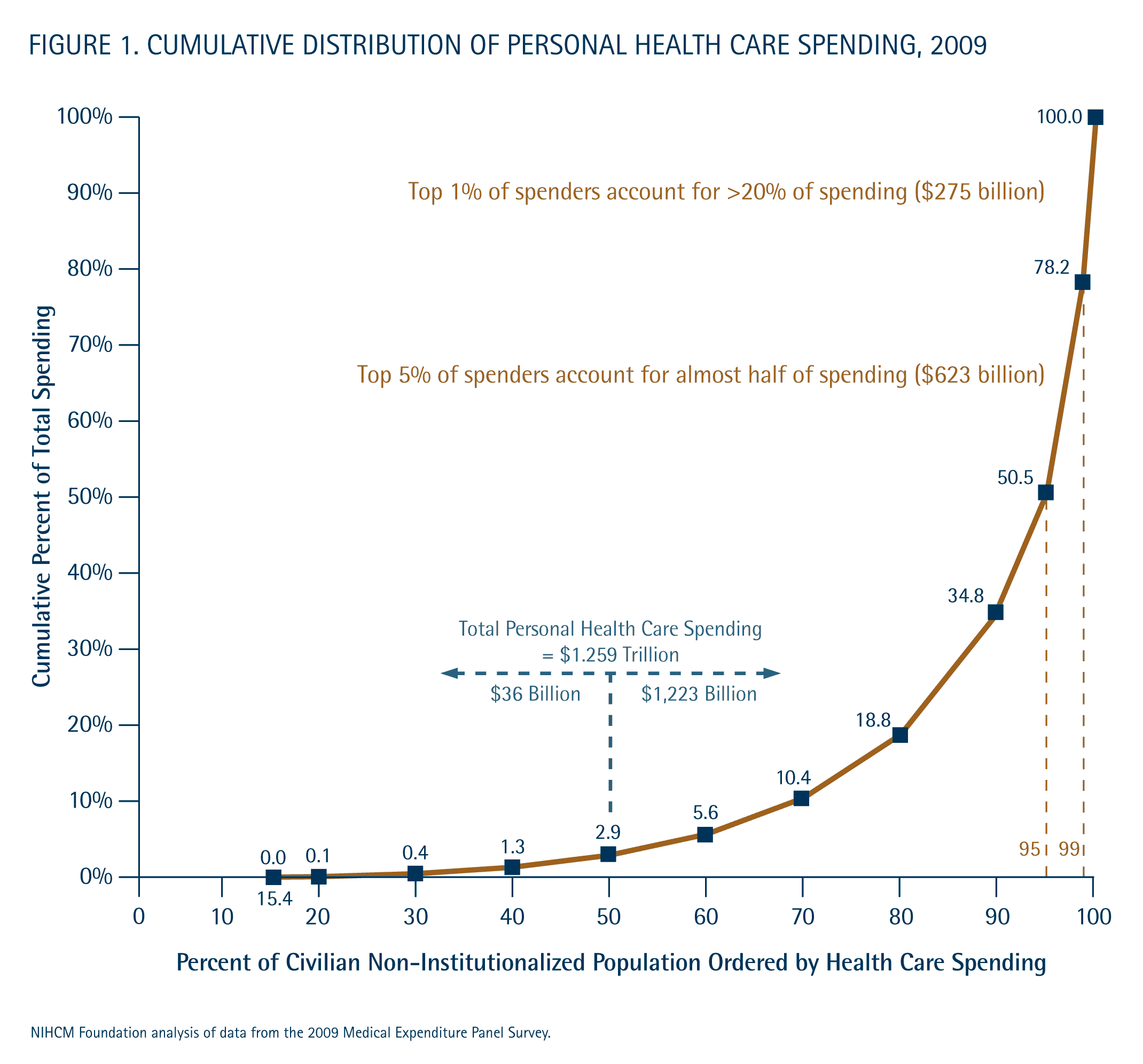
As the costs of health care reach center stage in the US election, the following graph is worth contemplating. The US cannot continue to spend as much as it does on health care is certainly true. But where to cut the spending is really the issue. As the graph demonstrates, health spending is hardly uniform: most of the spending is done by a very small number of patients, usually at the end of life. If this assessment is true, then the real discussion should be on how to think more effectively about medical procedures.
I’ve paid a lot of attention to the territorial disputes in the South China Sea, but there are other ocean disputes in East Asia. A dispute between South Korea and Japan over the status of an island group called Dokdo in South Korea and Takeshima in Japan has reached a head recently, leading the Japanese to recall their Ambassador. A group of South Korean swimmers are swimming a relay to the islands (124 miles!) and the Japanese are not amused. We’ll see ho this dispute unfolds.
The situation in Egypt continues to evolve. President Morsi has dismissed two top military leaders in an attempt to establish civilian control over the Egyptian state. It is a bold move, and it it isn’t yet clear the extent to which the military has accepted the move. If successful, however, the move holds great promise for the development of Egyptian civil society.
Israeli Deputy Foreign Minister Danny Ayalon made a rather dramatic statement to Israel Radio yesterday. He “called on the international community to declare the diplomatic channel with Iran over its nuclear program a failure.” When pressed for details about how much longer the world should rely on the US strategy of embargoes and sanctions, Ayalon replied “several weeks.” The language signals a very different timeline than the one seemingly held by the Obama Administration, and it is very difficult to believe that President Obama would want an attack before the November election.
Mitt Romney has selected Paul Ryan of Wisconsin to be his Vice-Presidential candidate. The selection has a number of dimensions, but one is pertinent to our interests: there is virtually no foreign policy experience on the Republican slate. Foreign policy is rarely a major issue in US elections, and there have been a number of American Presidents with little or no foreign policy experience. But the US has changed dramatically over the last 20 years, and it is hard to imagine how foreign policy could count for so little. Some of the foreign press have weighed in on the selection.
The BBC has an article distinguished by its depth of analysis on Israeli-Azerbaijani relations. Azerbaijan and Israel have forged a very strong anti-Iranian alliance. Curiously, the population of Azerbaijan is overwhelmingly Muslim, but the government maintains a strong secular position and regards the religious foundations of the Iranian state as a threat to that position. In the case of an Israeli attack on Iran, there are strong suspicions, strongly denied by the government, that Azerbaijan will allow its territory to be used as forward bases for the attack.
Reuters is reporting that the US and Turkey are exploring the option of a no-fly zone in Syria. Similar tactics were tried in Iraq, and, in a modified way, in Libya. But in both of those cases, the UN Security Council approved the move. It remains to be seen if China and Russia would approve the intervention. There is also the possibility that the US and Turkey could try to persuade NATO to implement the policy, sidestepping the Security Council as was done in Kosovo in 1998. In that case, the danger of the violence spilling over into a wider regional war increases dramatically.
Over the last three weeks, the tragedy in Syria has slowly been escalating into a much larger conflict. The Russians, the Iranians, and even the Chinese have stepped up their activities in Syria, and today the US singled out Hezbollah as an active participant in the brutal suppression of the civilian population. We will have to wait for the evidence supporting this accusation, but its practical effect is to commit the US to specific outcomes in Syria, e.g., to preventing any outcome which may have the effect of enhancing Iranian interests in the region. There is little doubt that this preference has always been the case, but the public pronouncement puts US credibility on the line. It also signals a clearer commitment to Israeli preferences in the region.
The Chinese economy has begun to slow sharply, raising concerns about the health of the global economy. The other emerging economies (Brazil and India, in particular) have also begun to slow, and the European economy is likely in a full recession. The US economy is the only one showing any signs of growth, and its growth (1.5%) is anemic. It does not appear as if there will be a dramatic slowdown at this point, but we should keep our eyes on food prices as the effects of the drought in the US begin to disseminate. We should also keep an eye on oil prices as tensions continue to rise on the issue of Iranian influence in the Middle East.
Stephen Walt has a great essay on foreign policy and the US election. Both Obama and Romney have not paid a great deal of attention to foreign policy, but it is a critical part of the job and we can’t afford to ignore those concerns.
The increasing exploitation of natural resources is a matter of great concern, but perhaps the most important resource constraint humanity is facing is fresh water. The overuse of fresh water is staggering, and for those areas that rely on underground aquifers, the concern is that these aquifers are being depleted at a rate that cannot be sustained. This map provides a rough idea of where these areas are and how severe the depletion rate is.
The intelligence “war” between the US and Israel on the Iranian nuclear weapons program continues. There is a report that President Obama has received a new National Intelligence Estimate (NIE) that claims that Iran is no on the verge of building a nuclear weapon and that it has not even made a decision to build one. The Israelis are making a claim that suggests that the situation is becoming even more urgent. We are left in a world of “reports” about “reports.” Obviously, a decision to go to war requires much more certitude than seems to currently be the case.
It is always important to remember that all political problems are, in theory, resolvable. We often fall into the trap of thinking that political disputes are etched in stone. They are not–the positions taken reflect one possible interpretation of interests and values. Interpretations, however, can be changed. What matters is imagination and a desire to solve the problems. Such is the case in the boundary disputes in the South China Sea which reflect the competing positions of China, Taiwan, the Philippines, Vietnam, and Malaysia. Each of these states asserts that their positions are immutable. But with just some simple differences in assumptions, all these disputes can disappear.
As we watch the Arab Spring unfold in a bewildering variety of forms, it is useful to think about how revolutions are often perceived by outsiders. Foreign Policy has an interesting essay on how the British viewed the American Revolution.
The Iranians have publicly declared their support for the Syrian regime, even as defections within Assad’s inner circle continue. The visit by Iranian officials is a signal of how important the Iranians regard the Syrian alliance. It is also a signal to the Russians and to the Americans. The geopolitical stakes are increasing in this situation.
The Philippines is the latest victim of extreme weather as heavy rains pounded the capital of Manila. About 30% of the city was under at least waist-deep water. The city was already reeling from flooding a few days ago from Typhoon Saola.
We use nation-states all the time as the essential unit of analysis in world politics. But most everything that is important ignores territorial boundaries. Zero-Hedge posted an interesting article and map on unemployment in Europe. The lines of unemployment follow their own logic.
New York state has filed charges against a British investment bank, Standard Chartered, for doing business with Iran in violation of the various laws that have been passed by the US Congress against such transactions. Apparently these transactions have been going on for some time and the New York office wired the British home office about the serious implications of continuing them in 2006. The response of the British office is outlined in the New York complaint and it is a classic. From page 5 of the complaint: “As quoted by an SCB New York branch officer, the Group Director caustically replied: ‘You f—ing Americans. Who are you to tell us, the rest of the world, that we’re not going to deal with Iranians.'” Such is life in a globalized world.
Many analysts assert that poverty breeds terrorism and violence against authority. That connection seems logical, but it doesn’t sit well with the normal experiences of poor people: they have precious little time to devote to such activities. Now research has been done testing the proposition, and it seems as if the connection really does not exist. Poor people often suffer greatly at the hands of terrorists and have little sympathy for their activities.
Foreign investors almost inevitably arouse animosity over time, and the Chinese seem to be experiencing the anti-imperialist backlash common to raw materials investment. In Zambia, a Chinese supervisor was killed in a coal mine dispute over wages. China’s push into Africa has been substantial, and many of its investments are beginning to elicit similar reactions.
The Palestinians have renewed their effort to obtain non-member observer status at the United Nations. A meeting of the Non-Aligned Movement scheduled to be held in the West Bank was disrupted by the Israeli refusal to allow certain members of the movement, representing countries that do not have diplomatic relations with Israel, to enter the West Bank. The Israeli action is not fully consistent with the obligations it agreed to in the Oslo Accords of 1993. We will have to see how this action affects the Palestinian campaign to receive UN recognition.
The Russian press is reporting on US-Israeli plans to attack Iran. The Russians have good relations with Iran and Syria and are therefore paying a great deal of attention to the possibility of an attack on Iran given the current focus on instability in Syria. So it is difficult to assess how accurate the report actually is. On the other hand, the Russians have very good intelligence services, so it is not appropriate to dismiss the report out of hand. Pressures to attack Iran before November are increasing on almost a daily basis, and there are many forces in play right now. We should pay close attention to all bits of evidence.