Archive for the ‘World Politics’ Category
The US budget debacle has elicited comments from various key players abroad about whether the US is a reliable economic power, and whether the dollar should retain its current privileged status. The concerns have begun to become more probing as analysts have tried to dissect the roots of the crisis. Jose Antonio Ocampo is a highly regarded economist who has often been critical of US policies. He has written an essay about the US’s privileged role in the International Monetary Fund.
The spying by the US National Security Agency (NSA) continues to roil the world. First, there were reports about spying on the Brazilian government which caused the Brazilian President to cancel a state visit to the US. Next came revelations that the US spied on the Mexican government on Mexican position papers on how to bargain with the US over certain trade matters. Now, it appears that the NSA intercepted over 70 million telephone calls in France. Spying is an old tradition in world politics, and there is no government that does not do it. Getting caught spying, however, is a grievous offense–it questions the competence of the spook and whether the illicit information could be used for a broad variety of reasons not related to statecraft.
There are a number of countries that appear to be heading toward some sort of debt crisis as economic growth slows down. The reduced economic activity lowers the tax revenues of a state, but rarely is that decline matched by a decline in expenditures. Global debt, therefore, is rising at quite a fast rate. We use credit rating agencies to measure the degree of risk posed by certain countries, and here is an essay that explains how the ratings are determined.
Thirty Greenpeace volunteers are in a Russian jail after they boarded an offshore oil rig to protest drilling in the Arctic. So far, they have been refused bail on charges of piracy. The Russian public approves of the harsh charges, and there is little question that the Greenpeace protesters were in Russian waters. What is unusual, however, is how little protest the harsh charges have elicited from the member states representing the 30 volunteers: 18 different states. Apparently, on questions of sovereignty, the world still gives tremendous latitude.
Two teenagers were arrested in Morocco after they posted a photograph of them kissing on Facebook. They were arrested on charges of violating public decency and they are part of a larger movement to challenge the social mores embedded in the law. The definition of human rights varies considerably across cultures. The internet hacker group, Anonymous, has decided to enforce its own definition of human rights, arguing that it is a question of freedom of speech.
The Christian Science Monitor has an impressive series of graphics trying to answer the question, “Why do Israeli Settlements Expand More During Peace Talks?” The question is a troubling one since it raises the distinct possibility that the peace talks between the Israelis and Palestinians may do more harm than good.

Worried about a Zombie invasion? Don’t worry, we have great allies in our fight against the walking dead. (Not a quiz link)
Anti-austerity protests broke out in both Italy and Portugal. Both countries have been forced to cut social spending and fire government workers in return for financial assistance from the European Central Bank, the European Union, and the International Monetary Fund. Unemployment is very high in both countries and economic growth is virtually non-existent. Young people are bearing the brunt of the austerity programs as jobs have disappeared and hiring has essentially stopped.
Argentinian President, Cristina Fernandez Kirchner, has been hospitalized for a blood clot. Kirchner has been President since 2007, and her predecessor was her late husband who was first elected in 2003. The ten years of power have been controversial, and the economy is in very bad shape. Inflation is running at about 25%, and foreign investors are leery of the policies of the government which have included some nationalizations which were not handled in a manner consistent with international law. It is likely that her party will lose the upcoming election.
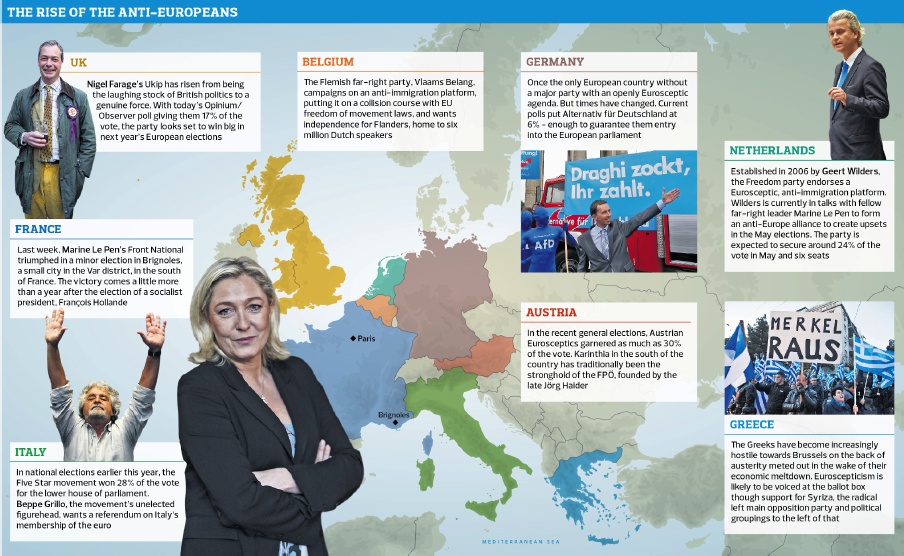
The anti-immigrant and anti-European Union movements in Europe are becoming stronger and more deep-seated. The economic slowdown in Europe has unleashed some dangerous politics, reminiscent of the movements in the 1920s and 30s. The Guardian has an informative graphic on the more prominent movements rising now.
For the first time in the history of the UN, an elected member state has refused to take its seat on the UN Security Council. Saudi Arabia declined to take its seat because it believes that the Security Council is unable to perform its duties in Syria and that the Council is plagued by “double standards.” The decision is a blow to the prestige of the Council, and represents the thinking of many other countries. The Russians, however, derided the Saudi decision, reflecting the current bad relations between the two states.
Pakistan has estimated that out of 2,200 people killed by US drone strikes, about 400 were innocent civilians. The use of drones is a very controversial military tactic, although the US defends the practice since it believes that the strikes have been effective in killing terrorists.
Ever wonder how common your name is? The Atlantic has published a fascinating graphic on the popularity of names for girls since 1960. It really is a remarkable commentary.
The Xinhua editorial calling for a “de-Americanized” world has been resonating throughout the foreign press, although it has received very little attention within the American media. Pepe Escobar is a regular contributor to the Asia TImes and I think that he is a very perceptive observer of world affairs. He picks up the Xinhua theme and makes some very good points, as well as some outlandish ones. The theme certainly picked up steam given the circus in Washington these last few weeks, but it would be a serious mistake to think that a structural shift away from US power is imminent. It will happen, but less quickly than many believe. Der Spiegel has a solid essay on the problems facing the emerging powers.
The Overseas Development Institute, one of the oldest and prestigious global poverty think tanks, has published a report that links extreme weather events to poverty. The poor are most susceptible to the disruptions caused by drought, flooding, and extreme rainfall. The poor also lack the resources to recover fully from such calamities. The number of people who are living in regions that are experiencing increased numbers of extreme weather events is considerable, and addressing this aspect of climate change is of urgent importance.
One of the great unknowns of the US-Iraq war that began in 2003 was the number of Iraqis killed. The US quite deliberately did not keep count of the enemy killed because it wanted to avoid the trap of keeping a “body count” as it did in Vietnam. It was also very difficult for the press and international and non-governmental organizations to operate within Iraq. The University of Washington Department of Global Health conducted a meticulous study in Iraq and has published its findings: the study estimates that the number of Iraqis killed as a result of US actions at 461,000. The number is consistent with previous estimates, but is considerably higher than most people think.
One of the very interesting things about the conflict in Syria is the fact that the US and Iran have somewhat compatible interests. The Iranians want President Assad to survive, and the US does not want the Sunni rebels who wish to overthrow Assad to succeed. Though these interests are not the same, these interests are both opposed to Saudi Arabia’s interest which is to see the Sunni insurgents succeed. If given a choice, the US would likely prefer Assad to survive rather than see a radical regime seize power in Syria. If Iran and the US could see their mutual interests, there may be a better opportunity to bring peace. If Assad were to survive, perhaps the US could demand a clear policy of reconciliation after the conflict ends.
The economic situation in Europe as a whole is precarious, but the situation in Greece is worse than anything we saw during the Great Depression of the 1930s. The inability of Greece to regain economic growth is, in large part, a result of the misguided “austerity” measures imposed on it by the EU and the IMF. The poverty of the policy is well-demonstrated by this long essay by C. J. Polychroniou, Unfortunately, the policies are similar to the ones being pushed in the US by those who support the Tea Party.
Parag Khanna is a senior research fellow at the New America Foundation and has written an op-ed piece for the New York Times on the end of the nation-state. It is a very insightful essay, but I’m not sure that the conclusion follows logically. I will concede that the complexity of the layers of authority in the contemporary world is mind-boggling, but I’m not sure that the ultimate power of the nation-state is being eroded. What we need to test that proposition is to see some sort of conflict between the nation-state and some of these completing authorities.
The humanitarian tragedy in Syria overshadows all other considerations. But it is also clear that besides losing moral standing in the world, the US is losing strategic ground there as well. The forces backed by the Western powers are steadily losing territory to the more radical groups fighting against Assad. Groups from Iraq are prevalent in the fighting and al Qaeda groups are steadily becoming more powerful. If these forces succeed in seizing control, Western efforts to support liberal movements in the Middle East will suffer a severe setback.
The National Front in France has won a by-election in southeast France by a wide margin. The National Front is a far-right group that has made anti-immigrant sentiment a central objective, and discontent with the current Socialist government has broadened its appeal. The by-election suggests that anti-Euro feelings in France are increasing, and the European Parliament elections are scheduled for next May. The trend does not augur well.
China’s official news agency published a very long article arguing that the world needs to free itself from the influence of the United States since it does not seem as if the US is capable of behaving responsibly. The current stalemate in Washington has shaken the confidence of many countries in the world, but the Chinese opinion is quite dramatic: “Such alarming days when the destinies of others are in the hands of a hypocritical nation have to be terminated. . .A new world order should be put in place, according to which all nations, big or small, poor or rich, can have their key interests respected and protected on an equal footing.” Unfortunately, the world is far from being able to choose a successor to the US, and the Chinese offer no real alternative.
Chinese exports fell unexpectedly by 0.3% in September (compared to last September), raising serious questions about the state of the global economy. The biggest drop was to countries in Southeast Asia, and analysts fear that the downturn is due to a fear that US monetary policy will stiffen as the Federal Reserve slows down its policy of quantitative easing. That easing will likely cause currencies around the world to rise leading to reduce spending on imports. The uncertainty over US budget and debt policy will also serve to aggravate that tendency.
We often have the sense that the media is not always reporting accurately, and nowhere does this suspicion arise more often than on the issue of climate change. Media Matters for America has done a study of media reporting on climate change and found that the media often try to present a “balanced” point of view by interviewing people who reject the possibility of human induced climate change even if their scientific credentials are lacking. The strategy thus leads to the sense that climate scientists themselves are having a similar debate, a conclusion that is most certainly not the case.

If you wish to be really spooked about climate change, you should check out the new research just published by a team of Rutgers geologists. I have no credentials whatsoever in assessing their findings.
Apparently, the Greek Party, Golden Dawn, has established chapters in the US. The party which is unapologetically sympathetic to Nazi ideology believes that it can find sympathetic followers in the US. It is hard to assess its popularity in the US, but it will undoubtedly find many frustrated Americans who might be looking for an alternative to the usual politics in Washington.
The east coast of India is bracing for the cyclone, Phailin, which is both very large and incredibly powerful. In US terms, the cyclone is easily a Category 5 hurricane, and the cyclone spreads over 1,000 miles from India to Myanmar. Mass evacuations have been ordered, but the expected damage will be considerable.
The Organization for the Prohibition of Chemical Weapons has been awarded this year’s Nobel Peace Prize. The selection was due in large part to the critical role the OPCW is playing in the chemical disarmament of Syria. The announcement doubtless disappointed those who wished to see Malala Yousafzai win the prize, but the selection is probably directed toward reinforcing the OPCW’s position in Syria. The Nobel Committee likely assumed that the prize would lend great legitimacy to the effort to disarm chemical weapons.
The current stalemate between the Republicans and the Democrats offers a fascinating opportunity to think about the balance of power. It is, after all, a power struggle between the two parties, and the standoff is an example of how two states find themselves on the brink of war. The Atlantic, has a great article on how the negotiations are playing out, and how important it is to find an outcome that does not eliminate an essential actor. Or, perhaps, why a power struggle can force a major actor to redefine its interests.
The European Parliament has awarded Malala Yousafzai its prestigious Sakharov prize for human rights. Yousafzai was shot by the Pakistan Taliban for her outspoken advocacy for education for girls and women in Pakistan. Her courage has been an inspiration to millions and the award is well-deserved.
The BBC has an article that reviews world reactions to the current stalemate in Washington, DC. The article emphatically refutes the idea that there is a sharp distinction between domestic and international politics. Unfortunately, the US Congress does not seem to appreciate the responsibilities of global power and seems incapable of understanding how its actions literally affect billions of people.
French President Hollande has issued a dire warning about the rise of right-wing parties in Europe, arguing that their rise could fatally compromise the European integration process. Hollande was particularly concerned about how well these parties might do in the elections for the European Parliament scheduled for next May. The rise of these parties is clearly a continent-wide phenomenon with virtually no country immune from the appeal of the far-right.

