The US Department of Defense issued a “roadmap” for how it will address the problem of climate change. [I will not ask any quiz questions from the report–it is too long] The Pentagon clearly regards the process as a national security threat. Its introduction to the document reads in part:
Among the future trends that will impact our national security is climate change. Rising global temperatures, changing
precipitation patterns, climbing sea levels, and more extreme weather events will intensify the challenges of global instability,
hunger, poverty, and conflict. They will likely lead to food and water shortages, pandemic disease, disputes over refugees and
resources, and destruction by natural disasters in regions across the globe.
In our defense strategy, we refer to climate change as a “threat multiplier” because it has the potential to exacerbate many of
the challenges we are dealing with today – from infectious disease to terrorism. We are already beginning to see some of these
impacts.
The report indicates that adapting to climate change is no longer a future consideration, but one that requires immediate changes in defense strategy.
The British Parliament has voted by 274 to 12 to ” ‘recognise the state of Palestine alongside the state of Israel’ as part of a ‘contribution to securing a negotiated two-state solution’.” It is a non-binding vote and the British Prime Minister has said that he will not act upon the motion. But the motion was sponsored by the Labour Party, suggesting that if it were to win the next election, it would change the policy toward Palestinian recognition. The vote follows the Swedish decision to recognize Palestine (which was an official change) and indicates a change in attitudes toward the Israeli-Palestinian conflict in Europe.
After the Beijing government broke off negotiations with the Hong Kong protesters, the people returned to the streets. There are rifts developing within the protest movement about the most effective strategy to move forward, but a large number believe that occupying the streets remains the best method. Unfortunately, there is a counter-protest movement developing, comprised of some people supportive of the Beijing position and frustrated with the protests but also some masked thugs who are resorting to physically attacking the protesters.
While the world is focusing on the tragedy unfolding in the city of Kobani, the Islamic State has made steady progress toward taking control of Iraq’s Anbar province. The province sprawls from the Jordanian border to the western suburbs of Baghdad, and it is primarily populated by Sunni Muslims, some of whom may be sympathetic to the IS. Iraqi authorities, however, are very concerned, and the leader of the province has called for the US to send ground troops to stem the tide. President Obama will not accommodate that request but it is ironic that Iraq was so insistent on the total withdrawal of US troops in 2012.
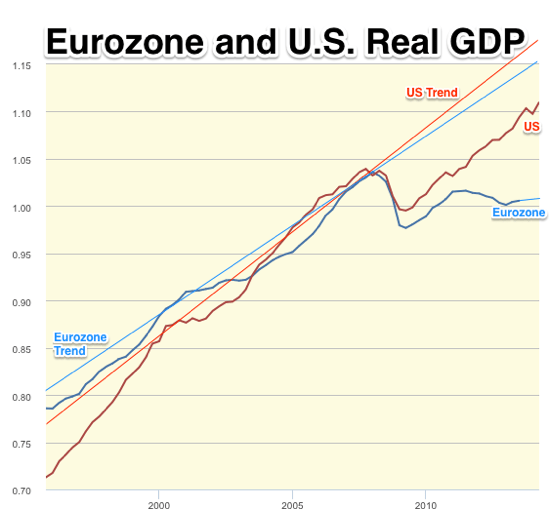
The global economy appears to be headed toward an unfortunate slowdown. Stock markets across the globe declined rather dramatically last week (the Dubai stock market declined 6% today) and the IMF issued a gloomy forecast. It is impossible to figure out what will happen next, but it does seem clear that national governments do not appear to have a plan to stimulate their economies. The economics editor of The Guardian has written an essay outlining his predictions for the future, and his outlook is not at all comforting.
Marina Silva has endorsed Aceio Neves for the upcoming Brazilian Presidential election. Silva came in third place, and there was some speculation that she would give her endorsement to Dilma Rousseff rather than the pro-business candidate Neves. Silva had asked Neves to support “land reform measures and better protections for indigenous communities as well as a demand that he drop plans to reduce from 18 to 16 the age at which minors can be tried as adults for serious crimes.” Neves has promised to act on the first two demands, but indicated that he will not change his position on the age at which juveniles can be tried as adults. Silva’s support increases the likelihood that Neves will win the election. We will see how Rousseff handles the end of the campaign.
In the face of an incredible tragedy, the real heroes of the Ebola crisis in West Africa are the local doctors and nurses who work selflessly to help the afflicted. They are aided by the group, Doctors Without Borders, which should also be regarded as heroic. The organization is fiercely independent and its mandate and method of operation completely repudiates the idea of the nation-state: it focuses only on the people who need medical assistance regardless of the political situation in a crisis. The New York Times has an article that gives a great background to the organization. And the US National Public Radio conducted an interview with some of the doctors working in West Africa. The last doctor interviewed is one of my oldest friends, Dr. Cameron Bopp, who was working in Monrovia, Liberia.
A Japanese medical study has indicated that male babies may be more susceptible to climate change than female babies. We have known for some time that female babies survive at a higher rate than male babies (even though the conception of males tends to be a little higher than for females). This study, however, suggests that temperature may have an adverse effect on male survival rates. It is far from a definitive study but we perhaps have another reason to question the effects of global warming on human society.
The UN is warning of a humanitarian disaster if the Islamic State seizes control of the town of Kobani (Ayn al-Arab in Arabic). Kurdish fighters are trying to prevent the takeover, but they are completely outgunned and Turkey refuses to open its borders so that the Kurdish fighters can be resupplied. The US has stepped up air strikes near the city, but the strikes are not likely to slowdown the IS advance. A UN official warned of a crisis roughly equivalent to the slaughter in the Bosnian town of Srebenica in 1995. In that incident thousands of innocents were slaughtered and the US was powerless to stop the violence. The Turkish refusal to allow aid to flow to the Kurds in Syria has led to increased violence within Turkey by Turkish Kurds.
The Hong Kong protests seem to have died down, but the Beijing government has broken off negotiations with the protesters after the leaders of the protests refused to encourage the protesters to leave the streets. Perhaps the street protests will return, but the next steps are unclear. One thing is certain: the discontent will not simply disappear. The issues are not merely political–they are also economic. The disparities between rich and poor in Hong Kong are one of the underlying causes of the dissatisfaction.
For those of you who follow economic news, you know that the price of oil has gone down dramatically. Part of the decline is due to reduced demand in world markets because economic growth has declined globally. But the oil producers, specifically Saudi Arabia, has continued to pump oil even though demand has gone down. This strategy appears to be a deliberate strategy to harm two other oil producers–Iran and Russia–who demand upon a very high price for oil Michael Klare, a Professor at Hampshire College, argues that this strategy is designed to persuade Iran to drop its nuclear program and Russia to stop its support for President Assad of Syria. The theory is certainly plausible, and we will have to see if it works.
Malala Yousafzai and Kailash Satyarthi have won the Nobel Peace Prize for 2014. Yousafzai is a Pakistani teenager who has worked hard promoting education for women and girls despite being shot by extremists who wished to silence her advocacy. Stayarthi is an Indian who has tirelessly worked to stop child trafficking and labor. The award is, as is always the case, a political statement against those who do not believe in the equal rights of women and children. But it goes further by offering the award to an Indian and a Pakistani together.
One of the curious elements of the US’s move to create a coalition against the Islamic State is the unwillingness of some of its allies to move forcefully against the group. No where is this more apparent than in the case of Turkey. Turkey has a great deal to fear from the establishment of a Caliphate in Syria and Iraq. As a Muslim country that also claims to have a secular authority, Turkey should be very concerned about how the Islamic State might affect Turkish politics. Yet the Turkish fear of arming the Kurds, is holding the country back from its clear national interest. It appears as if Turkey is waiting for the IS to destroy much of the Kurdish population before it is willing to take a stand. Needless to say, the Turkish Kurds do not take this position kindly.
The Occupy Central movement in Hong Kong is at a critical turning point. Support for the protests is waning, yet it is far from clear that the objectives of the group will be satisfied. A change in tactics is clearly necessary, but it is difficult to see how the movement should change in order to keep its objectives visible to the larger Chinese population.
India and Pakistan are exchanging fire in the disputed area of Kashmir, and the violence seems to be greater than it has been for nearly a decade. There is always instability along the Line of Control in Kashmir, but recently both sides seem to be adopting a more confrontational stance. Civilians are fleeing the region in an attempt to obtain safety, but there does not seem to be a desire on the part of either side to resolve this crisis quickly.
The International Monetary Fund (IMF) has issued its economic outlook for 2015 and its predictions for global economic growth next year have been lowered from 4% to 3.8%. The drop does not sound like much, but it is rather serious given the slow growth of recent years. Indeed, the Director of the IMF, Christine Lagarde, calls the projection a warning of the “New Mediocre.” The IMF believes that growth in Europe, Brazil, Russia, and China will slow considerably next year, offset slightly by higher growth in the US.
The protests in Hong Kong appear to be winding down. Discussions between the government and the protesters are ongoing, but very little is known about whether any progress is being made. The protesters seem to have accepted the fact that their point has been made, but also realize that continuing the protests would lead to a loss of support within the larger Hong Kong population as the disruptions begin to take a toll socially and economically. The open question is what will happen if the negotiations prove to be unproductive.
Kim Jong-eun has still not emerged from his long absence from the public eye. He has not been seen since 3 September and rumors are beginning to swirl. The rumors have been stimulated by the visit of North Korea’s Nos. 2 and 3 military leaders to South Korea–a visit with only one day’s notice. In addition, the nation’s capital Pyongyang has been on lock-down since 27 September, with entries and exits tightly restricted. Finally, he missed the Supreme People’s Assembly, one of the most important political events on the North Korean calendar. Kim Jong-eun might be the victim of a coup.
The protests in Hong Kong are entering a critical phase, and it appears as if an agreement may be in reach, at least with the more moderate protesters. The protests are clearly identified as political since the main issue seems to be how candidates for office are selected. But there is also an economic undertone to the protests which has not been openly articulated: the growing economic gap between the rich and poor in Hong Kong. Hong Kong is no different from the rest of China or the rest of the world. The growing economic disparity seems to be a structural feature of the process of globalization.
Brazilian President Dilma Rousseff won a plurality of votes in Sunday’s election, but failed to achieve a majority vote. She will therefore face the center-right candidate, Aecio Neves in a run-off election on 26 October. Surprisingly, the environmentally-focused candidate, Marina Silva, did not do well in the election, despite having a very strong beginning to her campaign. Neves is a former governor of Brazil’s second most populous state, Minas Gerais, and comes from a politically active family in Brazilian history. The run-off election will be a classic confrontation between center-right and center-left.
Great Britain estimates that about 50-60 women have left Britain to join the Islamic State in Syria. We know very little about the motivations of those who have emigrated from the West to join the group, and even less about the specific motivations of women in making the move. It’s not clear that women have motives that are different from men, but that possibility certainly exists. As the dispute between the West and the IS unfolds, it will be highly instructive to discern the objectives of those who emigrate. It does seem to be the case that those who emigrate are disillusioned with life within a liberal society.
For those in the class who wish to follow the protests in Hong Kong, the Occupy Central Secretariat (author is unknown) is maintaining an English blog and a Twitter feed. I won’t be asking any questions about these sites, but though that many of you might be interested in getting first-hand information even though the reports may not be entirely accurate.
Mexican authorities have recovered the remains of at least 34 bodies believed to be those of students who went to the city of Iguala to protest in support of striking teachers. The remains were found in mass graces, and the students are believed to have been executed by rogue police associated with drug cartel thugs. Gang-related violence has been a serious problem in Mexico and although Mexican President Enrique Pena Nieto has made some progress in addressing the scourge, obviously much more needs to be done.
Israeli Prime Minister Netanyahu gave and interview with CNN’s Fareed Zakaria and in it, he responded to those who support a Palestinian state. His comments suggested that a future Palestinian state would need to be very different from the traditional nation-state. Specifically, Netanyahu argued that full sovereignty could never be held by a Palestinian state because of the threat a fully sovereign state would pose to Israeli security. The comments were intriguing because Netanyahu did not reject outright a possible Palestinian state.
Troops from the African Union and Somalia have taken control of the city of Barawe, a port city Al Shabab has held since 2006. If those forces can retain control of the city, the move will deprive the Al Shabab militants of access to the sea and relieve pressure on the capital city of Mogadishu. The militant group is still in control of a great deal of Somalian territory, but it appears as if opposition to the Islamic group is becoming better organized and more durable.