The status of women varies tremendously across the globe. Many countries have made great strides in creating equal opportunities for women in a variety of circumstances, and there really is no breakdown by economic development: some rich countries are progressive as are some poorer countries. But some rich countries still have a long way to go. One richer country, South Korea has laws that promise greater equality, but the culture of South Korea still does not afford women many opportunities in the workplace.
The U.N.’s 2015 “Children and Armed Conflict” report identified the Saudi Arabian led coalition in Yemen as one of the major contributors to deaths of children in the world. In part, the report asserted that:
“6. In Yemen, a particularly worrisome escalation of conflict has been seen. The United Nations verified a fivefold increase in the number of children recruited in 2015 compared with the previous year. This compounded a sixfold increase in the number of children killed and maimed in the same period. These alarming trends continued into early 2016.
7. Attacks on schools and hospitals were prevalent in 2015, linked to the increasing use of air strikes and explosive weapons in populated areas. Armed groups particularly targeted girls’ access to education, although attacks on schools and hospitals were also carried out by government forces. Member States should consider, where necessary, changes in policies, military procedures and legislation to protect schools and hospitals.”
The United Nations Human Rights Committee issued a judgment that Ireland’s laws prohibiting abortion are a violation of human rights. Ireland currently has the strictest abortion laws in the European Union. The judgment will pose a serious political issue for the Irish government and it is the first time that the right to an abortion has been so vigorously defined and supported in international law. But the ruling is also a major infringement on Irish sovereignty. There may be repercussions to that intrusion.
Indian Prime Minister Narendra Modi gave a speech to the US Congress today and the tone of the speech was quite friendly to US interests. Historically, India has tried very hard not to align itself with the great powers, reflecting the suspicion of the politics that was responsible for the colonization of India by the British. Modi was open to increased contact with the US, including closer military and strategic relations. The shift in Indian foreign policy is based largely on its growing concern about Chinese power in the region.
Prime Minister Modi Before the US Congress
One of the reasons why globalization accelerated so sharply at the end of the 20th century was because communications and transportation technologies made far-flung supply chains feasible. Because components of manufactured products could be transported efficiently, producers of those products simply found the lowest wage areas suitable for producing each component. With increasingly automated and roboticized production processes, labor costs have become significantly less important in more recent years. With reduced labor costs, production is now taking place in areas that offer other cost advantages, such as reduced environmental protection costs, lower taxes, and better infrastructure. In some sense, globalization has brought about its own demise.
The Global Peace Index 2016 has just been published and it suggests that the world is becoming less peaceful as violence spreads to more countries. According to The Telegraph: “There are now only 10 countries considered completely free from conflict; Botswana, Chile, Costa Rica, Japan, Mauritius, Panama, Qatar, Switzerland, Uruguay, and Vietnam.” Since 2015, 81 countries have become more peaceful, and 79 countries have become more violent. Unfortunately, the rise in violence outweighed the more peaceful variables.
Reuters is reporting that North Korea has restarted recycling plutonium from its reactor at Yongbyon. Recycling plutonium from spent nuclear fuel is a more efficient process in creating the necessary fuel for a nuclear bomb than simply enriching uranium. The move indicates that North Korea wishes to build more bombs more quickly. No one has any firm evidence about how many bombs North Korea already has, but the accelerated building process is curious. North Korea already has a sufficient number of weapons to deter an attack from a nuclear power. Perhaps it is building more for sale on the black market.
Exhaust plumes seen at Yongbyon’s Radiochemical Laboratory’s Thermal Plant.
There was a car bomb attack yesterday that killed 11 people in Istanbul. It was the third such attack in recent weeks and it suggests that the Kurdish Workers Party (PKK) is redoubling its efforts to enforce its demands for greater Kurdish autonomy within the Turkish state. Popular support for Kurdish demands within Turkey seems to be waning, but Kurdish successes in Syria against Daesh (the Islamic State) seems to have embolden some Kurds to demand greater respect.
On 23 June British voters will decide whether Great Britain remains in the European Union. The media refers to the possibility of a British departure as a “Brexit” and the polls indicate that the decision will be a close one. The British Prime minister, David Cameron, is campaigning hard for Britain to remain in the Union, but the tide seems to be running against the Union throughout Europe. According to Reuters:
“The fall was most pronounced in France, where only 38 percent of respondents said they had a favourable view of the EU, down 17 points from last year.
Favourability ratings also fell by 16 points in Spain to 47 percent, by eight points in Germany to 50 percent, and by seven points in Britain to 44 percent.”
The growing disillusionment largely reflects the stress of the refugee crisis and the economic slowdown in Europe as a whole.
At age 74, Muhammed Ali has died. He was one of my heroes when I was in college even though I was not at all a boxing fan. But Ali was proud of who he was and always spoke his mind. His pride in being a black man was inspiring and his defense of civil rights was rock solid. And he jeopardized his career by refusing to be drafted to fight in the Vietnam War, proving to everyone that nothing was more important to him than to be the person he knew he was. He was a great role model.
Chile is suing Bolivia to assert its rights to the water of the Silala River which originates in Bolivia and enters the Atacama Desert in Chile. Bolivia is using the water from the river as a bargaining chip to restore its rights to access to the Pacific Ocean which it lost in the War of the Pacific (1879-1883) which was fought by Bolivia and Peru against Chile. The issue of fresh water is increasingly an issue of national security.
Boundaries Before the War of the Pacific
Spiegel Online has a very dramatic interactive series of graphics on extreme poverty in the world. It is a little difficult to navigate at the beginning, but once one gets the hang of it, the graphics reveal incredible detail and nuance in the analysis of poverty. It is quite remarkable.
The Universal Basic Income is a very old idea which has been floated around by various individuals over a long period of time. Thomas Paine, for example, in his pamphlet, Agrarian Justice (1795), argued that every citizen was due a part of his or her natural patrimony: the land upon which the civilization depends.
“[10] It is a position not to be controverted that the earth, in its natural, uncultivated state was, and ever would have continued to be, the common property of the human race. In that state every man would have been born to property. He would have been a joint life proprietor with rest in the property of the soil, and in all its natural productions, vegetable and animal.
[11] But the earth in its natural state, as before said, is capable of supporting but a small number of inhabitants compared with what it is capable of doing in a cultivated state. And as it is impossible to separate the improvement made by cultivation from the earth itself, upon which that improvement is made, the idea of landed property arose from that parable connection; but it is nevertheless true, that it is the value of the improvement, only, and not the earth itself, that is individual property.
[12] Every proprietor, therefore, of cultivated lands, owes to the community a ground-rent (for I know of no better term to express the idea) for the land which he holds; and it is from this ground-rent that the fund proposed in this plan is to issue.”
The “ground-rent” is what the owners of property owe to everyone who had a natural right to the land before it was divided up into private property.
The idea has been picked up at various times as a substitute for an incoherent welfare system that is excessively bureaucratic and as a fiscal stimulus policy. More recently, it has been touted as a way to provide incomes in the absence of jobs. Since 2008, job creation has been very sluggish due to globalization and automation of many jobs. The Swiss just held a referendum on whether such a policy should be adopted and it was overwhelmingly rejected. It is, apparently, still an idea whose time has not come.
The US now conducts more joint naval exercises with India than with any other country in the world (that fact snuck up on everyone). Given the size of the Indian Ocean and the competition of both countries with China, that reality is not surprising from a strategic point of view. India, however, is quite uncomfortable with the closeness of the relationship since it it also wishes to remain independent of all great powers. But the growing power of China in Southeast Asia gives it little choice in alternative allies.
Saudi Arabia has announced that the beginning of Ramadan will begin on Monday, 6 June. It confirmed seeing the crescent moon that marks the first day of the ninth month. During the month, Muslims will abstain from eating, drinking, smoking and having marital relations from dawn until sunset. It was during this month that the Quran was revealed to the Prophet Muhammed.
Turkey reacted with great fury to the vote in the German Bundestag to recognize the Armenian genocide of 1915. Turkish Justice Minister Bekir Bozdag said to Germany: “First you burn the Jews in ovens and then you come and accuse the Turkish people of genocide.” The US does not recognize the Armenian genocide even though it is home to the second largest community of Armenians outside of Armenia. Despite the efforts of many in Congress to pass such a resolution, US strategic ties to Turkey preclude such a declaration.
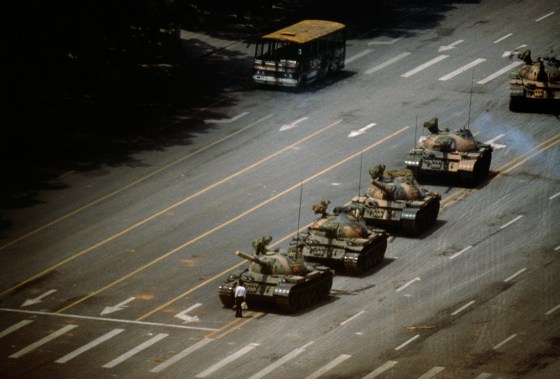
Tomorrow is the 27th anniversary of the pro-democracy protests in Tiananmen Square in Beijing, China. The protests were suppressed by force, but it is unclear how many protesters were killed. Discussion of the anniversary is not permitted in China, but it represents the beginning of the contract between the Chinese government and its citizens: the Communist Party will deliver strong economic growth and the citizens will not object to the lack of open discussion on the role of the Party in economic and political affairs. That contract has been honored in large part, although the economic slowdown in China is raising questions about whether the Party can deliver on its end of the contract.
The Iconic Image of a Lone Protester Facing PLA Tanks, 4 June 1989
The German Parliament has voted to recognize the slaughter of Armenians during World War I by Turkish officials as genocide. At the beginning of the war there were 2 million Armenians living in what was then the Ottoman Empire; at the end of the war there were 400,000. In the midst of the war, a movement arose led by what were called the “Young Turks” to Turkify the territory where Turks lived–that movement ultimately led to the creation of modern Turkey under the leadership of Ataturk. Germany was allied with the Ottoman Empire during the war and the Young Turks believed that the Armenians were working with their enemy, the Russians. No one disputes the fact that many Armenians were slaughtered as a consequence.
Modern Turks deny that a genocide occurred. Indeed, the word “genocide” was not even used as a word until 1944 and it was coined to describe the horror of the holocaust. The key disagreement over what happened to the Armenians centers on the question of “intent”. The Turks insist that there was never any intent to eliminate the Armenian people but that the Armenians represented a national security risk to the insists of the state of Turkey in a war. It is against the law in Turkey to refer to the Armenian slaughter as “genocide”.
Armenians believe that the policies employed against them during the war could have no other outcome other than their extermination and that the issue of intent was implicit in the pre-ordained outcome. The Armenian communities all over the world have been lobbying hard to have their suffering recognized as deliberate. The German Parliament voted to label the atrocities as genocide because Germany was allied with the Young Turks and contributed to their ability to kill Armenians.
The vote undoubtedly complicates the German-Turkish relationship which has emerged as a central issue in the refugee crisis in Europe. More than 20 countries, including France, have recognized the genocide, but Chancellor Merkel has been working with President Erdogan in regulating the flow of refugees out of Syria. Turkey has demanded money and visa-free travel for its citizens in Europe for that cooperation, but today it called back its Ambassador to Germany for “consultation”.
The Walk Free Foundation, based in Australia, estimates that there are about 45 million slaves in the world today, and that the majority of those slaves live in India, (18.4 million), followed by China (3.4 million), Pakistan (2.1 million), Bangladesh (1.5 million), and Uzbekistan (1.2 million). The Foundation released its Global Slavery Index which has a wealth of information about this incredible situation. It is hard to believe that despite laws against slavery in every country on the planet that this practice is so pervasive.
Reuters has published a satellite map of the Very Large Crude Carriers (VLCCs) that are currently transporting petroleum from the Middle East to Asia. The yellow dots on the map indicate the location of VLCCs on 11 April–as much as 200 million barrels of oil were floating on the oceans on that date. In the article, Reuters also shows the location of crude carriers that were waiting in line to offload their cargo at various ports in Asia. The traffic jam is incredible as traders are waiting for the price of oil to rise so that greater profits can be made when the oil is offloaded.
The Associated Press-NORC Center for Public Affairs Research has released poll results which show a very high level of disillusionment among Americans with their political system. According to the poll:
“Seventy percent of Americans say they feel frustrated about this year’s presidential election, including roughly equal proportions of Democrats and Republicans….. More than half feel helpless and a similar percent are angry.
“Nine in 10 Americans lack confidence in the country’s political system, and among a normally polarized electorate, there are few partisan differences in the public’s lack of faith in the political parties, the nominating process, and the branches of government.
“Americans do not see either the Republicans or the Democrats as particularly receptive to new ideas or the views of the rank-and-file membership.”
These results suggest that the American political system is far more fragile than is popularly believed.
Foxconn, a Taiwanese company that produces many of the components for Apple and Samsung products and that operates primarily in China, has announced plans to replace 60,000 workers in China with robots. That factory will go from 110,000 workers to 50,000. Foxconn has had serious labor problems in the past and this move solves a number of those problems, but it raises another, more serious, societal problem: what will these workers now do? China’s lower wage advantage has slowly been eroded as wages have increased. a development that is a clear consequence of globalization. But going from low wage production to no wage production suggests a longer term problem of consumer demand in a market economy.
For what we think is the fifth time, North Korea was unable to launch successfully its intermediate range ballistic missile. South Korean official asserted that the launch did not survive take-off. There were three tests in April, all of which failed, and North Korea seems eager to deploy the missile but will not likely do so until it tests one successfully. The UN Security Council has banned such missiles and it appears as if China is quite concerned about North Korea developing the capability. North Korea, however, does not seem to be concerned about the apprehensions of neighboring states.
The rise of right-wing parties in Europe has led to a flurry of articles and op-eds about the possible rise of fascism in Europe. The term is too loosely applied: while there are some striking similarities between the 1930s and the 2010s in Europe, there are also some very important differences. Zack Beauchamp interviews Cas Mudde, an associate professor at the University of Georgia and specialist on the European far right, in Vox. Professor Mudde makes some very important distinctions between nativism, nationalism, xenophobia, and fascism about which we should be aware when we discuss right-wing politics in the world today.
Former Chadian president Hissène Habré has been sentenced to life in prison by a special court set up in Senegal by the African Union. Habré was charged with crimes against humanity, war crimes and torture in July of 2013 after his arrest in Senegal. Habré ruled Chad from 1982 to 1990 and allegedly came to power with the help of the US Central Intelligence Agency. His rule was marked by horrific crimes, including rape, sexual slavery and ordering killings.
Relatives of Habre’s Victims at the Trial
NATO’s Parliamentary Assembly finished a three-day meeting in Albania and issued a declaration “to provide reassurance to those allies who feel their security is under threat, focusing on the eastern and southern flanks of the alliance.” Poland, the Baltic states (Latvia, Lithuania, and Estonia), and Turkey have been pressuring NATO to take a stronger stance against perceived Russian assertiveness. The Russians, on the other hand, assert that it is NATO that is acting provocatively. This cycle of mutual suspicion has been building ever since NATO intervened in Bosnia in 1994 against Serbia, a Russian ally, despite efforts to attain an equilibrium in military power in Europe in 1997 in the Founding Act on Mutual Relations, Cooperation and Security between NATO and the Russian Federation signed in Paris, France. Unless this cycle is broken, a new Cold War is inevitable.
Turkish President Recep Tayyip Erdogan gave a speech yesterday in which he stated that “no Muslim family can understand and accept” birth control and family planning. The statement enraged many women in Turkey who consider Erdogan’s views to be straight out of the “Middle Ages.” Turkey’s population is one of the fastest growing populations in the region, and it is significantly higher than many European states–a real consideration as the European Union considers Turkish accession to the Union.