Archive for the ‘World Politics’ Category
Der Spiegel conducted an interview with Iranian Vice President Ali Akbar Salehi on his country’s view of US discomfort with the joint nuclear agreement. Salehi is well aware of American reservations, but he insists that Iran has followed all the requirements of the agreement and that, if the US re-imposes sanctions, it will be the Americans who will break the agreement. Salehi makes a cogent argument that American actions could jeopardize the entire Non-Proliferation Movement. If the US leaves the agreement without clear evidence of an Iranian violation, then few countries would believe that the non-proliferation regime that has guided world politics since 1968 is supported by the nuclear powers.
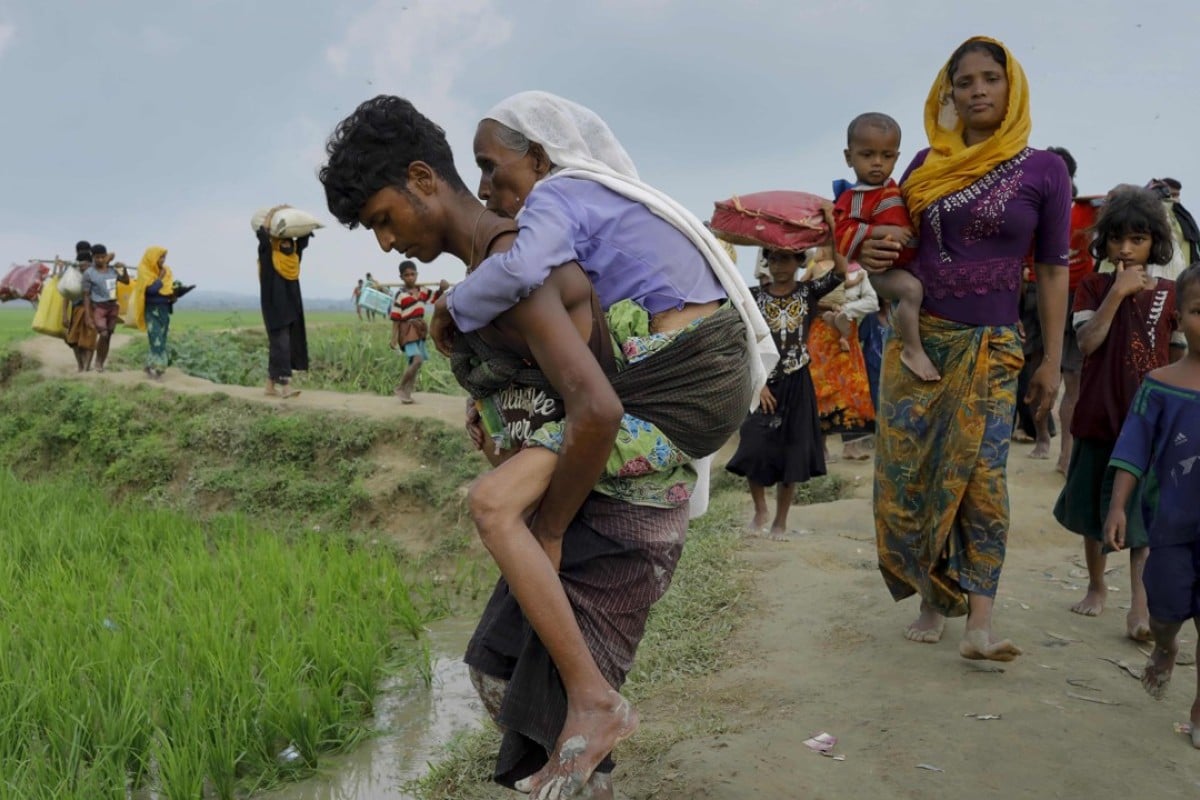
Amnesty International is reporting that the Myanmar military is planting anti-personnel land mines in front of Royingha who are fleeing the violence directed against them. The South China Morning Post quotes an official from the Human Rights Watch that the Myanmar military is following “wartime Japan’s sanko seisaku tactics of ‘kill all, burn all, destroy all’.” There is a treaty prohibiting the use of landmines which was introduced in 1997 and 162 states have signed the treaty. Myanmar and Syria, for example, have not signed the treaty, nor has the United States.
Royingha Refugees
Syrian government troops and US-backed rebels (the Syrian Democratic Forces) are converging on the Syrian city of Deir al-Zor. The rebels are coming in from the north and the Syrian government is coming from the south. Both are fighting Daesh (the Islamic State) forces, so they have the same strategic objective, but they are also sworn enemies. The forces are about 10 miles apart from each other. It is not clear whether both sides have spoken about what will happen when Daesh is defeated. It is possible that an agreement has been secretly reached about how the city will be controlled. It is also possible that the two forces will start fighting each other.

Evan Osnos has written an exceptionally detailed and informed article on North Korea’s perceptions of the current crisis for the New Yorker. Osnos spent a great deal of time talking with officials in North Korea and does a good job of being faithful to an honest presentation of their views. The article also has significant background information to the crisis. It is a long read, but well worth the time and effort. The conclusion of the essay is sobering:
“Our grasp of North Korea’s beliefs and expectations is not much better than its grasp of ours. To go between Washington and Pyongyang at this nuclear moment is to be struck, most of all, by how little the two understand each other. In eighteen years of reporting, I’ve never felt as much uncertainty at the end of a project, a feeling that nobody—not the diplomats, the strategists, or the scholars who have devoted their lives to the subject—is able to describe with confidence how the other side thinks. We simply don’t know how Kim Jong Un really regards the use of his country’s nuclear arsenal, or how much North Korea’s seclusion and mythology has distorted its understanding of American resolve. We don’t know whether Kim Jong Un is taking ever-greater risks because he is determined to fulfill his family’s dream of retaking South Korea, or because he is afraid of ending up like Qaddafi.”
The dance of two uninformed nuclear powers is particularly unnerving.
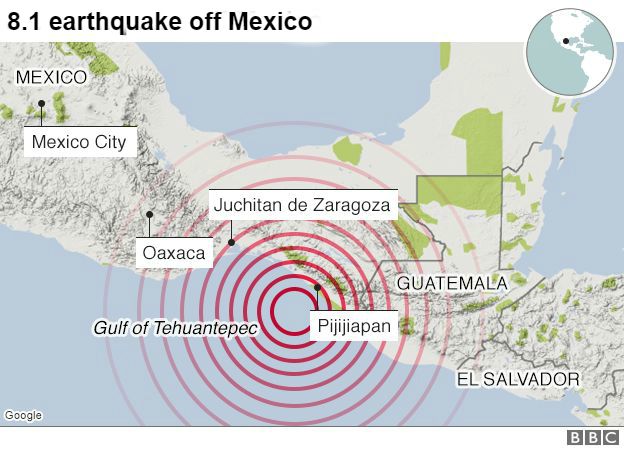
Mexico was hit by a 8.1 magnitude earthquake yesterday off its southern coast. The earthquake was very deep (70 kms) which lessened the impact somewhat. Nonetheless, at least 61 people died and more than 200 were injured. The earthquake was the strongest recorded since 2015. Its strength matched that of the quake that hit Mexico City in 1985 in which thousands of people died, but yesterday’s quake struck a much less populated area.
On this day in 1945 American troops entered what is now known as South Korea. Troops from the Soviet Union had entered what is now known as North Korea on 9 August 1945. The US and Soviet troops occupied Korea as part of the Yalta Agreement signed on 11 February 1945. At the Yalta Conference, the Allies agreed that the Soviet Union would enter the war against Japan three months after the defeat of Germany. The Germans had surrendered on 8 May 1945 and Stalin honored his promise to enter the war. That promise was welcomed by US President Roosevelt who wanted the Soviet Union to intervene in order to divide Japanese forces when the US invaded the country to end the war. As part of the Yalta Agreement, the Soviet Union was promised territorial gains to redress the losses it had suffered in its surrender to Japan in the Russ0-Japanese War of 1904.
Circumstances, however, had changed by August. Roosevelt was no longer the President–he had died and Harry Truman took his place and Truman was significantly more suspicious of the Soviet Union than Roosevelt had been. Second, the US tested an atomic bomb on 16 July 1945 which held out the promise of ending the war with Japan without an American invasion. The US dropped the first atomic bomb on Hiroshima on 6 August 1945, the Soviets declared war against Japan on 9 August, and the US dropped its second atomic bomb on the city of Nagasaki on the same day. On 10 August Japan offered to surrender.
The occupation of Korea by US and Soviet forces was supposed to be temporary, as was the division of Germany and the future division of Vietnam in 1954. There was a US-sponsored election in the South in 1948 but the Soviets refused to allow an election in the North. The United Nations then recognized South Korea as the legitimate government of Korea, laying the legal basis for a possible reunification of the two sectors along the lines of the government of the South. The US removed its troops from South Korea in June of 1949, leaving only 500 soldiers to train the South Korean military, but Soviet troops did not leave the North. In June of 1950, forces from North Korea invaded South Korea and the Korean War began. US troops re-entered the South under the auspices of the United Nations and the war lasted until an armistice was signed in July of 1953. North and South Korea are still technically in a state of war as no peace agreement has ever been signed between the two states.

The European Court of Justice has rejected a plea from Slovakia and Hungary to not enforce the European Union’s requirement that its members accept a quota of refugees. Since 2015 more than 1 million refugees have arrived in Europe and the reaction to them has varied from country to country. Slovakia and Hungary argued that the forced acceptance of refugees violated their sovereignty and that the EU had not followed the proper procedures to implement the relocation of refugees. The Hungarian Prime Minister, Viktor Orban, was quoted in Reuters as saying:
“The whole issue raises a very serious question of principles: whether we are an alliance of European free nations with the Commission representing our joint interests, or a European empire which has its center in Brussels and which can issue orders”.

The Pew Research Center has compiled some detailed information about Asian-Americans and immigration from Asian countries. The report finds that
“The U.S. Asian population grew 72% between 2000 and 2015 (from 11.9 million to 20.4 million), the fastest growth rate of any major racial or ethnic group. By comparison, the population of the second-fastest growing group, Hispanics, increased 60% during the same period.”
The countries with the largest representation within this immigrant group are China, India, and the Philippines. Asian-Americans on the whole do quite well in the US. According to the study: “The median annual household income of households headed by Asian Americans is $73,060, compared with $53,600 among all U.S. households.” But the income levels vary widely among the 19 different countries of origin studied.

Catalonia, the northeastern region of the country of Spain, has a referendum on independence scheduled for 1 October. The Catalans believe that they give more to the central government of Spain than they receive in benefits and that Catalonian culture is distinctive and constitutes a separate nation. Spanish authorities have declared the referendum illegal and the Spanish Supreme Court will rule on its legality. But Catalonian authorities have declared that they intend to go ahead with the referendum raising the possibility of a serious constitutional crisis in Spain.

Chetan Peddada is a former officer in the U.S. Army and he has written an article for Foreign Policy based on his impressions of the many war games the US military has run on potential conflicts with North Korea. War gaming is a complex undertaking as the military runs scenarios of conflicts based upon a number of different alternative conditions. Peddada’s analysis is understandably complicated, but unless one is interested in the intricate military details, it is sufficient to skim the article to appreciate his conclusion:
“We’ve never been closer to a conventional North Korean attack on South Korea, and I can attest that the U.S. military knows how devastating the consequences would be. We can expect a massive humanitarian crisis, enormous loss of life, and economic disaster. There’s almost no doubt that the North would lose — but in going down Pyongyang could take much of the Korean Peninsula with it.”
Turkey and the European Union have been negotiating the possible entry of Turkey into the Union since 2005. Those negotiations have been stalled over a variety of issues: Turkey’s control over parts of the island of Cyprus; its commitment to democratic principles, and; the issue of migration and the treatment of refugees from the Middle East and North Africa. German Chancellor, Angela Merkel, is campaigning to remain Chancellor and in a recent debate she argued that the accession negotiations should cease. Other members of the EU, Finland, Lithuania, and, most recently, France, have resisted the call to end the negotiations. The decision will not be easy for the Union.
Climate change is most obvious in the polar regions and changes in the Arctic Region have been better documented than those in the Antarctic. One of the least obvious changes in the northern polar regions has been the melting of permafrost–the “layer of frozen soil that covers 25 percent of the Northern Hemisphere.” Scientists fear that as the permafrost melts, thousands of tons of carbon dioxide and methane will be released, aggravating the process of global warming. Additionally, some fear the release of ancient microbes to which modern humans have lost immunity.
/cdn.vox-cdn.com/uploads/chorus_asset/file/9034347/permafrost_distribution_in_the_arctic.jpg)
Aung San Suu Kyi is a hero of the human rights movement. She was under house arrest for years by the military junta that ruled Myanmar (Burma) but steadfastly held her ground in defense of democracy and won the Nobel Peace Prize for her courage. She is now the leader of Myanmar but finds herself under serious criticism for her inability to protect the Royingha, a Muslim minority located in the Rakhine district of the country. The Royingha are considered illegal immigrants by the primarily Buddhist population of Myanmar. Increasingly, violence is being used to drive the Royingha out of the country and the Royingha are beginning to fight back. Suu Kyi is now arguing that the information about the persecution of the Royingha is “fake” news.
Anti-Royingha Protest

Gauri Lankesh, a prominent Indian journalist highly critical of the emerging Hindu nationalism in India was shot dead outside her home in Bangalore. According to the Committee to Protect Journalists, India is a dangerous place for independent journalists. The murder of Lankesh is a sign of how intense the spirit of Hindu nationalism has become in India–a worrying sign for a country dedicated to liberal freedoms.
Gauri Lankesh

US Ambassador to the United Nations, Nikki Haley, gave a speech to the American Enterprise Institute in which she argued that the nuclear agreement with Iran was flawed, laying the groundwork for scrapping the agreement. The agreement, known as the Joint Comprehensive Plan of Action, was forged between the 5 Permanent Members of the UN Security Council (China, France, Great Britain, Russia, and the United States), Germany, and Iran. It is a ten-year agreement limiting Iran’s ability to process uranium into fuel for a nuclear bomb and was signed on 14 July 2015. Every six months the International Atomic Energy Agency and the signatories must verify that Iran has adhered to the agreement, and the agreement has been verified twice. US President Trump, however, argued as a candidate and as President, that the agreement is not in the US national interest because it does not limit Iran’s support for organizations such as Hezbollah and Iran’s development of missile technology.
Those issues, however, are not part of the agreement and it is doubtful that the other signatories to the agreement will pull out of it because of US concerns. If the US does drop out of the agreement and imposes sanctions on Iran, then Iran will undoubtedly pull out of the agreement. Given the policies taken by the US vis-a-vis North Korea, Iran would most likely pull out of the Non-Proliferation Agreement and perhaps restart its weapons program. That course of action would be a disaster for the world.
Iran’s Nuclear Capabilities

Hurricane Irma appears to be the strongest Atlantic storm ever recorded and the Caribbean will likely suffer terribly from the storm. The Washington Post has some extraordinary videos of the storm, showing detail in the structure of the storm that I have never seen before. I really wish I could separate events like Irma from my apprehensions about climate change–there really is no scientific basis for a connection–but I fall into the trap too easily.

Russian President Putin has indicated that Russia will not support additional sanctions against North Korea, signaling the end of unanimity on the UN Security Council which had, up to this point, supported sanctions against the country for its nuclear program. The shift in Russian policy will most likely be paralleled by China. The US therefore can no longer rely on the support of the Security Council for any additional actions against North Korea. If, as anticipated, North Korea conducts a missile test this coming Saturday, the US will need to figure out an alternative response to the perceived threat.
The media continue to focus on the North Korean nuclear test, and it is hard to figure out the dynamics of the crisis. The US has issued a number of warnings, first from US Secretary of Defense Mattis, who warned that any threat to “the United States or its territories including Guam or our allies will be met with a massive military response”. UN Ambassador Nikki Haley followed this warning in a statement to the UN Security Council that argued that North Korea was “begging for war”. The rhetoric has been fierce, but much remains ambiguous about US policy since the rhetoric has remained constant since President Trump’s statement promising “fire and fury” on 9 August despite three missile and one nuclear test since that date.
There are also some confusing elements to US policy. President Trump has delayed talking with South Korean President Moon Jae-in until today and the US currently does not have an Ambassador to this important ally. Moreover, President Trump has indicated that he wishes to end the trade agreement with South Korea despite the US reliance on South Korea in its confrontation with the North. Indeed, President Trump has indicated that he may stop trading altogether with states that continue to trade with North Korea, and presumably that includes China from which the US imports $40 billion of goods and services every month. The Chinese have labeled this policy as “unacceptable”, and the threat is not at all credible.
The confusion over the situation has led some to question the effectiveness of the policy of confrontation with North Korea.
North Korea has conducted its sixth nuclear bomb test and it has asserted that it was a hydrogen bomb. The difference is crucial since a hydrogen (thermonuclear) bomb is significantly more damaging than an atomic (fission) bomb). It is hard at this stage to verify the North Korean claim, but the evidence suggests that at least American officials believe it to be true. The record of US-North Korean relations since the election of President Trump offers little hope for a peaceful resolution of the crisis. It is clear that President Trump believes that his overwhelming imperative is to prevent North Korea from developing the capability of launching nuclear missiles against the American homeland. That, indeed, is this most important priority.
But that priority is not only obtainable by attacking North Korea. American Presidents have faced similarly armed adversaries–Russia and China. At one point, some in the US believed that the US should have launched a preventive war against the Soviet Union before the Soviets developed their own atomic weapon and while the US had had an atomic bomb monopoly (1945-49). Phillip Meilinger recounts that early debate:
“LeMay’s predecessor, Gen. George C. Kenney, seconded LeMay’s belief. In a letter to the Air Force Chief of Staff, Gen. Hoyt S. Vandenberg, Kenney stated that he was ‘worried about the time elapsing from the day that the whistle is blown before we can launch our first atomic strike.’
“He feared a surprise attack would greatly reduce US war-making capability. ‘It is going to be so difficult to shorten the time before we can start effective retaliation that this in itself constitutes another argument for re-examining our national attitude toward fighting what has been wrongly termed a preventive war,’ said Kenney. ‘It would not be a preventive war, because we are already at war.'”
Fortunately, American Presidents ignored this advice, and defended the US by employing the tactic of deterrence. Now China is one of America’s largest trading partners, and yet President Trump has now threatened to cut off trade with China unless the North Korean threat is eliminated.
In a remarkable move, the Kenyan Supreme Court has nullified the recent presidential election, citing irregularities in the voting, and has ordered new elections in 60 days. The independence of the Kenyan Supreme Court is a solid sign of the strength of Kenyan democracy, and President Kenyatta indicated that he would obey the ruling, although he also criticized the decision. The upcoming campaign will be carefully scrutinized by both Kenyans and the international community.
Kenyan Supreme Court

Unfortunately, the civil war in Syria has not received much attention in recent weeks. It seems clear that Daesh(the Islamic State) has suffered serious setbacks in the country, and those reversals have strengthened the hand of Syrian President Assad. Assad’s advantages are also benefits to his allies, Russia and Iran. Indeed, Iran seems to have gained significant leverage in the country, and its presence presents difficulties for Saudi Arabia and Israel, both US allies.
Negotiations have started in Mexico City on a possible reworking of the North American Free Trade Agreement (NAFTA). The agreement among the US, Mexico, and Canada was first implemented in 1994 and has been credited with a massive expansion of trade. The agreement, however, has come under serious criticism, most recently by US President Trump. Renegotiating the treaty would be a massive undertaking and ending it would disrupt the economies of all three countries to a substantial degree.

The US has sent its most advanced fighter planes, the F35B Lightning II stealth fighters, to the Korean peninsula, and, for the first time, they flew a joint mission with B-1B Lancer bombers. The planes flew along side fighter planes from South Korea in a massive show of military force. The US Pacific Command “executed this mission to emphasize the combined ironclad commitment to the defense of Allies and the U.S. homeland.” On the other hand, the North Koreans likely interpreted the mission as a clear threat of invasion and probably reinforced their decision to develop nuclear weapons to deter such an attack. The relationship between the US and North Korea is a classic case of the Security Dilemma–the situation where one side believes it is acting defensively and the other side believes that the actions are aggressive.
B1-B Lancer Bombers and F35B Lightning II Stealth Fighters
I do not usually post op-ed pieces, but Daniel Drezner, professor of international politics at the Fletcher School of Law and Diplomacy at Tufts University, has written one for the Washington Post entitled “Why Secretary of State Rex Tillerson should resign”. One should read the piece to assess the current state of the State Department and not necessarily to ponder the question of whether Tillerson should resign. There are legitimate concerns about the health of the State Department which desperately need to be addressed by Tillerson or someone else. The unilateral disarmament of the diplomatic arm of one of the great powers in the world should be of concern to everyone, including non-US citizens.
I know that it is inappropriate, but I cannot help but think about Hurricane Harvey and climate change. It is a serious mistake to link weather to climate, but the immensity of Katrina, Sandy, and Harvey, as well as the monster storms in Asia–Haiyan, Nina, Lionrock, and Nepartak–make it a difficult link to ignore. Climate change will force more moisture into the atmosphere, rendering some places wetter and some places much drier. If there is indeed a link, then we must figure out better ways to address the phenomenon of monster storms in our future.
Hurricane Harvey from the International Space Station

 World Politics News