Since the Great Recession of 2008-09, many governments in the world have increased their total indebtedness. According to the Pew Research Center, “the total amount of government debt now exceeds $63.1 trillion”. The growth of debt has been particularly high in the rich countries: “In the world’s seven major advanced economies (known as the Group of Seven), debt as a share of GDP increased by an average of 22.2% between 2008 and 2011”. Debt is a very imperfect indicator of economic health. The real index is whether the debt will ultimately contribute to generating economic growth that will make repaying the debt easier. But debt is an marker for vulnerability to specific, unforeseen events. From that perspective, we should all hope that we are not surprised by natural or political disasters anytime soon.
US President Trump’s speech at the United Nations has received a wide range of responses. China’s People’s Dailyran an editorial which said:
“Trump’s political chest-thumping is unhelpful, and it will only push the DPRK to pursue even riskier polices, because the survival of the regime is at stake. It is time for the US to realize that irresponsible words and actions are backing the DPRK into a corner with no way out, and it would be a tragedy if Trump’s risky game of chicken with the DPRK crosses the point of no return.
“In over 30 years in my experience with the UN, I never heard a bolder or more courageous speech. President Trump spoke the truth about the great dangers facing our world and issued a powerful call to confront them in order to ensure the future of humanity.”
Iranian President Hassan Rouhani responded today to President Trump’s characterization of the nuclear agreement and stated that: “I declare before you that the Islamic Republic of Iran will not be the first country to violate the agreement; but it will respond decisively and resolutely to its violation by any party.” He went on to say:
“The ignorant, absurd and hateful rhetoric, filled with ridiculously baseless allegations, that was uttered before this august body by the president of America yesterday (Tuesday), was not only unfit to be heard at the United Nations – which was established to promote peace and respect between nations – but indeed contradicted the demands of our nations from this world body to bring governments together to combat war and terror.”
I have yet to read an analysis of the speech that is dispassionate. The speech clearly targeted certain constituencies which have responded somewhat predictably. But the language of the speech, particularly its emphasis on sovereignty and what I believe to be some misunderstandings of sovereignty suggested that the speech was an attempt to be something doctrinal. I have not yet figured out the specifics of the doctrine.
Spanish authorities raided Catalan government offices and arrested several Catalan government officials in an attempt to stop the proposed referendum on Catalan independence scheduled for 1 October. The Spanish Constitution has no provision for provincial secession and the central government argues that any effort to secede is illegal. Up to this point, it seemed as if the referendum would not support Catalonian independence, but the raids on the Catalonian governmental offices might provoke a counter-reaction to the central government. We should watch how this unfolds.
US President Trump gave his first speech to the United Nations today. In keeping with the character of his Presidency, the speech eschewed diplomatic language and was unusually blunt for a UN speech. The speech was anchored in what was called “principled” realism. He emphasized the centrality of sovereignty to his worldview, a point of view that is consistent with the language of “America first”. But he was straightforward in condemning specific states for following policies that they believe are essential to the protection of their sovereignty (and territorial integrity). For example, his criticism of North Korea’s nuclear program was apocalyptic:
“The United States has great strength and patience, but if it is forced to defend itself and its allies, it will have no choice but to destroy North Korea…Rocket Man is on a suicide mission for himself and for his regime”.
The purpose of war is most emphatically not to “destroy” one’s opponent; the purpose of war is to coerce one’s opponent to change a course of action. “Destroying” another country is rhetoric that is dangerous–if practiced, it is nothing other than genocide. Moreover, referring to the leader of a country in derogatory terms is a deliberate attempt to goad one’s opponent into a confrontation. Referring to Kim Jong-un as “Rocket Man” in a highly public forum personalizes the conflict. Such disrespect begs a countermove and President Trump seems to want an excuse to use force against North Korea. No leader should ever wish to use force. The use of force is a confession of failure to resolve a dispute without violence.
Similarly, President Trump signaled his clear dissatisfaction with the nuclear agreement with Iran:
“We cannot abide by an agreement if it provides cover for the eventual construction of a nuclear program….” calling it “one of the worst and most one-sided transactions the United States has ever entered into” and “an embarrassment to the United States. And I don’t think you’ve heard the last of it. Believe me.”
President Trump failed to mention that the agreement was one sanctioned by the very body he was speaking to: the United Nations. It was also an an agreement that the US voluntarily signed, fully exercising its sovereignty to agree or disagree with the agreement. It is also an agreement that all parties involved agree has had Iran’s full compliance. But the US undoubtedly has the sovereign right to leave the agreement. What President Trump left unsaid was what would come after the US leaves the agreement and whether the other six signatory countries would continue to adhere to the agreement. It is not enough to criticize the status quo; the purpose of criticism is to propose something better. As of yet, we have no idea what that better agreement might be.
There was also a thread to the speech that was inconsistent with the venue. President Trump emphasized the importance of nationalism in no uncertain terms:
“Are we still patriots? Do we love our nations enough to protect their sovereignty and take ownership of their futures?”
Again, this is rhetoric, but rhetoric that is at odds in an international body whose purpose is to maximize cooperation among nations. Indeed, these words from the Preamble to the United Nations Charter were expressed to counter the excesses of nationalism that had led to World Wars I and II:
to practice tolerance and live together in peace with one another as good neighbours, and
to unite our strength to maintain international peace and security, and
to ensure, by the acceptance of principles and the institution of methods, that armed force shall not be used, save in the common interest, and
to employ international machinery for the promotion of the economic and social advancement of all peoples
We will have a much better sense of the impact of the speech after more time to reflect on the words.
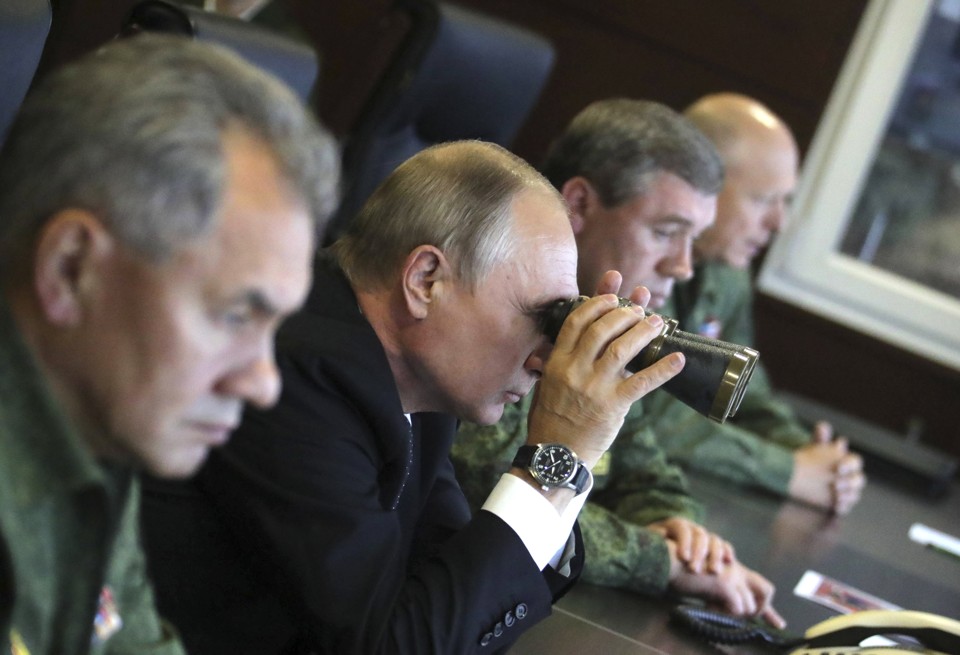
Russian President Putin personally observed the Russian military exercises with Belarus along the border with the Baltic States. It apparently is an impressive show of military power with 250 tanks and 70 fighter aircraft involved. Russia asserts that the exercise is purely defensive, but what one side may regard as defensive is invariably viewed by the other side as offensive. The US military and NATO forces are wargaming the exercise as well. The critical question is whether all Russian forces and military equipment are removed when the exercise ends in two days. If not, the pre-positioned forces will cause a high degree of concern among the Baltic allies in NATO.
The Syrian government has sent its military forces near the town of Deir al-Zor across the Euphrates River into an area controlled by US-backed rebels. The river has served as an informal dividing line between those forces backing the Syrian government and those opposed to President Assad. It has also served to keep pro-Russian and pro-US forces apart in the battle against Daesh (the Islamic State). The area is not densely populated but it is the region where Syrian oil and natural gas reserves are located. Thus far, the two sides have not openly clashed, but a potential clash is something to worry about.
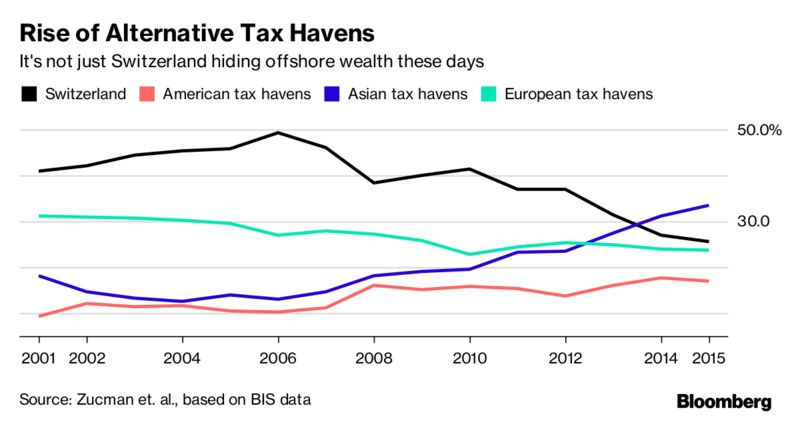
“One-tenth of the world’s GDP is held in offshore tax havens, but that share jumps to as much of 15 percent for Europe and as much as 60 percent for Gulf and some Latin American countries, new research shows. When it comes to total offshore wealth as a share of GDP, the United Arab Emirates, Venezuela, Saudi Arabia, Russia and Argentina lead the pack, while Germany, the U.K. and France all have above-average holdings. The U.S. is slightly below average.”
The money is increasing being held in Asian tax havens because national efforts to restrict the ability of citizens to hide their money in Swiss bank accounts have been successful to a degree. TO make sure that everyone pays their fair share for public services, these efforts should be redoubled.
Germany will hold its national elections on 24 September and all the polling evidence that Angela Merkel’s party will retain control of the Bundestag. But some observers are concerned about the apparent strength of the far-right nationalist party, Alternative for Germany (AfD). Reuters has an excellent run-down of the candidates and parties involved in the upcoming election. All the Germans parties have indicated that they will refuse to work with AfD, but if the polling is accurate, it could emerge with the third largest number of seats in the Bundestag, giving it considerable power.
Alice Weidel and Alexander Gauland of the AfD party
Since there were elections in 2006, the Palestinian people have been ruled by two political factions: Fatah, the more moderate wing of the Palestinian Authority has ruled in the West Bank; and Hamas, the more radical wing which has ruled in the Gaza Strip. The division has undermined the legitimacy of the Palestinian Authority and the welfare of the Palestinian people has suffered tremendously by the lack of leadership. But Hamas has apparently decided to initiate a reconciliation by permitting elections and inviting the new government to take control of the Gaza. There have been similar overtures in the past which have not succeeded, but this one, under the aegis of Egypt, seems to have a better chance of working.
Polls in Mexico indicate that most Mexicans now view the US very unfavorably. The shift in attitude was very sharp and is almost totally related to the election of Donald Trump as American President. Mexicans also have a negative view of their own country. According to the Pew Research Center:
“Overall, the national mood in Mexico is grim: 85% are dissatisfied with the way things are going in Mexico generally, and perceptions of the national economy are not much better, with seven-in-ten believing the economic situation is bad.
“Today, Mexicans are most concerned with crime, political corruption, cartel-related violence and rising prices, though corrupt police officers and a lack of employment also alarm many. Lower-level but still significant concerns include poor-quality schools and the wealth gap.”
Americans should be very concerned about the disintegration of this relationship, one of the most important for the US and the world.
Recent research indicates that the process of climate change is even more dangerous than we have expected. According to Scientific American:
“Scientists Yangyang Xu and Veerabhadran Ramanathan found in a paper published in the Proceedings of the National Academy of Sciences (PNAS) that there already exists a 1 in 20 chance that the 2.2 trillion tons of carbon dioxide in the Earth’s atmosphere could cause an existential warming threat. This “fat tail” scenario would mean the world experiences “existential/unknown” warming by 2100 — defined in the report as more than 5 degrees Celsius above preindustrial levels.”
A 1 in 20 chance is extraordinarily high. Particularly when one considers that those odds concerning extinction will be experienced, not by us, but by our grandchildren.
“After steadily declining for over a decade, global hunger appears to be on the rise, affecting 11 percent of the global population.
“In addition to an increase in the proportion of the world’s population that suffers from chronic hunger (prevalence of undernourishment), the number of undernourished people on the planet has also increased to 815 million, up from 777 million in 2015.”
To make matters worse, food production will have to increase by about 50% to feed the expected population in 2050. This shortage exists despite the fact that today “there is more than enough food produced in the world to feed everyone, yet 815 million people go hungry.”
Many, myself included, are perplexed by the use of violence by Buddhists in Myanmar against the Royingha. One of the cardinal tenets of Buddhism is ahimsa, meaning “not to injure” and it is difficult to find any endorsement of violence in any Buddhist teachings. Buddhists, however, are human and there is a history of Buddhists using violence either to defend Buddhism or in the practice of self-violence–usually self-immolation–to protest ill-treatment. In the Mahavamsa, one of the great works of Sri Lanka, one can learn about King Dutugemunu (164 BCE – 140 BCE) who waged war against Tamils who were regarded as invaders from South India to the island. There is a tradition of some Buddhists using violence to protect other Buddhists, but it is a dangerous departure when applied to ethnic or religious violence. The idea is very close to the concept of the Just War in the Christian Tradition.
Stone Figure Of King Dutugemunu At Anuradhapura
Every four years, the Russian military conducts military exercises on a massive scale. The exercises are called Zapad (“West”) and this year they are being conducted in Belarus. War games in Europe are loosely regulated by agreements between Russia and the West which allow observers from both sides to witness the maneuvers and limit the size of the contingents involved. This year, however, the Russians and Belarussians seem to be ignoring these conditions, leaving some observers worried that the large cache of armaments involved may remain in Belarus, giving the Russian military a pre-positioned advantage in a future invasion of the Baltic states.
“The United States does not support the Kurdistan Regional Government’s intention to hold a referendum later this month. The United States has repeatedly emphasized to the leaders of the Kurdistan Regional Government that the referendum is distracting from efforts to defeat ISIS and stabilize the liberated areas. Holding the referendum in disputed areas is particularly provocative and destabilizing. We therefore call on the Kurdistan Regional Government to call off the referendum and enter into serious and sustained dialogue with Baghdad, which the United States has repeatedly indicated it is prepared to facilitate.”
The referendum, if approved by Iraqi Kurds, does not demand the immediate independence of Kurdistan, and is most likely to be used as a bargaining chip in negotiations with the Iraqi government. Nonetheless, Turkey and Iran, both of which have significant Kurdish populations, are also adamantly opposed to the referendum. The President of the Kurdistan Region, Masoud Barzani, rejected the plea from the US.
Mayesha Alam is a Mount Holyoke graduate and she is making her name known as an analyst of international relations. Her most recent article is in the Washington Post, and it outlines some important characteristics of the humanitarian crisis in Myanmar. She makes clear why the long-standing animosity between the Muslim Royinghas and the Buddhist Burmese exploded so dramatically in the last few months. Mayesha argues that the “simplest” explanation is the decision by the Arakan Rohingya Salvation Army (ARSA) to respond militarily to the Burmese repression and the decision by the Burmese military to “ethnically cleanse” the country of Royingha.
Royingha Refugees
Nation-states are relatively young political agents. We can actually trace the formal beginnings of the modern nation-state to the peace of Westphalia in 1648. They currently number about 194 and are seemingly invulnerable to challenges from alternative institutions. Yet there is no reason to believe that they will always be around–many of the challenges facing humanity, such as climate change, are much too large to be solved by nation-states. Other problems, such as a meaningful and coherent political identity are too small to be addressed by a territorial state. Jamie Bartlett argues that perhaps the city-state is poised to make a comeback in the future.
North Korea has tested another missile. It’s still early and we do not have much solid information yet, but the missile flew over Hokkaido, the northernmost island of Japan. The missile flew about 2,300 miles, far enough to reach the US military base on Guam if it were directed in that direction. The missile test seems to be in response to the most recent round of sanctions imposed by the UN Security Council. But it also seems timed so that news about the hurricanes in Texas and Florida would be less distracting. North Korea clearly wanted everyone in the US and the world to know that Kim Jong-un was not intimidated by the threats against North Korea.
Two non-governmental organizations, the Organized Crime and Corruption Reporting Project (OCCRP) and the Balkan Investigative Reporting Network (BIRN), have released a report on how the US is funding and supplying weaponry to rebels in Syria and Iraq. Foreign Policy has an article on how the US is spending up to $2 billion a year buying Soviet-era weapons from the Balkans and the Caucasus and funneling them into Syria and Iraq. The arms pipeline is disguised through altered paperwork and through dealers of ill-repute leaving the region with a trove of weaponry that cannot be monitored or controlled. Those weapons will haunt the region for years to come and have enriched and emboldened arms dealers who have a vested interest in continued violence.
Since 1945 the US has been the principal champion of a liberal global economy. Since that time, the global economy has grown from about $2 trillion to about $90 trillion. It now seems as if the US no longer wishes to act as the guarantor of the global economy and that shift is having a dramatic effect on some of its key allies. Europe, for example, is quite concerned that the uncertainties associated with the US withdrawal will slow down economic growth considerably. Der Spiegel characterizes the fear in this way:
“The economic policy coming out of Donald Trump’s Washington is characterized by timidity and despondency, sometimes erupting into boastful nationalism. The former economic superpower has embarked on a self-prescribed retreat. Once the home of the Washington Consensus, a policy that emphasized international cooperation, competition and market forces, the U.S. capital is now beset by economic navel gazing.”
Whether the global economy can prosper without the backstop of a great power is unknown, as is the question of whether there are willing alternatives to the US in that role.
South Korea hopes to have a special military unit trained by the end of the year potentially to assassinate North Korean leader, Kim Jong-un. The unit, called Spartan 3000 was initiated by the previous South Korean government, but the newly elected President, Moon Jae-in, has accelerated its deployment. President Moon came into office as a dove, but events have forced his hand. It is hard to tell whether Moon is committed to the unit’s objective or his push is merely an attempt to pre-empt calls for the re-introduction of US nuclear weapons on the peninsula. His position was articulated in a speech given on 15 August in which he said:
“Only the Republic of Korea can make the decision for military action on the Korean Peninsula. Without the consent of the Republic of Korea, no country can determine to take military action….We cannot rely only on our ally for our security. When it comes to matters related to the Korean Peninsula, our country has to take the initiative in resolving them.”
Assassinating an enemy’s leader is not unknown, particularly when open conflict is too problematic and uncertain. The US tried on several occasions to assassinate Fidel Castro after the failed attempt to overthrow him in the Bay of Pigs invasion in 1961. Assassinating Kim Jong-un would be a very dicey operation–only if South Korea had worked out some prior arrangement with China and others in North Korea who were willing to stabilize the situation would there be any chance of it succeeding without making matters significantly worse.
Mexico has withdrawn its very generous offer of help to victims of Hurricane Harvey in Texas. Mexico has its hands full with its own natural disasters of an earthquake off the coast of southern Mexico and the effects of Hurricane Katia. Mexico made the offer even after US President Trump had attacked Mexico via Twitter as a crime-ridden country. But the fact that President Trump took over a week to respond to Mexico’s offer and has not, as of yet, offered any condolences or expressions of sympathy for Mexico’s catastrophes was a diplomatic insult that could not be forgiven. The breakdown of cordial relations with Mexico is a diplomatic tragedy that will resonate for years.
Iraqi Kurds are pursuing plans for a referendum on possible independence in the autonomous region of Kurdistan in Iraq as well as in areas outside that region, such as the city of Kirkuk, which are not within that Iraqi province. The referendum is scheduled for 25 September. The President of Iraqi Kurdistan, Massoud Barzani, indicated that opposition from the Iraqi central government would trigger off demands for secession and independence. The referendum is opposed by every state in the region, as well as by the strongest Kurdish ally, the US, which believes that the issue detracts from the central concern of defeating Daesh (the Islamic State). But the Kurds, and their militia, the Peshmerga, have been a very effective fighting force against Daesh and the Kurds believe that they have earned the right to their own state.
A new research paper has been published on the role of specific corporations in the process of climate change. The paper is based on earlier research that found that “nearly two-thirds of all industrial carbon dioxide (CO2) and methane (CH4) emissions can be traced to the products of a small number of major industrial carbon producers; 83 producers of coal, oil, natural gas, and 7 cement manufacturers”. The paper discusses the responsibility of these companies in addressing climate change, given that “more than a quarter of sea level rise and about half the warming from 1880 to 2010 can be traced back to just 90 corporations”. To the extent that they have profited from greenhouse gas emissions, a case could be made that they have a special responsibility in mitigating their consequences.





 World Politics News