On 18 September 2001, the US Congress approved Public Law 107–40, commonly known as the Authorization to Use Military Force (AUMF), in response to the attacks on the US on 11 September 2001. The most relevant part of the law reads as follows:
SECTION 1. SHORT TITLE.
This joint resolution may be cited as the ‘‘Authorization for Use of Military Force’’.
SEC. 2. AUTHORIZATION FOR USE OF UNITED STATES ARMED FORCES.
(a) IN GENERAL.—That the President is authorized to use all necessary and appropriate force against those nations, organizations, or persons he determines planned, authorized, committed, or aided the terrorist attacks that occurred on September 11, 2001, or harbored such organizations or persons, in order to prevent any future acts of international terrorism against the United States by such nations, organizations or persons.
(b) WAR POWERS RESOLUTION REQUIREMENTS.
(1) SPECIFIC STATUTORY AUTHORIZATION.—Consistent with section 8(a)(1) of the War Powers Resolution, the Congress declares that this section is intended to constitute specific statutory authorization within the meaning of section 5(b) of the War Powers Resolution.
Since the law was passed it has been used by Presidents George W. Bush, Barack Obama, and Donald Trump to justify the use of armed force in a variety of circumstances without direct oversight by the Congress. There is a growing sense that this law has institutionalized war powers in the Presidency that exceed the traditional powers inherent in the constitutional authority of Commander-in-Chief. Last month, the US Senate rejected a bill, 61-36, sponsored by Senator Rand Paul (R-KY) to limit the AUMF to a six month period. In hearings before Congress, US Secretary of State Tillerson and US Secretary of Defense Mattis, argued that President Trump does not need a new AUMF and that the old law gives him the power to continue using military force against any organization–even those not at all involved, or even extant at the time, in the attacks of 11 September 2001–that uses terrorism as a tactic. In his testimony, Secretary Tillerson argued that any new AUMF should not have any geographical or time limits. Those conditions are essentially a blank check and should be rejected. That interpretation of a 16-year old law suggests that there really are no limits on a US President to use military force abroad.
China included its “Belt and Road Initiative” (BRI) in its revision of its constitution at the most recent Communist Party Conference. The move suggests that the initiative is far more than an economic policy–it suggests that the initiative is a critical part of China’s vision of its global economic role. Alek Chance sheds an interesting light on Chinese ambitions, indicating that China does not aspire to be the “leader” of globalization as the US moves away from its central role in supporting the international liberal economic order. Nonetheless, the Chinese wish to demonstrate that this next phase of globalization will have a “center of gravity”. The difference is nuanced, but diplomatically important.
Getting reliable information about world politics is not an easy task, and the task is getting even more difficult because of propaganda easily insinuated into social media. Facebook is going to report to the US Congress that “roughly 126 million users in the United States may have seen posts, stories or other content created by Russian government-backed trolls around Election Day”. Google and Twitter are going to report similar false content on their pages. Public opinion is a vitally important aspect of political decision-making, but we have apparently allowed the dissemination of propaganda to a greater extent than anyone ever could have expected. Protecting ourselves against such propaganda needs to be an absolute priority.
“Globally averaged concentrations of CO2 reached 403.3 parts per million in 2016, up from 400.00 ppm in 2015 because of a combination of human activities and a strong El Niño event. Concentrations of CO2 are now 145% of pre-industrial (before 1750) levels, according to the Greenhouse Gas Bulletin….The last time the Earth experienced a comparable concentration of CO2 was 3-5 million years ago, the temperature was 2-3°C warmer and sea level was 10-20 meters higher than now.”
Despite strong growth in many renewable energies, it seems clear that the emissions of CO2 have not slowed appreciably. Every year, it becomes more difficult to avoid a seriously difficult outcome.
One of the more interesting aspects of the indictments of Paul Manafort and Richard Gates, people associated with the presidential campaign of Donald Trump, is that they were able to funnel an extraordinary amount of money through various banks in states such as Cyprus in order to avoid paying taxes. Using shell companies in countries with very lax banking regulations is not itself illegal; using those companies to avoid paying taxes is. But the behavior of Manafort and Gates is hardly unusual: tax havens such as Cyprus have become well institutionalized in the global economy to the detriment of governments strapped for revenues. According to Krishnadev Calamur in The Atlantic:
“Gabriel Zucman, the author of The Hidden Wealth of Nations: The Scourge of Tax Havens, estimates that $7.6 trillion is stashed in tax havens around the world. That accounts for about 8 percent of the world’s personal financial wealth. This hidden money, he argues, amounts to about an additional $200 million in global tax revenue each year. But as my colleague Uri Friedman previously reported : ‘Other experts claim that the amount of private offshore wealth may be two to four times as high as Zucman’s figure of $7.6 trillion. Needless to say, measuring the size of an industry whose purpose, in part, is to obscure its size isn’t easy or precise’”.
It is very hard to understand why governments allow such easy access to tax evading opportunities other than to assume that those governments are acting specifically to help the very rich avoid paying taxes.
Kurdish leader Masoud Barzani has announced that he will step down after it has become clear that the Kurds cannot implement their plans for independence within Iraq. Barzani has been the de facto leader of the Kurdish Autonomous Region within Iraq since 2005. But Barzani overplayed his hand in the bid for independence. His principal ally, the US, refused to back the move, and the Kurdish inability to retain control over the city of Kirkuk made clear that despite the undoubted strength of the Kurdish Peshmerga, the Kurds lacked the ability to sustain an independent state. We should now look to see if Iraq maintains a concilatory policy toward Kurdish autonomy or if it clamps down on Kurdish freedoms.
Masoud Barzani
The continuing stand-off between the US and North Korea is weakening the willingness of several states in East and Southeast Asia to remain nuclear weapons-free. The erosion is most obvious in South Korean and Japan which have both long relied on the US nuclear deterrent for defense. The situation is a major test of the sturdiness of the non-proliferation regime which has been in place since 1968. Both Japan and South Korea have been running peaceful nuclear reactors for many years and each has plenty of fuel that could be processed to produce thousands of nuclear weapons. Japan remains staunchly pacifist, but Prime Minister Abe has the necessary votes to amend the Japanese constitution which prohibits offensive military capabilities. Public sentiment in South Korea seems to be shifting in support of a nuclear deterrent given the huge casualties likely in a conventional war with North Korea.
The US considered launching a pre-emptive military strike on the People’s Republic of China in order to prevent it from developing nuclear weapons, a situation roughly reminiscent of the current position of the US vis-a-vis North Korea (one should not forget that North Korea alreadyFranz-Stefan Gady describes the decision-making process has nuclear weapons so the situation is also dramatically different). But the opinion of Mao Zedong as “irrational” seems to be the judgment of some US policymakers about North Korean leader Kim Jong-un. Fortunately, the US did not launch the attack and and how the US State Department exercised the necessary leverage to commit the US to the policy of deterrence instead.
US Defense Secretary Mattis warned that North Korea’s capability to hit US territory with nuclear weapons is “accelerating”. In a speech given in Seoul, South Korea, Mattis asserted that “I cannot imagine a condition under which the United States would accept North Korea as a nuclear power”. The speech was given a week before US President rump was scheduled to visit South Korea as well. I am not sure what Mattis means when he says that the US would not accept North Korea as a nuclear power since North Korea is already a nuclear power having successfully tested six nuclear weapons. Mattis must be well aware that there is no way that North Korea would give up its nuclear weapons. The Congressional Research Service has completed a report that argues that even a conventional war between North and South Korea would be devastating: even if the conflict was limited to “conventional munitions, estimates range from between 30,000 and 300,000 dead in the first days of fighting”.
Despite US President Trump’s announcement that the US will leave the Paris Agreement on climate change, the actual truth is that the US cannot formally leave the agreement until 2020. The agreement, which was signed by the US, stipulates that no state can leave the agreement until November 2020. Thus, the US will attend the next conference on the agreement which will be held in Germany between 6-17 November. The purpose of the conference is to develop the rules on the proposed shift away from fossil fuels. There is a fear among some of the parties that the Trump Administration might play the role of spoiler in articulating the rules given Mr. Trump’s desire to reinvigorate the coal industry in the US.
Somalia has been wracked by violence ever since the overthrow of the dictator Siad Barre in 1991. The violence has taken a serious toll: “An estimated 2.5 million Somalis were displaced with about 1 million leaving the country. Up to 1.5 million died as a result of the conflict, mostly civilians”. There really is no central government at all–the territory is carved up by a number of clans that fund themselves by demanding protection money from everyone. Al Shabaab is perhaps the largest and most well organized of all these groups and its espousal of radical measures to enforce its interpretation of Islam has made all efforts at reconciliation impossible. Spiegel has an article that describes what life is like under these conditions: life is apparently cheap and terror is a lucrative business.
The concentration of wealth in the world now mimics the degree of concentration in the early 20th Century and that dynamic is ushering in a Second Gilded Age. According to The Guardian:
“The world’s super-rich hold the greatest concentration of wealth since the US Gilded Age at the turn of the 20th century, when families like the Carnegies, Rockefellers and Vanderbilts controlled vast fortunes.
“Billionaires increased their combined global wealth by almost a fifth last year to a record $6tn (£4.5tn) – more than twice the GDP of the UK. There are now 1,542 dollar billionaires across the world, after 145 multi-millionaires saw their wealth tick over into nine-zero fortunes last year”.
The First Gilded Age induced a strong political backlash against the wealthy, led primarily by journalists such as Ida Tarbell who were labeled “muckrakers”. But the concentration of wealth in the early 20th century also created the conditions of underconsumption which ultimately led to the Great Depression.
Anti-Capitalism Poster of the Gilded Age
The Catalonian Parliament voted for independence and immediately thereafter the Spanish Government took control over the regional government. The Spanish Senate easily passed legislation to invoke Article 155 of the Spanish Constitution which allows the central government “to remove the Catalan regional president, suspend his ministers and assume authority over the region’s public media, police and finances.” The Catalonian vote to declare independence was 70-10, but 55 legislators refused to vote. The large number of abstentions shows the deep ambivalence about independence which will undoubtedly factor into the decisions of both sides about their next moves. The response of other European governments (and the US) was decidedly in favor of the Spanish government so it is unlikely that many states will recognize the newly declared independent state.
On he eve of US President Trump’s visit to China and other Asian states, China has strongly urged the US to deny Taiwan’s President Tsai Ing-wen the right to transit US territory on her visit to Pacific states which recognize Taiwan as the Republic of China. After the Chinese Revolution in 1949, the US supported Taiwan as the legitimate representative of the Chinese people, a policy that remained in force until 1972 when the US recognized the People’s Republic of China as the sole representative of the Chinese people. Since 1972, the US has supported a “One China” policy, but has also maintained commercial and military relations with Taiwan. China regards Taiwan as a renegade province and any limited recognition of Taiwan’s former diplomatic status is a profound insult to Beijing. We will have to see if Mr. Trump makes the concession to Beijing by denying President Tsai transit rights over American territory.
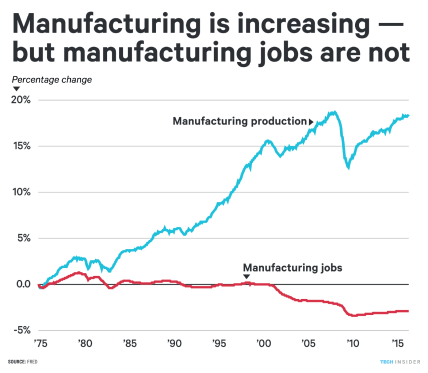
As the world rushes headlong into advanced technology without even a whisper of a discussion about whether it should be managed only after a serious conversation involving most of the people affected, the global economy continues to shed jobs while at the same time increasing output of all sorts of things. Manufacturing is not “dead” in the global economy; only manufacturing jobs are dying. The chart below shows the discrepancy between manufacturing and manufacturing jobs. And in one of the more bizarre twists to the new age we are entering, Saudi Arabia is the first country to grant citizenship to a robot.
You can listen to Robot “Sophia” at the ceremony granting her Saudi citizenship.
The United Nations has found the Syrian Government responsible for the chemical weapons attack against civilians in the town of Khan Sheikhoun in April of 2017. The UN also found that Daesh (the Islamic State) was responsible for killing civilians with Mustard Gas in 2016. The Syrian Government has repeatedly denied that it used sarin gas, but these findings leave the government of Assad liable for war crimes. Sarin gas is a particularly nasty chemical weapon whose use is completely banned by international law.
Kenya’s rescheduled election was marred by low turnout and violence. The election was held because the earlier election in August was annulled by the Supreme Court. But the main opposition leader, Raila Odinga, bowed out of the rescheduled election, citing voting irregularities and the difficulties in holding a far election. Voting was postponed until Saturday in four voting areas because of violence and it remains to be seen whether those polling areas will be open. The current President, Uhuru Kenyatta, won the election, but it is hard to describe the process as legitimate and Kenyatta will find it difficult to rule.
Kenyan Police Prepare to Use Tear Gas Against Election Protesters.
I do not usually quote from Vice News, but Nick Turse is a very reliable reporter and he has published an article on US operations in Africa. As I indicated in a previous post, I was unaware of the US military operation In Niger, but Turse suggests that the US presence in Africa is massive. Turse says that the US is conducting “3,500 exercises, programs, and engagements” in Africa every year and that US Africa Command has increased the number of such operations by 1,900% since it was created a decade ago. Turse estimates that there are between 5,000 and 6,000 US troops currently deployed in African countries. This military commitment is substantial and has been conducted pretty much under the radar for most Americans.
Pandemics occur sporadically, but sometimes they are devastating. The bubonic plague decimated parts of the European population in the 14th century. In 1918, a flu virus, commonly called the Spanish Flu at the times, killed nearly 50 million people. In recent years, there have been outbreaks of unanticipated viruses, such as SARS and MERS, as well as outbreaks of known viruses, such as Ebola, in West Africa in 2014 which was the largest outbreak ever recorded. There are an unknown number of viruses in the world, but, fortunately, only a limited number can effect humans. We suspect that the next pandemic will occur at some point, undoubtedly accelerated by the ease of travel in a globalized world, but it is impossible to predict when it might occur. Experts are working on the problem of how to prepare for such pandemics, but the difficulties in responding are formidable.
The US now has three aircraft carriers and their associated strike groups in the Pacific region as US President Trump goes on an extended tour of Asian countries. The USS Theodore Roosevelt will join the USS Carl Nimitz and the USS Ronald Reagan the convergence is undoubtedly a signal to North Korea.in the 7th Fleet. It is unusual for the US to have three aircraft carrier groups in the same region, and it is likely that the deployment is meant to send a message other countries in the region as a symbol of the US commitment to the region. Nonetheless, the North Koreans remain committed to the development of their nuclear capablity. Speaking of the threat made earlier by the North Koean Foreign Minister to explode a Hydorgen Bomb, a North Korean senior diplomat, Ri Yong Pil, said that “The foreign minister is very well aware of the intentions of our supreme leader, so I think you should take his words literally”.
Every five years the Chinese Communist Party holds a conference in which major decisions. In this year’s conference, the Party has decided to elevate the status of President Xi Jinping to a position eclipsed only by that of Mao Tsetung. The Party decided to include “Xi Jinping Thought on Socialism with Chinese Characteristics for a New Era” to the Chinese constitution. President Xi now becomes an incredibly strong leader with virtually no challenges to his power within the Party. He will remain President for the next five years, but there is also speculation that he may break tradition and decide to serve more than two terms as President.
President Xi Presiding over the 19th Party Congress.
“The two available national-scale studies that examine the economic effects of climate change across U.S. sectors suggested that potential economic effects could be significant and unevenly distributed across sectors and regions. For example, for 2020 through 2039, one study estimated between $4 billion and $6 billion in annual coastal property damages from sea level rise and more frequent and intense storms. Also, under this study, the Southeast likely faces greater effects than other regions because of coastal property damages”.
The US Congress is beginning to debate tax reform and tax cuts. The Pew Research Center did a study of how US tax rates compared with other countries in the world, and its results show that Americans do not have an unusually large tax burden. Comparing tax burdens is an incredibly complicated process since countries have a very large variety of tax which are not at all comparable. The Pew Center tried to “normalize” the tax burden and one should go to the report to see how careful it was in making the comparison and to check on the assumptions upon which the comparisons are based. But the conclusion of the 39-nation study was direct: “In all cases, the U.S. was below the 39-nation average – in some cases, well below.”
Global Forest Watch is reporting a dramatic increase in “tree cover” loss in the world in 2016. Tree cover includes “trees in plantations as well as natural forests, and “tree cover loss” is the removal of tree canopy due to human or natural causes, including fire.” Major losses occurred in Indonesia and Brazil, but the entire number of trees lost would cover all of New Zealand. Many of the fires associated with these losses come from fires due to drought likely caused in part by droughts–el Niño was an important factor in 2016. The statistics suggest a worrying trend of an important resource indispensable to reduce the rate of CO2 emissions.
Dani Rodrik is a prominent economist–one of my favorites–who once identified what he called the global “trilemma”. He describes the trilemma in these terms:
“I have an “impossibility theorem” for the global economy that is like that. It says that democracy, national sovereignty and global economic integration are mutually incompatible: we can combine any two of the three, but never have all three simultaneously and in full.”
There is increasing evidence that Rodrik’s insight was spot on. As we have witnessed the independence movements in Catalonia and Scotland, or the rise of right-wing parties in Europe and elsewhere, or the British decision to leave the European Union, it seems as if the three values cannot be realized simultaneously. The intriguing question is which of the values seems to be the one that will suffer the most. Sovereignty seems to be becoming stronger–witness President Trump’s speech to the UN last September. Global economic integration is clearly fraying, but there are states such as China and Germany who by virtue of their economic power who continue to press hard for such integration. At this point in time, it seems as if democracy is the value suffering the fastest decline.
Most economic growth in the US occurs in highly concentrated areas, with very few new investments in what are known as “distressed” communities. The Economic Innovation Group has broken down news jobs in the US by zip code and found that only 1 in 4 new jobs occur in those zip codes that have a large percentage of poor individuals. The growing discrepancy poses serious challenges to the democratic foundations of the US polity. The green areas denote “prosperous” zip codes and the dark red, “distressed” communities.
Japanese Prime Minister Shinzo Abe rolled the dice with a snap election and preliminary results suggest that it payed off well. The results indicate that Abe’s Liberal Democratic Party-Komeito bloc will win a two-thirds majority in the Lower House of the Japanese Parliament. The Japan Times assesses the significance of the victory:
“A solid showing for the ruling bloc will serve as a powerful public mandate for Abe, adding momentum to his widely rumored bid next year to run for a historic third term as LDP president. If re-elected, Abe, who briefly held office from 2006 to 2007, could remain in power until 2021, becoming the nation’s longest-serving prime minister.”
If that scenario plays out, it is highly likely that Abe will push for a reform of the Japanese Constitution which was written while Japan was under US occupation after World War II. The constitution forbids Japan from taking offensive military action and Abe wishes to change it. Abe cites concerns over North Korea and the growing military power of China as reasons for the change, but the pacifist constituency in Japan remains very strong.
Prime Minister Shinzo Abe
Scientists in China are concerned over the shrinking of China’s glaciers. The glaciers are the principal source of fresh water for the northwest region of China which receives very little rain. According to National Public Radio:
“Xinjiang, a land of mountains, forests and deserts, is four times the size of California and is home to 20,000 glaciers — nearly half of all the glaciers in China. Since the 1950s, all of Xinjiang’s glaciers have retreated by between 21 percent to 27 percent.”
The article describes how the melt from the glaciers is transported 200 miles through a remarkable system of wells, known as the Karez Wells, which were built almost 2,000 years ago. UNESCO describes the significance of this engineering feat. Unfortunately, because of the glaciers melting, many of these wells are now going dry.
On this day in 1962, US President John Kennedy delivered a televised speech in which he announced that the US would implement a quarantine around the island of Cuba to prevent the Soviet Union from sending nuclear missiles to the island. The speech triggered off what we now call the Cuban Missile Crisis, unquestionably one of the most dangerous episodes in the Cold War between the US and the USSR. The National Security Archive at George Washington University has compiled the most extensive collection of materials on the crisis for those who wish to delve further into the matter. The crisis marked the beginning of the end of the Cold War as both sides realized how dangerous their relationship had become. It would take years, however, before the Cold War finally eased up.
One of the Photographs of the Missile Facilities in Cuba







![Chinese President Xi Jinping at the opening of the 19th National Congress of the Communist Party of China at the Great Hall of the People in Beijing [Aly Song/Reuters]](https://i0.wp.com/www.aljazeera.com/mritems/imagecache/mbdxxlarge/mritems/Images/2017/10/24/0cfb6ede182f45529b11eba5cd07ff20_18.jpg)


 World Politics News