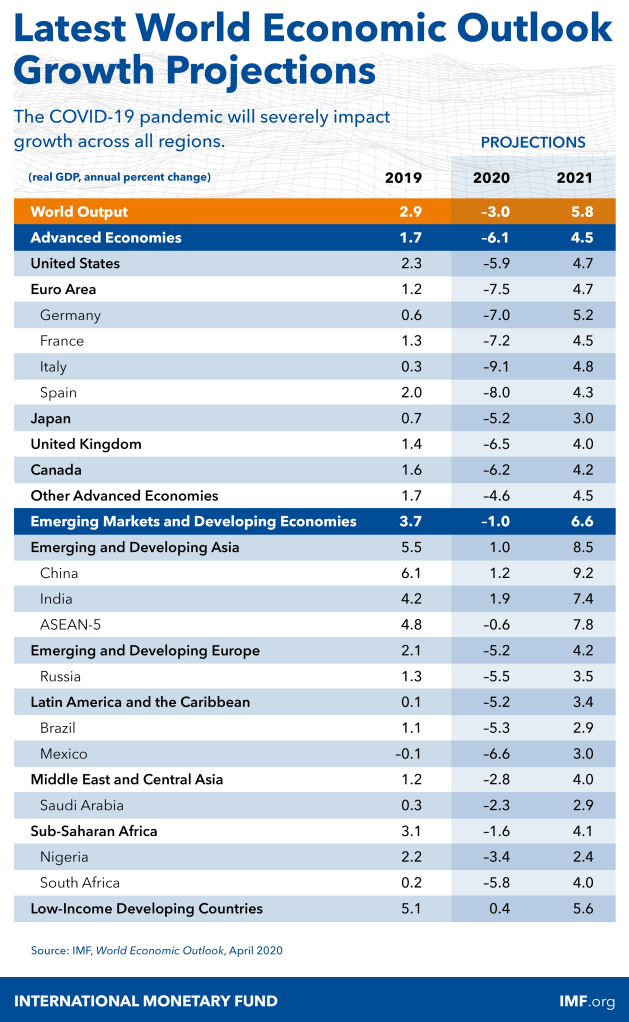
The International Monetary Fund has published its annual World Economic Outlook, and its estimates for global economic growth in 2020 are dismal. Those results reflect the effects of the COVID-19 pandemic on economic activity. According to the report:
“The COVID-19 pandemic is inflicting high and rising human costs worldwide, and the necessary protection measures are severely impacting economic activity. As a result of the pandemic, the global economy is projected to contract sharply by –3 percent in 2020, much worse than during the 2008–09 financial crisis. In a baseline scenario–which assumes that the pandemic fades in the second half of 2020 and containment efforts can be gradually unwound—the global economy is projected to grow by 5.8 percent in 2021 as economic activity normalizes, helped by policy support. The risks for even more severe outcomes, however, are substantial.”
My own view is that the IMF is overly optimistic for the prospects for growth in 2021. The projection assumes that the recovery from COVID-19 will mimic recovery from earlier pandemics which almost invariably take what is known as a “V-shaped” recovery–a sharp decline followed by a sharp uptick as things return to normal. I do not think that COVID-19 will follow this pattern because there is a great deal of uncertainty whether infections confer immunity. There are too many examples of people who are asymptomatic as well as people who apparently have been reinfected. This anomalous pattern suggests to me that a vaccine will be more problematic than in earlier viruses.
Second, I think that the IMF was not able to take into account what I believe will be a devastating impact on poor communities. So far, the virus has not been tracked effectively in Latin America and Africa, and we have no idea how it will be transmitted in societies that lack the resources for effective medical equipment as well as infrastructures that will make social distancing virtually impossible. The richer countries have always significantly underestimated the significance of the markets and resources in poor countries for economic health. COVID-19 will deprive the global economy of those important resources for economic activity.
Third, and most importantly, the IMF baseline for recovery relies upon experiences that assume fairly effective policy responses by governments in cases such as H1N1, SARS, and MERS. Those epidemics were addressed by multilateral responses that were, generally speaking, cooperative. What we have witnessed thus far in COVID-19 is essentially a free-for-all response dictated by the activities of the US: outbidding and hijacking supplies, nationalistic rhetoric of blame which has undermined trust, and the hollowing out of international organizations such as the World Health Organization. Politico outlines some of these issues:
“The coronavirus pandemic is pushing countries around the world into a cutthroat competition for medical resources — and the United States is being cast as a leading villain.
“President Donald Trump’s administration stands accused of effectively hijacking shipments of masks and additional crucial supplies meant for other countries, including U.S. allies, and strong-arming private firms to prioritize America over other parts of the world. On Friday, Trump announced he was invoking the Defense Production Act to restrict U.S. exports of key medical gear.
“Developing countries, where Covid-19 has yet to fully wreak havoc, are terrified of being left behind in the race for personal protective equipment, or PPE, and other materials because they cannot match the purchasing power of the U.S. and other wealthy countries.
“Independent aid organizations that cater to the neediest corners of the globe are finding themselves competing for attention from medical goods manufacturers. The Trump administration has even asked aid groups to share those supplies with the U.S. government, in a bizarre reversal of the usual dynamic between the world’s leading power and those it typically helps.
“’It’s ‘Lord of the Flies: PPE Edition’,’ said Jeremy Konyndyk, a former U.S. official who specializes in disaster response. ‘We need some global solidarity, and instead we have global competition.’
“The international scramble mirrors the beggar-thy-neighbor competition among U.S. states for ventilators and other items considered vital to halting the spread of infections. It’s a reflection of the astonishing dearth of coordination among world leaders on the response to the virus, which has appeared in more than 180 countries.
“It also could exacerbate and extend the crisis: If poorer countries are unable to stop the virus, it is even more likely reemerge in more developed parts of the world that thought they had defeated it.
“According to the I.M.F., the global economic contraction from 1929 to 1932 was approximately 10 percent. Advanced economies shrank by 16 percent during that period.
“Barry Eichengreen, the University of California, Berkeley, economist who is a scholar of the Great Depression, said there were several parallels between now and then. He pointed to the jobless rate in the United States, which he expects could top the 25 percent that was reached in 1933, and the global nature of the downturn, which could prolong the crisis as poor countries struggle to combat the virus.
“While the Great Depression started in the financial sector and played out over several years, Mr. Eichengreen notes that the drop in economic activity this year has been sudden and the bottom remains unclear. But some of the spillover effects could be similar, he said, with skittish households increasing their savings and businesses growing wary of large capital investments. And as deficits soar, some countries could push for austerity measures.”
Do not take the Great Depression analogy too seriously. If we have stupid people pushing for deficit reduction (good riddance, Paul Ryan) or for interest rate hikes, then maybe. But I think Pelosi and Schumer will make sure that such steps are avoided.
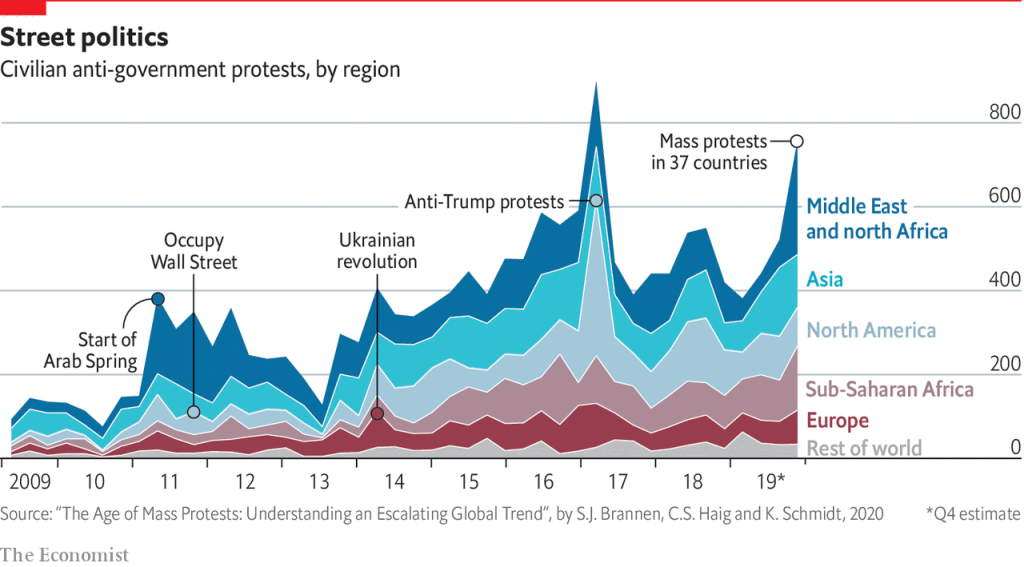
The Center for Starategic and International Studies has released a new report entitled “The Age of Mass Protests: Understanding an Escalating Global Trend”. The report is important because it gives substance to my intuitive sense that dissent is rising in the world. Its global scope also links disparate protests such as the Arab Spring to the protests in Hong Kong. All protests are based in local issues, and it would be a mistake to think that all protests are somehow linked. But my personal understanding of world politics has taken notice of how widespread dissatisfaction with the political status quo has become. The Executive Summary makes these points:
Mass protests increased annually by an average of 11.5 percent from 2009 to 2019 across all regions of the world, with the largest concentration of activity in the Middle East and North Africa and the fastest rate of growth in sub-Saharan Africa.
Analysis of the underlying drivers of this growth suggests the trend will continue, meaning the number and intensity of global protests is likely to increase.
Protests have resulted in a broad range of outcomes, ranging from regime change and political accommodation to protracted political violence with many casualties.
Factors that could increase the rate of protest include slowing global economic growth, worsening effects of climate change, and foreign meddling in internal politics via disinformation and other tactics.
Russia, China, and Iran are notably active in suppressing protest movements within their own borders. They also advise and assist other country governments in suppressing protest movements, and in some cases meddle uninvited in other countries’ protest movements by exploiting existing political cleavages.
Three potential catalyzing factors, which could intensify the trend or make it more manageable, warrant particular attention: (1) the use of technology by protestors and governments alike, (2) the tension between shifting democratic and authoritarian government types, and (3) the need for improved understanding and responsiveness between governments and their citizens.
To date, the U.S. government has failed to develop a systematic response to the rising tide of global protests. The Unites States has thus far treated each as an anomaly rather than a greater trend, failing to scale up U.S. capacity to achieve strategic ends, including by shoring up global democracy and pushing back against the spread of authoritarian tactics.
The outbreak of the novel coronavirus in early 2020 appears to have temporarily interrupted the surge of protests from 2019 in Hong Kong and Iran, though protest movements from Canada to India continue.
The report highlights significant factors contributing to this rise in protests: 1) the rise of social media which makes organizing protests easier; 2) youth unemployment, which has risen from 9.3% to 12.8% since 2991; 3) perceptions of rising governmental corruption and economic inequality; and 4) growing concerns over climate change.
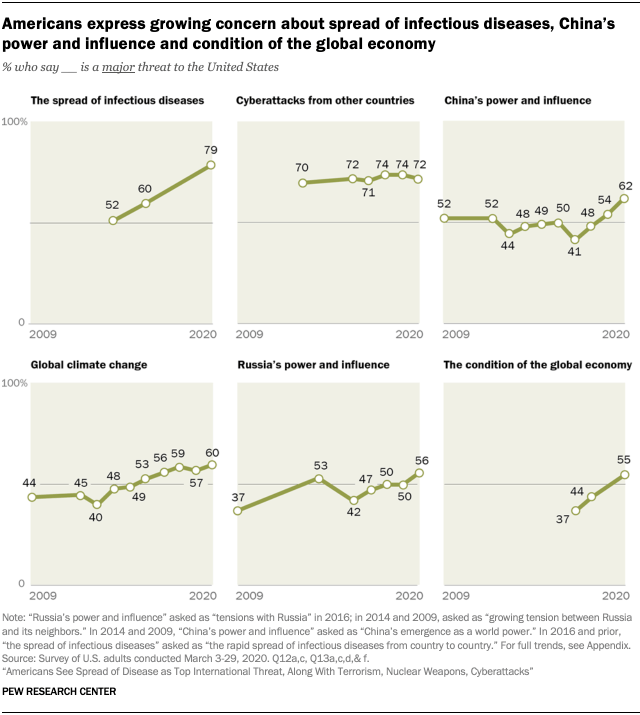
The Pew Research Center has published a report on how American citizens view various global threats. Not surprisingly, infectious diseases rank among the top threats (I wish there was a long-term poll of the threats to assess how infectious diseases ranked in the past). But what is most striking about the poll is that Americans apparently think that all threats are increasing–perhaps the poll is an index of paranoia.
But there was also another interesting aspect to the poll. Pew points out that Americans are favorably disposed toward international cooperation as a way of addressing these problems:
“Overwhelming majorities of Americans say cooperation with other countries is important when dealing with each of the international issues tested, and this is especially true of the spread of infectious diseases. On this issue, 86% say it is very important to cooperate with other countries, and 97% say it is at least somewhat important to cooperate.”
The results are clearly at odds with the “America First” policies of the current US administration. It would be good if policy-makers listened more carefully to US citizens.
Kyle Harper has written a fascinating essay for Foreign Policy on how previous pandemics have led to social and political change in human societies. He starts off by introducing the idea of Ibn Khaldun, a 14th century Arab scholar, who wrote a book entitled Preface which laid out what he regarded as a universal pattern in human history:
“The most original contribution of his Preface was the concept of asabiyyah, or group solidarity. For Ibn Khaldun, the basic pattern of human history was the dynastic cycle, the rise and fall of civilizations, and asabiyyah—the sense of common purpose and social cohesion—was the source of power that allowed collective action during the growth phase of a dynasty or civilization. Yet, in turn, success and prosperity acted to undermine the sense of solidarity that had allowed one group to rise to power. Thus, civilizations corrupted inevitably and from within.”
For Khaldun, who wrote against the backdrop of the Black Death, a pandemic forced societies to appreciate collective solidarity in order to survive. The crisis need not be natural. In US history, the Great Depression was the crisis that created the sense of social connectedness that propelled American society into a dynamic economic and cultural powerhouse. In China, the humiliations imposed on China by Western powers during the 19th and early 20th century, also created the sense of common purpose that underpinned the Chinese miracle of the late 20th century.
Harper analyzes the possible effects of the COVID-19 pandemic:
“Frankly the virulence of the pathogen could be much worse, and perhaps the next one—and there will be a next one—will be worse. But it is already clear that this disease, which will cause a much smaller relative mortality than history’s great pandemics, is going to have major reverberations. The social, economic, and possibly geopolitical impact of COVID-19 will overshadow the much deadlier 1918 influenza pandemic. This new disease strikes at the heart of our interdependent global order. It is breaking new ground: It is the first global pandemic of the social media age, our age of cultural and political polarization, and consequently, it has its own aesthetic, its own feel. It is a novel economic challenge in so many ways. Our hyperefficient labor markets, so reliant on gig jobs; our long, intricate, and just-in-time supply chains; our highly leveraged economy with extreme dependence on consumer, corporate, and sovereign debt—none of these systems have faced a disruption like the COVID-19 pandemic.”
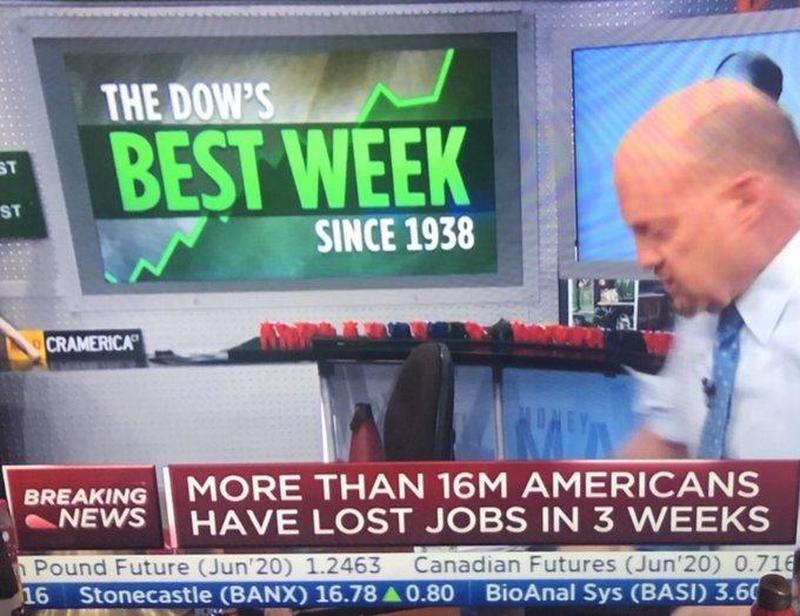
The effect is to accelerate and amplify the reasons for “success” into causes of “decline”. The very success of the American economic model in the 20th century is the basis for the growing economic inequality in the 21st century which may undermine US prosperity. COVID-19 offers the opportunity to see this negative process and to perhaps address that inequality before it leads to a serious economic crisis. There is perhaps no better way to understand this paradox than to view this TV screen shot which portrays the incredible discrepancy between rich and poor in the US.
Simon Tisdall has written a devastating critique of how US President Trump has damaged the reputation of the United States globally. Tisdall quotes Stephen Walt, a Professor at Harvard whose analyses I have often found to be quite compelling:
“‘The Trump administration’s self-centred, haphazard, and tone-deaf response [to Covid-19] will end up costing Americans trillions of dollars and thousands of otherwise preventable deaths,’ wrote Stephen Walt, professor of international relations at Harvard.
“’But that’s not the only damage the United States will suffer. Far from ‘making America great again’, this epic policy failure will further tarnish [its] reputation as a country that knows how to do things effectively.’
“This adverse shift could be permanent, Walt warned. Since taking office in 2017, Trump has insulted America’s friends, undermined multilateral alliances and chosen confrontation over cooperation. Sanctions, embargoes and boycotts aimed at China, Iran and Europe have been globally divisive.”
“That’s a title the US appears on course to lose – a fall from grace that may prove irreversible. The domestic debacle unleashed by the pandemic, and global perceptions of American selfishness and incompetence, could change everything. According to Walt, Trump has presided over “’a failure of character unparalleled in US history’”.
The essay is cogent and well-argued. I doubt that it will persuade many who support Mr. Trump, but Tisdall’s analysis deserves a direct response by those who would disagree with him.
“One way to think about the rise in inequality is to imagine how different the economy would be if inequality hadn’t soared over the past 40 to 50 years. In that scenario, with the same G.D.P. that we have today but with 1980 levels of inequality, every American household in the bottom 90 percent of income would be earning about $12,000 more — not just this year, but permanently.
“In effect, each household in this bottom 90 percent is sending a check for $12,000 to every household in the top 1 percent, year after year after year.”
This disparity accumulates and the authors suggest that since 1 January 2011, each family in the bottom 90% of families has transferred over $110,000 to families in the top 10%–in reality, the US economic system is “trickle-up”, not the “trickle-down” system romanticized by conservative economists.
The disparities in wealth are equally glaring:
“Overall, the richest 0.1 percent of American households own 19.6 percent of the nation’s total wealth, up from 15.9 percent in 2005 and 7.4 percent in 1980. The richest 0.1 percent now have the same combined net worth as the bottom 85 percent.
“The wealth trends have been especially hard on younger Americans. The median net worth of Americans under age 35 — who started off substantially poorer on average than older Americans — is 40 percent lower than the net worth of Americans under 35 was in 2004. The net worth of Americans over age 65, by contrast, has risen 9 percent over the same period. The Boomers, in short, are richer than their predecessors, and Millennials and Generation X are poorer than their predecessors.”
When race is factored into the analysis of wealth, the disparities grow even wider: “The median wealth of white households is now 10 times higher than the median wealth of black households. In 1992, the multiple was seven to one.”
The inequities have a decisive effect on the quality of life for most Americans: “Rich and poor Americans used to have fairly similar lifespans. Now, however, Americans in the bottom fourth of the income distribution die about 13 years younger on average than those in the top fourth.” Life expectancy in the US now lags behind those in other rich countries such as France and Germany. And the way Americans die has also changed:
“Another reason for the widening gap is “deaths of despair” — from suicide, alcoholism and drug abuse. The rate of these deaths among American adults (ages 25 to 64) without a four-year college degree has nearly tripled since the early 1990s. More now die from these causes than from cancer.
“For Americans with a college degree, the “deaths of despair” rate has risen only modestly over the same period — and is now less than one-fourth as high as it is for people without a degree.”
The health effects of the COVID-19 pandemic have aggravated these disparities. One hopes that the dramatic exposure of the economic inequities by the pandemic will lead to greater efforts to minimize and erase them. That outcome, however, does not seem likely given the economic plans currently being discussed by the US Congress.
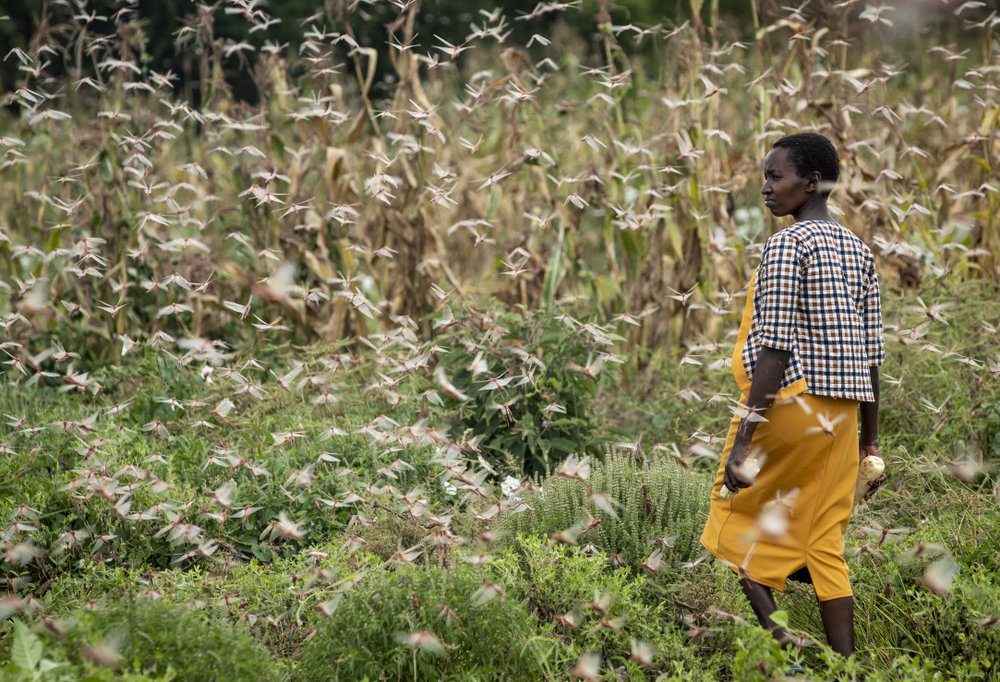
A second wave of locusts is overrunning parts of East Africa and it is estimated to be about 20 times the size of the first wave. The locusts are consuming vegetation in large amounts in Kenya, Ethiopia, South Sudan Djibouti, Eritrea, Tanzania, and Congo. Fighting the locust swarms has been complicated by the COVID-19 plague which has made shipments of necessary pesticides significantly more difficult.
Locust Swarm on a Farm in Kenya
The swarms appear to be much larger than those that affected the region earlier. According to Quartz:
“This infestation of desert locusts first arrived in East Africa last June, feeding on hundreds of thousands of hectares of crops and pastureland and chomping a path of destruction through at least eight countries (Kenya, Uganda, South Sudan, Ethiopia, Somalia, Eritrea, Djibouti and Sudan). Scientists say these devastating insects never left East Africa: in fact, favorable wet conditions due to above average rainfall this season means they are likely to achieve two generations of new breeding by June this year, increasing their population size up to 400 times.”
East Africa is already a food insecure region and the locust plague will make the situation significantly worse. Efforts to combat the locusts are hampered by the restrictions on the movement of people due to fears of COVID-19. But it is also the case that the attention of the world is more focused on the coronavirus in rich countries and it is doubtful that the necessary resources can be marshaled to address the locust infestations.
The price of oil continues to drop as demand declines and Saudi Arabia and Russia continue to disagree over the necessary production cuts to stabilize the price per barrel. The Asia Times reports:
“OPEC+, the group of oil producers led by Russia and Saudi Arabia, respectively the world’s second and third largest crude producers and top two exporters, reached a tentative agreement to trim oil production by 10 million barrels per day (bpd) to help ease the economic impact of the coronavirus crisis on global demand.
“The group of producers will cut 10 million bpd worth of production in both May and June, then drop the cut to 8 million bpd for the rest of the year. Starting in January 2021, production cuts will drop to 6 million bpd and last until April 22, 2021.
“The deal, as Asia Times reported, did not include other non-OPEC+ producers like the US, the largest global oil producer (at least for now), but OPEC kingpin Saudi Arabia called on other producers to also cut production.
“The push by both Russia and Saudi Arabia to have the US join a production cut, however, may have been over played since oil prices are so far beneath most US shale producers’ breakeven production costs that around 3 to 4 million bpd of US production could go offline soon.”
It is not clear that production cuts can offset the decline in demand. Air line travel, which accounts for about 8% of global petroleum demand, is at a standstill because of COVID-19, and is unlikely to resume its normal levels soon. And it appears that US shale oil producers are reluctant to cut production even as prices go below profitability: “The United States is currently the largest oil producer in the world — and Texas is the largest oil-producing state, accounting for 5 million of the 13 million barrels produced nationally each day.” While low oil prices are good for the American consumer, they also threaten to bankrupt many oil producers which in turn threatens the viability of the banks that lent them money. The Texas Railroad Commission regulates oil production in the US (a very long an complicated story about how a small bureaucratic organization has so much power) but most producers fear government intervention in price setting. According to the Austin American Statesman:
“But many oil and gas companies — especially major ones involved in production, refining and selling finished gas — are opposed to government intervention.
“’Chevron wants to operate in a fair competitive market and believes that the free market system will aptly regulate the price and supply of crude oil,’ Chevron Vice President Jeff Gustavson wrote the commission on April 8.
“The company is one of the largest acreage owners in the Permian Basin, with 2.2 million acres in Texas and New Mexico. ‘One state’s actions will not positively affect the global market supply, but it could negatively affect Texas’ competitiveness in that market,’ Gustavson wrote.”
Many countries depend on the revenues generated by oil and gas exports. The current price of oil is not high enough to satisfy their revenue demands and that shortfall may have significant repercussions on political stability in those countries.
The COVID-19 pandemic should make us think more seriously about the meaning of national security. Since 11 September 2001, the US has spent an incredible amount of money on the “war” on terror: “A 2018 study by the Stimson Center put the cost at $2.8 trillion during fiscal years 2002 through 2017. Spending on counterterrorism made up nearly 15 percent of the $18 trillion in federal discretionary spending during that period.” If one includes the costs of providing for the war veterans as well as the interest costs for all the money borrowed to pay for that war, the cost could be as high as $6.5 trillion. The war on terror was in response to about 3,000 lives lost on 9/11. For 2020, the US has budgeted $738 billion for the Pentagon to cover future threats to the US.
The COVID-19 pandemic could cost about 100,000 US lives. The costs of protecting American lives from the virus is likely substantially less. The Cato Institute offers these comparisons:
“Surveying that budget request from two months ago, the Trump administration had asked for $11.4 billion to purchase 79 F‑35 Joint Strike Fighters, $3.5 billion for 2 Arleigh Burke destroyers for the Navy, and $1.5 billion to modernize 89 M‑1 Abrams tanks.
“By way of comparison, then, and using high‐end estimates for the medical devices, for the cost of a single F‑35 ($144 million), we could have purchased at least 2,800 ventilators.
“Last month, Maryland Governor Larry Hogan called on hospitals to quickly expand the number of beds in the state. Six hospitals reported that it would cost nearly $40 million to add 340 by May 1st. At that rate, the one Navy destroyer in the Trump administration’s budget ($1.75 billion) costs as much as 14,870 hospital beds.
Americans need to debate these priorities in the upcoming presidential election. Defense budgets are generally passed in the US Congress with little or no debate. Yet talking about securing the health of citizens seems to be a highly controversial subject. These priorities are indefensible.
The Guardian has published an article which catalogs a number of cases in which orders for medical equipment for a number of countries were essentially hijacked by the US. Protective equipment, such as masks, and medical equipment, such as ventilators, were bound for different destinations but were diverted to the US after huge sums–in some cases three times the original price–were paid in cash. The Guardian explains:
“In the scramble for masks and other critical medical supplies, the US has a significant advantage in its fleet of large air freighters, three times the size of China’s. Buyers from national governments, US states and private buyers are going through a network of brokers, many in Shanghai.
“One broker, Michael Crotty, who runs Golden Pacific Fashion & Design in Shanghai, told the New York Times that Chinese factories sometimes move the highest-paying customers to the front of the line. ‘It’s a seller’s market,’ Crotty said. ‘You don’t see this very often.'”
“On the same day, French officials claimed that a mask order coming from China was bought from under them at the last moment. They cargo was already on the runway in Shanghai when it was bought for much more money, they said.
“The masks were reportedly already on a plane bound to leave the airport in Shanghai when US buyers turned up and offered three times the amount the French were paying, according to The Guardian.
“Jean Rottner, president of the GrandEst regional council in France, was quoted as telling RTL radio: ‘On the tarmac, they arrive, get the cash out…so we really have to fight.’
“While Rottner did not identify who exactly the buyers were, another French official said the group acted for the US government, The Guardian reported.
“French politician Rénaud Muselier told the channel BFMTV: ‘The icing on the cake, there is a foreign country that paid three times the price of the cargo on the tarmac.'”
These tactics are definitely the consequence of an “America First” policy. They are however, morally repugnant and hardly conducive to good relations among strong allies.
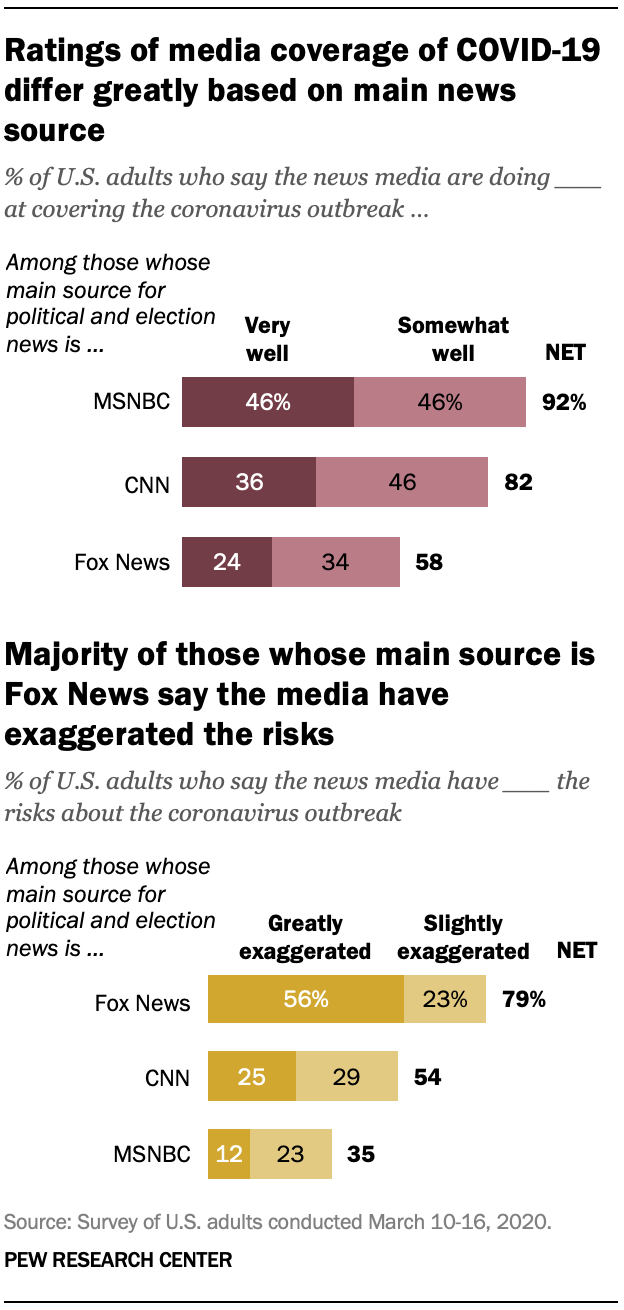
The Pew Research Center has conducted a poll of Americans on the COVID-19 crisis and their sources of information. Not surprisingly, there are some dramatic differences in interpretations of the crisis depending on the source of information. The Center points out:
“One such difference emerges around knowledge and understanding of the pandemic. The group who names MSNBC as their main news source is far more likely than the Fox News group to answer correctly that the coronavirus originated in nature rather than a laboratory and that it will take a year or more for a vaccine to become available. On both questions, the portion in the CNN group to answer correctly falls between the MSNBC and Fox News numbers. This analysis comes from a survey of 8,914 U.S. adults who are members of the Center’s American Trends Panel.
“The Fox News and MSNBC groups also differ in their evaluations of the media’s coverage of the pandemic. Those who call MSNBC their main political news source are far more likely to say the media covered the outbreak somewhat or very well (92%) than the Fox News group (58%). And they are much less likely than those who name Fox News as their main source to say the media exaggerated the risks posed by the pandemic (35% of the MSNBC group vs. 79% of the Fox News group). And again, those who identify CNN as their main news source fall in between (82% rate the media as doing somewhat or very well covering the outbreak; 54% say the media exaggerated the risks).”
These results are not surprising but are nonetheless troubling. The wide discrepancies suggest that meaningful responses to the virus will prove difficult to forge. They also indicate that viewers of Fox News seem to be unwilling to revise their positions in the face of conflicting information. Liberal Politics are virtually impossible under such circumstances. Science was always held to be an arbiter of disputes, but that no longer seems to be the case.
“Despite these and other extreme steps, the United States will likely go down as the country that was supposedly best prepared to fight a pandemic but ended up catastrophically overmatched by the novel coronavirus, sustaining heavier casualties than any other nation.
“It did not have to happen this way. Though not perfectly prepared, the United States had more expertise, resources, plans and epidemiological experience than dozens of countries that ultimately fared far better in fending off the virus….
“The Trump administration received its first formal notification of the outbreak of the coronavirus in China on Jan. 3. Within days, U.S. spy agencies were signaling the seriousness of the threat to Trump by including a warning about the coronavirus — the first of many — in the President’s Daily Brief.
“And yet, it took 70 days from that initial notification for Trump to treat the coronavirus not as a distant threat or harmless flu strain well under control, but as a lethal force that had outflanked America’s defenses and was poised to kill tens of thousands of citizens. That more-than-two-month stretch now stands as critical time that was squandered.”
The US had information as early as 31 December about the coronavirus cases in China and the Center for Disease Control learned about the virus on 3 January. By the time President Trump barred travelers from China at the end of January, over 300,000 people entered the US from China. The Post article reaches a very damning conclusion:
If the coronavirus has exposed the country’s misplaced confidence in its ability to handle a crisis, it also has cast harsh light on the limits of Trump’s approach to the presidency — his disdain for facts, science and experience.
“He has survived other challenges to his presidency — including the Russia investigation and impeachment — by fiercely contesting the facts arrayed against him and trying to control the public’s understanding of events with streams of falsehoods.
The coronavirus may be the first crisis Trump has faced in office where the facts — the thousands of mounting deaths and infections — are so devastatingly evident that they defy these tactics.”
As the COVID-19 plague spreads over the US, the evidence is accumulating that the poorer countries in the world are being overwhelmed and are not well prepared to deal with the crisis. Ecuador is one of those countries that have been seriously affected. Its most populous city, Guayaquil, has dead bodies in the streets because the medical system has been swamped by people seeking help. CNN reports:
“The coronavirus pandemic is overloading the public services in the country’s most populous city to a point of collapse. Hospitals have no beds left to accept sick patients, and morgues, cemeteries and funeral homes are straining. With no place left to put them, some residents say they have no choice but placing them outside.It’s unclear how many of the deceased are dying because of Covid-19. Many families say their loved ones had symptoms of the virus, while others only know the ill were unable to be treated at Guayaquil’s overwhelmed hospitals.”
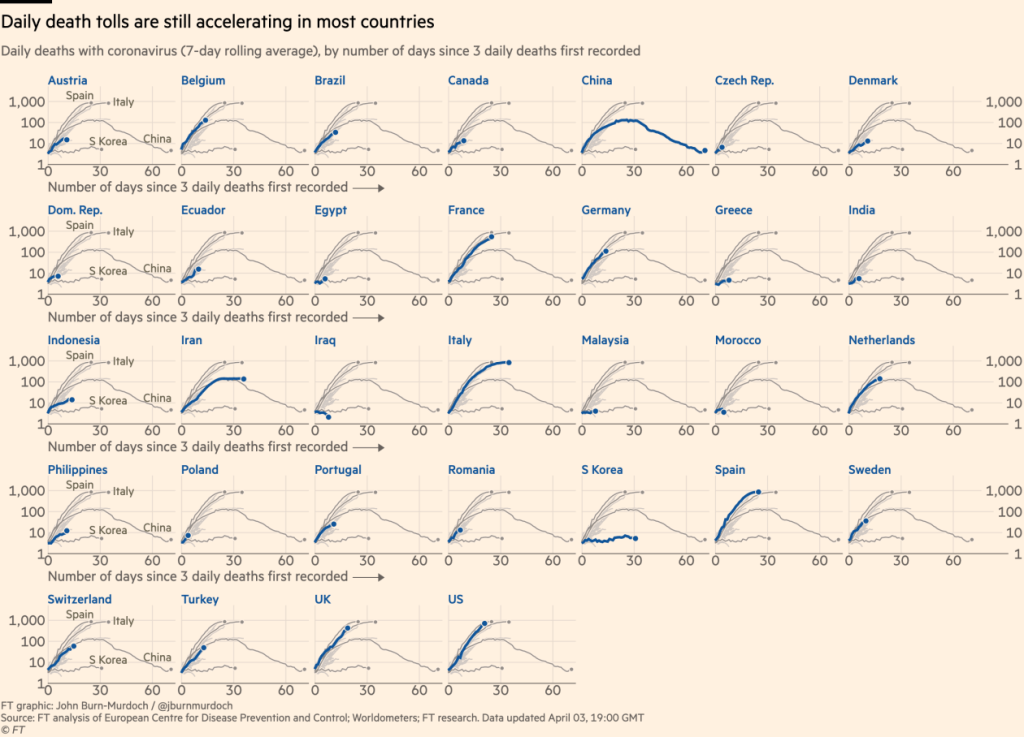
Ecuador is expecting as many as 3500 deaths in the city. The intensity of the situation in Ecuador is due to the large traffic between it and Spain, which itself has seen many deaths. The Financial Times has published graphs on the growth of coronavirus cases in various countries in the world.
The graph shows that some countries continue to see rapid growth in the number of cases, while others, such as Malaysia and South Korea, have been able to arrest the rate of growth. Clearly, effective governmental action can have a huge effect on how rapidly the virus spreads.
But there is an additional complicating factor. An effective response also requires the necessary medical supplies to take care of the sick. But the world is witnessing an extraordinary scramble for those supplies, pushing the cost of some of those supplies are too expensive for poor countries. Politico gives a sense of how the market is favoring rich countries:
“The coronavirus pandemic is pushing countries around the world into a cutthroat competition for medical resources — and the United States is being cast as a leading villain.
“President Donald Trump’s administration stands accused of effectively hijacking shipments of masks and additional crucial supplies meant for other countries, including U.S. allies, and strong-arming private firms to prioritize America over other parts of the world.On Friday, Trump announced he was invoking the Defense Production Act to restrict U.S. exports of key medical gear.
“Developing countries, where Covid-19 has yet to fully wreak havoc, are terrified of being left behind in the race for personal protective equipment, or PPE, and other materials because they cannot match the purchasing power of the U.S. and other wealthy countries.
“Independent aid organizations that cater to the neediest corners of the globe are finding themselves competing for attention from medical goods manufacturers. The Trump administration has even asked aid groups to share those supplies with the U.S. government, in a bizarre reversal of the usual dynamic between the world’s leading power and those it typically helps.
“’It’s ‘Lord of the Flies: PPE Edition’,’ said Jeremy Konyndyk, a former U.S. official who specializes in disaster response. ‘We need some global solidarity, and instead we have global competition.'”
Over time we shall all witness the rising number of deaths in the world that could have been avoided if the world had decided to work cooperatively. The rise of nationalism in the world is making that response impossible. The tragedy demands more than a Darwinian response.

 World Politics News