Andrea Mammone is a lecturer at Royal Holloway at the University of London and she has written an op-ed piece for the New York Times which investigates the rise of right-wing parties in Europe and the growth of anti-European Union sentiment on the continent. It is a perceptive essay and its conclusions are worrisome. Not only does it explain the anti-“other” hatred which is growing in Europe (against gays, Jews, Arabs, Muslims, and Roma), but it also suggests that support for the European experiment is weakening among the populations.
The Council on Foreign Relations has published a background piece on Hezbollah, the organization supported by Iran and Syria that operates within Lebanon. The backgrounder provides good information on how Hezbollah operates and what its objectives are. Given the recent upsurge of violence in Lebanon, it is useful to know more about this organization.
The IMF has issued a paper which warns that indebtedness in many of the advanced industrialized countries has reached a 200-year high and that write-downs of the debt are necessary. There are a variety of ways to write-down debt–all of them painful. But each technique for reducing debt falls on different groups. A simple write-off (“we won’t pay the full amount we promised”) hurts the holders of bonds. A write-off that involves increasing revenues to reduce the debt hurts taxpayers, and the tax burden is disproportionately weighted against the poor. A write-off that involves reducing government spending also affects the poor more than the rich. And a write-off that inflates the currency (reducing the “real”, not “inflated” currency, necessary to repay the debt) hurts savers and bond-holders, who are mostly rich. We’ll see what the mix of policies are employed to reduce the debt burden.
This will be the last posting for a few days. I’m off for a vacation and will be posting only sporadically. I’ll be back to daily postings on the 18th of January.
The New York Times ran an editorial today arguing that Edward Snowden, the leaker of the National Security Agency’s surveillance techniques, should be considered a whistle-blower, not a criminal. This assessment has been my own view since the beginning, but few shared it at the time the leaks were first revealed. The New York Times has less heft now than in times past, but the public position of the editorial board of the Times is an important move in the right direction. Until the Obama Administration gives substantive proof that the the country has suffered a tangible harm from the leaks, it has not proven a criminal case against Snowden. The revelations, while highly embarrassing to the US, are not evidence of criminal intent.
The Pitchfork Movement in Italy is one of the anti-austerity protest movements that have cropped up in Europe over the last three years. As is the case with several other movements in Europe (the True Finns in Finland, the Jobbik Party in Hungary, and Geert Wilders Party in the Netherlands, there is a strong right-wing element in the Pitchfork Movement. It became explicitly anti-Jewish in recent days, reviving some of the ugliest themes of the 20th century. We’ll have to see how the people of Italy respond to this very dangerous trend.
There was another major bomb blast in Beirut, Lebanon today, the most recent in a string of explosions that threaten to destabilize the already fragile Lebanese government. The attacks all seem to be aimed at Hezbollah, Iran’s ally in Syria and Lebanon. It seems likely that these attacks are an extension of the civil war in Syria, as Sunni groups, funded largely by Saudi Arabia, seem intent on reducing Iranian influence in the region. What is more likely is that the violence will continue to spill over into a number of other countries. The Syrian civil war is now a full-fledged regional war.
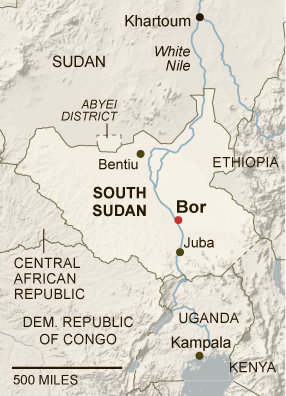
The New York Times has a very good background piece on the violence in South Sudan. South Sudan is the world’s newest nation-state (it was created on 9 July 2011), and it was forged because of long-standing disputes between its residents and those of the Sudan, from which it broke away. Nonetheless, there were cleavages within South Sudan that were never resolved. Some of these were ethnically defined–the relationship between the Nuer and the Dinka tribes was a well-defined problem. Some of the cleavages were personal, as manifest in the difficult relationship between Riek Machar and the current President, Salva Kiir. As always, the cleavages are simply a way to articulate the sides in a struggle for power.
The Iraqi government is reeling under threats by Sunni members of Parliament to resign. The ongoing violence in Anbar Province, where a majority of Sunni Iraqis live, has been fostered by an al-Qaeda related group, the Islamic State in Iraq and the Levant. The Shia majority government, led by Prime Minister Nouri al-Maliki, has been unable to contain the violence. Indeed, al-Maliki has asked the US for military assistance to contain the rebels. The US has refused, believing that it would be a serious mistake to help arm an Iranian ally.
I am always in pursuit of new music, and, while I’m not a fan of heavy metal (I tend toward the blues), I am more intrigued by how music cultures fuse. ArmadurA is a heavy metal band from Bolivia, and it is amazing how it has integrated traditional Bolivian instruments (like the Zampona) into the genre. If you like heavy metal, turn your speakers up. The title of the song is from an old Inca phrase: “Don’t steal, don’t lie, don’t be lazy.”
Today is the anniversary of one of the saddest moments in American history–the massacre at Wounded Knee in South Dakota. It was the last battle between US troops and the Native American Lakota nation, and it was a bloody incident characterized by confusion and race hatred. The battle was representative of most of the battles between indigenous peoples and more economically developed societies: the technological advantages of the latter predetermined the outcome. The number who died in the massacre is not known (between 150 and 300), but included many innocents.
Chief Spotted Elk
The violence in the Central African Republic (CAR) has reached horrific levels. According to UNICEF, more than 1,000 people have died in the last month, and there are reports of children being decapitated and mutilated. The civil war between Muslim Seleka rebels and Christian militias shows no sign of abating, and the presence of French peacekeepers has apparently had little effect. Indeed, the suspicion is that the French are supporting the Christian militias. As is always the case, do not believe that the battle is a religious one: the fighting is over who controls power, not a battle over doctrine.
I think that these posts need to be leavened a bit by a little diversion. Don’t believe your own eyes. Make sure you watch until the end to see how you have been deceived.
Gisèle Mounzer of esri, a brilliant company that specializes in mapping, has published a map of the travels of Odysseus in his ten-year journey from Troy to Ithaca. It uses a modern-day map of the Mediterranean and points out the various stops on his journey. It is impossible to verify the accuracy of the map, but the map itself is an extraordinary window into a great work of art.
There was a bomb attack at the central train station in Volgograd (known as Stalingrad during the Soviet era), Russia. Authorities believe that the attack was carried out by a female suicide bomber associated with a Islamic movement in the Caucasus. There has been a spike in violence in the region as rebels appear to be trying to disrupt daily life in Russia as the Winter Olympic games in Sochi get close to opening. Female suicide bombers are known as “black widows” by Russian authorities as they try to avenge the deaths of their husbands or loved ones at the hands of the Russian police or military.
Violence is breaking out in Bangladesh as elections near. The ruling Awami Party, led by Prime Minister Sheikh Hasina, has been rocked by the refusal of the Bangladesh Nationalist Party (BNP) to participate in the elections. The BNP, led by Khaleda Zia, believe that the elections will be rigged and are refusing to participate in protest. Hasina and Zia are longtime rivals, and their personal animosity toward each other is a major part of the deadlock. THe violence, however, will serve to undermine the legitimacy of the Bangladeshi state.
These were the stories listed on the “More News” sections of the front page of today’s online New York Times A depressing way to start my morning read:
The turmoil in Turkey is leading to serious economic problems. Not only are investors worried about the stability of the Turkish government, they are also being attracted to US dollar assets as the US Federal Reserve begins to ease off its program of quantitative easing (QE). The Federal Reserve’s easing is colloquially referred to as the “taper”. QE kept the yields on US Treasury bonds low and the taper means that interest rates on US Treasury bonds will now begin to rise slowly. As the yields rise, they become more attractive to investors. So the fearful investors in Turkish assets now have a more profitable alternative. If money begins to flow out of Turkey into the US, the Turkish economy will become weaker as it loses capital. The larger issue is that the “taper” will also attract investors in other countries that may be experiencing political turmoil, such as Ukraine and Thailand. A widespread capital flight from these emerging economies will trigger off a serious economic problem for these weaker economies.
The global balance of power began to shift slowly after the US invasion of Iraq. The removal of a Sunni government in Iraq and its replacement by a Shia-oriented government in 2004 was the beginning of a shift that accelerated in 2013 as the US and other powers sought an agreement with Iran on its nuclear program. Other governments have had to re-balance their interests to adjust to these changes, and the shifts are beginning to become quite dramatic. Nowhere are these changes more obvious than in Asia, and the US and Europe have been slow to anticipate the differences.
Another US District Court has issued a ruling on the US National Security Agency’s surveillance techniques that contradicts an earlier District Court’s decision. The first ruling, on 17 December held that the collection of metadata on telephone calls was unconstitutional; the decision today held that the surveillance was legal. The ruling today held that the NSA had not used the data for any purpose other than to track terrorists. How the Court knew that this conclusion was true is beyond me–I doubt that the Judge looked at all the files. How the judge could predict the future uses of those files is also beyond me. There are reasons why the Constitution has a 4th Amendment.
The Turkish Military has issued a statement that it does not wish to become involved in the political controversy surrounding corruption in the administration of Prime Minister Erdogan. The statement was probably necessary because of the fear of a military coup like the ones that occurred in 1960, 1971, and 1980. Turkish memories of military rule are bitter and harsh, and the fact that the military felt obliged to issue the statement is, in a very real sense, disquieting–it reflects an assessment that the current government is near breaking down.
Jackson Diehl is the Deputy Editorial Page Editor of the Washington Post and he has written an editorial which links the protests that have occurred throughout the world over the last three years. It is a very good essay, but he makes the mistake of referring to protests of the “elites.” I think he is actually referring to the middle classes of these countries, and using the word elite as a surrogate for those people who govern. The Washington Post is going to have to update its style book. In 2013, the word elite should be reserved for people who actually control large financial resources.
South Sudanese rebels have seized the oil producing sections of the country which puts the government in a very difficult position. Without the oil revenues, the government will have a difficult time maintaining its control over the country. China, which has significant interests in South Sudanese oil, has joined a large number of countries trying to defuse the two-week crisis. Although the violence in the country can be mapped out along ethnic lines (Nuer vs. Dinka), the real issue is control over the country and the oil wealth.
Japanese Prime Minister Shinzo Abe has visited the Yasukuni Shrine, a sacred site dedicated to the memorial of all the war dead of Japanese soldiers (and, indeed, of all soldiers who have died defending their countries). But the shrine also contains the remains of several Japanese soldiers who were convicted of Class A war criminals from World War II. The atrocities committed by those soldiers include many committed against Chinese and Korean civilians. Thus, the visit has raised outrage in those countries, who worry that the visit signals a return to Japanese militarism. The controversy over the shrine is long-standing so Abe knew that his visit would create a foreign outcry; his calculation is that the damage to foreign relations is outweighed by the domestic benefits of the visit. That calculation does raise some concern over the return of Japanese nationalism.
The political crisis in Turkey has deepened as three cabinet ministers resigned from the government. The crisis came about as Prime Minister Erdogan’s cohort has been charged with corruption. The Turkish media has splashed photographs of shoeboxes filled with cash as corroboration for the charges. The Erdogan government was roiled last summer as many people protested what they viewed as a growing authoritarianism in the government. The current crisis leaves the government very fragile and likely to fall, another weakness in the overall troubled state of political stability in the Middle East.
After a suicide bombing of a police headquarters, Egypt has determined that the Muslim Brotherhood should be considered a “terrorist” organization. The move signals a hard line against the group similar to the extreme measures used against the organization during the Mubarak years. The Muslim Brotherhood has denied any role in the bombing and another group, closely linked to al-Qaeda, has claimed responsibility. The political situation in Egypt seems to be drifting further away from any possibility of reconciliation and the likely imposition of authoritarian rule, an outcome that would be deplored by both the religious and the secular movements in Egypt.
This is the 99th anniversary of the famous “Christmas Truce” that occurred between Allied and German forces in World War I. It was a remarkable event, as the soldiers who had been trying to kill each other for months, observed an informal truce and exchanged presents and played soccer on the killing fields. The soldiers acted on their own, and their superiors were furious when they found out what had happened. But it was an extraordinary of human solidarity in the face of desperate conditions.