Author Archive
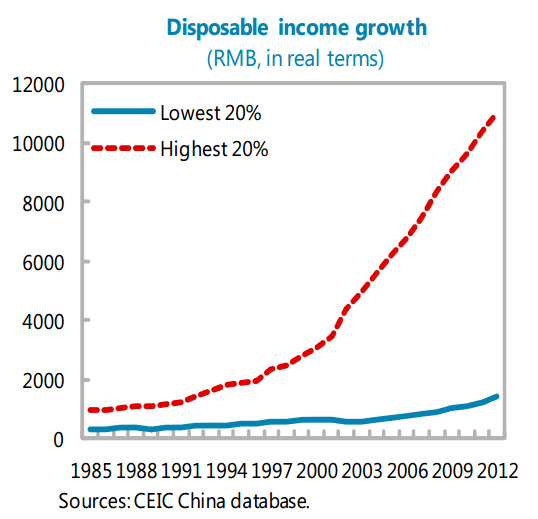
China has one of the most economies in the world right now. It has made extraordinary progress in reducing absolute poverty over the last 20 years but it also an economy where income inequality is growing the fastest. The paradox is resolved by looking at the growth of the highest incomes in China which has been explosive. China is creating more millionaires and billionaires than any other country. Whether the Chinese people care more about absolute or relative poverty is something we will likely learn in the next few years.
One country that is not experiencing such robust growth is Greece, and the situation there is getting desperate. Because of fears concerning the Greek economy, people are pulling their money out of Greek banks, and the decline in deposits has been precipitous. Given the rapid rate of withdrawal, it is not at all clear that Greek banks will be able to survive.

Tomorrow Nigerians will vote in their Presidential election. Current President Goodluck Jonathan and former President Muhammadu Buhari. It is a hotly contested race and the stakes are quite high for Nigeria and the world. Nigeria is a critically important country in the global economy, but it has failed to reach its full potential, largely because of poor governance and the inordinate influence of outside powers in its internal affairs. Elections in Nigeria have often been accompanied by violence; let’s hope that that pattern does not recur this time around.
As the deadline for an Iranian nuclear agreement nears, there are voices joining with Israeli Prime Minister Netanyahu who believe that no agreement should be reached. One of the leading analysts in the US neoconservative ranks is John Bolton, who was the US Ambassador to the UN in 2005-06. He has written an op-ed piece for the New York Times arguing that the only viable course of action is to destroy militarily the Iranian nuclear facilities. My own view is that Bolton is overly optimistic about what military action can accomplish, and that such an action would be disastrous.
Saudi Arabia has stepped up its pressure on Yemen by blockading the critical Red Sea. The critical Strait of Bab el Mandeb has been a strategic chokepoint since the time of the Pharoahs, and Saudi control of the Red Sea will put tremendous pressure on the Houthi rebels. Interestingly, the US has an important military base in Djibouti from which it will be able to give significant support to the Saudi effort. Moreover, the Saudis must have cleared the operation with Israel since a great deal of Israeli trade emanates from the Gulf of Aqaba at the northern part of the Red Sea. The seriousness of the effort is a good index of the increased fear of Iran which is motivating Saudi policy.


I have tried to track down some additional information on the Greek demands for reparations for the damages inflicted by Germany on the country during World War II. It has been a frustrating process since apparently no one wishes to talk openly about the matter. But Spiegel has run a short article which provides some additional information on the demands, and it seems from that report that the Greeks have a strong basis for their claims.
Saudi Arabia has launched an attack on the Houthi rebels who have seized power in Yemen. The Houthi rebels are nominally supported by Iran, although the Houthi struggle against the Sunni government of Yemen has long-standing internal issues. Nonetheless, the Houthi are Shia Muslims, and Saudi Arabia regards their overthrow of the Sunni government of Abd-Rabbu Mansour Hadi as an extension of Iranian power in the Gulf region. The Saudis claim to have a ten-state coalition supporting its efforts, but did not name those allies. Presumably the US has been apprised of the attack and is likely providing technical assistance. It is highly doubtful, however, that the US will get directly involved in this conflict.

The Greek government is in a desperate scramble to find enough money to repay an IMF loan which is due on 9 April. The Greeks are taking money out of pension plans, money designated for farm subsidies, and stopping payment on all supplies for the state government. Metaphorically, the Greeks are searching underneath the couch cushions to find enough money to avoid a default. In the midst of this crisis, the troika continues to insist upon regular repayment of the debt obligations. All evidence suggests that the relations between the government and the troika are essentially unproductive.
US-Israeli relations took another hit as news outlets are reporting that Israel has been spying on the current Iranian negotiations with the P5+1 and leaking that information to members of Congress in its attempts to derail the negotiations. The fact that Israel is spying on the negotiations is hardly surprising; indeed, one would have to assume that Israel would do so given how seriously takes the prospect of an Iranian deal. But leaking that information in an effort to undermine US diplomacy is clearly out of bounds for two erstwhile allies. Israel is playing a very high-risk game.
It is very difficult to comprehend how extraordinary China’s economic growth has been in recent years–it is truly unprecedented in human history. The Washington Post ran an article today with this factoid embedded in a fascinating slew of charts and photos: China used more cement in the last three years than did the US in the entire 20th century. I definitely recommend the photos of Shanghai in 1987 and in 2013: a remarkable transformation. There are, however, some problems with such rapid construction.

The President of Afghanistan, Ashraf Ghani, was in Washington, DC and asked the US to slowdown its troop withdrawal from his country. US relations with Ghani are much better than those with his predecessor, Hamid Karzai. US President Obama agreed to the slowdown because of a widespread belief in Washington that the rapid removal of US troops from Iraq allowed the rapid growth of the Islamic State. I am not persuaded that the analysis is correct (it conveniently omits the role of the total breakdown of authority in Syria as a causal factor). Obama’s agreement is yet another indication that he has decided that his planned disengagement of the US from global affairs needs to be reassessed.
In the American foreign policy class today we discussed US President Reagan’s Strategic Defense Initiative (SDI) that was an attempt to built an anti-missile system. Reagan believed that an effective anti-missile system would lift the US out of the condition of Mutual Assured Destruction (MAD) and thereby restore the American ability to threaten a nuclear attack without fear of nuclear retaliation. At the time the Soviets believed that SDI was highly destabilizing, and the Russians continue to lobby aggressively against the initiative. To get an idea of how seriously the Russians regard the threat of an American breakout of MAD one need only to examine the threat the Russians made against the apparent willingness of Denmark to become part of the anti-missile system. According to Reuters: “Russia threatened to aim nuclear missiles at Danish warships if Denmark joins NATO’s missile defense system.” I doubt that the Danes will back down.
The process of global warming is only dimly understood–the climate is extraordinarily complex and trying to model it is more than simply difficult. Scientists believe that there may be evidence for another twist in the possible consequences of global warming: a change in the ocean currents of the north Atlantic Ocean that may raise sea levels along the US Atlantic coast significantly more than had been anticipated. Indeed, there seems to be evidence for a “4-inch sea level rise of the U.S. East Coast in 2009 and 2010” due to the shifting currents. South Hadley may be beach property at some point.
The long-time leader of Singapore, Mr. Lee Kuan Yew, died at the age of 91. Almost single-handedly Mr. Lee guided Singapore from a poor colonial outpost of the British Empire into one of the most dynamic city-states in the world. Mr. Lee was an authoritarian leader who did not pay too much attention to principles of representative democracy but who also built a political system that is truly unique due to the near total absence of crime and corruption.
The dispute between Greece and Germany is reaching back into the past. Greece has revived its claims for reparations done by German troops in World War II. There is little question, even among Germans, that the devastation of Greece during the war was extensive. The question is whether sufficient reparations have already been made. Greece was never part of the World War II settlement between Germany and the allies (the US, France, the Soviet Union, and Great Britain). The Greeks are threatening a number of actions based upon their claims, all of which will inflame the situation further.
NATO (the North Atlantic Treaty Organization) continues to insist that Russia has not conformed to the cease-fire agreement and continues to pour heavy weapons into the rebel-held areas of Ukraine. Unfortunately, it did not produce the hard evidence necessary to prove the point to US allies such as Germany who do not wish to escalate the crisis by sending weapons to the Kiev government as a counterweight to Russia influence. At this point it appears as if Putin still retains the initiative in the crisis and will until the economic sanctions produce a change in the political calculations of the Russian people.
Human Rights Watch has issued a new report on the working conditions in the clothing factories of Cambodia. The factories produces clothes for some of the popular brands in the US and Europe, but few consumers are aware of the conditions in which their clothes are made. The report is a litany of abuses and describes an environment that can only be described as slavery. Globalization has certainly benefited many, but its costs for some are incredibly high.
The Kingdom of Saudi Arabia and Sweden are involved in a serious dispute. There are few who are willing to defend Saudi human rights practices, but there are remarkably few who are willing to do so openly. Swedish Foreign Minister Margot Wallstrom did so and cancelled a planned arms deal with Suadi Arabia after she was prevented from speaking about democracy and women’s rights at a meeting of the Arab League in Cairo. Saudi Arabia recalled its Ambassador for Swedish interference in its internal affairs and is threatening additional measures. Sweden is at risk of losing an important trade partner because of its sincere commitment to human rights.
The US is reassessing its relationship to Israel because of Prime Minister Netanyahu’s change of position with respect to the creation of a Palestinian state. The two-state solution to the question of Palestine has been the US position since the founding of the state of Israel in 1947, and the US would be hard-pressed to support Israel without firm assurances concerning the rights of the Arabs who live in the region. As expected, Prime Minister Netanyahu has denied that he had disavowed the possibility of a Palestinian state after the election was over. The New York Times has compiled a list of his statements over the years on the issue and one can decide for oneself whether one should trust the Prime Minister.
Diplomatic envoys from China, South Korea, and Japan have met for the first time in three years in hopes of reviving a practice designed to keep lines of communication open among the three Asian states. The annual meetings were scrapped three years ago because of rising tensions in the region due to South Korea’s and China’s belief that Japan had not yet fully apologized for its role in the second world war. The tensions were amplified by Japanese Prime Minister Abe’s plans to revitalize the Japanese military. Those plans are still proceeding, but the rebirth of the talks are a sign that the states have decided that they can manage the changes.
The Islamic State has taken responsibility for the triple suicide bombings of mosques in the capital of Yemen, Sanaa. THe attacks come on the heels of the terrorist attacks on the National Museum in Tunis. The bombings contained a number of messages. First, is was a warning to the Shia Houthi rebels who recently took control of the capital. Second, it was a warning to Al Qaeda which had been considered to be the strongest Sunni estremist group in Yemen. And finally, it was a warning to the West that the ability to conduct terrorist operations outside of Syria and Iraq seems to be steadily growing. Paradoxically, the attacks occur as the Islamic State seems to be losing control in its main base in Iraq.
Thousands of Irish citizens are protesting a water tax which was imposed by the European Union as part of its austerity program designed to bail Ireland out of its debt crisis. The protesters regard access to clean water as a human right and a cost already paid for through traditional taxes, and view the water tax as a way to pay back the loans made to banks which made indefensible loans in the early 2000s. As such, the Irish protests have strong rhetorical parallels to the Greek protests.
A secret European Union report on the political situation in the city of Jerusalem has been leaked, and the leaks suggest deep pessimism about the future of the city unless stronger actions are taken to protect the properties of Palestinians living in the city. The report predicts a high likelihood of greater violence and polarization in the city, and suggests steps that the international community could take to try to mitigate the outbreak of another intifada.
Although it is dicey at this stage of the year to make predictions about the extent of Arctic sea ice, there seems to be a consensus emerging that we have reached the lowest maximum extent of Arctic sea ice ever recorded. If no more sea ice forms in the Arctic, it will be the earliest maximum ever recorded as well. What these twin records mean is that we will have the longest summer temperatures to melt the smallest amount of ice. The poles are the most sensitive areas of the planet to global warming and it appears as if the warming at the North Pole has been unusually dramatic this year.
Tony Lake taught at the Five Colleges in the 1980s until he left to become President Clinton’s National Security Adviser in 1992. He is now the head of UNICEF, the UN’s children’s organization. He has given an interview about the status of children in the world, in particular the plight of children in the civil war in Syria. Tony is one of the smartest people I have ever known and he has generously served the public interest his entire life.
Some months ago China and Russia announced the formation of a new Asian Infrastructure Investment Bank. In many respects the bank serves a genuine need for financial capital in Asian infrastructure, but it is also designed to serve as an alternative to the US-led World Bank (the President of the World Bank has always been an American since its inception in 1944). The US did not treat the announcement of the new bank with great seriousness, but its main allies (Germany, France, Italy and Britain) all decided to join the bank this week. Some analysts view the new bank as the end of American financial supremacy. Perhaps, but let’s see how the new bank fares before we pronounce it a success.
I apologize for being off the map for the last few days–I have been preoccupied with an influenza bug that laid me low.
Israeli Prime Minister Netanyahu’s Likud Party secured 30 seats in the new Israeli Parliament, while Labor only secured 24 (interestingly, the three Arab parties came in third). The polls had suggested a better showing for Labor, but Netanyahu made a number of appeals to the more conservative elements of the Israeli polity in the last few days of the campaign. Those promises included: a statement that, contrary to his earlier statements, he would never support statehood for the Palestinians; a promise to build even more settlements in the Occupied Territories; and a warning that his opponents were encouraging Arabs to vote “in droves” to defeat him (Arabs make up 20% of the Israeli electorate). These statements clearly appealed to parts of the Israeli electorate, but will clearly complicate Israel’s relationship with Europe and the US. In particular, Netanyahu’s repudiation of a Palestinian state makes nonsense of the American negotiating position since the Oslo Agreements.
Tunisia has been one of the success stories of the Arab Spring revolutions. Despite some setbacks, Tunisians have been able to keep violence at a minimum and have kept open peaceful processes of change. Today, however, extremists attacked the national museum in Tunis, killing 17 foreign visitors and 2 Tunisians. It seems clear that the extremists were deliberately targeting tourism, one of Tunisia’s main source of revenue. As of the most current reports, it is not clear whether any of the artifacts in the museum were also targets of the attack.
It is estimated that about 1.5 million Brazilians protested the Rousseff administration, demanding that the President be impeached. The immediate causes of the protests are concerns over corruption in Petrobras, one of the world’s largest oil companies. But there are also larger issues looming that revolve around the rapid deterioration of the Brazilian economy in recent months. A few years ago, Brazil was considered one of the world’s most promising emerging economies. Its decline has been quite sharp and painful for the majority of Brazilian citizens.

