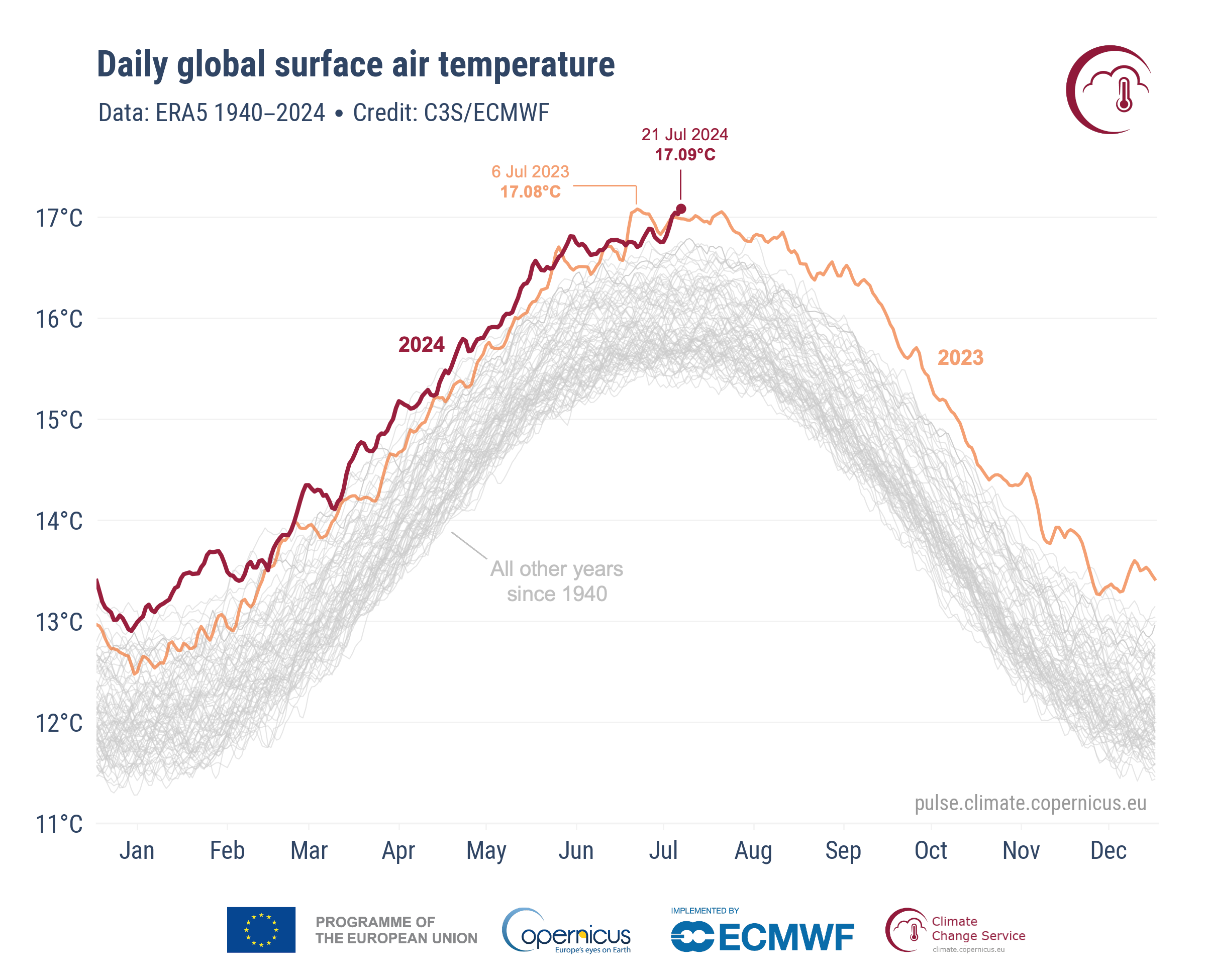
The Copernicus Climate Change Service, the climate change organization connected to the European Union, released data today that indicated that “…Sunday 21 July was the hottest day since at least 1940, by a small margin of 0.01ºC. While it is almost indistinguishable from the previous record, what really stands out is the difference between the temperatures since July 2023 and all previous years.”
“Prof Peter Thorne, director of the Icarus centre at Maynooth University, Ireland, and a coauthor of an IPCC report that found humanity was responsible for all of the observed rise in temperatures since the 1850s, said Sunday’s record might one day be seen as ‘anomalously cool’ if the world did not rapidly reach net zero emissions.
“’Just a quick glance at the range of events happening around the globe right now – wildfires, flooding, heatwaves – tells us that we are not remotely prepared for the extremes that this warmer world has bought us,’ he said. ‘We are even less prepared for what is to come.’”
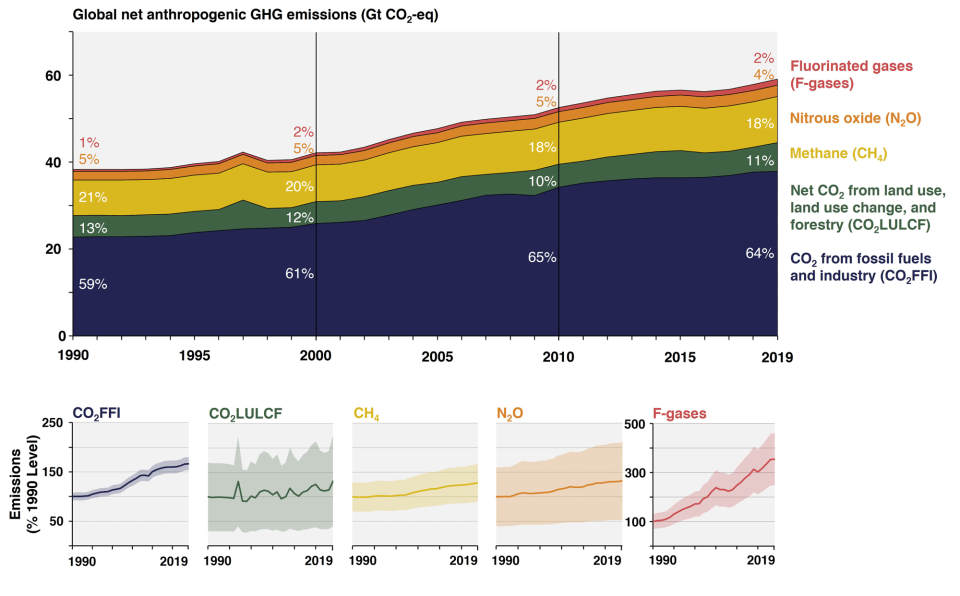
There has been substantial progress in developing sources of energy that do not rely on fossil fuels, but the world has not yet made significant progress in reducing the emissions of greenhouse gases.
There must be a more concerted effort to change these trends. Political will remains a rhetorical device. Citizens must begin to assert the need for more effective action.
Yesterday, the Israeli Knesset declared that the creation of a Palestinian states would “pose an existential danger to the State of Israel.” The vote was 68 to 9 out of a possible 120 votes, and the fact that 43 members did not votes is intriguing, and perhaps, telling. The vote was held just as Prime Minister Netanyahu is scheduled to deliver an address to the US Congress next Wednesday, 24 July. Since US President Biden has repeatedly held that the creastion of a Palestinian state is necessary for peace between the Israelis and the Palestinians, the vote was intended to undermine the US position. To further indicate the growing distance between the US and the Netanyahu government, the Israeli national security ministar, Itamar Ben-Gvir, prayed at the al-Aqsa mosque compound, stating that he had prayed for the Israeli government to not sign a cease-fire agreement over Gaza.
Today, however, the International COurt of Justice relieased its findings in a Advisory Position which was requested by the UN General Assembly in 2022. The decision, “Legal Consequences arising from the Policies and Practices of Israel in the Occupied Palestinian Territory, including East Jerusalem“, forcefully reiterated previous legal findings that the Israeli occupation of the Gaza Strip, the Golan Heights, and the West Bank, territories seized by Israel in the war of 1967, violated both the Geneva and Hague Conventions on occupied territories:
“Conclusion on Israel’s settlement policy
155. In light of the above, the Court reaffirms that the Israeli settlements in the West Bank and East Jerusalem, and the régime associated with them, have been established and are being maintained in violation of international law (see Legal Consequences of the Construction of a Wall in the Occupied Palestinian Territory, Advisory Opinion, I.C.J. Reports 2004 (I), p. 184, para. 120).
“156. The Court notes with grave concern reports that Israel’s settlement policy has been expanding since the Court’s Wall Advisory Opinion. In particular, in December 2022 Israel’s parliament approved the establishment of an additional minister within the Ministry of Defence vested with governing powers in the West Bank, including land designations, planning and co-ordination of demolitions, which would expedite the approval process for new settlements. Also, the size of existing Israeli settlements expanded from 1 November 2022 to 31 October 2023 at a significant rate, with approximately 24,300 housing units within existing Israeli settlements in the West Bank being advanced or approved, including approximately 9,670 in East Jerusalem (“Israeli settlements in the Occupied Palestinian Territory, including East Jerusalem, and in the occupied Syrian Golan: Report of the United Nations High Commissioner for Human Rights”, UN doc. A/HRC/55/72 (1 February 2024), paras. 7 and 10).” (p. 47)
“On July 19th the International Court of Justice (icj) rejected all of Israel’s legal claims in response to a request for a legal opinion by the United Nations General Assembly. In a series of coruscating majority rulings, it said that Israel’s prolonged presence can no longer be considered a temporary military occupation, but amounts to illegal annexation that undermines the rights of the Palestinians living there to self-determination. It said the occupation, ‘transfer by Israeli of settlers to the West Bank and Jerusalem’ and ‘forced displacement’ of Palestinians are clear breaches of international law. The bottom line, according to the judges, is that ‘Israel’s continued presence in the Occupied Palestinian Territory is unlawful’ and that the Jewish state is ‘under an obligation to cease immediately all new settlement activities’ and evacuate the settlers already there.
“’Successive Israeli governments have treated the settlements, as well as Israeli control over the area, as an immovable fact on the ground and not even made a pretence of negotiating with the Palestinians,’ says Eliav Lieblich, a professor of international law at Tel Aviv University. ‘This [ruling] was inevitable.’”
The decision is not enforceable. The International Court of Justice can only refer matters to the UN Security Council, and this is only an Advisory Decision. But there are members of the Security Council who would not be willing to even entertain an enforcement resolution. Nonetheless, the decision further isolates Israel and its allies from the vast majority of the states in the United Nations. Currently, 145 of the 193 member states in the UN recognize an independent Palestinian state.
What is most inrtiguing about the decision is that the preferred position of the US on the Israeli-Palestdinian question is that the only possible resolution lies in the creation of an independent Palestine. But the US insists that such an outcome needs to be negotiated and not imposed. The Israeli occupation has lasted for 57 years, and there have been numerous negotiations over those years which have had no discernable effect toward any effective resolution. There is no reason to believe that further negotiations will yield different outcomes. Israeli Prime Minister Netanyahu released this statement after the Court’s decision: “The Jewish people are not occupiers in their own land, including in our eternal capital Jerusalem nor in Judea and Samaria, our historical homeland. No absurd opinion in The Hague can deny this historical truth or the legal right of Israelis to live in their own communities in our ancestral home.”
The time has long past for the US to indulge the fantasy of negotiations. The International Court of Justice has created an opportunity for the US to change its position.
The decision of the Supreme Court on the matter of Trump vs. United States today was a profound disappointment. It offered little on the critical question of whether Mr. Trump’s actions within the Justice Department were official or unofficial acts. Those actions involved replacing certain members of the Justice Department with a new Attorney General (Jeffrey Clark) who wanted to write a letter to various state legislatures suggesting that there were irregularities in the votes cast in the 2020 election which would justify the naming of alternate Electors. The Washington, DC Bar Association moved to disbar Mr. Clark because of these actions, noting that
“‘We must do what we can to ensure that this conduct is never repeated. The way to accomplish that goal is to remove from the profession lawyers who betrayed their constitutional obligations and their country. It is important that other lawyers who might be tempted to engage in similar misconduct be aware that doing so will cost them their privilege to practice law. It is also important for the courts and the legal profession to state clearly that the ends do not justify the means; that process matters; and that this is a society of laws, not men,’ wrote disciplinary counsel Hamilton Fox III. ‘Jeffrey Clark betrayed his oath to support the Constitution of the United States of America. He is not fit to be a member of the District of Columbia Bar.’”
Apparently, the US Supreme Court thinks that Mr. Clark’s behavior fell within the scope of Presidential authority. The majority decision held that
“The indictment’s allegations that the requested investigations were shams or proposed for an improper purpose do not divest the President of exclusive authority over the investigative and prosecutorial func- tions of the Justice Department and its officials. Because the President cannot be prosecuted for conduct within his exclusive constitutional authority, Trump is absolutely immune from prosecution for the alleged conduct involving his discussions with Justice Department officials.”
Additionally, the Special Prosecutor, Mr. Smith, charged that Mr. Trump tried to improperly influence the actions of the Vice-President, Mr. Pence, to delay the certification of Electoral votes. The Supreme Court held that “The indictment’s allegations that Trump attempted to pressure the Vice President to take particular acts in connection with his role at the certification proceeding thus involve official conduct, and Trump is at least presumptively immune from prosecution for such conduct.”
Critical to both of these findings is the curious statement by the Supreme Court that
“In dividing official from unofficial conduct, courts may not inquire into the President’s motives. Such a ‘highly intrusive’ inquiry would risk exposing even the most obvious instances of official conduct to judicial examination on the mere allegation of improper purpose. Fitzgerald, 457 U. S., at 756. Nor may courts deem an action unofficial merely because it allegedly violates a generally applicable law. Otherwise, Presidents would be subject to trial on ‘every allegation that an action was unlawful,’ depriving immunity of its intended effect.”
These presumptions are bullshit. Essentially the Court is holding that subverting a valid electoral outcome is not unconstitutional as long as the subversion is done by the President and anyone who serves under the authority of the Executive Branch. By refusing to examine the motivations for the action, the Court is saying that replacing the appointed Attorney General with someone who would subvert the Electoral College was normal activity within the Justice Department. No one questions whether the President had the authority to name a new Attorney General; the only relevant question is whether that action contitutes a crime against the Constitution.
On this question, the Court punts:
“On Trump’s view, the alleged conduct qualifies as official because it was undertaken to ensure the integrity and proper administration of the federal election. As the Government sees it, however, Trump can point to no plausible source of authority enabling the President to take such actions. Determining whose characterization may be correct, and with respect to which conduct, requires a fact-specific analysis of the indictment’s extensive and interrelated allegations. The Court accordingly remands to the District Court to determine in the first instance whether Trump’s conduct in this area qualifies as official or unofficial.”
In this paragraph, the Court contradicts itself. Having said that an inquiry into the motives of the President are not permissable, the Court ends up holding that whether Mr. Trump was taking action to “ensure the integrity and proper administration of the federal election” is something that needs to be determined. The Court apparently believe that the motive of ensuring the integrity and proper administration of the federal election is both legitimate and appropriate.
Now the lower courts have to make such a determination. But is there any reason to think that the Supreme Court lacked the ability to make such a determination? Did this decision require more evidence as to whether Mr. Trump’s actions were motivated by his strong desire for a legitimate election outcome? The Court wanted to assure that future Presidents are not paralyzed by the fear of prosecution for official acts. But it now appears that the Court wants lower courts to make such decisions on a case-by-case basis. Future Presidents may not be “paralyzed” by threats to prosecute. However, they will undoubtedly be hamstrung by the Supreme Court’s invitation to anyone who differs on the meaning of an “official act” to sue in the lower courts. It has released the Kraken.
On 8 February 2024, US President Biden issued National Security Memorandum 20 (NSM20) to avoid a showdown with Democratic Senators who were threatening to pass an amendment to restrict US military aids to Israel because of its use of US weaponry in the conduct of the war in Gaza. The Senators believed that the weapons were already being used in a manner inconsistent with international and domestic laws safeguarding humanitarian use of the weapons and wanted the US to enforce the laws more stringently. According to Sarah Harrison, writing for Lawfare:
“Which is why it comes across as misleading that President Biden cites these laws and policies in NSM-20, a document based on the Van Hollen amendment, which was originally intended to put pressure on his administration to comply with them. If applied objectively, the president’s own Conventional Arms Transfer (CAT) Policy, the departments of State and Defense Leahy laws, and 620I of the Foreign Assistance Act—all of which are cited in NSM-20—arguably restrict some assistance to Israel. But so far, public reporting and indications from U.S. officials make clear that is not happening. (NSM-20 also references end-use monitoring requirements, though the State Department does not interpret them to mandate monitoring of actual use of equipment, but to strictly prevent diversion.)”
Importantly, NSM20 requires that such a determination be made within 45 days from the onset of a conflict in which US miliatary assistance is being used. The report from the State Department was released yesterday, a few days past that deadline. It is a textbook case in sophistry, holding two conclusions that do not support the policy recommendation.
The first conclusion is: “Nevertheless, given Israel’s significant reliance on U.S.-made defense articles, it is reasonable to assess that defense articles covered under NSM-20 have been used by Israeli security forces since October 7 in instances inconsistent with its IHL obligations or with established best practices for mitigating civilian harm.” (p. 22) That conclusion is followed by several pages of examples of Israeli military activity violating international humantiarian law.
That conclusion, however, does not suffice to halt military deliveries; the laws also require the US to assess whether the recipient of US military assistance is taking all necessary steps to follow international humanitarian law. If such measures are being taken, then the US can still legally provide aid, hoping that those measures can mitigate the harm to civilian populations.
However, the second conclusion is: “While Israel has the knowledge, experience, and tools to implement best practices for mitigating civilian harm in its military operations, the results on the ground, including high levels of civilian casualties, raise substantial questions as to whether the IDF is using them effectively in all cases.” (p. 28)
By these criteria, the US should stop all military assistance to Israel until there is more effective implementation of the requirements of international humanitarian law. But that course of action is not what the report calls for. The final policy recommendation (pp. 31-2) is: “While the USG has had deep concerns during the period since October 7 about action and inaction by Israel that contributed significantly to a lack of sustained and predictable delivery of needed assistance at scale, and the overall level reaching Palestinian civilians – while improved – remains insufficient, we do not currently assess that the Israeli government is prohibiting or otherwise restricting the transport or delivery of U.S. humanitarian assistance within the meaning of section 620I of the Foreign Assistance Act. This is an ongoing assessment and we will continue to monitor and respond to any challenges to the delivery of aid to Palestinian civilians in Gaza moving forward.”
The most benign interpretation of the incoherence of this document is that there are two competing factions in the State Department that failed to reach a compromise. A less benign interpretation is that the State Department had already decided not to follow the law and decided merely to follow the letter of the law with an act of obfuscation. Ni matter, the US should be ashamed of being an accomplice to the crime in Gaza.
Tomorrow is the 200th anniversary of the first performance of Beethoven’s 9th Symphony. I count myself as one of the multitude who regard this piece as one of the greatest in Western classical music. Despite the loss of much of his hearing, Beethoven was one of the conductors to this premiere. The Symphony was genuinely revolutionary, not only for the 4th movement which used the poem “Ode to Joy” written by Friedrich von Schiller, but also for its incredible power, unpredictability, and exuberance.
“….he was a deeply political man in the broadest sense of the word. He was concerned with moral behavior and the larger questions of right and wrong affecting all of society. Especially significant for him was freedom of thought and of personal expression, which he associated with the rights and responsibilities of the individual. He would have had no sympathy with the now widely held view of freedom as essentially economic, necessary for the workings of the markets.”
The symphony expresses the heady aspirations of the Enlightenment as it rested upon the vision of the bortherhood of humankind. We seem to be pretty far from realizing that aspiration today, but I remain convinced that that path is the only one remaining if humanity is to survive its recklessness and selfishness.
Friedrich von Schiller, “Ode to Joy” 1785
An die Freude
Freude, schöner Götterfunken, Tochter aus Elysium, Wir betreten feuertrunken, Himmlische, dein Heiligtum! Deine Zauber binden wieder Was die Mode streng geteilt;* Alle Menschen werden Brüder* Wo dein sanfter Flügel weilt.
Wem der große Wurf gelungen Eines Freundes Freund zu sein; Wer ein holdes Weib errungen Mische seinen Jubel ein! Ja, wer auch nur eine Seele Sein nennt auf dem Erdenrund! Und wer’s nie gekonnt, der stehle Weinend sich aus diesem Bund!
Freude trinken alle Wesen An den Brüsten der Natur; Alle Guten, alle Bösen Folgen ihrer Rosenspur. Küsse gab sie uns und Reben, Einen Freund, geprüft im Tod; Wollust ward dem Wurm gegeben und der Cherub steht vor Gott.
Froh, wie seine Sonnen fliegen Durch des Himmels prächt’gen Plan Laufet, Brüder, eure Bahn, Freudig, wie ein Held zum Siegen.
Seid umschlungen, Millionen! Diesen Kuß der ganzen Welt! Brüder, über’m Sternenzelt Muß ein lieber Vater wohnen. Ihr stürzt nieder, Millionen? Ahnest du den Schöpfer, Welt? Such’ ihn über’m Sternenzelt! Über Sternen muß er wohnen!
Ode to Joy
Joy, thou shining spark of God, Daughter of Elysium, With fiery rapture, goddess, We approach thy shrine! Your magic reunites those Whom stern custom has parted;* All men will become brothers* Under your protective wing.
Let the man who has had the fortune To be a helper to his friend, And the man who has won a noble woman, Join in our chorus of jubilation! Yes, even if he holds but one soul As his own in all the world! But let the man who knows nothing of this Steal away alone and in sorrow.
All the world’s creatures draw Draughts of joy from nature; Both the just and the unjust Follow in her gentle footsteps. She gave us kisses and wine And a friend loyal unto death; She gave the joy of life to the lowliest, And to the angels who dwell with God.
Joyous, as His suns speed Through the glorious order of Heaven, Hasten, brothers, on your way Exultant as a knight victorious.
Be embraced, all ye millions! With a kiss for all the world! Brothers, beyond the stars Surely dwells a loving Father. Do you kneel before Him, oh millions? Do you feel the Creator’s presence? Seek Him beyond the stars! He must dwell beyond the stars.[4]
“The West-Eastern Divan Orchestra conducted by Daniel Barenboim performs Beethoven’s Ninth Symphony at the Berlin Philharmonic. It’s supported by singers Angela Denoke, Waltraud Meier, Burkhard Fritz and René Pape. The West-Eastern Divan Orchestra is a very special ensemble: It is made up of young Israeli and Arab musicians and is campaigning for a peaceful solution to the Middle East conflict.
“The West-Eastern Divan Orchestra, which was founded in 1999, gives concerts all over the world. Proceeds from the concert in Berlin went to the Barenboim-Said Academy, which supports musical education programs. The 9th Symphony in D minor op. 125 is the last finished symphony by the composer Ludwig van Beethoven. The work was premiered in Vienna on May 7, 1824 in the presence of Beethoven, who was already completely deaf and was a complete success. The fourth movement is also known as “Ode to Joy” and is one of the most popular songs in the world. Since 1985, the main theme of the last movement has been the official European anthem.
The US vetoed a resolution in the UN Security Council which would have enabled the Palestinians to secure a seat in the United Nations. There were two abstentions (the UK and Switzerland) and all the other members of the Security Council voted in favor of the resolution. At the daily Press Briefing at the State Department, Vedant Patel, the spokesperson at the State Department, explained the US decision in a Question and Answer exchange:
“MR PATEL: So Matt, since October 7th, we have been pretty clear that sustainable peace in the region can only be achieved through a two-state solution, with Israel’s security guaranteed. And it remains our view that the most expeditious path towards statehood for the Palestinian people is through direct negotiations between Israel and the Palestinian Authority with the support of the United States and other partners who share this goal. We believe this approach can tangibly advance Palestinian goals in a meaningful and enduring way.
We also have been very clear consistently that premature actions in New York, even with the best intentions, will not achieve statehood for the Palestinian people. Additionally, as reflected in the report of the admission committee, there was not unanimity among the committee members as to whether the applicant met the criteria of membership set forth in Article 4 of the UN Charter. Specifically, there are unresolved questions as to whether the applicant can meet criteria to be considered as a state.
And Matt, as you also know, we’ve long called on the Palestinian Authority to undertake necessary reforms to establish the attributes of readiness for statehood and note that Hamas, which is – as you all know – a terrorist organization, is currently exerting power and influence in Gaza, which would be an integral part of the envisioned state in this resolution. And for that reason, the United States is voting no on this proposed Security Council resolution….
QUESTION: All right. And then you said the most – you believe, the U.S. believes that the most expeditious way to statehood is through direct negotiations. So just to make sure, I just kind of – I just googled “expeditious”: “Marked by or acting with prompt efficiency.” How many years has it been since Oslo?
MR PATEL: It’s been —
QUESTION: Isn’t the most expeditious way to Palestinian statehood to have a – have some kind of an announcement or a determination by the UN? Unless you’re not —
MR PATEL: We don’t think so.
QUESTION: Unless you don’t really mean expeditious, because expeditious means fast.
MR PATEL: We do mean expeditious, and we do not believe that the pathway through New York and the United Nations is the best path forward. And as I so noted, such action through the United Nations would statutorily require the United States to cease its funding to the UN. That’s certainly not something we’re interested in doing either.
I take your point on the number of years it has been Oslo, but this is something that we will continue to pursue, because we so firmly believe that it is in – not just in the interest of the Palestinian people, but it is a key tenet of establishing peace and security for the people of Israel as well.
QUESTION: Thanks.
MR PATEL: Humeyra, go ahead.
QUESTION: Vedant, so what is the U.S. alternative and the expeditious path to two-state solution, then, if you guys have blocked this?
MR PATEL: You’ve heard us talk about this pretty clearly, Humeyra. We’re continuing to press for a ceasefire, one that is coupled with the release of hostages, one that is coupled with the influx of additional humanitarian aid, and one that we hope can create additional conditions for broader diplomatic conversations that we think can lead to greater peace and stability in the region. This is a process. I will note that “expeditious” does not mean easy, but it is a process, and we’re going to —
QUESTION: Yeah, but it does mean fast.
MR PATEL: But it is one that we’re going to continue to work at.
This tortured exchange reflects the reality that the US has no coherent plan for the fate of the Palestinian people. The US veto was ill-advised and short-sighted.. After asserting the two-state solution was the only possible solution to the conflict in the Gaza Strip, the US is now on record as opposing the move unless that outcome was determined by negotiations between Israel and the Palestinians. But successful negotiations have been stalled for thirty years, due to the emergence of a settler movement which holds that all the lands occupied by Israel in the 1967 war belong to Israel and Israel alone. The US offered no substantive reason to believe that negotiations now will lead to a Palestinian state.
The Oslo Accords, signed by the Palestinians and Israel in 1994, called for the creation of a Palestinian State. That initative was derailed by the assassination of Prime Minister Yitzhak Rabin in November 1995 by ” Yigal Amir, an Israeli law student and ultranationalist who radically opposed Prime Minister Yitzhak Rabin‘s peace initiative, particularly the signing of the Oslo Accords.” Since that time, Israel has exercised almost complete control over the lives of the people living in the West Bank and the Gaza Strip. The settler movement has now placed about 700,00 Israelis in the West Bank (all the settlers were forcibly removed from the Gaza Strip by Israeli Prime Minister Ariel Sharon in 2005). And the current violence against Palestinians in the West Bank surpasses all previous levels.
The irony is that the state of Israel was created by a vote in the United Nations General Assembly in 1947. The vote was 33-13 in favor partitioning the British Mandate called Palestine into three zones: a Jewish zone, an Arab zone, and an internationalized city of Jerusalem (no state could claim sovereignty over the city). The six Arab states walked out of the vote in protest. The UN made the state of Israel possible; there is no reason why it could not create a Palestinian state. But that possibility cannot occur as long as those in Israel who believe that all the lands were reserved for Jews have such power in Israeli politics. And we wait for the US to take some effective action to foster the two-state solution.
On 1 April 2024 Israel attacked the Iranian Consulate in Damascus, Syria. The attack killed seven members of the Islamic Revolutinary Guard, including two senior members. The Vienna Convention on Diplomatic Relations (1961) governs the status of such missions. Article 22 of the Convention spells out some of the protections for diplomatic sites:
Article 22 1.The premises of the mission shall be inviolable. The agents of the receiving State may not enter them, except with the consent of the head of the mission. 2.The receiving State is under a special duty to take all appropriate steps to protect the premises of the mission against any intrusion or damage and to prevent any disturbance of the peace of the mission or impairment of its dignity. 3.The premises of the mission, their furnishings and other property thereon and the means of transport of the mission shall be immune from search, requisition, attachment or execution.
Defense Secretary Lloyd Austin spoke with Gallant on Monday and again on Thursday to discuss the current situation and “reaffirm the U.S. ironclad commitment to Israel’s security against threats from Iran and its proxies,” Ryder said.
Secretary of State Antony Blinken also spoke with Gallant on Wednesday to reiterate that same message, State Department spokesperson Matthew Miller said at the time.
And President Biden publicly warned Tehran on Wednesday during a White House Rose Garden press conference with Japanese Prime Minister Fumio Kishida.
“We also want to address the Iranian threat to launch a … significant attack on Israel. As I told [Israeli Prime Minister Benjamin Netanyahu], our commitment to Israel’s security against these threats from Iran and its proxies is ironclad,” Biden said.
I hope that these words are merely diplomatic fluff. Prime Minister Netanyahu committed an act of war against Iran with US-supplied weapons but without US knowledge or support. If he thinks that provoking Iran into an open conflict advances the interests of Israel, he is profoundly and criminally mistaken. The US should not allow itself to be manipulated into a larger, and unwinnable, war.
There are many reports about the deaths of over 100 Palestinians who were killed during a delivery of humanitarian assistance to northern Gaza. The truck delivering the aid was besieged by hungry people and the Israeli Defense Forces (IDF) fired live ammunition to disperse the crowd. The IDF claims that most of the people killed were crushed by the fleeing stampede; the Palestinians claim that most were killed by Israeli bullets.
Since the Israeli assualt on Gaza, living conditions in Gaza have deteriorated precipitously. The Associated Press reports:
“Maurizio Martina, the Food and Agriculture Organization’s deputy director general, described the horrific state of farmland, greenhouses, bakeries and irrigation systems that are essential to produce, process and distribute food.
“Since Oct. 9 – two days after the Hamas attacks – ‘the government of Israel’s reinforced blockade has included stopping or restricting food, electricity and fuel supplies, as well as commercial goods,’ he said.
“This has affected the entire food supply chain in different ways, Martina said.
“As examples, he said, severe restrictions on fuel shipments are crippling water supplies and the functioning of desalination plants, with the water supply at only 7% of pre-October levels. Fuel shortages have also crippled the production and delivery of food and electricity, and seriously hampered the ability of bakeries to produce bread, he said.
“Martina said the collapse of agricultural production in the north is already happening and in the most likely scenario will be complete by May. And as of Feb. 15, over 46% of all crop land in Gaza was assessed to be damaged, he said.”
There are a variety of reasons why deliveries of aid have failed to address the shortages. First, many of the agencies which supply aid, such as the UN World Food Program, have stopped deliveries because it is impossible to provide security for the delivery workers. To get around this problem, many countries are now air-dropping aid into Gaza. Second, some Israelis are preventing the delivery of aid through the Kerem Shalom checkpoint in an attempt to decrease the food available to Gazans, a blockade that the Washington Post claims is supported by the IDF forces guarding the checkpoint. Finally, the main agency supporting the Palesdtinian people, the United Nations Relief and Works Agency (UNWRA) which has been supporting the Palestinian people since 1948, has been charged by Israel that some of its employees participated in the 7 October massacre and has suffered a dramatic drop off in support. According to Care International:
“UNRWA staff have faced near impossible conditions for months: in addition to the 158 UNRWA staff killed during the ongoing hostilities, at least 404 people in UNRWA shelters have been killed during the hostilities; almost 1,400 have been injured; and 155 UNRWA installations have been damaged. UNRWA workers continue to serve their community amid this unprecedented violence. The funding suspension will have wider regional implications that need to be carefully considered. In addition to Gaza, UNRWA operates in 4 other locations (West Bank- including East Jerusalem, Lebanon, Syria, Jordan) where it delivers critical services such as education and healthcare.”
The situation in Gaza is catastrophic and the deaths of the Palestinians at the aid delivery site raises serious questions about whether any outside aid is possible under current conditions. There will unqeustionably be an investigation into what happened, but that investigation will be conducted by the IDF itself. Aside from Palestidnian journalists, there are no outside news agencies that have been allowed into Gaza. Haaretz makes the point: “Since the war began, Israel and Egypt have largely barred foreign reporters from entering Gaza. Of the handful of journalists who have been granted access to Gaza, almost all of them were ’embedded’ with the Israeli army, which brings with it a long list of restrictions.” Moreover, many Palestinian journalists have been killed in the conflict. Haaretz continues: “The most recent tally from the New York-based Committee to Protect Journalists puts the number of journalists and media workers killed in the war at 99, according to their website. (This number includes two Israeli journalists, who were killed on October 7 during the Hamas attacks.)”.
Thus, we do not know what has actually happened in this war, aside from the fact that about 1200 Israelis were killed and approximately 200 hostages taken and over 30,000 Palestinians killed, the majority of which are women and children. Presumably, the Biden Administration has its own information sources, but the US response to the conflict is signiticantly at odds with the redponse of most other countries, including strong US allies. Fareed Zakaria assesses the US policy:
“The United States has repeatedly pressured Israel to make greater efforts to protect innocent civilians, but to little avail. Now it has been counseling against an invasion of Rafah, the city nestled close to Egypt where more than 1 million Palestinians have huddled together. Israeli Prime Minister Benjamin Netanyahu has promised to invade Rafah, whether another hostage deal is made or not.
“The result is that American policy on the Gaza war now appears hapless, ineffective and immoral. The image of U.S. officials wringing their hands about civilian casualties while providing ever-more weapons is grotesque. The image of a president of the United States mumbling words such as ‘indiscriminate’ and ‘over the top‘ to describe Israel’s bombings suggests weakness and passivity.
“Part of the problem is that in trusting the Israeli government, Biden is trusting Netanyahu, an exceptionally clever politician who knows how to handle American presidents expertly and has done so for decades. This time, Bibi has outsmarted, outmaneuvered and outplayed Biden.”
We all need to be far better informed about what has happened in the Gaza Strip since last October. Without information that is independent of the warring parties, we are all allowing the tragedy to continue without respite for the innocents.
 World Politics News