Although they have not been officially published, here is my interpretation of the 15-point peace proposal that Trump submitted to Iran:
- Dismantle Iran’s nuclear weapons‑related capabilities.
- Commit permanently to never pursue nuclear weapons.
- Stop all uranium enrichment on Iranian territory.
- Transfer all enriched uranium to the International Atomic Energy Agency (IAEA) under a defined timeline.
- Decommission three major nuclear facilities: Natanz, Isfahan, and Fordow.
- Allow extensive international monitoring and inspections. (Reported as part of “international monitoring” and “civilian nuclear cooperation.”)
- Restrict Iran’s ballistic missile program to narrow “self‑defense” purposes.
- Impose limits on missile development and testing. (Implied in multiple reports.)
- End support, financing, and arming of regional proxy groups (e.g., Hezbollah, Houthis, Iraqi militias).
- Dismantle Iran’s proxy network and halt all cross‑border operations.
- 11. Reopen the Strait of Hormuz immediately and guarantee freedom of navigation.
- Commit to keeping the Strait open permanently under international norms. (Implied in multiple reports.)13.
- Agree to a one‑month ceasefire between the U.S. and Iran to negotiate a longer‑term deal.
- Suspend Iranian missile and drone attacks across the region during the ceasefire. (Implied by the ceasefire framework.)
- Sanctions relief in exchange for compliance, including economic normalization and possible civilian nuclear cooperation
Here is Iran’s counteroffer:
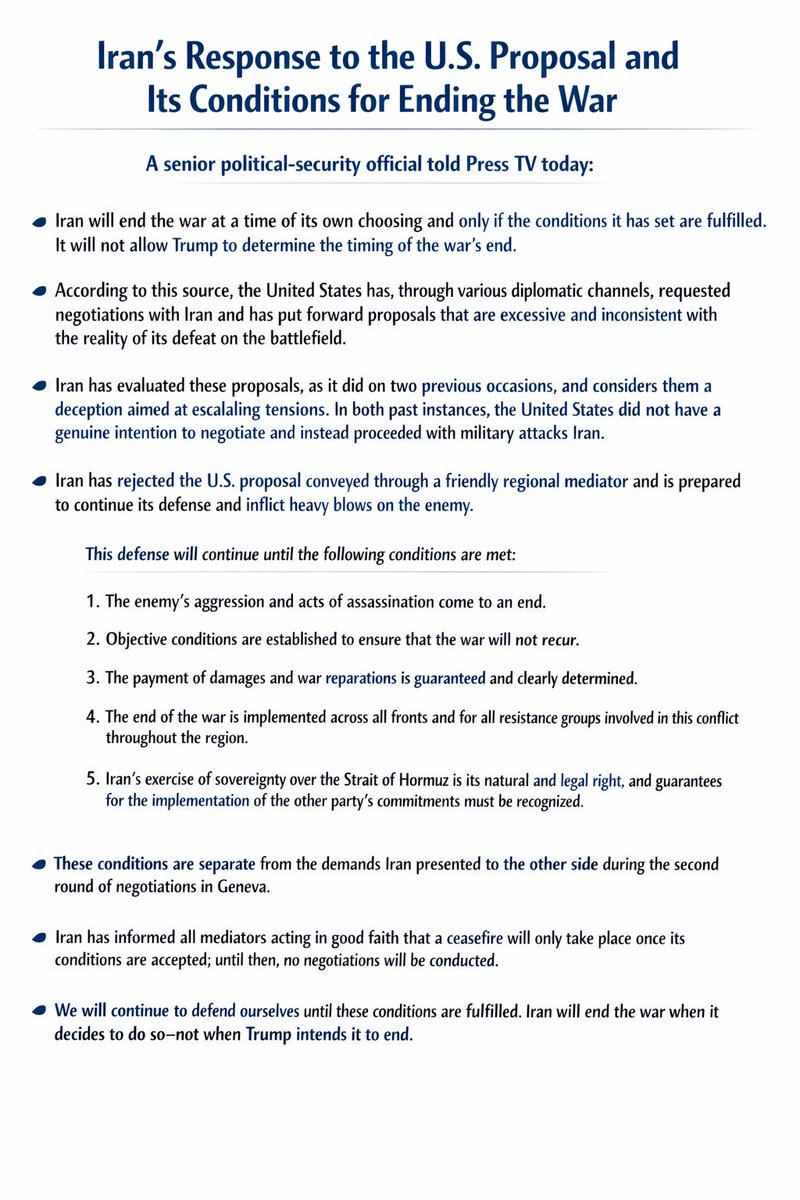
These demands are not ships passing in the night; they are ships passing in different universes. There is literally no common ground in these gambits which suggests that any resolution to the war is very far away.
The US, however, is making incredible threats against Iran. According to CNBC:
“U.S. President Donald Trump said Monday that the U.S. will ‘completely’ obliterate Iran’s electric generating plants, oil wells and Kharg Island if the strategically vital Strait of Hormuz is not ‘immediately’ reopened and a peace deal is not reached ‘shortly.’
“’The United States of America is in serious discussions with A NEW, AND MORE REASONABLE, REGIME to end our Military Operations in Iran,’ Trump said in a post on Truth Social.
“’Great progress has been made but, if for any reason a deal is not shortly reached, which it probably will be, and if the Hormuz Strait is not immediately ‘Open for Business,’ we will conclude our lovely ‘stay’ in Iran by blowing up and completely obliterating all of their Electric Generating Plants, Oil Wells and Kharg Island (and possibly all desalinization plants!), which we have purposefully not yet ‘touched.’”
These threats violate the laws of war. The purpose of war is to disarm one’s enemy, not to destroy it. Total destruction of an enemy is not a legitimate objective, although many states have gone that route. We have witnessed two contemporary wars which have violated this maxim: the Russian assault on Ukraine and the Israeli assault on the Gaza Strip. It seems as if states have become intoxicated with the destructiveness of their weaponry. Wars against the civilian populations is easy, but abhorrent–non-combatants have no defenses and pose no threat to a state’s military.
The reason why international law forbids wars against civilians is because such brutal actions often lead to conflicts that cannot be resolved by diplomacy. When the civilian populations feel aggrieved, restraints on war are difficult to achieve. War is not slaughter–we can slaughter people in all sorts of ways, and nature does a pretty good job of attacking civilians through hurricanes, wildfires, and earthquakes. But slaughter is not a political objective. It is the objective only for those who feel hatred and a need to shed blood vindictively. These attitudes do not lend themselves to an honest resolution of disputes.
When the Roman Empire destroyed Carthage in the final stages of the Punic Wars, the leader of the Roman forces was Scipio Africanus. He wept when he finally literally wiped Carthage off the face of the map:
“When it was over, Scipio began to weep and publicly lament the misfortune of the enemy. Polybius asked him why he was weeping and he compared the fate of Carthage to that of Troy. He spoke the words of Homer:
“The day shall come in which our sacred Troy and Priam and the people whom spear-bearing Priam rules, shall perish all.”
“Polybius asked him what he meant by this and he said ‘When I consider the mutability of human affairs, I fear that someday this may also be the fate of Rome.’”
Scipio understood well the dynamics of hate and how it should have no place in the conduct of war. All wars should be fought with an eye toward attaining the conditions that will re-establish peace.
 World Politics News
Leave a comment