There is news coming in about the war against Iran which I think is of great magnitude. Israel has attacked the South Pars Natural gas fields that are jointly managed by Qatar and Iran. That field is the largest natural gas field in the world and many states, particularly in Europe, are depending on natural gas as they make the transition to green energy since it is more environmentally friendly than coal and oil. Additionally, Europe used to buy a lot of natural gas from Russia, but that has deteriorated as the Ukrainian conflict rages on.
South Pars Natural Gas Field
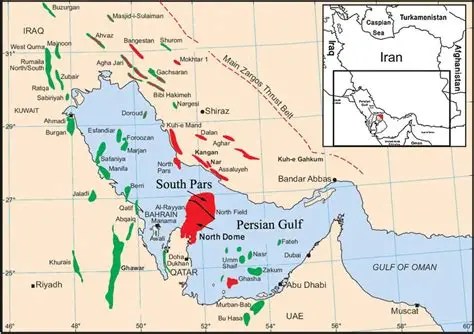
The Israeli attack crossed a profound redline. When Trump decided to bomb Kharg Island, which is where most Iranian oil is offloaded into tankers for sale abroad, he was careful to state that the US had not attacked any of the oil facilities on the island. That tactic is a critical factor. One can bomb the infrastructure of a state, its military installations, and even (unfortunately) civilian sites. But oil and natural gas are the only commodities that most of the Gulf States can export for profit. There has always been an implicit rule of war in the Middle East to not damage the oil and gas fields because such attacks pose the threat of economic catastrophe. In other words, attacking oil and gas fields is the economic equivalent of nuclear war to the oil producing states in the Gulf Region.
In response, Iran attacked oil facilities in Saudi Arabia and the United Arab Emirates. According to The Washington Post:
“After the strike on the South Pars gas field, Iran said energy infrastructure in Qatar, the United Arab Emirates and Saudi Arabia would now be considered legitimate targets.The strike on South Pars was “dangerous & irresponsible,” Qatar’s Foreign Ministry spokesman, Majed al-Ansari, said in a post on X.
“Iran’s state-run Press TV reported later on Wednesday that the country’s armed forces had struck ‘US-linked oil facilities in the region in retaliation for attacks on Iran’s oil facilities.’ Qatar’s state oil company said in a social media post that Ras Laffan Industrial City, a hub for exports of liquefied natural gas, was hit by rocket attacks. ‘Fires resulting from the attack … caused significant damage,’ QatarEnergy said.”
The Arab Gulf states are enraged, but now they are posing a very important new consideration for the world. An all-out assault on oil and gas fields would destroy the global economy for a considerable period of time. Although the world has made great progress in eliminating fossil fuels, the unfortunate fact is that those fuels since account for the bulk of economic activity in the world. This war has become one of much higher stakes than other important, but not global, issues in the current war such as the building of missiles, the funding of terror, or the enrichment of uranium.
For the Arab producing Gulf States there are unquestionably pressures to retaliate. But that course of action is not consistent with their long-term economic interests–it would lead to even more destruction of the reservoirs of oil and natural gas. And the destruction of those irreplaceable reservoirs is clearly not compatible with the interests of most people in the world. It remains to be seen whether cooler heads can prevail in this game of “chicken”. I also believe that Iran knows how counterproductive such escalation would be to its future.
The only country that has a more urgent priority than maintaining the integrity of the oil and natural gas markets is Israel. It has a more existential perspective on the war with Iran. Israel sees Iran not only as a threat to its existence, but also a threat to its military freedom in the Middle East. A nuclear armed Iran would place Israeli military actions in the region (Lebanon, Jordan, Syria, the Gaza Strip, and the West Bank) in a completely different strategic context. There are two possibilities that concern Netanyahu.
First, the real threat that Iran would blow up the state of Israel. This is not a threat that any Israeli Prime Minister could ignore, although military power is not necessarily the only way to dissuade Iran from building a bomb. But Netanyahu has chosen a military path to address the concern.
Second, and less obviously, is the possibility that an Iranian nuclear weapon would create the pressure of self-deterrence. Israel has considerable freedom of military action now because it does not face the possibility of nuclear annihilation. But would a real nuclear threat act as a deterrent even to conventional warfare? It apparently did in Ukraine, as the Biden Administration refused to allow Ukraine to procure long-range missiles because Putin had identified such transfers as a possible trigger for nuclear action. But the possibility of self-deterrence seeps down to the general population. Would Israelis have been more restrained in the Gaza Strip if Iran had had a nuclear weapon? Perhaps the citizens of Israel would have considered a different approach to responding to the horrific attacks of 7 October. If those fears are real, then those Israelis who wish to take over the lands they have occupied in the Gaza, the West Bank, Syria, and Lebanon might reconsider the costs and benefits of military action on such a broad scale.
 World Politics News
The Oct.7 attack was serious, but less so than the preceding 75 years of Israeli attacks on Palestinians. If Iran had more spectacular weaponry (like the US supplies to Israel), there would be an independent Palestinian state in place of Gaza & the West Bank.
LikeLike
Like all counterfactuals, this one is difficult to prove, but I think you are correct.
LikeLike