This is clearly a day that will live in infamy for the US, even as many in the US regard the insurrection as a patriotic act. I remain dumbfounded how the lie of a “stolen” election persists. It is a mark of how willing some are to be deluded in the thrall of an execrable and selfish person who manages to make promises that he can never keep. More bewildering, however, is how easily Trump has discarded the world order promised by the creation of the United Nations and the International Court of Justice. My hope was that some countries who benefited from that world order (think China and Europe) would have tried harder to maintain the system.
But, as argued in a previous post, Trump has led the world into the 19th Century system of the balance of power.
The balance of power is perhaps the most enduring pattern in world politics, and we can trace its applications in many historical situations. The first record of powers explicitly talking about the balance of power was during the Peloponnesian War between Athens and Sparta (431–404 BCE) written by Thucydides. The part of that war which most clearly expresses the logic of the balance of power occurs when the Athenians try to conquer the island of Melos, which was a colony of Sparta. In debating with the people of Melos, the Athenians are explicit about the importance of the balance of power: “Of the gods we believe, and of men we know, that by a necessary law of their nature they rule wherever they can. And it is not as if we were the first to make this law, or to act upon it when made: we found it existing before us, and shall leave it to exist forever after us; all we do is to make use of it, knowing that you and everybody else, having the same power we have, would do the same as we do.”
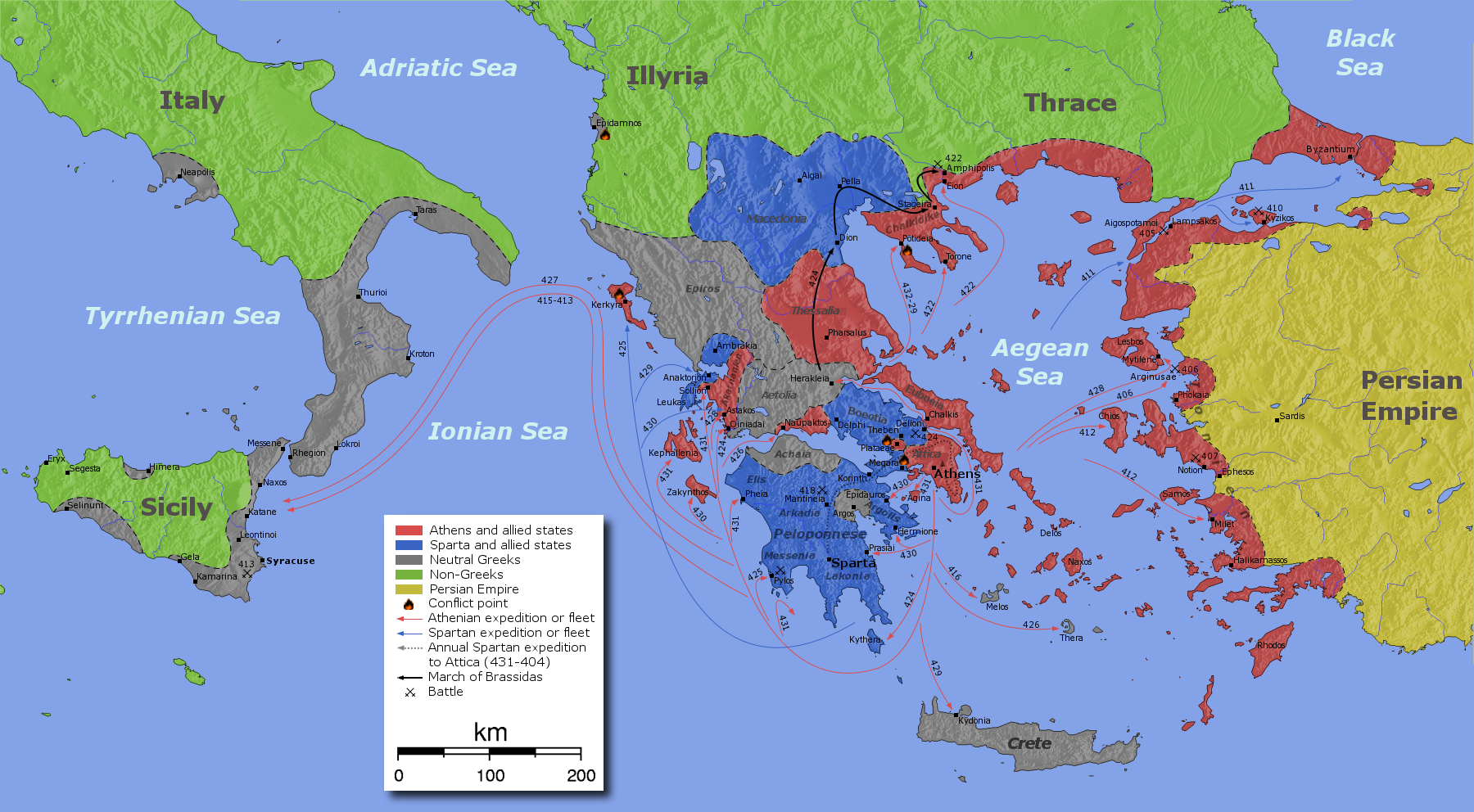
As one can see from this map, Melos was quite far from Athens, and it posed no security threat at all to Athens. The Melians tried to persuade the Athenians that they would remain completely neutral in Athens’ war with Sparta. When that gambit failed, they resorted to a moral argument: that it was morally wrong for a stronger power to exert its will on a weaker power if there was no security threat to manage. Ultimately, the Athenians simply said that their power gave them the right to subjugate Melos–the first fully articulated defense of the argument that “might makes right”.
In the end, the Athenians conquered Melos, and Thucydides, writing of this tragedy, simply stated “Reinforcements afterwards arriving from Athens in consequence….the siege was now pressed vigorously…the Melians surrendered at discretion to the Athenians who put to death all the grown men whom they took and sold the women and children for slaves…and settled the place themselves.”
With this in mind, it was startling to hear Stephen Miller, an advisor to Trump, in an interview with Jake Tapper of CNN, sounding exactly like the Athenians. For those who cannot bear to listen to Miller, the important part of the interview begins at around the 5:30 minute-mark.
The phrase “plus ça change, plus c’est la même chose” only hints at the melancholy I felt when I heard this interview. Indeed, Miller is correct that “might makes right” operates in many situations. But that adage brought about World War I and World War II, and the effort after 1945 was to try to create a different world order. I guarantee that Miller’s worldview will only lead to similar catastrophes to the world wars because the Great Powers today agree on very little about the world they prefer. Eventually, the balance of power system fails after there are no longer any weaker states to conquer and the Great Powers turn on each other.
 World Politics News
Leave a comment