This morning’s headline for the online version of the New York Times was “U.S. enters War Against Iran”. The headline is misleading. The more accurate headline would have been “US President Trump Declares War on Iran”. The actual headline ignores the fact that the US has been engaged in coercive diplomacy against Iran since 2018 when President Trump withdrew the US from the Joint Comprehensive Plan of Action (JCPOA) which was considered by most analysts as an effective check on any nuclear ambitions that Iran might have held, although there was no evidence at the time (nor two days ago) that Iran had made a decision to build a nuclear weapon:
“More than three years of Iran’s compliance with the JCPOA from January 2016-May 2019 demonstrated its nonproliferation benefits. Taken together, the array of restrictions on uranium enrichment ensures that Iran’s capability to produce enough weapons-grade uranium sufficient for one warhead would be approximately 12 months for a decade or more. The JCPOA also effectively eliminated Iran’s ability to produce and separate plutonium for at least 15 years. Just as importantly, the JCPOA mandates unprecedented international monitoring and transparency measures that make it very likely that any possible future effort by Iran to pursue nuclear weapons, even a clandestine program, would be detected promptly.”
Israeli Prime Minister Netanyahu had held for a long time that Iran’s nuclear program represented an “existential threat” to Israel. Indeed, he warned about the Iranian nuclear program when he was just a member of the Knesset in 1992:
“Since 1992, when Netanyahu addressed Israel’s Knesset as an MP, he has consistently claimed that Tehran is only years away from acquiring a nuclear bomb. ‘Within three to five years, we can assume that Iran will become autonomous in its ability to develop and produce a nuclear bomb,’ he declared at the time. The prediction was later repeated in his 1995 book, Fighting Terrorism.
“The sense of imminent threat has repeatedly shaped Netanyahu’s engagement with United States officials. In 2002, he appeared before a US congressional committee, advocating for the invasion of Iraq and suggesting that both Iraq and Iran were racing to obtain nuclear weapons. The US-led invasion of Iraq followed soon after, but no weapons of mass destruction were found.”
Netanyahu has worried about Iran for 33 years and yet the Iranians never developed a nuclear bomb, even though it clearly had the expertise and means to do so. Instead, Iran adhered to its commitment to the Non-Proliferation Treaty and refused to take that path, despite being surrounded by nuclear powers: Russia to the north, China to the east, India and Pakistan to its southeast, Israel to its west, and US air and sea forces parked in the Mediterranean, the Persian Gulf, and in bases in Oman and Bahrain. Netanyahu went so far as to bring a visual aid to the UN General Assembly to communicate his fears about Iran.
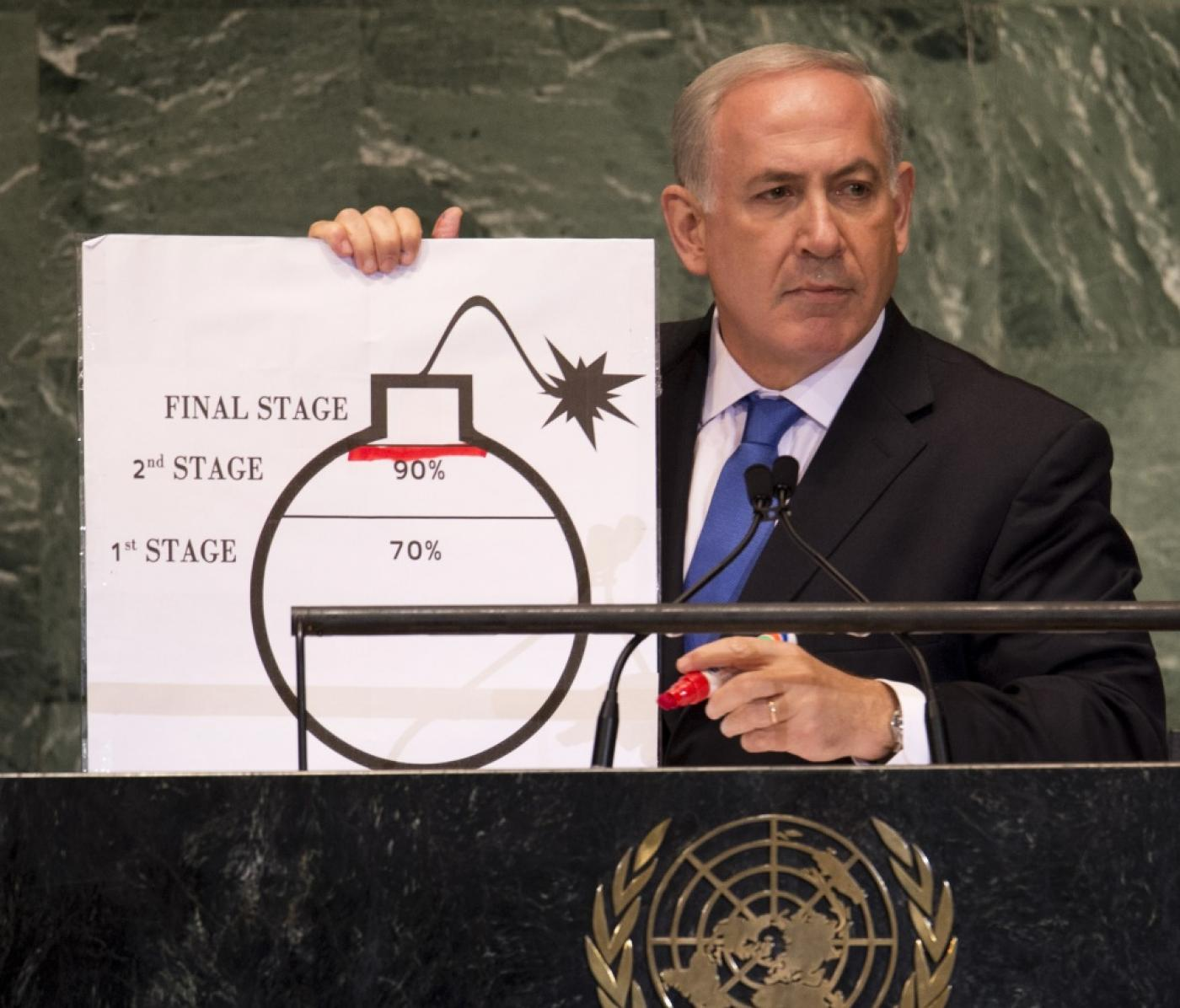
We should be clear about what Netanyahu regards as an “existential threat”. Does Netanyahu actually believe that Iran would drop a nuclear bomb on Israel, killing millions of Palestinians in the process? One cannot dismiss the possibility that at some point there will be an Iranian regime that would commit such a heinous crime. But one would have to offer more evidence of Iranian indifference to human life to persuade me that such an outcome was likely. There are currently nine nuclear powers in the world and some of them engaged in reckless propaganda (“godless communists” and “capitalist running dogs” are two of my favorites) that is roughly comparable to Iranian propaganda (“America is Satan”). But none of these states, except for the US, has ever dropped a nuclear bomb
The existential threat that Netanyahu fears is the possibility of Israeli self-deterrence in the face of a nuclear Iran. Nuclear threats are taken seriously by civilian populations and are effective even when palpably implausible. The US threatened nuclear war against China in 1956 over two insigificant islands (Quemoy and Matsu) which were controlled by the Republic of China, now known as Taiwan. Similarly, the US refrained from arming Ukraine with advanced weaponry after Russian President Putin started referring to Russian nuclear capabilities. Israel currently has a free military hand in Lebanon, Syria, the Gaza Strip and the West Bank, and it has used that advantage to its benefit after the attacks of 7 October. A nuclear-armed Iran, however, might restrain Israeli military power just by posing the possibility of a nuclear attack, forcing the Israeli people to ask the question “Is dropping more bombs on the Gaza Strip worth risking nuclear annihilation?” States are reluctant to gamble on their existence, even when the odds are in their favor. An Israeli government may not want to be constrained by an Israeli population afraid of a nuclear attack. And that fear is the real existential threat to Israel.
The last few weeks have been confusing. There were statements that the US wanted to restart the negotiations to revive the JCPOA, but refused to entertain the possibility that Iran would be allowed to enrich Uranium, a right guaranteed by the Non-Proliferation Treaty and the JCPOA. The precipitating event for the Israeli attack on Iran was the Iranian decision on 13 April to enrich its Uranium far beyond the traditional limit of 20% which is considered essential for civilian nuclear power purposes (Iran believes that it makes more money selling its petroleum rather than burning it for energy purposes). But the Stockholm International Peace Research Institute interpeted this decision quite differently than one designed to build a nuclear bomb:
‘On 13 April, Iran announced its intention to enrich uranium to 60 per cent U-235. This was characterized by Iran as a response to a sabotage of its vast underground enrichment cascades at Natanz two days before. The move comes against the backdrop of sensitive negotiations happening in Vienna aimed at rescuing the 2015 Iran nuclear deal, the Joint Comprehensive Plan of Action (JCPOA), and bringing the United States back into compliance with the deal…
“Uranium enriched to 60 per cent cannot be used to make a useful nuclear explosive device, and Iran has no other realistic use for this material.
“Nevertheless, 60 per cent was not an arbitrary choice. Cascades of centrifuges are designed to enrich uranium in steps; Iran’s centrifuges are likely set up to enrich up to 20 per cent, from 20 to 60 per cent, and from 60 to 90 per cent. Assuming the 60 per cent-enriched uranium is stored in the form of uranium hexafluoride (UF6) gas—and there would be no point in Iran converting it to any other chemical form—the enrichment step from 60 per cent-enriched to weapons-grade uranium is very short.
“This strongly suggests that Iran’s decision was intended to send a political message: ‘We have gone as far as we can go in response to provocations without producing weapons-grade uranium.’”
One needs to appreciate the position of Iran after Trump pulled the US out of the JCPOA: it was placed under punishing sanctions which have severely damaged the Iranian economy and was not offered any way to remove those sanctions without giving up its right to enrich Uranium. The question we need to answer is whether the decision to enrich Uranium to 60% actually signaled an intent to build a nuclear bomb. Trump’s Director of National Intelligence, Tulsi Gabbard, was explicit on this question: “In March, Gabbard testified on Capitol Hill that the U.S. ‘continues to assess that Iran is not building a nuclear weapon and Supreme Leader Khamenei has not authorized the nuclear weapons program he suspended in 2003.'” Trump insisted that Gabbard was wrong, but that is not the first time he has disagreed with his own intelligence services.
We should also think about Trump’s decision to declare war on Iran in the context of the US Constitution. Only Congress has the right to declare war: “Article I, Section 8, Clause 11 states that Congress has the power to declare war. Initially, the draft of the Constitution granted Congress the power to make war. There were suggestions to give this power solely to the President, solely to the Senate, or to both the President and the Senate. However, the Framers decided that involving both the President and Congress addressed their concerns. They didn’t want just one person to decide something so significant, nor did they trust a single branch alone.” The wisdom of the writers of the Constitution has been lost. Iran did not attack the US, so the US claim of self-defense is hollow. Nor does Iran have any ability to hit the US mainland with a nuclear bomb or any conventional bomb. Iran does pose a threat of terror attacks on US citizens, but such threats are better dealt with by local officials and not the US military.
Now the US and Iran are in a state of war. Iran does not need to declare war on the US for a state of war to exist–the US attack on Iranian territory constituted a state of war. For example, the US declared war on Japan after the Pearl Harbor attack, but Roosevelt wanted to focus on fighting Germany immediately (he didn’t have much choice since the US fleet was at the bottom of the Pacific and therefore didn’t have the ability to fight Japan immediately). Foolishly, Hitler declared war on the US first, relieving the US of the need to make a decision about declaring war against Germany. Now that the US has created a state of war, it is imperative to ask the question: What are the US war objectives?
The US is still committed to preventing the Iranians from developing a nuclear bomb. We have yet to see whether the US attack effectively destroyed Iranian capabilities. Trump declared that the facilities had been “completely and totally obliterated” but we have no way to confirm that assessment (it’s not clear on what evidence he based this assertion). More importantly, there is no way for the US to destroy the knowledge that Iran has about building a bomb. That knowledge will endure if the Iranians want it to endure. At best, the US and Israel have gained some time derailing Iran nuclear intentions, but to maintain that respite, Israel and the US will have to keep bombing Iran anytime there is a suspicion that Iran is engaged in nuclear-related activities.
Unless, of course, that the Israeli and US intention is to force regime change in Iran in order to prevent any government that would attempt to build a bomb. The US has often forced regime change (Iran 1953; Guatemala, 1954; the Dominican Republic in 1965; Grenada, 1983; Panama, 1989; and Iraq in 2003). One would be hard pressed to assert that these efforts genuinely served the US national interest. And it is more likely that the Iranian people will want a more aggressive regime given the humiliation inflicted on them by the Israeli and US attacks. They may welcome a new regime that is less stringent in terms of personal conduct. But given the obvious failures of the current regime to prevent the wholesale leakage of Iranian secrets, it is more likely that Iranians would support greater scrutiny (how else does one explain the precision Israeli attacks against specific military and scientific individuals in early June? Someone was telling the Israelis names, addresses, and times, and it is likely that the Iranians will direct most of their efforts to uproot those spies).
I suspect that the Iranians will do two things. First, they will announce their withdrawal from the Non-Proliferation Treaty which allows states to abrogate the treaty after 90 days of warning. Since Israel and the US did not believe that Iran was adhering to the treaty, the repercussions of such a move would be small diplomatically. There will, however, a great deal of negative press for the Iranians, but both the US and Israel have muzzled the press on this matter already. Leaving the NPT would end the pretense that a nuclear weapon is not necessary for national defense against nuclear powers. Iraq proved that nuclear weapons are the only way to prevent an invasion, and North Korea proved that breaking the NPT does not preclude engagement with nuclear powers. Furthermore, the Iranians do not have a choice unless they wish to submit to the dictates of Israel–their previous strategy of relying on proxies and air defenses was an abject failure. Israel has forced the Iranian hand on this matter.
Second, Iran will likely make noises about shutting down the Strait of Hormuz, a narrow channel through which 40% of the world’s exported petroleum passes. Noises could go from verbal threats to actually blocking the channel with sunken vessels. The threats are probably sufficient to force insurance rates for oil-carrying cargo shops to skyrocket. That alone would focus the attention of India, Europe, and China on finding a better solution to this state of war. Moreover, it would force Saudi Arabia and the Gulf States to gauge their interests less in alignment with the interests of the US. Finally, a spike in oil prices would doom Republican chances in the mid-term elections in 2026.
For me, the most unfortunate aspect of this remarkable event is that allowing this war to be declared unilaterally by the President has insulated US foreign policy from democratic processes. Foreign policy has almost always been determined by small groups of people (did you notice that as Trump delivered his speech at the White House announcing the bombing, he was flanked by Hegseth, Rubio, and Vance?), and moving foreign policy in the democratic process was an arduous and difficult process which began with the Vietnam War. That process was never completed and today it seems to be unattainable.
 World Politics News
Leave a comment