The Economic Innovation Group has published a new study entitled “The Great Transfer-mation” which is a report decrying the dependence of US citizens on income transfers from the government. There are many points in the report with which I strongly disagree and I found it personally useful to go through the mental exercise of critiquing flawed arguments and evidence. But the report does provide some information which I found quite interesting, the most important of which was the correlation between getting transfers from the Federal Government and votes in the recent presidential election in the US.
According to the report, in 2000 about 10% of counties in the US received significant income from the government; by 2022, that percentage increased to 53%. Those counties tended to be rural with a significant population of elderly people and considerably poorer than many other counties in the US. The transfer programs idenitified in the study include:
- ● Old age supports such as Social Security and Medicare
- ● Medical supports to low-income households such as Medicaid
- ● Veterans benefits
- ● Poverty alleviation and income maintenance supports such as the Earned Income Tax Credit (EITC), Supplemental Nutrition Assistance Program (SNAP), and Supplemental Security Income (SSI)
- ● Unemployment insurance (UI) compensation
- ● Education and training supports, such as Pell grants
The report is trying to make the case that the only way to address the growing dependence of Americans on income transfers is to stimulate economic growth through lower taxes and reduced regulation–in other words, a stronger commitment to the “trickle-down” myth of modern capitalism (despite all the evidence suggesting that that ideology is fundamentally flawed). But I found the link between income transfers and voting to be highly intriguing as reflected in the following graph:
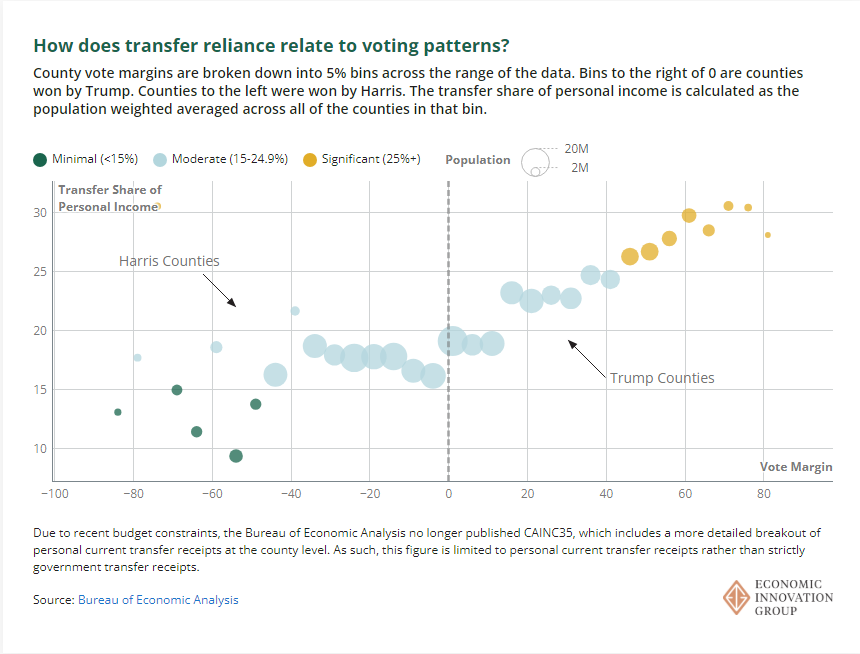
The graph shows that those most dependent on income transfers were more likely to vote for Mr. Trump and that those who are less dependent on income transfers were more likely to vote for Vice-President Harris. That conclusion is not surprising and comports to my own understanding of why Trump was able to secure a popular majority.
The question is why were people who relied so heavily on aid from the Federal Government were so willing to back a candidate who made such an issue of government deficits and the need to control the Federal budget. The answer is that Mr. Trump was able to make the case that Federal aid was going to the “undeserving” poor (“illegal” immigrants and people who benefit from discriminatory DEI programs) and that he would protect the income transfers to those that truly “deserved” the support. Presumably, those Americans who voted for Trump obviously believed that they deserved those transfers.
The Harris campaign tried to refute those assertions, but many people were not persuaded even though the idea that undocumented individuals without social security numbers could ever receive aid from the Federal Government was clearly ludicrous. The question that nettles me is why it was so difficult for so many Americans to clearly assess their own self-interest.
The question is important to me because I dedicated much of my life to a process that demanded close attention to evidence and logic and I am now confronted with the possibility that many people no longer believe those standards are valid. Give me a few more days to think this over, and I will post those thoughts in a few days.
 World Politics News
It nettles me, too, that so many voted against their “self-interest.” The pundits have said, and continue to say, that people were voting with their wallets/pocketbooks, mostly because of inflation and the high cost of groceries. As someone who is solidly middle class, I understand the pain, but cannot understand why they think Trump would make things better.
I frequent a convenience store on my way to work each day. The owner is from Sri Lanka. He is a kind and gentle soul. His wife is there sometimes, wearing a head scarf, so I surmise that they are Muslims. In the days before the election, he told me he hoped something new and different would ensue. (He is a naturalized citizen and can vote.) Two days after the election, he greeted me, kindly as always, and expressed his happiness with the results. His little convenience store is struggling. He thought and thinks that Trump will save him.
I resisted the urge to tell him differently. He will learn, by and by.
I’m not sure what point I’m trying to make with that anecdote. But it seems illustrative of something.
LikeLike
Your observations reveal much of what I have experienced as well. Self-interest seems to be something we assume is evident but is devilishly difficult to define. I will write more on this topic to describe the difficulties I have wrestled with as I explore what may be a paradox, but might also be a question of semantics, perspective, and timeframe.
LikeLike