In 1917, US President Wilson asked the US Congress to declare war against Germany. There were many incidents that provoked Wilson to seek the declaration. His Presidential Campaign of 1916 was adamantly opposed to US participation in the war that had raged in Europe since August 1914. But Wilson’s justification for this change was more deeply rooted in his belief that wars were initiated by leaders who felt little constraints on their ability to use war for spurious reasons:
“We have no quarrel with the German people. We have no feeling towards them but one of sympathy and friendship. It was not upon their impulse that their government acted in entering this war. It was not with their previous knowledge or approval. It was a war determined upon as wars used to be determined upon in the old, unhappy days when peoples were nowhere consulted by their rulers and wars were provoked and waged in the interest of dynasties or of little groups of ambitious men who were accustomed to use their fellow men as pawns and tools.”
It is not at all clear that Wilson’s diagnosis for the causes of war were accurate but they were based on a long-standing tradition in political thought stimulated by Immanual Kant’s pamphlet, Perpetual Peace, which was published in 1795. Kant’s argument was straightforward. Kant believed that the leaders of a country reaped all the benefits of war, such as the expansion of territory, without paying the real price of war. Ordinary people bear the real costs of war (through taxes, conscription, and destruction of property) and would therefore oppose going to war if they were given an effective voice in making decisions. To Wilson, expanding democracy was the most effective way to secure peace.
The meeting yesterday between leaders of the US and Russia in Saudi Arabia was exactly the type of scenario that both Kant and Wilson found compelling. There were no members of the Ukrainian government, nor were there any representatives of other European states. Moreover, the discussion centered on several issues which were decidedly peripheral to the conflict that has been ongoing for three years. According to the Associated Press:
“In an interview with The Associated Press, Secretary of State Marco Rubio said that the two sides agreed broadly to pursue three goals: to restore staffing at their respective embassies in Washington and Moscow, to create a high-level team to support Ukraine peace talks, and to explore closer relations and economic cooperation.”
Two of these three goals are broad issues that relate exclusively to the US-Russian relationship. Both the US and Russia are more interested in normalizing relations, and Ukraine in that context is nothing more than an impediment. But Ukraine and Europe do not view Ukraine in that context. Their context is that Russia ruthlessly invaded Ukraine with no real provocation and has waged a brutal war against the civilian population in Ukraine. At the press conference in Saudi Arabia, both Secretary of State Rubio and National Security Adviser Waltz gave lip service to the idea that there is a need to involve Ukraine and Europe in the negotiations but there was no indication whatsoever whether Trump was concerned about those issues.
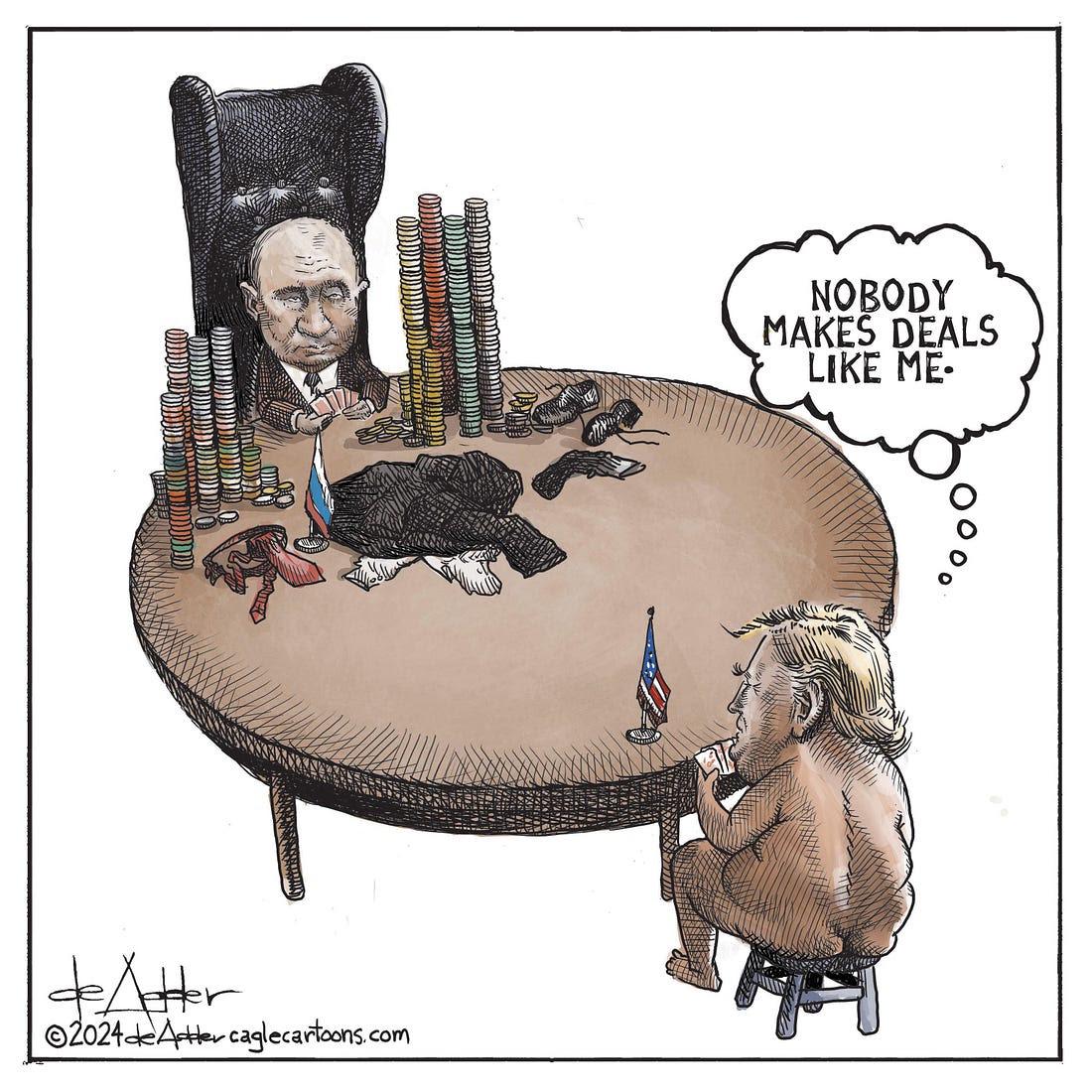
As I indicated in my previous post, Trump has yet to extract any concessions from Putin. Instead, he has already conceded on the two principal issues for Putin: control over wide swathes of Ukrainian territory and a promise that Ukraine would not be allowed to join NATO. These concessions are profound and are on the scale that is usually made by a side that has been routed in war. But Russia has fared dismally in proving its military prowess. The Economist reports:
“Any assessment of Russia’s negotiating position should start with the military situation. Its army has performed dismally. The pace of advance is excruciatingly slow: since last July it has struggled to take the town of Pokrovsk, where current losses are staggering. Most of its gains were in the first weeks of the war. In April 2022, following Russia’s retreat from the north of Ukraine, it controlled 19.6% of Ukrainian territory, and its casualties (dead and wounded) were perhaps 20,000. Today Russia occupies 19.2% and its casualties are 800,000, reckon British sources.”
Trump has declared Ukraine’s unconditional surrender without securing any guarantees that Ukraine’s future sovereignty will be protected, and that condition will only weaken US credibility in the future. Inevitably, those states–not only in Europe but also in Asia, Southeast Asia, Africa, and Latin America–who rely upon US power to keep stability will lose faith in the US and will either resort to self-reliance in defense (most likely, the possession of a nuclear weapon) or will find other protectors (China and Russia are eager to fill a US vacuum).
Trump’s abject surrender to Putin, however, is a greater tragedy. He has seriously damaged US relations with its European allies, and all other states now have legitimate doubts about the integrity of US promises. The world is significantly less safe because of his foolish infatuation with Putin.
President Trump’s comments about Ukraine in the last few days (echoed by the Secretary of Defense, Hegseth, who had, quite ironically, spoke earlier at the Munich Security Conference) spoke volumes about the emerging Trump Doctrine. We have witnessed one of the most inept diplomatic episodes in the history of American foreign policy. The BBC reports:
“The phone call between Putin and Trump lasted nearly an hour-and-a-half, during which the Russian president extended an invitation to visit Moscow, Peskov said.
“Trump also told reporters at the White House that it was unlikely Ukraine would return to its pre-2014 borders but, in response to a question from the BBC, he said ‘some of that land will come back’.
“The president said he agreed with Hegseth, who told a Nato summit earlier on Wednesday that there was no likelihood of Ukraine joining the military alliance.”
With these pronouncements, Trump essentially ended whatever negotiations might ensue. What else is there to offer the Russians? Trump gave away the land the Russians took by force and gave Putin the prize: a promise to keep Ukraine out of NATO. Incredibly, no European state was involved in any of these discussions and President Zelensky was only informed after the fact. The statements brought to my mind the way Churchill and Stalin divided up Eastern Europe after World War II in the Yalta Conference in February 1945. Trump handled the issue in the manner that European states employed in the 19th Century–decisions were made on the basis of what the Great Powers wanted with little or no consideration for the welfare of the citizens most directly involved.
The degree to which Ukraine was ignored is actually quite stunning. The Washington Post reports:
“President Donald Trump’s phone call to Russian President Vladimir Putin has deeply rattled Kyiv and its European partners, intensifying long-held fears that Ukraine could be excluded from peace talks determining its own future and security — as well as that of the rest of the continent.
“Trump, who spoke to Putin on Wednesday and then phoned Ukrainian President Volodymyr Zelensky to inform him of the call, said he and his Russian counterpart will try to meet soon in Saudi Arabia, without the Ukrainian leader. Trump clarified Thursday afternoon that the meeting in Saudi Arabia would involve officials from the United States, Russia and Ukraine. ‘Not with myself or with President Putin, but with top officials,’ Trump told reporters.
“The announcement of the Trump-Putin call, which made no mention of Europe, plays into the fears of European leaders that their defense interests will fall by the wayside if Trump sidelines them in talks with Russia. Kremlin spokesman Dmitry Peskov said Thursday that it was ‘premature’ to discuss a role for Europe in any talks.”
The fiasco will reverberate in all sorts of ways. The credibility of the US has been seriously damaged since Trump ignored all US allies leaving them with the distinct impression that US interests have become brutally narrow. Members of NATO can rightly ask, given Trump’s skepticism of NATO, whether the US will honor its commitments to the alliance in a dispute with Russia. Non-NATO states have witnessed the abject abandonment of a state that has valiantly resisted blatant aggression at considerable cost.
The capitulation of the US brings to mind the decision of British Prime Minister Neville Chamberlain to capitulate to Hitler’s decision to invade Czechslovakia in 1938. Timothy Synder, one of the most astute analysts of European politics today, makes a compelling comparison:
“As American and Russian negotiators converge today in Munich for a major security conference, carrying in their briefcases various plans about Ukraine without Ukraine, the temptation is to recall another meeting in that city. Appeasement of the aggressor seems to be the plan now, as it was with Germany in 1938.
“But the resemblances between that moment and this go deeper, and it worth pausing to consider them. The symmetry between Germany-Czechoslovakia in 1938 and Russia-Ukraine in 2022 is uncanny, and pausing for a moment on the resemblances might help us to take a broader view of today. We are prisoners, now more than ever, of the rumors and disinformation and emotions of the moment. History can give us at least a calmer perspective. And so consider:
“Hitler denied the legitimacy of the Czechoslovak state. As German chancellor, he systematically denied that it had a right to exist. Although its leaders were democratically elected, he claimed that they had no right to rule. Because its people spoke various languages, he claimed that there was no such thing as a body of Czechoslovak citizens. Hitler argued that Czechoslovakia itself was artificial, the result of a historical turning point that never should have happened, the settlement after the First World War. He claimed that the existence of national minority gave him the right to intervene in Czechoslovak politics. In May 1938, he ordered his army to make preparations for a quick strike on Czechoslovakia. He also activiated his agents inside the country. On September 12th Hitler gave a rousing speech to Germans about the entirely fictional extermination of the German minority in Czechoslovakia. We know what comes next: Britain and France, together with Germany and Italy, decided in Munich on September 30th that Czechoslovakia should cede crucial border territories to Germany. These were the most defensible parts of the country. Czechoslovakia’s leaders, although they were not consulted, chose to accept the partition of their country.”
The Munich analogy is dangerous, since it is often used to justify actions whenever there seems to be a breach of international norms. The most common mistake is to regard initial acts of aggression as part of a larger plan to dominate other states. The example was often invoked in the Vietnam War: “We should resist North Vietnamese agression in Southeast Asia or we will be fighting them in San Francisco”.
“It was not until the advent of the Johnson administration, however, that the Munich analogy came into its own. President Lyndon B. Johnson and his secretary of state, Dean Rusk, considered Munich to be the most important historical lesson of their time. Remembering Munich, they saw weakness overseas as leading to World War III. Johnson explained, “Everything I knew about history told me that if I got out of Vietnam and let Ho Chi Minh run through the streets of Saigon, then I’d be doing exactly what Chamberlain did in World War II. I’d be giving a big fat reward to aggression.” Rusk was equally attuned to the lessons of the 1930s, which he described as the realization that “aggression must be dealt with wherever it occurs and no matter what mask it may wear…. The rearmament of the Rhineland was regarded as regrettable but not worth a shooting war. Yet after that came Austria, and after Austria came Czechoslovakia. Then Poland. Then the Second World War.”
“This belief in the applicability of the Munich analogy to his situation led Johnson to increase troop levels, first to 300,000 and then to 500,000 by 1968. At a National Security Council meeting in July 1965 to discuss an increase in troops, an exchange occurred between Undersecretary of State George Ball, who was opposed to committing more men, and the U.S. ambassador to Vietnam, Henry Cabot Lodge. Lodge rebutted Ball’s arguments, explaining that ‘I feel there is a greater threat to start World War III if we don’t go in. Can’t we see the similarity to our own indolence at Munich?’ No one present at the meeting questioned this statement. Even McGeorge Bundy, the national security adviser who often criticized others for using inaccurate analogies, did not comment. The administration’s policymakers were convinced of the appropriateness of the analogy to their own situation in Vietnam, and often reminded one another of this fact. Even former president Eisenhower resorted to the analogy in advising Johnson in 1965. He warned the president not to be convinced by Britain’s arguments for negotiation. Prime Minister Harold Wilson, he said, ‘has not had experience with this kind of problem. We, however, have learned that Munichs win nothing.'”
The Munich analogy was inappropriate in Vietnam because there was no evidence that North Vietnam was interested in taking over the world. But there is conisderable evidence that Putin does have larger global ambitions, not the least of which is the restoration of the empire of the Soviet Union. For this reason, the Baltic states and Poland desperately wanted to join NATO after the collapse of the Soviet Union. Indeed, NATO expanded, not because the US wanted to include the East European countries, but because those states feared the resurgence of the Russian Empire, a point that became even more persuasive after the Russian invasion of Ukraine in 2014.
The incompetence of the Trump foreign policy with respect to Ukraine will haunt the US as long as Trump is in power. We will see how China regards Trump on the matter of Taiwan or on the relations between North and South Korea. In the absence of US support for countries resisting aggression, many states will look for other allies or perhaps even to develop their own nuclear weapons. Fortune assesses the feelings of US allies:
“The track Trump is taking also has rocked Europe, much as his dismissive comments about France and Germany did during his first term.
‘French Deputy Foreign Minister Benjamin Haddad described Europe as being at a turning point, with the ground shifting rapidly under its feet, and said Europe must wean itself off its reliance on the United States for its security. He warned that handing a victory to Russia in Ukraine could have repercussions in Asia, too.
“’I think we’re not sufficiently grasping the extent to which our world is changing. Both our competitors and our allies are busy accelerating,’ Haddad told broadcaster France Info on Thursday.”
Trump is not pursuing an “America First” policy; rather, he is pursuing a policy of “America Alone”.
 World Politics News