As we approach the one-year anniversary of the brutal Hamas attack on Israel, the conflict is also nearing a critical point in the escalation cycle. After the Iranian missile attack last Tuesday, Israeli Prime Minister Netanyahu declared that:
“This evening, Iran again attacked Israel with hundreds of missiles. This attack failed. It was thwarted thanks to Israel’s air defense array, which is the most advanced in the world. I commend the IDF for the impressive achievement. It was also thwarted thanks to your alertness and responsibility, citizens of Israel. I also thank the US for its support in our defensive effort.
“This evening, Iran made a big mistake – and it will pay for it. The regime in Tehran does not understand our determination to defend ourselves and to exact a price from our enemies…
“We will keep to the rule we have determined: Whoever attacks us – we attack them.
“This is true wherever we fight the axis of evil. It is true in Judea and Samaria. It is true in Gaza, Lebanon, Yemen and Syria – and it is also true in Iran. We are fighting the axis of evil everywhere, including in southern Lebanon and Gaza, where our heroic soldiers are active.
“Today, more than ever, the forces of light in the world must unite and work together against the ayatollahs’ dark regime, which is the source of terror and evil in our region. They must stand alongside Israel. The choice has never been more clear, between tyranny and freedom, between the blessing and the curse.”
Both Israel and Iran face a very serious problem–their efforts to deter each other have failed. Iran thought that by arming Hamas and Hezbollah, Israel would not take actions to endanger their citizens. Further, Iran believed that its missile forces would deter Israeli action against Iran. Israel proved these assumptions to be incorrect. Israel believed that its anti-missile systems, buttressed by US forces in the region, would lead Iran to believe that a missile attack on Israel would fail. That assumption is less certain now than it was before 7 October.
Both Hamas and Israel miscalculated. Many observers, including me, were shocked by the intensity of the Israeli response to the 7 October atrocity. And many, including me, believe that the Israeli response in the Gaza (and now in Lebanon) to be wildly disproportionate. After the Iranian missile attack last April, which consisted of about 300 missiles most of which were intercepted by the Israeli and US forces, Israel determined that its civilian population was sufficiently protected to permit extensive Israeli military actions, including the missile attack on Tehran which killed the leader of Hamas, Haniyeh. But that assumption now looks to be problematic.
The Iranian missile attack last Tuesday consisted of 200 missiles, but about 20 of those missiles actually hit Israeli military bases., suggesting that the Israelil missile defense was not as robust as was assumed. The Israeli Defense Force first announced that the Iranian attack had been unsuccessful and that damage was minimal. But National Public Radio quotes Jeffrey Lewis, a professor at the Middlebury Institute of International Studies at Monterey:
“Lewis notes that although over 30 missiles landed inside the base perimeter, the damage caused was still somewhat limited. That’s notable because Iran is believed to have used some of its most advanced Fattah missiles.
“‘Even these missiles, which look substantially more accurate, still struggled to do damage,’ he says.
“Still, he thinks the attack has shown that Iran can strike at targets well inside Israel. ‘They can definitely get missiles through,’ he says.”
If Iranian missiles can penetrate the Israeli missile defense system, then the Israeli civilian population is at risk. The missiles on Tuesday struck Israeli military bases. Iran clearly made a decision not to target civilian population centers. One such missile hitting a city like Tel Aviv or Haifa could be damaging (but not catastrophic), and would change the calculations of acceptable losses for Israel.
There are, however, questions to be raised before the expected Israeli counterattack. The Iranians launched 300 missiles last April, but only around 200 on Tuesday. That difference is significant. It could signal that Iran’s response to the assassination of Nasrallah was not so important and that the Iranians felt they could be restrained. Or it could be that Iran was trying to preserve as much of their missile force as possible for future asttacks. Or it could mean that Iran was only trying to get a better read on the effectiveness of Israeli missile defenses. I personally believe thats Iran’s decision to avoid population centers was a clear signal that Iran did not wish to provoke a major escalation, even though it was bound to retaliate for the assassination of Nasrallah.
Now Israel has to send some messages as well. Interestingly, US President Biden indicated to journalists that he did not think the Israelis should attack the nuclear facilities in Iran, nor should it attack the oil production centers in Iran. An attack on Iranian population centers would be roundly condemned by most in the world. So Israel has to think about what message it wishes to send to both Tehran and Washington.
There are other considerations as well. The Israeli missile defense system is mostly effective, but it is truly expensive. Offensive missiles are reltively cheap; defensive missiles require a great deal of infrastructure,, including extensive radar systems and very sophisticated targeting mechanisms. Offensive missiles can be used for a variety of targets. Defensive interceptor missiles have only one objective, but an objective that has to be perfectly targeted to be considered a “success”. The drain on the Israeli economy will be substantial and Israel’s economy is already suffering from the costs of the war. The Economist reports:
“Stronger economic growth would ease the pain. Although reservists have returned to work and consumption has returned to pre-war levels, Israel’s economy remains smaller than it was on the eve of war. Mr Smotrich has cushioned the least productive parts of society and starved industry of resources. The labour market remains ultra-tight, with the unemployment rate at just 2.7%. Firms are struggling to fill vacancies and Israel’s small high-tech companies are under strain. They are losing out on funding owing to the war, warns Startup Nation, a local think-tank.
“Some 80,000 Palestinian workers were denied permits after October 7th, and have never been replaced. As a consequence, the construction industry is 40% smaller than it was this time last year, greatly impeding housebuilding and repairs. For now, the biggest impact has been on inflation, which hit an annual rate of 3.6% in August, having accelerated over the summer. Should the scale of Hizbullah attacks increase, the lack of construction workers will become an even bigger problem….
“Then there is the nightmare scenario. Few investors are preparing for a war that would engulf all of Israel, including Jerusalem or Tel Aviv—even though Hizbullah may be capable of launching such an attack. In these circumstances economic growth would be hit hard, perhaps even harder than after October 7th. Army outgoings would soar. Fleeing investors would probably topple banks and send the shekel plummeting, forcing the Bank of Israel to intervene and spend its reserves.
“Whatever happens, Israeli economists are resigned to things getting worse. Even Mr Smotrich, generally a bullish type, now emits an air of exhaustion: ‘We are in the longest and most expensive war in Israel’s history.’ Previous conflicts have come at a heavy cost to Israel. Do not be surprised if this one does, too.”
Israel is also free to ignore President Biden’s caution, but the price of that tactic could be substantial. Prime Minister Netanyahu has already ignored several US proposals for a cease-fire, and the cumulative effect of indifference to US preferences could lead many in the US to consider Israel to be an unreliable ally–a problem that could get very difficult for Netanyahu if Kamala Harris wins the Presidential election. In many places in the world, Israel is already becoming a pariah nation.
Finally, a massive Israeli counterattack would send a clear message to Iran that its reliance on conventional weapons is dangerous. A unfortunate paradox of Israeli miltary prowess is that it may lead Iran to the decision that its only effective defense is to build a nuclear weapon–exactly the most troubling scenario nettling the Israeli defense establishment.
Deterrence has failed for both sides. Re-establishing deterrence is a very tricky business, fraught with the possibility of serious misreadings of intentions or inaccurate calculation of risks and costs. Israel’s response to Iran will determine the course of this wretched conflict.
Israeli Prime Minister Netanyahu has established Israel as a rogue state with no red lines. It has attacked the Gaza Strip, Syria, Lebanon, Yemen, and Iran with few repercussions to its own security. And it has launched these attacks with no hints whatsoever as to what would be acceptable terms of peace. Consider: the Gaza Strip has been almost completely destroyed and its inhabitants do not know how the devastation might stop. The US and its allies have all stated that the only possible resolution to the conflict would be the implementation of a two-state solution. Netanyahu has explicitly rejected this approach, according to the New York Times:
“Prime Minister Benjamin Netanyahu of Israel doubled down on his opposition to the creation of a Palestinian state this weekend, again rebuffing pressure from President Biden to agree to that path after the war in Gaza is over.
“My insistence is what has prevented — over the years — the establishment of a Palestinian state that would have constituted an existential danger to Israel,” Mr. Netanyahu said in a statement in Hebrew on Sunday. “As long as I am prime minister, I will continue to strongly insist on this.”
“The statement reiterated comments he made on social media the previous day, when he said in Hebrew that he “will not compromise on full Israeli security control of the entire area west of the Jordan River — and that is irreconcilable with a Palestinian state.”
Because it has offered no alternative, Israel only offers continued occupation, and it demands that the “elimination” of its enemies is the price that the Palestinian people have to pay for those terms if they want peace. And now the same terms are being offered to Lebanon, Syria, and Iran. Moreover, there are apparently no limits on how Netanyahu defines “elimination”. The current war in Gaza was precipated by a heinous Hamas attack that killed 1,200 Israelis but the counterattack on the Gaza has killed almost 42,000 Palestinians, the majority of which are women and children. The disproportionate ratios are also reflected in the losses suffer by the Lebanese in the current escalation, as demonstrated graphically byBloomberg:
The one-sidedness of this conflict means many things, but the one point most relevant to any possible settlement is that the terms of a settlement acceptable to Israel is the complete and utter capitulation of the Palestinian people and that Israel is willing to kill as many people and to attack any state required to achieve that capitulation.
As I have argued before, Israel is only able to follow this strategy because the US continues to arm and financially support Israel with no conditions and that the US is willing to provide the necessary shield to prevent any Israeli civilian losses from attacks from any state in the region. The attack on the Hezbollah headquarters in Beirut was likely done by a 2,000 pound bomb supplied by the US, even though President Biden had earlier banned the export of such bombs to Israel because of their indiscriminate destruction. The Israeli air strike against Yemen yesterday was especially significant because it was a difficult mission that demonstrated the geographic reach of Israeli power as described by The Jerusalem Post:
“Until July, the IDF had outsourced responses to the Houthis to the US, which was fighting the group over various maritime aggression issues. However, after the Houthis killed a civilian in Tel Aviv, the Jewish state struck back directly for the first time.
“During Israel’s July counterstrike, it took two hours and 50 minutes for the IDF’s F-15s, F-35s, and other fighter jets, which carried out around 10 airstrikes against the Houthis, to reach their targets in the Hodeidah Port area. Those aircraft took off around 3 p.m. on July 20 and struck their targets around 6 p.m.
“Although the IDF kept classified the exact number of aircraft it used to refuel its fighter jets to make the 1,800-kilometer flight and return safely during that July attack, it provided a dramatic video showing some of the mid-air refueling in real-time.
“Sunday’s flights and refueling were equally complex, intended to completely destroy the Houthis’ capability (as opposed to a partial cut in July) to receive refined products, including weapons, from Iran.”
The significance of the attack was not in the destruction it caused in Yemen, but rather the message sent by Israel to Iran that it had the capability to attack Iran (also because the Saudis allowed Israel to use its airspace to make the flight). Reuters highlights Netanyahu’s objective:
“Israel warned Iran on Monday that nowhere in the Middle East was beyond its reach and hinted at a land invasion of Lebanon after assassinating the leader of the Tehran-backed Hezbollah group, one of its biggest adversaries, in a Beirut suburb last week.
“‘There is nowhere we will not go to protect our people and protect our country,’ Prime Minister Benjamin Netanyahu said in a three-minute video clip in English that he addressed to the Iranian people.”
The Iranians have taken actions, such as hiding high-ranking officials, in anticipation of such an attack. I doubt, however, that the Iranians want such a war–the country is weak economically and suffering from drought, a weak economy, and questions about the legitimacy of the regime. More importantly, however, Iran does not have a viable military option. As long as the US is committed to the aerial defense of Israel, there is probably nothing that the Iranians could do do change Netanyahu’s determination to eliminate Israel’s enemies. This is particularly true given that Israel has demonstrated that its has pierced Iranian intelligence by its assassination of Ismail Haniyeh right in the heart of Tehran. Israel also compromised the communications network of Hezbollah by its bold tactic of planting explosives in the pagers and walkie-talkies of Hezbollah activists.
There is, however, one course of action open to the Iranians. It could take to heart the lesson of the fate of the “axis of evil” identified by US President George W. Bush after the 11 September attack on the US. The axis consisted of Iraq, North Korea, and Iran. Iraq had no nuclear weapons and was invaded by the US in 2003 and its government was overthrown and the country occupied by the US for a number of years. North Korea, on the other hand, did have nuclear weapons and does not have to worry about an attack by the US or its allies. The lesson seems clear: if one is worried about an attack by a state that is militarily superior and has indicated that it has no constraints on the use of force, then possession of a nuclear weapon is the best defense.
I sincerely doubt that Iran wants a nuclear weapon. The late Ayatollah Khamenei, the Supreme Leader of the Islamic Republic, called nuclear weapons inconsistent with Islam in 2010. But Iran exists in a dangerous neighborhood. Some of its closest neighbors–Russia, China, India, Pakistan, and Israel–already have nuclear weapons and the US is constantly patrolling the Persian Gulf with ships that are nuclear-capable. Iran unquestionably has the capability to develop a nuclear weapon. but would have to develop a nuclear weapon secretly so that Israel would not launch a pre-emptive strike against its nuclear facilities. A nuclear test conducted by Iran would quickly raise the costs of any Israeli action against it. The outcome of a nuclear Iran is decidedly against Israel’s and the world’s interest. But territorial integrity and sovereignty are attributes without which a state cannot exist, and Israel is currently threatening both of those attributes.
The US must immediately announce that it is suspending all military and financial assistance to Israel until Israel puts forth a proposal for the two-state solution that effectively creates the opporunity for the Palestinians to exercise their inherent right of self-determination. That aspiration will never die no matter how many leaders in Hamas, Hezbollah, Yemen, and Iran that the Israelis succeed in assassinating. This has been the official position of the US ever since the war in 1967, and it is second only to the Cuban Embargo as a bootless policy–it is an objective that has been purely rhetorical and meaningless to the countless number of people who have died in the region. Fifty-seven years is a very long time for a power to remain impotent, and Netanyahu has apparently no compunction to disregard American counsel or interests.
The situation is reminiscent of the difficulties the US had in floating peace proposals during the Vietnam war. In 1972, the US had reached agreement with North Vietnam on a cease-fire, but South Vietnamese President Thieu rejected the proposal as a “surrender to the Communists”. Rather than using its formidable levers to change Thieu’s mind, the US instead chose to amplify its military commitment to South Vietnam and the war expanded and dragged on for two more years. President Nixon chose the military path because he did not wish the US to appear as a “pitiful, helpless giant”. The US became a hostage to its weaker ally and many died because of US inaction on the diplomatic front. In the immediate case, choosing a diplomatic path is the only effective course of action. The US must clearly tell Netanyahu that that path is the only one it will support even as it promises to defend Israel against any attack on its territory, but it will not support any further expansion of the war.
Like Thieu, Netanyahu can ignore the US, but the US needs to make clear to its ally that it means what it says. If Israel wants to continue the carnage, then the US should no longer be an accomplice to the war crimes being committed. Israel is a sovereign state and the US should not dictate to Israel what it should do. But Israel also should not tell the US that it has to support actions that do not serve US interests.
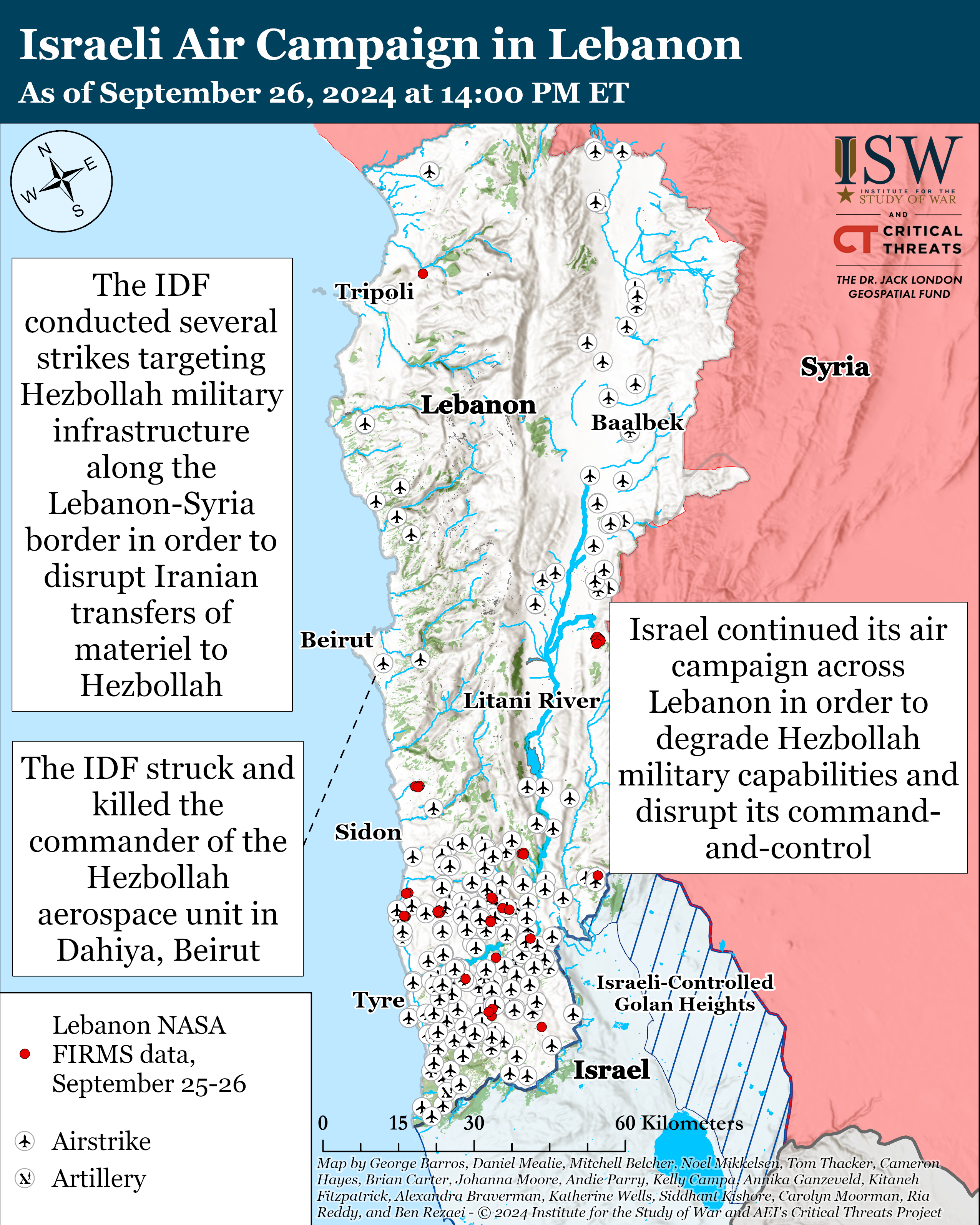
Israel dramatically escalated the conflict in the Middle East by bombing what it called the headquarters of Hezbollah in Beirut, killing the leader of Hezbollah, Hassan Nasrallah, as well as Gen. Abbas Nilforushan, one of the prominent generals in Iran’s Revolutionary Guard. The timing of the attack was impeccable: the Israeli Knesset is in recess until 24 October and the US in nearing its Presidential election which make any dramatic change in US policy unlikely. The US was not forewarned about the attack and it came as Israel rebuffed US efforts to forge a temporary cease-fire between Hezbollah and Israel.
Hezbollah has long been opposed to the state of Israel and there have been many clashes between the two entities which included Israeli occupation of southern Lebanon in 1982, an event that led to the formation of Hezbollah and an occupation that lasted 20 years. That occupation was a disaster for Israel–it was very costly in lives and expense–and it settled nothing: “In 1982, tens of thousands of Israeli soldiers were sent into Lebanon. About 650 Israeli soldiers were killed in the fighting and another 750 during the subsequent occupation. That makes it Israel’s third costliest war, after 1948 and 1973.” [that article was published in 2006 and does not include the expense of the current war].
There is little sympathy for Hezbollah in the world, but in 2018 Lebanese election, Hezbollah and its allies gained a majority in the Parliament (but lost the majority in the 2022 election). So we are not just talking about a terrorist organization but also a major political actor in Lebanon. The US and its European allies will not shed any tears about the killing of Nasrallah, but all Israeli allies are worried about what the next step in the conflict may be.
It seems likely that both Iran and Hezbollah will respond in force, but neither side has any good options given the Israeli defenses and the willingness of the US to provide additional air defense protection. THe failure of an earlier Iranian attack, in which it launched almost 300 missiles which were mostly intercepted, makes anything other than a massed missile attack likely to fail. Such an attack would likely require attacks against population centers which would outrage the world. But Iran and Hezbollah lack the ability to make effective attacks aginst specific military targets in Israel. Neither Iran and Hezbollah can afford to appear impotent if they wish to maintain their ability to organize opposition to Israel.
While there may not be an effective response to the Israeli attack, it is also not clear what Israel has gained through this attack. Both the US and Israel have a fixation on assassinating individuals in hopes of affecting the dynamics of the long-standing conflict. Israel has been remarkably successful in killing people it believed were involved in terrorist activities. Wikipedia has a list of those killed by Israeli forces and it is extensive (too long to reproduce here).
But killing individuals is not the same as addressing the root causes of the violence. Nasrallah is dead, but does anyone doubt that Hezbollah will find a new leader? Indeed, the ranks of Hezbollah have probably increased as a result of the Israeli attacks. And, if Israel invades Lebanon to ssecure its border, how long will the Israeli occupation last?
Israel has seemingly unlimited resources ot fight its wars and the US offers Israel almost airtight protection against counterattacks. Netanyahu obviously believes that more war is the right course of action for Israel. Perhaps Netanyahu should be reminded that there is a real possibility that its allies will withdraw their support unless Netanyahu begins to pursue policies that lead to peaceful resolution.
It seems to me that Israeli Prime Minister is trying to goad Iran into war. A drone attack in Beirut assassinated Saleh Al-Arouri,deputy head of the political bureau of Hamas, on Tuesday. Al-Arouri acted as a liaison between Hamas and Hezbollah in Lebanon and was a critical figure in Hamas. Although Israel has not taken responsibility for the act, it seems clear that there are few other possibilities. And that act was followed by two bomb explosions near the tomb of Iranian general Qasem Soleimani which killed almost 100 people who were observing the 4th anniversary of Soleimani’s assassination by US forces. Again, Israel has not taken responsibility for the bombing, but it seems likely that Israel coordinated the attack.
The attacks elicited responses from both Hezbollah and Iran. The Washington Post reports:
“Hezbollah chief Hasan Nasrallah said in an address Wednesday that Israel should expect ‘a response and punishment’ a day after the death of senior Hamas leader Saleh Arouri in a suspected Israeli drone strike in a Beirut suburb. Hezbollah, an Iranian-backed militant group based in Lebanon, has traded fire with Israel in recent weeks, though the Lebanese government said it was urging Hezbollah to show restraint. ‘If the enemy thinks of waging a war on Lebanon,’ Nasrallah said, they ‘will regret it.’”
The New York Times reports on the reaction from Iran:
“Iran’s supreme leader, Ayatollah Ali Khamenei, issued a statement blaming the attack on Iran’s ‘malicious and criminal enemies,’ but stopped short of naming any group or country. Mr. Khamenei vowed that Iran’s enemies should know that ‘this tragedy will have a strong response.’
“While no group has claimed responsibility for the attack, Iran’s president, Ebrahim Raisi, seemed to blame the country’s archrivals, the United States and Israel. ‘We tell the criminal America and Zionist regime that you will pay a very high price for the crimes you have committed and will regret it,’ he said.”
It is no secret that Netanyahu has long regarded Iran as an “existential threat” to Israel and opposed the multilateral deal known as the Joint Comprehensive Plan of Action which was designed to prevent Iran from developing nuclear weapons (an agreement that US President Trump unilaterally abrogated in 2017). Netanyahu has supported a military action against Iran for a long time and he regards Iran as the main supporter of Hamas, something which is unquestionably true. And earlier this year. Fox News reported that Israel was preparing for an attack to destroy Iranian nuclear facilities:
“Israel will prepare for possible action against Iran’s nuclear facilities after a series of secret meetings between the prime minister and leaders from the defense and intelligence ministries, according to a leaked report.
“‘Israel will not allow Iran to become nuclear,’ Brigadier-General (Reserves) Amir Avivi, founder and chairman of the Israeli Defense Security Forum, told Fox News Digital. ‘As we are witnessing the continued unhindered progress of the Iranian military nuclear program with weapons-grade enrichment, Israel is readying its credible military option.’
“Israeli Prime Minister Benjamin Netanyahu held five meetings with his defense and intelligence chiefs, as well as the head of Mossad, to discuss the possible attack, local news outlet Channel 12 reported. The report did not name any source, and The Times of Israel speculated that officials could have leaked the report in order to make clear the country’s resolve and intent.”
It is not clear why Netanyahu would want to attack Iran at this particular point in time given the current action in the Gaza which is already straining the Israeli economy. But it could be that Netanyahu thinks that his current abysmal standing in the opinion polls in Israel could be bolstered by a successful attack on Iran and might ultimately vindicate his hawkish policies. Moreover, it is not clear to me that either Hezbollah or Iran would want to engage in open conflict with Israel. But both of those parties are now in a very difficult position given the atrocities that are occurring in the Gaza.
If my paranoid fears turn out to be true (and I don’t think I’ve ever wanted to be proven so wrong), the US should wash its hands of Israeli military action. Under no circumstances should the US come to the aid of Israel in a war against Iran, no matter what provocations are assumed to be Iranian-inspired.

 World Politics News