In what is likely the most consequential decision of his administration, Trump has allowed the Environmental Protection Agency (EPA) to repeal its “endangerment” policy. That policy codified a 2009 scientific conclusion that greenhouse gas emissions pose a danger to Americans’ health and welfare, allowing the EPA to regulate those gases. The repeal of the policy means that these gases can no longer be regulated by the Agency. The endangerment finding is pretty straightforward:
“The endangerment finding is a 2009 EPA ruling that determined greenhouse gases were a threat to public health. The finding originated from a 2007 Supreme Court case, Massachusetts v. EPA, in which the Court ruled that greenhouse gases qualify as pollutants under the Clean Air Act. Following the ruling, the Court ordered the EPA to determine whether greenhouse gasses endanger public health and welfare. The EPA concluded in the 2009 endangerment finding that six greenhouse gases—including carbon dioxide, methane, and hydrofluorocarbons—posed a threat to the public. The agency was then able to use those findings to regulate emissions from cars, trucks, and power plants.”
The repeal of the finding will have a direct effect on the health of American citizens but also on people all over the world. According to the New York Times:
“By repealing the endangerment finding, the United States is likely to add up to 18 billion metric tons of emissions to the atmosphere by 2055, according to the Environmental Defense Fund, an advocacy group. That is about three times the amount of climate pollution the country emitted last year.
“The added pollution could lead to as many as 58,000 premature deaths and an increase of 37 million asthma attacks between now and 2055, the group said.”
President Trump has called climate change a hoax, and he has stopped projects designed to promote alternative sources of energy and has ordered the Pentagon to increase its reliance upon coal-fired power plants. Coal is unquestionably the most damaging fuel for the environment. ABC News documents the significance of coal in climate change: “According to the EPA, ‘coal combusting is more carbon-intensive than burning natural gas or petroleum for electric power production.’ The EPA reported that in 2022, coal was responsible for 55% of CO2 emissions but only represented 20% of the electricity generated in the U.S.” Scientific American outlines Trump’s wrecking of the institutional mechanisms for restraining greenhouse gases:
“Trump has long referred to climate change as a ‘hoax’ despite decades of rigorous research and evidence in support of global warming. He began his second presidency by once again removing the U.S. from the Paris climate agreement to limit warming to below 1.5 degrees Celsius. Trump also in 2025 withdrew the U.S. from the U.N. Framework Convention on Climate Change, the treaty under which the Paris agreement was negotiated.
“The current Trump administration has also sought to hobble the buildout of renewable energy in the U.S., particularly offshore wind turbines, which the president has falsely linked to the deaths of whales. The administration has also sought to bolster fossil fuels, opening more federal lands to drilling and ordering coal plants marked for retirement to stay open.”
Despite the overwhelming scientific evidence supporting the dangers of climate change, Trump relied upon a hand-picked panel of 5 researchers to support his contention that climate change is a hoax. That panel released a report entitled “A Critical Review of Impacts of Greenhouse Gas Emissions on the U.S. Climate”. That report has been resounding rejected by most climate scientists, as reported by the Sierra Club:
“The larger climate science community has resoundingly criticized the DOE’s report, which was not peer reviewed. Some scientists say their work was misrepresented by the report authors. A recent Carbon Brief analysis revealed that the report contains over 100 false or misleading statements.
“’This assessment appears to be manufacturing uncertainty and stoking controversy where there is none,’ Carlos Martinez, a senior scientist at the Union of Concerned Scientists, told Sierra….
“Martinez also noted the stark contrast between the DOE report and the congressionally mandated National Climate Assessment reports, the latter of which are peer reviewed and offer multiple opportunities for public comment, involve hundreds of scientists and take several years to produce. ‘In terms of the credibility here, the contrast is clear as day,’ he said.”
The repeal of the endangerment finding will be contested in court, so this is hardly the end of the story. The urgency of the danger posed by climate change is only increasing. The Washington Post ran an article on the possibility that climate change may in fact be accelerating. The article is worth reading since it has a number of graphs that I cannot reproduce on this medium. The article holds that:
“For about 40 years — from 1970 to 2010 — global warming proceeded at a fairly steady rate. As humans continued to pump massive amounts of greenhouse gases into the atmosphere, the world warmed at about 0.19 degrees Celsius per decade, or around 0.34 degrees Fahrenheit.
“Then, that rate began to shift. The warming rate ticked up a notch. Temperatures over the past decade have increased by close to 0.27 degrees C per decade — about a 42 percent increase.
“Those data — combined with the last few years of record heat — have convinced many researchers that the world is seeing a decisive shift in how temperatures are rising. The last 11 years have been the warmest years on record; according to an analysis by Berkeley Earth, if we assume a constant rate of warming since the 1970s, the last three years have a less than 1-in-100 chance of occurring solely due to natural variability.
“’There is greater acceptance now that there is a detectable acceleration of warming,’ said Zeke Hausfather, a climate scientist and the research lead at the payments company Stripe.”
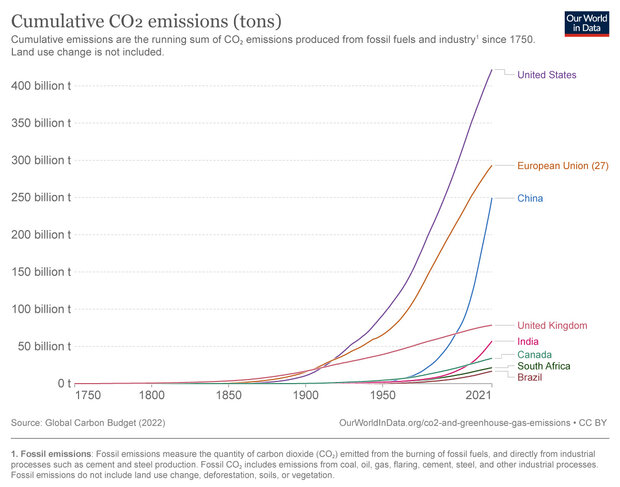
Trump’s decision is fateful for the vast majority of the global population, who have no voice in this decision. The US is by far the country most responsible for greenhouse gases since the beginning of the Industrial Revolution, but it only accounts for about 4% of the global population. The following chart gives an idea of how unfair the US position on climate change is to the rest of the world.
“The world’s several dozen global climate models offer little guidance on how much the climate responds to elevated CO2, with the average surface warming under a doubling of the CO2 concentration ranging from 1.8°C to 5.7°C [Section 4.2]. Data-driven methods yield a lower and narrower range [Section 4.3]. Global climate models generally run “hot” in their description of the climate of the past few decades − too much warming at the surface and too much amplification of warming in the lower- and midtroposphere [Sections 5.2-5.4]. The combination of overly sensitive models and implausible extreme scenarios for future emissions yields exaggerated projections of future warming.
“Most extreme weather events in the U.S. do not show long-term trends. Claims of increased frequency or intensity of hurricanes, tornadoes, floods, and droughts are not supported by U.S. historical data [Sections 6.1-6.7]. Additionally, forest management practices are often overlooked in assessing changes in wildfire activity [Section 6.8]. Global sea level has risen approximately 8 inches since 1900, but there are significant regional variations driven primarily by local land subsidence; U.S. tide gauge measurements in aggregate show no obvious acceleration in sea level rise beyond the historical average rate [Chapter 7].
“Attribution of climate change or extreme weather events to human CO2 emissions is challenged by natural climate variability, data limitations, and inherent model deficiencies [Chapter 8]. Moreover, solar activity’s contribution to the late 20th century warming might be underestimated [Section 8.3.1].
“Both models and experience suggest that CO2-induced warming might be less damaging economically than commonly believed, and excessively aggressive mitigation policies could prove more detrimental than beneficial [Chapters 9, 10, Section 11.1]. Social Cost of Carbon estimates, which attempt to quantify the economic damage of CO2 emissions, are highly sensitive to their underlying assumptions and so provide limited independent information [Section 11.2].
“U.S. policy actions are expected to have undetectably small direct impacts on the global climate and any effects will emerge only with long delays [Chapter 12].”
All of these criticisms are partially true, but they all ignore the fact that the earth has in fact warmed considerably in the last decades. The criticisms suggest that the underlying reality should be ignored and that we should instead nitpick aspects of the concerted efforts of thousands of climatologists working together–this report was actually written by 5 people: John Christy, Ph.D., Judith Curry, Ph.D., Steven Koonin, Ph.D., Ross McKitrick, Ph.D., and Roy Spencer, Ph.D. Further, the study was coordinated by Christopher Wright, who was the CEO of Liberty Energy, North America’s second largest hydraulic fracturing company. Wright’s sentiments are clear in his forward to the study:
“Climate change is real, and it deserves attention. But it is not the greatest threat facing humanity. That distinction belongs to global energy poverty. As someone who values data, I know that improving the human condition depends on expanding access to reliable, affordable energy. Climate change is a challenge—not a catastrophe. But misguided policies based on fear rather than facts could truly endanger human well-being.
“We stand at the threshold of a new era of energy leadership. If we empower innovation rather than restrain it, America can lead the world in providing cleaner, more abundant energy—lifting billions out of poverty, strengthening our economy, and improving our environment along the way.”
The position taken by the Trump Administration is clearly an outlier. The overwhelming evidence, however, does not support the Trump position. According to Copernicus, the European climate agency, the data are straightforward:
◾ The global average was 1.3 degrees above the 1991-2020 global average and .21 degrees above 2023, the previous warmest year on record.
◾ The temperature was 2.9 degrees above the estimated temperature between 1850-1900, often referred to as the preindustrial era.
◾ Each of the past 10 years has been one of the warmest 10 on record.
◾ A new record-high daily global average temperature was reached on July 22, at 30.8 degrees.
◾ Every month since July 2023, except for July 2024, was above the 2.7 degrees Fahrenheit (1.5 C) threshold.
Recently the International Court of Justice issued a ruling that takes a dramatically different position as explained by Zoë Schlanger in The Atlantic:
“Last month, the world’s highest court issued a long-awaited opinion on how international law should regard climate harm. The International Court of Justice concluded, unanimously, that states have binding legal obligations to act to protect the climate system, and failure to do so—by continuing to produce, consume, and subsidize fossil fuels—may ‘constitute an internationally wrongful act.’ In other words, curbing greenhouse-gas emissions is not merely voluntary in the eyes of the court; failure to do so is illegal.”
The ruling can only be enforced through actions taken by the UN Security Council and it is doubtful that that body would take any effective action to reduce greenhouse gas emissions. But it does stand as a marker for future action.
In the meantime, the Trump Administration has been busy erasing the studies done by the US government that suggested that climate change was real. Jody Freeman writes in the LA Times:
“President Trump has been trying to eliminate climate regulations since his first day back in office when he signed an executive order declaring the primacy of fossil fuels.
“But his administration’s most radical step came last week, when the Environmental Protection Agency unveiled a proposal that would rescind its 2009 “endangerment finding” — the scientific conclusion that greenhouse gases contribute to global warming and harm human health and well-being.
“This isn’t just another regulatory rollback. It’s an assault on the foundation of all federal climate policy.
“The endangerment finding originally applied to vehicle emissions, but it also underpins every major federal climate rule in America: car and truck emissions standards, power plant regulations and limits on oil and gas facilities. By removing this cornerstone, Trump’s EPA is repudiating federal authority to limit greenhouse gases, our most powerful tool for fighting climate change.”
In addition, the Trump Administration has removed the website of the U.S. Global Change Research Program in addition to the five National Climate Assessments that are required by US law. Moreover, according to ABC News “all the authors working on the upcoming Sixth National Climate Assessment, set for release in 2028, were also dismissed.” Finally, according to the Irish Star “NASA has been given orders by the White House to destroy two major satellites in space that are used by farmers, scientists, as well as oil and gas companies.”
The Trump Administration has determined that the US citizenry should not be able to view information that supports the idea thats climate change is occurring. That policy is a fool’s errand. Just as the Catholic Church could not dispel the idea that the earth revolved around the sun, Americans will have access to non-US-governed sources on climate change. More importantly, Americans will not be able to deny the reality of a warming planet because heat waves, intense storms, and migration caused by climate change will continue to unsettle our daily lives. Trump’s policies are a repudiation of the Enlightenment, which raised standards of living all over the world because of its commitment to policies based upon rational analysis based upon empirical evidence. The upcoming Dark Ages will be hot.
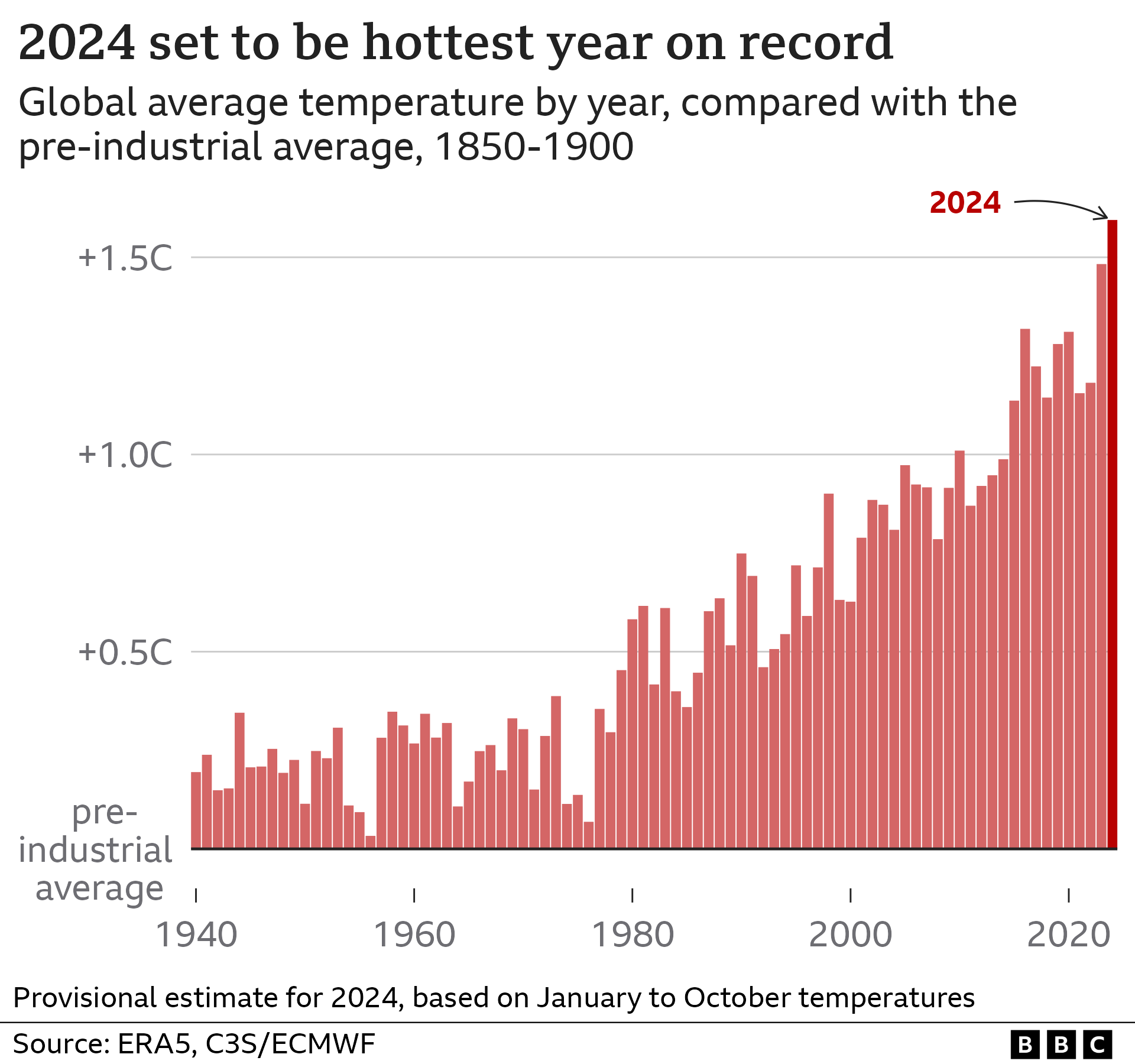
The Paris Agreement of 2015 set a goal of keeping global temperatures below pre-industrial levels, and determined that the appropriate goal of reaching that objective was to keep global temperature increases below 1° Celsius. The year 2024 saw the first time in human history that that objective was surpassed. The BBC reports:
“The planet has moved a major step closer to warming more than 1.5C, new data shows, despite world leaders vowing a decade ago they would try to avoid this.
“The European Copernicus climate service, one of the main global data providers, said on Friday that 2024 was the first calendar year to pass the symbolic threshold, as well as the world’s hottest on record.
“This does not mean the international 1.5C target has been broken, because that refers to a long-term average over decades, but does bring us nearer to doing so as fossil fuel emissions continue to heat the atmosphere.
“Last week UN chief António Guterres described the recent run of temperature records as climate breakdown'”.
“‘We must exit this road to ruin – and we have no time to lose,’ he said in his New Year message, calling for countries to slash emissions of planet-warming gases in 2025.”
The goal was reached long before the date most climate models predicted. Zeke Hausfather, a climaste scientist, pointed out: “I think it’s safe to say that both 2023 and 2024 temperatures surprised most climate scientists – we didn’t think we’d be seeing a year above 1.5C this early.” The last ten years have been the hottest years on record. The report by Copernicus, the European Union’s climate monitor, outlines the significance of these developments in terms that affect human habitation.
It is impossible to connect directly weather events, such as wildfires, droughts, and heavy rains to climate change. But the evidence does suggest that climate change played a key role in the current wildfires in Los Angeles. According to the Yale School of the Environment, the connection is strong:
“As the planet heats up, rainfall is growing more erratic over much of the globe, leading to wide swings between wet and dry conditions. So-called ‘weather whiplash’ is ramping up the risk of wildfire in California, said Daniel Swain, a climate scientist at UCLA.
Last year, Los Angeles saw record rainfall, which fueled the growth of grasses and shrubs, but so far this winter the city has gotten a fraction of its usual rainfall, leaving dense vegetation to dry out. In light of the arid conditions, federal officials warned of ‘significant fire potential’ in the region.
Making matters worse, the region is seeing unusually strong Santa Ana winds, which bring hot, dry air from the mountains out to sea during the winter months. There is little evidence that warming has made the winds more potent, Swain said, but with climate change, California’s dry season is extending into the early winter, when the Santa Ana winds typically take shape. This, he said, ‘is the key climate change connection to Southern California wildfires.’”
And yet, President-Elect Trump blames the wildfires in LA on lack of forest management, water management, and disaster preparation. According to the New York Times: “In his post on Wednesday, Mr. Trump said: “I will demand that this incompetent governor allow beautiful, clean, fresh water to FLOW INTO CALIFORNIA! He is the blame for this. On top of it all, no water for fire hydrants, not firefighting planes. A true disaster!” I am not an expert on wildfires, and I suspect that there is probably a lot Los Angeles could have done to mitigate some of the destruction. The underlying conditions–months without rain and hurricane force winds–would probably have overwhelmed any response.
More importantly, perhaps it is possible to face the underlying conditions with more stored water, more firefighters, and airplanes capable of accurately dropping fire retardant in hurricane force winds. And maybe it is possible to control floods such as those caused by Hurricane Helene in western North Carolina. Who is going to pay for all these preventive and remedial efforts? This question is critical since we will have to pay for climate change in some way (money or lives) at some point (unpreductable).
But Trump is only raising the issue to divert attention from the issue of climate change which he described as a “hoax”. Instead, he wants to “drill, drill, drill”, a policy that would only accelerate climate change. He will likely pull the US out of the Paris Agreement (as he did in 2017) thereby compromising international efforts to control climate change.
Curiously, however, Trump apparantly does believe that climate change is real. His interest in purchasing Greenland stems from his belief that Greenland is going to be crucial as climate change creates a reliable northern passage for container ships. Moreover, Greenland is reputed to be a storehouse for minerals essential to a green revolution. The Economist reports: “….Greenland’s resource wealth is immense. It has known reserves of 43 of the 50 minerals deemed ‘critical’ by America’s government, including probably the largest deposits of rare earths outside China. These are crucial to military kit and green-energy equipment.”
If Greenland remains frozen, it would remain irrelevant to Trump’s aspirations. Unfortunately, climate change does not give us the ability to choose which outcomes we prefer.


 World Politics News