“Transparency International, a global corruption watchdog, has identified Bulgaria as the most corrupt member state in the European Union. Reporters Without Borders ranked it 111th out of 180 countries in its annual world press freedom index, the lowest in the European Union.”
Reporters without Borders identifies 57 journalists killed in 2018, as well as 10 citizen journalists and 4 media assistants. Investigative reporting is one of the most important elements of a liberal society. It is clear that those in power have decided that there are no consequences to eliminating a free press, and those who should be most supportive of a free press in the world have decided to be silent in the crimes.
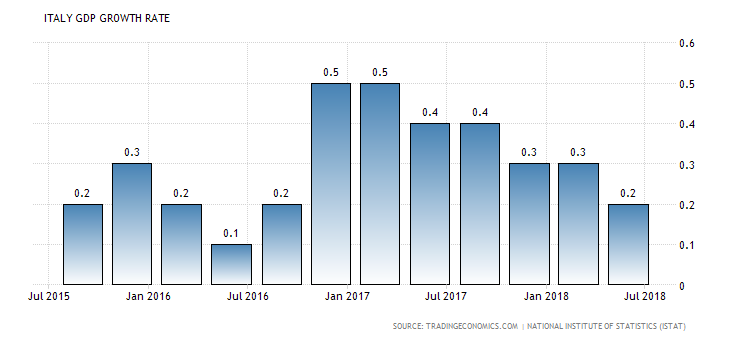
We need to keep our eyes on the Italian economy. It is one of the largest economies in the European Union (EU) and is currently led by a coalition government that seems to be contemptuous of EU rules. The Italian government has announced plans for significant increases in spending, even though the Italian economy remains sclerotic. The European Commission has issued stern warnings against these plans, but the Deputy Prime Minister, Matteo Salvini, rejected those warnings. According to the Australian Economic Review:
“Yields on Italy’s 10-year debt spiked to 3.62 per cent after the League strongman and deputy prime minister, Matteo Salvini, vowed to sweep away the existing European -order. He called Jean-Claude Juncker and his Commission aides ‘enemies of Europe barricaded inside their Brussels bunker'”.
The Italian government is comprised of a eurosceptic party, the 5-Star Movement and a right wing party called the League. The plans for spending are a direct challenge to the EU which the parties blame for the slow Italian economy. The plans are quite substantial:
“Italy’s populist coalition is targeting a deficit of 2.4% of GDP next year, tripling the previous government’s target, as it pledges more spending despite a huge debt pile, which at about 130% of GDP is the biggest in the eurozone behind Greece.”
The plans have frightened investors, who demanded higher yield rates on Italian bonds as protection against a government default on those bonds. The rates are at a 4 year high and unsustainable unless Italian economic growth were to miraculously pick up dramatically. If the Italian government defaults on those bonds, there would be great panic in European financial markets.
The European colonization of the Western Hemisphere was a turning point in human history. The decimation, intentional and unintentional, of the indigenous populations in the Western Hemisphere. and the enforced transfer of African populations to the Western Hemisphere as slaves, were cataclysms that defied any possibility of “normal” recovery from a population collapse. But there were also extraordinary transformations in agriculture as Europeans gained access to foods that were completely unknown to the very bland diets of the time. The potato and cane sugar became the primary source of calories for the poor in Europe. But it would be hard to imagine the modern world without tomatoes, peppers, corn (maize), cassava, tobacco, vanilla, and chocolate. Imperialism was not necessary for these foods to be transferred to other parts of the world–trade alone had introduced many of the spices of Asia to Europe long before the European conquests in Asia.
“But just when the world needs to go faster, the political headwinds in some nations are growing. Brazil, home to the world’s largest rainforest, looks increasingly likely to elect the climate sceptic Jair Bolsonaro as president.
The world’s second-largest emitter – the US – immediately distanced itself from the report, issuing a statement that said its approval of the summary “should not be understood as US endorsement of all of the findings and key messages”. It said it still it intended to withdraw from the Paris Agreement.
The summary was adopted by all governments at a closed-door meeting between officials and scientists in Incheon, South Korea that finished on Saturday. The US sought and was granted various changes to the text. Sources said the interventions mostly helped to refine the report. But they also tracked key US interests – for example, a mention of nuclear energy was included.
Sources told CHN that Saudi Arabia fought hard to amend a passage that said investment in fossil fuel extraction would need to fall by 60% between 2015 and 2050. The clause does not appear in the final summary.
Despite the urgency of the report, it is unlikely that any substantive policies will be taken by any state at this time. Indeed, it is hard for me to imagine any state taking any additional steps as long as the US acts as if the issue is a hoax.
Today marks the beginning of the 18th year US troops have been in Afghanistan. The US invaded Afghanistan in 2001 when the government of Afghanistan refused to hand over Osama bin Laden, the architect of the 11 September 2001 attack on the US. The Afghan government was quickly overthrown, and a viable government has yet to be established. Indeed, by most accounts, the Taliban control more territory now than it did in October 2001. The Watson Institute at Brown University calculates that the total economic costs of the various military operations in the “War on Terror” since 11 September 2001 is about $5.6 trillion. The cost to US soldiers is unbelievably high:
” First, and most important, is the cost borne by the 2,350 U.S. troops who died, the 20,092 who suffered injuries, and their families who have to live with the consequences.
“Improvements in battlefield medicine meant that more than 90 percent of soldiers wounded in Afghanistan survived. That’s better than the Vietnam War’s 86.5 percent track record. Unfortunately, that also means these veterans and their families now must live with the effects of permanent and grave damage. More than 320,000 soldiers from Afghanistan and Iraq have traumatic brain injury that causes disorientation and confusion. Of those, 8,237 suffered severe or invasive brain injury. In addition, 1,645 soldiers lost all or part of a limb. More than 138,000 have post-traumatic stress disorder. They experience flashbacks, hypervigilance, and difficulty sleeping.
“On average, 20 veterans commit suicide each day according to a 2016 VA study. The Iraq and Afghanistan Veterans of America found that 47 percent of its members knew of someone who had attempted suicide after returning from active duty. The group considers veteran suicide to be its number one issue.
“The cost of veterans’ medical and disability payments over the next 40 years will be more than $1 trillion. That’s according to Linda Bilmes, a senior lecturer in public finance at Harvard’s Kennedy School of Government. “The cost of caring for war veterans typically peaks 30 to 40 years or more after a conflict,” Bilmes said.
“Afghanistan is particularly pernicious in this regard, because the strategy is open-ended. The Trump administration will not put a timeline on when U.S. forces will come home, but the goals of the intervention are unachievable. In 17 years, we have been unable to build an Afghan government that is capable of providing for its own security. There is no reason to believe that will change.
“So, what we have essentially created is a situation where a war can rage on without end, with no enduring progress, and no one cares enough to stop it. That’s a bad spot for a liberal democracy to be in.”
“My argument, stated briefly, is that nationalism and realism almost always trump liberalism. Our world has been shaped in good part by those two powerful isms, not by liberalism. Consider that five hundred years ago the political universe was remarkably heterogeneous; it included city-states, duchies, empires, principalities, and assorted other political forms. That world has given way to a globe populated almost exclusively by nation states. Although many factors caused this great transformation, two of the main driving forces behind the modern state system were nationalism and balance-of-power politics.”
It is also true that nationalism and balance of power politics brought us World Wars I and II. There really has to be a better way.
Turkish officials are claiming that Saudi Arabian journalist Jamal Khashoggi was murdered in the Saudi Embassy in Istanbul. Turkish officials claim to have evidence, but Embassy grounds are the sovereign territory of the Embassy state, so Turkish officials do not have the right to investigate what happens within the Embassy. The Atlantic has reported on Khashoggi’s disappearance: “On Saturday, Reuters and others reported that Khashoggi had been murdered inside, and some reports added that his dismembered corpse had been smuggled out in multiple parcels. The Saudis say he left the consulate freely.” If these allegations are true, the incident will pose a serious problem for the US since Khashoggi was also a journalist for The Washington Post. The Trump Administration has been a staunch supporter of the Saudi regime, despite evidence that the Saudis have committed war crimes in Yemen.
There are some weird things going in the world of dissidents. Prominent investigators of political corruption are going missing. Jamal Khashoggi is a well-respected Saudi Arabian journalist who is missing after being seen going into the Saudi Embassy in Istanbul, Turkey. Khashoggi is not a fierce critic of the current government of Saudi Arabia, but in some of his posts in The Washington Post he has been somewhat critical of the human rights record of the regime. There are reports that Kashoggi has been killed. Interpol President Meng Hongwei has also gone missing in China. Interpol is an international organization that facilitates coordination among policy authorities across international borders, and President Meng has been criticized for helping China track down dissidents in China. So far, there has been little official outcry about these disappearances from any major government.
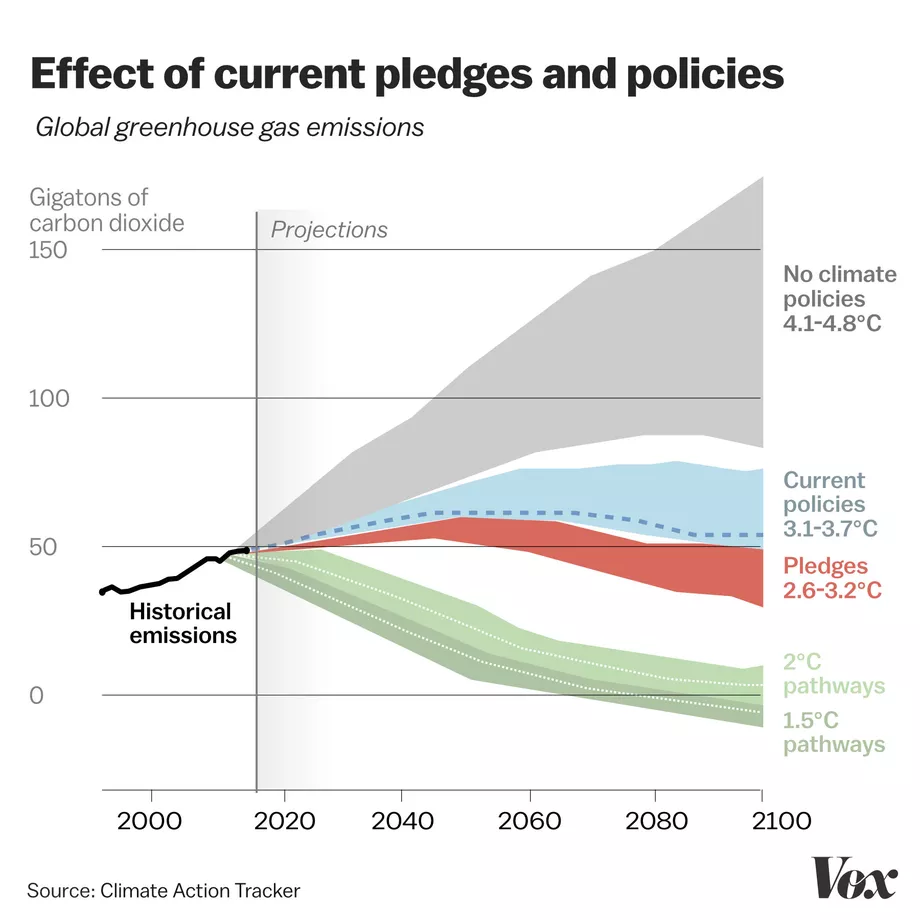
The Intergovernmental Panel on Climate Change (IPCC) is preparing to release its sixth report on the scientific understanding of climate change. The IPCC was created in 1988 by the United Nations and charged with releasing a report every five years on whether climate change was occurring and the steps necessary to avert it. Every report has been increasingly confident that climate change is occurring and can be attributed directly to human, and not natural, activities. The report is expected to be released on Sunday, but leaked copies have been made available to the press. According to Vox:
“According to the drafts, the report finds that it would take a massive global effort, far more aggressive than any we’ve seen to date, to keep warming in line with 1.5°C — in part because we are already en route to 3°C of warming. And even if we hit the 1.5°C goal, the planet will still face massive, devastating changes. So it’s pretty grim.
There is little evidence that any country has yet to show the commitment to reduce greenhouse gas emissions to any substantial degree.
Brazil will hold its national election on Sunday, but recent polls indicate that as many as 25% of the electorate remains undecided. It is a hotly contested race with two front-runners: Jair Bolsonaro who is a right-wing candidate who has expressed admiration for US President Donald Trump and Fernando Haddad who is running for the party of Luiz Inácio “Lula” da Silva, a popular left-wing former president who cannot run because of a corrruption conviction. Although there is mush fire and fury in the current campaign, it is unlikely that the election will resolve the problems facing Brazil. Vox describes the problems facing the country:
” Brazil was once seen as an up-and-coming developing country, with strong economic growth and a rising global profile. But in recent years, the economy has careened off course, in large part because corruption scandals have decimated the country’s most powerful companies, putting huge swaths of people out of work and weakening investor confidence.
“Nearly a third of Brazilians have struggled to buy food in the past year, and a quarter say they’ve had trouble affording adequate shelter, according to a recent Gallup poll. The unemployment rate is in the double digits, and some studies say extreme poverty has more than doubled since the mid-2010s.
“On top of this, Brazil is facing a serious security crisis. Murder rates are at an all-time high. The country’s biggest gang, Primeiro Comando da Capital (PCC) is rapidly expanding as it battles with rivals over important drug routes. Once-vaunted public safety strategies have failed to contain the mayhem, but there’s little consensus on how — or whether — to change course.”
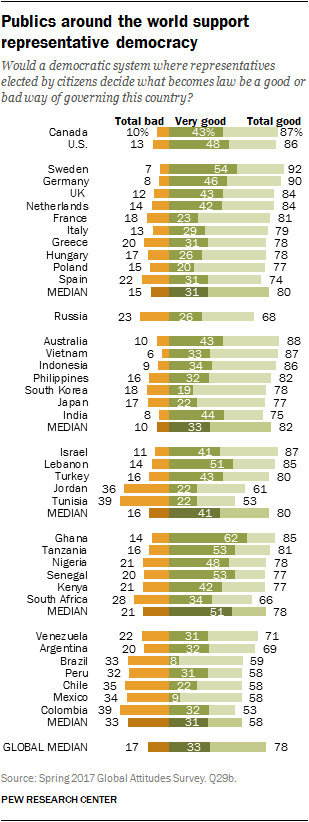
The two major candidates are in many respects polar opposites and it is difficult to conceive of a compromise position that could bridge the gap between the two. Elections are supposed to resolve matters, not make them more complicated. But the Pew Research Center found in October 2017 that only about 8% of Brazilians thought democracy was a “very good” system.
India has announced that it will buy the Russian S-400 Long Range Surface to Air Missile System, disregarding the US sanctions on economic transactions with Russia. The proposed purchased violates the Countering America’s Adversaries Through Sanctions Act (CAATSA) which was passed by the US. It is an extraterritorial law–extending US national law to the conduct of other nations. It is on the basis of this law that the US imposed sanctions on China for buying Russian military equipment, and is pressuring Turkey to not buy Russian arms. India will likely ask for a waiver from the law, and whether the US grants it will be a real test of how committed the US is to Indian foreign policy.
The International Monetary Fund (IMF) has conducted a review of global economic policies since the turmoil of the Great Recession in 2008-09. Generally speaking, global economic growth has been tepid since that time, an outcome that was not unexpected since the crisis was spawned by very high rates of debt that choked off money that could have gone into productive investments. The IMF notes that there have been some important policy changes implemented in order to prevent a similar explosive growth of debt, but that these changes do not seem to have been entirely effective. As The Guardian notes:
“The sequence of aftershocks and policy responses that followed the Lehman bankruptcy has led to a world economy in which the median general government debt-GDP ratio stands at 52%, up from 36% before the crisis; central bank balance sheets, particularly in advanced economies, are several multiples of the size they were before the crisis; and emerging market and developing economies now account for 60% of global GDP in purchasing-power-parity terms – which compares with 44% in the decade before the crisis – reflecting, in part, a weak recovery in advanced economies.”
The article goes on to link the growth in income inequality since 2008-09 as problematic since it may lead to a crisis of underconsumption, where there is insufficient demand in the economy to sustain economic growth: “Like many institutions the IMF has warned that rising levels of inequality have a negative impact on investment and productivity as wealthier groups hoard funds rather than re-invest them in productive parts of the economy. Without a rise in investment economies remain vulnerable to financial stress.”
Bloomberg has published an article that can only be described as devastating to the idea of fully globalized supply chains that underpin the global economy. As the world has moved into digitized modes of production, there are very few modern products that are fully assembled in a single place. Instead, most products are filled with components that are produced by the most efficient producers and then assembled in a final stage. This approach to production creates extraordinary efficiencies that minimize costs and enhance value. But the complicated networks of the different components require unbelievable coordination. The networks also create opportunities for sabotage and surveillance that many thought were unthinkable because the advantages from such subterfuge would call into question the viability of the whole idea of globalization.
Apparently, the Chinese military decided that the risks were worthwhile. It tried to subvert the supply chain by infiltrating the makers of microchips (through bribery and intimidation) with its own chips that would give it access to the hardware of any computer using the corrupted chips. According to Bloomberg the gambit was discovered by Amazon Web Services which was checking on the reliability of servers made by a company named Elemental it was going to use for its cloud services:
“[Amazon] hired a third-party company to scrutinize Elemental’s security, according to one person familiar with the process. The first pass uncovered troubling issues, prompting Amazon Web Services to take a closer look at Elemental’s main product: the expensive servers that customers installed in their networks to handle the video compression. These servers were assembled for Elemental by Super Micro Computer Inc., a San Jose-based company (commonly known as Supermicro) that’s also one of the world’s biggest suppliers of server motherboards, the fiberglass-mounted clusters of chips and capacitors that act as the neurons of data centers large and small. In late spring of 2015, Elemental’s staff boxed up several servers and sent them to Ontario, Canada, for the third-party security company to test, the person says.
“Nested on the servers’ motherboards, the testers found a tiny microchip, not much bigger than a grain of rice, that wasn’t part of the boards’ original design. Amazon reported the discovery to U.S. authorities, sending a shudder through the intelligence community. Elemental’s servers could be found in Department of Defense data centers, the CIA’s drone operations, and the onboard networks of Navy warships. And Elemental was just one of hundreds of Supermicro customers.
“During the ensuing top-secret probe, which remains open more than three years later, investigators determined that the chips allowed the attackers to create a stealth doorway into any network that included the altered machines. Multiple people familiar with the matter say investigators found that the chips had been inserted at factories run by manufacturing subcontractors in China.
“This attack was something graver than the software-based incidents the world has grown accustomed to seeing. Hardware hacks are more difficult to pull off and potentially more devastating, promising the kind of long-term, stealth access that spy agencies are willing to invest millions of dollars and many years to get.”
All the companies involved have vigorously denied that the hacks occurred or were successful, but one could hardly expect them to admit such egregious security lapses. Indeed, I suspect that this story will not receive much attention because of a fear of panic. But it is instructive to note that the stock of Super Micro Computer fell by -41.12% today. Warfare in the 21st century takes forms that Napoleon would find hard to comprehend.
The International Court of Justice (ICJ) has ruled against some of the sanctions the US re-imposed on Iran after the US left the Joint Comprehensive Plan of Action (JCPOA–commonly referred to as the Iranian Nuclear Agreement). Specifically, the ICJ ruled that the re- imposition of sanctions on certain goods violated the 1955 Treaty of Amity, Economic Relations, and Consular Rights between Iran and the US which gives the ICJ jurisdiction over legal disputes between the two states. The Court ruling is straightforward:
” THE COURT,
Indicates the following provisional measures:
(1) Unanimously, The United States of America, in accordance with its obligations under the 1955 Treaty of Amity, Economic Relations, and Consular Rights, shall remove, by means of its choosing, any impediments arising from the measures announced on 8 May 2018 to the free exportation to the territory of the Islamic Republic of Iran of
(i) medicines and medical devices;
(ii) foodstuffs and agricultural commodities; and
(iii) spare parts, equipment and associated services (including warranty, maintenance, repair services and inspections) necessary for the safety of civil aviation;
(2) Unanimously, The United States of America shall ensure that licences and necessary authorizations are granted and that payments and other transfers of funds are not subject to any restriction in so far as they relate to the goods and services referred to in point (1);
(3) Unanimously, Both Parties shall refrain from any action which might aggravate or extend the dispute before the Court or make it more difficult to resolve.
There is no likelihood whatsoever that the US will obey this ruling as the ICJ has no enforcement powers. Indeed, immediately after the ruling the US pulled out of the 1955 Treaty.
Jen Kirby has written a very succinct piece for Vox on how the trade agreement among the US, Mexico, and Canada–once known as as NAFTA–has changed. Many of these changes are largely symbolic, but there are some important provisions that benefit certain economic sectors. The Washington Postsummarizes the changes:
“A handful of major industries scored big wins in President Trump’s North American trade agreement — at times at the expense of ordinary consumers in the United States, Canada and Mexico.
“The winners include oil companies, technology firms and retailers, but chief among them are pharmaceutical companies, which gained guarantees against competition from cheaper generic drugs.”
It seems as if the new trade deal does not change much in terms of trade, i.e., lowering tariffs or quotas or the other types of constraints on the movement of goods and services. Instead, it seems to focus more on how labor and capital are treated across borders. In a sense, it seems more like a cartel agreement designed to control competition more than a trade agreement to facilitate movements across borders.
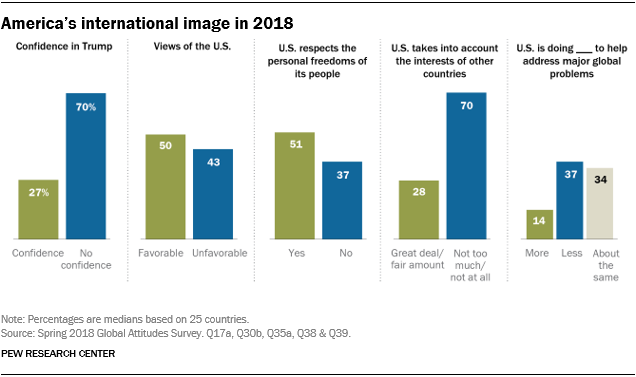
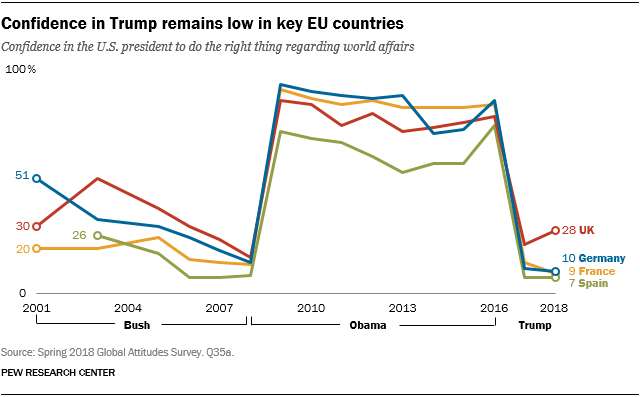
The Pew Research Center has conducted another poll of America’s global image. The results are depressing: Many in the world do not hold a very favorable view of US policies on some important issues although the the overall US favorability rating remains positive.
The drop in confidence in the US seems to be related primarily rooted in the question of leadership and is most dramatic among important US eiropean allies:
Statistics such as these call into question the ability of the US to command support for important policy initiatives it may wish to implement. The lack of confidence makes strong alliances very difficult, despite shared interests.
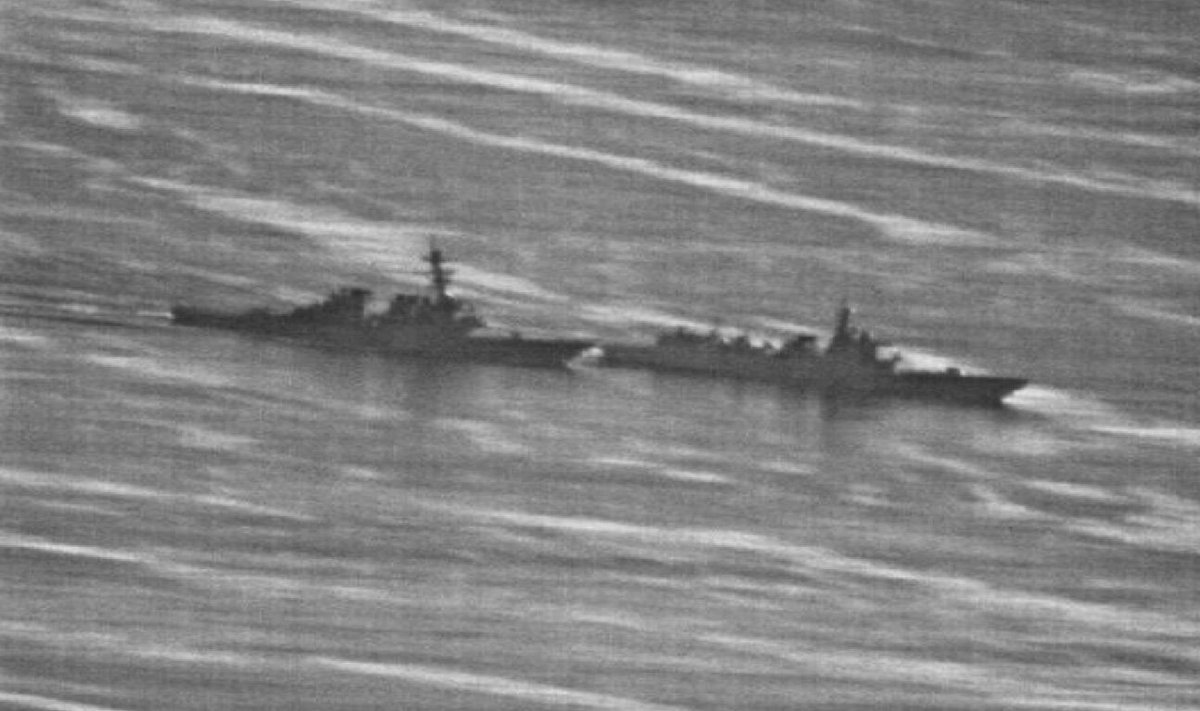
The US-Chinese competition in the South China Sea has heated up. A Chinese war vessel challenged the USS Decatur by sailing within 45 meters of each other, a very dangerous maneuver. According to Business Insider:
“The Chinese ship, reportedly the People’s Liberation Army Navy (PLAN) Type 052C Luyang II-class guided-missile destroyer Lanzhou (170), part of the Chinese navy’s South Sea Fleet, took on the US Navy’s Arleigh Burke-class destroyer USS Decatur (DDG-73) during a close approach near Gaven Reef in the disputed Spratly Islands.
“The Chinese vessel ‘conducted a series of increasingly aggressive maneuvers accompanied by warnings’ for the US Navy ship to “leave the area,” Pacific Fleet revealed in an official statement Monday. US Navy photos first obtained by gCaptain and confirmed to CNN by three American officials show just how close the Chinese destroyer got to the US ship.
The US Naval Institute quotes Cmdr. Nathan Christensen, a U.S. Pacific Fleet spokesman on the incident:
“U.S. Forces operate in the Indo-Pacific region on a daily basis, including the South China Sea. As we have for decades, our forces will continue to fly, sail and operate anywhere international law allows. All operations are designed in accordance with international law and demonstrate that the United States will fly, sail and operate wherever international law allows. That is true in the South China Sea as in other places around the globe.”
The Chinese, of course, have a different view of the encounter. The China Times, a usually reliable media outlet reflecting official Chinese policy, said this:
“The US repeatedly sends military ships without permission into seas close to South China Sea islands, seriously threatening China’s sovereignty and security, damaging Sino-US relations as well as military ties and harming regional peace and stability,” said Wu Qian, spokesperson of the Ministry of National Defense.
“Wu said the Chinese navy ship conducted an identification and warning process to drive the USS Decatur away on Sunday, a day before China’s National Day.
“China has irrefutable sovereignty over the South China Sea islands and the waters around them, and the situation there is progressing well thanks to the hard work of China and countries in Southeast Asia, Wu noted.”
Photograph of the US-Chinese Encounter in the Chinese Sea
My apologies for not posting these last two nights. I have had a miserable cold and have just been sleeping.
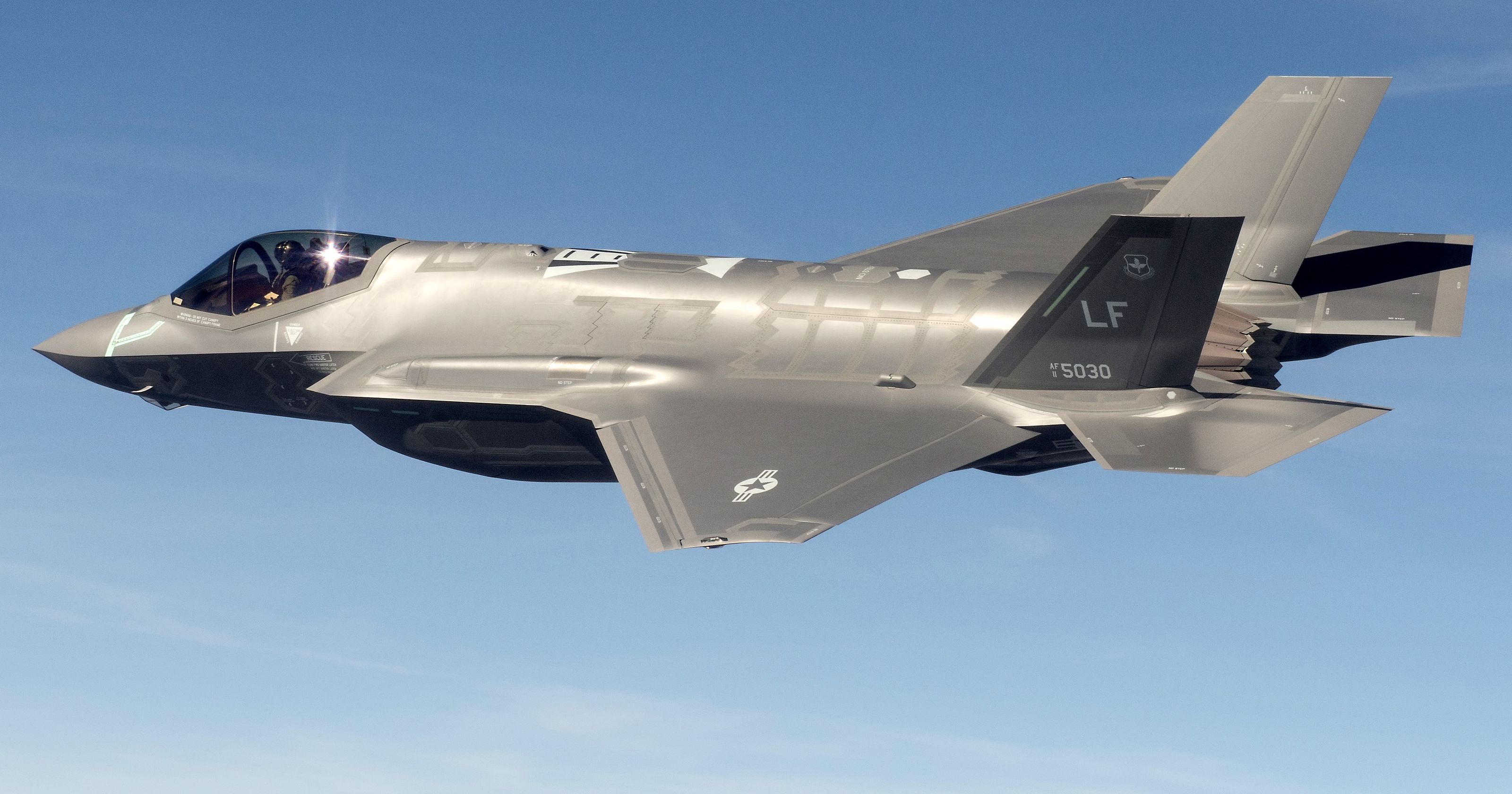
The announcement that Russia was sending its most sophisticated anti-aircraft missile system, the S-300, count many analysts by surprise. The move represents a substantial stiffening of Russian commitment to the Syrian government. It is also a serious threat to the Israeli and US air force, both of which have enjoyed air dominance in the region for many years. In particular, the S-300 system represents a serious threat to the most sophisticated jet fighter in the US arsenal, the F-35, which has yet to be deployed by the US in the Middle Easy but has been deployed by Israel. The total cost of the F-35 has gone over one trillion dollars in recent years. The deployment leaves little doubt that Russia intends to call all the shots in Syria from now on, and it will be difficult, if not impossible, to dislodge it from that position of dominance.
F-35
Markus Brunnermeier, Rush Doshi and Harold James have published a fascinating essay in the Washington Quarterly comparing British-German economic competition in the early 20th century with US-Chinese economic competition in the early 21st century. The analysis is compelling and leaves me with the clear sense that some lessons have not been learned. Technological competition clearly gives short-term advantages in strategic bargaining, but it also makes the stakes much higher. The competition also has global implications, since the two sides try to impose standards for their preferred technology for others. The essay also shows how corporate interests can strongly influence national interests.
The US and Canada have agreed to new trading terms which will preserve the basic parameters of NAFTA, but we will have to be careful not to call it NAFTA (it will be called the U.S.-Mexico-Canada Trade Agreement, or USMCA). The major changes include the dropping of restrictions on US dairy products imported into Canada, primarily from the US state of Wisconsin and and agreement that more components of automobiles exported between Mexico, Canada, and the US have to be produced in factories that pay more than $16 dollars an hour. The deal will likely harm Canadian dairy farmers and Mexican autoworkers, and will likely increase automobile prices for US consumers. But President Trump’s major objective, the scrapping of a dispute resolution system that sidesteps US courts, was not agreed upon, leaving Chapter 19 of the NAFTA agreement intact.
“The Trump administration pressed ahead Friday with plans to create an ‘Arab NATO’ that would unite U.S. partners in the Middle East in an anti-Iran alliance.
“Secretary of State Mike Pompeo met in New York with foreign ministers from Bahrain, Egypt, Jordan, Kuwait, Oman, Qatar, Saudi Arabia and the United Arab Emirates to advance the project. The State Department said Pompeo had stressed the need to defeat the Islamic State group and other terrorist organizations as well ending the conflicts in Syria and Yemen, securing Iraq and ‘stopping Iran’s malign activity in the region.'”
There is little evidence that Iran, a nation committed to Shia Islam, is working the the Islamic State, a group committed to Sunni Islam. The fact that Mr. Pompeo seems not to know that Iran has been fighting the Islamic State in Syria since 2011, as has been the the US, is incredible.
The US and its allies have been quietly and slowly ratcheting up military pressure on China in the South China Sea. The British sent the warship HMS Albion into the Sea and Japan sent a submarine. He French have indicated that they are willing to send a warship in the contested area as well. The US has sent two B-52 bombers through the region, asserting the right to navigate in international airspace. In response, China refused to allow the USSWasp, an amphibious assault ship, to dock in the port of Hong Kong. The moves come against the backdrop of a deepening trade war and heated rhetoric over a second arms deal with Taiwan, which China regards as a renegade province.

 World Politics News