“No graduate-level comprehension of history or politics is necessary to perceive that these unfolding events in the three most important Western democracies, while unquestionably local or national in character, are not separate or disconnected. Throw in the slow-motion downward trajectory of Germany, with Angela Merkel on her way out and nationalism on the rise, and this process of decay clearly afflicts the four most important Western democracies.
“These disparate political crises are all manifestations of the same deeper phenomenon, which is amorphous and threatening and admittedly difficult to talk about. This could be called the crisis of democratic legitimacy, which has been creeping towards us from the periphery of the Western world for some time and just accelerated abruptly. We see it right now, playing out in the state capitols of Wisconsin and Michigan, in the streets of Paris, and in the pseudo-medieval rituals of the House of Commons.”
O’Hehir intimates that the deepening income inequality in these countries is responsible for this transformation. I think it is unquestionably the cause of it.
Simon Tisdall is an editorial writer for the Guardian and I especially like his analyses of world politics. He has an interesting take on the dispute between the US and China over the arrest of the CFO of Huawei, Meng Wanzhou. The US has managed to persuade other countries, notably Germany, to be suspicious of Huawei products, specifically its new 5G telephone. Tisdall considers the extra-territorial reach of US law on this matter to be out of date and inappropriate in today’s world, and China’s challenge to the US claims to be actually a challenge to US hegemony. More importantly, Tisdall considers both the US and China to be pursuing a fool’s game in this matter:
“There can be little doubt Meng is a highly symbolic victim of this global rivalry. Typically clueless, Trump gave the game away when he explicitly linked the possible dropping of the case against her to resolving the US-China trade war. Trump’s clumsy intervention – rapidly disavowed by his own justice department – left the US looking no better than Beijing. Both sides appear guilty of what amounts, in effect, to hostage-taking – not what the world expects from superpowers.”
Humility, however, has never been a strong point for world powers.
A US Senate report has detailed the extent of Russian interference in the 2016 US national election. There were two studies done: one by New Knowledgeand another by the University of Oxford. Much of the interference was done by a Russian entity called the Internet Research Agency (IRA) which conducted extraordinary misinformation campaigns, much of which targeted African-Americans. The interference was huge: “The new research also points to the previously underappreciated prominence of the IRA’s use of Instagram. It notes that IRA posts on the photo-sharing platform received 187 million engagements, which dwarfed the 76.5 million engagements that IRA posts received on Facebook.” The Russian effort was incredibly sophisticated and showed an uncanny understanding of American culture and politics. The effort shows that we need to have a more up-to-date understanding of war.
It appears as if Hungarian Prime Minister Viktor Orban might be overplaying his hand in his attempt to turn Hungary into an “illiberal” democracy (whatever that means). Large protests have taken place after the Parliament passed a number of controversial laws, particularly one which gave employers the right to demand overtime from employees. The protests mimic somewhat the yellow vest protests in France in that there is no organized opposition or recognized leaders. But there does seem to be widespread support for the protests and there are a number of issues that the protesters are raising.
The US recently stepped up additional sanctions against individuals in North Korea for human rights abuses. In response, North Korea indicated that the sanctions have had, and will not have, any beneficial effects on the denuclearization negotiations. North Korea went further and threatened to return to “exchanges of fire”. The threat follows a statement by US President Trump that the US is in “no hurry” to pursue denculearization with North Korea. It appears as if the US is content with the testing pause by North Korea, but, in the absence of some reciprocal action by the US, it is not clear how long North Korea will adhere to the pause. Meanwhile, the US and South Korea have failed, after ten negotiating sessions, to agree on a cost sharing formula for US defense assistance. There seems to be little progress on many fronts in the Korean peninsula.
The UN Conference in Poland on climate change has finally ended and it produced a “rulebook” for gauging commitments to the Paris Accords. Many delegates had already left the conference by the end and there was dissatisfaction with the energy policies of the host government, Poland, for its heavy emphasis on coal for its primary energy source. The rulebook determines the specific scientific measures that will be used to gauge progress toward reducing the emissions of greenhouse gases. That result is significant progress since many states had been using different metrics (such as per capita emissions as opposed to absolute totals) that generally overstated the commitment to emission declines. Now all states will be measured by the same yardsticks. But the conference did not make any progress on developing carbon credits to spur alternative energies nor did it come up with any stronger goals for enforcing the commitments for 2020. It is safe to say that the conference fell far short of what was necessary. Common Dreams quotes one of the scientists criticizing the outcome:
“‘Without immediate action, even the strongest rules will not get us anywhere,’ said Jennifer Morgan, executive director of Greenpeace International. ‘People expected action and that is what governments did not deliver. This is morally unacceptable and they must now carry with them the outrage of people and come to the UN Secretary General’s summit in 2019 with higher climate action targets.'”
The conference will meet again next year in Chile.
“Yet during the entire 200-year history of British rule in India, there was almost no increase in per capita income. In fact, during the last half of the 19th century – the heyday of British intervention – income in India collapsed by half. The average life expectancy of Indians dropped by a fifth from 1870 to 1920. Tens of millions died needlessly of policy-induced famine.
“Britain didn’t develop India. Quite the contrary – as Patnaik’s work makes clear – India developed Britain.”
The common argument that colonialism was beneficial to the colonies is profoundly wrong. But was there any reason to believe that powerful states would ever engage in altruistic behavior?
The British Raj
Global financial markets slumped today as data from China indicated that the world’s second largest economy was slowing down dramatically. The slowdown is rippling through many other economies, such as Japan and Germany, and suggests that the efforts by China to stimulate the economy through easier credit was not having much of an effects. There are many reasons for the slowdown and many analysts believe that the uncertainties associated with the trade disputes between the US and China is having a significant effect on investment decisions.
British Prime Minister Teresa May survived a vote of no confidence in Parliament, securing 63% of the votes of her Conservative party members. The vote gives May a year’s breathing space but was secured by her promise to not stand for re-election in the next scheduled election in 2022. The vote gives May another chance to negotiate with the European Commission about the terms of the British exit from the European Union even though the Commissioners had said that they were not willing to renegotiate. The vote did not clarify in the slightest degree what possible terms nor renegotiation exist, and suggest that no deal is likely before the scheduled departure date of 29 March 2019. The absence of a deal will be very unsettling for the Republic of Ireland and Northern Ireland.
Prime Minister Viktor Orban of Hungary moved Hungary further away from a liberal democracy by getting Parliament to pass a new law creating a parallel judiciary system over which the executive will have the power of appointment. The new judiciary system will handle matters of corruption, electoral issues, and political protest. The move effectively neuters the existing judiciary system and prevents it from monitoring the actions of the executive. Another law was passed which gives employers the right to demand greater overtime hours from employees and was described by the opposition as a “slave law”. Orban’s Fidesz Party commands a two-thirds majority in the Parliament and can essentially change the constitution whenever it desires.
Russian President Putin regarded the fall of the Soviet Union as “the greatest geopolitical catastrophe” of the 20th century. His ambition has been to restore Russia as a great power and the Pew Research Center has conducted a poll of 25 countries that indicates that he has been successful to a certain degree. According to the Center:
“The prevailing view in a new 25-country poll by Pew Research Center is that Russia plays a more important role in international affairs than it did a decade ago. But increased stature does not mean being better liked. The same survey finds that views of Putin and the Russian Federation are largely negative.”
It is an interesting result. Russia is regarded as more powerful but most people find Russia and President Putin to be not trustworthy.
The Pew Research Center also conducted a poll on how citizens of both countries regard each other and the results of that poll are widely divergent. The poll found that
“At a time of rising tensions between their countries, people in the United States and Germany express increasingly divergent views about the status of their decades-long partnership. They are divided not only on the overall state of the relationship, but also on future levels of cooperation, the importance they ascribe to each other on foreign policy and the efficacy of retaliatory tariffs.”
It is hard to interpret these results except to assume that one or the other citizenry is poorly informed for whatever reason. My own interpretation is that the US views are historically informed, but uninformed about current disagreements between the two countries. But it is a troubling result for two countries that genuinely need each other as a strong ally.
The Stockholm International Peace Research Institute (SIPRI) is a highly regarded as a arms control think tank. It has released its annual report on arms sales in the world which show that arms sales are growing substantially in the world:
“Sales of arms and military services by the world’s largest arms-producing and military services companies—the SIPRI Top 100—totalled $398.2 billion in 2017, according to new international arms industry data released today by the Stockholm International Peace Research Institute (SIPRI).
“The total for the SIPRI Top 100 in 2017 is 2.5 per cent higher than in 2016 and represents an increase of 44 per cent since 2002 (the first year for which comparable data is available; figures exclude China). This is the third consecutive year of growth in Top 100 arms sales.
A heated debate has erupted at the UN conference on climate change (COP24) taking place in Poland. The delegates were asked to “welcome” the report of the Intergovernmental Panel on Climate Change (IPCC) that was issued two months ago that gave the world about 12 years to limit greenhouse gases if temperatures were to be kept below 2°C. Four countries–Kuwait, Saudi Arabia, Russia, and the US–have been pushing hard to change the word from “welcome” to “note”. The change may seem minor, but it would ease the pressure on various governments to take more effective action to limit greenhouse gases–the resolution would fall short of being an endorsement of the IPCC findings. There are still five days left in the conference, so we shall see if the majority of countries will stand up to these four countries.
British Prime Minister May has cancelled the vote on Brexit which was scheduled for tomorrow saying that “If we went ahead and held the vote tomorrow, the deal would be defeated by a significant margin.” There does not appear to be a Plan B and the whole Brexit scheme has been forced into limbo (although a decision has to be technically made by 29 March 2019). But the agreement forged between May and the European Commission had virtually no support:
“Opposition has hardened against the withdrawal agreement. The hard Brexiteers — those who want a clean break from the EU — see this document as potentially trapping the UK in a dependent relationship with the bloc indefinitely. Those who are pro-Europe, or ultimately want to Remain, view the deal as weakening the UK and leaving it in a much worse position economically and politically.”
There are many issues complicating a deal, but the main one seems to be over whether an agreement can be reached over the border between the Republic of Ireland (which is a member of the European Union) and Northern Ireland (which is part of Great Britain and would be outside the EU if a Brexit occurs). No one wants to see a “hard” border between the Republic of Ireland and Northern Ireland–the recent agreements between the two sides eliminating the border was purchased with a great deal of blood and political capital. No one has any idea what happens next: May resigns? A new referendum? An abrupt Brexit with no agreement?
China’s Belt and Road Initiative is incredibly ambitious, conjuring up the economic dynamism that the original Silk Road created in Eurasia. The original plans were drawn up when China’s economy was in high gear and when infrastructural financing in Eurasia was very small. The first phase of the Initiative is coming to a close and both China and the recipients of China’s aid are rethinking the whole enterprise. China’s economy is slowing down and less money is available given the high levels of government debt in China. And the recipients have soured on some of the terms of China’s aid, some of which was offered regardless of the ability to repay the loans. It remains to be seen if the Initiative will remain as robust in the future.
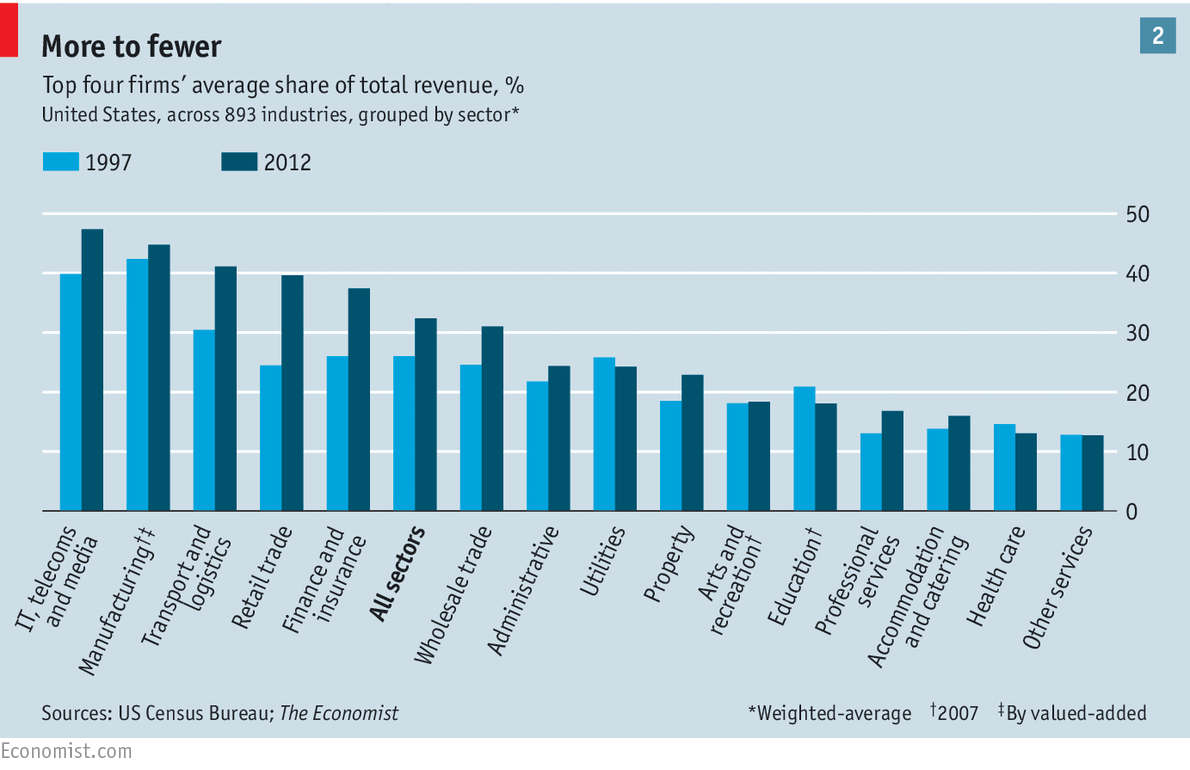
There is a high degree of concentration in the global economy. We are often flummoxed by what appears to be a bewildering number of choices in the market. But the choices are really an illusion. Many of the products that we see on the store shelves are produced by a very small number of companies. The actual number of companies in competitive sectors is actually declining in the US, and The Economist quantifies the decline:
“Revenues in fragmented industries—those in which the biggest four firms together control less than a third of the market—dropped from 72% of the total in 1997 to 58% in 2012. Concentrated industries, in which the top four firms control between a third and two-thirds of the market, have seen their share of revenues rise from 24% to 33%. And just under a tenth of the activity takes place in industries in which the top four firms control two-thirds or more of sales. This oligopolistic corner of the economy includes niche concerns—dog food, batteries and coffins—but also telecoms, pharmacies and credit cards.”
US President Trump has blamed the yellow vert protests in France on the Paris climate agreement, but that argument does not really square with the reality of the protests which have been largely focused on broader economic concerns. Nonetheless, the French have not appreciated Trump’s comments which they regard as an intrusion in their internal affairs. Trump tweeted: “The Paris Agreement isn’t working out so well for Paris. Protests and riots all over France. People do not want to pay large sums of money, much to third world countries (that are questionably run), in order to maybe protect the environment. Chanting ‘We Want Trump!’ Love France.” The chanters were actually from England a few months ago, not from France. French President Macron is scheduled to give a speech on Monday which he hopes will address the concerns of the protesters.
“Analysts said it is worth noting that the containment of China and the country’s technology comes not only from the US, but also its allies.
“Australia and New Zealand joined the US in banning Huawei from providing technology for their 5G rollout, CNBC reported Wednesday.
“However, not all countries are following the US. French Finance Minister Bruno Le Maire said on Friday that investments by Huawei are welcome in France, Xinhua reported.
“Western media like German publication Der Spiegel also questioned US accusations against Chinese companies, saying that the US never provided any concrete evidence, and that mistrust of Chinese products is limited in Germany despite US claims they are not trustworthy.”
For the Chinese, the trade war with the US is a struggle over hegemony.
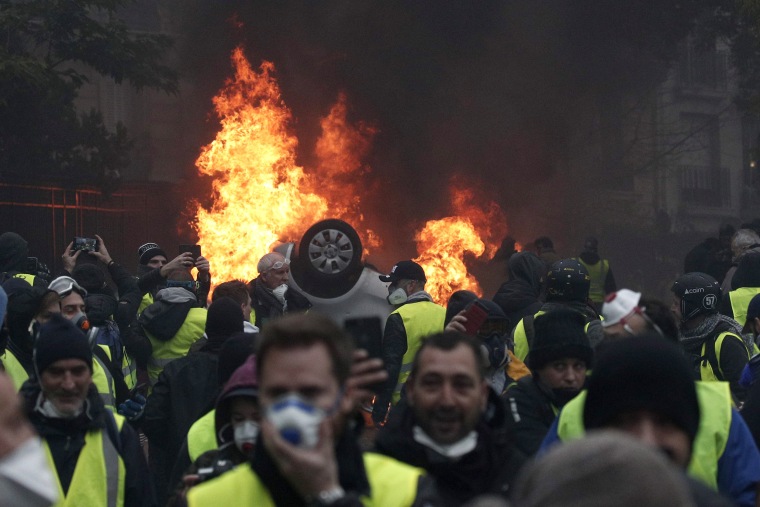
The yellow vest protesters filled the streets of France today and over 8,000 police officers were deployed on the streets of Paris. The demands of the protesters have expanded beyond rescinding the fuel tax increases (which the government has already done) to include a raise in the minimum wage and a decrease in the retirement age. The protests seemed to be targeting President Macron, but it is hard to tell since the protests remain unorganized. But Macron came to power in 2017 and has dismantled some labor laws and reformed the railway system, both of which were unpopular with labor, and decreased taxes on the very rich which was unpopular with everyone except the very rich Virtually all the major tourist sites in Paris were closed today for fear of violence. US President Trump has characterized the protests as ones against steps to reduce the threat of climate change, using them to validate his position against the Paris Accords. That interpretation, however, seems overstated. The protests against the fuel taxes were juxtaposed with the decreases in taxes on the rich. It seems as if the issue is more economic, a concern shared by protesters in Belgium and the Netherlands which did not have a fuel tax increase.
Protests in France
The US suffered a defeat at the United Nations as a resolution it proposed condemning Hamas did not pass with the required 2/3s vote, even though it received a majority of the votes cast. The resolution was proposed by outgoing US Ambassador Nikki Haley and it condemned Hamas for firing rockets into Israel. The General Assembly did pass a resolution favoring a Middle East peace settlement. According to The Australian:
“The assembly also adopted by a wide margin of 156 to six with 12 abstentions a Palestinian-drafted measure, presented by Ireland, calling ‘for the achievement, without delay, of a comprehensive, just and lasting peace in the Middle East’ based on UN resolutions.
“The US, Israel, Australia, Liberia, Marshall Islands and Nauru voted against that measure.”
The US opposed the measure because it favors bilateral peace talks between Israel and the Palestinians. But it seems clear that the world does not hold out hope for such negotiations. France has called for a lifting of the Israeli blockade against the Gaza Strip.
Spiegel has a very detailed analysis of the standoff between Russia and Ukraine over access to the Sea of Azov. The article contains important information about which I was unaware such as the harassment of shipping through the Kerch Strait that has been ongoing since the building of the Kerch Strait Bridge by Russia in last May. The effects of the bridge on Ukrainian trade was profound. According to Spiegel:
“To understand this, one must look backward. Ukraine has in effect lost large parts of its coastline through the annexation of Crimea and the war in Donbass, but it has held onto the only deep-water ports in the Sea of Azov. One of them is Mariupol, the second-largest city in the region with half-a-million inhabitants. It has two enormous steel plants and the curious charm of a beachfront industrial city.
“It is almost a miracle that Ukraine has been able to hold onto the strategically important port city. Kiev had lost control over it in the spring of 2014. From Mariupol, Ukraine can export steel and iron manufactured by the country’s richest oligarch, Rinat Akhmetov. He’s the city’s biggest employer and practically runs the place. Mariupol and the neighboring port of Berdiansk are also transit points for wheat exports.
“That, at least, was the case until recently, when Russia made access to the Sea of Azov more difficult. The Crimean Bridge, which was inaugurated in May 2018, is too low for many of the Panamax-class ships that previously sailed to Mariupol and Berdiansk. And regardless, ships trying to exit and enter the strait have been getting jammed up because the traffic goes in one direction and pilotage is compulsory. Freight and crew members are forced to accommodate systematic inspections by FSB [Federal Security Service] border guards.”
Given this stranglehold, there is little Ukraine can do short of confronting Russia directly, a losing proposition without US and European support. That support, however, is not forthcoming.
I do not typically link to scholarly articles, but Ruben Gonzalez-Vicente has published a fascinating (albeit dense) essay on why authoritarian movements have grown so dramatically since the Great Recession of 2008-09. He argues that what he calls the neoliberal response (his phrase for the authoritarian/populist movements) is, in fact, a response to globalization by some of its strongest supporters–a paradoxical volte-face. He writes (I have taken out the references–they are extensive):
“Across the world, we are observing an emergence of illiberal politics in countries that have represented the backbone of neoliberal globalization, and indeed at its very Anglo-American core. In many places, reactionary politicians have been first to galvanize social discontent successfully by publicly condemning the negative social impacts of economic globalization, such as increased inequalities and growing insecurity. In the United States, the UK or France, for example, it has been the populist right that has more prominently hoisted the anti-globalization flag, even if its discourses place targets on ethnic minorities or national trade imbalances, rather than on class inequality or the increased leverage of businesses in processes of transnational integration. We can see, for example, how rising job insecurity and deteriorating living standards in the UK were mobilized by the Brexit campaign. While much of the ‘Leave’ discourse was problematic, and focused its anger towards European Union regulations and immigrants, Brexit advocates successfully tapped into a widespread sense of vulnerability and precarization throughout the isles that is intimately linked to neoliberal transformations at home and to the consolidation of the world market and its competitive pressures more broadly.
“Similarly, Donald Trump’s anti-China and anti-migrant rhetoric resonated with the experiences of many in the middle class who have been on the losing side of growing inequality and declining social mobility for decades, but also remarkably in the aftermath of the Global Financial Crisis, with the top 1% capturing 85.1% of the country’s income growth between 2009 and 2013.”
The argument is intriguing, but I need to examine more evidence before I accept it. At this time, I tend to think that the supporters of the populist programs are the losers of globalization, not the winners. But Gonzalez-Vicente’s argument suggests that the winners adopted neoliberalism in order to “close the door” on other possible winners.
Along the same lines, we need to rethink the role of political parties in liberal democracies. Many of the most recent elections in the world have featured “new” parties–ones that are not the traditional parties, such as En Marche in France, Alternative for Germany, the Sweden Democrats, Podemos in Spain, and the 5 Star Movement in Italy. Indeed, US President Trump is probably the first third party candidate to have won the presidency–his roots in the Republican Party are quite thin. Patrick Liddiard has written an essay for the Wilson Center that is entitled, “Are Political Parties in Trouble?” His concern is clear: “a worldwide decline in political party influence would raise fundamental issues of democratic accountability, an issue that is already associated with increasing unrest worldwide, and is likely to degrade the quality of democracy worldwide in the future.”
“The US will not stop countering China’s rise in the technology sector and will never drop its hostility toward China’s ‘Made in China 2025’ strategy, Wang Yanhui, head of the Shanghai-based Mobile China Alliance, told the Global Times on Thursday.
“‘Huawei has become another card for the US to play against China in the ongoing trade war,’ he said.
“China and the US announced a trade truce following a meeting between the two countries’ top leaders in Buenos Aires on Saturday.
“But experts warned that China should be prepared for a long-lasting and heated trade war with the US, as it will continue to attempt to counter China’s rising power.
“‘The latest Huawei incident shows that we should get ready for long-term confrontation between China and the US, as the US will not ease its stance on China and the arrest of a senior executive of a major Chinese tech company is a vivid example,’ Mei Xinyu, a research fellow with the Beijing-based Chinese Academy of International Trade and Economic Cooperation, told the Global Times on Thursday.”
Financial markets were rattled by the news as the arrest will make the trade negotiations between the US and China significantly more problematic. It is important to remember that the US views the trade dispute as and economic issue; China views it as an attempt by the US to contain Chinese power.


 World Politics News