Richard Youngs has written a fascinating and insightful essay on non-Western support for democracy. He outlines the difficulties of making the argument that liberal states, located primarily in North America, Europe, and Japan are always supportive of democracy and points out many situations in which countries outside of those geographic areas have been stronger supporters of democracy than the rich states we usually identify.
“Despite these trends, analysts still commonly assume that Western powers’ international support for democracy is of a completely and qualitatively different order to that of non-Western efforts. Yet, while these emerging powers’ commitment to democracy is undoubtedly patchy and less than fulsome, it is worth noting that Western democracy support increasingly shares many of these limitations and this tepidness. That is to say, much Western democracy support today has itself become relatively indirect, largely second-order, and merely declaratory. The standard assumption that Western countries’ commitment to democracy is qualitatively distinctive and of a completely different magnitude to that of other powers can easily be overstated.
“This problem of unexamined assumptions runs both ways. The perceptions that Western and non-Western democracies have about each other tend to be rather caricatured. Non-Western powers often accuse Western governments of forcefully seeking to impose democracy on other countries. Western governments, in turn, tend to accuse non-Western powers of unconditionally cozying up with even the most authoritarian regimes. Non-Western democracies sometimes insist that, unlike Western powers, they strive to disassociate their democracy support from particular political models and geopolitical interests; these emerging democracy supporters tend to claim that they link democracy support to issues of social justice, peaceful mediation, and local values to a greater extent than Western policymakers do.”
The argument is incredibly important. We tend to overestimate the willingness of rich states to support liberal values. Non-Western definitions of democracy are critically important to any rethinking of the international liberal order. Varieties of democracy are possible and the Western template is not the only one possible.
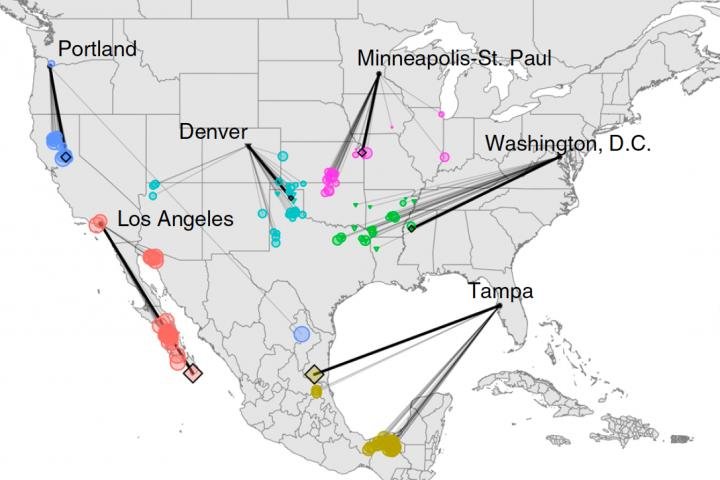
The University of Maryland Center for Environmental Science has published a study which indicates how much the climate of North America will change by the year 2080. According to the study:
“Scientists analyzed 540 urban areas that encompassed approximately 250 million inhabitants in the United States and Canada. For each urban area, they mapped the similarity between that city’s future climate expected by the 2080s and contemporary climate in the western hemisphere north of the equator using 12 measures of climate, including minimum and maximum temperature and precipitation during the four seasons….
“The study found that by the 2080s, even if limits are placed on emissions, the climate of North American urban areas will feel substantially different, and in many cases completely unlike contemporary climates found anywhere in the western hemisphere north of the equator. If emissions continue unabated throughout the 21st century, the climate of North American urban areas will become, on average, most like the contemporary climate of locations about 500 miles away and mainly to the south. In the eastern U.S., nearly all urban areas, including Boston, New York, and Philadelphia, will become most similar to contemporary climates to the south and southwest. Climates of most urban areas in the central and western U.S. will become most similar to contemporary climates found to the south or southeast.
Map of How Climate Will Change North America by 2080
It is incredible how much things might change in a single generation if we do not address the issue of climate change in a substantive manner.
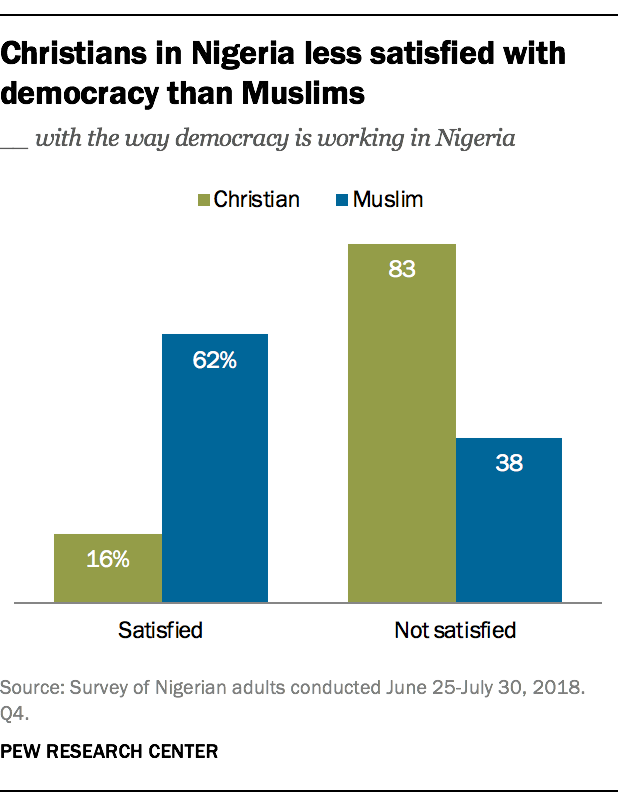
Nigeria will hold its national election on 16 February and the Pew Research Center has conducted a poll on how Nigerians view the state of their democracy. The poll was conducted in the summer of 2018 and the Center describes the context of the poll:
“Nigeria is home to the largest population in Africa, which is almost evenly split between Muslims and Christians. Incumbent President Muhammadu Buhari of the All Progressives Congress (APC) will be running against multiple candidates including former Vice President Atiku Abubakar of the People’s Democratic Party (PDP), John Gbor of the All Progressives Grand Alliance (APGA), Usman Muhammed of the Labour Party (LP) and others. Tensions in the country have grown in the final weeks before elections because of Buhari’s controversial decision to suspend the country’s chief justice.”
The poll found a wide discrepancy between the views of Christians and Muslims in Nigeria.
Nigerian Attitudes Toward Democracy
What happens in Nigeria is critical to the future of Africa and of the world. Many Nigerians are leaving the country and the religious and ethnic divisions continue to be very difficult to address.
Even though there is little clarity about the proposed US withdrawal from Syria, there seems to be little question that it will occur. As it does, it will be very interesting to watch how Russia, Iran, and Turkey manage their relations. Up to this point, all three had an interest in dislodging ISIS from Syria as well as a common interest in countering US influence in the Middle East. ISIS has lost territorial control within Syria although it still remains a somewhat inchoate terrorist threat to the world and the US withdrawal means that the common interests of all three states have been satisfied.
That means that the three states can pursue other interests. For Turkey, the most important objective is to reduce the threat of Kurdish nationalism. For Iran, the most important objective to to remove the Sunni and US threat to the continued survival of the Islamic Republic. For Russia, the most important objective to secure Russian dominance in the region which translates into support for Syrian President Assad (to make sure that Russian military bases in Syria remain) and for Israel (as the other militarily dominant state in the region). The main cleavage in these objectives is policy toward Israel: Israel supports the Kurds which alienates Turkey; Israel fears Iran which alienates Russia from Iran; and Israel needs to curry favor with Russia as it begins to doubt the willingness of the US to maintain its role as counterweight to Russian dominance in the region.
There is no necessary reason why these three states cannot work out a sustainable accommodation, but it is clear that there are possible points of deep disagreements. Whether these disagreements lead to conflict depends to a great deal on how Israel decides to define its most important objectives with respect to all three of these states. At this stage of the conflict, Israel seems to be taking the road of countering Iranian influence even if that means that it takes military action which weakens Russia’s main objective of supporting Assad.
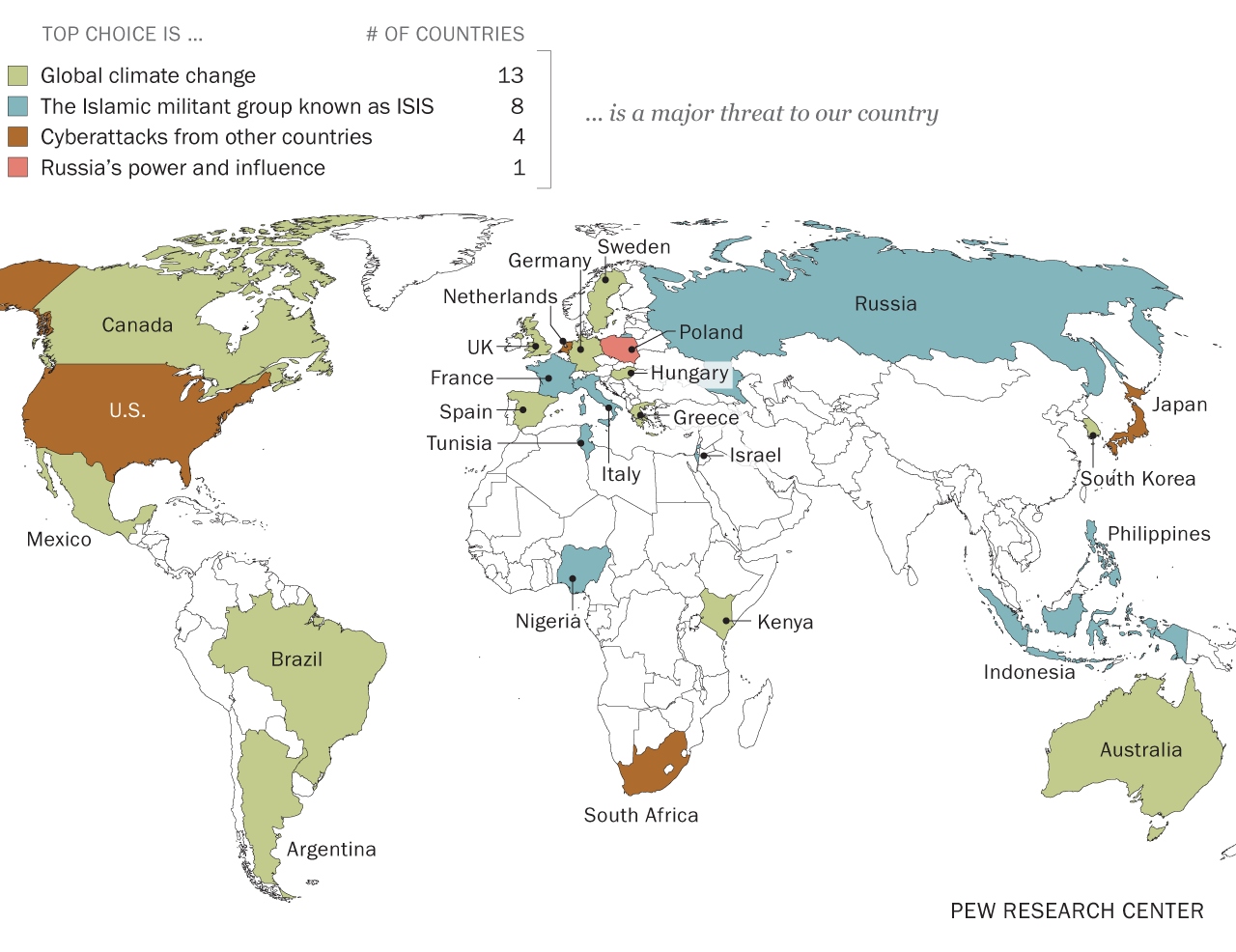
The Pew Research Center has conducted a poll within 26 countries to determine how citizens define their top international threat. In a majority of countries, climate change was identified as the major concern, but there were a number of other concerns articulated:
“Broadly speaking, people around the world agree that climate change poses a severe risk to their countries, according to a 26-nation survey conducted in the spring of 2018. In 13 of these countries, people name climate change as the top international threat.
“But global warming is just one of many concerns. Terrorism, specifically from the Islamic extremist group known as ISIS, and cyberattacks are also seen by many as major security threats. In eight of the countries surveyed, including Russia, France, Indonesia and Nigeria, ISIS is seen as the top threat. In four nations, including Japan and the United States, people see cyberattacks from other countries as their top international concern. One country, Poland, names Russia’s power and influence as its top threat, but few elsewhere say Russia is a major concern.”
The concern over climate change has increased considerably since Pew started conducting the poll in 2013: “For example, in 2013, well before the Paris climate agreement was signed, a median of 56% across 23 countries surveyed said global climate change was a major threat to their country. That climbed to 63% in 2017, and in 2018 it stands at 67%.”
Another finding of the poll that is quite interesting is that many people in world regard the US as a major threat to their interests. That shift in sentiment is quite dramatic.
“The largest change in sentiment among the global threats tracked are for those who see U.S. power and influence as a major threat to their countries. In 2013, only a quarter across 22 nations saw American power as a major threat to their country, but that jumped substantially to 38% in 2017, the year after Trump was elected president, and to 45% in 2018.
“In fact, in 18 of the 22 countries surveyed in both 2013, when Barack Obama was the U.S. president, and 2018, there has been a statistically significant increase in those who name the U.S. as a major threat. This includes increases of 30 percentage points in Germany, 29 points in France and 26 points in Brazil and Mexico.
“There is also a strong connection between seeing America as a threat and lack of confidence in U.S. President Donald Trump. In 17 of the countries surveyed, people who have little or no confidence in the U.S. president are more likely than those who do have confidence in Trump to name U.S. power and influence as a top threat. This difference is most acute among America’s traditional allies, such as Canada, the UK and Australia, where overall views of the U.S. and its president have plummeted in recent years.
The survey was quite extensive and I recommend the report to anyone who wishes to take a snapshot of global public opinion on a large number of global issues.
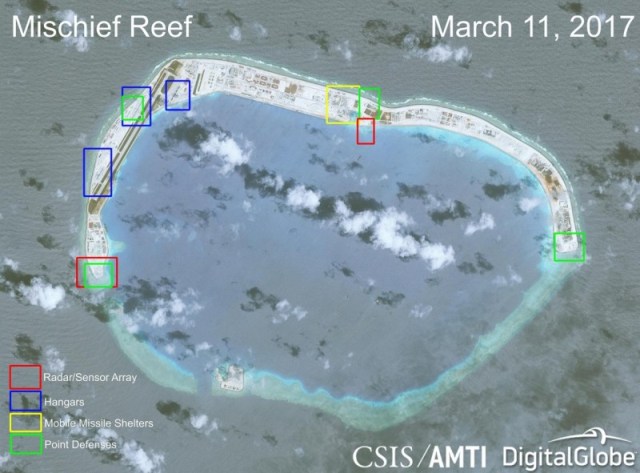
“’The relevant actions of the US warships violated Chinese sovereignty and undermined peace, security and order in the relevant sea areas,’ Hua said. ‘The Chinese side expresses strong dissatisfaction and resolute opposition.’
“‘China has indisputable sovereignty over islands in the South China Sea, including the Second Thomas Shoal, Mischief Reef and the adjacent waters,’ Hua said.
“’China has always respected and safeguarded freedom of navigation and flight based on international laws in the South China Sea, but resolutely opposes any country falsely using these harm the sovereignty and security of coastal countries.’”
The confrontation comes as the US and China restart their trade negotiations to stave off new tariffs that the US has threatened if an agreement is not reached by 1 March. Stirring both pots simultaneously does not seem to be an optimal negotiating strategy.
“The experiment aims to test Russia’s cyber defenses and ensure the nation’s internet service, known as Runet, can continue to function in the event of a foreign attack. Officials will verify whether Russia can continue to operate its web service without passing data to and from the outside world. Russian telecom companies will have to re-route all internet traffic to exchange points managed or approved by the Russian telecom supervisor Roskomndazor….
“The experiment is part of a new draft law known as the Digital Economy National Program. The law will also obligate Russia to create its own Domain Name System (DNS) so it can continue to operate if it loses connection to international servers. The DNS is what translates domain names into Internet Protocol (IP) addresses so that people surfing the web can access them.”
Such an experiment might be highly controversial as it suggests that the Russian government could try to block all outside information from coming into the country. Other states exercise a great deal of control over outside sources of information, but a physical block would represent a major step forward in complete state control of information. The BBC outlines the worst case:
“The test is also expected to involve ISPs demonstrating that they can direct data to government-controlled routing points. These will filter traffic so that data sent between Russians reaches its destination, but any destined for foreign computers is discarded.
“Eventually the Russian government wants all domestic traffic to pass through these routing points. This is believed to be part of an effort to set up a mass censorship system akin to that seen in China, which tries to scrub out prohibited traffic.”
Such a move would also make it very difficult to penalize Russian users of the internet for Russian government efforts to spread disinformation abroad.
A new study published in the journal, Biological Conservation, has indicated that global insect populations are declining at a precipitous rate, signalling a likely serious agricultural crisis in the future. The Guardian summarizes the new study:
“More than 40% of insect species are declining and a third are endangered, the analysis found. The rate of extinction is eight times faster than that of mammals, birds and reptiles. The total mass of insects is falling by a precipitous 2.5% a year, according to the best data available, suggesting they could vanish within a century.
“The main drivers of species declines appear to be in order of importance: i) habitat loss and conversion to intensive agriculture and urbanisation; ii) pollution, mainly that by synthetic pesticides and fertilisers; iii) biological factors, including pathogens and introduced species; and iv) climate change. The latter factor is particularly important in tropical regions, but only affects a minority of species in colder climes and mountain settings of temperate zones. A rethinking of current agricultural practices, in particular a serious reduction in pesticide usage and its substitution with more sustainable, ecologically-based practices, is urgently needed to slow or reverse current trends, allow the recovery of declining insect populations and safeguard the vital ecosystem services they provide.
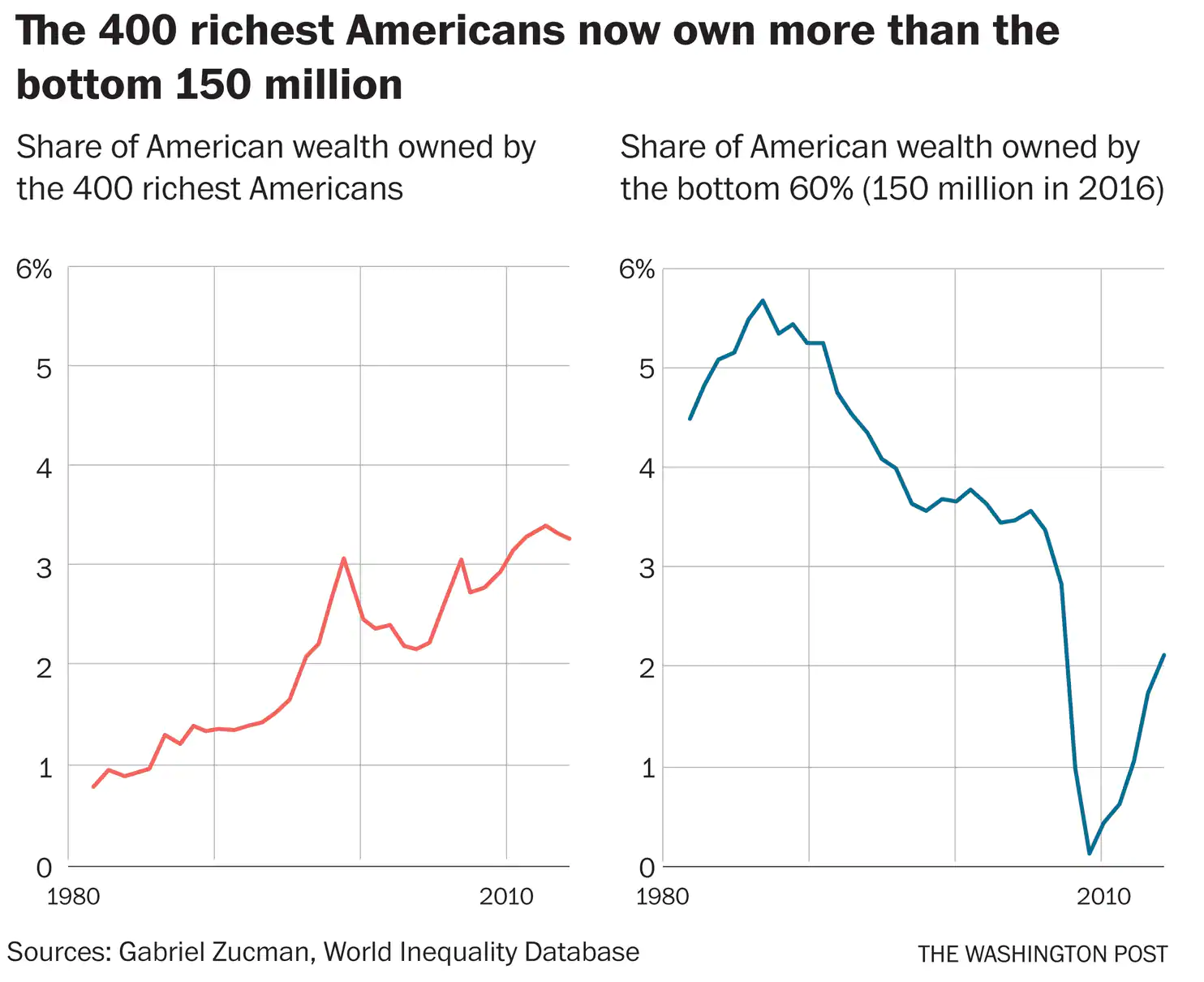
The economist, Gabriel Zucman, of the University of California, Berkeley, has done pioneering work measuring wealth inequality in the United States. Wealth is notoriously difficult to measure since there are no official statistics measuring wealth (unlike income which is officially measured by the Internal Revenue Service in the US) and also because much wealth is hidden in offshore banking centers (perhaps as much as 8% of all wealth resides in those centers). Zucman has just published a new study on wealth inequality in the US. Zucman found that
“U.S. wealth concentration has followed a marked U-shaped evolution of the last century. It was high in the 1910s and 1920s, with a particularly fast increase in the second half of the 1920s. The top 0.1% wealth share peaked at close to 25% in 1929. It then fell abruptly in the early 1930s (in the context of the Great Depression) and continued to fall gradually from the late 1930s to the late 1940s (in the context of the New Deal and the war economy). After a period of remarkable stability in the 1950s and 1960s, the top 0.1% wealth share reached its low-water mark in the 1970s, and since the early 1980s it has been gradually rising to close to 20% in recent years. U.S. wealth concentration seems to have returned to levels last seen during the Roaring Twenties.”
The market does not correct this trend except in one circumstance: if the wealth available to the lower groups drops below a level that can sustain consumption, then market demand will collapse leading to a depression. That is precisely what happened in 1929 and we are at similar levels now.
The US has nominated David Malpass to lead the World Bank once the current President, Jim Yong Kim steps down. By tradition, the US gets to choose the head of the World Bank and Europe gets to choose the Director of the International Monetary Fund. That process was initiated when the US and Europe were the largest contributors to each institution. But that is no longer the case. Nonetheless, the Trump Administration is acting as if the tradition should continue.
But Malpass is not a good choice for an international organization, although he does represent the views of President Trump. Stewart Patrick assesses Malpass:
“Malpass, for his part, has at times been critical of the Bank, characterizing it as obsolete in an era of accessible private capital markets. While he played a role in shepherding the recent U.S. funding increase, he has also criticized the Bank’s failureto “graduate” countries no longer needing its resources (not least China), which he made a stipulation of the recent capital infusion. More generally, he regards the Bank as overly “intrusive” on its member states, part of a “multilateral system that often drifts away from our values of limited government, freedom, and the rule of law.”
There is much to criticize about the operations of the World Bank, but those criticisms suggest that the world would be better served by someone who takes the idea of economic development as something that departs from the traditional notion of a “bank”. Malpass wrote that the US economy was in great shape in 2007, just before the financial disaster we call the Great Recession of 2008-09. Malpass wrote an op-ed for the Wall Street Journal entitled “Don’t Panic About the Credit Market”.
France has recalled its Ambassador to Italy, an extraordinary event usually reserved to the penultimate step to breaking off diplomatic relations. That it has occurred to two of the most important members of the European Union is difficult to explain. But the rupture reflects the deteriorating relations between the Italian government and the European Union over the Italian budget. It also reflects the populist character of the current Italian government dominated by the eurosceptic 5 Star Movement and the right-wing League Party. The antipathies between Italy and France are deep and complicated, but this immediate action was precipitated by the visit by Luigi Di Maio, the leader of the 5 Star Movement with members of the “yellow vest” movement in France. The Washington Post lists the other issues facing the two states:
“The war of words between the Italians and Macron has touched on immigration, nationalism, neocolonialism and European values. It has spilled over into culture, threatening a planned loan of works by Leonardo da Vinci for a major exhibition at the Louvre in October.”
As Politico describes the da Vinci dispute: “The Louvre wants to celebrate the 500th anniversary of Leonardo Da Vinci’s death in October. In 2017 the Italian government agreed to lend the Paris museum much of the work it owns by Da Vinci. But that might now not happen. “Leonardo is Italian, he just died in France,” said Lucia Borgonzoni, Italy’s undersecretary of state for culture, in November. “He’s not called Leonardò, as they call him, but Leonardo,” she added while announcing her intention to renegotiate the deal.” Such is the stuff of world politics today.
The Trump Administration has indicted that it will not meet the deadline to report to Congress on the death of journalist Jamal Khashoggi last October. The deadline is one imposed by the Magnitsky Act which requires the President to respond to a request by Congress on certain human rights abuses within 120 days of receipt from the Congressional request. According to Bloomberg:
“The former chairman of the Senate Foreign Relations Committee, Bob Corker of Tennessee, and the senior Democrat on the panel, Bob Menendez of New Jersey, sent a letter to the administration in October invoking the Magnitsky Act of 2016 to demand an investigation of Khashoggi’s death and determine whether new sanctions should be imposed on Saudi Arabia….
“The New York Times reported Thursday that the crown prince once told another top aide, Turki Aldakhil, that he would use a “bullet” on Khashoggi if the columnist didn’t return to the kingdom and stop his criticism. The Times, citing unidentified current and former U.S. intelligence officials, said the 2017 conversation was intercepted by U.S. spy agencies.”
President Trump has consistently refused to blame the Saudi Crown Prince Salman for the murder despite the CIA’s assessment that the Crown Prince was definitely responsible. Politico points out: “Last year, CIA intelligence overwhelmingly implicated Saudi Crown Prince Mohammed bin Salman in the plot to kill Khashoggi, who had criticized the crown prince and members of the royal family. Khashoggi was living in exile in the United States.”
The Magnitsky Act does not seem to offer the President discretion in not responding to a request from Congress, but I am not a lawyer. But it would be difficult for President Trump to deny Salman’s responsibility–and the consequent sanctions on Salman demanded by the Act–in the face of the CIA’s finding.
US Secretary of State Mike Pompeo suggested that the US has a national security interest in Venezuela because Hezbollah is active in that country. Hezbollah is an extremist group based in Lebanon and it receives support from Iran. It is hostile to Israel but also fought against ISIS in Syria, as did the US. There is no question that Hezbollah and the US are enemies, but the idea that Hezbollah would be an active agent in the current crisis in Venezuela is utter nonsense. Pompeo’s statement is clearly designed to scare people into supporting US actions in Venezuela–the terrorist card has been used many times in the past.
“Above all, the EU is not prepared to throw Ireland, which insists on keeping the backstop in order to avoid a hard border, under the bus. The interests of a member come above those of a leaver. It argues that the backstop is an inevitable outcome of Britain’s desire to leave the customs union and single market. Stopping a hard border is also seen as vital to protect the Good Friday Agreement that ended decades of sectarian “Troubles” in Northern Ireland.
“Claims that some untried new technology can avoid all checks and controls on the Irish border are still viewed in Brussels as magical thinking. Indeed, Brexiteers’ insistence on removing the backstop is treated as evidence of doubts that their own magic would work. The repeated lurches in Britain’s approaches to Brexit seem only to strengthen the case for keeping the backstop as an insurance policy.”
It now appears as if the only real option is to somehow change the deadline date of 29 March. Which means that this embarrassing mess will only continue indefinitely.
US President Trump indicated today that it is unlikely that he will meet with Chinese President Xi Jinping before 1 March, the announced date for the implementation of new tariffs on Chinese goods imported into the US. Politico indicates that it is unlikely that the date can be changed: “The United States is not expected to extend its March 1 deadline for reaching a deal. To do so, the Office of the U.S. Trade Representative would have to file a Federal Register notice, as it did in December, when it extended an earlier deadline. So far, there is no sign of that.” Reuters outlines the implications of not changing the deadline:
“Trump has vowed to increase U.S. tariffs on $200 billion worth of Chinese imports to 25 percent from 10 percent currently if the two sides cannot reach a deal by 12:01 a.m. (0501 GMT) on March 2.
“CNBC reported that the tariffs were likely to remain at the 10 percent rate. Three sources familiar with the matter indicated that report was wrong. The president has said repeatedly that the tariffs would go up if no deal has been reached, and that position has not changed, one source said.”
If the tariffs do go up by 25%, the economic shock to the global economy will be quite substantial.
“When asked what his first priority would be as a member of the SAB, Christy said he would try to convince his colleagues that nature is responsible for rising temperatures, not people.
“‘I think it would be to demonstrate to the board what we know about climate and its variability and what’s really going on,’ Christy said. ‘And secondly is our inability to characterize it well with our models.’
“Christy said he wants EPA to revoke regulations related to greenhouse gases. He described the endangerment finding, which is the scientific underpinning for the agency’s climate rules, as being scientifically flawed.
“’I think the endangerment finding is one that doesn’t stand on the best science that we have out there, mainly because the best science is expressing tremendous uncertainties we have on this issue,’ Christy said. ‘The overconfidence we have on the climate issue in the climate community is incredibly large, and we need to pull back on that.’”
Today NASA announced that 2018 was the fourth warmest year ever recorded and The New York Times assesses NASA’s conclusion: “the five warmest years in recorded history have been the last five, and that 18 of the 19 warmest years ever recorded have occurred since 2001.” Recent evidence indicates that a third of the glaciers in the Himalayas could disappear by 2100 putting at risk the fresh water of about 240 million people. It is also clear that Antarctica is losing its ice at an increasingly faster rate: “Antarctica as a whole went from losing about 40 gigatons of ice per year in the 1980s to 252 gigatons per year over the last decade. (One gigaton is a billion tons.)” Importantly, US President Trump did not even mention climate change in his State of the Union address last night.
Venezuela has blocked a critical bridge connecting it to Colombia in order to prevent humanitarian aid from reaching its citizens. The Maduro government used large trucks to block the bridge as a convoy of aid supplied by the US made its way from Bogota, Colombia into Venezuela. The convoy is an attempt to force the Venezuelan military to make a choice between supporting Maduro and allowing desperately needed supplies from reaching the civilian population. The Guardian points out the political stakes in this challenge:
“Mike Pompeo, the US secretary of state, tweeted: ‘The Venezuelan people desperately need humanitarian aid. The U.S. & other countries are trying to help, but #Venezuela’s military under Maduro’s orders is blocking aid with trucks and shipping tankers. The Maduro regime must LET THE AID REACH THE STARVING PEOPLE.’
“However, Maduro and members of his inner circle have remained publicly adamant that the aid will not be allowed in.
“’With this show of humanitarian aid they are trying to send a message: ‘Venezuela has to go begging to the world!’ And Venezuela will not beg for anything from anyone in this world,’ Maduro said on Monday.”
Some Americans often refer to the US as an “exceptional” country, contrasting the development of the United States with the behavior of European states in the world during the modern period. Indeed, the absence of an “imperial” past is often used to suggest that the US can play a unique role in fostering liberal values in the world system. Jackson Lears has written a very good book review for The New York Review of Books which assesses the accuracy of this claim. Lears makes a compelling case that there is no good foundation to the idea that, because the US had few formal colonies (the Philippines being the only analog to the European pattern), we can make the case that the US was, and is, not “imperial”. I highly recommend this insightful review.
“Prof. Ferraro, could you please comment on this press release from NATO? I assumed that withdrawal from the INF treaty was a unilateral act by the US like withdrawal from the Iran treaty. Then I saw a tweet from French ambassador to the US Gerard Araud blaming Russia for necessitating US suspension of its participation in the treaty. The NATO press release says, “Allies fully support this action.” https://www.nato.int/cps/en/natohq/news_162996.htm Yet I see many analysts saying the US withdrawal can only benefit Russia. Can you please clarify whether the US is acting in concert with European allies here or is acting essentially alone and forcing them to construe it in the best possible light?
The answer to the question lies in the distinction between the security agencies within the European NATO governments and the opinions of the European publics. The European security agencies do regard Russia as a strategic threat and are deeply invested in supporting NATO. Those agencies are currently deeply apprehensive about the attitude of the Trump Administration toward NATO and do not wish to provide an excuse for President Trump to end US support for NATO. Therefore, they are inclined to mirror President Trump’s concern about the new Russian missile.
There is actually a great deal of confusion about the Russian violation of the INF Treaty–the Russians insist that the violating missile has not yet been deployed even though it has been tested. Nonetheless, NATO views the possible violation in the light of other Russian actions: its annexation of Crimea, its continued support for rebels in eastern Ukraine, its provocative behavior in the Kerch Strait, its testing of air and maritime space in the Baltic and North Seas, and its military activity in the Kaliningrad enclave.
However, outside of NATO–which was created precisely to counter a perceived threat from the then Soviet Union–there has always been apprehension about US intermediate range missiles in Europe. Those missiles, stationed in Great Britain and Germany in Europe, but also in Turkey and Japan during the height of the Cold War, were necessary to provide a deterrent to aggressive Soviet action before the development of Intercontinental Ballistic Missiles (ICBMs). After ICBMS were developed in the early 1960s, the intermediate-range missiles were not really necessary to deter a Soviet attack on the US homeland. Indeed, intermediate-range missiles, defined as those missiles which fly between 310 and 3,250 miles, could not hit the Soviet homeland if fired from the US.
So the intermediate-range missiles became part of what was called “extended deterrence”: missiles that would be used in case of a Soviet/Russian attack on an American ally, not an attack on the American homeland. Currently the US missiles are deterring attacks on 32 nations: 28 US NATO allies, plus Japan, South Korea, Australia, and Israel.
For some in Europe, the US intermediate-range missiles actually make US allies targets of a Soviet/Russian attack. This constituency fears that the presence of American missiles on their soil could embroil them in a US-Soviet/Russian dispute in which they have no national interest. This fear became quite pronounced in Europe during the Reagan Administration in the 1980s, and there was a strong European movement to remove those missiles. In the US, this movement was known as the Nuclear Freeze Movement. That movement led to the INF Treaty which removed US and Soviet intermediate-range missiles from European soil, a singular triumph for arms control.
What we should look for is any movement to place ground-based intermediate-range missiles in Europe (the INF Treaty did not cover air- or sea-launched intermediate-range missiles). Even if the Trump Administration does end the INF Treaty (right now, it is merely a “suspension” although I am not really sure what that means), I sincerely doubt that the European publics would support such a move.
The Trump Administration is rather more concerned about the Chinese development of intermediate-range missiles and wishes a free hand to develop such missiles to counter that threat. Russia does not make a distinction between intermediate-range missiles targeting China from such missiles targeting Russia because they can me moved around quickly. We will have to see what the next step is for the US.
Talks between the US and Russia to preserve the Intermediate-Range Nuclear Forces (INF) Treaty have apparently failed. The treaty, which was signed in 1987, was a landmark treaty because it banned either side from stationing short- and intermediate-range, land-based missiles in Europe. No other nuclear treaty has ever been able to ban an entire class of nuclear weapons. The US claimed that a Russian missile, the Novator 9M729 (called the SSC-8 by NATO), violated the treaty. The Russians have asserted that the missile’s range put it outside the constraints of the treaty. But it was also clear that the Trump Administration did not wish to support the treaty because it did not cover the intermediate-range missiles being developed by China. The possible end of this treaty is consistent with the renewed interest in nuclear weapons by all of the current nuclear powers, a deeply troubling development in world politics.
The European Union has announced a new financial mechanism to skirt the sanctions on Iran being pushed by the US after it ended its participation in the Joint Comprehensive Plan of Action (JCPOA), known more commonly as the Iran nuclear agreement. The US monitors international financial transactions through a mechanism known as SWIFT. The new European plan bypasses SWIFT. Al Jazeera describes the new system:
“The new institution, named INSTEX – Instrument In Support Of Trade Exchanges – will allow trade between the EU and Iran without relying on direct financial transactions. It is a project of the governments of France, Germany and Britain and will receive the formal endorsement of all 28 EU members.
INSTEX will initially be used to support transactions on humanitarian goods, an objective that falls far short of Iranian demands for fully free economic transactions in order for continued Iranian adherence to the JCPOA. If the European Union fails to satisfy Iranian interests–a key objective persuading the Iranians to sign the JCPOA–, then Iran may decide not to stay in the nuclear agreement.
 World Politics News