Russia, China, and Iran are conducting four days of naval exercises in the northern Indian Ocean. The exercises come despite the increased tensions between the US and Iran and it is difficult to figure out exactly what message Russia and China are sending. If an open conflict between the US and Iran were to break out, it is highly unlikely that either China or Russia would intervene–even though both countries have a strong interest in Iranian oil, the interest is not sufficient to risk an open conflict with the US. Nonetheless, joint military exercises are difficult and expensive and one would be derelict to dismiss their significance. The exercises will definitely complicate US attempts to further isolate Iran from the international economic system. The exercises also come as Japan decided to send a destroyer to the region after a very contentious debate:
“Despite being a U.S. ally, Japan’s troop dispatch is not part of a U.S.-led coalition protecting Middle East waterways, apparently an attempt to maintain neutrality in a show of consideration to Iran.
“Under the plan, Japan will send about 260 Maritime Self-Defense Force personnel with a destroyer and a pair of P-3C reconnaissance aircraft, mainly for intelligence-gathering in the Gulf of Oman, the Arabian Sea and the Bab el-Mandeb Strait connecting the Red Sea and the Gulf of Aden.”
Japan’s interest in protecting the flow of oil from the Middle East is obvious since it gets 80% of its oil from the region. But Japan has tried to maintain good relations with both Iran and the US so it is a difficult balancing act.
Paul Krugman has written an op-ed for The New York Times on the effects of great wealth on the political process in the US. He uses information that was gleaned from published reports by The Guardian, a reliable lefty newspaper (it is not an accident that a British newspaper would report on something that many US media outlets apparently are unwilling to investigate). The article quotes from the research conducted by US academics Benjamin I Page, Jason Seawright, and Matthew J Lacombe. The researchers do not mince their words:
“Our new, systematic study of the 100 wealthiest Americans indicates that Buffett, Gates, Bloomberg et al are not at all typical. Most of the wealthiest US billionaires – who are much less visible and less reported on – more closely resemble Charles Koch. They are extremely conservative on economic issues. Obsessed with cutting taxes, especially estate taxes – which apply only to the wealthiest Americans. Opposed to government regulation of the environment or big banks. Unenthusiastic about government programs to help with jobs, incomes, healthcare, or retirement pensions – programs supported by large majorities of Americans. Tempted to cut deficits and shrink government by cutting or privatizing guaranteed social security benefits….
“Both as individuals and as contributors to Koch-type consortia, most US billionaires have given large amounts money – and many have engaged in intense activity – to advance unpopular, inequality-exacerbating, highly conservative economic policies. But they have done so very quietly, saying little or nothing in public about what they are doing or why. They have avoided political accountability. We believe that this sort of stealth politics is harmful to democracy.”
Forbes, a reliable righty journal, did an analysis of how wealthy politicians have become very prominent in world politics in recent years. The phenomenon of rich politicians is hardly new; but the amount of concentrated wealth in the hands of so few will be difficult for democracies to manage.
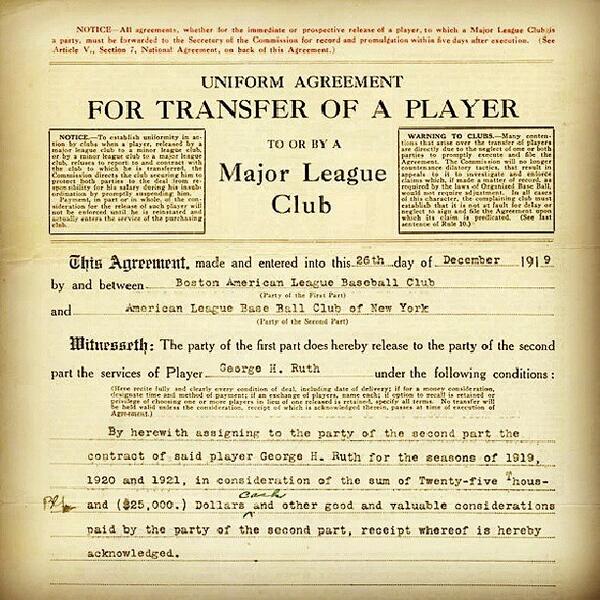
On this day one hundred years ago, the Boston Red Sox sold George “Babe” Ruth to the New York Yankees, a.k.a. the Spawn of Satan. The misbegotten sale would condemn the Red Sox to 86 years of wandering in the wilderness of Major League Baseball. Ruth was sold for $100,000 which is equivalent to about $1,522,624.24 in today’s dollar. For comparison, the lowest paid player on the Red Sox today, Heath Hembree, makes $1.6 million. Or put another way, that amount is about 4.75% of what current player David Price makes today. This post is designed to make us all feel better about all the stupid decisions that are being made today in almost every walk of life.
The Pew Research Center has conducted a poll which puts numbers to a state of affairs that seems to be intuitively obvious: that there is a sharp partisan divide between Republicans and Democrats in the US. The poll covers a very large number of issues, and there is an extended section of the analysis which deals with foreign policy.
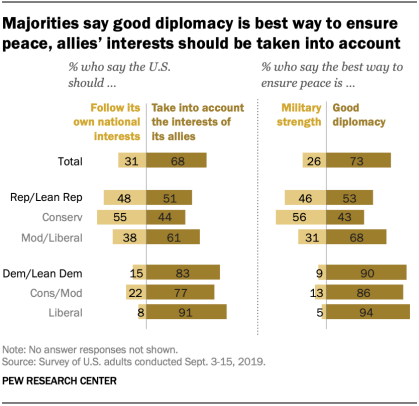
“Roughly seven-in-ten Americans (73%) say that good diplomacy is the best way to ensure peace, while 26% say that military strength is the best way to do this. By a similar margin, more Americans say the U.S. should take the interests of allies into account, even if it means making compromises, than think the U.S. should follow its own national interests when allies disagree (68% vs. 31%).
“There are stark partisan divides on both of these foreign policy values. Wide majorities of Democrats and Democratic-leaning independents see good diplomacy as the best way to ensure peace (90%) and say the U.S. should take allies’ interests into account even if that results in compromises (83%).
“By comparison, Republicans and Republican leaners are more divided in both of these views. About half (53%) see good diplomacy as the best means of ensuring peace, while 46% think military strength will best achieve this. The GOP split is nearly identical in views of how to consider allies’ interests: 51% say allies’ interests should be taken into account even if it means making compromises, while 48% say America’s national interests should be followed even if allies strongly disagree.”
There are some strong effects of age and education on the results of the poll, with older, less-educated individuals more willing to support a US disengagement from the world (even though that same cohort believes that the US should remain the world’s dominant military power).
US President Trump made a speech to a campus group in Florida, accompanied by Rush Limbaugh and Laura Ingraham. It was a rambling speech but one part about the Green New Deal caught my attention. It is not surprising that Mr. Trump does not favor the Green New Deal.
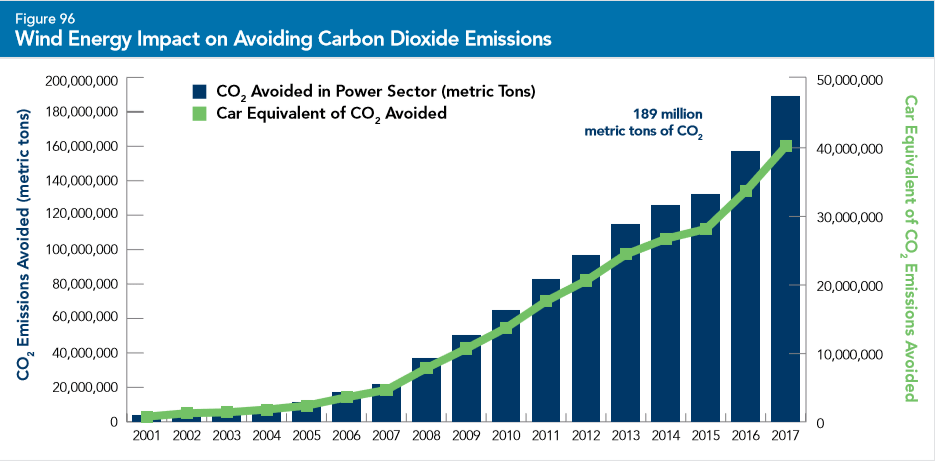
“We’ll have an economy based on wind. I never understood wind. You know, I know windmills very much. I’ve studied it better than anybody I know. It’s very expensive. They’re made in China and Germany mostly — very few made here, almost none. But they’re manufactured tremendous — if you’re into this — tremendous fumes. Gases are spewing into the atmosphere. You know we have a world, right? So the world is tiny compared to the universe. So tremendous, tremendous amount of fumes and everything. You talk about the carbon footprint — fumes are spewing into the air. Right? Spewing. Whether it’s in China, Germany, it’s going into the air. It’s our air, their air, everything — right?
“So they make these things and then they put them up. And if you own a house within vision of some of these monsters, your house is worth 50 percent of the price. They’re noisy. They kill the birds. You want to see a bird graveyard? You just go. Take a look. A bird graveyard. Go under a windmill someday. You’ll see more birds than you’ve ever seen ever in your life.”
The incoherence of this statement is astonishing and should cause alarm. It is obvious that Mr. Trump does not favor wind power, but even if the manufacture of wind turbines emits greenhouse gases, the level of emissions are far lower than that of a coal powered electric plant. And Mr. Trump’s preferred icon–glass skyscrapers–kill many more birds–about 600 million every year–than a wind turbine. Indeed, if Mr. Trump cares about birds, a better first step would be to enforce the Migratory Bird Treaty Act, which the Department of the Interior gutted on 14 June 2018. In a letter, the Department stated: “The Solicitor’ s Opinion M – 37050 dated December 22, 2017, issued by the Principal Deputy Solicitor of the Department of the Interior, establishes that the Migratory Bird Treaty Act does not prohibit the incidental take of migratory birds. The take of birds, eggs, or nests occurring as the result of an activity, the purpose of which is not to take birds, eggs, or nests, is not prohibited by the Migratory Bird Treaty Act.” In other words, you can destroy birds, eggs, and nests as long as that was not your primary objective.
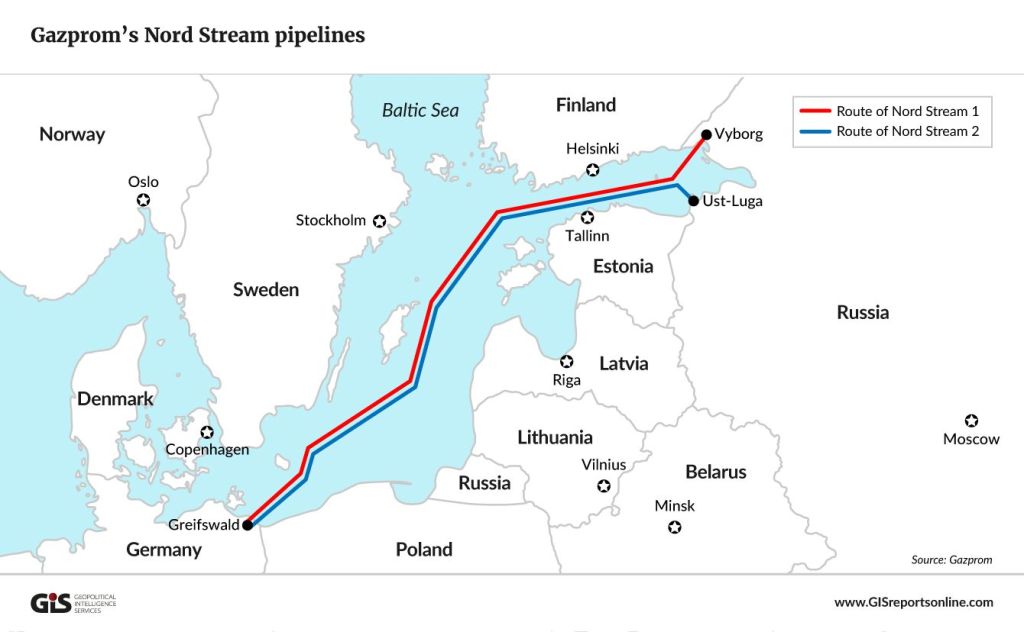
The US has finally put sanctions on companies and individuals that contribute to the building of a natural gas pipeline call Nord Stream 2 which connects Russia and Germany. Europe is interested in the pipeline since it will increase natural gas supplies to European state and Russia wants the pipeline because it will increase its gas exports. The US, however, has been opposed for two reasons. First, it will reduce demand in Europe for US natural gas which is critical to maintaining the profitability of gas companies that use fracking to produce natural gas. Second, it increases European dependence on Russia which harms US influence on Europe. The US, however, has been slow to impede the Nord Stream 2 project and it now appears as if the pipeline is a done deal. Forbes reports:
“Already last year it was clear that the pipeline was probably unstoppable unless the U.S. took immediate action, which it did not. Since then, Denmark has given the last approval needed for the project. The company construction Nord Stream 2 says it is now 83% finished, with 2,042 kilometers (1,270 miles) already laid at the bottom of the Baltic Sea. They say the last section through Danish territorial waters, approved after a long delay in October, can be constructed in just five weeks.
“The pipeline is expected to start pumping gas midway through next year.”
“The burgeoning movement against the citizenship act is a refreshing sign of possible constitutional regeneration. But it may struggle against the headwinds of Modi’s assertive Hindu nationalism. The BJP’s policy priorities in recent months reflect a hard ideological turn: the shredding of Kashmir’s nominal autonomy and the ensuing crackdown in the restive territory; the triumphant exultation over the Supreme Court decision to allow the building of the powerfully symbolic Ram Temple in Ayodhya; and talk of anti-conversion and population control legislation. Even in public discourse, the baiting and demonization of minorities is more palpable. In a recent speech in the central state of Jharkhand, Modi made a sly reference to the fact that those protesting the citizenship law could be ‘recognized by their clothes,’ a clear dog whistle for Muslims.
“Modi’s robust combination of Hindu majoritarianism and authoritarianism will not be defeated easily. But the passage of the citizenship act has woken India to the dangers that threaten its core constitutional values. The road to recover and protect those values will be long, arduous, and full of conflict. Many Indians are finally saying, ‘Enough is enough.’”
Other countries have been slow to express their opinions on the government’s response to the protests. Not long ago, Prime Minister Modi’s position in India seemed unassailable. But his actions in Kashmir and the larger issue of the Registry of Citizens raised suspicions about his commitment to the idea of secular India and the Citizenship Amendment Act has solidified those suspicions into outright mistrust among many Indians.
Joseph E. Stiglitz, Todd N. Tucker, and Gabriel Zucman have written an essay for Foreign Affairs entitled “The Starving State: Why Capitalism’s Salvation Depends on Taxation” which makes a powerful argument that the US government’s policies since the 1980s of lowering tax rates on capital have led to the growth of inequality in the US.
“That simple truth is being forgotten today. In the United States, total tax revenues paid to all levels of government shrank by close to four percent of national income over the last two decades, from about 32 percent in 1999 to approximately 28 percent today, a decline unique in modern history among wealthy nations. The direct consequences of this shift are clear: crumbling infrastructure, a slowing pace of innovation, a diminishing rate of growth, booming inequality, shorter life expectancy, and a sense of despair among large parts of the population. These consequences add up to something much larger: a threat to the sustainability of democracy and the global market economy.
“This drop in the government’s share of national income is in part the result of conscious choices. In recent decades, lawmakers in Washington—and, to a somewhat lesser extent, in many other Western countries—have embraced a form of fundamentalism, according to which taxes are a hindrance to economic growth. Meanwhile, the rise of international tax competition and the growth of a global tax-avoidance industry have put additional downward pressure on revenues. Today, multinationals shift close to 40 percent of their profits to low-tax countries around the world. Over the last 20 years, according to the economist Brad Setser, U.S. firms have reported growth in profits only in a small number of low-tax jurisdictions; their reported profits in most of the world’s major markets have not gone up significantly—a measure of how cleverly these firms shift capital to avoid taxes. Apple, for example, has demonstrated as much inventiveness in tax avoidance as it has in its technical engineering; in Ireland, the technology giant has paid a minuscule annual tax rate as low as 0.005 percent in some years.”
About “eight percent of the world’s household financial wealth is hidden” in tax havens permitted by many governments which further reduces the revenue base. The consequences of this reduced tax base harms democracy in two different ways:
“This spiraling inequality is bad for the economy. For starters, inequality weakens demand: the bulk of the population has less money to spend, and the rich don’t tend to direct their new income gains to the purchase of goods and services from the rest of the economy; instead, they hoard their wealth in offshore tax havens or in pricey art that sits in storage bins. Economic growth slows because less money overall is spent in the economy. In the meantime, inequality is passed down from generation to generation, giving the children of the wealthy a better shot at getting into the top schools and living in the best neighborhoods, perpetuating a cycle of ever-deeper division between the haves and the have-nots.
“Inequality also distorts democracy. In the United States especially, millionaires and billionaires have disproportionate access to political campaigns, elected officials, and the policymaking process. Economic elites are almost always the winners of any legislative or regulatory battle in which their interests might conflict with those of the middle class or the poor. The oil magnates the Koch brothers and other right-wing financiers have successfully built political machines to take over state houses and push anti-spending and anti-union laws that exacerbate inequality. Even rich individuals who are seen as more politically moderate—technology executives, for instance—tend to focus their political efforts on narrow technocratic issues rather than the distributional conflicts that define today’s politics.”
Inequality should be a central question in the upcoming US election. It is a challenge to the future more serious than any other issue, save that of climate change.
Powers to make the Brexit deal legal domestically.
The legislation enabling the transition period allowing the UK to stay in the customs union and single market between 1 February and 21 December 2020.
Powers to ensure key elements of the European Communities Act of 1972 remain applicable domestically. The UK will remain a rule-taker and not a rule maker.
Extensive powers to ministers and devolved governments to deal with the separation issues.
So-called “Henry VIII powers”, under which ministers can repeal or amend an act of parliament without going back to MPs, allowing them to implement the protocol on special arrangements intended to avoid a hard border between Northern Ireland and Ireland. These are “a bit of a blank cheque”, says Joe Owen, Brexit director at the Institute for Government. But as nobody knows the detail of how they will operate they reflect the complexity of the consequences of the divorce from the EU.
Powers and arrangements to ensure EU citizens’ rights laid out in the withdrawal agreement are implemented.
What has been removed?
The clauses that give parliamentary say on future Brexit deals, negotiating objectives or the extension period have been removed. Specifically they are:
The clause giving MPs the right to approve an extension to the transition period.
The clause 31 requirement for parliamentary approval for negotiations on the future relationship in the October bill has gone. Under the old bill, the House of Commons would have had to approve the negotiating objectives of the government in the next phase of talks. The parliamentary approval process for any future relationship treaty subsequently negotiated with the EU has also gone.
The removal of clauses pledging alignment with the EU on workers’ rights. The government on Thursday promised in the Queen’s speech that workers’ rights would instead be “protected and enhanced” under an employment bill.
Legal protections for refugee children reunited with family members in the UK have been watered down. The bill removes, via clause 37, obligations in regard to unaccompanied children seeking asylum in the EU with an obligation to make a statement within two months of passing the act.
The promise that the government’s position on negotiating the future relationship will be in line with the political declaration that accompanied the withdrawal agreement.
A clause locking in Brexit at the stroke of midnight, 31 December. The only way that can change is if the EU changes its summer daylight saving.
The bill gives the government new powers in several areas, including Northern Ireland, to change Brexit-related laws through secondary legislation rather than primary, which has the potential to reduce parliamentary scrutiny.
Time limits on any discussion of the divorce bill payments, removing the option of debate up to March 2021. This is in line with the other clauses removing any chance of an extension to the transition period.
It gives the House of Lords’ EU committee the right to scrutinise developments in EU law of “vital national interest” to the UK during the transition or implementation period. The House of Commons already had these powers under the October bill.
An independent monitoring authority to allow EU nationals in the UK to appeal against decisions relating to their rights has slightly changed, with the authority given the power to delegate decisions to launch inquiries.
Readers of this blog know that I am concerned about the extent to which US President Trump and his Republican allies seem to be receptive to Russian influence, particularly Russian propaganda. Russian President Putin held his annual press conference and in that conference stated that he believed that the charges of Russian interference in the 2016 election were fabricated. That denial flies in the face of the strong belief in the US intelligence community that Russian interference was “extensive”. One of President Trump’s strongest supporters, Senator Lindsey Graham (R-SC), introduced a bill in the US Senate entitled “Defending American Security from Kremlin Aggression Act” (DASKA) last August. The bill makes clear that “the United States will never recognize the illegal annexation of Crimea by the Russian Federation” and that “No funds authorized or appropriated by any Act may be used to support, directly or indirectly, any efforts on the part of any United States Government official to take steps to withdraw the United States from the North Atlantic Treaty, done at Washington, DC, April 4, 1949, until such time as the Senate passes, by an affirmative vote of two-thirds of Members, a resolution advising and consenting to the withdrawal of the United States from the treaty.” CNBC describes the likely effect of the passage of the bill:
“If passed, it would completely prevent American entities from purchasing Russian debt securities, sanction Russian state banks and potentially issue secondary sanctions on investing in the country’s oil sector, something that would draw particular opposition from the European Union.
“Sanctions experts have described the measures as ‘extreme’ and ‘nuclear’ as well as broad-based and more likely to be effective than previous efforts to deter Russian election interference.
“While likely to be heavily debated and amended before going to a final vote, the measures detailed in the bill are expected to be a more powerful tool against Moscow.”
Needless to say, Russia firmly opposes the passage of the bill.
“Almost from the moment he took office, President Trump seized on a theory that troubled his senior aides: Ukraine, he told them on many occasions, had tried to stop him from winning the White House.
“After meeting privately in July 2017 with Russian President Vladimir Putin at the Group of 20 summit in Hamburg, Trump grew more insistent that Ukraine worked to defeat him, according to multiple former officials familiar with his assertions.
“The president’s intense resistance to the assessment of U.S. intelligence agencies that Russia systematically interfered in the 2016 campaign — and the blame he cast instead on a rival country — led many of his advisers to think that Putin himself helped spur the idea of Ukraine’s culpability, said the officials, who spoke on the condition of anonymity to describe internal discussions.
“One former senior White House official said Trump even stated so explicitly at one point, saying he knew Ukraine was the real culprit because ‘Putin told me.’
“Two other former officials said the senior White House official described Trump’s comment to them.
“The Ukraine theory that has consumed Trump’s attention has now been taken up by Republicans in Congress who are defending the president against impeachment. Top GOP lawmakers have demanded investigations of Ukrainian interference for which senior U.S. officials, including the director of the FBI, say there is no evidence.”
Unfortunately, President Trump has not allowed transcripts of his conversations with President Putin from being examined so we may never know the basis for his beliefs.
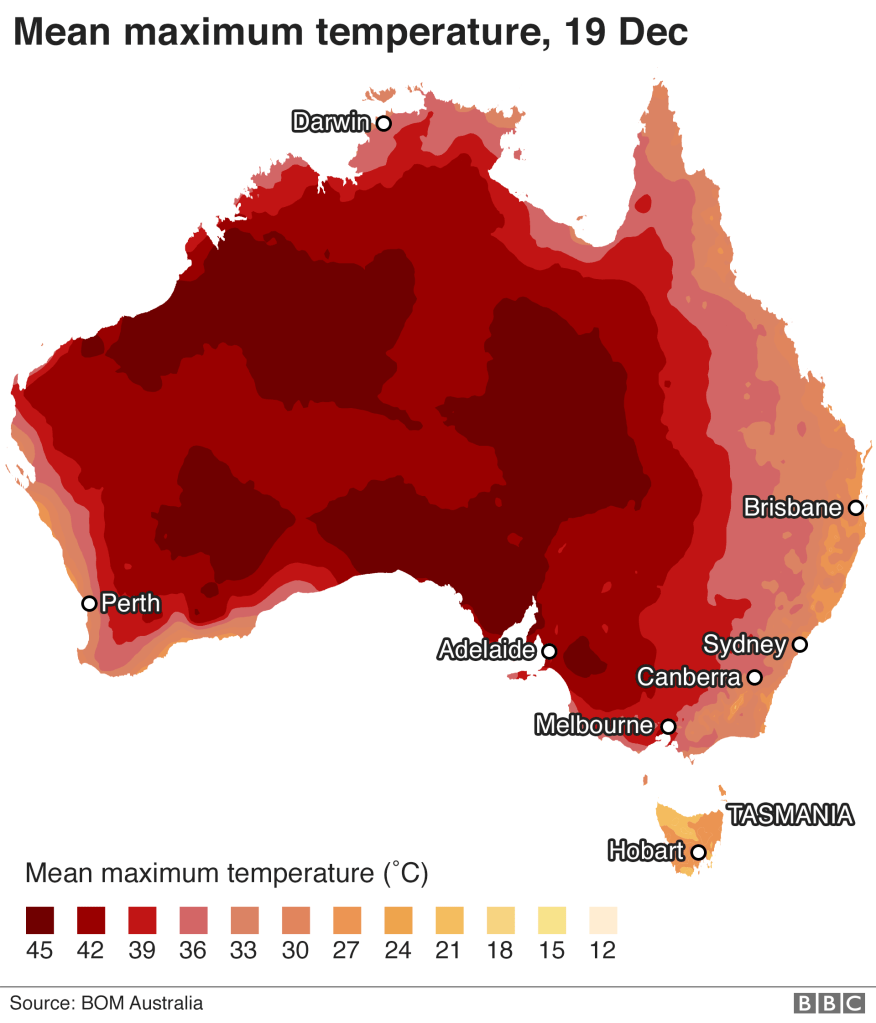
Australia is enduring an early summer heat wave which has broken all records–including a temperature of 107.4 degrees F. The situation has been aggravated by drought which, in combination with the high temperatures, has led to serious wildfires. These fires have led to emergency declarations in cities such as Sydney which has been blanketed by noxious smoke. Unfortunately, the weather forecasts suggest that even higher temperatures can be expected soon.
The Indian Supreme Court refused to rule immediately on the constitutionality of the Citizenship Amendment Act which offered citizenship to persecuted religious minorities in neighboring countries except to Muslims. The passage of the act has led to many protests in states such as Assam which has a large number of Muslims who account for about 14% of the Indian population. Issac Chotiner of the New Yorker conducted an interview with Niraja Gopal Jayal, a professor at the Center for the Study of Law and Governance at Jawaharlal Nehru University. The concerns about the law are deep:
“It introduces, for the first time, a religious criterion as a test for citizenship. Obviously, someone who supports it could argue that it only applies to people who are refugees or illegal migrants—it doesn’t apply to existing Indian citizens. That argument has indeed been made, but I think that it is a threat to the idea of Indian citizenship per se. It is, in some senses, a body blow to the constitutional ideal of equality of citizenship regardless of caste, creed, gender, language, and so on. Ours is a secular constitution, and the worry is that the introduction of the religious criterion will yield, effectively, a hierarchy of citizens, a kind of two-tiered, graded citizenship.
“The even bigger worry is the introduction of religion as a criterion of citizenship in India, because then you open up the floodgates. Like you said, what’s next? If this gets validated in the courts, the next step is that there will be a national register of Indian citizens, for which the law has existed for several years now. That will be activated, and the promise has been made that it will be completed by 2024, which is the next general election. If the Citizenship Amendment Act, which was just passed the other day, is actually enabling some religious groups to become naturalized citizens, leaving out only one major religious group—that is, Muslims—what the National Register of Citizens would do would be to essentially disenfranchise people, including existing Muslim citizens, but Hindus as well who cannot establish, as per the list of documents that may be required, that they are, in fact, Indian citizens.”
US President Trump sent a six-page letter to Speaker of the House of Representatives, Nancy Pelosi, decrying the impeachment process in the US Congress. There are many misstatements of fact in the letter, far too many to catalog in this post (nor do I wish to spend the time since they merely repeat many that have been completely debunked–Mr. Trump is apparently non-educable). But the more important issue is the tone of the letter. It seems as if the letter was dictated and simply recorded. The letter is intemperate, nasty, and demeaning to the Office of the President. David Graham writes in The Atlantic:
” The six-page letter to House Speaker Nancy Pelosi is a wild ride. The president veers among incoherent semantic lament (‘You have cheapened the importance of the very ugly word, impeachment!’), bald-faced lies (about former Vice President Joe Biden’s actions in Ukraine), self-righteous whining (‘You did not recant. You did not ask to be forgiven. You showed no remorse, no capacity for self-reflection’), and atrocious misrepresentation of history (‘More due process was afforded to those accused in the Salem Witch Trials’).
“For the most part, the letter is a farrago of common complaints the president has issued in rallies and on his Twitter feed. The president may be most comfortable at 280 characters, but he can expand to six pages given the opportunity. But even though the substance is recycled, the letter is notable because it’s an official communication, on White House letterhead.”
I doubt that there will be any official comments from leaders around the world. There really is no response, but I am certain that most leaders will regard the letter as one that can be clearly characterized as unhinged. The more important question is whether the President’s supporters in Congress will take the letter as evidence of unfitness for the position. I suspect, however, that there will be only silence.
The climate meeting in Madrid was extended for 40 hours after its scheduled conclusion, but it still failed to meet important goals. The most ambitious goal was to reach agreement on Article 6 of the Paris Agreement which allows states to take actions outside of their borders (such as contributing to efforts to control deforestation in tropical forests) which would count toward their national targets for climate change mitigation. There seemed to be a clear sense that the efforts to address climate change are not effective without the participation of the US which is leaving the Paris Agreement.
“At the heart of many of the meeting’s debates was the core of the injustice of climate change: That the people who have contributed least to the problem stand to suffer the most while those who have gained the most from emitting greenhouse gases will suffer the least.
“The United States, the second-largest emitter of greenhouse gases (and the largest historical emitter), has already committed to withdrawing from the Paris agreement next year, and was one of the countries watering down provisions for compensating poorer countries for loss and damage incurred from climate-linked disasters.
“Several countries also expressed alarm that even seemingly benign language around the need for international financing mechanisms for developing countries to deal with climate change was being diluted by powerful nations.”
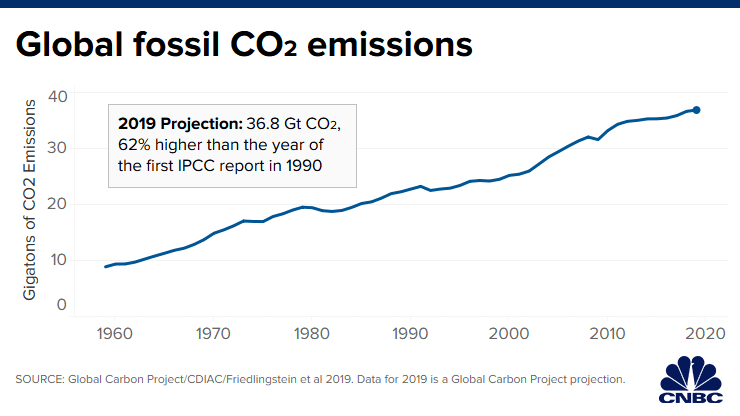
Reuters has compiled a number of quotations from some of the participants to the conference. The quotes capture the frustration and anger of some of the delegates over the lack of progress. The Guardian provides data which highlights the seriousness of the failure: “Research published during the two weeks of talks showed that greenhouse gas emissions have risen 4% since the Paris accord was signed in 2015, and the world will need to cut carbon by more than 7% a year in the next decade to heed scientific advice.”
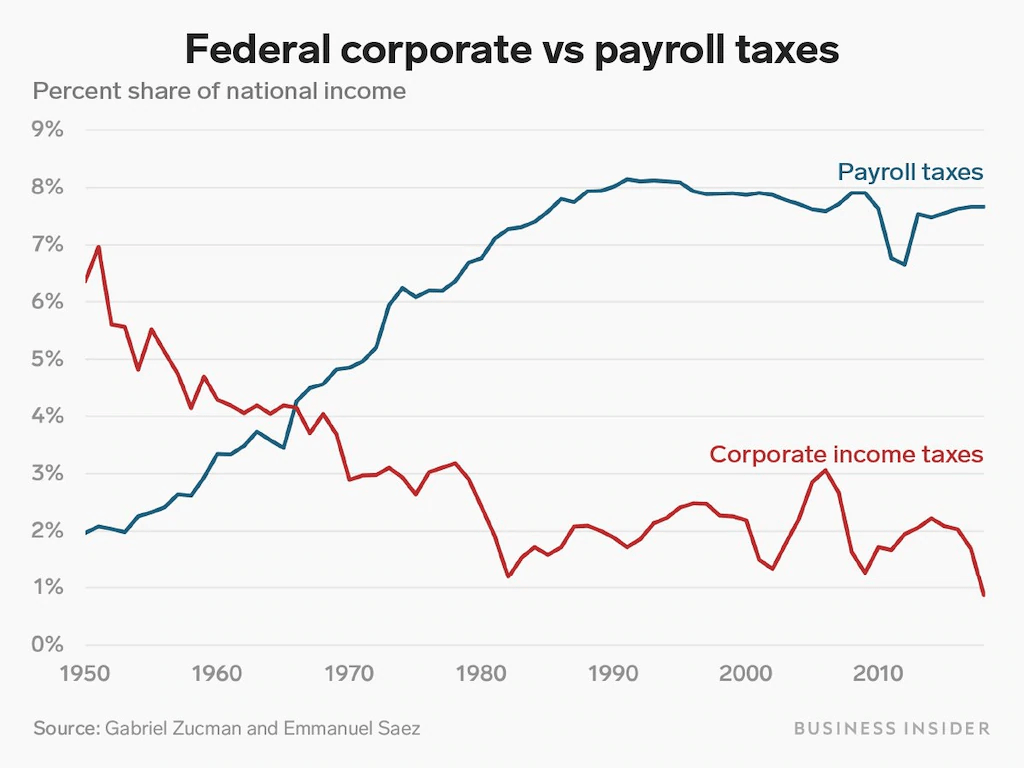
Business Insider has posted an article on how payroll taxes (the taxes that go to Social Security and Medicare) have increased dramatically over the years while corporate taxes have gone down. Payroll taxes are essentially regressive since they start at the very first dollar of income but end when income reaches the $128,400 cap on taxable wages. Income and corporate taxes are supposed to be progressive, but since the 1980s the tax rates on both sources of income have been steadily decreased. According to the study “Payroll taxes made up 7.8% of national income in 2018, compared to 0.9% for corporate ones — the widest gulf in almost two decades.” It is yet another case of the poor subsidizing the rich.
 World Politics News