Marko Milanovic has written an essay for The European Journal of International Law entitled The Soleimani Strike and Self-Defence Against an Imminent Armed Attack. It is a very detailed legal brief on the issues raised by the US strike in Iraq on the Iranian general, Qassem Suleimani. Milanovic carefully parses through a number of contingencies relevant to assessing the legality of the attack. The essay is hamstrung by the lack of concrete information about the strike, but Milanovic goes through different circumstantial possibilities that affect the legal analysis. Despite the ambiguities, Milanovic argues that:
“….even if one accepts a broad theory of self-defence against an attack that is yet to occur, such as that espoused by the US government itself, the strike is likely to be unlawful. It is improbable that the US would be able to meet the factual requirements that it needs to justify the strike – in particular, there are serious doubts that there even was an imminent attack, and there are serious doubts that the method the US chose to resist that supposed attack was necessary under the circumstances. If such was the case, the US breached the prohibition on the use of force in Article 2(4) of the UN Charter vis-à-vis both Iran and Iraq. Finally, the post will look at the illegality of the threats of further use of force made by President Trump against Iran, which are unlawful both as a matter of the jus ad bellum and the jus in bello.”
The essay is a very useful road map of the issues raised by the attack and the conclusion is well-supported by both evidence and logic. It is doubtful that the Trump Administration really cares about international law but it is important for us all to think clearly about violence wielded in our names.
There have been protests in Lebanon since last October and the most recent protests left more than 300 people injured. The protests stem from a sense among the citizens of Lebanon that the political system–which guarantees certain government posts to specific sects–has completely atrophied, leading to a complete breakdown of government services. Basic services such as the provision of water, picking up garbage, and fighting wildfires seem to be beyond the capabilities of the government. The Prime Minister, Saad Hariri, resigned last October, but finding a viable replacement has proven to be a fruitless exercise. But the underlying economic weakness of Lebanon continues to aggravate the situation:
“Economic growth fell to 0 percent this year, according to Reuters, and the country carries a debt of about $85 billion. Its current GDP is $55 billion. Meanwhile, the unemployment rate for those under 35 has soared to 37 percent. The value of the Lebanese pound has fallen as prices increased, a monetary situation worsened by a dearth of US dollars.
“For the last 20 years, Lebanon has interchangeably used US dollars and the Lebanon pound thanks to a central bank policy that set the exchanged rate at about 1,500 pounds to the dollar, according to The New York Times.
“In theory, using both currencies should pose no problems. But to sustain the system, Lebanon has to continuously bring in new dollars, something it did in the past largely by wooing investors. The system began showing strain as local banks were required to honor high interest rates they had promised these investors. And it was further taxed by difficulty in finding new investors who weren’t frightened by regional turmoil.”
Lebanon is also a hostage to outside interests. Iran, Syria, Russia, and the US have all been involved with the domestic politics of Lebanon and many of the most active groups in the country act as agents of a foreign power. Under these circumstances, it is hard to imagine the Lebanese regaining control of their government.
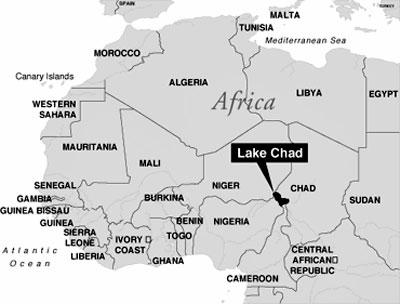
We know that climate change is occurring–we know why it is occurring and we can measure departures from the norm which give us a sense of the scale of the change. What we do not know is how humans will react to the change and the extent to which those reactions will involve violence and instability. Spiegel has run a very thought-provoking article on the effects of climate change on Lake Chad and how that change has affected the peoples of Nigeria, Niger, Cameroon, and Chad. The artile notes:
“In Chad, in Central Africa, a tragedy is playing out that will become increasingly common in the years to come: Existing conflicts over land and resources are being exacerbated by increasingly unpredictable weather. Here, it can be seen how global warming can fuel wars.
“One of the world’s worst humanitarian crises is unfolding on the shores of Lake Chad, according to the United Nations. In Nigeria, Niger, Cameroon and Chad, people are suffering from more than just extreme poverty. Boko Haram and other violent Islamist groups combined with corrupt governments and the absence of any functional state administration are making their lives hell — not to mention diseases, natural disasters and overpopulation. All these problems are now being made worse by climate change.”
Lake Chad serves almost 20 million people and the article recounts the myriad ways changes in climate have changed long-standing patterns of behavior. In many respects, those changes have led to open conflict as the sense of declining resources have led to acts of desperation. We all live in this period of change and managing the adaptive measures necessary will tax the legitimacy of governments and political systems. What seems to be clear is that those adaptive measures will always favor the interests of the rich and powerful to the detriment of the interests of the poor. World Oil quantifies the difference: “Climate-related disasters in high income countries caused $1.4 trillion in economic losses over the past 20 years, which shaved just 0.4% off economic activity, according to the UN Office for Disaster Risk Reduction. In developing nations, $21 billion of losses cut output by almost 2%.”
“China and the United States have agreed on the text of a phase one economic and trade agreement based on the principle of equality and mutual respect.
“The text includes nine chapters: the preface, intellectual property rights, technology transfer, food and agricultural products, financial services, exchange rate and transparency, trade expansion, bilateral assessment and dispute settlement, and the final terms, according to a statement issued by the Chinese side on Dec 13.
“Both sides have reached consensus that the US side will fulfill its commitments to phase out its additional tariffs on Chinese products, so as to achieve a switch from hiking to cutting additional tariffs.”
“While threatened tariffs on finished consumer goods such as clothes and electronics were avoided, the deal also reaffirmed the White House’s commitment to tariffs as an enforcement mechanism, leaving in place sanctions on $370 billion worth of Chinese imports for the foreseeable future.
“This gives American buyers of those goods — primarily parts for items made in the U.S. — a greater degree of certainty in their input costs, albeit not in the direction they wanted. Trade analysts said this means companies facing higher input costs would probably begin passing those along to consumers in the form of higher prices, if they had not done so already.”
The deal leaves a lot undetermined. China made promises on protecting intellectual property, but it made exactly the same promises when it joined the World Trade Organization in 2001. Similarly, the Chinese have promised to purchase US agricultural exports, but added an important caveat that those purchases depended on market conditions. And the enforcement of all the Phase 1 agreements is bilateral, not multilateral. That means that if there is a dispute about adherence to the agreement, the only enforcement mechanism is the threat of additional tariff increases or other constraints on trade. In short, it is not clear that the Phase 1 agreement really addresses the central issues that started the trade war in the first place.
It should have been obvious that the Chinese were not enthusiastic about the deal. President Trump had indicated earlier that he expected President Xi Jinping to sign the agreement and that the signing would be held in Beijing. Instead, the agreement was signed by Vice-Premier Liu He in Washington, DC which allows President Xi to override the agreement if he deems that action necessary or desirable. The two-year trade war does not appear to have accomplished much and that failure stems from a misunderstanding of the Chinese economy by the US. Zachary Karabell explains:
“The United States has fundamentally misread the relative strengths of both itself and China. It has acted as if Chinese exports to the United States are the key driver of the Chinese economy and hence tariffs are a potent weapon. As underscored by a recent McKinsey study, in fact, China has been aggressively, purposefully and successfully shifting from an export-driven economy to a consumer-driven one. Much of the gain of exports accrues to the multinational companies that source in China and not to the domestic Chinese economy, and more and more Chinese manufacturing activity is geared toward its own vast internal ecosystem. Tariffs certainly stung, but their greatest impact was not economic but rather as a signal to Beijing that the United States was no longer a reliable economic partner.”
It seems safe to say that a pause in the trade hostilities is a welcome step. But it is hard to make the case that the trade war has really accomplished much, and the mutual suspicion between the US and China has only deepened because of the dispute.
The consulting group, Verisk Maplecroft, publishes an annual report entitled Political Risk Outlook, and the 2020 report has just been released. The report quantifies what we have been posting about recently–that civil unrest seems to be increasing globally. According to the summary of the report:
“Our quarterly Civil Unrest Index reveals that over the past year 47 jurisdictions have witnessed a significant uptick in protests, which intensified during the last quarter of 2019. This includes locations as diverse as Hong Kong, Chile, Nigeria, Sudan, Haiti and Lebanon….
“The number of countries rated extreme risk in the Civil Unrest Index has also jumped by 66.7%; from 12 in 2019 to 20 by early 2020. Countries dropping into this category include Ethiopia, India, Lebanon, Nigeria, Pakistan and Zimbabwe. Sudan, meanwhile, has overtaken Yemen to become the highest risk country globally.
“An ‘extreme risk’ rating in the index, which measures the risks to business, reflects the highest possible threat of transport disruption, damage to company assets and physical risks to employees from violent unrest. Most sectors, ranging across mining, energy, tourism, retail and financial services, have felt the impacts over the past year.
“The resulting disruption to business, national economies and investment worldwide has totalled in the billions of US dollars. In Chile, the first month of unrest alone caused an estimated USD4.6 billion worth of infrastructure damage, and cost the Chilean economy around USD3 billion, or 1.1% of its GDP.”
The forecast of the report is that these protests are likely to continue, and even to increase in number, in 2020:
“The pent-up rage that has boiled over into street protests over the past year has caught most governments by surprise. Policymakers across the globe have mostly reacted with limited concessions and a clampdown by security forces, but without addressing the underlying causes. However, even if tackled immediately, most of the grievances are deeply entrenched and would take years to address. With this in mind, 2019 is unlikely to be a flash in the pan. The next 12 months are likely to yield more of the same, and companies and investors will have to learn to adapt and live with this ‘new normal’.”
It remains to be seen to what extent these protests have common roots. All civil unrest is unique to each country, but the protests in 2019 all seem to grow out of concerns about corruption. Most governments have a miserable recent record of addressing that issue. When governments fail to stop corruption, the only real alternative for citizens is to take to the streets.
The entire Russian government resigned today as President Putin pushed through government reforms that would enhance the powers of the President and the Parliament and reduce the powers of the Prime Minister and other governmental officials. The details of his proposed changes were not entirely spelled out, but some observers believe that Putin intends to remain the leader of Russia for life:
“He gave no details as to what that could mean. But the proposal led some observers to speculate that, after Putin’s term runs out in 2024, he could decide to take the helm of the State Council and effectively continue to govern Russia from there. ‘Putin looks like he is counting on becoming the head of the State Council, which will get increased powers and become a key decision-making platform with input from the Presidential Administration, the government and the governors,’ Tatiana Stanovaya, an expert at the Carnegie Moscow Center think tank, wrote in a Facebook post. In all but name, this newly empowered entity, with Putin at its helm, could then begin to function as a de facto Kremlin.”
Putin’s announcement caught government officials in Russia by surprise. One proposal for changing the constitution would be to elevate the power of the State Council, which is now an advisory committee. The BBC reports:
“One of the standout proposals is making the State Council a formal government agency enshrined in the constitution.
“At the moment it is an advisory body packed with 85 regional governors and other officials including political party leaders. It is so large that when it meets it fills a hall in the Kremlin.
“But Mr Putin clearly has designs on its future. One theory is that he could become a new, powerful leader of the State Council.”
“‘What we talk about there – is the classic democratic system with three pillars of government – judiciary, the government and executive’, says Ben Aris, political analyst, editor-in-chief of Business News Europe. ‘So he is talking about a classic democratic government. This is not what we hear normally in the press about ‘Putin’s Russia’ and his personal control. This is about constructing a long term stable political system with checks and balances where the bits of the government play the proper role as defined by the constitution which is not the case now’.”
Putin has been in power in a variety of offices for 21 years and his tenure has been somewhat rocky. He has accomplished many strategic goals in foreign policy, notably the invasion and annexation of Crimea as well as keeping Syrian President Assad in power after a nine-year civil war. But his domestic popularity has declined recently as he tried to push through pension reforms that many citizens oppose. The New Statesman assesses his current popularity:
“Oil prices have been more responsible for economic growth than astute policymaking, 20 million Russians live below the poverty line and incomes have declined for five straight years.
“Economic stagnation has been accompanied by recent political turmoil. The summer of 2019 saw widespread anti-government protests on the streets of Moscow, orchestrated by an increasingly resilient political opposition.
“After 20 years in charge, are the tides turning against Putin? When Putin first came to power, in 1999 as prime minister and then in 2000 as president, ordinary Russians were the least of his concerns. From the start, he focused on neutralising the elite: the governors and party leaders, the bureaucrats and, of course, the oligarchs. Putin quickly established a quid pro quo: if the elite forsook any attempt to block or resist his power, the regime would protect its wealth and influence.”
Putin follows the steps of Chinese President Xi Jinping, who persuaded the Chinese government to abolish terms limits opening the door for him to remain President for life. US President Trump has also broached the idea of being President for life.
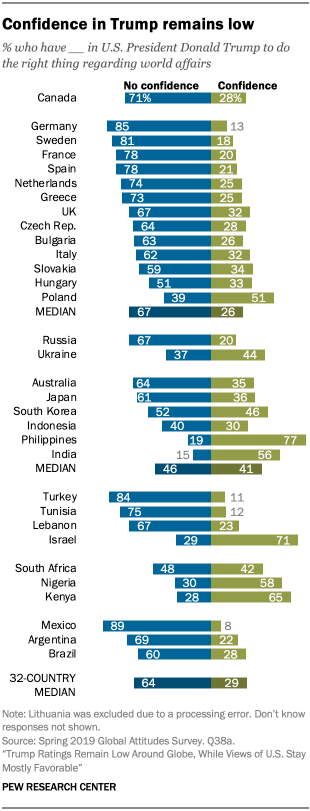
On specific issues, there is little support for most of President Trump’s initiatives except for his overtures to North Korea:
“Looking at the median levels of support across these countries, disapproval is strongest for Trump’s policies of the U.S. increasing tariffs or fees on imported goods from other countries, the U.S. withdrawal from international climate change agreements, and the U.S. building a wall on the U.S.-Mexico border. Fewer than half in all 33 countries surveyed approve of these policies.
“Global publics also disapprove of the Trump administration’s policy of allowing fewer immigrants into the U.S. However, there is some support for the U.S. restricting immigration among Israelis and some publics in Central and Eastern Europe.
“Additionally, most publics disapprove of the U.S. withdrawing from the Iran nuclear weapons agreement, but Israelis support this action. Israelis also support moving the U.S. Embassy to Jerusalem, while Tunisians, Lebanese and Turks strongly disapprove of this policy.
“Trump garners strongest approval for his negotiations with North Korean leader Kim Jong Un over the country’s nuclear weapons program. This includes majority approval from people in Japan and South Korea, as well as Israel, the UK, the Netherlands, Australia, Poland and Germany.”
The report is quite long, but well worth the effort.
We have had a number of different explanations for the assassination of Qassem Soleimani, and there has been a great deal of controversy over whether the Iranian general was planning an “imminent” (not “eminent”) attack on US troops. The word is important. If the attack was indeed imminent, then the President in his role as Commander in Chief can use force to protect US soldiers without consulting Congress. If the attack was not imminent, then the President does not have the authority to conduct an act of war without a declaration of war from Congress. For Mr. Trump to say that it does not matter if an Iranian attack was imminent conveys his total lack of appreciation for the Constitution. The tweet also indicates a very cavalier attitude toward the truth, an attitude that all should regard as unacceptable.
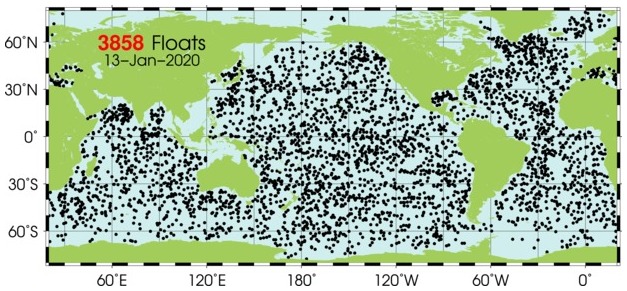
New research indicates that the oceans are rapidly warning due to climate change. Much of the data for this research comes from a system of free-floating monitors called Argo that measure the “temperature and salinity of the upper 2000 m of the ocean. This allows, for the first time, continuous monitoring of the temperature, salinity, and velocity of the upper ocean, with all data being relayed and made publicly available within hours after collection.” The Guardian summarizes some of the conclusions of the research:
“The world’s oceans are the clearest measure of the climate emergency because they absorb more than 90% of the heat trapped by the greenhouse gases emitted by fossil fuel burning, forest destruction and other human activities.
“The new analysis shows the past five years are the top five warmest years recorded in the ocean and the past 10 years are also the top 10 years on record. The amount of heat being added to the oceans is equivalent to every person on the planet running 100 microwave ovens all day and all night.
“Hotter oceans lead to more severe storms and disrupt the water cycle, meaning more floods, droughts and wildfires, as well as an inexorable rise in sea level. Higher temperatures are also harming life in the seas, with the number of marine heatwaves increasing sharply….
“The results show heat increasing at an accelerating rate as greenhouse gases accumulate in the atmosphere. The rate from 1987 to 2019 is four and a half times faster than that from 1955 to 1986. The vast majority of oceans regions are showing an increase in thermal energy.”
CNN reports that the “world’s oceans are now heating at the same rate as if five Hiroshima atomic bombs were dropped into the water every second.” Needless to say, the warming of the oceans poses serious problems for the future of the planet.
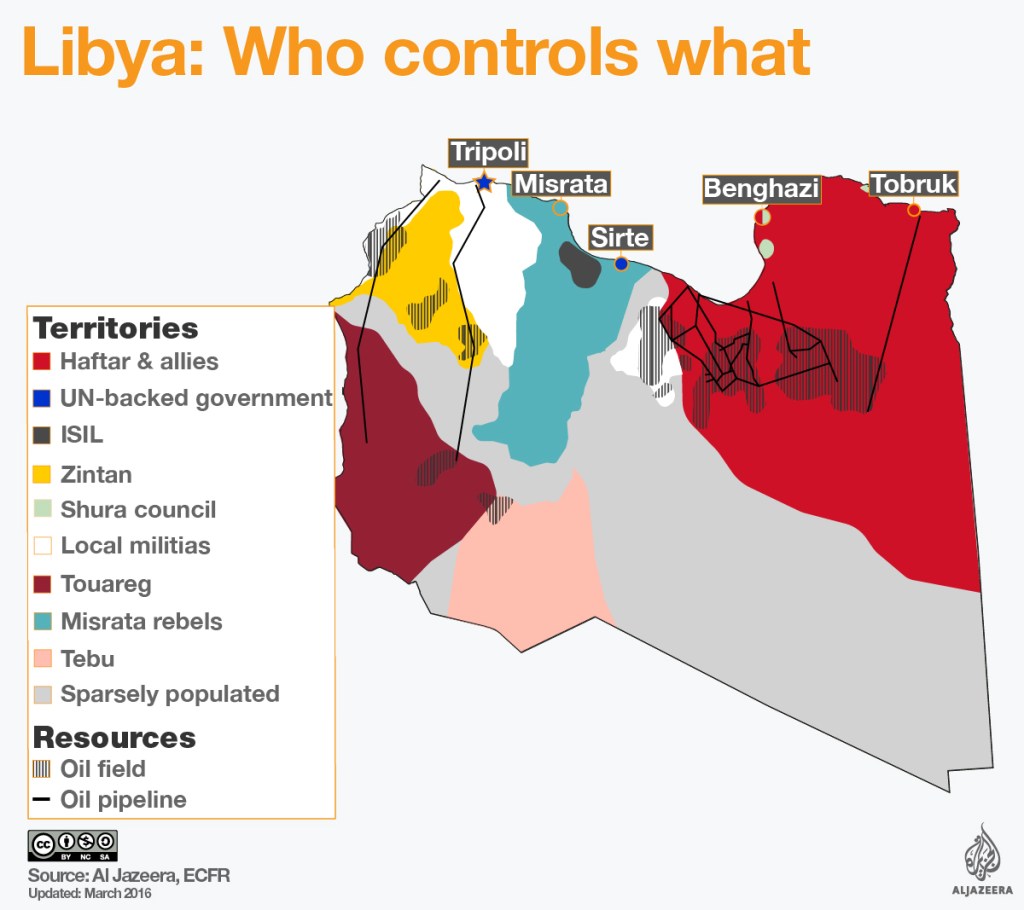
In 2011 Libya was thrown into political chaos after the overthrow of Muammar Gaddafi. It was an important year because a number of Arab countries went through what came to be known as the “Arab Spring” in which despotic governments were overthrown by protesters looking for more accountable governments. In the case of Libya, however, there was an intervention, led by the US, ostensibly to prevent a humanitarian catastrophe. Since that time, the country has been divided among a variety of factions, none of which has been able to achieve legitimacy or sufficient power to control the entire country. One center of power was located in Tobruk and was led by what was called the Council of Deputies; the other center of power was located in Tripoli and was led by the General National Congress. Since 2014, the UN has recognized a Government of National Accord as the official government of Libya, but it has failed to achieve control over all of Libyan territory.
Since last April, the forces in Tobruk, led by Khalifa Haftar, have mobilized against the government in Tripoli and other powers, notably Russia and Turkey, have sought to gain influence over events in Libya. The fighting has led to concerns that Libya may dissolve into a “second Syria”. The United Arab Emirates, Egypt, Saudi Arabia, Russia, and France have supported Haftar with military assistance. Italy and Turkey support the Government of National Accord in Tripoli, and Turkey has begun to send troops to the country, again, ostensibly for humanitarian purposes. There is also lip service to the Tripoli government by other European governments and, to a very limited and half-hearted extent, the US.
This story, unfortunately, is familiar. None of the outside powers have any real interest in Libya other than oil and a self-interest in stopping the flow of refugees through Libya to Europe. But the direct intervention by Turkey into the conflict may expand the turmoil to a regional crisis. John Andrews tries to determine Turkey’s interest in Libya:
“This will be a military and diplomatic folly. Erdoğan already has the distressing example of the Syrian conflict on Turkey’s own doorstep. Does he really imagine that sending a few hundred – or even many thousand – Turkish troops to aid the beleaguered GNA will somehow resolve Libya’s tragic and bloody turmoil, itself the result of the 2011 intervention by foreign powers that toppled Colonel Muammar el-Qaddafi’s regime?
“If Erdoğan expects either a GNA victory or an imminent peace settlement, he is deluding himself. Haftar’s well-equipped LNA has the support of Egypt, the United Arab Emirates, Saudi Arabia, Russia, and (at least covertly) France. With mercenaries from Russia and Sudan on his side, Haftar must feel rather more optimistic than Fayez al-Sarraj, the GNA’s prime minister. Support for the GNA from Turkey and Qatar, along with the fig leaf of UN recognition, weighs rather less in the military balance.”
The great powers almost always take advantage of turmoil in weaker countries. This situation, however, comes close to a free-for-all since the UN, without the strong backing of the US, has proven to been inadequate to the task of protecting the interests of the Libyan people.
The Pew Research Center has published a fascinating report on how American citizens regard the fairness of the US economic system. The report reveals that the vast majority of Americans think the US economic system is unfairly biased toward the interests of the rich.
“The survey finds, among other things, that most Americans believe there is too much inequality in the United States, with a majority of those who hold this view saying that major changes to the economic system are needed in order to address inequality.
“Across income groups, Americans tend to agree that the economic system unfairly favors powerful interests. Two-thirds of upper-income adults (66%) say this, as do 69% of middle- and 73% of lower-income adults. No more than about a third in each income group say the economic system is generally fair to most Americans.”
The report goes over the differences between Democrats and Republicans, and on some of the questions there are sharp divergences. But there does seem to be some common agreement. On the question regarding who in the US has too little power, the answer suggests that most Americans know what is going on in the society: “When it comes to who has too little power and influence in today’s economy, three groups stand out for Americans: people who are poor (75% say this), small businesses (73%) and the middle class (72%).”
Taiwan president Tsai Ing-wen (蔡英文) was re-elected in a stunning blow to Beijing’s preferred candidate, the Kuomintang party’s Han Kuo-yu. When Tsai was first elected in 2016, Beijing imposed several strict policies on Taiwan because it was believed that Tsai was less committed to reunification of the island to the mainland. Tsai’s overwhelming victory was attributed to the protests in Hong Kong which made people in Taiwan very suspicious of Beijing’s commitment to the “One Country, Two Systems” policy which was supposed to govern Hong Kong’s government until 2047. It is also likely that Taiwanese voters were thinking of China’s treatment of Uighers and Tibetans in the mainland. The US State Department issued a statement that will likely roil US-Chinese relations:
“The United States congratulates Dr. Tsai Ing-wen on her re-election in Taiwan’s presidential election. We also congratulate Taiwan for once again demonstrating the strength of its robust democratic system, which—coupled with a free market economy and a vibrant civil society—makes it a model for the Indo-Pacific region and a force for good in the world.
“The American people and the people on Taiwan are not just partners—we are members of the same community of democracies, bonded by our shared political, economic, and international values. We cherish our constitutionally protected rights and freedoms, nurture private sector-led growth and entrepreneurship, and work to be positive forces in the international community.
“The United States thanks President Tsai for her leadership in developing a strong partnership with the United States and applauds her commitment to maintaining cross-Strait stability in the face of unrelenting pressure. Under her leadership, we hope Taiwan will continue to serve as a shining example for countries that strive for democracy, prosperity, and a better path for their people.”
“Tsai’s authorities are able to maintain their rule by playing tricks to woo voters, but they are unable to tie the Taiwan society to the chariot of Taiwan secession. In fact, the Taiwan society has formed a collective consciousness to oppose Taiwan secession among Taiwan people. Even the US has refrained from publicly promoting Taiwan secession, which will lead to a showdown with Chinese mainland. China has enough international support to safeguard its one-China principle.
“The reelection of Tsai will increase the uncertainty across the Taiwan Straits. It may encourage Tsai and the DPP to take the extreme path.
“Yet no matter how much uncertainty there is across the straits, the fact that the Chinese mainland is getting increasingly stronger and the Taiwan island is getting weaker is an inevitable reality. In the long run, the role the US can play across the straits will be gradually weakened. Recognizing and complying with the reality is the only feasible option for Taiwan’s peaceful development. If Tsai and the DPP authorities are to lead the island toward the opposite direction, history will label them as a sinner of all Chinese people.”
It is easy to understand Beijing’s discomfort, but one cannot help but feel that Beijing’s behavior toward regions who do not share the common feeling of most Chinese people is largely responsible for the outcome.
Neta Crawford is at the Watson Institute at Brown University. She has run a project for many years trying to determine how much the wars since 11 September 2001 have cost. It is a very difficult task, since the money spent is spread among many different agencies, and much of the money spent is deliberately disguised. Crawford has done a remarkable job, including not just the money spent, but also determining how much money will be spent serving veterans who have suffered physical and mental trauma and the interest we will be paying on the deficits run up to finance the wars. The actual numbers are staggering. CNBC reports:
“American taxpayers have spent $6.4 trillion on post-9/11 wars and military action in the Middle East and Asia, according to a new study.
“That total is $2 trillion more than the entire federal government spending during the recently completed 2019 fiscal year. The U.S. government spent $4.4 trillion during the fiscal year that ended Sept. 30, according to the Treasury Department.
“The report, from the Watson Institute of International and Public Affairs at Brown University, also finds that more than 801,000 people have died as a direct result of fighting. Of those, more than 335,000 have been civilians. Another 21 million people have been displaced due to violence.”
We should keep this information in mind as there seem to be some in the Trump Administration who wish to change the regime in Iran and there is substantial evidence that Iran will take steps to avenge the death of General Suleimani. The Federal Government will run a deficit of almost $1 trillion this coming year. A hot war with Iran will be substantially more expensive than the wars in Afghanistan, Iraq, and Syria. Wars without conscription and without taxes are catastrophic delusions.



 World Politics News