China has announced sanctions on 28 Trump Administration officials for their conduct toward China over the last four years. Interestingly, the sanctions did not include former President Trump himself. According to the South China Morning Post:
“Beijing announced sanctions against a slew of recently departed Trump administration officials over their positions on China on Thursday, barring them from entering or doing business with the country.
“Among those sanctioned were former secretary of state Mike Pompeo, former national security adviser Robert O’Brien, former White House trade adviser Peter Navarro, and former deputy national security adviser Matt Pottinger, considered one of the key architects of the Trump administration’s hardline China policies.
“In total, 28 people were targeted by the measures, which also apply to the individuals’ immediate family members. Besides mainland China, they will not be permitted entry to Hong Kong or Macau, while any companies or entities associated with them will be restricted from doing business with China.
“In a statement issued early Thursday morning, a foreign ministry spokesman said the individuals were responsible for a number of ‘crazy moves’ that had ‘gravely interfered in China’s internal affairs, undermined China’s interests, offended the Chinese people, and seriously disrupted China-US relations’”.
It is unlikely that any of these officials had any current intentions to go to China, but the sanctions will seriously constrict their ability to conduct any business with China, Hong Kong, or Macau. The Chinese newspaper, Global Times, explains the underlying logic of the sanctions:
“The message was clear. It aimed to punish former officials who contained China in a reckless manner, telling those politicians that they should bear the consequences and meanwhile send out a warning to the US that when it comes to China policy, it should always respect China’s core interests and safeguard the bottom line of ethics and regulations, Li Haidong, a professor at the Institute of International Relations of China Foreign Affairs University, told the Global Times.
“Lü Xiang, an expert of US studies at the Chinese Academy of Social Sciences in Beijing, told the Global Times Thursday that in US politics, there was a revolving door for US politicians to be employed in private sector companies, financial institutes and think tanks after they leave office.
“The sanctions would seriously affect ‘the politicians’ road for gaining money,’ Lü said. ‘For instance, like Stilwell on the sanction list, we met in Washington when he was going to retire from the Joint Chiefs of Staff in 2015,’ Lü said. ‘At that time, the issues that most interested him were about doing business.'”
US President Biden has indicated that he does not plan to make any rapid changes toward China, particularly on the issue of the tariffs imposed on China by the Trump Administration. Nonetheless, the Biden Administration was critical of China’s moves, although the critical language was not especially harsh:
“‘Imposing these sanctions on Inauguration Day is seemingly an attempt to play to partisan divides,’ Biden’s National Security Council spokeswoman Emily Horne said in a statement to Reuters.
“‘Americans of both parties should criticize this unproductive and cynical move. President Biden looks forward to working with leaders in both parties to position America to out-compete China,’ Horne said.”
President Biden, however, seems to be well aware of the fact that China is in a much stronger position in world affairs given the ineptitude of the Trump Administration. And China is too important to the US and the global economy to allow hostility to fester, as explained by Javier Solana and Eugenio Bregolat:
“The US-China relationship is ‘too big to fail.’ Because continued deterioration would bring unacceptable risks for them and the entire world, both countries should seize the opportunity to put relations on a new footing. The framework for peaceful coexistence that Biden and his team hope to find will require maintaining a fine balance between principles and realities. To be sure, combining competition with cooperation will not always be easy, but the new US administration is perfectly capable of passing this critical, era-defining test.
The Trump Administration has issued “The 1776 Report” which is its attempt to present American history in terms different from the New York Times report entitled “The 1619 Project“. The 1619 Project highlighted the importance of slavery to the development of American society and that emphasis was viewed by many conservatives as a distortion of history. According to the Washington Post, the document was not well-received by historians:
“Historians responded with dismay and anger Monday after the White House’s ‘1776 Commission’ released a report that it said would help Americans better understand the nation’s history by ‘restoring patriotic education.’
“’It’s a hack job. It’s not a work of history,’ American Historical Association executive director James Grossman told The Washington Post. ‘It’s a work of contentious politics designed to stoke culture wars.’
“The commission was created in September with a confusing news conference featuring Housing and Urban Development Secretary Ben Carson. The 45-page report is largely an attack on decades of historical scholarship, particularly when it comes to the nation’s 400-year-old legacy of slavery, and most of those listed as authors lack any credentials as historians. While claiming to present a nonpartisan history, it compares progressivism to fascism and claims the civil rights movement devolved into ‘preferential’ identity politics ‘not unlike those advanced by [slavery defender John C.] Calhoun and his followers.’
“….Grossman, the AHA executive director, said: ‘This is written as if no historical scholarship has been produced in nearly 70 years, so it’s bereft of any professional historical sensibility at all. There are no historians on this commission. Would you take your car to a garage where there’s no mechanic?’”
I cannot recommend reading this document, but there are snippets that reveal a great deal. For example, the following paragraph appears to be beyond ironic in the wake of the insurrection at the Capitol on 6 January:
“Finally, the right to keep and bear arms is required by the fundamental natural right to life: no man may justly be denied the means of his own defense. The political significance of this right is hardly less important. An armed people is a people capable of defending their liberty no less than their lives and is the last, desperate check against the worst tyranny.”
The section on slavery attempts to minimize the significance of the practice by noting that slavery has been an endemic feature of all societies historically and that ultimately the US decided to abolish the practice. It is a variation of the “in the long run” apology that ignores the horror of the moment experienced by all the Africans who were kidnapped from their families and homes. Moreover, the treatment of slavery conveniently forgets the legacy of racism that haunts the American society to this day. Much of the wealth of the American society is due to the use of coerced labor and stolen lands of the indigenous peoples of North America. Finally, the report outlines the rather cold-blooded calculations of those drafting the Constitution as they tried and failed to reconcile the moral abomination of slavery with the language of the Declaration of Independence. That reconciliation moved forward with the Civil War but remains unfulfilled.
The report condemns the Progressive Movement in the US in the late 19th Century but the language is more likely directed toward the progressives in the US today. The report states:
“Based on this false understanding of rights, the Progressives designed a new system of government. Instead of securing fundamental rights grounded in nature, government—operating under a new theory of the ‘living’ Constitution—should constantly evolve to secure evolving rights.
“Far from creating an omniscient body of civil servants led only by ‘pragmatism’ or ‘science,’ though, progressives instead created what amounts to a fourth branch of government called at times the bureaucracy or the administrative state. This shadow government never faces elections and today operates largely without checks and balances. The founders always opposed government unaccountable to the people and without constitutional restraint, yet it continues to grow around us.”
I will admit that I am impressed that the authors of this report resisted the urge to identify this development as the “deep state” that seems to preoccupy conservatives today. But the implication is clear.
Finally, the report bemoans the development of what it terms “identity politics”.
“Today, far from a regime of equal natural rights for equal citizens, enforced by the equal application of law, we have moved toward a system of explicit group privilege that, in the name of ‘social justice,’ demands equal results and explicitly sorts citizens into ‘protected classes’ based on race and other demographic categories….
“Identity politics makes it less likely that racial reconciliation and healing can be attained by pursuing Martin Luther King, Jr.’s dream for America and upholding the highest ideals of our Constitution and our Declaration of Independence.”
This radical celebration of individualism completely ignores the awareness of those who wrote the Constitution of the fact that all individuals exist in a social universe which demands a sense of the common good. This interpretation of the significance of the individual underpins the justification of those today who refuse to wear masks in the face of the pandemic, insisting that mask mandates are an intolerable infringement on personal freedom. It also justifies those who insist that they have a right to carry weapons in public, even those weapons such as automatic rifles that the Founders never could have imagined.
This argument gets additional attention in Appendix III of the report. I found the Appendix incomprehensible but perhaps others can make more sense of it. Indeed, I consider this part to be more of a screed than a thoughtful analysis:
“In recent times, however, a new creed has arisen challenging the original one enshrined in the Declaration of Independence. This new creed, loosely defined as identity politics, has three key features.
“First, the creed of identity politics defines and divides Americans in terms of collective social identities. According to this new creed, our racial and sexual identities are more important than our common status as individuals equally endowed with fundamental rights.
Second, the creed of identity politics ranks these different racial and social groups in terms of privilege and power, with disproportionate moral worth allotted to each. It divides Americans into two groups: oppressors and victims. The more a group is considered oppressed, the more its members have a moral claim upon the rest of society. As for their supposed oppressors, they must atone and even be punished in perpetuity for their sins and those of their ancestors.
“Third, the creed of identity politics teaches that America itself is to blame for oppression. America’s ‘electric cord’ is not the creed of liberty and equality that connects citizens today to each other and to every generation of Americans past, present, and future. Rather, America’s ‘electric cord’ is a heritage of oppression that the majority racial group inflicts upon minority groups, and identity politics is about assigning and absolving guilt for that oppression.
“According to this new creed, Americans are not a people defined by their dedication to human equality, but a people defined by their perpetuation of racial and sexual oppression.”
I am not sure who this straw man is, but it is a caricature of those who seek to honor the struggles that many minorities have had to endure to achieve equality in American society.
I am certain that this report will find a nice place to gather dust in the National Archives.
I would like to take an opportunity to make an observation about the attack on the US Capitol on 6 January. I honestly never thought that I would witness such an event and I believe that the word “insurrection” aptly describes happened. I also believe that President Trump was responsible for the chaos and violence and have been disturbed by the defenses of his behavior that have been articulated by some who support him.
I keep hearing that the President never said anything about being violent after he encouraged the crowd to march to the Capitol. Indeed, some have stated that his speech to the crowd was speech protected by the 1st Amendment. Noah Feldman, writing for Bloomberg, gives a nice summary of the current legal interpretations of what constitutes free speech:
“They [Trump defenders] are going to make that argument again. And this time, they will also be able to wrap themselves in the patriotic flag of the First Amendment. Specifically, they are going to rely on an iconic 1969 free-speech decision by the Supreme Court, Brandenburg v. Ohio.
“The Brandenburg case reframed the law of incitement, extending the protection of the First Amendment beyond where it had been before. As late as the notorious 1951 case of Dennis v. United States, the court was still using a version of the “clear and present danger” test first devised by Justice Oliver Wendell Holmes in 1920. In the Dennis case, that standard was interpreted to allow conviction of nearly a dozen leaders of the Communist Party USA for sedition.
“By 1969, free-speech advocates and scholars had come to see the Dennis approach as out of step with contemporary values of political self-expression. In the Brandenburg case, the court said that the government can’t outlaw or punish ‘advocacy of the use of force or of law violation except where such advocacy is directed to inciting or producing imminent lawless action and is likely to incite or produce such action.’
“The Brandenburg rule thus has two components. The first is that the speech is ‘directed’ to inciting imminent lawlessness. The second is that the speech is actually likely to achieve its result.
The distinctions made by Feldman are useful for legal scholars, but I do not think that it is necessary to go into that level of detail. Just a cursory reading of President Trump’s speech to the protesters on 6 January leads me to the conclusion that the speech was critical for the transformation of a crowd of protesters to a crowd of insurrectionists who then used violence to express their opinions. Moreover, the 1st Amendment is constructed to prevent the government from infringing upon the right of speech for private citizens. I am not sure that we should consider the President as simply a private citizen–a remarkably low bar for an institution that carries with it incredible authority and power (something that apparently has never been understood by Mr. Trump). Surely we should have a different expectations for the desired conduct of the President.
I have little patience for those who defend Mr. Trump because he never said words such as “go and trash the Capitol building”. That defense is one that could be applied to a private citizen, but when applied to the President is disingenuous and insulting.
One of the leading Human Rights organizations in Israel, B’Tselem, has characterized Israel as an apartheid regime in terms of its treatment of Palestinians. The term refers to the institutionalized system of racial segregation in South Africa from 1948 to the 1990s. The system was universally condemned by most states when it was in force. The use of the term to describe Israeli conduct is highly provocative, and Hagai El-Ad, the director of B’Tselem defended the use of the word in an interview with The Week:
“In a recent report, B’Tselem, one of Israel’s leading human rights organizations, says that while Palestinians live under different forms of Israeli control in the occupied West Bank, blockaded Gaza, annexed east Jerusalem and within Israel itself, they have fewer rights than Jews in the entire area between the Mediterranean Sea and the Jordan River.
“’We have decided to use this word because it is the correct term to describe the reality between the Jordan River and the Mediterranean Sea and the entire area that is under Israel’s control,’ said Hagai El-Ad, executive director of B’Tselem.
“’There are no two regimes between the river and the sea. The perception that Israel is somehow a democracy on one side of the green line to which a temporary occupation project is attached on the other side of the Green Line, that perception has become completely untethered from reality,’ El-Ad added.”
The B’Tselem report outlines specific areas which it believes justifies the use of the term: Immigration for Jews only; Taking over land for Jews while crowding Palestinians in enclaves; Restriction of Palestinians’ freedom of movement; and Denial of Palestinians’ right to political participation. The report also marks 2018 as the year in which the discrimination against Palestinians became institutionalized:
“Recent years have seen a rise in the motivation and willingness of Israeli officials and institutions to enshrine Jewish supremacy in law and openly state their intentions. The enactment of Basic Law: Israel – the Nation State of the Jewish People and the declared plan to formally annex parts of the West Bank have shattered the façade Israel worked for years to maintain.
“The Nation State basic law, enacted in 2018, enshrines the Jewish people’s right to self-determination to the exclusion of all others. It establishes that distinguishing Jews in Israel (and throughout the world) from non-Jews is fundamental and legitimate. Based on this distinction, the law permits institutionalized discrimination in favor of Jews in settlement, housing, land development, citizenship, language and culture. It is true that the Israeli regime largely followed these principles before. Yet Jewish supremacy has now been enshrined in basic law, making it a binding constitutional principle – unlike ordinary law or practices by authorities, which can be challenged. This signals to all state institutions that they not only can, but must, promote Jewish supremacy in the entire area under Israeli control.
“Israel’s plan to formally annex parts of the West Bank also bridges the gap between the official status of the Occupied Territories, which is accompanied by empty rhetoric about negotiation of its future, and the fact that Israel actually annexed most of the West Bank long ago. Israel did not follow through on its declarations of formal annexation after July 2020, and various officials have released contradicting statements regarding the plan since. Regardless of how and when Israel advances formal annexation of one kind or another, its intention to achieve permanent control over the entire area has already been openly declared by the state’s highest officials.”
The practical effect of the different treatment of Palestinians is obvious when looking at the vaccinations against COVID-19. Israel far exceeds other countries in its successful vaccinations in Israel, but has not extended that system to the Occupied Territories. The Middle East Eye points out:
“However, the same responsibility of the State of Israel does not appear to apply to Palestinians in areas it occupies. Edelstein [Health Minister Yuli Edelstein] calls them instead ‘neighbours’ who should really learn to take care of themselves.
“Edelstein, told Sky News on Monday: ‘I think that we’ve been helping our Palestinian neighbours from the very early stages of this crisis, including medical equipment, including medicine, including advice, including supplies.
“‘I don’t think that there’s anyone in this country, whatever his or her views might be, that can imagine that I would be taking a vaccine from the Israeli citizen and, with all the goodwill, give it to our neighbours.’
“The use of the word “neighbour” to describe Palestinians in the West Bank, Gaza and in Jerusalem is a legal nonsense. To establish this, I turned to Sir Geoffrey Bindman QC, one of the UK’s legal experts on human rights. Bindman has examined the international legal implications of Israel’s responsibility to provide Palestinians under its occupation with the Covid-19 vaccine.”
“He said they were obliged to do so under Article 56 of the Fourth Geneva Convention, which states that Israel as an occupying power must ensure ‘the adoption and application of the prophylactic and preventive measures necessary to combat the spread of contagious diseases and epidemics’.”
This abdication of responsibility is reprehensible. Either the Israelis control the lives of Palestinians or they do not. If not, then the Palestinians deserve their own state so that they can discharge the obligations of sovereignty to the people that live on their territory. If the Israelis do control the Palestinians, then they have to discharge those obligations to the people that live within their control.
The British newspaper, The Guardian, has published a report on who was financing the members of Congress who sought to question the results of the 2020 national election. One wonders why US media has thus far not pursued this matter. The article is clear:
“An anti-tax group funded primarily by billionaires has emerged as one of the biggest backers of the Republican lawmakers who sought to overturn the US election results, according to an analysis by the Guardian.
“The Club for Growth has supported the campaigns of 42 of the rightwing Republicans senators and members of the House of Representatives who voted last week to challenge US election results, doling out an estimated $20m to directly and indirectly support their campaigns in 2018 and 2020, according to data compiled by the Center for Responsive Politics.
“About 30 of the Republican hardliners received more than $100,000 in indirect and direct support from the group.
“The Club for Growth’s biggest beneficiaries include Josh Hawley and Ted Cruz, the two Republican senators who led the effort to invalidate Joe Biden’s electoral victory, and the newly elected far-right gun-rights activist Lauren Boebert, a QAnon conspiracy theorist. Boebert was criticised last week for tweeting about the House speaker Nancy Pelosi’s location during the attack on the Capitol, even after lawmakers were told not to do so by police.”
The article reminds us that thinking about the insurrection at the Capitol on 6 January solely in terms of President Trump is a serious mistake. Ever since the Citizens United decision by the US Supreme Court, the political landscape in the US has changed dramatically. Tim Lau wrote in 2019 about the significance of the decision:
“….a bare majority of the justices held that ‘independent political spending’ did not present a substantive threat of corruption, provided it was not coordinated with a candidate’s campaign.
“As a result, corporations can now spend unlimited funds on campaign advertising if they are not formally ‘coordinating’ with a candidate or political party. “
As I have noted in many previous posts, the political economy of the US is decidedly skewed toward greater concentrations of income and wealth. Citizens United allows the beneficiaries of this political economy to influence the political system to ensure that the government has insufficient revenues to cover the needs of the citizenry and to create a tax system that inordinately falls on the poor and middle classes, creating an anti-government sentiment.
One hopes that the investigations into the insurrection asks some fundamental questions about the financing of the protest. Who paid for the bus and airplane tickets, the hotels, and meals? Who financed the pre-planning of the insurrection? These questions demand answers.
Researchers from a aide variety of institutions have published an especially grim report on the state of the world’s environment entitled “Underestimating the Challenges of Avoiding a Ghastly Future“. The opening paragraph of the report reads as follows:
“We report three major and confronting environmental issues that have received little attention and require urgent action. First, we review the evidence that future environmental conditions will be far more dangerous than currently believed. The scale of the threats to the biosphere and all its lifeforms—including humanity—is in fact so great that it is difficult to grasp for even well-informed experts. Second, we ask what political or economic system, or leadership, is prepared to handle the predicted disasters, or even capable of such action. Third, this dire situation places an extraordinary responsibility on scientists to speak out candidly and accurately when engaging with government, business, and the public. We especially draw attention to the lack of appreciation of the enormous challenges to creating a sustainable future. The added stresses to human health, wealth, and well-being will perversely diminish our political capacity to mitigate the erosion of ecosystem services on which society depends. The science underlying these issues is strong, but awareness is weak. Without fully appreciating and broadcasting the scale of the problems and the enormity of the solutions required, society will fail to achieve even modest sustainability goals.”
The significance of this report is that it makes the important connection between economic growth and the destruction of the environment. The connection deserves closer attention since many who believe that protecting the environment is an intolerable economic burden, identifying the loss of jobs that would accompany dramatic changes in economic activity. These people tend to be climate change deniers.
The report, however, identifies this perspective as one of the main reasons humanity is facing such a serious crisis. The truth is that the focus on economic growth is precisely the reason why the crisis has become so acute:
“Simultaneous with population growth, humanity’s consumption as a fraction of Earth’s regenerative capacity has grown from ~ 73% in 1960 to 170% in 2016 (Lin et al., 2018), with substantially greater per-person consumption in countries with highest income. With COVID-19, this overshoot dropped to 56% above Earth’s regenerative capacity, which means that between January and August 2020, humanity consumed as much as Earth can renew in the entire year (overshootday.org).”
The lesson seems to be clear: humanity needs to define the “good life” in terms that are more consistent with the carrying capacity of the planet. Instead of trying to preserve a standard of living that is clearly unsustainable, we need to define a standard of living as “good” that is more consistent with what the earth can provide without exhausting its resources.
“Taiwan is a vibrant democracy and reliable partner of the United States, and yet for several decades the State Department has created complex internal restrictions to regulate our diplomats, servicemembers, and other officials’ interactions with their Taiwanese counterparts. The United States government took these actions unilaterally, in an attempt to appease the Communist regime in Beijing. No more.
“Today I am announcing that I am lifting all of these self-imposed restrictions. Executive branch agencies should consider all ‘contact guidelines’ regarding relations with Taiwan previously issued by the Department of State under authorities delegated to the Secretary of State to be null and void.
“Additionally, any and all sections of the Foreign Affairs Manual or Foreign Affairs Handbook that convey authorities or otherwise purport to regulate executive branch engagement with Taiwan via any entity other than the American Institute in Taiwan (AIT) are also hereby voided. The executive branch‘s relations with Taiwan are to be handled by the non-profit AIT, as stipulated in the Taiwan Relations Act.”
“The United States government maintains relationships with unofficial partners around the world, and Taiwan is no exception. Our two democracies share common values of individual freedom, the rule of law, and a respect for human dignity. Today’s statement recognizes that the U.S.-Taiwan relationship need not, and should not, be shackled by self-imposed restrictions of our permanent bureaucracy.”
The American Institute in Taiwan was created in 1979 as an informal US embassy in Taiwan. Such a move was necessary after the US recognized the People’s Republic of China as the sole representative of the Chinese people, ending US recognition of Taiwan as the sole representative of the Chinese state in 1949 after the Communist takeover of power. After the revolution in China, the Chinese government, led by the political party known as the Kuomintang. From 1949 to 1972, the US and other countries recognized Taiwan as a way of delegitimizing the Communist rule over China. That futile fiction ended with President Nixon’s visit to China and the issuance of the Shanghai Communique by which the US ended its recognition of Taiwan in return for a promise by Communist China that it would not pursue reunification with the island by military means.
The communique was designed to buy time for both sides and it did not resolve the underlying tension concerning US and Taiwanese interests in avoiding Communist rule in the island. The situation has always been ambiguous, leading to conflicts over what constituted US support for Taiwan and the nature of Taiwan’s ultimate relationship to Beijing. The Trump Administration has consistently moved toward treating Taiwan as more autonomous in ways that have angered the Chinese government, including a bricks and mortar building for the American Institute in Taiwan in 2018. For the Chinese, that building represented too much of an official embassy. Pompeo’s recent action angered Beijing and Xinhua reports:
“A Chinese government spokesperson on Thursday voiced firm opposition to any form of official ties between the United States and China’s Taiwan region.
“Zhu Fenglian, spokesperson for the Taiwan Affairs Office of the State Council, made the statement when asked about U.S. Secretary of State Mike Pompeo’s announcement that the U.S. ambassador to the United Nations would visit Taiwan.
“Zhu voiced opposition to these ‘extremely wrong actions,’ saying they are violations of the one-China principle and the three China-U.S. joint communiques.
“The Democratic Progressive Party authority’s stubborn reliance on the United States to seek ‘Taiwan independence’ leads nowhere and will backfire, Zhu said”
Additionally, the Trump Administration is sending a high-ranking official to Taiwan: “The U.S. ambassador to the United Nations, Kelly Craft, will visit Taiwan next week for meetings with senior Taiwanese leaders, Taiwan’s government and the U.S. mission to the U.N. said, prompting China to warn they were playing with fire.” The Chinese government has angrily responded to the decision:
“China on Thursday warned the United States would pay a ‘heavy price’ if its United Nations Ambassador Kelly Craft made good on plans to travel to Taiwan next week.
“Democratic and self-ruled Taiwan lives under the constant threat of invasion by authoritarian China, which views the island as its own territory and has vowed to seize it one day, by force if necessary.
“Beijing opposes any diplomatic recognition of Taiwan and has pushed to keep it isolated on the world stage.
“Outgoing US President Donald Trump has sent multiple senior officials to Taipei over the last year as he clashed with China on a host of issues such as trade, security and human rights.
“Craft’s January 13-15 visit will come just a week before the inauguration of US President-elect Joe Biden and creates a fresh diplomatic headache for the incoming administration.
“’The United States will pay a heavy price for its wrong action,’ a statement from the Chinese mission to the UN said in response to the planned trip next week by Craft.
“’China strongly urges the United States to stop its crazy provocation, stop creating new difficulties for China-US relations and the two countries’ cooperation in the United Nations, and stop going further on the wrong path.’”
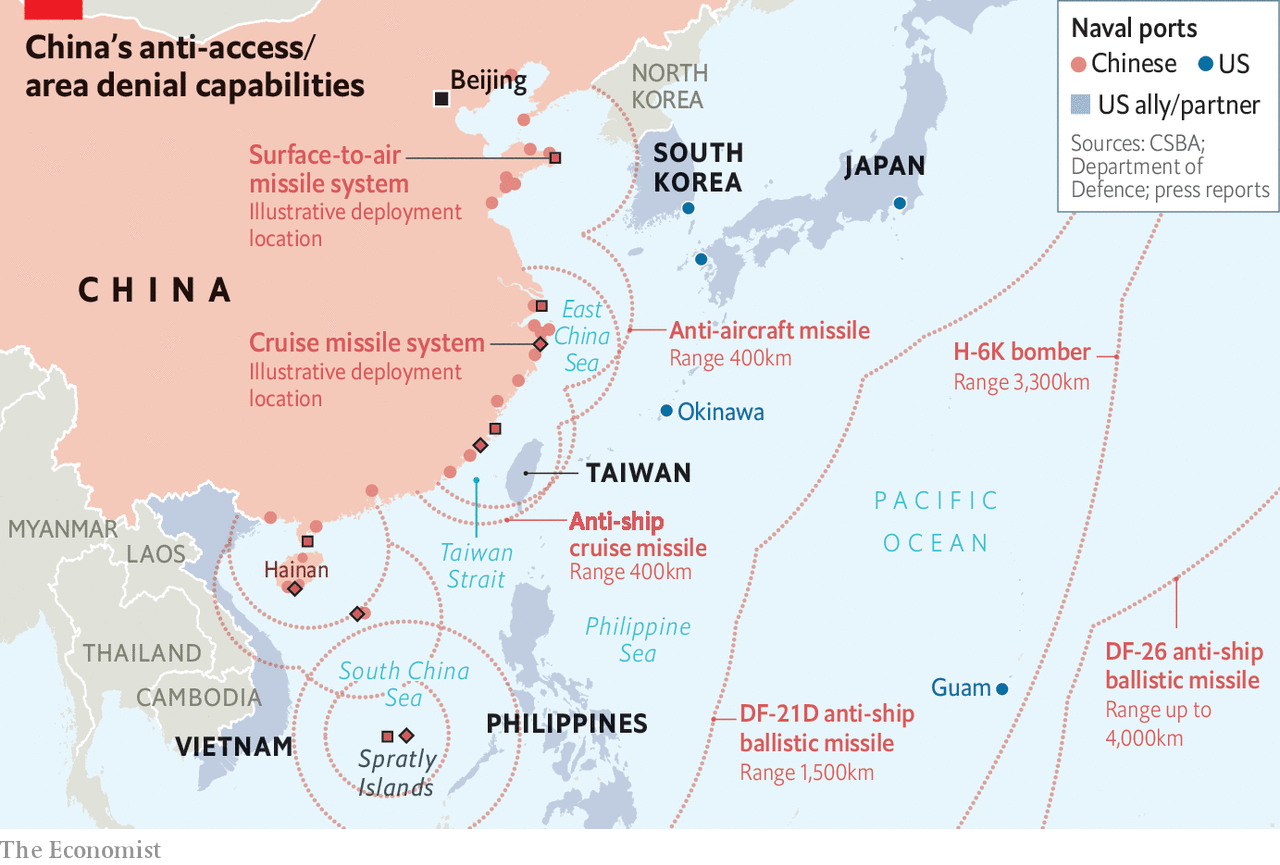
I strongly suspect that the incoming Biden Administration is opening informal channels (he’s not President yet) to the Chinese indicating that the recent Trump decisions will be overturned. Such last-minute actions are quite typical of US administrations that are being succeeded by administrations from the opposing party. But overturning them is a burdensome bureaucratic task and the changes will be slow in coming. I suspect that the Chinese will be sympathetic to Biden, but their patience on Taiwan has been solely taxed since 1972. Let us hope that Mr. Trump does not attempt any further provocations such as naval actions in the Taiwan Strait and in the South China Sea which would box the Chinese into a very dangerous corner.
Robin Wright has written an essay for the New Yorker on global reaction to the assault on the US Capitol. That the assault occurred because of doubts held by some that the national election on 2020 was corrupted, and it is not at all unusual that such doubts arise every four years. There were serious questions about the election of 1960 in which John F. Kennedy became President even though there were concerns about the vote tabulations in Illinois. Similarly, there was great controversy about the election in 2000 which saw George W. Bush defeat Al Gore on the basis of contested votes in Florida.
But the sturdiness of the US system of election over two centuries is distinctive in political history. Having a regular procedure that is regarded as legitimate solves one of the most serious problem in politics: getting people used to holding power to give it up without a struggle. Political succession is more often associated with violence and it is the central problem facing most authoritarian regimes. The US example has been one of the most important attributes of American power in world affairs. It has conducted regular elections during the civil war, World Wars I and II, and the Great Depression. The election cycles persisted even when Presidents died, either from natural causes or assassination.
The attack on the Capitol has done irreparable damage to that asset. It may be the case that the US will return to its historical pattern, and it may be the case that the inauguration of President Biden will seem to some that the pattern was not in fact broken. But the images of the mob in the Capitol building will never fit that narrative, and those images are likely indelible. And those images delighted authoritarian regimes all over the world who no longer have to deal with the US example as a possible threat to their hold on power. Wright writes:
“Authoritarian leaders were gleeful about the chaos in the world’s most powerful democracy. As armed insurrectionists, white supremacists, and rioters stormed the U.S. Capitol, the Foreign Minister of Venezuela—a failing state with rival claims to the Presidency, and shortages of power, food, and medicine—tweeted a warning about political polarization in the United States. With more than a whiff of Schadenfreude, Jorge Arreaza wished Americans well in finding ‘a new path towards stability and social justice.’
“Officials in Turkey, which has witnessed a dramatic erosion of democracy amid arrests of dissidents and journalists, called on all parties in Washington ‘to maintain restraint and prudence’—and then warned its own citizens in the United States to avoid crowded places. Iranian state television ran live coverage of the chaos at the Capitol, with a running ticker underneath, as Hossein Dehghan, a former Revolutionary Guard and a Presidential candidate in the upcoming June election, tweeted, ‘The world is watching the American dream.’ The Russian deputy U.N. Ambassador compared the turmoil in Washington, D.C., to the 2014 protests in Kyiv that toppled the Ukrainian government. On social media platforms like Telegram, supporters of isis and Al Qaeda celebrated the turmoil in the United States. An isis publication predicted that America would be consumed with turmoil for the next four years….
“America’s rivals cited the chaos at the Capitol as a sign that America has forfeited its claim to be a political model or world leader. ‘The celebration of democracy is over,’ Konstantin Kosachyov, the chairman of the international-affairs committee in the Russian upper house, said. ‘I say this without a hint of gloating. America is no longer charting the course, and therefore has lost all its rights to set it. And especially to impose it on others.’ In a televised address, on Thursday, the Iranian President, Hassan Rouhani, said that the unrest in Washington ‘really showed that first how floppy and weak the Western democracy is, and how weak its foundations are.’ From Zimbabwe, which last year appeared on the verge of collapse as unemployment hit ninety per cent and inflation neared eight hundred per cent, President Emmerson Mnangagwa tweeted outrage on Thursday that Trump had once criticized the African nation. ‘Yesterday’s events showed that the U.S. has no moral right to punish another nation under the guise of upholding democracy,’ he wrote.”
It is always a mistake to consider the US as an “exceptional” country, but its strong commitment to the peaceful transfer of power placed it in a very select group of countries. With the loss of that important characteristic, the world has lost an important voice for restraints on authoritarian rule.
One of the most disturbing aspects of the storming of the Capitol building in Washington, DC was the stark contrast between the treatment of the Black Lives Matter protesters in June 2020 and the terrorists that broke into the Capitol yesterday. In Lafayette Square the consensus of most observers was that the protest was overwhelmingly peaceful. But a very well armed contingent of police used chemicals and rubber bullets to disperse the crowd. The situation at the Capitol yesterday was that there were very few officers save the Capitol police who were inadequately armed and staffed.
There is a clear explanation for the difference between the two events which stems from the composition of the two protesting groups (people of color vs. whites) as well as the issues pursued by both (issues not supported by Trump and issues favorable to Trump). For me, that explanation is both valid and compelling.
But there is another concern raised by the difference: the degree to which security officials were prepared for the possibility of violence. In Lafayette Square there was overwhelming and armed preparation and we can probably assume that, if violence had broken out, it would have been quickly snuffed out. But at the Capitol, there was seemingly no preparation at all.
The lack of preparation needs to be explained. There was no lack of evidence that violence was likely on 6 January 2021. Indeed, on 19 December, President Trump tweeted: “Statistically impossible to have lost the 2020 Election. Big protest in D.C. on January 6th. Be there, will be wild!” There was a website (thedonald.win) posted on Reddit that allowed people to suggest that violence would occur on 6 January. The Washington Post quoted some excerpts from the site:
“The group said thedonald.win had more than 18 million visits in November, and the recent posts with calls for violence had more than 40,000 engagements. One particularly troubling post said protesters should travel in groups that should ‘not let [anyone] disarm someone without stacking bodies.’ It added that protesters should be ‘ARMED WITH RIFLE, HANDGUN, 2 KNIVES AND AS MUCH AMMO AS YOU CAN CARRY.’
“In one thread promoted by moderators Tuesday morning, titled ‘GOOD LUCK PATRIOTS, THE EYES OF THE WORLD LOOK UPON YOU NOW!!!,’ posters shared tactical guides on how to avoid police blockades and D.C. gun laws, including: ‘If you plan on carrying concealed, don’t tell anyone you have a gun.’ One commenter responded, ‘We The People, will not tolerate a Steal. No retreat, No Surrender. Restore to my President what you stole or reap the consequences!!!’”
A key question for the lack of preparation is why the National Guard was not called out earlier to provide security. The District of Columbia has its own National Guard, but, unlike the Guard for the 50 states, the DC Guard is governed by the US Defense Department. That Department has witnessed a very large turnover within its ranks since the election in November with many career officials being replaced by people clearly loyal to President Trump (and with very few appropriate credentials). The Washington Post notes the constraints imposed on the DC Guard just before the 6 January ceremony in Congress confirming the victory of Biden as President:
“In memos issued on Jan. 4 and 5, the Pentagon prohibited the District’s guardsmen from receiving ammunition or riot gear, interacting with protesters unless necessary for self-defense, sharing equipment with local law enforcement or using Guard surveillance and air assets without the defense secretary’s explicit sign-off, according to officials familiar with the orders.
“The D.C. Guard was also told it would be allowed to deploy a Quick Reaction Force only as a measure of last resort, the officials said.
“The need for higher-level approval appeared to have slowed the military response when the Capitol Police, the law enforcement force that reports to Congress and protects the House and the Senate, requested backup from 200 troops during a call with top Pentagon officials early Wednesday afternoon, according to officials familiar with the call.”
It appears to me that deliberate decisions were made to make the Capitol more vulnerable to violence and also to eschew an opportunity to demonstrate a willingness to repress violence that might have alienated the people who supported Trump. This possibility suggests that, for the next weeks and until the time that President Biden can replace some people in the Defense Department, there is a real possibility that decisions will be made that prioritize politics over security.
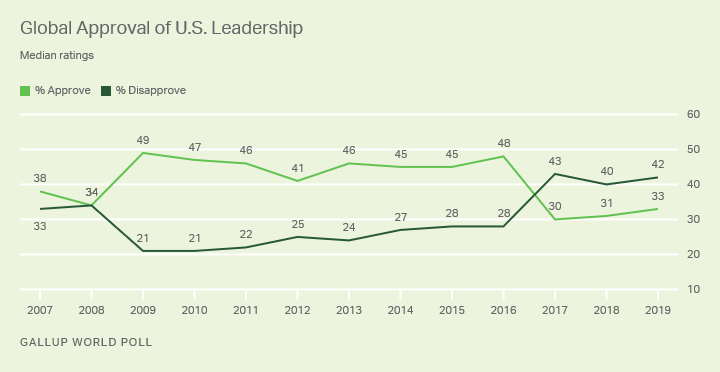
The Trump Administration has been unpopular with many in the world. Dissatisfaction with US leadership in world affairs plummeted after Mr. Trump’s election in 2016. Gallup has been conducting polls on global opinion of the US for many years and its analysis of Trump’s effect on US popularity is stark:
“After tumbling to a record-low 30% during the first year of Trump’s presidency, the image of U.S. leadership was not much better in the third year of his term. The median global approval rating for U.S. leadership across 135 countries and areas edged up to 33% in 2019. This rating is slightly higher than the previous low under Trump, but it is still one percentage point lower than the previous low of 34% under former President George W. Bush in 2008.”
Opinions in Europe (except for Poland, Kosovo, and Albania) and in Asia (except for Israel, Mongolia, Turkmenistan, the Philippines, Nepal, and Myanmar) were quite negative. Opinions in Africa (except for the north African states) were stable although low but in Latin America opinions actually improved. Interestingly, global opinions of Russia and China were also quite low:
“China and Russia continue to cluster closely together in the lower 30s. Although China edged slightly ahead of the U.S. in 2018 with an approval rating of 34%, China’s 32% rating in 2019 places it on par with the rating for the U.S. Russia’s approval rating of 30% in 2019 was unchanged from the previous year and now stands slightly lower than that of the U.S.”
The only country securing high approval ratings and where global leadership was feasible was Germany: “Across the 29 countries and areas that Gallup has surveyed so far in 2020, a median 62% approves of Germany’s leadership, up slightly from a median of 59% for this same group in 2019. Approval ratings are at, or top, previous record highs in 18 of the 29 countries.” Chancellor Merkel’s leadership appears to be quite attractive to many in the world even though she is due to step down soon. It seems unlikely, however, that the Germans would actively seek to take a more active role in world affairs.
It remains to be seen whether President-elect Biden can regain the trust that the US enjoyed during the Obama Administration. I suspect that most Americans want Biden to focus on domestic affairs and there will probably be little money available to re-establish an active US role in world affairs. In many respects, that outcome is probably desirable. But the stability of the global system is not self-executing–the expansion of influence by China, Russia, and Turkey in recent years suggests that a world system without the support of a major power or a collective of major powers could unravel into conflict fairly easily. That was the clear lesson of the years following World War I where Great Britain lacked the ability to act as a stabilizing force (not necessarily a good force) and the US lacked the will to perform a similar role.
 World Politics News