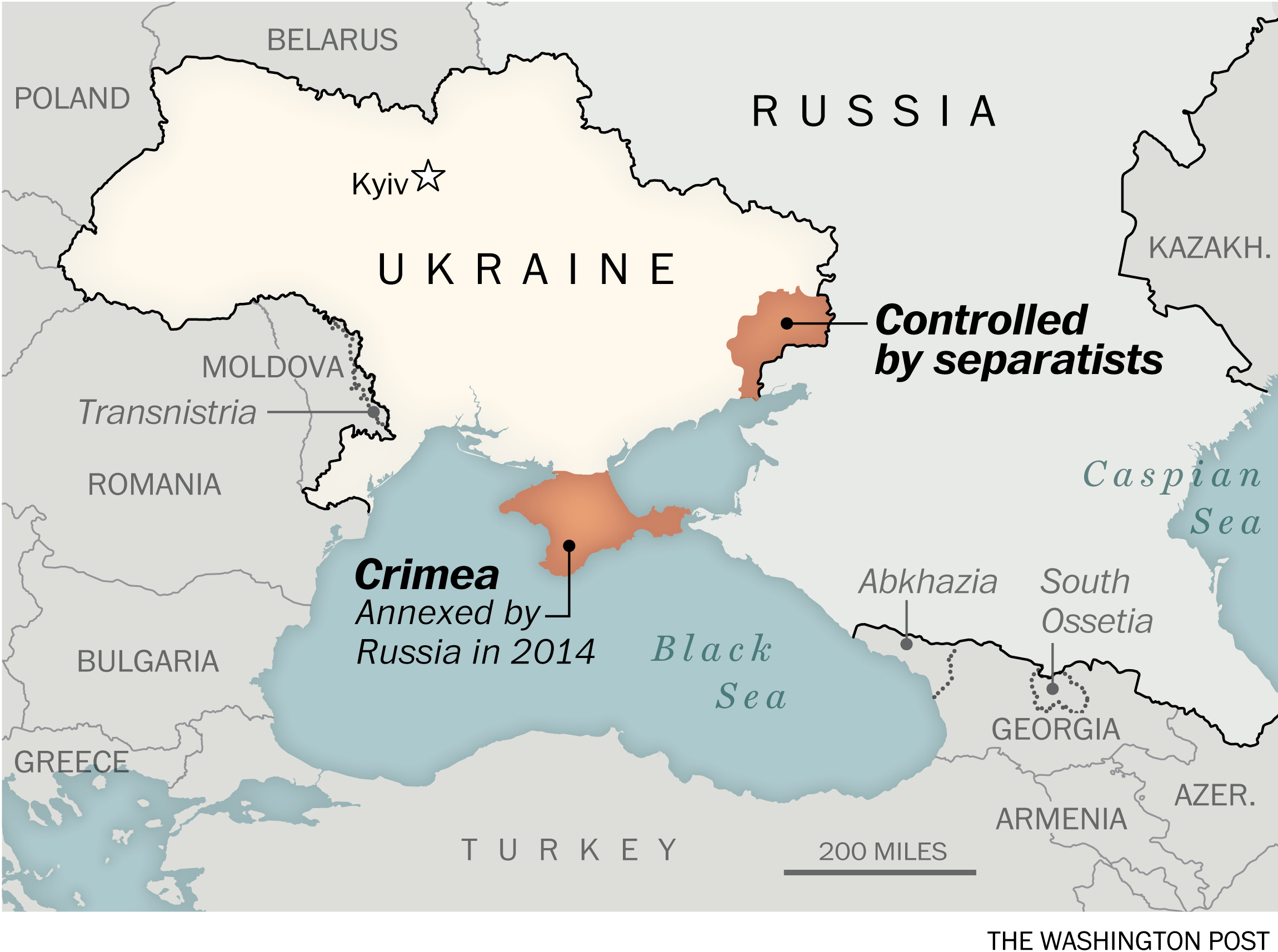
“In Ukraine, Parliament on Tuesday approved a statement declaring an ‘escalation’ along the front, essentially acknowledging that a cease-fire negotiated in July had broken down. It pointed to a ‘significant increase in shelling and armed provocations by the armed forces of the Russian Federation.’
“The statement called on Western governments to ‘continue and increase international political and economic pressure on Russia,’ something Ukraine has been requesting for years. The United States and European allies have imposed financial sanctions on Russia, targeting President Vladimir V. Putin’s inner circle, banks and oil companies.”
Since 2018 there have been 8 cease-fires between Ukraine and the Russian separatists, the most recent of which was brokered by the the Organization for Security and Cooperation in Europe. That cease-fire has broken down. Ukraine cut off water supplies to Crimea after the Russian invasion in 2014 and there are fears that Russia will try to divert water from the Dnieper River in Ukraine in order to address the water shortages in Crimea. Such a move would unquestionably trigger a higher level of violence.
We still do not know if Russia is serious about consolidating its control in Crimea and Eastern Ukraine or whether the Russians are testing the US commitment to Ukraine. It is a deadly game and the Ukrainians have asked for membership consideration to NATO. Reuters quotes the Ukrainian President: “‘NATO is the only way to end the war in Donbass,’ Zelenskiy told NATO Secretary General Jens Stoltenberg in a phone call, according to a statement from Zelenskiy’s office. A Membership Action Plan laying out Ukraine’s entry path into the alliance ‘will be a real signal for Russia’, he said.”
I sincerely doubt that US President Biden would seriously entertain such a proposal since the Russians would regard the move as highly provocative. It would replicate many of the passions that the US and Russia endured in Georgia in 2008 when US President George W. Bush broached the idea of Georgian membership in NATO. Ted Galen Carpenter relates that struggle in The National Interest:
“Bush and other officials were effusive in their praise of Saakashvili and Georgia’s democratic revolution. In a May 2005 speech in Tbilisi, Bush hailed Georgia as ‘a beacon of liberty’ and praised that country’s self-styled democrats for creating the template for other ‘color revolutions.’ Therefore, he believed that Georgians deserved special recognition. ‘Your courage is inspiring democratic reformers and sending a message that echoes around the world: Freedom will be the future of every nation and every people on Earth.’ He added (erroneously) that Georgia itself was ‘building a democratic society where the rights of minorities are respected; where a free press flourishes; where a vigorous opposition is welcomed and where unity is achieved through peace.’
“Bush also had pushed the NATO allies to give Georgia (and Ukraine) membership in the Alliance. Even though French and German opposition postponed that scheme, Saakashvili apparently believed that NATO would confront Russia militarily in any showdown between Moscow and Tbilisi. In August 2008, he launched a military offensive to regain control of a breakaway region, South Ossetia, which had been under the protection of Russian peacekeeping forces since the early 1990s. Unfortunately, Saakashvili’s offensive also inflicted casualties on the Russian peacekeeping troops. Moscow responded with a full-scale counteroffensive that soon led to the occupation of several Georgian cities and brought Russian troops to the outskirts of the capital….
“The parallels between Washington’s excessive encouragement of Ukraine and Bush’s blunder with respect to Georgia are eerie and alarming. Vladimir Putin’s government has given the West numerous warnings over the years that attempting to make Ukraine a NATO military client crosses a bright red line in terms of Russia’s security. The Kremlin’s 2014 annexation of Crimea in response to the U.S.-European Union campaign to help demonstrators oust Ukraine’s elected, pro-Russia government and replace it with a pro-West regime should have conveyed that message with great clarity.”
James Goldgeier, writing in Foreign Affairs, suggests that the Ukrainian confrontation is only one of the many issues that rattles the US-Russian relationship. His essay is a decidedly bleak overview of that relationship: “As Biden begins his presidency, one aspect of U.S.-Russian relations is over: the high hopes for what an incoming U.S. president can achieve. The SolarWinds hack, Russian election interference, the conflict in Ukraine, and the poisoning and arrest of the Russian opposition leader Alexei Navalny are just some of the issues that will hinder any return to a more positive U.S.-Russian relationship. But ever since Putin first became president more than 20 years ago, the bigger issue has been the clashing ambitions that U.S. and Russian leaders have for the world and especially for Europe. Although it is possible that Trump would have bowed to Putin’s vision in a second term, Moscow’s and Washington’s conflicting visions will be on full display in the Biden years.”
There is political turmoil in Jordan, one of the US’s most reliable allies in the Middle East. According to CNN: “A member of the Jordanian royal family and the former head of the royal court were arrested on Saturday due to ‘security reasons,’ according to Jordan’s state news agency Petra, and the country’s former crown prince claimed he has been told not to leave his home. Former Crown Prince Hamzah bin Hussein had released a video in which he stated he blamed the country’s leaders of being responsible for “the breakdown in governance, for the corruption, and for the incompetence that has been prevalent in our governing structure for the last 15 to 20 years, and has been getting worse by the year.”
King Abdullah has ruled Jordan since 1999 and he has walked a very difficult line between US interests in supporting Israel and the sentiments of the large Palestinian population in Jordan which opposes Israel’s control of the West Bank. Tensions between the Palestinians and the Jordanian government are long-standing, and there was a major break in 1970-71 which is referred to as Black September which led to the ouster of the Palestine Liberation Organization from Jordan. Additionally, the Jordanian economy, which is based on territory which has few valuable resources, has been ravaged by the COVID pandemic. Finally, relations between Israel and Jordan have been strained over the last few months as Israel continues to exercise greater control over East Jerusalem which was once under control of Jordan, compromising King Abdullah’s claim to be the custodian of the al Aqsa mosque, one of the holiest sites to many Muslims:
“Israel recognised the Hashemite role as safekeepers of al-Aqsa as part of the two countries’ 1994 peace treaty, and maintains overall security control over the holy site.
“Amman has long condemned what it says are Israeli efforts to restrict non-Jewish access to the 35-acre (14-hectare) compound, known to Muslims as the Noble Sanctuary and to Jews as the Temple Mount.
“Israel cites security concerns for restricting the access of Palestinians in the occupied West Bank to the site and any limits it imposes on the number of Muslim worshippers allowed into the compound.”
The current situation resembles that of an attempted coup d’etat, but Jordan refuses to characterize it as such, even though 20 people have been arrested. King Abdullah has received strong messages of support from its Sunni Arab allies in the region and one can expect the US to continue its strong support for him. At this point it is not clear why Hamzah, King Abdullah’s oldest son, released the critical video or what his interests may be. The New York Timesdescribes the family relationships in the Jordanian royal family:
“King Abdullah II, 59, has reigned since 1999, having succeeded his father, King Hussein. In a sign of earlier palace intrigue, Abdullah replaced Hassan bin Talal, a brother of King Hussein, as crown prince just weeks before his father’s death. Hassan had apparently fallen out of favor after making some moves that were widely interpreted as an attempt to consolidate his own power while King Hussein was undergoing treatment for cancer.
“The current crown prince is King Abdullah II’s son, Hussein bin Abdullah, 26.
“Prince Hamzah is the eldest son of King Hussein and Queen Noor, his fourth wife and widow who was born to a Syrian-American family. Hamzah was named crown prince of Jordan in 1999, but his half brother, King Abdullah II, transferred the title to his son, Prince Hussein, in 2004.
“Prince Hamzah is often photographed meeting with tribal figures and is known to be popular, especially among tribal and East Bank Jordanians for his uncanny resemblance to his father, who was beloved by many in the kingdom.”
It may be a few days before we have a clearer picture of what is going on in Jordan, but this turmoil is just another wrinkle in the political instability of the region.
The Iranian nuclear deal (the Joint Comprehensive Plan of Action–JCPOA) which appeared dead last week is showing signs of life. The signatories to the agreement–Britain, France, Germany, Russia, China, and Iran–have agreed to meet next week in Vienna, although it appears as if the US and Iran will be in separate rooms for the discussion. The European Union was principally responsible for reviving the negotiations and it seems as if the announcement of the Chinese-Iranian partnership deal a few days ago was a major force in re-opening the talks. That move signaled the futility of continued US sanctions to achieve results.
The primary focus of the talks will be on the possible lifting of sanctions. The US has insisted that it will not lift the economic sanctions until Iran returns to all the original terms of the agreement; the Iranians have insisted that they will not even talk unless sanctions are lifted first. The Guardianhighlights the disagreements:
“The private discussions have focused on agreeing a framework whereby the US could start to lift sanctions in return for specific and verifiable steps by Iran to come back into full compliance with the deal. Iran has taken a series of reversible steps to reduce its compliance including increasing uranium enrichment and reducing the UN inspectors’ access to its nuclear sites.
“The US had also sought for the deal at some point to be extended in length and broadened to include other issues, such as regional security, something Iran had rejected.
“Some observers fear Biden does not understand the urgency of making progress ahead of Iran’s June presidential elections, where hardliners opposed to the principle of the deal are likely to triumph in a low-turnout election.”
The talks in Vienna will need to be carefully choreographed. The differences between the US and Iran are not irreconcilable but both sides will feel intense pressure to not appear as if they have capitulated to the other. Hardliners in both the US and Iran would use such a possibility to sink the talks.
“Washington initially insisted that Tehran must return to adhering to the limits of the deal before the sanctions are lifted. But in recent weeks, US officials have been calling for talks to negotiate mutual and gradual compliance with the accord.
“‘We can play games about who goes first. I think anyone who’s dealt with this knows that neither side is going to go first entirely,’ US envoy for Iran Rob Malley said last month.
“‘There’s going to have to be some agreement on choreographing, on synchronising. We’re open to discussing that, but it’s going to have to be discussed. It’s not going to happen simply unilaterally by one side taking all the steps and waiting.’
“Iranian Foreign Minister Mohammad Javad Zarif also signalled an openness to an approach of a gradual return to the accord earlier this week.
“Zarif confirmed next week’s talks to revive the deal, but he appeared to rule out direct negotiations with Washington.
“‘At virtual JCPOA JC meeting, Iran & EU/E3+2 agreed to resume in-person talks in Vienna next Tues,’ he wrote on Twitter on Friday.
“‘Aim: Rapidly finalize sanction-lifting & nuclear measures for choreographed removal of all sanctions, followed by Iran ceasing remedial measures. No Iran-US meeting. Unnecessary.'”
If both sides are sensitive to the constraints of the other and are careful not to describe any move as a “victory” for their side, it is possible that the JCPOA can be restored. Quiet, careful diplomacy is called for, but I think that US President Biden and Foreign Minister Zarif are up to the task.
There are reports that Russia has sent an additional 4,000 troops to the border with Ukraine. The move comes after years of a low-level of military activity in the eastern region of Ukraine called Donbass and failed attempts to broker a cease-fire among Ukrainian forces and rebels supported by Russia. Foreign Policy describes the context of the move:
“Russia recently conducted a military exercise in the region and announced last week that it would permanently base an airborne regiment in Crimea, which experts say could account for some, but not all, of the recent troop movements.
“’They are conducting a sizable deployment, and in a manner intended to be visible, but this so far does not appear to be the sort of force size one would expect for an invasion of Kherson Oblast [the Ukrainian region opposite Crimea] or a large-scale operation along those lines,’ said Michael Kofman, a senior research scientist with CNA. ‘There is a host of other activity along Ukraine’s borders, which consequently raises questions about intentions,’ he added.
“That, combined with a flare-up in fighting in eastern Ukraine between the military and Russian-backed separatists, is stoking a lot of unease in Washington and European capitals. But Kofman cautioned against alarmism. ‘To me, it does not appear that Russia is positioning itself for an imminent invasion,’ he said, adding that the build-up was more likely an effort to coerce Ukraine. Ukrainian President Volodymyr Zelensky called the actions ‘muscle-flexing’ in a Russian attempt to raise pressure amid stalled peace talks.”
“MR PRICE: Yeah, he – he did, correct. No, but I think it’s worth us reiterating it from here and, of course, when we talk about the state of the relationship between the United States and Russia, we can’t forget Russia’s ongoing aggression in Ukraine. And we’re absolutely concerned by recent escalations of Russian aggressive and provocative actions in eastern Ukraine, including violations of the July 2020 ceasefire that led to the deaths of four Ukrainian soldiers on March 26th and injuries to others. Russia’s destabilizing actions undermine the de-escalation intentions achieved through the OSCE-brokered agreement of July of last year.
“Additionally, we are aware of Ukrainian military reports concerning Russian troop movements in – on Ukraine’s borders. We are discussing our concerns about that increase in tensions and ceasefire violations and regional tensions with NATO Allies. You’ve heard from various departments and agencies including the State Department; Secretary Blinken had a call with his Ukrainian counterpart yesterday. The chairman of the Joint Chiefs of Staff had a call with his counterpart. And National Security Adviser Jake Sullivan had a call with Andriy Yermak in Ukraine as well. We will continue to be in close touch with our partners in Kyiv and in Ukraine more broadly in the face of these recent escalations.”
The Russians have struck a belligerent tone on Ukraine but it is hard to determine whether the language reflects an intent to take over additional Ukrainian territory or whether it is merely a test of the new Biden Administration. Chatham House, a reliable British think tank, published an article that observed:
“The idea that the simmering conflict in Ukraine would burst into new fighting comes after a belligerent speech Putin made at the Davos Forum at the end of January. The Russian president said that ‘foreign policy propaganda rhetoric’ was growing, and he expected ‘practical actions’ by America against Russia to become more aggressive. Such a game with no rules, he said, ‘critically increases the risk of unilateral use of military force’.
“He did not state who might be using military force, but the next day Margarita Simonyan, the boss of Russia’s RT English-language news channel, gave a fiery speech at a conference in the Russian-controlled city of Donetsk in eastern Ukraine where she said: ‘Mother Russia, take Donbass home!’ “
Russian President Putin is facing declining popularity at home and challenges from popular protests led by dissident Alexei Navalny who is how in a Russian gulag. Additionally, European states also seem to be lining up in opposition to the Russian moves near the Ukraine border.
China and Iran have signed a 25-year strategic partnership which poses a clear repudiation of The US’s strategy of pressuring Iran to return to the Joint Comprehensive Plan of Action (JCPOA). The details of the partnership are a secret and observers have asserted that its goals are “aspirational”. According to The Guardian:
“Detailed work on the agreement has taken two years, with the bulk of the recent drafting undertaken by Ali Larijani, a former speaker of the Iranian parliament.
“Although the deal has been touted as being worth $400bn, the Chinese and the Iranian foreign ministries insist no detailed contracts have been signed, so valuations of this sort are largely worthless.
“The heart of the 25-year deal is an expansion of China’s presence in Iranian banking, telecommunications, ports, railways and dozens of projects. In exchange, China would receive a regular and heavily discounted supply of Iranian oil.”
In many respects the deal appears to be consistent with China’s “Belt and Road Initiative” which it has worked out with a large number of Central Asian states. The deal, however, is a slap in the face of the US which has been trying to persuade the other signatories to the JCPOA to maintain stiff sanctions until Iran agrees to the JCPOA. The New York Times points out that “President Biden has offered to resume negotiations with Iran over the 2015 nuclear accord that his predecessor, President Donald J. Trump, abrogated three years after it was signed. American officials say both countries can take synchronized steps to bring Iran into compliance with the terms of the agreement while the United States gradually lifts sanctions. Iran has refused to do so, and China has backed it up, demanding that the United States act first to revive the deal it broke by lifting unilateral sanctions that have suffocated the Iranian economy. China was one of five world powers that, along with the U.S., signed the 2015 nuclear agreement with Iran.” The Times is also reporting that China is seeking to revive its relations with Saudi Arabia, the UAE, and other Gulf States that normally oppose Iran.
China’s move comes as the US is seeking to restart negotiations with Iran. Politico reports:
“Biden administration officials, mindful of the increasingly unfavorable calendar, plan to put forth a new proposal to jump-start the talks as soon as this week, two people familiar with the situation told POLITICO.
“The proposal asks Iran to halt some of its nuclear activities, such as work on advanced centrifuges and the enrichment of uranium to 20 percent purity, in exchange for some relief from U.S. economic sanctions, said one of the people, who stressed that the details are still being worked out.
“It’s not at all certain that Iran will accept the terms. Earlier this year, Tehran rejected a U.S. proposal it deemed unacceptable, then offered its own idea that Biden’s team declared a non-starter, two people familiar with the situation said.
“Still, officials in both countries are aware that if no breakthrough takes place over the next few weeks, little is likely to happen until September at the earliest, and that’s if the deal can be saved at all. The warnings come as progressives pressure Biden to rejoin the deal and as some officials and analysts wonder if Biden is genuine about his stated desire to see the agreement revived.
“’Iran is poised to blow through additional nuclear deal restrictions in the next few weeks. This is the crucial time to avoid an escalation of the situation,’ said Daryl Kimball, executive director of the Arms Control Association, an organization that has closely tracked nuclear negotiations involving Iran.”
There is a great deal of diplomatic movement in the Middle East as the US, Russia, and China are trying to formulate their policies toward the region. The Biden Administration has yet to clearly articulate its goals in the region and China seeks to take advantage of US indecision. It is interesting, however, to note how US influence in the region has declined so dramatically in such a short period of time. The Trump Administration’s intent of leveraging an Israeli/Saudi Arabian axis seems to have come to naught.
The National Bureau of Economic Research has published a study on tax evasion by high-income individuals in the US. This topic is particularly difficult to study since there a myriad number of legal tactics to disguise income from the Internal Revenue Service. The study does not suggest that low-income individuals do not try to disguise income, but acknowledges that the rewards for evasion are considerably higher for the wealthy:
“The model allows a taxpayer to adopt some costly form of tax evasion that is unlikely to be discovered on audit at some cost. We show that adoption of such an evasion technology is likely to be concentrated at the top of the income distribution for two reasons. First, high-income taxpayers have a greater demand for sophisticated evasion strategies that reduce the probability of detection if (i) the desired rate of evasion does not become trivial at large incomes, and (ii) the cost of adopting becomes a trivial share of income at large incomes. This is true even holding the probability of audit by income fixed. Second, overall audit rates and scrutiny of tax returns are substantially higher at the top than at the bottom of the distribution, making evasion that is less likely to be detected and corrected on audit more attractive at the top. We can also reinterpret the model to think about situations where the outcome of an audit, if it occurs, is uncertain. With this interpretation, for the same reasons as before, we show that high-income people are then more likely to adopt positions in the ‘gray area’ between legal avoidance and evasion.”
The techniques used include placing money in offshore accounts that disguise the owners of wealth, “pass-through” corporations that are exempt from corporate taxes, and by a variety of legal accounting tricks that make it difficult for the IRS to follow the money.
It is important to understand that these techniques are generally legal reflecting the bias of the tax code to favor the rich more than the poor. Additionally, the ability and willingness of the IRS to audit high-income individuals is constrained by a lack of financial support from the Congress. As reported in The Huffington Post:
“The percentage of income tax evasion generally increases with the income category, the study found. Taxpayers in the bottom half of income categories evade taxes on around 7% of their income. Taxpayers in the top fifth evade taxes on 10% of their income, with the richest 5% avoiding taxes on at least 20% of income.
“The average annual income of the top 1% of earners is approximately $1.7 million. They collect some 20% of the money earned annually in the nation, according to the Pew Research Center.
This bias aggravates the problem of economic inequality in the US which is the worst of all the rich countries. The Pew Research Center documents how the situation of inequality has significantly worsened over time:
“The wealth gap between America’s richest and poorer families more than doubled from 1989 to 2016,according to a recent analysis by the Center. Another way of measuring inequality is to look at household wealth, also known as net worth, or the value of assets owned by a family, such as a home or a savings account, minus outstanding debt, such as a mortgage or student loan.
“In 1989, the richest 5% of families had 114 times as much wealth as families in the second quintile (one tier above the lowest), at the median $2.3 million compared with $20,300. By 2016, the top 5% held 248 times as much wealth at the median. (The median wealth of the poorest 20% is either zero or negative in most years we examined.)”
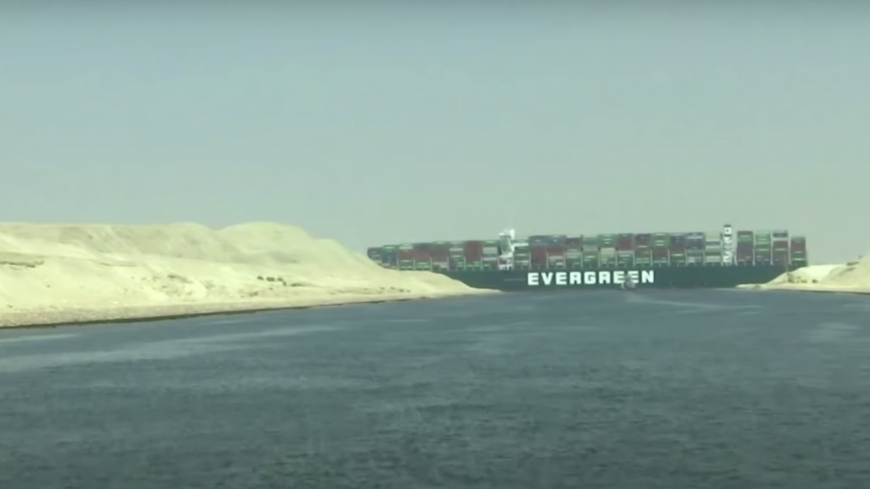
There is a traffic jam in the Suez Canal, caused by the grounding of a container ship, Ever Given (owned by Evergreen Marine of Taiwan and sailing under a Panamanian flag), the length of the Empire State building. The vessel ran aground due to high winds, and ships sailing both north and south have been forced to anchor in place. Shutting down the Suez Canal has a dramatic effect on the global economy, and CNN assesses the significance of the canal:
“The passage accounts for approximately 30% of container ship traffic globally each day, according to Reuters, with the alternative shipping route between Asia and Europe — navigating around the African cape — taking a week longer.
“Nearly 19,000 ships, or an average of 51.5 ships per day, with a net tonnage of 1.17 billion tonnes passed through the canal during 2020, according to the Suez Canal Authority.”
It is not clear how long it will take to refloat the ship, but the longer it takes, the more effect it will have on the world economy. Crude oil prices briefly surged when the news was announced, but have since returned to its earlier prices. But the stoppage highlights the vulnerability of oil prices to such chokepoints, raising fears about Iranian abilities to stop ship traffic through the Strait of Hormuz.
Although it is several years old, the data visualization firm Kiln and University College London’s Energy Institute produced a fascinating map of the movement of world commercial vessels in 2012 which can be accessed here.
Australia suffered some of the worst wildfires in its history in 2019-20, fires which were attributed to devastating droughts. Today, Australia is enduring unprecedented flooding. The Washington Post reports:
“Most of eastern New South Wales and southeast Queensland has seen four inches or more of rainfall since late last week, with many locales picking up a great deal more:
Comboyne, about 150 miles northeast of Sydney on the Mid North Coast, had received a staggering 35 inches by Monday morning local time. Sydney itself had its wettest day of the year Sunday with 4.4 inches.
Minnie Water, about 125 miles south of Brisbane in New South Wales, had seen more than 10 inches of rain since between 9 a.m. local time Monday and midnight. Nambucca Heads, just to the south, had tallied 9.6 inches, while nearby Woolgoolga saw 7.2 inches.
Reuters reported the flooding in Sydney’s western regions was the worst since 1961.
The floods come at the end of a wetter-than-average summer, with dams and catchments at close to capacity.”
Millions of Australians have been evacuated because of the floods which are expected to continue for two more days. Counterintuitively, climate change is likely responsible for both the wildfires and the flooding. Extended droughts are associated with climate change as are periods of intense rainfall. Robert Glasser, writing for the Sydney Morning Herald, explains:
“Premier Gladys Berejiklian has described the devastating flooding in NSW as a ‘one-in-100-year event’ that was ‘beyond anyone’s expectations’. She’s wrong on both counts. Climate change is rapidly increasing the frequency and severity of extreme weather events such as the floods that are now spilling over Warragamba Dam.
“Little over a year ago, the unprecedented Black Summer bushfires also threatened the dam and its catchment, a critical source of Sydney’s water supply. These back-to-back disasters are becoming the new normal.
“For many Queenslanders, this is the new normal. In just the past three years, 53 of that state’s 77 local governments have been buffeted by three or more major disasters.
“It is no longer useful or accurate to describe disasters such as the current floods as one-in-100-year events. These determinations are based on Australia’s historical experience of floods in a stable climate, not one in which the global average temperature has now risen by more than one degree and is probably on its way to at least two degrees.
“The rapid pace of global change is completely outside of human experience. In only a matter of decades, for example, what has historically been a one-in-100-year extreme coastal flood will become annual events in most places.
Australians now have to endure droughts, floods, and the COVID pandemic. Climate change seems to be creating catastrophes of biblical proportions.
The hostility against Asians and Asian-Americans in the US has been growing since China was identified as the source of the coronavirus early in 2020, hostility which has been deliberately stoked by officials in the US government and rampant speculation in social media. It would be a mistake, however, to think that such sentiments only began in 2020. Anti-Asian sentiments have been almost constant in the history of the United States.
Asian immigration on a large scale into the US began in the 19th century and Asians and Asian-Americans constitute one of the largest constituencies in the country:
“As of 2019, there were 14.1 million immigrants from Asia residing in the United States, representing a 29-fold increase from 1960. Today, people born on the continent of Asia account for 31 percent of the 44.9 million immigrants in the United States. This number refers to national origin, not race or ethnicity; while most immigrants from Asian countries identify as Asian, others describe themselves as White or as members of other racial groups.
“Asia is the second-largest region of birth for U.S. immigrants, after the Americas, and since 2013 India and China have been the leading origin countries, displacing Mexico. Looking forward, arrivals from Asia are projected to comprise a greater share of all immigrants, becoming the largest foreign-born group by 2055, according to Pew Research Center estimates.”
Asian immigrants into the US started largely because of the growth of the Pacific economies in the US and the immigration focused in the urban areas of San Francisco and Los Angeles. That growth inspired anti-Asian feelings as many in the US feared the effects of Asian immigration on employment. Those feelings erupted into violence fairly soon after the arrival of the immigrants:
“With the first wave of East Asian immigration to the United States in the 1850s, ‘there was discrimination and violence … right away,’ Chris Kwok, a board member of the Asian American Bar Association of New York, told TODAY. ‘Since the Chinese were here first in large numbers, that set the framework for the political and social treatments of almost all other Asian immigrants.’
“Many Chinese people who emigrated to the western U.S. during the gold rush were ‘driven out of town’ out of fear they were driving down wages, he added. ‘They didn’t want to accept them as American.’
“During this period, some 300 Chinese settlements were displaced, Jeung told TODAY. In 1906, a fishing village of 200 people outside Monterey, California, where his family lived at the time, was burned down, he said.
“Kwok added that there were ‘many, many recorded lynchings and killings, but obviously not on the same scale as Native Americans and African Americans.’
“In the 1871 Chinese massacre, rioters killed 10% of the Chinese population in Los Angeles, about 18 people, according to the L.A. Public Library. Eight people were convicted of manslaughter, but the convictions were overturned and no one was retried. In 1885, white mobs in Rock Springs, Wyoming, murdered 28 Chinese coal miners, wounded 15 more and burnt down the city’s Chinatown, according to the state’s historical society.”
“An 1854 California Supreme Court Case called the People v. Hall also set a dangerous precedent by ruling that an Asian person couldn’t testify against a white person in a criminal proceeding.
“‘That understanding that there would be no legal repercussions for violence against Chinese people just changed … the way that white people in America interacted with Chinese,’ Beth Lew-Williams, history professor at Princeton University and author of ‘The Chinese Must Go: Violence, Exclusion, and the Making of the Alien in America,’ told TODAY. ‘They were seen as open to attack.'”
In 1882 the US Congress passed the Chinese Exclusion Act which was the first piece of legislation regulating immigration into the US.
” This act provided an absolute 10-year moratorium on Chinese labor immigration. For the first time, Federal law proscribed entry of an ethnic working group on the premise that it endangered the good order of certain localities.
“The Chinese Exclusion Act required the few nonlaborers who sought entry to obtain certification from the Chinese government that they were qualified to immigrate. But this group found it increasingly difficult to prove that they were not laborers because the 1882 act defined excludables as “skilled and unskilled laborers and Chinese employed in mining.” Thus very few Chinese could enter the country under the 1882 law.
“The 1882 exclusion act also placed new requirements on Chinese who had already entered the country. If they left the United States, they had to obtain certifications to re-enter. Congress, moreover, refused State and Federal courts the right to grant citizenship to Chinese resident aliens, although these courts could still deport them.
“When the exclusion act expired in 1892, Congress extended it for 10 years in the form of the Geary Act. This extension, made permanent in 1902, added restrictions by requiring each Chinese resident to register and obtain a certificate of residence. Without a certificate, she or he faced deportation.
“The Geary Act regulated Chinese immigration until the 1920s.”
Early in this period, sensationalist newspapers in the US hyped up what was termed the “Yellow Peril” which held that Asian culture was incompatible with US culture. The anti-immigrant sentiment continued to grow in the US and in 1924 the US Congress passed the National Origins Act which severely limited immigration into the US:
“The National Origins Act specified that quotas be based on nationalities in proportion to the original nationality of the White population of the United States in 1920. Non-European peoples residing in the country were omitted from the population universe governing the quotas, including (a) all Blacks and mulattoes; (b) residents of groups deemed ineligible for citizenship, including Chinese, Japanese, and South Asians; and (c) populations of Hawai‘i, Puerto Rico, and Alaska. In effect, the National Origins System effectively ignored and indeed excluded all non-White, non-European peoples from the future vision of the United States.”
Anti-Asian immigration also spiked in one of the more shameful episodes of American history: the incarceration of Japanese and Japanese-Americans during World War II. One can more fully appreciate how egregious this act was by noting that Germans and German-Americans were not incarcerated during the war, even though their numbers were substantially larger than those of Japanese and Japanese-Americans.
So the current wave of anti-Asian sentiment, while significantly more intense than it has been in recent years, is not a new phenomenon. And it continues to present a serious challenge to those Americans who do not subscribe to the ideology of America as a white, Christian nation. The sentiment also poses a problem for the Biden Administration as it continues to formulate a policy toward China, North and South Korea, Japan, and the countries of South and Southeast Asia. Domestic policy is always part of foreign policy.





 World Politics News