“Scipio, beholding this city, which had flourished 700 years from its foundation and had ruled over so many lands, islands, and seas, rich with arms and fleets, elephants and money, equal to the mightiest monarchies but far surpassing them in bravery and high spirit (since without ships or arms, and in the face of famine, it had sustained continuous war for three years), now come to its end in total destruction – Scipio, beholding this spectacle, is said to have shed tears and publicly lamented the fortune of the enemy.
“After meditating by himself a long time and reflecting on the rise and fall of cities, nations, and empires, as well as of individuals, upon the fate of Troy, that once proud city, upon that of the Assyrians, the Medes, and the Persians, greatest of all, and later the splendid Macedonian empire, either voluntarily or otherwise the words of the poet escaped his lips:
The day shall come in which our sacred Troy And Priam, and the people over whom Spear-bearing Priam rules, shall perish all. [Homer, Iliad, 6.448-449]
“Being asked by Polybius in familiar conversation (for Polybius had been his tutor) what he meant by using these words, he said that he did not hesitate frankly to name his own country, for whose fate he feared when he considered the mutability of human affairs. And Polybius wrote this down just as he heard it.”
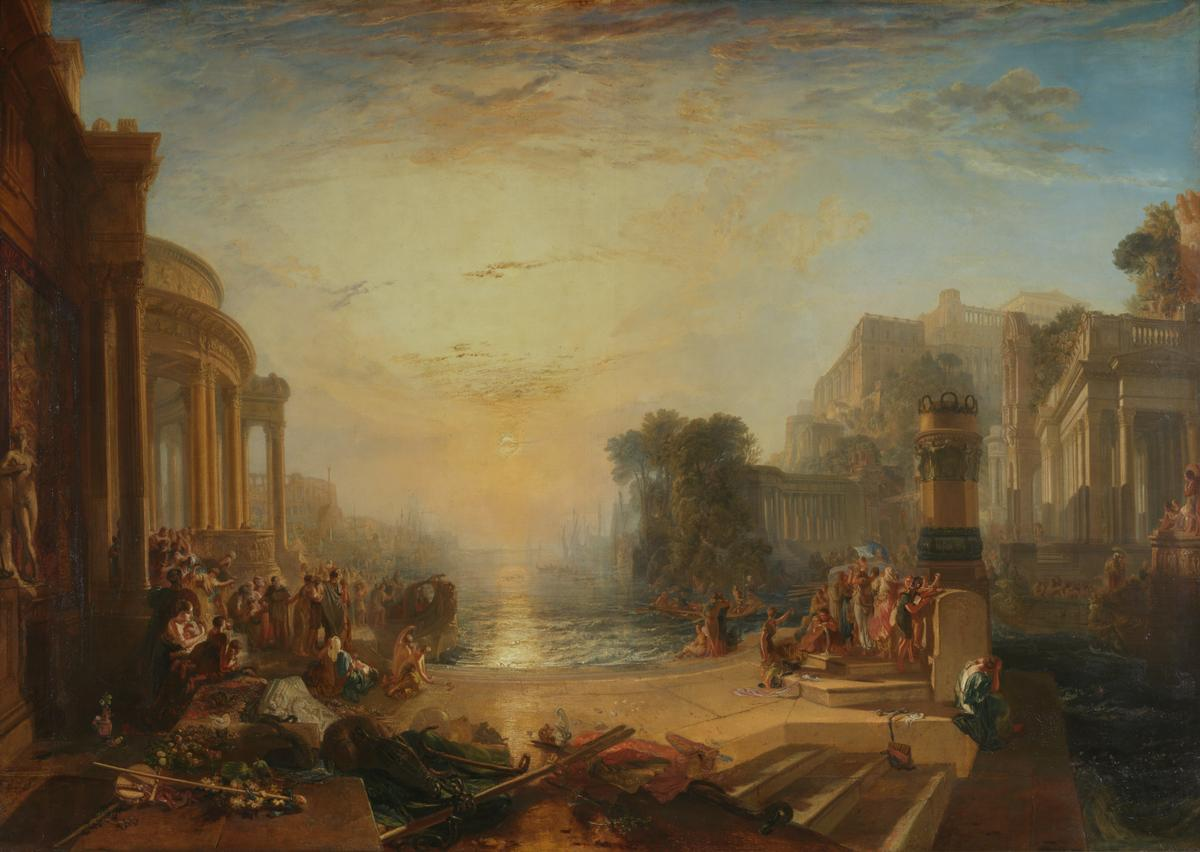
“The Decline of the Carthaginian Empire” Joseph Mallord William Turner, 1817
Over the weekend, Israeli Prime Minister Netanyahu sat for an interview with ABC News. In that interview, he indicated that Israel would maintain a security presence in the Gaza Strip after the conflict dies down (presumably after Hamas is “eliminated”):
“I think Israel for an indefinite period will have the overall security responsibility because we’ve seen what happens when we don’t have it. When we don’t have that security responsibility, what we have is the eruption of Hamas terror on a scale that we couldn’t imagine.”
The United States has indicated that it does not support an indefinite occupation of the territory, although it has waffled on whether it would support a temporary reoccupation. From the US State Department press briefing on 7 November:
QUESTION: Okay. And then if I could ask about some comments that Netanyahu made yesterday —
MR PATEL: Sure.
QUESTION: — about who should govern Gaza when fighting is over, he said he thinks Israel for an indefinite period will have overall security responsibility. What’s your take on those comments? Have you sought any clarification from the Israeli Government about what they meant by that? Do you have any concerns?
MR PATEL: So we, of course, engage with our partners in the Israeli Government about a numerous number of things, especially currently as this situation continues to be ongoing. I would refer you to the prime minister’s office for further elaboration on that particular quote. Our viewpoint is that Palestinians must be at the forefront of these decisions, and Gaza is Palestinian land and it will remain Palestinian land. And generally speaking, we do not support reoccupation of Gaza, and neither does Israel. Secretary Blinken was fairly clear about that during his travels as well.
But it’s important to note that, at the same time, we agree with Israel that there is no returning to the October 6th status quo. Israel and the region must be secure, and Gaza should and can no longer be a base from which to launch terror attacks against the people of Israel or anyone else. And so we’re working with partners on various scenarios – on interim governance, on security parameters, on security situations in Gaza – for once this crisis recedes. But I’m not going to get ahead of that process or get into it from here.
Netanyahu’s statement gives no inkling on whether Israel will honor international law which requires an occupying power to provide for the well-being of people held in the occupation. The United Nations Office of the High Commissioner on Human RIghts issued a summary of the obligations of an occupying power in 2017:
“The duties of an occupying power are spelled out primarily in the 1907 Hague Regulations (articles 42-56), the Fourth Geneva Convention, and Additional Protocol I to the Four Geneva Conventions. The overarching principle is that an occupant does not acquire sovereignty over an occupied territory and therefore any occupation must only be a temporary situation. The occupant has an obligation to ensure the well-being of the population, and is prohibited from making permanent changes to the territory in the judicial, economic, or social spheres. The main duties of the occupying power under international law can be summarised as follows:
The occupying power must respect the laws in force in the occupied territory, unless they constitute a threat to its security or an obstacle to the application of the international law of occupation. The occupying power must take measures to restore and ensure, as far as possible, civil life and public order and safety.
To the fullest extent of the means available to it, the occupying power must ensure sufficient hygiene and public health standards, as well as the provision of food and medical care to the population under occupation. The population in occupied territory cannot be forced to enlist in the occupier’s armed forces. Collective or individual forcible transfers of population from and within the occupied territory are prohibited. Transfers of the civilian population of the occupying power into the occupied territory, regardless whether forcible or voluntary, are prohibited. Collective punishment and measures of intimidation are prohibited.
The taking of hostages is prohibited. Reprisals against protected persons or their property are prohibited. The confiscation of private property by the occupant is prohibited.
The destruction or seizure of enemy property is prohibited, unless absolutely required by military necessity during the conduct of hostilities. Cultural property must be respected. People accused of criminal offences shall be provided with proceedings respecting internationally recognised judicial guarantees (for example, they must be informed of the reason for their arrest, charged with a specific offence and given a fair trial as quickly as possible). Food and medical supplies may be requisitioned exclusively for the use of the occupation forces and administration personnel themselves (i.e., not for purposes of export outside of the occupied territory and not for the benefit of anyone beyond the occupying personnel, unless necessary for the benefit of the population under occupation itself) and only if the needs of the civilian population have been taken into account.
These are heavy responsibilities, particularly the requirement that “the occupying power must ensure sufficient hygiene and public health standards, as well as the provision of food and medical care to the population under occupation.” It is not clear that the Israeli population will be willing to pay for the needs of the 2.1 million people who lived in the Gaza prior to the war. Indeed, it is not clear that those who fled the war and fled to the southern part of the Gaza will be allowed to return to the northern part of the Strip.
Option A: The population remaining in Gaza and the import of Palestinian Authority (PA) rule.
Option B: The population remaining in Gaza along with the emergence of a local Arab authority.
Option C: The evacuation of the civilian population from Gaza to Sinai
The memo recommends Option C: “The option that will yield positive, long-term strategicoutcomes for Israel, and is an executable option. It requiresdetermination from the political echelon in the face of internationalpressure, with an emphasis on harnessing the support of the United Statesand additional pro-Israeli countries for the endeavor’
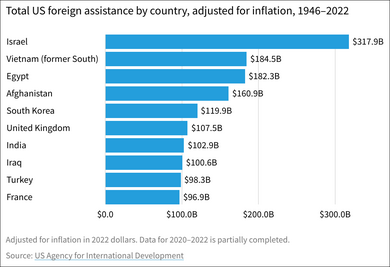
I sincerely doubt that the rest of the world will support Option C, but the critical determinant is whether the US will approve the option. The Biden Administration should make clear to Israel that it will not support Option C under any circumstances. If pressed on the matter, the US should end its support for Israel’s military operations. The Netanyahu government will then have to decide whether it accepts the end of the annual support the US gives Israel (around $3.5 billion a year).
The news is certainly dispiriting, and I don’t have any insights to share. My thoughts are with the people in the Gaza Strip who are desperately trying to seek shelter. I often turn to music when I’ve run out of ideas. The need to provide shelter to the innocent civilians, both Palestinian and Israeli, is overwhelming, and, curiously, the idea of shelter reminded me of an old Rolling Stones song, “Gimme Shelter” which was released in 1969. The Stones had a gift for hiding very good ideas within their raunchy songs and “Gimme Shelter” is a good example of how the group tried to send messages to those who listened carefully.
Wikipedia provides the context of the song which explains why I thought of it as the war in Gaza continues unabated:
“As released, the song begins with Richards performing a guitar intro, soon joined by Jagger’s lead vocal. Of Let It Bleed‘s bleak world view, Jagger said in a 1995 interview with Rolling Stone magazine:
‘Well, it’s a very rough, very violent era. The Vietnam War. Violence on the screens, pillage and burning. And Vietnam was not war as we knew it in the conventional sense. The thing about Vietnam was that it wasn’t like World War II, and it wasn’t like Korea, and it wasn’t like the Gulf War. It was a real nasty war, and people didn’t like it. People objected, and people didn’t want to fight it … That’s a kind of end-of-the-world song, really. It’s apocalypse; the whole record’s like that.’
‘It was a very moody piece about the world closing in on you a bit … When it was recorded, early ’69 or something, it was a time of war and tension, so that’s reflected in this tune. It’s still wheeled out when big storms happen, as they did the other week [during Hurricane Sandy]. It’s been used a lot to evoke natural disaster.'”
The lyrics are profoundly simple (not unusual for Rock and Roll), but the words match perfectly with the music (which is also primitive). The combination is, for me, powerful. But at around 2:39 minutes into the song there is a very dramatic vocal event which conveys intensity, desperation, and commitment and makes the song significantly more dramatic and human.
The backup vocal is performed by a woman named Merry Clayton (her name is misspelled “Mary” on the original album cover). Radio station KSAT in south Texas describes how she came to record with the Rolling Stones:
“One day, Merry Clayton was in her bed, pregnant, with hair curlers in and silk pajamas on, when she received a phone call at her Los Angeles home about midnight in the autumn of 1969, according to Far Out.
“At the time, Clayton was a 20-year-old with extensive singing experience, having sung at her father’s church as a child. She had started her recording career at age 14….
On the other line was producer Jack Nitzchke, who said there were some musicians in town from England who wanted a female vocalist to help with a song.
Those musicians happened to be the Rolling Stones, and the song was “Gimme Shelter,” but Clayton had no clue who the Rolling Stones were and initially resisted.
After all, she was pregnant, tired and almost in bed with her husband.
But after being convinced by her husband to go help out, Clayton put on a coat and went outside to a car waiting to take her to the studio.
Clayton was still in her hair rollers and her pajamas when she arrived to meet the band.”
Unfortunately, Clayton suffered a miscarriage after the recording. But her voice made an otherwise good song into one which stands as one of the most powerful antiwar songs ever recorded.
My heart breaks when I hear Clayton’s voice crack. We all seek shelter at times but the idea of shepherding children and elderly people through a war zone is impossible to comprehend except through experience. The same is true for all refugees who endure horrific travails as they seek some place which offers safety.
Today, Israeli Prime Minister Netanyahu, when asked about a cease-fire in the conflict in Gaza, said: ““That will not happen. The Bible says that there is a time for peace and a time for war. This is a time for war.”
It is not war; it is slaughter.
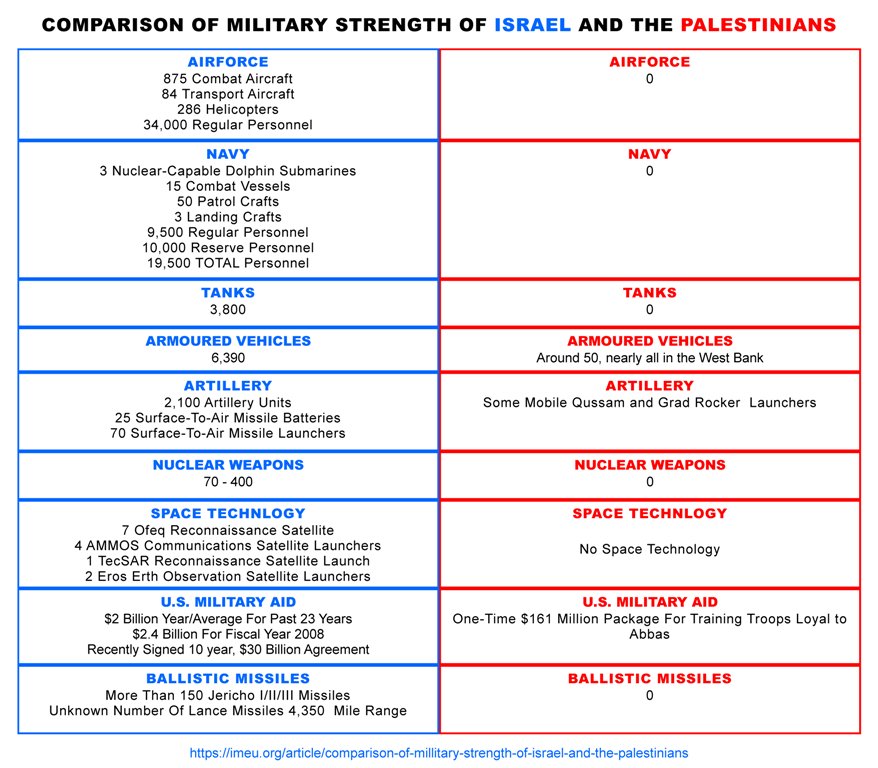
There really is no comparison between the military arsenals of Israel and Hamas. The chart below is from 2009, but the military balance now is even more heavily weighted toward Israel.
In addition, Israel has the Iron Dome air defense system to defend itself against rocket attacks. Hamas has no similar defense.
The overwhelming military superiority of Israel allows it to conduct its operations at arms-length. Nonetheless, Israel has mounted a ground invasion of Gaza which will require even more attacks from the air to protect Israeli soldiers on the ground. The Palestinians have no place to go to avoid these attacks–Egypt has kept the southern crossing closed and the Israeli army and navy keeps the other possible exits closed.
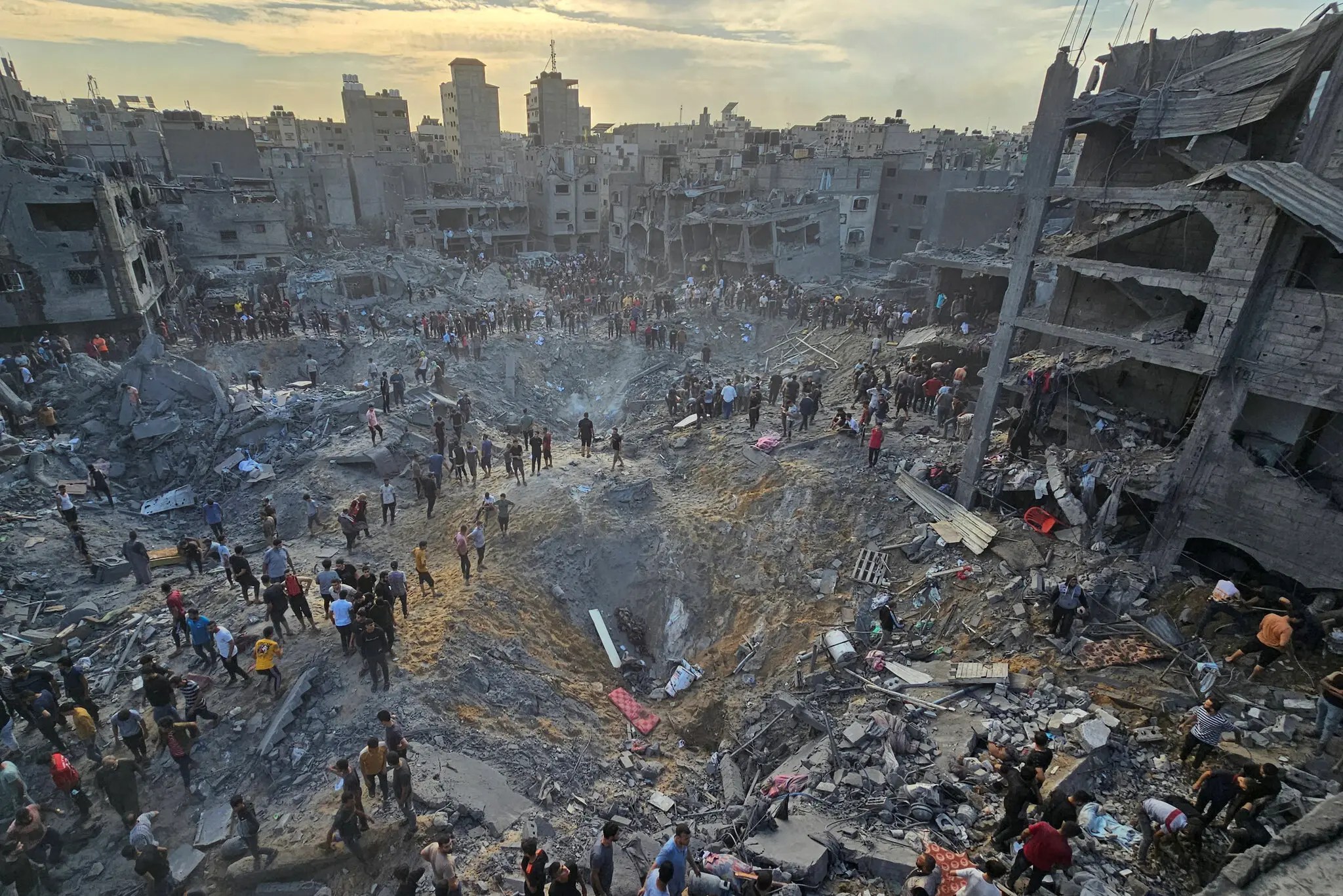
Today, the asymmetry was obvious as the Israelis bombed the Jabaliya refugee camp to kill Ibrahim Biari, a Hamas commander who the Israelis called one of the ringleaders to the 7 October attack.
Jabaliya Refugee Camp after the Bombing
We do not know how many innocents were killed by the air strike. The calculation made by Israel that the death of one commander justified the deaths of these innocents is depraved. I am certain that Israel takes every necessary step to avoid civilian deaths, but Hamas is not using civilians as shields. The Gaza Strip has a population of over 2 million people and spans only 140 square miles. There is probably no way to conduct large-scale aerial attacks against Hamas without jeopardizing civilian lives.
Israel unquestionably has the right of self-defense but the ground invasion does not offer any defense unless the Gaza Strip is depopulated. Depopulation may be an unstated objective of the Netanyahu government because if any Palestinians remain in Gaza, they will be implacably opposed to the state of Israel after this conflict. The Netanyahu government is simply sowing the seeds of another war.
The international community should demand an immediate cease-fire. The UN General Assembly approved such a resolution on 27 October:
“The U.N. General Assembly approved a nonbinding resolution Friday calling for a “humanitarian truce” in Gaza leading to a cessation of hostilities between Israel and Gaza’s Hamas rulers, the first United Nations response to the war.
“The 193-member world body adopted the resolution by a vote of 120-14 with 45 abstentions after rejecting a Canadian amendment backed by the United States. It would have unequivocally condemned the Oct. 7 ‘terrorist attacks’ by Hamas and demanded the immediate release of hostages taken by Hamas, which is not mentioned in the Arab-drafted resolution.”
But the General Assembly does not have the authority to order a cease-fire, only the UN Security Council can compel action on sovereign signatories. The Russian Federation introduced a cease-fire resolution which ” would have strongly condemned all violence and hostilities directed against civilians and all acts of terrorism. By its further terms, it would also have called for the secure release of all hostages and unimpeded provision and distribution of humanitarian assistance, including of food, fuel and medical treatment.” Of the five members of the Security Council with the power of veto, only Russia and China voted for the resolution. The US, France, and Great Britain voted against the resolution.
The United States should itself introduce another resolution to the Security Council calling for an immediate cease-fire–not some bootless “humanitarian pause”. And the US should announce that it would not offer Israel any further assistance except for defensive weaponry such as missiles for the Iron Dome until hostilities have subsided. That decision would have enormous implications for US-Israeli relations, but the US should not be an accomplice to violence against civilians.
The proposed action is unquestionably drastic and unfortunate. Israel has been a good ally of the US, but the Netanyahu government has been pursuing policies that do not serve US interests. Indeed, the continued slaughter of civilians will only force Hezbollah in Lebanon to join the battle, likely bringing Iran into the conflict. The last thing we would want is for an Israeli attack on Iran–long an objective of the Netanyahu government–because that escalation would be very difficult to control.
Israel is conducting a very intense military campaign on what it regards as places where terrorists can be found. The emphasis of the Israeli attacks is on the Gaza Strip, but it has also conducted attacks on southern Lebanon, Syria, and Iraq. The Israeli government justifies these actions as acts of legitimate self-defense against those who conducted the brutal raid on Israeli kibbutzim on 7 October. I firmly believe in the right of states to self-defense, but believe that current Israeli actions do not fall under that exception for the legitimate use of violence.
The 7 October attack was unquestionably a war crime and an abomination, and the grievous state of the Palestinian population in the Gaza Strip does not in any way justify the acts committed against Israeli and foreign citizens. Israel is justified in trying to prevent a repeat of those horrific actions.
The relevant question is what does it mean to eliminate Hamas? And will military action eliminate Hamas? I think there is a great deal of ambiguity about what that objective means. The Israeli Defense Minister, Yoav Gallant, said that “We will eliminate everything”:
Giora Eiland is a senior research associate at the Institute for National Security Studies and former head of the Israeli National Security Council and he made this comment: “Gaza will become a place where no human being can exist, and I say this as a means rather than an end. I say this because there is no other option for ensuring the security of the State of Israel. We are fighting an existential war.” Revital “Tally” Gotliv, a member of the Knesset for Israel PM Benjamin Netanyahu’s Likud party, said this: “‘I urge you to do everything and use Doomsday weapons fearlessly against our enemies,’ adding that Israel ‘must use everything in its arsenal,’ she said, adding, ‘Only an explosion that shakes the Middle East will restore this country’s dignity, strength and security! It’s time to kiss doomsday. Shooting powerful missiles without limit. Not flattening a neighbourhood. Crushing and flattening Gaza. … without mercy! without mercy!’” Finally, Finance Minister Bezalel Smotrich declared, “It’s time to be cruel,” and Knesset member Ariel Kallner called for a “Nakba that will overshadow the Nakba of 48,” a reference to the massacre and expulsion of more than 750,000 Palestinians upon Israel’s founding. These are the opinions of individuals and not necessarily that of the Israeli government, but some of these statements come from officials within that government.
These are not calls for self-defense. These statements reflect the accurate assessment that Hamas exists in the context of a population of 2.1 million people, half of which are children. Under such circumstances, it is unquestionably difficult to separate civilians from combatants. Using Mao’s fish/water metaphor for the relationship between guerilla forces and the civilian population, one can ask the question: is it morally acceptable to drain the water to eliminate one particularly noxious species of fish even if that course of action means that all the other fish will die?
At this point, it is impossible to tell how much of Gaza needs to be destroyed in order to eliminate Hamas. We do know that Israel has encouraged the people of Gazan to leave, and its embargo on much food, water, and fuel coming into the war zone will accomplish what Israeli military action fails to accomplish. But the critical question is where will the people of Gaza go?
The people of Gaza live in limbo and their political status is uncertain. It has been a permanent refugee camp since 2005 (when the Israelis withdrew). The refugee population has been maintained through the efforts of the United Nations and private groups who have maintained a steady flow of life’s necessities into the territory. But Israel has controlled the borders of the Gaza Strip and no one who lives in Gaza has the right to move freely in and out of the zone or to have access to food, water, or fuel without the consent of the Israeli government. Thus, there is a powerful argument to make that Israel has a moral obligation to assure the security and well-being of those whose lives they control.
However, many argue that other states, such as Egypt, have an obligation to give sanctuary to Gazan refugees. There is merit to this argument, but it permits the Israelis to slough off their obligation to the people whose lives they have controlled. And it begs the question of who will be responsible for reconstructing the infrastructure of the Gaza that has been destroyed by the military actions of the Israeli government. Writing for The Atlantic, Grame Wood explains:
“The fear that the worst-case scenario will happen is not something Israel is trying its hardest to dispel. It is a promise of permanent demographic change. When Israeli forces left Gaza 18 years ago, Israeli settlements had been established, chiefly in the southern portion of Gaza, and it took the authority of Prime Minister Ariel Sharon to order their forcible removal. Pangs of conscience over Palestinian dispossession were not, shall we say, his principal motivation. The Jewish state could most easily maintain its Jewish character when it was not mixed up with non-Jews. And Gaza, particularly Gaza City, is so packed with Muslims that no amount of Israeli-settlement construction could tip the balance toward Jews. That would take ethnic cleansing.
“One can see why residents of Gaza City might, in this context, be reluctant to leave just because Israel tells them to. Gazans know that if they leave, they will have to rely on the goodwill of Israel to let them back in and not use this moment to remake the region’s demography. Even if Israel cannot empty the city and replace the population, the government could render the area uninhabitable and nudge some portion of its Arab inhabitants into permanent exile.”
So, the most important question now is what does Israel plan for the Gaza if the military objective of eliminating Hamas is attained? Will it aid in the reconstruction of the territory? Will it occupy the territory with military force? Will it allow the refugees to return? Will Israel open up parts of Gaza to the settlers?
It is only by the answers to these questions that we can assess the extent to which the Israelis are exercising their right of self-defense or whether the Israelis intend to permanently remove the threats by eliminating a people hostile to its control over them.
Israel is preparing for a ground invasion of the Gaza Strip and it has encouraged the Palestinians in the north of the Gaza to move to the southern part of the territory so that civilians will not be subjected to what will likely be a very intense campaign.
It is difficult to move 1.1 million people in such a short period of time given that much of the Gazan infrastructure has been destroyed by bombing. Many people in Gaza have no place to go in the bleak southern part of the Strip and Egypt has not opened the Rafah crossing into Egyptian territory. I suspect that Egypt does not want to be responsible for such a huge influx of refugees. And many Palestinians do not want to leave their homes or familiar neighborhoods. Hamas has encouraged the people not to move to the south, which has been interpreted by some as an attempt to use the civilians as a shield from Israeli bombardment.
The more likely explanation for the number of Palestinians who chose not to evacuate is the fear that they could never return to their homes. While Israel has a “right of return” for any Jew who wishes to emigrate to Israel, it has not allowed the more than 750,000 Palestinians who left their homes in 1948 upon the creation of the state of Israel to return. Many Palestinians refer to that episode as theNabka (“the Catastrophe”). That refusal is a violation of international law as described by the Institute for Middle East Understanding:
All refugees have a right to return to areas from which they have fled or were forced, to receive compensation for damages, and to either regain their properties or receive compensation and support for voluntary resettlement. This right derives from a number of legal sources, including customary international law, international humanitarian law governing rights of civilians during war, and human rights law. The United Nations’ Universal Declaration of Human Rights states in Article 13(2) that “[e]veryone has the right to leave any country, including his own, and return to his own country.” This is an individual right and cannot be unilaterally abrogated by third parties.
In December 1948, following Israel’s establishment and the attendant displacement of approximately 750,000 Palestinians from areas that fell within its control, the UN General Assembly passed Resolution 194, which states, “refugees wishing to return to their homes and live at peace with their neighbours should be permitted to do so at the earliest practicable date, and that compensation should be paid for the property of those choosing not to return and for loss of or damage to property which, under principles of international law or in equity, should be made good by the Governments or authorities responsible.”
The Palestinian right of return has been confirmed repeatedly by the UN General Assembly, including through Resolution 3236, which “Reaffirms also the inalienable right of the Palestinians to return to their homes and property from which they have been displaced and uprooted, and calls for their return.”
There were Israeli settlers who lived in the Gaza Strip after the 1967 war but all 21 Israeli settlements in the Gaza Strip were unilaterally evacuated in 2005. I suspect that many Palestinians fear that depopulating the Gaza will offer an opportunity for Israel to assert renewed territorial control in the Gaza. I doubt that Israel is thinking about such a radical move and most Americans do not seem to be aware of that historical episode. But the Palestinian fear is not far-fetched to a people who suffered displacement. It remains unclear, however, what the Israeli plans for the Gaza are. Given the level of destruction that has already occurred in the Gaza, it is unlikely that anyone will be living comfortably there for an extraordinarily long time.
The news out of Israel is simply horrendous. The attack by Hamas on Israeli citizens was unquestionably a war crime and deserves the world’s condemnation. Rage is an appropriate human response to these atrocities and I have no patience for those who argue that the actions of the Israeli government justify the actions of Hamas. I have plenty of problems with the current Israeli government, but the slaughter of civilians can never be justified.
But rage is an inappropriate mindset for the pursuit of a better world. We should have learned that lesson after 11 September 2001 (I am deeply troubled by those who refer to the actions of Hamas as “Israel’s 9/11). The US allowed the justifiable outrage of American (and global) citizenry to influence its foreign policy to an inordinate degree and that lack of discipline led to the US invasion of Iraq which I regard as the greatest foreign policy mistake of the US in the post-1945 period. If Israel decides to conduct a massive invasion of the Gaza Strip, I would be concerned of an error of similar magnitude.
The language used by some of the members of the Israeli Cabinet are inflammatory. To call the Palestinians who conducted the attack “animals” is dehumanizing and that identification of the enemy will inevitably lead to inhuman actions. Consider the words of Israeli Defense Minister Yoav Gallant:
“There will be no electricity, no food, no fuel, everything is closed,” he was reported as telling commanders at the Israel Defense Forces’ Southern Command.
“‘We are fighting human animals and we are acting accordingly,’ he added, per the paper’s translation of his remarks.
“Gallant’s remarks were followed by an order from Israel’s Energy Minister Israel Katz to cut off water to Gaza, per the Times of Israel. Electricity and fuel were halted two days ago, he is reported to have added.
The idea that Israel can eradicate Hamas is superficial, roughly comparable to the foolish policy of the US to conduct a “war” on terror. It also underestimates the intelligence of those Palestinians who either support Hamas or who have no choice but to live under the rule of Hamas.
The attack on Israel was a carefully planned and choreographed operation, one which exploited the weaknesses of the Israeli intelligence services. Daniel Byman, writing for Lawfare is blunt:
“Israel’s legendary intelligence services failed to warn of and stop the Hamas attack. ‘This is a major failure,’ lamented Yaakov Amidror, a former national security adviser to Prime Minister Benjamin Netanyahu. And in the days and weeks to come, more and more fingers will be pointed at the leaders of Israel’s intelligence services.
“But intelligence failures come in many forms. We are still (very) early in the conflict, but there are five potential forms of intelligence failure to consider: poor assessments by the Israeli government about Hamas’s capabilities; poor assessments about Hamas’s intentions; misunderstanding the impact of Israel’s own policies; overestimating the effectiveness of Israel’s security services; and the possible unwillingness of senior Israeli policymakers to heed intelligence warnings. Some of these problems may stem from poor or incomplete collection of intelligence, while others may be due to cognitive biases or other analytic challenges.
“Israeli leaders appear to have wrongly assumed that Hamas, while hostile to Israel, could not launch a major attack. Part of this comes from Hamas’s track record, which is usually a good way to judge an organization’s goals and capabilities. Hamas has repeatedly used rockets and missiles to attack Israel, but the salvos have been more modest in size. Hamas has never done a mass infiltration of Israel from Gaza: this time it sent in hundreds of fighters or more. In addition, although Hamas has long sought to attack Israel from Gaza, some of the means used—such as the ‘kite war’ in 2018—suggested limited capabilities, at best. Israeli defensive systems like Iron Dome seemed highly effective, while the “smart fence” protected Israel from infiltration.”
The sophistication of the attack on Israel raises a very troubling question. Given that Hamas had figured out where the Israelis were weak, why would anyone attribute the slaughter of innocents to simple mindless barbarism? Kidnapping people suggests another level of planning and decapitating babies serves no useful purpose but is guaranteed to provoke spastic anger. In the struggles to liberate the European colonies after World War II, one tactic used by guerilla groups was to induce disproportionate acts of violence by the colonial powers. The assumption was that one could highlight the violence of colonialism by forcing the colonists to display graphically the violence used by the powerful against the weak.
If you want to see the logic of this tactic unfold, just watch The Battle of Algiers which was directed by Gillo Pontecorvo and released in 1966. It masterfully shows the logic of the National Liberation Front in Algeria against French rule. Or read the preface to The Wretched of the Earthby Frantz Fanon written by Jean-Paul Sartre as he discusses the violence of the Algerian war of liberation:
“This fat, pale continent ends by falling into what Fanon rightly calls narcissism. Cocteau became irritated with Paris — ‘that city which talks about itself the whole time’. Is Europe any different? And that super-European monstrosity, North America? Chatter, chatter: liberty, equality, fraternity, love, honour, patriotism and what have you. All this did not prevent us from making anti-racial speeches about dirty niggers, dirty Jews and dirty Arabs. High-minded people, liberal or just soft-hearted, protest that they were shocked by such inconsistency; but they were either mistaken or dishonest, for with us there is nothing more consistent than a racist humanism since the European has only been able to become a man through creating slaves and monsters. While there was a native population somewhere this imposture was not shown up; in the notion of the human race we found an abstract assumption of universality which served as cover for the most realistic practices. On the other side of the ocean there was a race of less-than-humans who, thanks to us, might reach our status a thousand years hence, perhaps; in short, we mistook the elite for the genus. Today, the native populations reveal their true nature, and at the same time our exclusive ‘club’ reveals its weakness — that it’s neither more nor less than a minority. Worse than that: since the others become men in name against us, it seems that we are the enemies of mankind; the élite shows itself in its true colours — it is nothing more than a gang. Our precious sets of values begin to moult; on closer scrutiny you won’t see one that isn’t stained with blood. If you are looking for an example, remember these fine words: ‘How generous France is!’ Us, generous? What about Sétif, then? And those eight years of ferocious war which have cost the lives of over a million Algerians? And the tortures?”
If the Israelis consider the Palestinians to be “animals”, their fight against Hamas cannot be won. The Israeli government must protect its people but it can only do so by patiently and systematically disarming Hamas supporters. If it chooses to starve the people of the Gaza Strip, or to cut off their water or electricity, then it will only increase the number of Hamas supporters in the future. Worse–the Israelis will lose their humanity.
The End of the Liberal Rules-based International Order, Part I
I went to a talk recently given by Professor Stephen Jones, an old colleague who now runs the Kathryn W. and Shelby Cullom Davis Center for Russian and Eurasian Studies at Harvard. He spoke about the situation in Ukraine, and, as always, he made me think more deeply about something that I thought I knew something about. The point that intrigued me the most was Stephen’s analysis of the reasons why Russian President Putin invaded Ukraine. I was quite familiar with Putin’s outrageous view that Ukraine is not a nation-state, and that it is a genuine part of Russia. But Putin’s view of the geopolitical situation which he believes justifies Russian action in Ukraine offers a distinct perspective:
“Like a mirror, the situation in Ukraine reflects what is going on and what has been happening in the world over the past several decades.… Our western partners, led by the United States of America, prefer not to be guided by international law in their practical policies, but by the rule of the gun. They have come to believe in their exclusivity and exceptionalism, that they can decide the destinies of the world, that only they can ever be right. They act as they please: here and there, they use force against sovereign states, building coalitions based on the principle ‘If you are not with us, you are against us.’”
The Liberal Rules-Based International Order
This perspective is a critique of the “liberal rules-based international order” which is the phrase some analysts use to describe the international system nurtured by the US at the end of World War II. At that time, the US knew that the devastation of the war, which the territory of the US did not experience, would create a massive power vacuum that could be exploited by resurgent states. As was the case in 1918, the US itself was reluctant in 1945 to insert itself as a global power, largely because the US was geopolitically disadvantaged: its allies (and potential allies such as Germany and Japan) were far away from the US while the US opponent–the USSR–was close to those allies. The Soviet explosion of the atomic bomb in August 1949, the Chinese Revolution in October 1949, and the North Korean invasion of South Korea in June 1950 convinced many that the US had no choice but to become a global superpower. That decision was difficult for the US but was embraced by the governing elites and became the basis for the protracted Cold War which only ended in 1991.
The US, however, had a problem. The template for Great Powers throughout the period of Western domination was imperial–direct territorial control over peoples who were forced to submit. The US, as the first country to overthrow its colonial overlords in 1776, viewed itself as an anti-imperial power (despite the Spanish-American War). More importantly, after having fought two wars in the Atlantic and Pacific theaters, the US was aware of the difficulties and costs of direct control.
The solution for the US was to construct a set of international organizations that could be relied upon to protect American interests and foster liberal values without direct territorial control outside of the US. Those institutions were the United Nations (to address the problem of aggression and to create a democracy of states), the International Monetary Fund and the World Bank (to enforce the rules of market capitalism), and the International Court of Justice (to enforce the rules of human rights as outlined in the Univeral Declaration of Human Rights). The US had a preeminent role in all these organizations and the US was confident that its allies would support those institutions. This system of indirect control was effective for many circumstances throughout the Cold War, and, indeed, the Cold War period saw some states, like South Korea benefit from the liberal world order. US Secretary of State Blinken described this outcome in a recent speech:
“We will advance this vision guided by a sense of enlightened self-interest that has long animated U.S. leadership at its best. We helped build the international order after World War II and invested in the progress of other nations and people because we recognized that it would serve humanity’s interest, but also our own. We understood that, even as the most powerful nation on Earth, forging shared global rules – accepting certain constraints – and supporting the success of others would ultimately make the American people more prosperous, more peaceful, more secure.
“It still does. Indeed, America’s enlightened self-interest in preserving and strengthening this order has never been greater.
“Now, our competitors have a fundamentally different vision. They see a world defined by a single imperative: regime preservation and enrichment. A world where authoritarians are free to control, coerce, and crush their people, their neighbors, and anyone else standing in the way of this all-consuming goal.
“Our competitors claim that the existing order is a Western imposition, when in fact the norms and values that anchor it are universal in aspiration – and enshrined in international law that they’ve signed onto. They claim that what governments do within their borders is their business alone, and that human rights are subjective values that vary from one society to another. They believe that big countries are entitled to spheres of influence – that power and proximity give them the prerogative to dictate their choices to others.”
The Contemporary Critique of the US System
The liberal world order, however, did not benefit all states and was challenged by the Soviet bloc which slowly expanded. This bloc offered a world order based on socialist economics and people’s democracy and was described by Russian analysts as an anti-hegemonic world order, a point of view which has increasingly resonated with many states in the international system. But both the US and the Soviet Union never resolved the fundamental tension of working to establish a world order while at the same time protecting their national interest. This tension, which is one of thinking about the short term at the expense of the long term, forced both states to take actions which contradicted the aspirational rhetoric used to defend their preferred world order. Thus, the US intervened in the internal affairs of states that it feared were sympathetic to the rival world order, undermining its rhetoric about self-determination and democracy: Iran, 1953; Guatemala, 1954; Vietnam, 1962; the Dominican Republic, 1965; and Grenada, 1983. Similarly, the Soviet Union intervened in East Germany, 1953, Hungary, 1954, Czechoslovakia, 1968, and Afghanistan, 1979. These hypocritical actions were tolerated by other states in the system since protecting the national interest is held by all states in common as the most important state objective (the world would be a different place if individuals were making decisions about consistency in moral judgments).
The willingness to tolerate hypocrisy faded more rapidly after the dissolution of the Soviet Union in 1991. The contest over world order ended and many in the US and Europe celebrated the end of the Cold War and led some analysts, such as Francis Fukuyama to declare the “end of history”. Importantly, the two US Presidents during and after the Soviet collapse–George H.W. Bush and Bill Clinton–kept the faith in the liberal order. The US response to the Iraqi invasion of Kuwait in 1991 was a textbook case in working through the mechanisms of the UN and assembling a coalition of states to support the counterattack on Iraq. The Clinton Administration also worked through international institutions to formulate a response to the atrocities in the Balkans in the early 1990s. These examples suggested that the US was not going to use the opportunities afforded by the end of the Cold War to move from a rules-based world order to an imperial order.
The 2003 Invasion of Iraq and the Scuttling of the Liberal Rules-Based Order
The al Qaeda attack on the US on 11 September 2001 would have posed serious problems for any Great Power. The organization had no identifiable territory, no recognized government, and no uniformed military. It was not clear to many analysts that there was any effective military response to the attack. Nonetheless, the US invaded Afghanistan in October 2001 and remained there until 2023. Most states in the world doubted whether the US could eliminate al Qaeda, but few states openly objected to the invasion, since, once again, all states share the common principle of self-defense. The US decided to escalate the conflict by invading Iraq on the pretense that the leader of Iraq, Saddam Hussein, was prepared to give al Qaeda “weapons of mass destruction”. This decision ultimately proved to be both tragic and unacceptable to most of the world.
The US President at the time, Geroge W. Bush, was able to persuade Great Britain and some other states to join the fight in Iraq, but additional assistance was not necessary to topple the government of Iraq and Hussein was overthrown after only three weeks of fighting. The country was plunged into a civil war in which US and coalition forces found themselves without any Iraqi allies on the ground.
It is safe to say that the invasion of Iraq was one of the most consequential foreign policy decisions of the US since 1945. US and coalition troops left Iraq in 2011, having failed to stabilize the internal politics of Iraq. There were many strategic consequences of the failed invasion, but those consequences are not the subject of this particular post. Rather, the failed invasion raised serious doubts in the halls of many states about the commitment of the US to the liberal rules-based international order.
First, for the first time the US used military force without the sanction of an international organization. The US had always been careful to pay at least lip service to international organizations whenever it intervened in another country. In the Cuban Missile Crisis, President Kennedy got the approval of the Organization of American States as it did in the Dominican Republic intervention in 1965. The US argued that the Southeast Treaty Organization (SEATO) authorized its intervention in Vietnam. Even in the invasion of Grenada, US President Reagon claimed to have received a request for the intervention from the Organization of Eastern Caribbean States. There were a number of UN Security Council Resolutions condemning Saddam Hussein for a variety of offenses, but not a single one of those resolutions–even the last one, Resolution 1441–had the critical sentence: “Therefore, the Security Council authorizes the use of force to bring about international peace and stability”.
In the end, the Bush Administration assembled what it called “the coalition of the willing” but the failure to obtain authorization of an international organization blew apart the pretense of a “rules-based” order.
Second, the invasion failed to produce anything remotely like a democratic outcome. Indeed, the US found itself in the position of supporting minority populations like the Sunnis and Kurds and not the dominant population demographic of Shiite Muslims. The Sunni population had been protected by Saddam Hussein and, without his protection, that demographic produced a Sunni organization–what the US called ISIS–that proved to be as morally reprehensible as al Qaeda.
Third, the US violated many precepts of the human rights regime it had championed since 1945. It found itself using techniques such as waterboarding which is universally held as torture. The photographs from the Abu Ghraib prison shocked many in the world and American citizens were forced to view the graphic evidence of techniques that the US had traditionally condemned. The US also imprisoned what it claimed were combatants in the “war” on terror at the US military base in Guantanamo, Cuba. These individuals were held, not under the terms usually afforded to prisoners of war but without access to counsel or any of the normal processes to assure fair treatment.
Unfortunately, many states violate human rights but the US is distinctive among most countries in the world by the amount of attention it pays to the issue of human rights. For example, the US regularly condemns the treatment of Uighurs in China, the treatment of the Rohingya in Burma, and the issue of hijab in Iran. Moreover, the US has made progress in addressing its own domestic record on human rights, particularly in terms of protecting the rights of minorities such as African-Americans and the rights of women and people who identify as LBGTQ. Moreover, the US stance on human rights is one of the most attractive messages to people all over the world.
Thus, the behavior of the US in its war on terror eroded its distinctive role in world affairs. And human rights are the most differentiating component of “liberal” in the liberal rules-based order since many other countries embrace democracy and market capitalism. The US lost its voice on human rights and that voice has yet to recover. Since 2003 the singular attractiveness of the liberal rule-based order has been diminished and other states are articulating alternative orders which have resonated with other countries in the world.
 World Politics News