“Blood and soil” nationalism has deepened in Italy, as the Interior Minister, Matteo Salvini, announced plans for a census of the country’s Roma community and to expel those Roma who are not of Italian nationality. The Roma are an itinerant people who live throughout Europe and elsewhere and who identify closely with their traditions, relatives, and customs. Because of their migratory patterns and their close-knit behavior, they are often regarded by suspicion (and are often pejoratively referred to as “Gypsies”) and have historically been mistreated (they were also victims of the Nazi holocaust during World War II). The announcement by Salvini raised many fears about the nature of the nationalism being fostered by the new government in Italy.
The US Senate has approved a hefty increase ($82 billion) for military spending in the 2019 budget, bringing the total allocation to about $719 billion. If approved, it would be the highest allocation for military spending since the height of the Iraq War. The budget does not include President Trump’s plans for a new military branch in space: “I’m hereby directing the Department of Defense and Pentagon to immediately begin the process necessary to establish a space force as the sixth branch of the armed forces….It is not enough to merely have an American presence in space. We must have American dominance in space.” There were no plans to increase taxation to provide the new monies for the military, so apparently the military budget will continue to be funded by deficit spending.
President Trump has threatened $200 billion in additional tariffs on Chinese products if the Chinese do not rescind their retaliatory tariffs on the US aluminum and steel tariffs. The tit-for-tat trade war with China seems to be quickening in pace.
March 22: Trump announces the US will soon hit $50 billion worth of Chinese goods with a 25% tariff. China announces tariffs in retaliation for the steel and aluminum tariffs, promises response to new announcement.
April 3: The USTR announces the full list of Chinese goodsthat could be subject to the tariff, there is a mandatory 60 day comment period for industries to ask for exemptions from the tariffs.
April 4: China rolls out a list of more than 100 US goods with roughly $50 billion that will be subject to retaliatory tariffs.
May 29: The White House announces that the tariffs on $50 billion of Chinese goods will move forward, with the final list of goods released June 15. The move appears to wreck the nascent trade deal.
June 15: Trump rolls out the final list of goods subject to new tariffs. Chinese imports worth $34 billion will be subject to the new 25% tariff as of July 6, with another $16 worth of imports subject to the tariff at a later date. China retaliates with an equivalent set of tariffs.
It is hard to imagine China backing down from its tariffs. Indeed, it is likely that China will take further steps to respond to the US tariffs. A trade war seems inevitable at this point.
In a surprising move, India announced that it would also impose equivalent tariffs on US imports in retaliation for the US tariffs on aluminum and steel produced in the US. The size of the retaliatory moves are not large, but the move is nonetheless surprising because the US and India and earlier announced that they would negotiate their trade differences. The announcement reads as follows:
“India hereby reiterates its decision to suspend concessions or other obligations notified to the Council for Trade in Goods on 18 May 2018… that are substantially equivalent to the amount of trade affected by the measures imposed by the United States….The proposed suspension of concessions or other obligations takes the form of an increase in tariffs on selected products originating in the United States, based on the measures of the United States.
“India reserves its right to further suspend substantially equivalent concessions and other obligations based on the trade impact resulting from the application of the measures of the United States.”
The announcement was conveyed to the World Trade Organization (WTO) and indicates that more states are treating the US tariffs as a first move in a generalized trade war. Given that the trade between India and the US in these products is rather small, it is clear that the tariffs are becoming a matter of principle.
In a move that is historically unprecedented, US President Trump tweeted a statement that seems to undermine the government of one of the US’s most important allies. German Chancellor Merkel faces a collapse of her coalition government over the issue of immigration but despite that vulnerability, Trump tweeted: “The people of Germany are turning against their leadership as migration is rocking the already tenuous Berlin coalition. Crime in Germany is way up. Big mistake made all over Europe in allowing millions of people in who have so strongly and violently changed their culture!” The facts are otherwise. Crime in Germany is down and immigration is also down. Italy is also confronting Germany over the Dublin Rules of the European Union (EU) which establishes immigration quotas on each member state, If Merkel’s government does collapse it is not at all clear how it will be replaced which will leave the EU adrift without its most important backer.
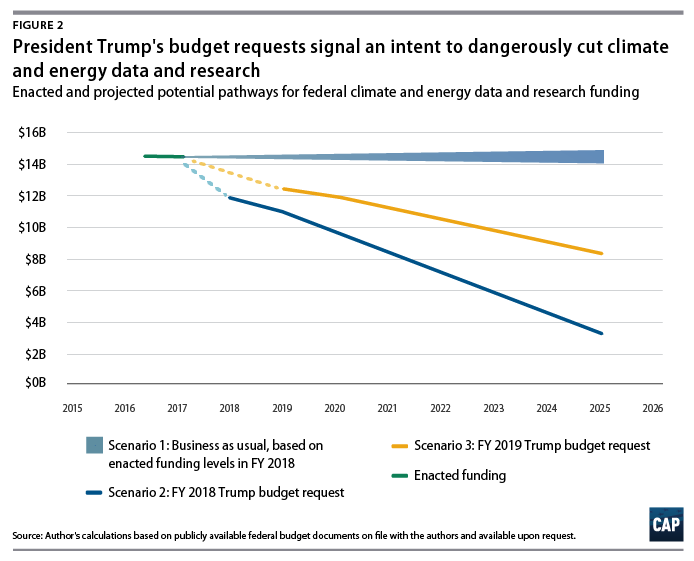
The Center for American Progress (CAP) is a lefty non-governmental organization with a decided point of view so I read its reports regularly but with a degree of skepticism. It has released a report on federal funding for scientific research and support on climate change. The Trump Administration views climate change from its own highly skeptical point of view so it is not a revelation to know that federal funding has gone down. The Center has compiled data which is quite striking, not simply because it shows that research on the specific issue of climate change has been going down, but also because it shows that baseline climate information–independent of whether it shows climate change–is being lost. It seems as if very valuable data is being lost which might be necessary for issues that have little or nothing to do with climate change.
One of Chancellor Angela Merkel’s coalition partners, the Christian Social Union (CSU), is threatening to leave the government, a move that could end Merkel’s government. The CSU is philosophically aligned with Merkel’s Christian Democratic Union (CDU), but, faced with upcoming elections in their base, Bavaria, is moving further away from Merkel’s more lenient stance on immigration. Horst Seehofer is the Interior Minister and a member of the CSU, and he has submitted a plan to end immigration, violating both Merkel’s and the European Union’s policies on immigration. Merkel’s most recent government has only been in power for three months, but they have been very difficult months for liberals in Europe. After the election in Italy, Merkel’s commitment to a rules-based liberal order is shared by one other major European economy, France. The US under President Trump has moved far away from the post-World War II consensus and authoritarian governments, in Europe and outside of Europe, are gaining power.
China has retaliated with its own tariffs to match those imposed by the US on its products. The tariffs amount to about $50 billion, exactly the same amount of the value of the tariffs imposed by the US. According to New York Magazine:
“China says its tariffs will follow the same time line as the new U.S. ones, with the first wave hitting July 6, targeting 545 U.S. products worth about $34 billion, including soybeans, whiskey, orange juice, electric cars, salmon, and cigars. The second wave of Chinese tariffs will come later in the year, aiming at 114 other products worth $16 billion, including chemicals, medical equipment, and energy products like coal, crude oil, and gasoline.
“China also said that ‘all economic and trade agreements reached by previous negotiations will be nullified’ when the new tariffs go into effect. In one of those agreements, which was conditional on Trump not threatening new tariffs, China promised to buy $70 billion worth of U.S. agricultural and energy products — a trade-deficit reducing deal which Trump had prematurely hailed as a victory.”
“In recent years, China has reduced its trade surplus with many countries, and some later had a trade deficit. But it is difficult to reduce the trade surplus with the US. The fundamental cause is how the US has a low national savings rate.
“Americans spend more than they can make, which guarantees the country will always have a significant trade deficit with another nation. Furthermore, the high-tech industry is a US trade advantage, but they like to play the role of ‘agriculture country’ and while the Middle East likes to play the role of ‘energy production country’ in trade with China. The US continues to limit its high-tech exports to China but is more than willing to sell their soybeans, corn, wheat, petroleum and natural gas.
“Besides reducing the trade deficit, the Trump administration aims to curb China’s high-tech upgrades and prevent it from advancing along the global supply chain. They routinely accuse China of stealing intellectual property and force international companies to transfer their technology. The tariffs announced Friday by the White House begin with China’s high-tech products.
“Anyone with a primary education could easily realize there will never be a balanced China-US trade relationship by selling soybeans and petroleum. There isn’t one country who would give up their rights to advance technology and make industrial upgrades, and yet President Trump insists on selling agricultural products to China.”
Its editorial conclusion is a sharp rebuff to the historical position of the US:
“The US ignores the rules of the multilateral global trading system and has even set their credibility aside for bilateral negotiations. For a long time, it has been a staunch advocate of the current international system. Its interest should be fostered and appropriately collected. And yet here they are willing to sacrifice everything for short-term gains.
“Dealing with the US is difficult, but China can easily refuse theft and coercion. China will remain with the US through negotiations and war. If a trade war between the two becomes fierce, the result will not provide a favorable political environment for President Trump.”
There are three weeks before any of these tariffs are finalized. We should know by then if the world will be engaged in a trade war.
The history of negotiations with North Korea on the question of nuclear weapons is very long and complicated. Denuclearization was agreed upon in the “Agreed Framework” that North Korea signed with the US in 1994 under the Clinton Administration. Since that time, each side has accused the other of breaking agreements and of negotiating in bad faith. Most of those breakdowns have occurred because each side had different interpretations of the meanings of specific terms in the agreements. That history was one of the reasons why the P5+1 negotiated an excruciatingly detailed agreement with Iran called the Joint Comprehensive Plan of Action which ran to 109 pages and 5 annexes. The Sentosa Agreement (as the 2 page agreement signed in Singapore is now being called) is thin on details. For some reason, US President Trump believes that the details can be worked out easily. In the press gaggle at the White House today, Mr Trump said:
“And I will tell you this: We now have a very good relationship with North Korea. When I came into this job, it looked like war — not because of me, but because — if you remember the sit-down with Barack Obama, I think you will admit this, he said the biggest problem that the United States has, and by far the most dangerous problem — and he said to me — that we’ve ever had, because of nuclear, is North Korea.
“Now, that was shortly before I entered office. I have solved that problem. Now, we’re getting it memorialized and all, but that problem is largely solved, and part of the reason is we signed, number one, a very good document. But you know what? More importantly than the document — more importantly than the document, I have a good relationship with Kim Jong Un. That’s a very important thing.”
The fact that Mr Trump and Mr. Kim talked is important, but to declare that the “problem is largely solved” is an overstatement given the history of previous agreements.
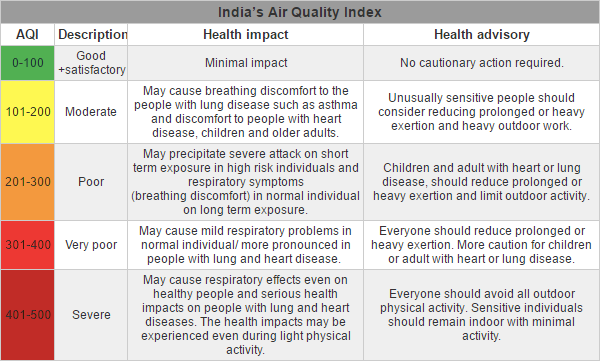
Air pollution in Delhi has risen to levels beyond the capabilities of monitoring devices. The devices can measure particulates in the air and use a range of 0-999, with a level of 270 considered “very unhealthy”. But a duststorm combined with the normal pollution in the city to levels above 999. Levels are expected to remain at very high levels until the temperature cools off a bit in October. The range of pollution levels around the city are very high and construction projects in the city are being delayed to help lower the pollution.
Macedonia is a former province in what was once Yugoslavia which became an independent state after Yugoslavia dissolved. But Macedonia is also the home of Alexander the Great who the Greeks regard as one of their historic figures. Ever since Macedonia became independent, the Greeks have protested its name, leading the United Nations to call the state the “Former Yugoslav Republic of Macedonia” when it was admitted to the organization. After many years of intense discussion, the Macedonians and the Greeks have agreed upon a compromise, and Macedonia will be known as the “Republic of Northern Macedonia”. The agreement stills needs formal ratification, but the dispute is dramatic evidence over the political power of nationhood and the singular importance of cultural identity.
Dr. Jeffrey Lewis is a scholar at the Middlebury Institute of International Studies at Monterey and he has written a short essay on the radically different interpretations of the Singapore Summit held by the US and the North Korean sides. Not surprisingly, each side has a different interpretation of the 400-word communique signed by each. The US continues to insist that North Korea must get rid of its nuclear weapons before sanctions are eased, while the North Koreans are heralding the easing of sanctions soon.
“For Kim Jong Un, it is his nuclear weapons that brought Trump to the table. He is happy to talk and suspend some tests, but seems prepared to draw the line at actually abandoning the programs that brought him to this point…..
“Trump, on the other hand, has promised loudly and repeatedly that this process will end with North Korea’s disarmament. He has made it clear that Kim Jong Un must give up his nuclear weapons. In this way, the dispute about whether to proceed all at once or in a gradual process is really a dispute about the ultimate goal: Is North Korea’s disarmament an aspiration, one that Kim Jong Un may leave unfilled? Or is it something that must happen now — or at least no later than the end of Donald Trump’s first term? On this issue, the parties appear as far apart as ever.”
There should be no question about which side will prevail on this issue. The US has no additional leverage other than the threat of war to coerce the North Koreans. The North Koreans will simply continue the negotiations, and as long as both sides are talking, the US will be prevented from using force.
Bloomberg is reporting that the US will impose tariffs on about $50 billion of Chinese imports on Friday. The list includes about 1,500 products, but they are targeted on the Chinese technology sector. According to Bloomberg: “The administration has said it wants to aim its tariffs at industries identified in China’s 2025 plan. ‘Made in China 2025’ identified 10 industries that the world’s second-biggest economy wants to become globally competitive, and dominant in during this century.” The tariffs are therefore more than just economic instruments–they are also strategic, which will make the Chinese even more angry. We will have to see how the Chinese respond, but it is hard to imagine that the Chinese will welcome the scheduled talks on trade with the US.
US President Trump apparently questioned the stance of Western allies opposed to the Russian annexation of Crimea in 2014 in discussions at the recent G7 meeting in Canada. According to sources, Mr. Trump pointed out that the majority of people in Crimea speak Russian and that the government of Ukraine was so corrupt that its sovereignty should not have been defended. If these reports are accurate, Mr. Trump is clearly signaling a retreat from the rules-based liberal world order in which aggression against a sovereign state is not a sufficient reason for collective security. That stance is an implicit endorsement of a return to a balance of power system.
New York Magazine has published an article entitled “This Is What a Nuclear Bomb Looks Like” which examines the likely consequences of a single nuclear bomb explosion on New York City and its surrounding environs. The article is not a technical analysis, nor does it examine the circumstances under which a bomb might explode. But it does provide an important context for discussions of “fire and fury” which seems to be lacking in the discussions concerning Iran, North Korea, and the unprecedented nuclear arms build-up by the US, Russia, and China.
The melt rate of ice in Antarctica has tripled over the last ten years, and it is now sending 200 billion tons of ice into the ocean annually. The research, published today in the journal Nature, is a welcome addition to the information we have about Antarctica, an area of the world about which we actually know very little. The paucity of hard information is troubling since if all the ice at the South Pole melted, it would raise sea levels by almost 100 feet, making most of the major coastal cities in the world uninhabitable.
I still remain completely uncertain about what happened in Singapore between President Trump and Leader Kim. Some sort of agreement was reached but I am not at all clear how it differs from previous North Korean statements about its commitment to denuclearization. There are also a number of issues not addressed in the join communique, one of which was the process of verifying denuclearization. This exchange between a reporter and US Secretary of State, Mike Pompeo, suggests that, at this point, the US does not have any idea of what it expects in the verification process:
QUESTION: Mr. Secretary, I wanted to ask you about “verifiable and irreversible.”
SECRETARY POMPEO: Mm-hmm.
QUESTION: You said – the day before you said it’s our only objective, our – it’s clear we want that. It’s not in the statement. Why it’s not in the statement? And the President said it will —
SECRETARY POMPEO: Mm-hmm, it’s in the statement. It’s in the statement. You’re just wrong about that.
QUESTION: How is it in the statement? And I am also —
SECRETARY POMPEO: You’re just – because “complete” encompasses verifiable and irreversible. It just – I suppose we – you could argue semantics, but let me assure you that it’s in the document.
QUESTION: And the President said it will be verified.
SECRETARY POMPEO: Of course it will.
QUESTION: Can you tell us a little bit more about —
SECRETARY POMPEO: Of course it will. I mean —
QUESTION: — what is – what discussed about how?
SECRETARY POMPEO: Just so you know, you could ask me this – I find that question insulting and ridiculous and, frankly, ludicrous. I just have to be honest with you. It’s a game and one ought not play games with serious matters like this.
President Trump tweeted “There is no longer a Nuclear Threat from North Korea”, but actually nothing of substance has changed. I remain befuddled and cannot really offer any assessment of the agreement until more details are made available.
The UN has released its report on extreme poverty in the United States, “Report of the Special Rapporteur on extreme poverty and human rights on his mission to the United States of America”. It is a searing and sobering indictment of poverty in one of the richest countries in the world. It points out that
“The United States is a land of stark contrasts. It is one of the world’s wealthiest societies, a global leader in many areas, and a land of unsurpassed technological and other forms of innovation. Its corporations are global trendsetters, its civil society is vibrant and sophisticated and its higher education system leads the world. But its immense wealth and expertise stand in shocking contrast with the conditions in which vast numbers of its citizens live. About 40 million live in poverty, 18.5 million in extreme poverty, and 5.3 million live in Third World conditions of absolute poverty. It has the highest youth poverty rate in the Organization for Economic Cooperation and Development (OECD), and the highest infant mortality rates among comparable OECD States. Its citizens live shorter and sicker lives compared to those living in all other rich democracies, eradicable tropical diseases are increasingly prevalent, and it has the world’s highest incarceration rate, one of the lowest levels of voter registrations in among OECD countries and the highest obesity levels in the developed world.
“The United States has the highest rate of income inequality among Western countries. The $1.5 trillion in tax cuts in December 2017 overwhelmingly benefited the wealthy and worsened inequality. The consequences of neglecting poverty and promoting inequality are clear. The United States has one of the highest poverty and inequality levels among the OECD countries, and the Stanford Center on Inequality and Poverty ranks it 18th out of 21 wealthy countries in terms of labour markets, poverty rates, safety nets, wealth inequality and economic mobility. But in 2018 the United States had over 25 per cent of the world’s 2,208 billionaires. 6 There is thus a dramatic contrast between the immense wealth of the few and the squalor and deprivation in which vast numbers of Americans exist. For almost five decades the overall policy response has been neglectful at best, but the policies pursued over the past year seem deliberately designed to remove basic protections from the poorest, punish those who are not in employment and make even basic health care into a privilege to be earned rather than a right of citizenship.”
The report goes into detail about how race and gender affect the character of poverty in the US and how incarceration is used to disguise the extreme poverty in the country. It is a report that everyone should read.
The media has been totally fixated on the meeting between US President Trump and North Korean leader Kim. Some outlets call the meeting “historic”, and, in some sense, it was, since it was the first time that an American President has met with a leader of North Korea. We should keep in mind that Kim, his father, and his grandfather were all eager to be treated as leaders of a sovereign state, and that previous US Presidents had held that such recognition had to be earned. Kim Jong-un’s father, Kim Jong-il, forced the matter by developing nuclear weapons and Kim Jong-un made the matter of recognition urgent by developing a ballistic missile capability that threatened the US homeland. Presidents Clinton, Bush, and Obama did not face the missile capability but all of them tried to reach an accommodation with North Korea. The Arms Control Association has an excellent chronology of previous agreements. Here are some key events in the chronology.
1992
“The two Koreas sign the South-North Joint Declaration on the Denuclearization of the Korean Peninsula. Under the declaration, both countries agree not to ‘test, manufacture, produce, receive, possess, store, deploy or use nuclear weapons’ or to ‘possess nuclear reprocessing and uranium enrichment facilities.’ They also agree to mutual inspections for verification.”
1994
“The United States and North Korea conclude four months of negotiations by adopting the ‘Agreed Framework’ in Geneva. To resolve U.S. concerns about Pyongyang’s plutonium-producing reactors and the Yongbyon reprocessing facility, the agreement calls for North Korea to freeze and eventually eliminate its nuclear facilities, a process that will require dismantling three nuclear reactors, two of which are still under construction. North Korea also allows the IAEA to verify compliance through “special inspections,” and it agrees to allow 8,000 spent nuclear reactor fuel elements to be removed to a third country.
In exchange, Pyongyang will receive two LWRs and annual shipments of heavy fuel oil during construction of the reactors. The LWRs will be financed and constructed through the Korean Peninsula Energy Development Organization (KEDO), a multinational consortium.
Calling for movement toward full normalization of political and economic relations, the accord also serves as a jumping-off point for U.S.-North Korean dialogue on Pyongyang’s development and export of ballistic missiles, as well as other issues of bilateral concern.
2000
“Following a historic summit, North and South Korea sign a joint declaration stating they have ‘agreed to resolve’ the question of reunification of the Korean Peninsula. The agreement includes promises to reunite families divided by the Korean War and to pursue other economic and cultural exchanges. No commitments are made regarding nuclear weapons or missile programs or military deployments in the Demilitarized Zone.”
2001
“In a press release, President Bush announces the completion of his administration’s North Korea policy review and its determination that ‘serious discussions’ on a ‘broad agenda’ should be resumed with Pyongyang. Bush states his desire to conduct ‘comprehensive’ negotiations, including ‘improved implementation of the Agreed Framework,’ ‘verifiable constraints’ on North Korea’s missile programs, a ban on North Korea’s missile exports, and ‘a less threatening conventional military posture.'”
2002
“In his State of the Union address, President Bush criticized North Korea for ‘arming with missiles and weapons of mass destruction, while starving its citizens.’ Bush characterized North Korea, along with Iraq and Iran, as constituting an ‘axis of evil, arming to threaten the peace of the world.’”
2003
“North Korea accuses the United States of violating the spirit of the 1992 Joint North-South Declaration on the Denuclearization of the Korean Peninsula, calling the agreement a ‘dead document’ in a KCNA statement.
2005
“The participants in the six-party talks conclude a joint statement of principles to guide future negotiations.
“According to the statement, North Korea commits ‘to abandoning all nuclear weapons and existing nuclear programs and returning, at an early date, to the Treaty on the Non-Proliferation of Nuclear Weapons and to IAEA safeguards.’ It also calls for the 1992 Joint Declaration of the Denuclearization of the Korean Peninsula, which forbids the two Koreas from possessing uranium-enrichment and plutonium-separation facilities, to be “observed and implemented.” Washington affirms in the statement that it has no intention to attack or invade North Korea.
“The statement commits the participants to achieving ‘the verifiable denuclearization of the Korean Peninsula in a peaceful manner’ and says that the parties agree ‘to take coordinated steps to implement’ the agreed-upon obligations and rewards ‘in a phased manner in line with the principle of ‘commitment for commitment, action for action.’”
“The statement says that North Korea ‘stated that it has the right to peaceful uses of nuclear energy’ and that the other parties ‘expressed their respect and agreed to discuss, at an appropriate time, the subject of the provision’ of a light-water nuclear power reactor to Pyongyang. This issue had been controversial during the negotiations and the final agreement was the result of a compromise between Washington and Pyongyang. North Korea insisted that the statement recognize its right to a peaceful nuclear energy program and commit the other participants to provide it with light-water reactors while the United States argued that North Korea should not receive any nuclear reactors.”
2006
“North Korea conducts an underground nuclear test near the village of P’unggye. Most early analyses of the test based on seismic data collected by South Korean, Japanese, and U.S. institutes estimates the yield to be below one kiloton. Russian estimates differed significantly, and Foreign Minister Sergei Ivanov said Oct. 10 that the estimated yield was between 5 and 15 kilotons.
“North Korea’s Foreign Ministry states that its ‘nuclear test was entirely attributable to the US nuclear threat, sanctions and pressure,’ adding that North Korea ‘was compelled to substantially prove its possession of nukes to protect its sovereignty.’ The statement also indicates that North Korea might conduct further nuclear tests if the United States ‘increases pressure’ on the country.
However, the Foreign Ministry also says that North Korea remains committed to implementing the September 2005 joint statement, arguing that the test ‘constitutes a positive measure for its implementation.’ Additionally, Pyongyang ‘still remains unchanged in its will to denuclearize the peninsula through dialogue and negotiations,’ the Foreign Ministry statement says, adding that the ‘denuclearization of the entire peninsula was President Kim Il Sung’s last instruction and an ultimate goal’ of North Korea.
The chronology highlights the fact that there have been many contacts between the US and North Korea over the last 26 years. There have been many agreements and none has succeeded. Each agreement was greeted with a lot of hope. We should keep this chronology in mind as we assess the agreement reached between President Trump and Leader Kim.
Austria has closed seven mosques and expelled all Turkish-funded Imams. According to The Local, an English-language Austrian newspaper, the move comes after “an investigation by Austria’s religious affairs authority sparked by images which emerged in April of children in a Turkish-backed mosque playing dead and re-enacting the World War I battle of Gallipoli. That battle was between British and French forces against the Ottoman Empire and ended in a disastrous defeat for the Western allies at the hands of a Muslim empire. The Austrian government claimed that the act breached a 2015 agreement that included religious guidelines that required “a positive attitude towards the state and society”. The move also reflects a growing tension between Austria and Turkey as well as the hardening of anti-Muslim sentiment in many sectors of European society. Turkish President Erdogan denounced the move and declared that “these measures taken by the Austrian prime minister are, I fear, leading the world towards a war between the cross and the crescent.”
The United Nations is engaged in intense negotiations to forestall a Saudi Arabian coalition attack on the Yemeni port city of Hudeida. The port serves as the only access point for humanitarian assistance to the Yemeni civilian population which is suffering from high rates of malnutrition and cholera. The war began in 2014 as Houthi rebels, which Saudi Arabia considers proxies for Iran, took control of Yemen, and more than 10,000 civilians have died and 22 million civilians are in dire need of humanitarian assistance. At this time, the US military is mulling over a request from Saudi Arabia for assistance in conducting the assault on the port city, a move that would be disastrous for the people of Yemen and which would run the risk of a wider war in the region.
The Destructiveness of the War in Yemen
There were widespread protests in Vietnam over a proposed new law creating “Special Economic Zones” (SEZ) in some of the provinces in the country. The zones would offer investment incentives in an effort to stimulate economic activity, and one of those incentives would include 99-year leases for investors. The protests were ignited by fears that Chinese investors would dominate the SEZs and further empower Chinese influence in the country. The Vietnamese government is trying to tamp down the protests lest they frighten investors. The protests reflect both the historical mistrust of China in Vietnam as well as the strong economic nationalism in Vietnam at this time, a nationalism which is consistent with sentiments in other countries (think of “America First”). The protests also stem from the growing fear of Chinese hegemony in Southeast Asia.
US President Trump took the US signature off the joint communique issued by the G7 after he departed for Singapore to meet with Korean leader Kim Jong-un. Mr. Trump’s reason for the act was that he considered the statement by Canadian Prime Minister Justin Trudeau to be “dishonest” and a “betrayal”. Here is the statement made by Prime Minister Trudeau:
JUSTIN TRUDEAU, CANADIAN PRIME MINISTER: We move forward with retaliatory measures on July 1st, applying equivalent tariffs to the ones that the Americans have unjustly applied to us. Canadians, we’re polite, we’re reasonable, but we also will not be pushed around.
WALLACE: Well, President Trump responded with this tweet while flying here on Air Force One to Singapore. Trudeau of Canada acted as meek — so meek and mild during our G-7 meetings only to give a news conference after I left. Very dishonest and weak.
Question, Mr. Navarro, is that really how we want to deal with our second biggest trading partner?
PETER NAVARRO, WHITE HOUSE TRADE ADVISER: Chris, there’s a special place in hell for any foreign leader that engages in bad faith diplomacy with President Donald J. Trump and then tries to stab him in the back on the way out the door. And that’s what bad faith Justin Trudeau did with that stunt press conference. That’s what week, dishonest Justin Trudeau did. And that comes right from Air Force One.
And I’ll tell you this, to my friends in Canada, that was one of the worst political miscalculations of a Canadian leader in modern Canadian history. All Justin Trudeau had to do was take the win. President Trump did the courtesy to Justin Trudeau to travel up to Quebec for that summit. He had other things, bigger things on his plate in Singapore, where you are now, Chris. He did him a favor and he was even willing to sign that socialist communique. And what did Trudeau did — do as soon as — as soon as the plane took off from Canadian airspace, Trudeau stuck our president in the back. That will not stand.
We need to appreciate Canada’s position. Under the rules of the World Trade Organization, there are criteria used to define “national security” exceptions which are included in Article XXI of the Charter. Those exceptions are as follows:
(b) to prevent any contracting party from taking any action which it considers necessary for the protection
of its essential security interests
(i) relating to fissionable materials or the materials from which they are derived;
(ii) relating to the traffic in arms, ammunition and implements of war and to such traffic in other
goods and materials as is carried on directly or indirectly for the purpose of supplying a military
establishment;
(iii) taken in time of war or other emergency in international relations
One would be hard pressed to argue that the US-Canada relationship falls under any of these conditions. Thus, Canada does believe that the aluminum and steel tariffs imposed on it under the “national security” exception is “insulting”.
US Economic Adviser Larry Kudlow on Trudeau’s Statement
Mr. Trump’s advisers justified the harsh language by asserting that Trudeau made Mr. Trump look “weak” before his meeting with North Korean leader Kim. There might be merit in a show of solidarity before allies confront a mutual enemy. But that argument is considerably weakened by Mr. Trump’s earlier request that Russia be allowed back into the G7 even without demanding any concessions from Russia on the Ukrainian invasion. “Being tough” is often a good negotiating tactic, but only if one is consistently regarded as tough.
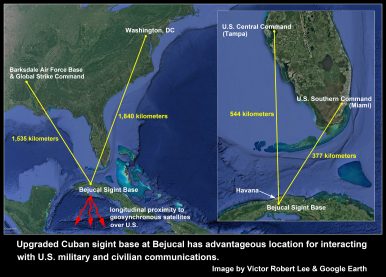
Satellite images have revealed the construction of a new radome (steerable parabolic antenna and its spherical enclosure) in Cuba. There are other radar stations in the area and they are used to eavesdrop on electronic transmissions in the US. The new tracking station is ideal for listening in on the US Central Command, the main operations station for US forces in the Middle East. We do not know who built the new station but both Russia and China have been investing in Cuba, and the Cubans have been known to sell captured information to states interested in US military activities. It is most likely that the US has known about the ongoing construction for some time, but it has not issued an official statement on whether it regards the new station as a threat. But the US has been historically sensitive about military activities in Cuba and now that the news is out, the US will probably issue some statement.
US President Trump has left the G7 meeting, but not before he issued what seems to be a threat to the main trading partners of the US. Reuters describes his comment:
“‘We’re like the piggy bank that everybody is robbing,’ he said at a press conference before making an early exit from the two-day summit in La Malbaie, Quebec, where he met with leaders of Canada, Britain, France, Italy, Germany and Japan.
“’This isn’t just G7. I mean, we have India, where some of the tariffs are 100 percent … And we charge nothing,’ he said. ‘And it’s going to stop. Or we’ll stop trading with them.’”
Trade currently accounts for about 30 percent of the US Gross Domestic Product (GDP) so it is unlikely that anyone takes the threat of ending trade seriously. But Mr. Trump also suggested that all tariffs, quotas, and subsidies should be abolished, a proposal that no one–least of all the US–will find credible. It is difficult to imagine what the other 6 world leaders are thinking about the US role in the world economy right now. French President Macron decided to test Mr. Trump’s mettle in a contest of handshakes. Mr. Trump is famous for pulling on a handshake to demonstrate dominance. President Macron refused to be pulled toward Mr. Trump and grasped Trump’s hand so tightly that photographs captured Macron’s thumbprint on Mr. Trump’s hand. Diplomatic games.
Karen DeYoung has written an op-ed for The Washington Post on the aftermath of the G7 meeting. DeYoung quotes the President of the European Council, Donald Tusk:
“‘What worries me most . . . is the fact that the rules-based international order is being challenged. What is surprising is that the challenge is driven not by the usual suspects, but by its main architect and guarantor, the U.S.
“‘Trump’s actions’, he said, ‘play into the hands of those who seek a new post-West order where liberal democracy and fundamental freedoms would cease to exist.’ Tusk’s usual suspects certainly include China and Russia, the latter suspended from the group after its 2014 annexation of Crimea. As Trump left Washington early Friday, he said Russia should be invited ‘back in’ to the club.”
The world order fashioned by liberal states after World War II is not self-regulating–there are constant challenges to it by a number of states who seek advantages by breaking the rules. When the strongest power in the system chooses to break the rules, the system has little chance of surviving.




 World Politics News