Archive for the ‘World Politics’ Category
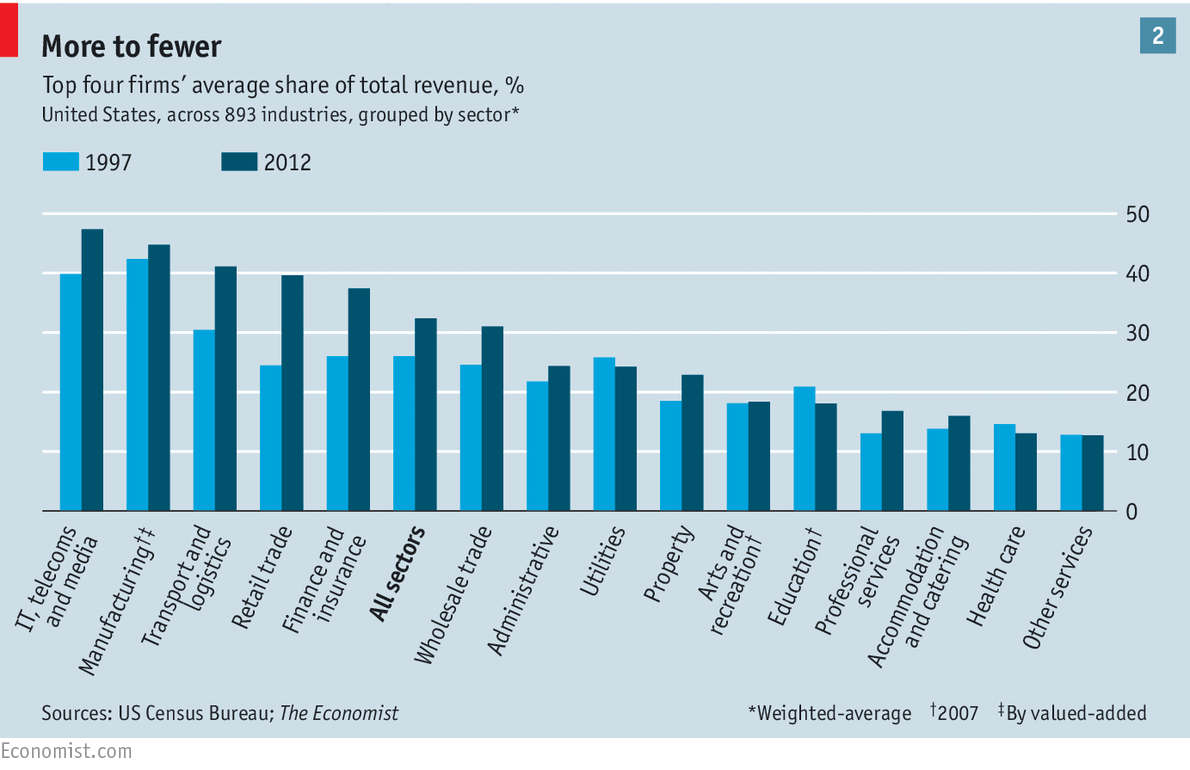
There is a high degree of concentration in the global economy. We are often flummoxed by what appears to be a bewildering number of choices in the market. But the choices are really an illusion. Many of the products that we see on the store shelves are produced by a very small number of companies. The actual number of companies in competitive sectors is actually declining in the US, and The Economist quantifies the decline:
“Revenues in fragmented industries—those in which the biggest four firms together control less than a third of the market—dropped from 72% of the total in 1997 to 58% in 2012. Concentrated industries, in which the top four firms control between a third and two-thirds of the market, have seen their share of revenues rise from 24% to 33%. And just under a tenth of the activity takes place in industries in which the top four firms control two-thirds or more of sales. This oligopolistic corner of the economy includes niche concerns—dog food, batteries and coffins—but also telecoms, pharmacies and credit cards.”

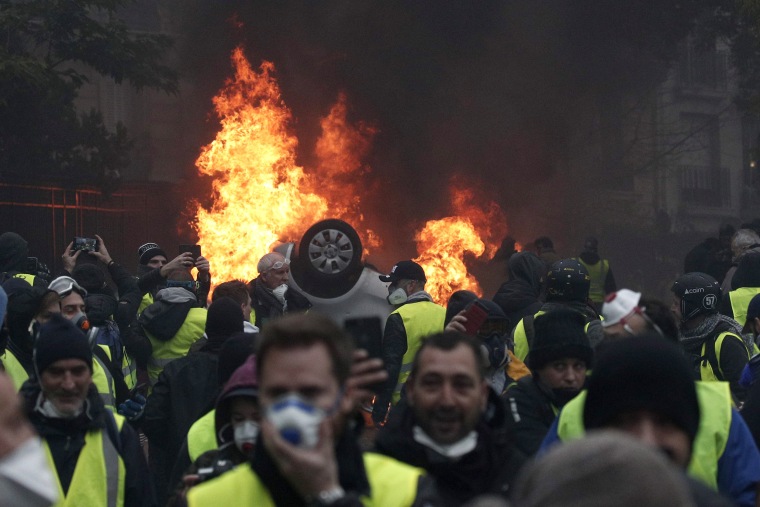
US President Trump has blamed the yellow vert protests in France on the Paris climate agreement, but that argument does not really square with the reality of the protests which have been largely focused on broader economic concerns. Nonetheless, the French have not appreciated Trump’s comments which they regard as an intrusion in their internal affairs. Trump tweeted: “The Paris Agreement isn’t working out so well for Paris. Protests and riots all over France. People do not want to pay large sums of money, much to third world countries (that are questionably run), in order to maybe protect the environment. Chanting ‘We Want Trump!’ Love France.” The chanters were actually from England a few months ago, not from France. French President Macron is scheduled to give a speech on Monday which he hopes will address the concerns of the protesters.
Chinese Vice Foreign Minister Le Yucheng summoned the US Ambassador to China, Terry Branstad, to lodge a strong protest against the actions taken against the CFO of Huawei. The Canadian Ambassador was also dressed down for agreeing to arrest Meng Wangzhou. The Global Times articulates the Chinese objection in a broad context:
“Analysts said it is worth noting that the containment of China and the country’s technology comes not only from the US, but also its allies.
“Australia and New Zealand joined the US in banning Huawei from providing technology for their 5G rollout, CNBC reported Wednesday.
“However, not all countries are following the US. French Finance Minister Bruno Le Maire said on Friday that investments by Huawei are welcome in France, Xinhua reported.
“Western media like German publication Der Spiegel also questioned US accusations against Chinese companies, saying that the US never provided any concrete evidence, and that mistrust of Chinese products is limited in Germany despite US claims they are not trustworthy.”
For the Chinese, the trade war with the US is a struggle over hegemony.
The yellow vest protesters filled the streets of France today and over 8,000 police officers were deployed on the streets of Paris. The demands of the protesters have expanded beyond rescinding the fuel tax increases (which the government has already done) to include a raise in the minimum wage and a decrease in the retirement age. The protests seemed to be targeting President Macron, but it is hard to tell since the protests remain unorganized. But Macron came to power in 2017 and has dismantled some labor laws and reformed the railway system, both of which were unpopular with labor, and decreased taxes on the very rich which was unpopular with everyone except the very rich Virtually all the major tourist sites in Paris were closed today for fear of violence. US President Trump has characterized the protests as ones against steps to reduce the threat of climate change, using them to validate his position against the Paris Accords. That interpretation, however, seems overstated. The protests against the fuel taxes were juxtaposed with the decreases in taxes on the rich. It seems as if the issue is more economic, a concern shared by protesters in Belgium and the Netherlands which did not have a fuel tax increase.
Protests in France
The US suffered a defeat at the United Nations as a resolution it proposed condemning Hamas did not pass with the required 2/3s vote, even though it received a majority of the votes cast. The resolution was proposed by outgoing US Ambassador Nikki Haley and it condemned Hamas for firing rockets into Israel. The General Assembly did pass a resolution favoring a Middle East peace settlement. According to The Australian:
“The assembly also adopted by a wide margin of 156 to six with 12 abstentions a Palestinian-drafted measure, presented by Ireland, calling ‘for the achievement, without delay, of a comprehensive, just and lasting peace in the Middle East’ based on UN resolutions.
“The US, Israel, Australia, Liberia, Marshall Islands and Nauru voted against that measure.”
The US opposed the measure because it favors bilateral peace talks between Israel and the Palestinians. But it seems clear that the world does not hold out hope for such negotiations. France has called for a lifting of the Israeli blockade against the Gaza Strip.
Spiegel has a very detailed analysis of the standoff between Russia and Ukraine over access to the Sea of Azov. The article contains important information about which I was unaware such as the harassment of shipping through the Kerch Strait that has been ongoing since the building of the Kerch Strait Bridge by Russia in last May. The effects of the bridge on Ukrainian trade was profound. According to Spiegel:
“To understand this, one must look backward. Ukraine has in effect lost large parts of its coastline through the annexation of Crimea and the war in Donbass, but it has held onto the only deep-water ports in the Sea of Azov. One of them is Mariupol, the second-largest city in the region with half-a-million inhabitants. It has two enormous steel plants and the curious charm of a beachfront industrial city.
“It is almost a miracle that Ukraine has been able to hold onto the strategically important port city. Kiev had lost control over it in the spring of 2014. From Mariupol, Ukraine can export steel and iron manufactured by the country’s richest oligarch, Rinat Akhmetov. He’s the city’s biggest employer and practically runs the place. Mariupol and the neighboring port of Berdiansk are also transit points for wheat exports.
“That, at least, was the case until recently, when Russia made access to the Sea of Azov more difficult. The Crimean Bridge, which was inaugurated in May 2018, is too low for many of the Panamax-class ships that previously sailed to Mariupol and Berdiansk. And regardless, ships trying to exit and enter the strait have been getting jammed up because the traffic goes in one direction and pilotage is compulsory. Freight and crew members are forced to accommodate systematic inspections by FSB [Federal Security Service] border guards.”
Given this stranglehold, there is little Ukraine can do short of confronting Russia directly, a losing proposition without US and European support. That support, however, is not forthcoming.
Kerch Strait Bridge

I do not typically link to scholarly articles, but Ruben Gonzalez-Vicente has published a fascinating (albeit dense) essay on why authoritarian movements have grown so dramatically since the Great Recession of 2008-09. He argues that what he calls the neoliberal response (his phrase for the authoritarian/populist movements) is, in fact, a response to globalization by some of its strongest supporters–a paradoxical volte-face. He writes (I have taken out the references–they are extensive):
“Across the world, we are observing an emergence of illiberal politics in countries that have represented the backbone of neoliberal globalization, and indeed at its very Anglo-American core. In many places, reactionary politicians have been first to galvanize social discontent successfully by publicly condemning the negative social impacts of economic globalization, such as increased inequalities and growing insecurity. In the United States, the UK or France, for example, it has been the populist right that has more prominently hoisted the anti-globalization flag, even if its discourses place targets on ethnic minorities or national trade imbalances, rather than on class inequality or the increased leverage of businesses in processes of transnational integration. We can see, for example, how rising job insecurity and deteriorating living standards in the UK were mobilized by the Brexit campaign. While much of the ‘Leave’ discourse was problematic, and focused its anger towards European Union regulations and immigrants, Brexit advocates successfully tapped into a widespread sense of vulnerability and precarization throughout the isles that is intimately linked to neoliberal transformations at home and to the consolidation of the world market and its competitive pressures more broadly.
“Similarly, Donald Trump’s anti-China and anti-migrant rhetoric resonated with the experiences of many in the middle class who have been on the losing side of growing inequality and declining social mobility for decades, but also remarkably in the aftermath of the Global Financial Crisis, with the top 1% capturing 85.1% of the country’s income growth between 2009 and 2013.”
The argument is intriguing, but I need to examine more evidence before I accept it. At this time, I tend to think that the supporters of the populist programs are the losers of globalization, not the winners. But Gonzalez-Vicente’s argument suggests that the winners adopted neoliberalism in order to “close the door” on other possible winners.
Along the same lines, we need to rethink the role of political parties in liberal democracies. Many of the most recent elections in the world have featured “new” parties–ones that are not the traditional parties, such as En Marche in France, Alternative for Germany, the Sweden Democrats, Podemos in Spain, and the 5 Star Movement in Italy. Indeed, US President Trump is probably the first third party candidate to have won the presidency–his roots in the Republican Party are quite thin. Patrick Liddiard has written an essay for the Wilson Center that is entitled, “Are Political Parties in Trouble?” His concern is clear: “a worldwide decline in political party influence would raise fundamental issues of democratic accountability, an issue that is already associated with increasing unrest worldwide, and is likely to degrade the quality of democracy worldwide in the future.”
The US is asking Canada to extradite Meng Wanzhou, the Chief Financial Officer (CFO) of Huawei, the Chinese technology firm that ranks among the largest in the world. The US charges that Huawei violated the sanctions against Iran, but the US has long been concerned about Huawei’s links to the Chinese government and fears that its technology is compromised by that connection. China has protested Ms Meng’s arrest and believes that the US extradition request is merely another attempt by the US to limit Chinese technological development. Global Times, which often represents the official view of the Chinese government, places the arrest in the context of the trade war with the US:
“The US will not stop countering China’s rise in the technology sector and will never drop its hostility toward China’s ‘Made in China 2025’ strategy, Wang Yanhui, head of the Shanghai-based Mobile China Alliance, told the Global Times on Thursday.
“‘Huawei has become another card for the US to play against China in the ongoing trade war,’ he said.
“China and the US announced a trade truce following a meeting between the two countries’ top leaders in Buenos Aires on Saturday.
“But experts warned that China should be prepared for a long-lasting and heated trade war with the US, as it will continue to attempt to counter China’s rising power.
“‘The latest Huawei incident shows that we should get ready for long-term confrontation between China and the US, as the US will not ease its stance on China and the arrest of a senior executive of a major Chinese tech company is a vivid example,’ Mei Xinyu, a research fellow with the Beijing-based Chinese Academy of International Trade and Economic Cooperation, told the Global Times on Thursday.”
Financial markets were rattled by the news as the arrest will make the trade negotiations between the US and China significantly more problematic. It is important to remember that the US views the trade dispute as and economic issue; China views it as an attempt by the US to contain Chinese power.
The International Labour Organisation has published its annual report on wage growth in the world and its conclusions are downbeat:
“Global wage growth in 2017 was not only lower than in 2016, but fell to its lowest growth rate since 2008, remaining far below the levels obtaining before the global financial crisis. Global wage growth in real terms (that is, adjusted for price inflation) has declined from 2.4 per cent in 2016 to just 1.8 per cent in 2017…..Looking at trends in average wages and labour productivity over the period 1999–2017 in 52 high-income countries, the report finds that, on average, labour productivity has increased more rapidly (by a total of 17 per cent) than real wages (13 per cent), although the gap between the two trends narrowed between 2015 and 2017. Overall, the decoupling between wages and labour productivity explains why labour income shares (the share of labour compensation in GDP) in many countries remain substantially below those of the early 1990s.”
The slow growth in wages explains much of the political dissatisfaction we see in the world, such as the yellow jacket protests in France. There must be a concerted effort to make sure that wages grow as productivity grows, The report also points out that there is a significant gender gap in wages, after accounting for the differences in work performed: “Using these four different combinations (mean/median and hourly/monthly), the report finds that the weighted global estimates range from about 16 per cent to 22 per cent, depending on which measure is used. The gender pay gap of 22 per cent is obtained when using median monthly wages.”

North Korea is expanding its missile bases at Yeongjeo-dong and Hoejung-ri despite its professed aims of working toward denuclearization. The North Koreans use mobile missile launchers so that their missiles cannot be targeted by an opponent and taken out before launch. The mobile missile launchers are hidden in tunnels drilled into mountains which make them virtually indestructible. The expansion also occurs as North Korean leader Kim is planning a visit to Seoul to meet his South Korean counterpart, President Moon. There is also evidence that China is increasing its trade with North Korea despite the US’s insistence that the trade sanctions remain in place. The Chinese behavior makes US pressure on North Korea less effective.

Secretary of State Mike Pompeo gave a speech yesterday to NATO in which he tried to position the US Administration’s emphasis on “America First” with the liberal international order the US helped to create after World War II. The speech mentioned multilateral institutions that he believes have failed in their mission and called for reform. He first praised the liberal order:
“The men who rebuilt Western civilization after World War II, like my predecessor Secretary Marshall, knew that only strong U.S. leadership, in concert with our friends and allies, could unite the sovereign nations all around the globe.
“So we underwrote new institutions to rebuild Europe and Japan, to stabilize currencies, and to facilitate trade. We all co-founded NATO to guarantee security for ourselves and our allies. We entered into treaties to codify Western values of freedom and human rights.
“Collectively, we convened multilateral organizations to promote peace and cooperation among states. And we worked hard – indeed, tirelessly – to preserve Western ideals because, as President Trump made clear in his Warsaw address, each of those are worth preserving.
“This American leadership allowed us to enjoy the greatest human flourishing in modern history. We won the Cold War. We won the peace. With no small measure of George H. W. Bush’s effort, we reunited Germany. This is the type of leadership that President Trump is boldly reasserting.”
He then goes on to raise questions about the virtue of multilateralism:
“After the Cold War ended, we allowed this liberal order to begin to corrode. It failed us in some places, and sometimes it failed you and the rest of the world. Multilateralism has too often become viewed as an end unto itself. The more treaties we sign, the safer we supposedly are. The more bureaucrats we have, the better the job gets done.
“Was that ever really true? The central question that we face is that – is the question of whether the system as currently configured, as it exists today, and as the world exists today – does it work? Does it work for all the people of the world?
The speech then goes on to defend the Trump Administration decision to leave agreements such as the Paris Accords, the Iran nuclear agreement, and the International Criminal Court. The critique of the liberal order was intense (with the exception of NATO itself) , but the strategy articulated does not offer any hints about how to reform or replace any of the components of the liberal order.
For the first time in history, the British House of Commons found the British government in contempt of Parliament for failing to the cabinet’s full legal advice on Brexit. The vote led to a flurry of newspaper articles in Britain castigating Prime Minister May, dealing her a humiliating defeat. The controversy centered on the British government’s desire to avoid a “hard border” (one requiring the full gamut of legal and customs restrictions) between the Republic of Ireland (which would remain in the European Union (EU)) and Northern Ireland (which as part of Britain would leave the EU). A hard border would institutionalize the separation of Northern Ireland from the Republic of Ireland, an outcome that literally no one wants give the historic turmoil over that separation. The Irish Times points out: “The legal status of the arrangements for preventing a hard border in Northern Ireland – and in particular, the UK’s ability to extricate itself – are at the heart of the bitter political row about whether MPs should accept the prime minister’s deal.” Prime Minister May wants a “meaningful” vote in Parliament on the Brexit deal in a few days, but, at this time, it seems as if Parliament will reject the deal.
The news out of the COP24 climate conference in Poland remains unremittingly depressing. After a brief hiatus, carbon emissions grew 1.6 percent in 2017 and the rise in 2018 is projected to be 2.7 percent. According to the Washington Post, “The expected increase, which would bring fossil fuel and industrial emissions to a record high of 37.1 billion tons of carbon dioxide per year, is being driven by nearly 5 percent emissions growth in China and more than 6 percent in India, researchers estimated, along with growth in many other nations throughout the world. Emissions by the United States grew 2.5 percent, while emissions by the European Union declined by just under 1 percent.” Further, “Scientists have said that annual carbon dioxide emissions need to plunge almost by half by the year 2030 if the world wants to hit the most stringent — and safest — climate change target. That would be either keeping the Earth’s warming below 1.5 degrees Celsius — when it is already at 1 degrees — or only briefly “overshooting” that temperature.”

The UN is holding its annual climate conference, COP24, in Katowice, Poland. The environmental situation today is beyond serious. Mihai Andrei describes it in this way: “Recent studies have shown that 20 of the past 22 years have been the warmest in recorded history, and climate change action needs to be increased fivefold if we want to have a chance to avoid catastrophic warming, which would cause permanent and irremediable damage to both human and natural environments.” The naturalist, Sir David Attenborough addressed the conference and in his speech he said: ““Right now we are facing a manmade disaster of global scale, our greatest threat in thousands of years: climate change. If we don’t take action, the collapse of our civilisations and the extinction of much of the natural world is on the horizon.” The difficulties facing the UN Conference are huge, and the feeling is one of dark realism, as the US, Brazil, and Australia are all backing off from their previous commitments to the Paris Accords. Stephen Walt argues that climate change itself will lead to the end of American hegemony in world politics.
The protests in France, named after the yellow vests all drivers in France are required to carry, represent the general feeling of distrust that many ordinary citizens throughout the world feel toward traditional patterns of governance. Lauren Collins, writing in the New Yorker, describes the movement in these terms:
“Like Macron’s own party, which he founded only months before running for President, the gilets jaunes confound traditional political divisions and have appeared seemingly out of nowhere. Its adherents are old and young, male and female (even if women were conspicuously underrepresented among the rampaging crowds in Paris), apolitical and activist, nonviolent and nihilistic.”
The movement draws its power from the same feelings that propelled the right parties in Hungary and Poland, the anti-European sentiment in Brexit, and the populist parties like the Five Star Movement in Italy. But the catalyst was the increase in fuel taxes which shows the difficulty in trying to take steps to reduce carbon emissions.
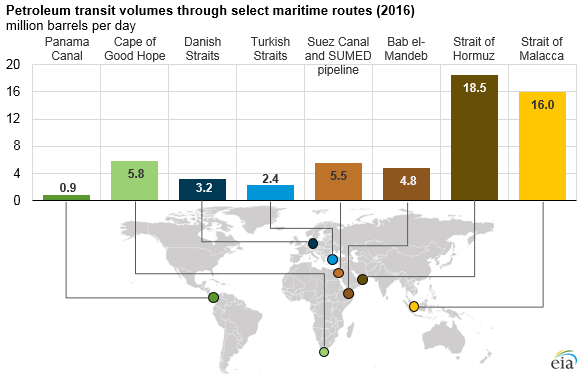
We also need to keep an eye on Iran. The Iranian President threatened today to block the Strait of Hormuz, through which much of the world’s petroleum exports flow, if the US blocks its oil exports. The US has sent its aircraft carrier, the USS John C. Stennis and its affiliated carrier group to the Persian Gulf–the first time the US has had an aircraft carrier in the Persian Gulf since last March. At this time, it seems unlikely that any actions will be taken by either side, but both sides are preparing for any contingency.
The US and China reached some sort of trade agreement on Saturday, but, on closer examination, it is not clear what the agreement actually entailed. Bloomberg went through both the US and Chinese statements and found significant differences between the two (Bloomberg also notes that the Chinese statement was partially censored). Markets responded favorably to the news, but there is no question that a high degree of uncertainty exists. It is, however, troubling that the US interpretation of the agreement is not substantiated by the Chinese version. I would suspect that the US interpretation is excessively optimistic.
| U.S. STATEMENT (LINK) |
CHINESE STATEMENT (LINK) |
| Tariffs on $200 billion of Chinese goods won’t be raised on Jan. 1. |
Wang Yi’s statement says there will be no higher tariffs. Deputy Commerce Minister Wang Shouwen said separately tariffs on $200 billion of Chinese goods won’t be raised on Jan. 1. |
| Those tariffs will be raised to 25 percent if a deal is not reached in the next 90 days. |
90-day deadline not mentioned. |
| Not mentioned. |
Both leaders asked their teams to speed up talks, work toward scrapping all tariffs and reach a mutually beneficial, win-win agreement. |
| U.S., China will negotiate immediately on forced technology transfer, intellectual property protection, non-tariff barriers and cyber theft. |
U.S., China will work together to reach a consensus on trade issues. |
| China will purchase “very substantial” farm, energy, industrial and other products. |
China will import more U.S. goods. |
| China will immediately restart buying agricultural products. |
Not mentioned. |
| Xi will reconsider Qualcomm-NXP deal. |
Not mentioned. |
| Bilateral visits not mentioned. |
Trump, Xi will visit each other’s countries at an appropriate time. |
| China will designate Fentanyl a Controlled Substance. |
China will tighten supervision of Fentanyl, revise rules on the drug. |
| U.S., China and North Korea will work toward a nuclear-free Korean Peninsula. |
China supports another meeting of U.S. and North Korea’s leaders. |
| One-China policy not mentioned. |
U.S. agrees to continue respecting One-China policy. |
| Market access not mentioned. |
U.S. and China agree to boost market access. |
| Chinese students in U.S. not mentioned. |
Xinhua story forwarded on Foreign Ministry WeChat account says U.S. welcomes Chinese students to live and study |
The need to reduce carbon emissions is urgent but we often tend to look at country-by-country statistics. The real issue is how much we as individuals are responsible for. Per Capita carbon emissions are rarely discussed, but there is little question that richer countries have a more substantial obligation to make a more serious effort. While India and China have larger populations and therefore are beginning to contribute more carbon on a country basis than some of the richer countries (the US excepted), individuals in those larger countries do not benefit in material terms from the consumption of carbon products. The impact of carbon reductions on development prospects in poorer countries needs to be carefully considered.

Presidents Trump and Xi agreed upon a 90 day pause in their trade dispute. The agreement defers the $200 billion in additional tariffs President Trump had threatened and, according to the US, includes an agreement that “China will agree to purchase a not yet agreed upon, but very substantial, amount of agricultural, energy, industrial, and other product from the United States to reduce the trade imbalance between our two countries. China has agreed to start purchasing agricultural product from our farmers immediately.” It is very hard to interpret the pause. It could be an indication that progress was more difficult than expected. But it could also be an indication that promising accommodations were discussed but time was short. We will simply have to watch the trade deficit during those 90 days. If it deepens, as it has over the last three months, a compromise would be difficult for the Trump Administration. The burden is clearly on the Chinese to make concessions.
The heads of state attending the recent G-20 meeting made many concessions to the US on some very central points. Language about climate change and the Paris Accords was finally included but noted that the US did not agree. The communique also did not include the word “protectionism” but added that the World Trade Organization should be reformed. Both changes were at the insistence of the US. Language about immigration was also altered at the request of the US. But the European leaders were adamant about including this language in the communique: “We renew our commitment to work together to improve a rules-based international order that is capable of effectively responding to a rapidly changing world.” According to the Guardian:
“The US delegation had opposed the positive reference to a ‘rules-based international order’ as they argued the current system is skewed against the US and has allowed China to get away with unfair trading practices. For the same reason, the US opposed references to the threat of protectionism to global growth, insisting Trump’s use of tariffs is a legitimate response to a skewed playing field.”
Diplomatic communiques are generally not substantively important, but the rhetoric is symbolically important.
The Wall Street Journal (unfortunately there is a paywall) is reporting that Saudi Crown Prince Salman had exchanged 11 messages with Saud al-Qahtani just before and after the murder of Jamal Khashoggi. AAero Hedge has extensive quotes from the WSJ article. The most significant paragraph reads:
“The electronic messages sent by Prince Mohammed were to Saud al-Qahtani, according to the CIA. Mr. Qahtani supervised the 15-man team that killed Mr. Khashoggi and, during the same period, was also in direct communication with the team’s leader in Istanbul, the assessment says. The content of the messages between Prince Mohammed and Mr. Qahtani isn’t known, the document says. It doesn’t say in what form the messages were sent.”
The article goes on:
“The judgment on Prince Mohammed’s likely culpability, the CIA assessment says, is based on the crown prince’s personal focus on Mr. Khashoggi, his tight control over the Saudi operatives sent to Istanbul to kill him, “and his authorizing some of the same operators to violently target other opponents.”
“Mr. Qahtani has led Prince Mohammed’s efforts to crack down on dissent internally and abroad. He is one of the 17 sanctioned by the Treasury.
“[…]
“The highly classified CIA assessment says that the Saudi team sent to kill Mr. Khashoggi was assembled from Prince Mohammed’s top security units in the Royal Guard and in an organization run by Mr. Qahtani, the Center for Studies and Media Affairs at the Royal Court, the Saudi royal court’s media department.
“‘We assess it is highly unlikely this team of operators…carried out the operation without Muhammed bin Salman’s authorization,’ it says.
“The document says that Mr. Qahtani ‘explicitly requested the Crown Prince’s permission when he pursued other sensitive operations in 2015, which reflects the Crown Prince’s command and control expectations.’“
It is therefore true that there is no “smoking gun” proving that Salman ordered the murder, the available evidence seems to point to no other conclusion. For the US government to pretend otherwise is an insult to our intelligence.
The “yellow jacket” protests seem to be escalating and show no signs of letting up in France. The protests began in November in dissatisfaction against rising fuel prices caused by higher taxes designed to reduce greenhouse gas emissions, but they seemed to have morphed into more generalized protests against the economic situation in France. The Guardian describes the situation in France:
“Across France, more than 75,000 gilets jaunes demonstrated in cities or blocked roads and toll booths, some briefly stormed the runway of Nantes airport and others blocked supermarkets and major motorway junctions or staged barricades near government buildings. There were 580 roadblocks across the country.
The yellow jacket protest movement has no leader and no clearly articulated program–it seems to have support across both the left and right. But it has also spread to Belgium, a worrying sign that it will be difficult to address.
Protests in France

The Ebola virus is a hemorrhagic fever with a mortality rate of about 70%. The most deadly outbreak was in West Africa in 2014-16 which killed about 11,000 people, but a new outbreak in Democratic Republic of Congo is particularly worrisome. The new outbreak is in a very dangerous war zone which makes it very difficult to address because medical authorities are reluctant to send in the highly skilled personnel necessary to contain the spread of the virus. The violence in Congo has killed hundreds of thousands and has led to “at least 2.7 million internally displaced persons in the DRC, and approximately 450,000 DRC refugees in other nations.” There is also a large movement of people across the borders to Rwanda and Uganda which is generally uncontrolled. We will have to watch this situation carefully.

US President Trump and Chinese President Xi are scheduled to have a meeting tomorrow at the G-20 meeting in Argentina. CNBC has a very informative article on the timeline of the US-China trade dispute which includes some interactive graphics which contain an incredible amount of information. The timeline shoes the ups and downs of the negotiations between the two states. At risk tonight is the possibility of an additional $200 billion worth of tariffs on imports of Chinese goods as well as a yet unknown Chinese retaliation to that move. The stakes are very high in these negotiations. One bad sign is that Peter Navarro, one of President Trump’s most hawkish trade advisors, is scheduled to be at the negotiations.

The Murderers of Journalists Share a Laugh at the G-20

 World Politics News