“Prof. Ferraro, could you please comment on this press release from NATO? I assumed that withdrawal from the INF treaty was a unilateral act by the US like withdrawal from the Iran treaty. Then I saw a tweet from French ambassador to the US Gerard Araud blaming Russia for necessitating US suspension of its participation in the treaty. The NATO press release says, “Allies fully support this action.” https://www.nato.int/cps/en/natohq/news_162996.htm Yet I see many analysts saying the US withdrawal can only benefit Russia. Can you please clarify whether the US is acting in concert with European allies here or is acting essentially alone and forcing them to construe it in the best possible light?
The answer to the question lies in the distinction between the security agencies within the European NATO governments and the opinions of the European publics. The European security agencies do regard Russia as a strategic threat and are deeply invested in supporting NATO. Those agencies are currently deeply apprehensive about the attitude of the Trump Administration toward NATO and do not wish to provide an excuse for President Trump to end US support for NATO. Therefore, they are inclined to mirror President Trump’s concern about the new Russian missile.
There is actually a great deal of confusion about the Russian violation of the INF Treaty–the Russians insist that the violating missile has not yet been deployed even though it has been tested. Nonetheless, NATO views the possible violation in the light of other Russian actions: its annexation of Crimea, its continued support for rebels in eastern Ukraine, its provocative behavior in the Kerch Strait, its testing of air and maritime space in the Baltic and North Seas, and its military activity in the Kaliningrad enclave.
However, outside of NATO–which was created precisely to counter a perceived threat from the then Soviet Union–there has always been apprehension about US intermediate range missiles in Europe. Those missiles, stationed in Great Britain and Germany in Europe, but also in Turkey and Japan during the height of the Cold War, were necessary to provide a deterrent to aggressive Soviet action before the development of Intercontinental Ballistic Missiles (ICBMs). After ICBMS were developed in the early 1960s, the intermediate-range missiles were not really necessary to deter a Soviet attack on the US homeland. Indeed, intermediate-range missiles, defined as those missiles which fly between 310 and 3,250 miles, could not hit the Soviet homeland if fired from the US.
So the intermediate-range missiles became part of what was called “extended deterrence”: missiles that would be used in case of a Soviet/Russian attack on an American ally, not an attack on the American homeland. Currently the US missiles are deterring attacks on 32 nations: 28 US NATO allies, plus Japan, South Korea, Australia, and Israel.
For some in Europe, the US intermediate-range missiles actually make US allies targets of a Soviet/Russian attack. This constituency fears that the presence of American missiles on their soil could embroil them in a US-Soviet/Russian dispute in which they have no national interest. This fear became quite pronounced in Europe during the Reagan Administration in the 1980s, and there was a strong European movement to remove those missiles. In the US, this movement was known as the Nuclear Freeze Movement. That movement led to the INF Treaty which removed US and Soviet intermediate-range missiles from European soil, a singular triumph for arms control.
What we should look for is any movement to place ground-based intermediate-range missiles in Europe (the INF Treaty did not cover air- or sea-launched intermediate-range missiles). Even if the Trump Administration does end the INF Treaty (right now, it is merely a “suspension” although I am not really sure what that means), I sincerely doubt that the European publics would support such a move.
The Trump Administration is rather more concerned about the Chinese development of intermediate-range missiles and wishes a free hand to develop such missiles to counter that threat. Russia does not make a distinction between intermediate-range missiles targeting China from such missiles targeting Russia because they can me moved around quickly. We will have to see what the next step is for the US.
Talks between the US and Russia to preserve the Intermediate-Range Nuclear Forces (INF) Treaty have apparently failed. The treaty, which was signed in 1987, was a landmark treaty because it banned either side from stationing short- and intermediate-range, land-based missiles in Europe. No other nuclear treaty has ever been able to ban an entire class of nuclear weapons. The US claimed that a Russian missile, the Novator 9M729 (called the SSC-8 by NATO), violated the treaty. The Russians have asserted that the missile’s range put it outside the constraints of the treaty. But it was also clear that the Trump Administration did not wish to support the treaty because it did not cover the intermediate-range missiles being developed by China. The possible end of this treaty is consistent with the renewed interest in nuclear weapons by all of the current nuclear powers, a deeply troubling development in world politics.
The European Union has announced a new financial mechanism to skirt the sanctions on Iran being pushed by the US after it ended its participation in the Joint Comprehensive Plan of Action (JCPOA), known more commonly as the Iran nuclear agreement. The US monitors international financial transactions through a mechanism known as SWIFT. The new European plan bypasses SWIFT. Al Jazeera describes the new system:
“The new institution, named INSTEX – Instrument In Support Of Trade Exchanges – will allow trade between the EU and Iran without relying on direct financial transactions. It is a project of the governments of France, Germany and Britain and will receive the formal endorsement of all 28 EU members.
INSTEX will initially be used to support transactions on humanitarian goods, an objective that falls far short of Iranian demands for fully free economic transactions in order for continued Iranian adherence to the JCPOA. If the European Union fails to satisfy Iranian interests–a key objective persuading the Iranians to sign the JCPOA–, then Iran may decide not to stay in the nuclear agreement.
On Tuesday the US Intelligence agencies released their annual Worldwide Threat Assessment which outlines the best estimates of the collective agencies on the most serious threats facing the US in the upcoming year. It is an interesting read although it is clear that the assessment is generally based on worst-case scenarios. The heads of those agencies testified in Congress yesterday and, as I pointed out in yesterday’s blog posts, their assessments differed quite substantially from those offered by President Trump. Today, President Trump offered his assessment of his intelligence community in a tweet:
“The Intelligence people seem to be extremely passive and naive when it comes to the dangers of Iran. They are wrong! When I became President Iran was making trouble all over the Middle East, and beyond. Since ending the terrible Iran Nuclear Deal, they are MUCH different, but….
“….a source of potential danger and conflict. They are testing Rockets (last week) and more, and are coming very close to the edge. There economy is now crashing, which is the only thing holding them back. Be careful of Iran. Perhaps Intelligence should go back to school!”
“…Time will tell what will happen with North Korea, but at the end of the previous administration, relationship was horrendous and very bad things were about to happen. Now a whole different story. I look forward to seeing Kim Jong Un shortly. Progress being made-big difference!
It need hardly be said that these public comments are unprecedented, as well as nasty, and it begs the question: “why doesn’t the President fire people he regards as incompetent?”
But it is also clear that the intelligence chiefs knew exactly what they were doing–they are incredibly smart people. Not only did they downplay the threats from Iran and play up the threats from ISIS and North Korea, they also included climate change as a threat to national security and did not mention the US-Mexican border as a security threat. The implication is that these chiefs felt obliged to repudiate the President. One cannot help but come to the conclusion that we all would be well served by ignoring the President and instead pay close attention to some of his appointed officials on the issues concerning foreign policy.
Berkeley Earth, a California-based non-profit research organization, has just published its global mean temperature report for 2018. The report was supposed to be published by the US National Oceanic and Atmospheric Administration but that proved to be impossible because of the shutdown of the US government. The conclusion of that report is straightfoward:
“We conclude that 2018 was likely the fourth warmest year on Earth since 1850. Global mean temperature in 2018 was colder than 2015, 2016, and 2017, but warmer than every previously observed year prior to 2015. Consequently, 2016 remains the warmest year in the period of historical observations. The slight decline in 2018 is likely to reflect short-term natural variability, but the overall pattern remains consistent with a long-term trend towards global warming.”
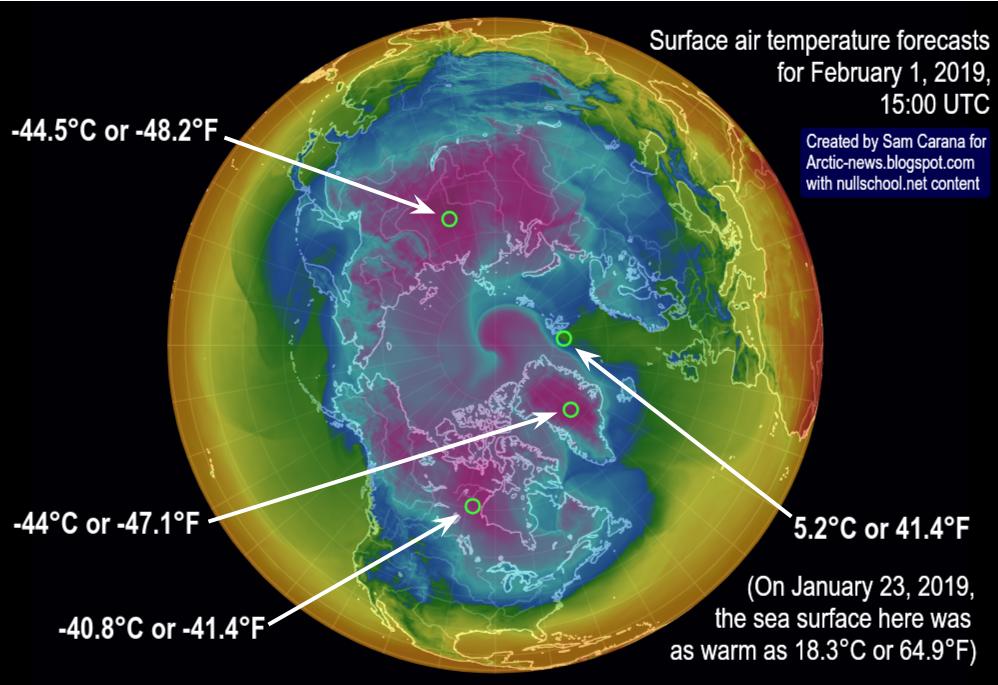
Surface Temperature Predictions for 1 February 2019
“America’s top intelligence official on Tuesday publicly broke with President Donald Trump on several critical foreign policy fronts, saying North Korea is not likely to give up its nuclear weapons, Iran is not yet seeking a nuclear weapon and the Islamic State terrorist group remains a forceful presence in Iraq and Syria.”
President Trump has stated that ISIS had been defeated in Syria, that there is great progress in the nuclear talks with North Korea, and that Iran has violated the nuclear agreement with the US and other great powers. The issue is not so much that Trump’s pronouncements seem to be misinformed–presumably there are always disagreements within any administration. The larger issue is that US friends and enemies do not know which American voice to believe.
The McKinsey Global Institute has published a report on the current state of globalization which argues that the pace of globalization has slowed considerably since the Great Recession of 2008-09. Visual Capitalist summarizes the key points of the report as follows:
“1. A smaller share of goods is traded across borders Trade is still growing in absolute terms, but a smaller share of the physical goods made worldwide is now being traded. More specifically, during the span of 2007 to 2017, gross exports as a percentage of gross output decreased from 28.1% to 22.5% globally.
“2. Services trade is growing 60% faster than goods trade When we think of trade, we often focus on the trade of physical goods (i.e. autos, aerospace, oil). However, services are becoming increasingly important to the global economy – and if accounted for properly, it’s possible that the value of services is closer to $13.4 trillion, which is higher than the total goods trade.
“3. Labor-cost arbitrage has become less important It’s a common perception that trade flows are driven by companies searching for low-cost labor. However, in value chains today, only 18% of the goods trade is based strictly on labor-cost arbitrage.
“4. R&D and innovation are becoming increasingly important Companies are spending more on R&D and intangible assets such as brands, software, and IP as a percentage of overall revenue. This spending has increased from 5.4% to 13.1% of revenue over the period of 2000-2017.
“5. Trade is becoming more concentrated within regions The geography of global demand is changing as emerging markets consume a higher percentage of total goods. Since 2013, intraregional trade has increased by 2.7 percentage points – a reverse from the longstanding trend.”
The report supports the analysis provided by The Economist. There is no question that the slower pace of globalization has been brought about by the decline of incomes among the middle and lower classes and the consequent rise of protectionist measures typified in the US-China trade war.
“Then, Trump and the others will be ready to go for the more muscular approach. Not by accident, this could also benefit Trump as elections approach or if he is cornered by investigations and impeachment. War distracts and makes money. Only this won’t be a regional plunder: China and Russia, both with key interests in Venezuela and elsewhere in the region, have followed Bolivia, Mexico, Uruguay and Cuba to call Guaidó’s stunt by its real name: a coup. Russia has indicated it would come to the defence of its ally. In Venezuela, many who may be critical of Maduro but fear most the return of the rightwing opposition to power are unlikely to cheer the newly converted humanitarians. Unlike the supporters of Chile’s Salvador Allende in 1973, they’re armed. Washington awaits developments on the ground while keeping “all options on the table”. That’s doublespeak for hoping the heavy-handed response by Maduro’s government would provide moral justification for an intervention that would surely be approved by the Organization of American States.”
US National Security Adviser Bolton told the press today that a military intervention in Venezuela remained a possibility, saying that “The president has made it clear that all options are on the table”. Such statements are typically boilerplate in many diplomatic situations, but given Mr. Bolton’s hawkish views, it is hard to dismiss them as I would usually do.
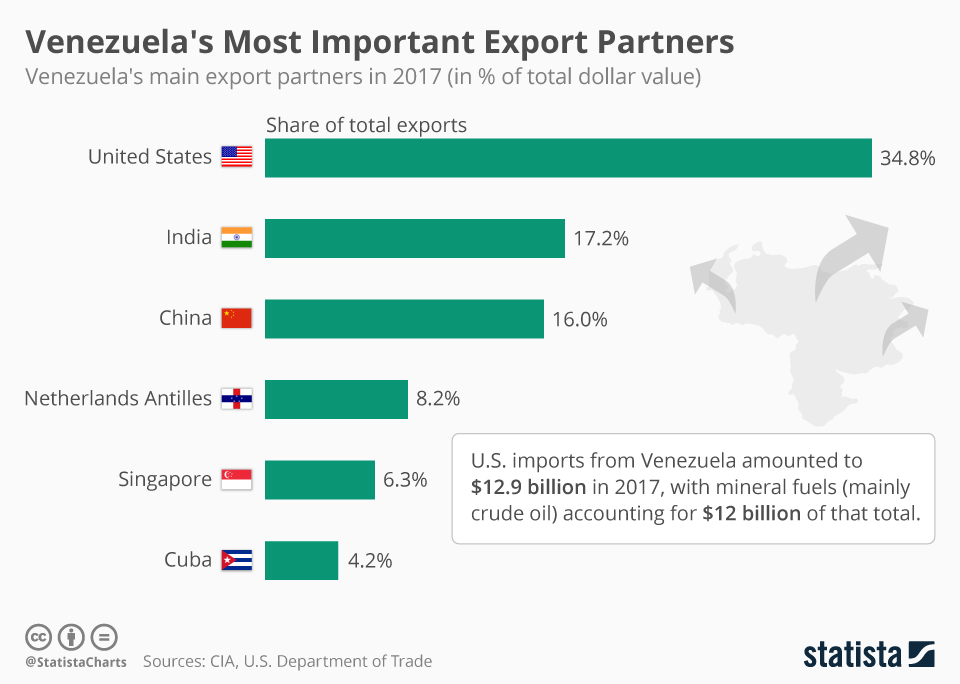
Venezuela’s Export Partners
In a move that will undoubtedly complicate the US-Chinese trade negotiations, the US has filed criminal charges against Chinese telecoms giant Huawei and its chief financial officer, Meng Wanzhou. The charges will also make US-Canada relations more difficult since the US has asked Canada to extradite Ms Meng to the US. Most of the charges have to do with Huawei’s economic transactions with Iran which were supposed to be prevented by sanctions. But many suspect that the actions are designed to prevent Huawei from competing with US and European firms in the development of a 5G infrastructure. CNBC reports:
“According to The Times report, the U.S. government sees fifth generation, or 5G, network, as part of a new arms race where the winner would gain an economic, intelligence and military edge for much of this century. The 5G standard is meant to allow more devices to be on one internet connection, with faster device communications and data transfers. Competition in the telecommunication space to move to 5G is fierce.
In a related move, China’s envoy to the European Union warned on Sunday that excluding Huawei could hamper 5G development, according to a report in the Financial Times.
China’s lead trade negotiator, Liu He, is scheduled to meet with US officials in Washington, DC to continue the trade negotiations, but this US move will clearly make those meetings very difficult. This action against Huawei shows how seriously the two states take the idea of the technological basis for national power.
Today is International Holocaust Remembrance Day, marking the 74th anniversary of the liberation of Auschwitz, one of the most notorious of the Nazi death camps. There are two important reasons to remember this event. The first is that knowledge of the Holocaust is in steady decline as each year passes. Time magazine provides some dispiriting information:
“A new study released in recent days by the Conference on Jewish Material Claims Against Germany and the Azrieli Foundation found that 52 percent of millennials in Canada cannot name even one concentration camp or ghetto and 62 percent of millennials did not know that 6 million Jews were killed in the Holocaust.
“Its findings were similar to a similar study carried out a year before in the United States.
“In Britain, a new poll by the Holocaust Memorial Day Trust found that one in 20 adults in Britain do not believe the Holocaust took place.
“The poll of more than 2,000 people released Sunday also found that nearly two-thirds of those polled either did not know how many Jews had been murdered or greatly underestimated the number killed during the Holocaust.”
If we forget that horror, we also forget that humans are capable of extraordinary atrocities, something that Armenians, Cambodians, Rwandans, and Bosnians know first-hand.
The second reason why it is important to remember the Holocaust is that the seeds of the Holocaust, anti-semitism, are sprouting all over the world. Anti-semitism, like racism, never goes away, but it can be encouraged and fostered by those who wish to use hate as a tool of political mobilization. UN Secretary-General António Guterres warns of the present dangers we now face, as reported by UN News:
“‘The old anti-Semitism is back – and getting worse,’ said the UN chief, warning that Nazi symbols and slogans remain widespread, as anti-hate organizations track hundreds of neo-Nazi, pro-Nazi and white supremacist groups.
“’And as we know all too well, where there is hatred of Jews, hatred of others is also near at hand,’ he said, noting that indeed, the world was witnessing a disturbing increase in other forms of bigotry: attacks on Muslims were on the rise; intolerance was spreading at lightning speed across the Internet and social media; and hate groups were using social media to link up with like-minded bigots across borders.
“’Hate is moving into the mainstream – as major political parties incorporating ideas from the fringes and parties once rightly considered pariahs are gaining influence,’ he said, adding: ‘We should not exaggerate the comparisons to the 1930s, but equally we should not ignore the similarities.’”
Liberation of Auschwitz, 1945
Liberation by Soviet soldiers surviving prisoners of Auschwitz (Auschwitz). Above the gate of the camp is the famous sign-slogan “Arbeit macht frei» (Arbeit macht frei), which means – “Work makes you free”. Concentration released January 27, 1945 part of the 100th Infantry Division of General Fyodor Krasavina. 1st Ukrainian Front.
“The U.S. Department of the Treasury’s Office of Foreign Assets Control (OFAC) today lifted sanctions imposed on En+ Group plc (“En+”), UC Rusal plc (“Rusal”), and JSC EuroSibEnergo (“ESE”), following an earlier notification submitted to Congress on December 19, 2018.
Under the terms of their removal from OFAC’s List of Specially Designated Nationals and Blocked Persons (“SDN List”), En+, Rusal, and ESE have reduced Oleg Deripaska’s direct and indirect shareholding stake in these companies and severed his control. This action ensures that the majority of directors on the En+ and Rusal boards will be independent directors – including U.S. and European persons – who have no business, professional, or family ties to Deripaska or any other SDN, and that independent U.S. persons vote a significant bloc of the shares of En+.
The companies have also agreed to unprecedented transparency for Treasury into their operations by undertaking extensive, ongoing auditing, certification, and reporting requirements. All sanctions on Deripaska continue in force.
The move truly defies explanation. Deripaska has been implicated in the investigation into Russian interference in the US 2016 presidential election–he was an associate of Paul Manafort, Mr. Trump’s campaign manager. Both The New York Timesand The Washington Post have run articles on how lightly Deripaska has been treated and that the sanctions against him have had little effect. The Treasury Department argues that Deripaska’s ties to the sanctioned companies had been severed, but the evidence of that is both slim and hard to substantiate. There is something quite fishy going on here.
The US and the Taliban are engaged in serious negotiations to end the US military role in Afghanistan. The US invaded Afghanistan in October 2001 after the attacks on the US on 11 September 2001 to capture the mastermind of those attacks, Osama bin Laden. That objective was finally reached in May 2011 with the death of bi Laden in Pakistan, but the war in Afghanistan has dragged on with no resolution in sight. The negotiations are being conducted in Qatar between Zalmay Khalilzad, the US special representative for Afghan reconciliation and Abdul Ghani Baradar, one of Taliban’s cofounders. Baradar had been captured in 2010 in Pakistan but was released from prison last October at the request of Khalilzad.
It is no secret that US President Trump wants to withdraw US troops from Afghanistan and these talks may lead to that outcome since US withdrawal has been a key demand of the Taliban for a number of years. A US withdrawal would likely lead to a lot of turmoil in Afghanistan and would be regarded as a betrayal by many. On the other hand, the war has been going on for more than 17 years. Reuters assesses the current strategic situation in the country:
“Despite the presence of U.S.-led foreign forces training, advising and assisting their Afghan counterparts 17 years after the U.S.-led an invasion to drive them from power, the Taliban controls nearly half of Afghanistan.
“Afghan President Ashraf Ghani said last week that 45,000 members of the country’s security forces had been killed since he took office in 2014.”
Reuters is reporting that there is a draft agreement for US forces to leave in 18 months after the agreement is signed. This possibility would be an extraordinary development, but, as is also the case with the withdrawal of US troops from Syria, how the withdrawal is handled is of critical importance.
The political turmoil in Venezuela was apparently preceded by some very sophisticated diplomacy by Juan Guaido. According to the Voice of America:
“In mid-December, Guaido quietly traveled to Washington, Colombia and Brazil to brief officials on the opposition’s strategy of mass demonstrations to coincide with Maduro’s expected swearing-in for a second term on Jan. 10 in the face of widespread international condemnation, according to exiled former Caracas Mayor Antonio Ledezma, an ally….
“The decision to confront Maduro directly was only possible because of strong support from the Trump administration, which led a chorus of mostly conservative Latin American governments that immediately recognized Guaido.
“It was no small diplomatic feat, given the mistrust of the U.S. in Latin America due to the painful memories stemming from U.S. military interventions in the region during the Cold War.”
The crisis in Venezuela has produced an interesting divide in world politics: The US, EU, Canada, and a group of Latin American countries have supported opposition leader Juan Guaido; China, Cuba, Bolivia, Iran, Mexico, Turkey, Russia, and Syria have backed President Nicolas Maduro. There really is no ideological reason for the split, although Cuba and Bolivia have had long-standing ties with the Chavez-Maduro regime. It seems more likely that the divide is best explained by those who see Maduro as a good way to challenge the US role in world affairs. The Venezuelan military officers seem to be supporting Maduro, but the rank and file soldiers seem to be supporting change. There have been reports of violence, but it appears as if the situation is still under control.
Students in Europe and Australia have been engaged in protests against policies that do nothing to stave off climate change, including signing a manifesto that they will not work for companies that are identified as heavy polluters. We are learning more and more about threats to the environment caused by climate change that were not previously understood. One example is the effect of climate change on the availability of groundwater. According to Quartz:
“In a paper published this week in Nature Climate Change, scientists from the UK, Australia, Canada, Germany, France and the US used modeling and hydrological data sets to find how devastating climate change could be to aquifers. They found that climate-related changes to rainfall in the next century will make it harder for 44% of the world’s aquifers to recharge, particularly the shallower ones we rely on to fill up faster.
That means within the next 100 years, nearly half the world’s groundwater supply will become less reliable; since humanity’s need for water is certainly not diminishing, the newly deprived aquifers will begin to deplete—or deplete faster than they already are.
The European Union climate organization has released dire information about the climate in 2018 which is summarized in The Atlantic:
“But the report contains plenty of records worth noting in their own right. 2018 was the hottest year ever recorded in Antarctica, a finding with worrisome implications for sea-level rise. Twenty-nine countries—including France, Germany, Italy, Greece, and the United Arab Emirates, where temperatures hit 123 degrees Fahrenheit in June—experienced their warmest year ever last year, too.
The report also underscores that climate change has already begun—and that we are running out of time to keep it under control. It finds that Earth was about 1.16 degrees Celsius warmer in 2018 than it was during the late-19th century. Last year, the Intergovernmental Panel on Climate Change (IPCC) warned that if global warming exceeds 1.5 degrees Celsius—just 0.4 degrees Celsius above where we are now—then widespread environmental upheaval could result. Perhaps as soon as 2040, climate change could leave hundreds of millions of people with scarce food and water.
It remains to be seen whether young people in the US, China, India, Russia, and Brazil will follow the lead of their cohort in Europe and Australia.
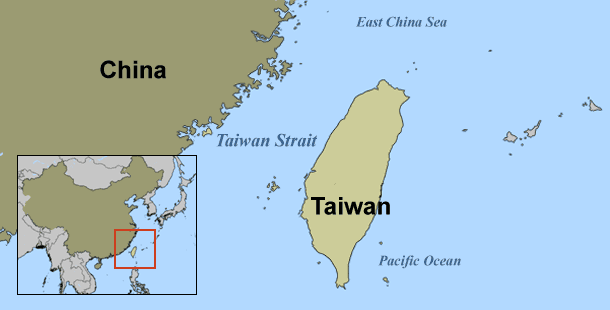
The US sent two naval vessels through the Taiwan Strait which separates China from the island of Taiwan. China regards Taiwan as a renegade province and the US acknowledged in 1972 that Taiwan was part of China in the Shanghai Communique signed by US President Richard Nixon. The voyages were intended by the US to represent innocent passages allowed by international law, but China, since it regards Taiwan as part of its national territory, considers the passages provocative. Earlier this month, Chinese President Xi Jinping gave a speech which was described by The Guardian: “’We make no promise to renounce the use of force and reserve the option of taking all necessary means,’ Xi said, adding that the issue was an internal one and that China would permit ‘no external interference’”. The CHinese newspaper, Global Times, assessed the US military action:
“That US warships and planes keep provoking in China’s coastal areas will obviously increase the possibility of a military clash between the two. The moves by the US military will not only worsen strategic understanding between the two militaries, but also increase the difficulty of the front-line troops of the two countries to stay tactically secure. From a long-term perspective, US war games will become the largest source of risks that will be hard to manage between Beijing and Washington. If the US does not intend to provoke a strategic confrontation with China, or increase the risk of military clashes with China, it should refrain from staging military provocation in China’s coastal areas. The US should take the initiative to reduce its confrontational acts and try its best to manage the risks.”
US President Trump has recognized Venezuelan opposition leader Juan Gauido as the legitimate leader of the country, pushing aside Nicolas Maduro’s claim as President after a recent election. Maduro came to power after the death of Hugo Chavez in 2013 after being President for 14 years. Chavez was supported by the poor in Venezuela because of his willingness to spend money subsidizing the poor, a policy made possible by relatively high prices for oil, Venezuela’s main export. Maduro has attempted to continue that policy despite the collapse of oil prices, a policy that has led to inflation rates calculated in the millions of a percent. Maduro remains popular among some sectors of the Venezuelan population, but millions of Venezuelans have fled the country because of widespread shortages of food, medicine, and other necessary supplies. Al Jazeera outlines the problems that Venezuela has faced since the death of Chavez:
“When Maduro took over as president after Hugo Chavez’s death in 2013, the oil-reliant economy was already in trouble. When global oil prices dropped in 2014, businesses were no longer able to import goods at the same rate as before, skyrocketing prices and inflation.
“According to analysts, the contraction of the national and per capita gross domestic product (GDP) in Venezuela between 2013 and 2017 was more severe than that of the United States, during the Great Depression, or Russia, and Cuba following the collapse of the Soviet Union, heavily impacting the living conditions of millions.
“In 2014, thousands took to the streets to protest inflation and living conditions. The government cracked down on the protests, leaving at least 11 dead.
“In 2015, opposition politicians won a majority in the legislature – the National Assembly – for the first time in nearly two decades.
“However, in 2016, Venezuela’s government stripped the National Assembly of powers to oversee the economy, and in March 2017, the judicial branch briefly dissolved the National Assembly.”
The opposition had boycotted the election in January which raised serious questions about the legitimacy of Maduro’s tenure as President. Gaudio has led a spirited and dangerous campaign against Maduro, urging the Venezuelan military to oust the President. Today the US recognized Gauido as the legitimate President of Venezuela and, in response, Maduro has ordered all US diplomats out of the country in 72 hours. Much depends on which side the Venezuelan military supports and we should know the answer to that question fairly soon.
The US is in a very difficult situation. It needs to express its support for democratic institutions in Venezuela but it also needs to keep out of Venezuela’s internal affairs. If violence breaks out in Venezuela, there will be great pressure on the US to protect US citizens in the country and perhaps even to help bring about an end to violence. The US, however, would be well advised not to do either of these things unilaterally but rather in combination with other states in the region.
Zimbabwe’s President Emmerson Mnangagwa has responded forcefully to the protests against his government, leading many observers to fear a return to the authoritarian policies followed by his predecessor Robert Mugabe. The economy is in very dire straits and inflation is increasing rapidly, putting many necessary goods out of reach for many Zimbabweans. The country requires outside financial assistance but it currently is behind on repaying loans to the World Bank, African Development Bank and European Investment Bank. The violence in Zimbabwe has never really abated, but it seems as if the hopes for a better future after Mnangagwa took power will not be realized.
Brett McGurk was the Special Presidential Envoy for the Global Coalition to Counter ISIL who served in senior national security positions under Presidents George W. Bush, Barack Obama, and Donald Trump. He resigned from his position after US President Trump announced that the US would pull its troops out of Syria. He has written an op-ed explaining why he believed that Mr. Trump’s decision was wrong and why that decision will likely make ISIS stronger. McGurk’s conclusion is telling: “The irony is that defeating the Islamic State is what the president identified as his goal from the beginning. In 2016, he vowed to “knock the hell out of ISIS.” His recent choices, unfortunately, are already giving the Islamic State — and other American adversaries — new life.”
In 1997 Great Britain left its colony of Hong Kong and turned over control to the central government of China. It did so with an important caveat: that China continue to respect the liberal laws governing human rights for a period of 50 years under the governing rubric “One Country, Two Systems”. The Chinese central government in Beijing has repeatedly tested that proposition, leading to demonstrations in 2014 that were known as the “umbrella” movement. That movement was repressed and Beijing continues to try to exert control over the Hong Kong citizenry. The most recent attempt is a new law that makes it a criminal offense to disrespect the Chinese national anthem, “The March of the Volunteers”. The proposed legislation will likely encounter resistance, as suggested by The Economist:
“Such restrictions are not endearing the Chinese government to Hong Kongers. A survey by the University of Hong Kong found that in May 54% of respondents lacked confidence in ‘one country, two systems’—a near-record high. At the time of the handover fewer than one in five had misgivings about the idea. Over the same period those who expressed distrust in the central government rose from fewer than a third to nearly half of those surveyed. A poll last month conducted by the same university found that Hong Kongers would sooner call themselves ‘global citizens’ than ‘Chinese’. “
The new legislation will be closely watched by people on the island of Taiwan which is experiencing greater pressure from Beijing to accept control by the central Chinese government.

 World Politics News