Iranian-backed militias in Iraq have launched a series of attacks on US military bases in Iraq. The attacks are part of a series of attacks and counterattacks between the US and Iran after the US assassination of Iranian General Qassem Soleimani. On Thursday, the US attacked a military base which it considered a base of operations for Kataib Hezbollah, an Iranian militia group in Iraq. In the attack, the US killed “three Iraqi army soldiers, two policemen and a civilian worker”, placing the Iraqi government in a very difficult position. The Iranian objective in these attacks is clear: it wishes to put the Iraqi government in a position where it has no choice but to ask the US to leave Iraq. Up to this point, the US has managed to deflect such demands by threatening to withhold vital military assistance and cash payments. But these attacks on Iraqi sovereignty cannot be ignored much longer: Iran is very close and the US is very far away. The Irish Times describes the tension:
“Around 5,000 US troops remain in Iraq, most in an advisory capacity, as part of a wider international coalition formed to help Iraq drive back and defeat Islamic State militants.
“But the Iraqi military said the new US air attack went against ‘any partnership’ under the coalition. ‘It will have consequences that subject everyone to the most serious dangers.’
“Iran’s foreign ministry said on Friday that the ‘presence and behavior’ of US and allied forces in Iraq was to blame for attacks against them.
“Iranian-backed paramilitary groups have regularly rocketed and shelled bases in Iraq that host US forces and the area around the US embassy in Baghdad.
“The United States, which believes Iran wants to drive it from the region, has conducted several strikes inside Iraq, killing top Iranian general Qassem Suleimani and Kataib Hizbullah founder Abu Mahdi al-Muhandis in January.
“Many Iraqis say it is they who stand to suffer most from US-Iranian tensions and some, including caretaker prime minister Adel Abdul Mahdi, have called for US troops to withdraw.”
Iraq does not wish to be the battlefield in a war between the US and Iran. There is no likelihood that Iran will attack the US, nor does it need to to fulfill its strategic objectives. The question is whether the US will decide that the only effective course of action to deter future Iranian attacks is an attack on Iran itself. There seems to be no viable alternative given US objectives.
I rely heavily on news feeds that are sent to my email for collecting news about events around the world. Unfortunately, 95% of all the feeds that I have received for the last few days have been on the COVID-19 pandemic. It is an issue of unquestionable importance, but one about which I do not feel comfortable. I have no expertise on viruses and as far as I can tell there is actually little hard evidence about the pandemic that I deem reliable. The problem is that some states, such as China, do not have a good track record on providing information. Other states, such as the US, have not been testing so there is no way to assess the spread in the US. But we have hard evidence from Italy that the virus is truly deadly and that it spreads very quickly.
What became clear today is that perceptions about COVID-19 are driving many decisions about how to respond to the pandemic. Professional and collegiate sports have cancelled their activities. Colleges and elementary and secondary schools are closing. And global stock markets are declining precipitously. And all these decisions were made the day after US President Trump made a speech designed to reassure citizens. In my lifetime, I have never seen a presidential speech fail so abjectly. Today, the President declared a national emergency because of COVID-19 and the US stock market responded with a 2,000 point increase in the Dow Jones Index. The volatility is a measure of how uncertainty affects decision-making.
It is impossible for me to predict how this particular pandemic will play out. We have historical records of previous pandemics, but they all occurred at times when medical techniques were significantly inferior to those available today (we should keep in mind that two centuries from now, people will remark at how primitive medicine was in 2020). The most catastrophic pandemic was the Black Death which peaked in Europe between 1347-1351. The Economist notes:
“The Black Death carried off an astounding one-third to two-thirds of the population of Europe, leaving lasting scars. But in the wake of the plague there was far more arable acreage than workers to farm it. The sudden scarcity of workers raised labourers’ bargaining power relative to landlords and contributed to the breakdown of the feudal economy.
“It seems also to have ushered parts of north-west Europe onto a more promising growth path. Real incomes of European workers rose sharply following the pandemic, which struck the continent from 1347 to 1351. In pre-industrial times, higher incomes usually enabled faster population growth, which eventually squeezed incomes back to subsistence levels (as observed by Thomas Malthus). But in parts of Europe, Malthusian rules did not reassert themselves after the pandemic receded. Nico Voigtländer, of the University of California, Los Angeles, and Hans-Joachim Voth, now of the University of Zurich, argue that the high incomes induced by plague led to more spending on manufactured goods produced in cities, and thus to higher rates of urbanisation. The plague effectively shoved parts of Europe from a low-wage, less urbanised equilibrium on a path more congenial to the development of a commercial, and then an industrial, economy.”
The Economist article continues on a less optimistic note:
“More often, though, a pandemic’s economic consequences are unambiguously negative. Trade links which spread a pathogen can themselves be undone by its effects. During the Roman Empire, a high degree of specialisation and trade lifted incomes to levels that would not be reached again for more than a millennium. Alas, the same links facilitated the spread of disease. The Roman economy was dealt a blow in the late second century ad, when an outbreak of what is thought to have been smallpox ravaged the empire. A century later, the Plague of Cyprian, which may have been a haemorrhagic fever, emptied many Roman cities and coincided with a sharp and permanent decline in economic activity, as measured by numbers of shipwrecks (a proxy for trade volumes) and levels of lead pollution (generated by mining activity). Reduced trade fed a cycle of falling incomes and weakened state capacity from which the western empire never recovered.”
How COVID-19 will ultimately affect today’s societies really depends on how those societies respond to the challenges. It is likely that the pandemic will significantly retard the process of globalization as companies realize how fragile the supply chains they have assiduously constructed actually are. But that process of deceleration was already coming into play because of the economic inequities created by the reliance on low wage workers. We will also have to see how the pandemic affects international travel and the movement of people across national borders.
Saudi Arabian Crown Prince Mohammed bin Salman (often referred to as MbS) is consolidating his control over the Saudi government by arresting other royals he suspects of disloyalty. The Crown Prince is a close friend of Jared Kushner, US President Trump’s son-in-law, and when he became Crown Prince he was hailed as a reforming modernizer. But The Guardian has published an editorial by Madawi al-Rasheed casting doubts on that characterization:
“Though the prince built his reputation as a young moderniser, garnering favour among the western media as a monarch who could free Saudi Arabia from the shackles of religious conservatism, economic stagnation and a state-controlled economy, his idea of progress was always two-faced. Prince Mohammed allowed women to drive while presiding over the arrests of women’s rights activists and the criminalisation of feminism. He promised religious reforms and social liberalisation while detaining hundreds of religious scholars, activists and intellectuals.
For the last three years, Russia has been working with the Organization of Petroleum Exporting Countries (OPEC) on production schedules that served to stabilize oil prices. But the advent of the COVID-19 virus has led to a dramatic decrease in petroleum consumption globally. OPEC, led by Saudi Arabia, proposed some dramatic production cuts in order to prevent a further decline in prices. But Russia refused to go along with the production cuts, and Saudi Arabia has retaliated with an unprecedented increase in oil production from 10 million to 12 million barrels a day. The act was the opening salvo in what we call a price war, where Saudi Arabia intends to undercut other producers and draw their customers away. It is a risky strategy because Saudi Arabia is betting that it can weather the loss of revenues better than other producers. At some point, producing oil for export will become unprofitable for some producers. The Middle East Eye reports:
“The break in a three-year alliance between the Saudi-led oil cartel and Russia to support prices may be temporary. The moves over the weekend may well have been part of a negotiating chess game, and the Saudis and Russians can still reach a compromise. But if the collapse is lasting, oil executives say there is nothing to stop oil prices from tumbling to the lowest levels in at least five years, the New York Times reported on Sunday.
“’If a true price war ensues, there will be plenty of pain in the oil markets,’ Badr Jafar, president of Crescent Petroleum, a United Arab Emirates oil company, told the Times. ‘Many will be bracing for the economic and geopolitical shocks of a low-price environment.’
“The production increase and deep discounts mark a dramatic escalation by the Saudis after Russia rejected an ultimatum on Friday in Vienna at the Opec+ meeting to join in a collective production cut. After the talks collapsed, Russia indicated countries were free to pump-at-will from the end of March.
“With jet fuel, gasoline and diesel consumption rapidly decreasing amid the economic impact of the coronavirus outbreak, the energy market now faces a simultaneous supply-and-demand shock.
“After the failure in Vienna, Riyadh responded within hours by cutting its so-called official selling prices, offering record discounts for some of the crude it sells worldwide, according to a copy of the prices seen by Bloomberg News. Aramco has set the prices, but the official communication to clients is likely to come on Monday, a person familiar with the matter said.”
“Many industry people I spoke with over the weekend expect oil to open trading in the $30 dollar range, if not worse by week’s end. That’s very bad news for Texas, North Dakota and anyone still left invested in oil and gas stocks. Shares of Chevron are down 20% in 2020, making it the best performing energy stock in America. Most are down 30%, 40% or even 50% since January 1st. The S&P Oil & Gas ETF (XOP) is down 33% this month.
“The industry is facing a three-sided attack: falling prices, a move of institutional investors to divest from fossil fuel companies, and crushing debt loads.
“Debt is the problem. The U.S. oil and gas industry has about $86 billion of rated debt due in the next four years, according to Moody’s. Nearly all of that debt is either junk rated, or rated just above junk. Fifty-seven percent of that is due in just the next two years. As oil prices fall and credit markets tighten, many companies won’t be able to refinance their debts or extend maturities.”
Both Saudi Arabia and Russia fear the productivity of the US fracking potential which has propelled the US into the spot of being the top oil producer in the world. Their objective is to throttle the fracking industry to eliminate the competition. But they also wish to slow down the transition to renewable energies and an oil price of $20 a barrel would make many of those alternatives unprofitable. Consumers all over the world will benefit from the lower prices and that result will mitigate some of the costs of containing COVID-19. The actual winners and losers will not be fully known until the process plays out completely.
Lebanon has announced that it will attempt to restructure a $1.2 billion bond due on 9 March, putting the country in default for the first time. Lebanon has been on the brink of default for some time and the situation aggravates the serious political crisis the country has been going through for some months. The political crisis stems from the archaic political system the country has used to balance its competing political sects–the constitution allocates important political positions to different religious communities. The Guardian reports:
“Lebanon’s sovereign debt rating slid into junk territory long ago, but investor confidence has fallen further since the mass protests erupted. Credit rating agencies have warned of further downgrades in the event of a default, but economists have stressed the need to protect Lebanon’s foreign currency reserves.
“Jad Chaaban, an economics professor at the American University of Beirut, blamed the political class for Lebanon’s predicament, accusing it of decades of corruption. The crisis ‘is the creation of a failed and criminal political class that has lied and robbed for more than 30 years,’ he said on Facebook.”
NBC is reporting that US officials have serious doubts about whether the Taliban will uphold its obligations under the recent agreement it signed with the US. According to the report:
“‘They have no intention of abiding by their agreement,’ said one official briefed on the intelligence, which two others described as explicit evidence shedding light on the Taliban’s intentions.
“Trump himself acknowledged that reality in extraordinary comments Friday, saying the Taliban could ‘possibly’ overrun the Afghan government after U.S. troops withdraw.
“‘Countries have to take care of themselves,’ Trump told reporters at the White House. ‘You can only hold someone’s hand for so long.’ Asked if the Taliban could eventually seize power, Trump said it’s ‘not supposed to happen that way, but it possibly will.'”
The report confirms what many analysts have suspected: that the US is really not interested in the way the war in Afghanistan ends as long as the US is able to withdraw its troops. The Taliban have carried out 70 attacks on Afghan government forces since the peace agreement was signed on 29 February. Many in Afghanistan view the agreement as a betrayal, as reported by the Washington Post:
“Many Afghans who see themselves most closely allied with American values — and most dependent on U.S. support — fear they have the most to lose from the peace deal. Supporters of women’s rights, civil society and some sectors of the country’s political and security establishment described reading the deal with a mix of disbelief and anger.
“’I want peace. All Afghans want peace. But I don’t think this deal will bring us peace,’ the Afghan official said, describing it as a step in the wrong direction that will further destabilize the country.”
The US withdrawal from Afghanistan will end the war for the US, but it will most likely lead to greater turmoil in the country. Other powers, such as Iran and Pakistan, will view the power vacuum as an opportunity to advance their own interests. And the peace agreement does little to protect human rights, particularly the rights of women. The withdrawal is a classic example of the priority of interests over values in a realpolitik world.
The International Criminal Court (ICC) announced yesterday that it would begin an investigation into alleged war crimes committed in the Afghanistan war by the Afghanistan government, the US, and the Taliban. The ICC was created by the Rome Statute in 1998 which went into effect in 2002. It was charged with the responsibility to address crimes of concern to the international community: genocide, war crimes, crimes against humanity and the crime of aggression. Since its creation:
There have thus far been 27 cases before the Court, with some cases having more than one suspect.
ICC judges have issued 34 arrest warrants. Thanks to cooperation from States, 16 people have been detained in the ICC detention centre and have appeared before the Court. 15 people remain at large. Charges have been dropped against 3 people due to their deaths.
ICC judges have also issued 9 summonses to appear.
The judges have issued 8 convictions and 4 acquittals.
The US never signed the Rome Statute. The ICC Charter defers to national systems of justice to first investigate and prosecute war crime. Only if national authorities do not conduct such investigations and prosecutions will the ICC intervene. The US claims that its national systems of justice are more than adequate and that it therefore does not need the oversight of an international body. But the US rejected the ICC’s authority to investigate possible war crimes in Afghanistan and the rejection sought also to undermine the authority of the ICC:
“Today, the International Criminal Court (ICC) Appeals Chamber authorized an investigation into the alleged activities of the Taliban and U.S. and Afghan personnel related to Afghanistan. This is a truly breathtaking action by an unaccountable political institution, masquerading as a legal body.
“It is all the more reckless for this ruling to come just days after the United States signed a historic peace deal on Afghanistan – the best chance for peace in a generation. Indeed, the Afghan government, itself, pleaded with the ICC to not take this course. But the ICC politicians had other goals.
“The United States is not a party to the ICC, and we will take all necessary measures to protect our citizens from this renegade, so-called court.
“This is yet another reminder of what happens when multilateral bodies lack oversight and responsible leadership, and become instead a vehicle for political vendettas. The ICC has today stumbled into a sorry affirmation of every denunciation made by its harshest critics over the past three decades.
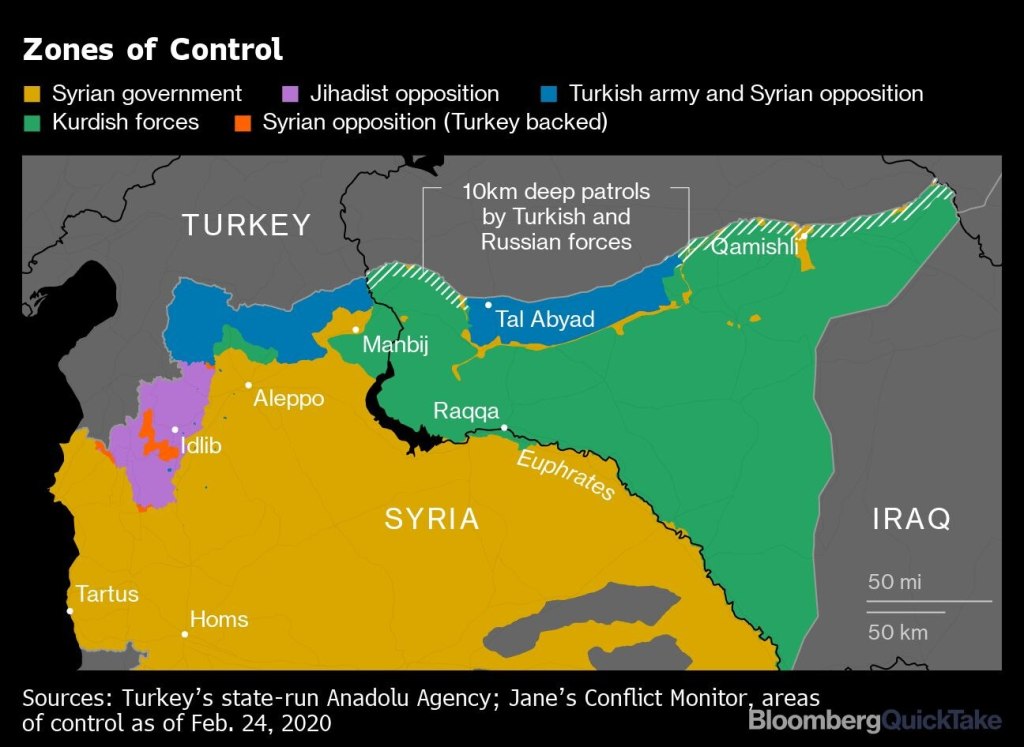
Turkey and Russia have agreed upon cease-fire lines in the Syrian province of Idlib which consolidates Syrian gains at the expense of Turkish interests. But it seems clear that Turkish President Erdogan had little choice but to accept the losses:
“Sinan Ulgen, visiting scholar at Carnegie Europe and a former Turkish diplomat, said Erdogan had to make concessions to Putin because the alternative – a return to military conflict – would be ‘a lose-lose scenario for Turkey’.
“Russia’s air control over Idlib, although challenged by Ankara when it carried out waves of drone assaults on Syrian forces and shot down three Syrian warplanes, would have left Turkish troops exposed to lethal firepower.
“At least 34 Turkish soldiers were killed in an air strike in Idlib last week, the deadliest attack suffered by the Turkish military in nearly three decades.
“’Turkey sat at the negotiating table with this military vulnerability,’ Ulgen told Reuters. ‘Achieving a ceasefire was important from that aspect, but this ceasefire had a cost.’”
It is likely that President Erdogan now regrets his decision to demand the removal of US troops from Syria. There is no likelihood that US troops would have engaged Russian troops, but Syrian President Assad could not have afforded to take such a risk. Erdogan was playing checkers but President Putin, as always, was playing chess.
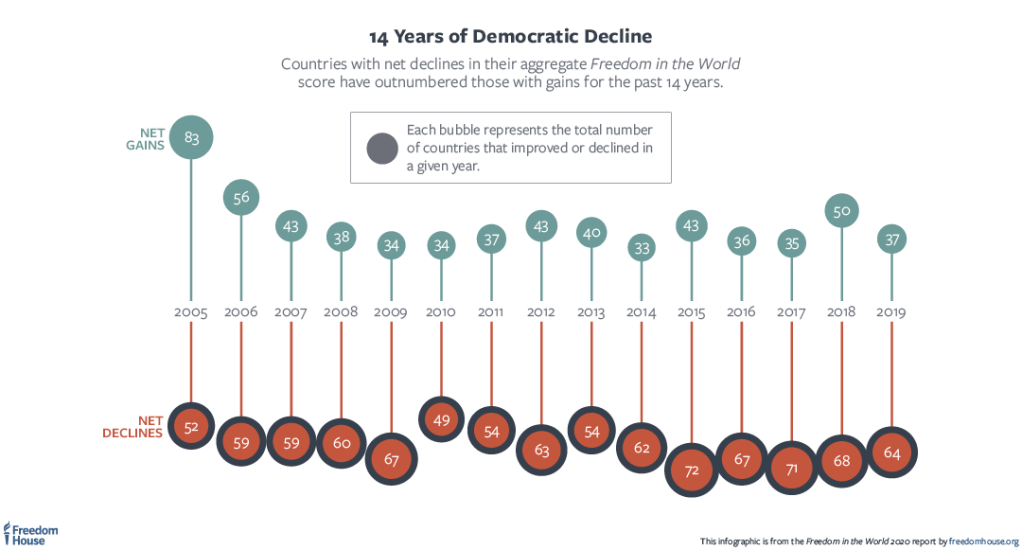
Freedom House is a non-partisan organization that publishes an annual report on the state of personal freedoms in the world. It is an organization that is committed to a liberal ideology that is primarily concerned with the institutions protecting representative democracy, market capitalism, and human rights. It has just published its report for 2020 and, not surprisingly, it found that individual freedoms have been increasingly constrained globally:
“Freedom House found that 2019 was the 14th consecutive year of decline in global freedom. The gap between setbacks and gains widened compared with 2018, as individuals in 64 countries experienced deterioration in their political rights and civil liberties while those in just 37 experienced improvements. The negative pattern affected all regime types, but the impact was most visible near the top and the bottom of the scale. More than half of the countries that were rated Free or Not Free in 2009 have suffered a net decline in the past decade.
“Ethnic, religious, and other minority groups have borne the brunt of government abuses in both democracies and authoritarian states. The Indian government has taken its Hindu nationalist agenda to a new level with a succession of policies that abrogate the rights of different segments of its Muslim population, threatening the democratic future of a country long seen as a potential bulwark of freedom in Asia and the world. Attacks on the rights of immigrants continue in other democratic states, contributing to a permissive international environment for further violations. China pressed ahead with one of the world’s most extreme programs of ethnic and religious persecution, and increasingly applied techniques that were first tested on minorities to the general population, and even to foreign countries. The progression illustrated how violations of minority rights erode the institutional and conventional barriers that protect freedom for all individuals in a given society.”
Many societies do not share the same emphasis on personal freedoms and even within liberal societies there are many who place a higher priority on values other than personal freedom, such as justice, equality, or social stability. The Freedom House report uses India as a revealing case study, but supporters of Prime Minister Narendra Modi would argue that India should take further steps to protect India’s identity as a Hindu nation, despite its liberal constitution. Michael Carpenter has written an essay for Foreign Affairs that looks more generally at the growth of illiberal politics in the world today.
Here is a video of a talk I gave to the World Affairs Council of Western Massachusetts yesterday in Springfield, MA. The topic was “America and the Middle East: Will the Wars Ever End?” I appreciate the opportunity to discuss the topic with such a well-informed and engaged audience.
Turkey has begun an offensive against Syrian forces in the province of Idlib, responding to a Syrian attack that killed 30 Turkish soldiers. Turkish forces claim to have shot down two Syrian jets and to have hit 200 Syrian regime targets with artillery and drone strikes. Under an agreement with Russia and Syria forged in 2018, Turkey has the right to maintain 12 observation sites in Syria, but those sites have come under attack by Syrian forces. The counteroffensive is a delicate operation since the Turks do not wish to engage Russian forces which are supporting the Syrian troops, but making those distinctions between Russian and Syrian forces is difficult.
On another front, Turkey is releasing Syrian refugees on its western border and many of those refugees are trying to seek asylum in Greece. Once in Greece, those refugees will try to move to other EU countries. The EU wants to avoid that influx for political reasons which have been aggravated by fears of the coronavirus. The Turkish move is an attempt to put pressure on Europe to offer support to Turkey in its confrontation in Syria. Barring a Syrian or Russian attack on Turkish soil, there is probably no way that Europe would offer military support to Turkey, particularly in light of the long-standing tensions between Turkey and the EU. But “Erdogan said Turkey, home to some 3.6 million refugees, did not plan to close the borders because ‘the (EU) should keep its promises’. He was referring to the 2016 deal with Brussels to stop the flow of refugees in exchange for billions of euros.”
Turkish President Erdogan is scheduled to meet with Russian President Putin in Russia on Thursday. They will undoubtedly discuss measures to assure that Turkish troops do not fire on Russian troops in Syria. But whether Putin can make any promises about the behavior of Syrian troops is unlikely. Russia has sent large amounts of military equipment to Syria in response to the Turkish attacks. Those weapons could be a bribe to induce Syrian President Assad to hold back. Or they could be a clear statement that Russia backs its Syrian ally wholeheartedly. Russia has sent two naval frigates armed with cruise missiles through the Bosporus Strait into the eastern Mediterranean, signaling its intent to support Syria.
The US, Afghanistan, and the Taliban have signed an agreement that some hope may lead to peace in Afghanistan. The agreement is the result of protracted negotiations between the US and the Taliban which have been conducted in Qatar. The text reflects the extraordinary dance all sides had to make in order to save face–the title of the text is convoluted: “Agreement for Bringing Peace to Afghanistan between the Islamic Emirate of Afghanistan which is not recognized by the United States as a state and is known as the Taliban and the United States of America”. The language reflects the desire of the US not to create the illusion that the Taliban is equal in status to the government of Afghanistan.
The agreement was signed after a week-long “test” of the willingness of both the US and the Taliban to limit violence (it is not clear to me what a week-long hiatus means in the context of a war that has been going on for 19 years). The US has agreed to withdraw
“….all of its military forces and supporting civilian personnel, as well as those of its allies, within 14 months. The drawdown process will begin with the U.S. reducing its troop levels to 8,600 in the first 135 days and pulling its forces from five bases.
“The rest of its forces, according to the agreement, will leave “within the remaining nine and a half months.”
“The Afghan government also will release up to 5,000 Taliban prisoners as a gesture of goodwill, in exchange for 1,000 Afghan security forces held by the Taliban.”
Further:
“The U.S. intends, along with members of the United Nations Security Council, to ‘remove members of the Taliban from the sanctions list with the aim of achieving this objective by May 29, 2020’ — and Washington, in particular, aims to remove the group from U.S. sanctions by Aug 27, 2020….
“The Afghan government will also begin negotiations with the Taliban to map out a political settlement which would establish the role the Taliban would play in a future Afghanistan. These negotiations are expected to start next month. One of the first tasks in these intra-Afghan talks will be to achieve a lasting ceasefire in Afghanistan.”
The last point is important because the Taliban has refused to engage the Afghan government as long as US troops were in the country. Apparently, the commitment to withdraw was sufficient to induce the Taliban to consider changing its position.
There is considerable ambiguity in the agreement. The Taliban are supposed to cease working or communicating with al Qaeda, the group that led the attacks against the US on 11 September 2001 and was the target of the US invasion in October 2001. But one of the most important groups within the Taliban is one led by Sirajuddin Haqqani who is a deputy in the Taliban but also a member of al Qaeda.
There are some who believe that the agreement is nothing more than a face-saving way for the Trump Administration to get out of a war that was incredibly expensive and not very effective. The Taliban controls most of Afghanistan other than the immediate vicinity of the capital city, Kabul. And some conservatives in the US believe that the Taliban will not honor the agreement in much the same way that North Vietnam used the peace agreement with the US in 1973 as a prelude to its invasion of South Vietnam in 1975. Additionally, many do not believe that the agreement provides sufficient guarantees for the rights of women and girls in the country and that the Taliban will revert back to its oppression of women prior to 2001.
Indeed, the total spending on the wars associated with the “war on terror” since 2001 as estimated by researchers at Brown University is considerable: “The United States has appropriated and is obligated to spend an estimated $5.9 trillion (in current dollars) on the war on terror through Fiscal Year 2019, including direct war and war-related spending and obligations for future spending on post 9/11 war veterans”.
There is no evidence that these efforts have materially changed the security situation of the US in any meaningful way. Even if the current agreement with the Taliban is fundamentally flawed, it is accurate to say that the policy of seeking a peace through military action was a fool’s errand.
 World Politics News