The stalemate in Israeli politics seems to have been broken by an agreement between Benjamin Netanyahu and Benny Gantz to form an emergency unity government. Under the agreement, Netanyahu will remain as Prime Minister for 18 months after which Gantz will serve as Prime Minister for another 18 months. There are obviously terms of the agreement about which we remain ignorant, but there was one part of the agreement which was made public. NBC News points out:
“In a deal to form an emergency unity government last week, Netanyahu and his centrist rival Benny Gantz agreed that Netanyahu will be able to bring forward legislation to annex parts of the West Bank for approval by the government and the Israeli Parliament by July 1.
“Washington would need to agree to the move, according to the power-sharing agreement, under which Netanyahu will serve as prime minister for 18 months before handing power over to Gantz.”
It is highly likely that the Trump Administration will approve the annexation since it has previously recognized Jerusalem as the capital of Israel despite Palestinian hopes for East Jerusalem as its capital in its own state. Additionally, the Trump Administration has also recognized Israeli sovereignty over the Golan Heights, a region Israel took from Syria in the war of 1967. The US State Department made the following statement on Monday:
“‘As we have made consistently clear, we are prepared to recognise Israeli actions to extend Israeli sovereignty and the application of Israeli law to areas of the West Bank that the vision foresees as being part of the State of Israel,’ a US State Department spokesperson said on Monday.
“‘The step would be “in the context of the Government of Israel agreeing to negotiate with the Palestinians along the lines set forth in President Trump’s Vision,’ she said.
“The statement came after Netanyahu said on Monday he was confident the US would give Israel the approval within two months to move ahead with the de facto annexation of parts of the occupied West Bank.”
The plan effectively ends the “two-state” solution which has been the preferred option for most of the countries of the world (including the US, until the Trump Administration, although the current US Administration insists that it is still an option). The annexation of the West Bank would give Israel almost total control over the water resources of the region and it is hard to imagine a viable Palestinian state that would certainly be non-contiguous. Most Arab states, including important US allies such as Jordan and Saudi Arabia, have indicated that they oppose the unilateral Israeli annexation of the West Bank.
If the annexation does occur, then Israel will have to decide what place Palestinians will have in the future. There were 5.79 million Palestinians in 2017: 2.16 million in the West Bank, 1.84 million in Israel, and 1.79 million in the Gaza Strip. There are 6,697,000 Jews in Israel, out of a total population of 9,152,100 in 2020. If the Israelis cannot agree on a Palestinian state that is capable of sustaining itself (which essentially means access to water, agricultural land, and the resources necessary for a viable economy), then it is impossible for me to imagine a stable future for either the Palestinians or the Israelis. The only other alternative is for the Israelis to accept the Palestinians as full-fledged citizens of the Israeli state.
It is a terrible shame that such a dramatic change has occurred when the attention of the world was focused on the COVID-19 pandemic. At some point in the future, the world will be reminded of the price of its inattention.
Most of us have been preoccupied with the tragedy of the COVID-19 pandemic, but we should remember that there have been other tragic events in the world. A week ago, 22 people in Nova Scotia were murdered by a lone gunman. One of the victims was a young woman named Emily Hunt who was recorded playing the violin sometime before her death. The Canadian Broadcasting Corporation memorialized some of the victims and posted an extraordinary tribute to Emily Hunt. One can open the video here.
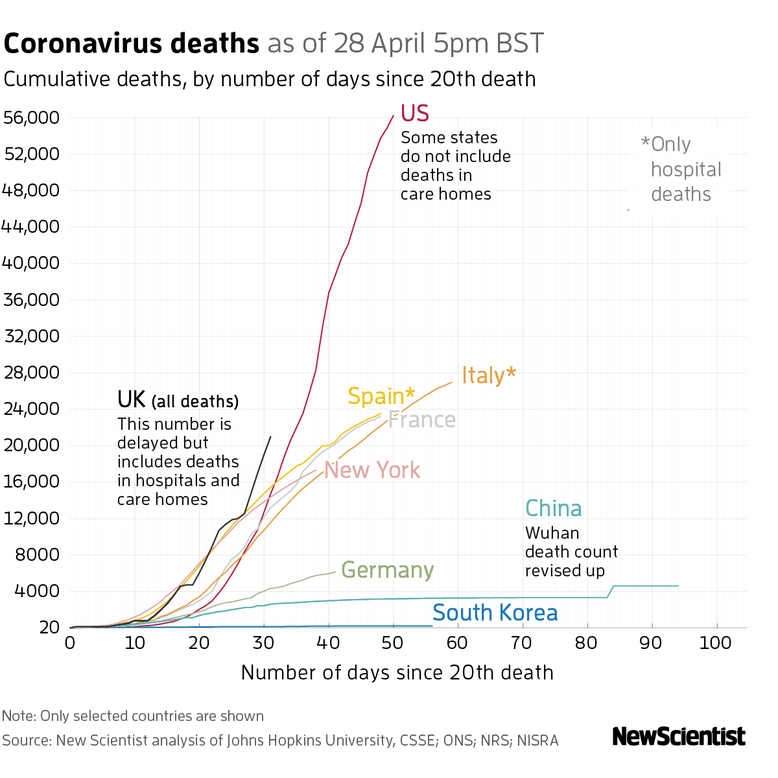
We do not have a solid understanding of the actual scale of the COVID-19 pandemic. Many countries have not tested adequately or have accurate death counts. But, as of yesterday, CNN estimated that there have been 2.9 million people infected globally and of that number 205,000 have died. In the US, 963,168 people have been infected and 54,614 people have died. If we consider these statistics to be roughly accurate, they indicate that the US has had about one-third of the infections and about 25% of the deaths. It could be the case that the US has been reporting more accurately its situation than other countries, and therefore its record looks particularly bad comparatively. But these metrics are all we have right now and they suggest that the US has handled the crisis poorly, since the US population only constitutes 4.25% of the global population. That record should bring great shame to US citizens.
But there is another country which has also taken the pandemic with less seriousness than it deserves. Issac Chotiner, writing in the New Yorker, describes how President Bolsonaro of Brazil has address the pandemic:
“When faced with the coronavirus outbreak, Bolsonaro responded that Brazilians are immune from diseases and won’t ‘catch a thing,’ adding that ‘God is Brazilian.’ He has also harshly criticized governors who have shut down their states despite his opposition. In mid-April, Bolsonaro fired his health minister, Luiz Henrique Mandetta, for supporting social-distancing policies and, according to Bolsonaro, endangering the economy. Although testing remains limited, Brazil has had about fifty thousand confirmed covid-19 cases and thirty-three hundred deaths, and the disease has reached every one of Brazil’s twenty-seven states.”
The Washington Post asserts that Brazil “is moving closer to becoming one of the world’s hardest hit by the coronavirus pandemic.” Bolsonaro has also suffered defections from his government because of the way he has belittled the pandemic and has replaced those who have resigned in protest with favored cronies. Some experts fear that Brazil will replace the US as the worst COVID-19 hot spot, and, given the close interactions between Brazil and the US, that possible development will undoubtedly complicate US efforts to contain the virus. Remember–Brazil is now moving into its winter months as the US is moving into summer.
North Korean leader, Kim Jong-un, missed another important celebration–the anniversary of the founding of the North Korean military. His absence has spawned a number of reports, none of which can be verified. Some assert that he is dead. Others assert that he is in a vegetative state after a botched heart surgery. There is no way to verify any of these reports and we will have to wait until the government makes an official announcement or Kim appears in public. But the uncertainties have spawned speculation on his possible successor, with some asserting that his sister, Kim Yo-jong, could take Kim’s place. Jieun Baek, writing in The National Interest, outlines some of the possibilities:
“Kim Yo-jong has been being groomed to be a senior political figure, but may lack the necessary preparations to be presented as the first female head of state. If she were to succeed Kim Jong-un as the fourth leader of North Korea, she may face strong hesitation and skepticism from the political male elders who embody a patriarchal system. For North Korea watchers, it may be worth considering the possibility that Kim Pyong-il (Kim Jong-il’s paternal half-brother) may be asked to be a political guardian of Kim Yo-jong, or be the successor himself. Kim Pyong-il, who has been serving as a diplomat abroad for forty years and recently returned to Pyongyang, is within the Baektu Bloodline and may be invited into the inner circle to support Kim Yo-jong to maintain the regime within the Kim Dynasty. He could be part of a larger ‘collective leadership’ that supports and guides Kim Yo-jong as the head of state. If she is not prepared to be immediately presented to the public amidst a sudden death of Kim Jong-un, there may be a transitional period during which a collective leadership reigns.
“While possible, it is difficult to imagine that a collective leadership will take over the state in the long run in the absence of a successor who is from the Kim Family. This is because the political legitimacy of the state is derived from the mythical narrative that North Korea’s founding father Kim Il-sung is essentially a god, and his successors will continue to lead the Socialist revolution and protect the nation. North Korea without a successor from the Kim family is like worshippers going to church without a deity to worship.”
This is not the first time Kim has disappeared from public events: “Kim, believed to be 36, has disappeared from coverage in North Korean state media before. In 2014 he vanished for more than a month and North Korean state TV later showed him walking with a limp. Speculation about his health has been fanned by his heavy smoking, apparent weight gain since taking power and family history of cardiovascular problems.” US President Trump, who has invested a great deal of personal diplomacy with Kim, said yesterday that he believed the reports were incorrect. Reuters reports:
“U.S. President Donald Trump on Thursday threw more cold water on reports that North Korean leader Kim Jong Un was gravely ill, but declined to say if he had been in touch with officials there.
“’I think the report was incorrect,’ Trump said at a daily White House briefing, adding that he had heard it was based on ‘old documents.’
“Trump had said on Tuesday that he might contact North Korean officials to inquire about Kim but gave no indication on Thursday he had done so. The two leaders have had regular communications over the past couple of years.
“’We have a good relationship with North Korea, I have a good relationship with Kim Jong Un and I hope he’s okay,’ Trump said.
We shall simply have to wait to see what has actually happened. But if there is a new leader in North Korea, it will be difficult for the US to re-establish the dialog about nuclear weapons until the new leader is firmly in power. There are real dangers to personal diplomacy.
Yesterday, US President Trump tweeted that US naval forces will retaliate if Iranian “fast boats” threaten them: “I have instructed the United States Navy to shoot down and destroy any and all Iranian gunboats if they harass our ships at sea” (one should note that gunboats do not fly and therefore cannot be “shot down”). In response, Iranian Foreign Minister, Javad Zarif, tweeted an equally provocative message: “The US military is hit by over 5000 #covid19 infections. @realdonaldtrump should attend to their needs, not engage in threats cheered on by Saddam’s terrorists. Also, US forces have no business 7,000 miles away from home, provoking our sailors off our OWN Persian Gulf shores.” The exchange comes after Iranian vessels came dangerously close to US naval forces in the Persian Gulf last Wednesday. Iran does not have the ability to confront US naval forces directly and has instead chosen to employ “guerrilla-type” tactics of harassing US vessels with small, but very fast boats. The US vessels cannot know if those Iranian vessels have weapons, such as missiles, which could inflict significant, but not fatal, damage. You can view a video of the confrontation here.
The confrontations come after a relatively quiet period in US-Iranian relations after some tense moments last January. And the Pentagon was quick to note that President Trump’s tweet did not affect the rules of engagement in the Persian Gulf–US naval vessels always operate with the understanding that they have the right of self-defense. The question is why the mood has changed so dramatically so quickly. Both countries are dealing with serious outbreaks of the COVID-19 virus, and Colin P. Clarke and Ariane Tabatabai, writing in Vox, suggest the following:
“So why, in the midst of grappling with an out-of-control pandemic and an economy in free fall, would Tehran devote time and money to fighting the US? The answer, at least in part, is that the Iranian government believes the United States is particularly weak right now, too.
“With Washington’s ineptitude on full display in its domestic response to the coronavirus, few people outside of a select group of Iran hawks — which includes Secretary of State Mike Pompeo — have much of an appetite for continued clashes with Iranian proxies in Iraq or incidents with the IRGC in the Persian Gulf right now.”
The authors point out how the pandemic has affected US military forces all over the world:
“The coronavirus pandemic sweeping throughout the world has led the United States to draw down its forces, repositioning soldiers within Iraq and consolidating troops to fewer bases. US special forces soldiers have been withdrawn from some of the world’s most dangerous active conflict zones, leaving local host-nation forces to contend with an array of well-equipped and battle-hardened terrorists, insurgents, and militias.
“This has presented Iran with a unique opportunity to expand and consolidate its control in Iraq and push the US entirely out. And the country’s leaders aren’t going to squander their chance.”
Additionally, Iran launched what it described as a “military satellite” which was a demonstration of its ballistic missile capabilities, an issue that the US regards as highly provocative. Jane’s, a highly regarded military journal, quotes a high-ranking US military official:
“The United States did not immediately confirm the launch’s success, but General John Hyten, vice chairman of the Joint Chiefs of Staff, left little doubt that Iran had put a satellite into orbit.
“‘There’s a lot that has to happen before a satellite becomes operational or whether it even works or not and it takes a long time to characterise that because it goes around the world,’ he said during a press conference later that day. ‘By this time tomorrow I imagine, if I was to stand up in front of you, I could explain exactly what was going on, whether it was successful or not. I just don’t have that information yet.’
“‘What I can tell you is that it went a very long way, and if you have a missile that goes a very long way, whether it works or not, puts a satellite into space or not, [it] means it has the ability, once again, to threaten their neighbours, our allies,’ he added.”
There is also President Trump’s concern over the health of the US fossil fuel industry which has been hammered by overproduction by Saudi Arabia which seeks to undermine the production of US shale oil. The threat of open conflict in the Persian Gulf had a dramatic effect on the price of oil in the world. The Maritime Executive notes the effect:
“At the moment of the tweet, the NYMEX West Texas Intermediate (WTI) front-month contract – the benchmark for American crude oil – was trading at about $11.52 per barrel. It began a rally about 20 minutes later, and by 0945 it had risen about 40 percent to peak at $16.12 per barrel. The increase is believed to reflect investor optimism that instability in the Strait of Hormuz could restrict Persian Gulf oil shipments, thereby reducing supply in a glutted market.”
Unfortunately, both Iran and the US have an interest in stoking an international confrontation to distract their populations from the horrors of the pandemic and the damage it is doing to their economies. It is doubtful that either side really wish to go to war under these circumstances, but dialing up the rhetoric always runs the risk of miscalculation and misunderstandings.
Tomorrow will be the 50th anniversary of Earth Day. I do not remember the first one very well (I will confess that I was paying far more attention to the Vietnam War at the time). But I was aware of the growing movement to protect the environment, a movement that now seems to be very powerful yet still not centrally involved in the decision-making of most states. The Council on Foreign Relations has produced a very useful timeline of the environmental movement in the proceedings of the United Nations, itself not well represented in national decision-making. The UN only created the Intergovernmental Panel on Climate Change (IPCC) in 1992. That panel has produced five environmental assessments since that time and is currently working on the sixth which is scheduled for release in 2022. Those assessments have become increasingly dire since 1992 and the IPCC has clearly concluded that climate change is caused by human activity.
Unfortunately, the COVID-19 pandemic will put a damper on the celebrations of the anniversary, but that sad situation also highlights the significance of the climate for human health. Lynda V. Mapes, writing for PhysOrg, explains the link:
“Organizers for Earth Day’s 50th anniversary envisioned a 1-billion-person, global commemoration marked with gatherings, marches, speeches, concerts and more. Years of work in the organizing—now canceled by the coronavirus pandemic. But the global standstill itself is a profound statement of nature’s power, and human vulnerability, not only now in the pandemic but as the planet hurtles toward a warmer future.
“‘COVID is a real warning that when Mother Nature decides to act, we are pretty puny,’ said Gene Duvernoy, who helped organize 50th anniversary events for Earth Day Northwest 2020. COVID-19 is the disease caused by the novel coronavirus, which as of Friday had claimed . Today, humankind faces not only the emergency of the coronavirus pandemic but the catastrophe of global warming. In the scale of geologic time, it is happening just as fast, and already for some species and communities is more destructive.
The stay-in-place orders have reduced economic activity to a substantial degree and it is a very heavy price for many people. But the economic slowdown has also reduced the emission of greenhouse gas emissions which is dramatic and which demonstrates the significance of human activity on climate:
Comparison of air quality based on NO2 in China before and after social distancing measures
Second, the arguments against climate change and the significance of the COIVD-19 virus are all based upon an affirmation of “common sense” as opposed to scientific analysis. That struggle continues (as it has since the Scientific Revolution of the 17th Century). In the case of COVID-19, however, it does appear that science has the upper hand because of the immediacy of the effects of ignoring it. The protests against the stay-at-home orders have been intense, but small, despite President Trump’s encouragement. Polling evidence indicates that large majorities of the US population support the stay-at-home orders. One can hope that the sentiment supporting science vis-a-vis COVID-19 might ultimately spillover to the climate change debate.
Third, there is accumulating evidence that the degradation of the environment has contributed to the emergence of COVID-19 and perhaps other novel viruses. Air pollution had a definite effect on the seriousness of the COVID-19 infection:
“Because COVID-19 attacks our lungs, air pollution makes us more vulnerable to the virus. It’s no surprise that COVID-19 deaths are high in places with poor air quality. Recent research from Harvard University documents this well. In fact, the study’s findings, the researchers noted, “underscore the importance of continuing to enforce existing air pollution regulations to protect human health both during and after the COVID-19 crisis.”
Additionally, the rapid growth of human populations has infringed upon the natural environment, leading to a closer interaction between humans and wildlife. The Guardian reports:
“Nature is sending us a message with the coronavirus pandemic and the ongoing climate crisis, according to the UN’s environment chief, Inger Andersen.
“Andersen said humanity was placing too many pressures on the natural world with damaging consequences, and warned that failing to take care of the planet meant not taking care of ourselves.
“Leading scientists also said the Covid-19 outbreak was a ‘clear warning shot’, given that far more deadly diseases existed in wildlife, and that today’s civilisation was ‘playing with fire’. They said it was almost always human behaviour that caused diseases to spill over into humans.
“To prevent further outbreaks, the experts said, both global heating and the destruction of the natural world for farming, mining and housing have to end, as both drive wildlife into contact with people.”
The connection between climate change and the coronavirus is not clear to most people. But the pandemic may be tipping the scales back in favor of a more scientific approach to policy issues. More importantly, the breakdown of the petroleum industry, as reflected in the negative price for oil, may weaken the power of the oil and natural gas industry to dominate the discussion about climate change. We will see how much money the Trump Administration uses from the bailout programs to rescue the industry.
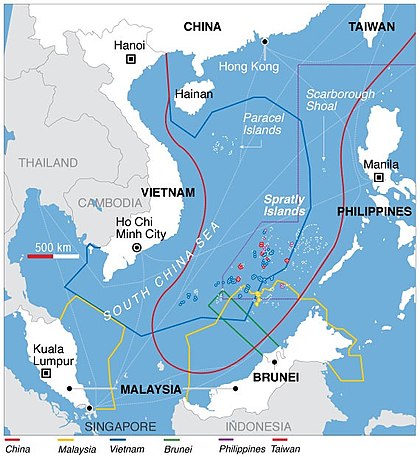
According to Reuters, China has “established an administrative district on the Paracel islands and another on the Spratly islands. The two districts are under the control of China’s Sansha city”. The two islands are in the South China Sea which China claims as part of its national territory even though that claim does not rest on any interpretation of international maritime law. Other states in the region, such as Vietnam, the Philippines, and Indonesia also have made claims on the South China Sea. Vietnam protested the action:
“‘The establishment of the so-called Sansha City and related activities seriously violated Vietnam’s sovereignty,’ Vietnam’s Foreign Ministry spokeswoman Le Thi Thu Hang said in a statement.
“’Vietnam demands that China respect Vietnam’s sovereignty and abolish its wrongful decisions,’ Hang said in the statement.”
Some analysts believe that China is making these moves now because the world–especially the US–is preoccupied with the COVID-19 crisis:
“Richard Heydarian, an academic and former Philippine government adviser, described the move as China taking advantage of a ‘strategic vacuum’ created by the Covid-19 crisis.
“’On the one hand it’s engaging in face mask diplomacy [providing medical supplies to other countries] … but on the other hand it’s on the offensive,’ he said.
“’All of them should be seen as part of one package in which China seizes the strategic opportunity of not only its neighbouring countries scrambling to deal with the coronavirus outbreak, but also the US Navy’s suspension of overseas appointments.’”
The US has yet to comment on the Chinese moves. I doubt that there will be any response.
And now, for something completely different (apologies to Monty Python)
President Trump held his daily coronavirus briefing yesterday which lasted a very long time. It covered a multitude of issues, although I personally found it difficult to follow the train of thought. But there was an interesting point where Mr. Trump began to talk about his relationship with the North Korean leader, Kim Jong-un:
“No, I think we’re doing fine. Yeah, sure, it’s — North Korea, I see they’re testing short-range missiles. And, you know, they’ve been doing it a long time. I received a nice note from him recently. It was a nice note. I think we’re doing fine.
“Look, if I wasn’t elected, you would, right now, be at war with North Korea. Okay? I’ll tell you, for your people that don’t understand the world and they don’t understand how life works: If I wasn’t elected, you would, right now — maybe the war would be over, hopefully with a victory.
“But if you remember, when I first came in, we didn’t have ammunition. Not a good way to fight a war. President Obama left us no ammunition. Okay? And he left us virtually no medical and ventilators. He left us — the cupboard was dry, right? The cupboard was dry.
“No, I think, right now, you’d be at war, essentially — in some form — it would be over, it would be raging — with North Korea, if I weren’t President. And we’re doing just fine with North Korea. Just fine. We’ll see how it all ends up.
“You know, in the meantime, they said, ‘Oh, Trump has given up.’ And then they said ‘Oh, really, what’s he given up?’ And they said, ‘I don’t know.’ Then they said, ‘He met.’ Oh, I met. I met.
“No, I have a good relationship with Kim Jong Un. That’s not a bad thing to have a good relationship. Obama wanted a relationship; he wouldn’t meet with Obama. Wouldn’t meet with him. Okay? I have a good relationship with him. We met at the line. I stepped over the line. The first time anything like that’s ever — it’s all good. It’s just — it’s good.”
It is difficult to determine exactly what point Mr. Trump was trying to make, but his assertion that he had received a “nice note” from Kim Jong-un elicited a response from North Korea. According to Politico:
“North Korea’s Foreign Ministry said in a statement that there was no letter addressed to Trump recently by “the supreme leadership,” a reference to Kim.
“It said it would examine why the U.S. leadership released ‘the ungrounded story’ to the media.
“’The relations between the top leaders of [North Korea] and the U.S. are not an issue to be taken up just for diversion nor it should be misused for meeting selfish purposes,’ the statement said.”
Kim was not present at the celebrations for the Day of the Sun, an annual event honoring the birthday of Kim Il-sing, the founder of North Korea and Kim’s grandfather. It is difficult to interpret his absence from the event. It may be simply that Kim is avoiding public contact as the COVID-19 virus works its way through the North Korean population. Or it could be something more serious, such as Kim himself being sick. It is difficult to know what is going on in North Korea.
President Trump has characterized himself as a “war president” in dealing with the COVID-19 pandemic. In my lifetime, I have witnessed a number of wartime presidents: Johnson had his war on poverty, Nixon had his war on cancer, Carter termed energy conservation as the “moral equivalent of war”, Reagan had his war on drugs, and W. Bush had his war on terror. On 13 March 2020 Mr. Trump invoked the Stafford Act to declare a national public health emergency. I’ve also been around when the US has fought a number of wars: Vietnam, Afghanistan, and Iraq. And I am concerned that other wars are waiting to be launched against Iran and North Korea. The war analogy is a dangerous one, designed to mobilize public support for actions that undermine the very principles of democratic governance.
“‘Americans know war,’ theologian Stanley Hauerwas notes, and when we ‘are frightened … ironically war makes us feel safe.’ Michael Sherry concurs — building on the work of the late historian Marilyn B. Young — when he calls the United States ‘a nation deeply wedded to and defined by war, though maddeningly reluctant to admit it.’
Still, real war remains distant and abstract for the overwhelming majority of Americans. As scholar Andrew Bacevich indicated in 2011, ‘approximately half of 1 percent of our citizens bear the burden of service and sacrifice’ — meaning 99.5% of Americans are not personally attached to the military or the national security state. The physical and emotional distance separating most Americans from the battlefield allows them to glorify war while knowing nothing of its unspeakable horrors or the sacrifice it entails.”
“Donald Trump’s authoritarian tendencies and resistance to oversight make him more like Orban than like the British. With uncertainties about how this year’s presidential election will be conducted—and with Trump’s friend Bibi Netanyahu showing how to leverage the coronavirus crisis into staying in power despite even an indictment for corruption—political maneuvering by Trump that would undermine electoral democracy seems likely. It becomes all the likelier to the extent he can claim that being at ‘war’ necessitates compromising even democratic principles and practices.
“The issue of how the end of the metaphorical war is complicated when applied to the coronavirus. Given what epidemiologists tell us, a burst of short-term sacrifice in the form of highly restrictive lockdowns and quarantines would be more beneficial than any short-term efforts that might be made in the name of counterterrorism. This kind of anti-viral ‘surge’ would pay more dividends than the military surges in Iraq and Afghanistan.
“The fight against covid-19, however, will not have an ending even remotely analogous to the World War II surrender on the deck of a battleship. Even those experts who are optimistic about the development of a vaccine are not talking about eradication of covid-19 in the way smallpox has been eradicated. Shoving aside other principles and priorities for the sake of ‘winning’ a current ‘war’ is inappropriate when what is needed are sustainable, long-term arrangements that accommodate interests of public health, economic prosperity, and political rights and liberties.”
A few days ago, Mr. Trump declared that he had “total authority” over the actions of states, despite the 10th Amendment to the Constitution. An today, he tweeted out to protesters in three states, advocating that the protests should “liberate” citizens from the very strictures his administration had articulated yesterday before the stay at home orders are relaxed. NBC News describes how some citizens interpret the tweets:
“Trump’s tweets, however, pushed many online extremist communities to speculate whether the president was advocating for armed conflict, an event they’ve termed ‘the boogaloo,’ for which many far-right activists have been gearing up and advocating since last year.
“There were sharp increases on Twitter in terms associated with conspiracies such as QAnon and the ‘boogaloo’ term immediately following the president’s tweets, according to the Network Contagion Research Institute, an independent nonprofit group of scientists and engineers that tracks and reports on misinformation and hate speech across social media.
“Posts about the ‘boogaloo’ on Twitter skyrocketed in the hours after the president’s tweets, with more than 1,000 tweets featuring the term, some of which received hundreds of retweets.

 World Politics News