There are five Iranian oil tankers approaching Venezuela’s 200 exclusive economic zone (EEZ). There is irony in oil exports to Venezuela, home to one of the largest oil reserves in the world. But the economic chaos in Venezuela due to the mismanagement of the Maduro regime and the economic sanctions imposed on Venezuela by the US has led to gasoline shortages in the country, compounding the misery in the country. The Guardian reports:
“Iran is supplying about 1.53m barrels of gasoline and alkylate to Venezuela, according to both governments, sources and calculations made by TankerTrackers.com based on the vessels’ draft levels.
“The shipments have caused a diplomatic standoff between Iran and Venezuela and the US, as both nations are under US sanctions. Washington is considering measures in response, according to a senior US official who did not elaborate on any options being weighed.
“The US recently beefed up its naval presence in the Caribbean for what it said was an expanded anti-drug operation. A Pentagon spokesman, Jonathan Hoffman, said on Thursday he was not aware of any operations related to the Iranian cargoes.”
The US could probably seize those tankers in the EEZ (or, more likely, just before they enter the EEZ), but it is unclear what interests such actions would serve. Both Russia and China have supported the Maduro regime, and Iran would achieve little more than a symbolic poke in the US eye. Additionally, both Cuba and Turkey have offered Venezuela support. The US currently does not have any good relations with any of those five states, but it also does not have much support for its sanctions against either Venezuela or Iran among its closest allies.
“Venezuela’s permanent envoy to the UN Samuel Moncada has warned of a threat which he argued is posed by Washington to Iranian tankers bound for the South American country.
“In a tweet on Friday, Moncada announced that Venezuela had alerted the UN Security Council and its Secretary General Antonio Guterres of ‘the threat of imminent use of military force by the United States against Iranian vessels carrying Venezuelan-directed gasoline’.
“In another tweet, Moncada insisted that an ‘armed attack on tankers, exercising free trade and navigation between sovereign nations, is a crime of aggression’.
“He added that ‘a naval blockade is aggravated by the fact that it aims to deprive an entire population of its vital means of subsistence’ and that ‘it is a crime of extermination’.”
“Government officials piled some 9 tons of gold — an amount equal to about $500 million — on Tehran-bound jets this month as payment for Iran’s assistance in reviving Venezuela’s crippled gasoline refineries, the people said. The shipments, which resulted in a sudden drop in Venezuela’s published foreign reserve figures, leave the crisis-ravaged country with just $6.3 billion in hard-currency assets, the lowest amount in three decades.”
At this point I would be surprised if the US tried to interfere with the tankers. The materials will only supply Venezuela for about two months and it seems clear that Venezuela does not have more gold to pay Iran. Thus, the risks do not seem commensurate with the benefit of additional pressure on the Maduro regime. But I have often been surprised by the foreign policy moves of the current administration.
China has proposed a new security law that will have ramifications on the people of Hong Kong. Hong Kong became a British colony at the end of the 2nd Opium War in the mid-19th century, and in the 20th century the colony became an important conduit for foreign capital into the Chinese economy. The inflows were possible because investors trusted British law to protect their interests even though the money ultimately flowed into the more problematic Communist economy. The British lease for the colony expired in 1997, but British laws remained in force under a compromise known as the “one country, two systems” agreement. As the Chinese economy grew into one of the largest in the world, the attractiveness of the compromise has worn thin for the Communist Party and over the last few years it has tried to gain greater control over Hong Kong. In many respects, the Communist Party has viewed the autonomy of Hong Kong as a threat to its control and views that autonomy in the same light as it views the restiveness in Taiwan, Tibet, and Xinjiang–all areas that have movements that favor independence from the control of the central Chinese government.
“The United States condemns the People’s Republic of China (PRC) National People’s Congress proposal to unilaterally and arbitrarily impose national security legislation on Hong Kong. The decision to bypass Hong Kong’s well-established legislative processes and ignore the will of the people of Hong Kong would be a death knell for the high degree of autonomy Beijing promised for Hong Kong under the Sino-British Joint Declaration, a UN-filed agreement.
“Hong Kong has flourished as a bastion of liberty. The United States strongly urges Beijing to reconsider its disastrous proposal, abide by its international obligations, and respect Hong Kong’s high degree of autonomy, democratic institutions, and civil liberties, which are key to preserving its special status under U.S. law. Any decision impinging on Hong Kong’s autonomy and freedoms as guaranteed under the Sino-British Joint Declaration and the Basic Law would inevitably impact our assessment of One Country, Two Systems and the status of the territory.
“We stand with the people of Hong Kong.”
Members of the US Congress have proposed legislation that would impose penalties on individuals and banks that “are complicit in China’s illegal crackdown in Hong Kong”. Interestingly, however, US President Trump has yet to comment on the security proposal, despite his campaign to blame China for the spread of COVID-19: “Spokesman speaks stupidly on behalf of China, trying desperately to deflect the pain and carnage that their country spread throughout the world. Its disinformation and propaganda attack on the United States and Europe is a disgrace….” Relations between the US and China have deteriorated at an alarming rate, largely because there is confusion in the US decision-making arena about which issue is most important. Is it trade? Taiwan? Technology transfer and theft? South China Sea? COVID-19? Trump’s personal relationship with President Xi? All I can find in incoherence when I try to determine the overall policy toward China.
For its part, China seems to have a handle on what it wants, although it does not really know how to interact positively with either the US or the world as a whole. The Global Times, a media outlet that often speaks for the Communist Party in China, is very clear about how it regards the issues in Hong Kong:
“The US’ biggest card is canceling Hong Kong’s separate customs territory status. This would be a blow to Hong Kong’s economy, making a dent in the city’s status as an international financial center. But, at the same time, Hong Kong is a rare contributor to tens of billions of US trade surplus each year. A large number of US companies are doing business there, where 85,000 US citizens work and live. Throwing a punch at Hong Kong means hitting the US itself.
“Hong Kong has been a link between China and the West. Yet, with the deepening of China’s reform and opening-up, this function of Hong Kong has been largely decentralized to China’s coastal areas. If the US cuts its bond with China on Hong Kong, the damage to the Chinese mainland’s economy will be not even close to the blow the US could make 20 years ago.
“More importantly, when China announced the plan, it meant Beijing had already evaluated how Washington would respond, and has been prepared for possible challenges. The possibility of China retreating under US pressure is zero.”
It is hard for me to imagine the US pushing China hard except in terms of political rhetoric which is largely directed toward the American domestic political situation. But it certainly seems to be the case that the Chinese are bewildered about US Chinese policy.
Edward Luce has written a very comprehensive article for the Financial Times on how the US handling of the COVID-19 pandemic compares with other countries and on the decision-making process in the US (fortunately, the Financial Times is making its articles on the coronavirus free for the time being). The article is based on many interviews with people from all over the planet and it provides a refreshing change from the US-based media. The analysis is devastating:
“Again and again, the story that emerged is of a president who ignored increasingly urgent intelligence warnings from January, dismisses anyone who claims to know more than him and trusts no one outside a tiny coterie, led by his daughter Ivanka and her husband, Jared Kushner – the property developer who Trump has empowered to sideline the best-funded disaster response bureaucracy in the world.
“People often observed during Trump’s first three years that he had yet to be tested in a true crisis. Covid-19 is way bigger than that. ‘Trump’s handling of the pandemic at home and abroad has exposed more painfully than anything since he took office the meaning of America First,’ says William Burns, who was the most senior US diplomat, and is now head of the Carnegie Endowment.
“’America is first in the world in deaths, first in the world in infections and we stand out as an emblem of global incompetence. The damage to America’s influence and reputation will be very hard to undo.’”
The conclusion is reinforced by a study just released by the Department of Environmental Health Sciences, Mailman School of Public Health at Columbia University. The study has not yet been peer reviewed so its findings are tentative. But the study found that if effective social distancing rules of 15 March had been imposed one week earlier (8 March), 35,927 deaths could have been prevented. If those rules had been enforced two weeks earlier (1 March), then 53,990 deaths could have been avoided. When asked about the study, Mr. Trump called it a “political hit job”. We will look back on this period as one of the most pathetic times in US history.
The Washington Post has an interesting story on whether the handshake will survive the COVID-29 pandemic. The article suggests that the handshake will survive, a conclusion with which I agree. But aside from a cursory reference to the emergence of the handshake to medieval Europe when knights would extend their hands to show that they were unarmed, the article does not investigate why the handshake is so pervasive.
The handshake is indeed a way of discovering whether a stranger is unarmed, but it extends further back from medieval Europe. Consider the almost universal way we greet strangers from afar: the wave. Extending an upright arm with an open palm is a way to prove to others that we are indeed unarmed. The Romans, instead of clasping hands, clasped forearms because togas could hide a knife buried surreptitiously in the folds of the toga. Soldiers are required to salute a superior officer with an open palm salute in order to prove that they were not carrying a weapon in their hand, a general concern in a population that is almost always armed.
Moreover, the ability of humans to clench their fists tightly is different from primates. Primates retain their ability to use their hands in particular ways as an aid to locomotion, usually in trees, but those uses preclude the ability to make a clenched fist. Humans, on the other hand, have evolved the ability to clench their fists tightly, essentially giving them the ability to use their fist as a club. That ability was necessary in order to use hands as a weapon, an attribute unique among all primates.
Humans developed cultural norms in order to survive in hostile environments, and to assure survival when meeting strangers. The handshake and the wave suggest that humans had deep fears of aggressive behaviors. Unfortunately.
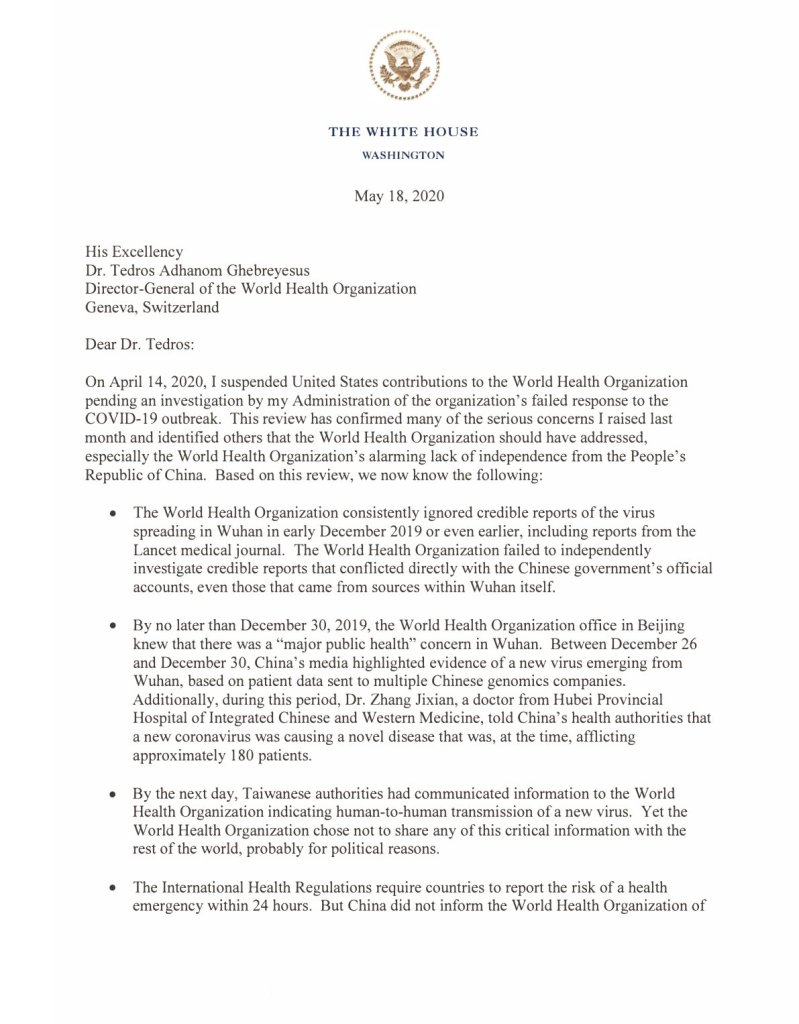
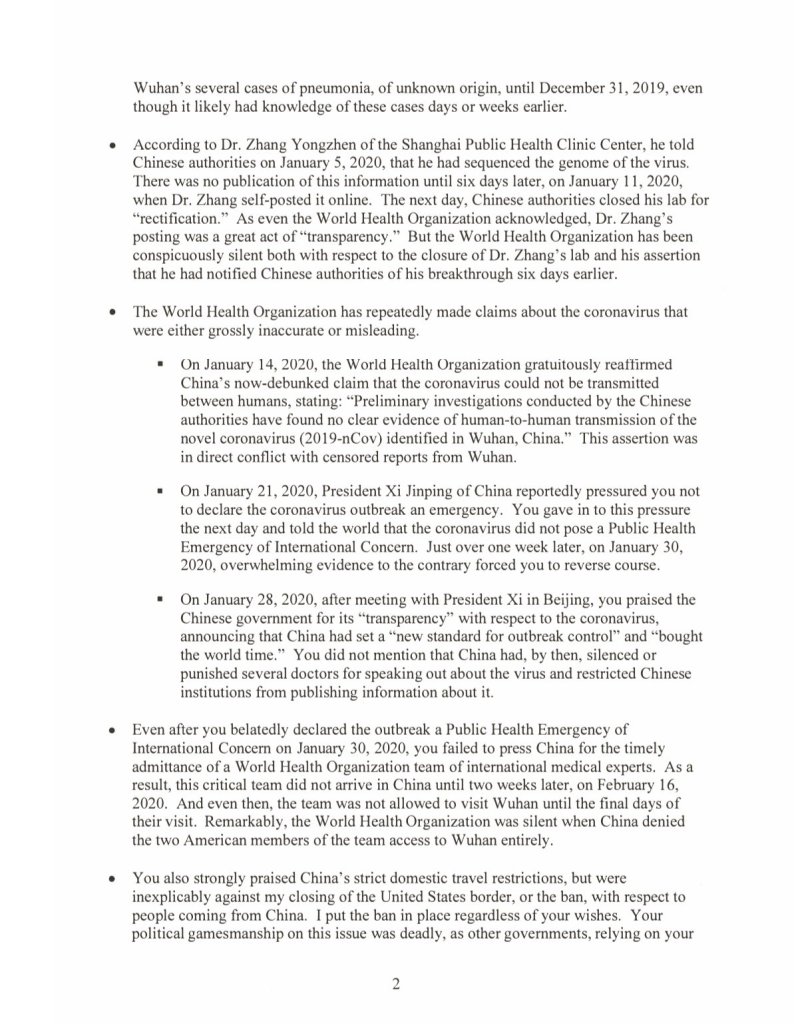
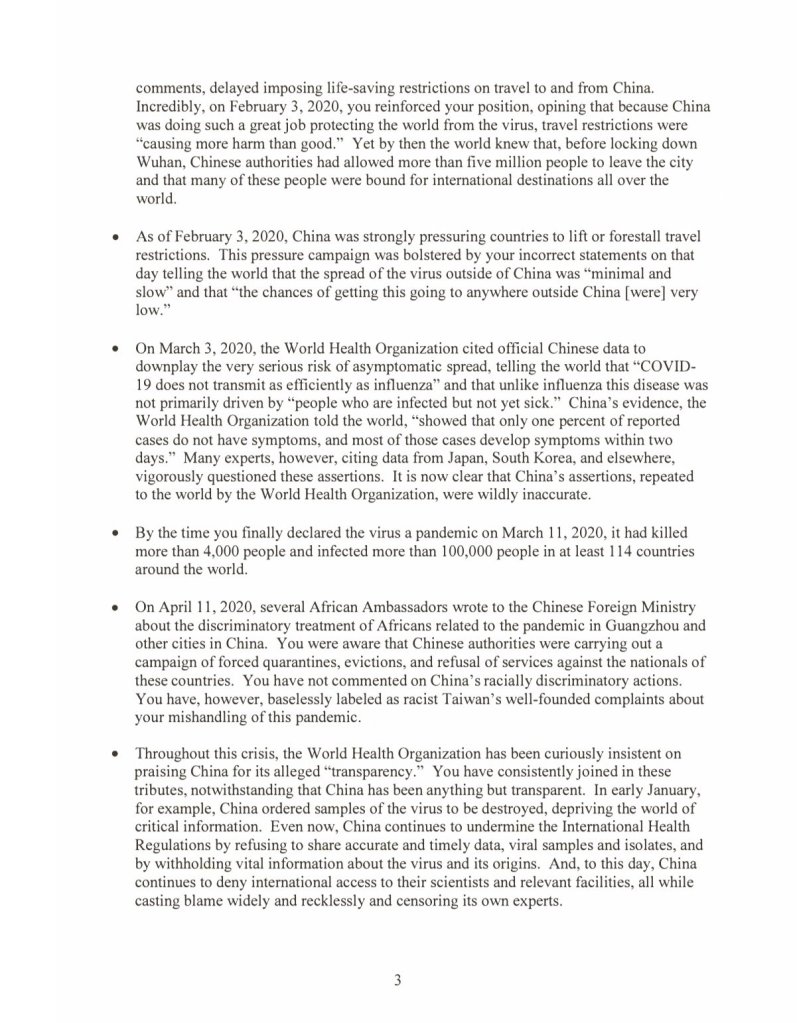
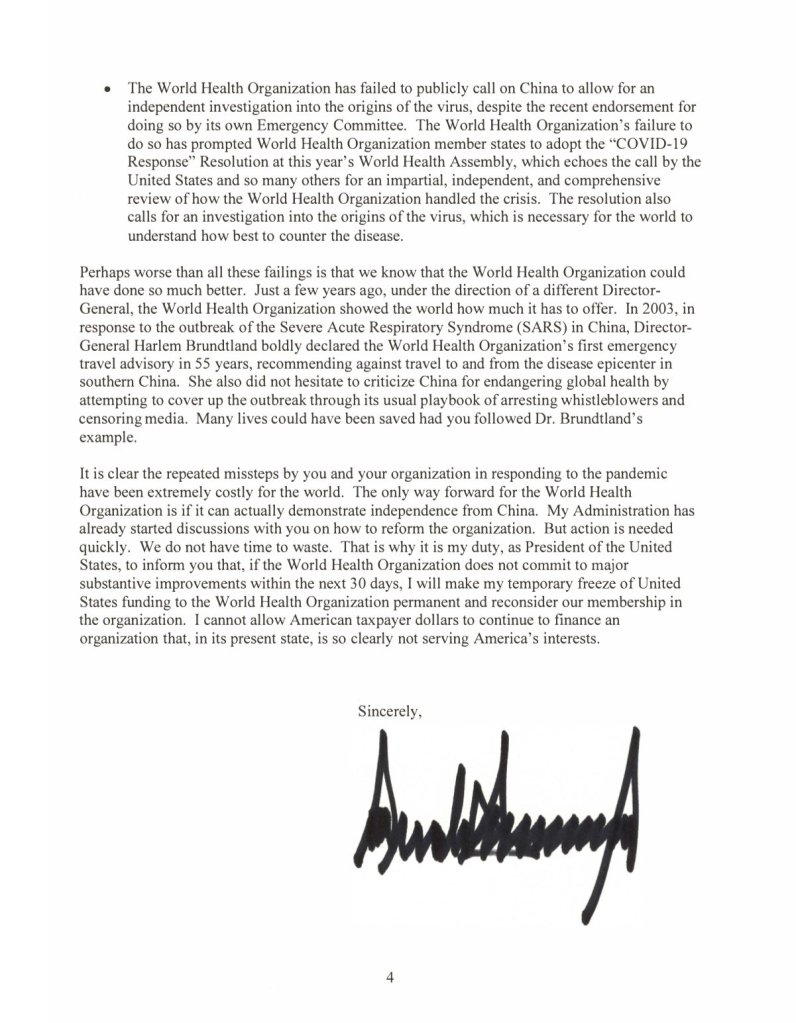
US President Trump sent a 4-page letter (reproduced below) to the World Health Organization (WHO) giving it 30 days to submit to his demands or the US will permanently leave the organization. The US accounts for 14% of the WHO budget, so it is a serious threat that cannot be dismissed. And, in truth, there are good reasons to review how WHO handled the early stages of the pandemic, but there is a highly legitimate concern that conducting such a review in the middle of a pandemic would divert WHO from more immediate concerns. There is no reason why the review cannot be conducted after the pandemic has been better controlled. The letter is extraordinary in its petulant language as well as its factual errors.
For example, his reference to a report from the prestigious British medical journal, The Lancet, was repudiated by the journal which termed the reference “factually incorrect”. The Lancet also disputed Mr. Trump’s claims that the Chinese were reticent to share information with outsiders, pointing out that the Chinese “worked with us to quickly make information about this new epidemic outbreak and the disease it caused fully and freely available to an international audience.”
But the letter ignores a number of statements President Trump made earlier in the year. On 22 January in an interview with Fox News: “It’s all taken care of. And China is working very hard on the problem. We spoke about it and China is working very hard on it.” On 24 January: “China has been working very hard to contain the Coronavirus. The United States greatly appreciates their efforts and transparency. It will all work out well. In particular, on behalf of the American People, I want to thank President Xi!” On March 24: “Look, I have a very good relationship with President Xi and they went through a lot. You know some people say other things. They went through a lot. They lost thousands of people. They’ve been through hell.”
More importantly, however, is the fact that, regardless of what WHO did or did not do, President Trump had more than enough information available to him from US intelligence agencies to take action on his own. I wrote about this information on 4 April. I will repeat the section from the Washington Post article on that day which pointed out:
“Despite these and other extreme steps, the United States will likely go down as the country that was supposedly best prepared to fight a pandemic but ended up catastrophically overmatched by the novel coronavirus, sustaining heavier casualties than any other nation.
“It did not have to happen this way. Though not perfectly prepared, the United States had more expertise, resources, plans and epidemiological experience than dozens of countries that ultimately fared far better in fending off the virus.
“The failure has echoes of the period leading up to 9/11: Warnings were sounded, including at the highest levels of government, but the president was deaf to them until the enemy had already struck.
“The Trump administration received its first formal notification of the outbreak of the coronavirus in China on Jan. 3. Within days, U.S. spy agencies were signaling the seriousness of the threat to Trump by including a warning about the coronavirus — the first of many — in the President’s Daily Brief.
“And yet, it took 70 days from that initial notification for Trump to treat the coronavirus not as a distant threat or harmless flu strain well under control, but as a lethal force that had outflanked America’s defenses and was poised to kill tens of thousands of citizens. That more-than-two-month stretch now stands as critical time that was squandered.”
The decision to withhold funding is the epitome of short-sightedness. WHO can marshal some of the world’s pre-eminent scientists to work on possible vaccines. Yet the US has decided to put a 30-day ultimatum to the organization rather than to contribute to an effort which is clearly in its self-interest. All to distract the American people from focusing on the failures of the Administration in order to win an election.
Finally, China outplayed the US at the recent WHO meeting. It agreed that an investigation into its conduct is appropriate and will cooperate with the investigation after the pandemic is contained. Moreover, Reuters reports that China will support WHO generously, more than offsetting the loss of US funding:
“Chinese President Xi Jinping pledged $2 billion over the next two years to help deal with COVID-19, especially in developing countries.
“The amount almost matches the WHO’s entire annual programme budget for last year, and more than compensates for Trump’s freeze of U.S. payments worth about $400 million a year.”
It certainly appears that Mr. Trump is a dime short on his nickel bet.
“The current temperature spike follows a considerably warmer April than normal for the Arctic. In mid-April average temperatures reached highs of more than 0C, meaning overall some recordings were up to 20C above the long-term normal values for the area, according to data collected by Nasa and other agencies.
Speaking to The Independent about the record-breaking data, climate scientist Martin Stendel of the Danish Meteorological Institute said ‘the temperature anomalies in the high Arctic and large parts of Siberia are indeed quite extreme’.
“’I could not find anything comparable for the high Arctic in a data set which goes back to 1958.’
“’There is no similar event so early in the season’ on record, he said.”
Even though it did not feel that way in South Hadley, MA, the National Oceanic and Atmospheric Administration (NOAA) reported that April 2020 was the second warmest April on record for the planet as a whole: “The eight warmest Aprils have all occurred since 2010, and April 2020 marked the 44th consecutive April above the 20th-century average.”
Last year, there were record wildfires in Siberia but it appears as if this year could be worse. According to Ecowatch:
As of April 27, ten times the amount of land was on fire in the Krasnoyarsk region compared to the same time last year, The Siberian Times reported. In Transbaikal, meanwhile, three times as much land was burning, and in the Amur region, there were 1.5 times as many fires.
“‘A critical situation with fires has developed in Siberia and the Far East,’ Emergencies Minister Evgeny Zinichev said in a video conference with Russian President Vladimir Putin reported by The Siberian Times.”
Although there are some who still deny that climate change is occurring, the evidence is overwhelming that the process is occurring. Given the present trends, some parts of the planet will be unlivable soon. A recent study published in the Proceedings of the National Academy of Sciences concluded that:
“We show that for thousands of years, humans have concentrated in a surprisingly narrow subset of Earth’s available climates, characterized by mean annual temperatures around ∼13 °C. This distribution likely reflects a human temperature niche related to fundamental constraints. We demonstrate that depending on scenarios of population growth and warming, over the coming 50 y, 1 to 3 billion people are projected to be left outside the climate conditions that have served humanity well over the past 6,000 y.”
The Guardian is a reliably lefty British newspaper and it is one of the few newspapers in the world that has earned a high level of respect despite its clear ideological bias. It has published an essay penned by a number of its reporters who canvassed public opinion from a wider variety of global sources. Its conclusion is that there is a substantial number of people abroad who have been discouraged by the US handling of the COVID-19 pandemic, leading to a sharp decline in respect for the US as a global leader.
“The Trump administration has repeatedly claimed that the US is ‘leading the world’ with its response to the pandemic, but it does not seem to be going in any direction the world wants to follow.
“Across Europe, Asia, Africa and Latin America, views of the US handling of the coronavirus crisis are uniformly negative and range from horror through derision to sympathy. Donald Trump’s musings from the White House briefing room, particularly his thoughts on injecting disinfectant, have drawn the attention of the planet.
“’Over more than two centuries, the United States has stirred a very wide range of feelings in the rest of the world: love and hatred, fear and hope, envy and contempt, awe and anger,’ the columnist Fintan O’Toole wrote in the Irish Times. ‘But there is one emotion that has never been directed towards the US until now: pity.’
“The US has emerged as a global hotspot for the pandemic, a giant petri dish for the Sars-CoV-2 virus. As the death toll rises, Trump’s claims to global leadership have became more far-fetched. He told Republicans last week that he had had a round of phone calls with Angela Merkel, Shinzo Abe and other unnamed world leaders and insisted ‘so many of them, almost all of them, I would say all of them’ believe the US is leading the way.
“None of the leaders he mentioned has said anything to suggest that was true. At each milestone of the crisis, European leaders have been taken aback by Trump’s lack of consultation with them – when he suspended travel to the US from Europe on 12 March without warning Brussels, for example. A week later, politicians in Berlin accused Trump of an ‘unfriendly act’ for offering ‘large sums of money’ to get a German company developing a vaccine to move its research wing to the US.
Perhaps the clearest indication of the loss of respect can be found in an editorial published in the highly respected British medical journal, The Lancet, a publication not known for a political bias. The editorial argues that:
“In the decades following its founding in 1946, the CDC became a national pillar of public health and globally respected. It trained cadres of applied epidemiologists to be deployed in the USA and abroad. CDC scientists have helped to discover new viruses and develop accurate tests for them. CDC support was instrumental in helping WHO to eradicate smallpox. However, funding to the CDC for a long time has been subject to conservative politics that have increasingly eroded the agency’s ability to mount effective, evidence-based public health responses….
“…The USA is still nowhere near able to provide the basic surveillance or laboratory testing infrastructure needed to combat the COVID-19 pandemic.
“But punishing the agency by marginalising and hobbling it is not the solution. The Administration is obsessed with magic bullets—vaccines, new medicines, or a hope that the virus will simply disappear. But only a steadfast reliance on basic public health principles, like test, trace, and isolate, will see the emergency brought to an end, and this requires an effective national public health agency. The CDC needs a director who can provide leadership without the threat of being silenced and who has the technical capacity to lead today’s complicated effort.”
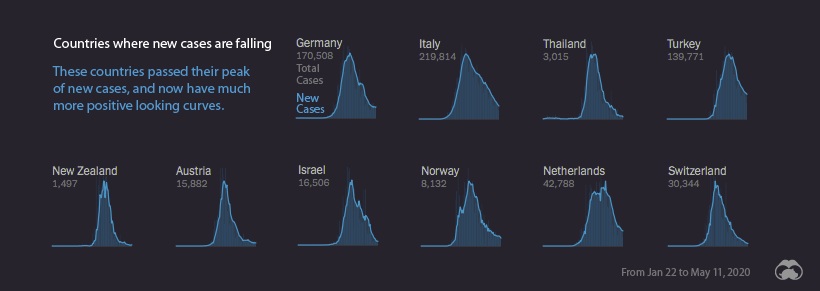
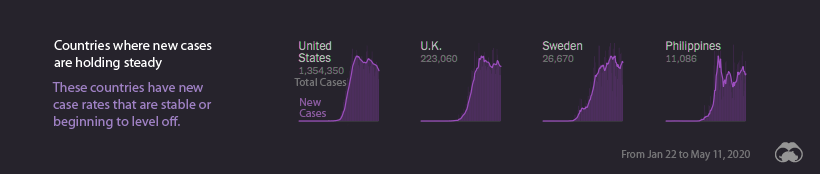
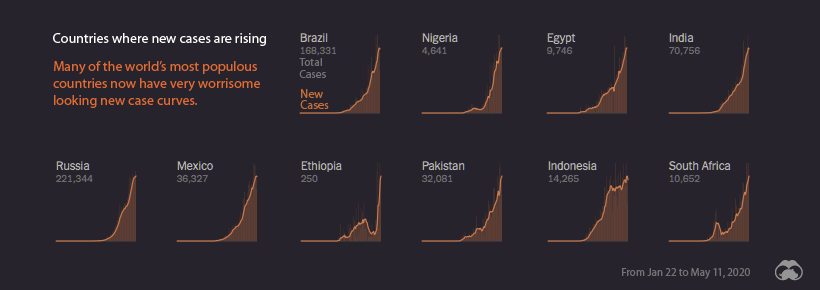
It is instructive to compare the US with other countries where the COVID-19 cases are falling, steady, and rising. The US does not compare favorably with other rich countries.
Falling Number of Cases
Steady Number of Cases
Rising Number of Cases
As of 14 May, the US had 87,638 recorded deaths, out of a worldwide total of 310,326 deaths, or 28% of the total. These numbers are only a rough guide since I suspect that there are serious undercounts of deaths attributed to COVID-19. Many deaths are recorded as caused by pneumonia and heart attacks, complications stemming from the coronavirus. But the US only accounts for 4.25% of the global population. Its record responding to COVID-19 appears to be dismal.
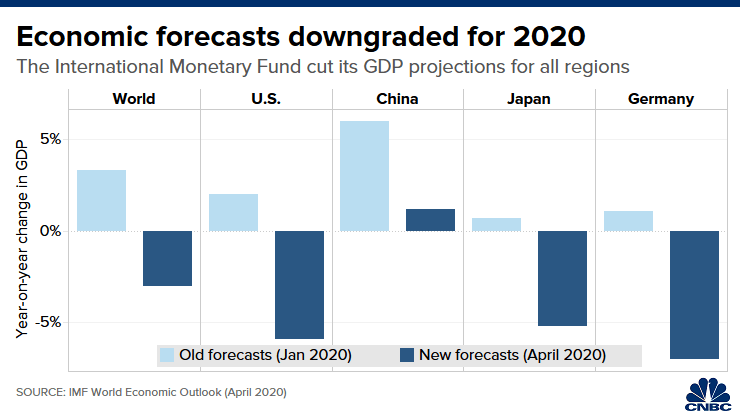
The economic consequences of the COVID-19 pandemic have been severe. In the rich countries, the lockdowns associated with attempts to contain the contagion have led to mass unemployment and sharp drops in economic growth. The effects of these slowdowns are not equally felt in all classes domestically and all nations internationally. The IMF Blog makes this prediction:
“The COVID-19 crisis is now widely seen as the greatest economic calamity since the Great Depression. In January, the IMF expected global income to grow 3 percent; it is now forecast to fall 3 percent, much worse than during the Great Recession of 2008-09. Behind this dire statistic is an even grimmer possibility: if past pandemics are any guide, the toll on poorer and vulnerable segments of society will be several times worse. Indeed, a recent poll of top economists found that the vast majority felt the COVID-19 pandemic will worsen inequality, in part through its disproportionate impact on low-skilled workers.”
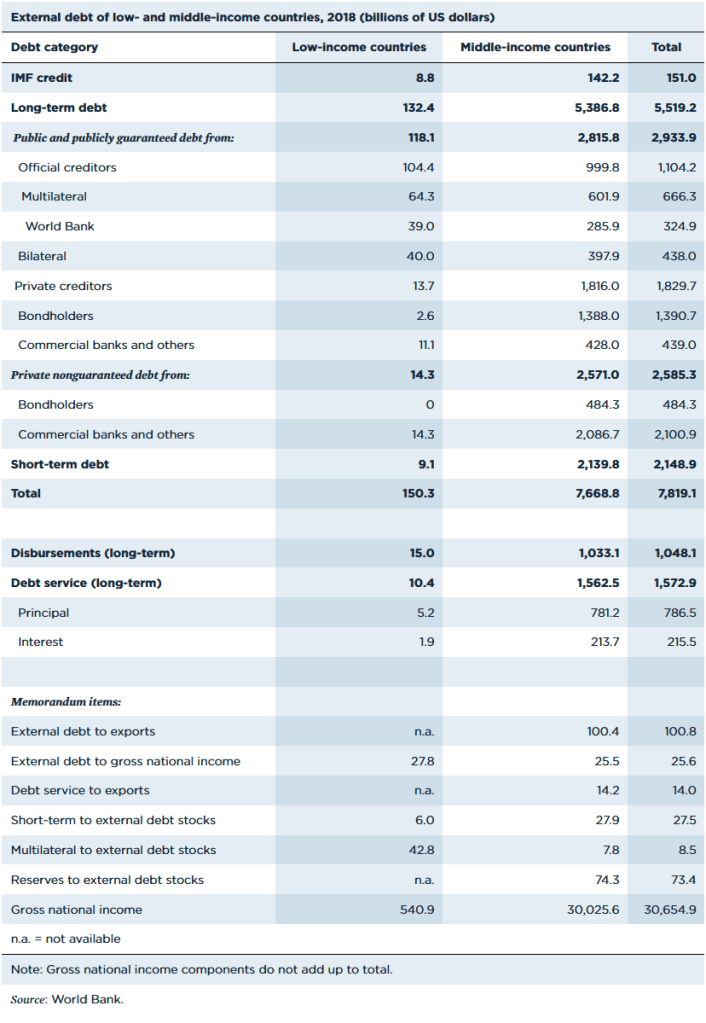
Poorer countries will be hit especially hard, largely because they are already burdened with heavy debts that will only have to be refinanced leading to an even heavier burden in the future. The Brookings Institution points out:
“Emerging markets and developing countries have about $11 trillion in external debt and about $3.9 trillion in debt service due in 2020. Of this, about $3.5 trillion is for principal repayments. Around $1 trillion is debt service due on medium- and long-term (MLT) debt, while the remainder is short-term debt, much of which is normal trade finance.
Many poor countries spend far more on repaying their debts to external lenders than they currently spend on health care in their own countries. These countries face the prospect of a massive default on their debts, and at the recent G20 meeting, the rich countries decided that a moratorium on debt repayments was far preferable to a default.
A moratorium on payment that does not also include a cessation of interest accruals does these countries no good. True, they will not have to make payments but all that money saved will likely be used to address the health costs of the pandemic. And when the payments resume, the actual amounts to be repayed will be larger. So a number of analysts are arguing for a “debt jubilee”. The phrase refers to a passage in the Bible which refers to an overall forgiveness of debts:
“Some argue that there is: a “debt jubilee”. Drawn from the Old Testament book of Deuteronomy, the concept derives from the biblical injunction for a day of rest one day out of every week, a “sabbath” day that reflects the teaching the God rested on the seventh day after creating the world in six.
“There is another injunction for a sabbath year every seventh year, in which people are to not work and on the year after the seventh of those sabbatical years , i.e. the 50th, (one year after the 49th) there would be a jubilee year during which any slaves would be emancipated and everyone would return to their land and family to live off of natural providence. A clear implication of this teaching is that all obligations, including debt obligations, would be forgiven in the process.”
The forgiveness of the debts of poor countries is probably the only way to avoid an economic catastrophe in them which would have a serious effect on the overall global economy. Overall forgiveness sounds far fetched, but the truth is that these debts will never be repaid–the debts are too large and the ability to repay is insufficient. Forgiving the debts is likely the only way to avoid the chaos of generalized defaults.
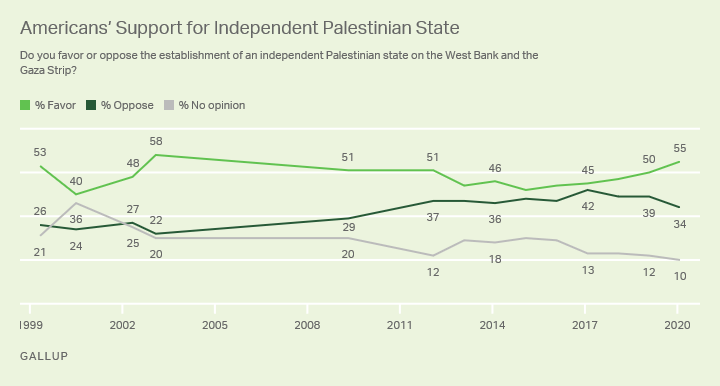
The Gallup polling organization has conducted a poll of Americans every year to see how many citizens favor a Palestinian state as a solution to the conflict between Israel and the Palestinian people. The most recent poll, conducted last February, indicates that 55% of the American people favor a separate Palestinian state in the West Bank and Gaza Strip while 34% are opposed and 10% are unsure. The previous high in favor of a Palestinian state was 58% in 2003. The result surprised me since US policy under the Trump Administration has essentially abandoned the 2-state solution. But when President Trump was elected only 45% of the American people favored a Palestinian state–a shift of 10% is quite dramatic. Even among citizens who identify as Republicans, the number has increased from 25% on 2017 to 44% in 2020. At the same time, however, more Americans have a favorable view of Israel than of the Palestinian Authority. These findings do not coexist easily, and I will have to think deeply about them in order to make sense of the results.
The matter has some urgency. Under the terms of the power-sharing agreement between the current Prime Minister, Benjamin Netanyahu, and his opponent, Benny Gantz, the annexation of the West Bank cannot be broached until 1 July. Netanyahu can bring an annexation proposal to either his Cabinet or to the Knesset; both options have potential obstacles. But Netanyahu will likely make the decision before the US national election in November, in order to create a fait accompli in case President Trump loses the election. US Secretary of State Pompeo is scheduled to visit Israel this week, so we may have a better sense of what might happen soon.
UN Secretary-General António Guterres called for a general ceasefire in all current violent conflicts in the world, arguing that the COIVD-19 pandemic demanded the attention of all nations if it were to be contained. That call was made six weeks ago, and in that time there has been constant wrangling in the UN Security Council about the wording of the cease-fire resolution. His statement last March was clear:
“‘The fury of the virus illustrates the folly of war’, he said. ‘That is why today, I am calling for an immediate global ceasefire in all corners of the world. It is time to put armed conflict on lockdown and focus together on the true fight of our lives.’
“The ceasefire would allow humanitarians to reach populations that are most vulnerable to the spread of COVID-19, which first emerged in Wuhan, China, last December, and has now been reported in more than 180 countries.
“So far, there are nearly 300,000 cases worldwide, and more than 12,700 deaths, according to the World Health Organization (WHO).
“As the UN chief pointed out, COVID-19 does not care about nationality or ethnicity, or other differences between people, and ‘attacks all, relentlessly’, including during wartime.
“It is the most vulnerable – women and children, people with disabilities, the marginalized, displaced and refugees – who pay the highest price during conflict and who are most at risk of suffering ‘devastating losses’ from the disease.”
Unfortunately, consistent with its policies at the G7 and G20 meetings, the Trump Administration has decided to block any progress on other issues to pursue its goal of blaming the Chinese for the pandemic, this time using the World Health Organization as a foil for its tactic. The Security Council resolution initially called for support for WHO, but the US objected to the Chinese sponsored resolution. A compromise resolution mentioning only support for international health organizations was similarly opposed by the US. Reuters reports:
It appeared the 15-member body had reached a compromise late on Thursday, diplomats said and according to the latest version of a French- and Tunisian drafted-resolution.
Instead of naming the WHO, the draft text, which was seen by Reuters, “emphasizes the urgent need to support all countries, as well as all relevant entities of the United Nations system, including specialized health agencies.” The WHO is the only such agency.
The United States rejected that language on Friday, diplomats said, because it was an obvious reference to the Geneva-based WHO.
A UN Security Council Resolution would, under most circumstances, have little effect on ongoing conflicts. But in the midst of a crisis which demands almost complete attention to resolve, most of the participants to these conflicts might welcome a ceasefire. Their overriding self-interest now is in assuring that the pandemic is contained, not in continuing a conflict which drains resources and attention. But the petulance of the US in pursuing an agenda which is driven by the re-election interests of Mr. Trump has squandered this opportunity.
 World Politics News