I had the sense today that there was a dramatic shift in attitudes toward the Trump Administration occasioned by his decision to deploy active military units to the demonstrations in Washington, DC. Such a move is not technically forbidden by the Constitution which remains obscure on many important issues. But the clear sense throughout US history, that deploying active troops (not National Guard troops) is an act that should be reserved only for the most extreme circumstances. The demonstrations by those who support the Black Lives Matter movement hardly qualify as a national emergency. There has been looting, but the looters are not participants in the protests, but rather organized gangs taking advantage of the chaos in the streets (some of those gangs have brought power tools to assist in their looting). The protests have been overwhelmingly peaceful.
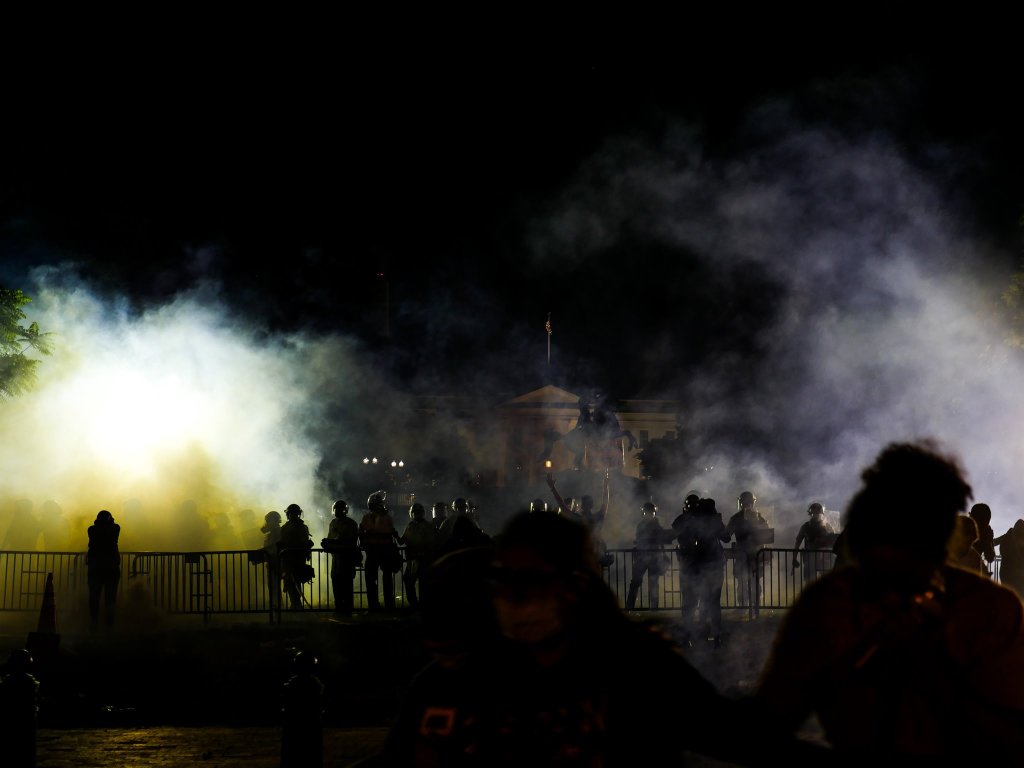
The breaking point seems to have been the decision to break up the protest in Lafayette Square so that President Trump could walk from the White House to a church and hold up a bible. That particular protest was not accompanied by any looting (there are no businesses near Lafayette Square) and the press reports indicate that there were no assaults upon police officers from the protesters. The decision to break up the demonstration was a decision to deny citizens of the US the right to exercise their First Amendment rights to assemble and speak freely–in other words, to break the law. And the decision to break the law was backed up by the active military forces of the US.
This act was a bridge too far for many. President Trump’s first Secretary of Defense, James Mattis, a highly regarded Marine General, issued a statement which was both forceful and unexpected, since Mattis had always held that he did not think it appropriate for him to criticize the Commander in Chief. His statement was published in The Atlantic:
“I have watched this week’s unfolding events, angry and appalled. The words ‘Equal Justice Under Law’ are carved in the pediment of the United States Supreme Court. This is precisely what protesters are rightly demanding. It is a wholesome and unifying demand—one that all of us should be able to get behind. We must not be distracted by a small number of lawbreakers. The protests are defined by tens of thousands of people of conscience who are insisting that we live up to our values—our values as people and our values as a nation.
“When I joined the military, some 50 years ago, I swore an oath to support and defend the Constitution. Never did I dream that troops taking that same oath would be ordered under any circumstance to violate the Constitutional rights of their fellow citizens—much less to provide a bizarre photo op for the elected commander-in-chief, with military leadership standing alongside.
“We must reject any thinking of our cities as a ‘battlespace’ that our uniformed military is called upon to ‘dominate.’ At home, we should use our military only when requested to do so, on very rare occasions, by state governors. Militarizing our response, as we witnessed in Washington, D.C., sets up a conflict—a false conflict—between the military and civilian society. It erodes the moral ground that ensures a trusted bond between men and women in uniform and the society they are sworn to protect, and of which they themselves are a part. Keeping public order rests with civilian state and local leaders who best understand their communities and are answerable to them.
“James Madison wrote in Federalist 14 that ‘America united with a handful of troops, or without a single soldier, exhibits a more forbidding posture to foreign ambition than America disunited, with a hundred thousand veterans ready for combat.’ We do not need to militarize our response to protests. We need to unite around a common purpose. And it starts by guaranteeing that all of us are equal before the law.
“Instructions given by the military departments to our troops before the Normandy invasion reminded soldiers that ‘The Nazi slogan for destroying us…was ‘Divide and Conquer.’ Our American answer is ‘In Union there is Strength.’’ We must summon that unity to surmount this crisis—confident that we are better than our politics.
“Donald Trump is the first president in my lifetime who does not try to unite the American people—does not even pretend to try. Instead, he tries to divide us. We are witnessing the consequences of three years of this deliberate effort. We are witnessing the consequences of three years without mature leadership. We can unite without him, drawing on the strengths inherent in our civil society. This will not be easy, as the past few days have shown, but we owe it to our fellow citizens; to past generations that bled to defend our promise; and to our children.
“We can come through this trying time stronger, and with a renewed sense of purpose and respect for one another. The pandemic has shown us that it is not only our troops who are willing to offer the ultimate sacrifice for the safety of the community. Americans in hospitals, grocery stores, post offices, and elsewhere have put their lives on the line in order to serve their fellow citizens and their country. We know that we are better than the abuse of executive authority that we witnessed in Lafayette Park. We must reject and hold accountable those in office who would make a mockery of our Constitution. At the same time, we must remember Lincoln’s ‘better angels,’ and listen to them, as we work to unite.
“Only by adopting a new path—which means, in truth, returning to the original path of our founding ideals—will we again be a country admired and respected at home and abroad.”
Second, Admiral Mike Mullen, the former Director of the Joint Chiefs of Staff, published the following letter in The Atlantic:
“It sickened me yesterday to see security personnel—including members of the National Guard—forcibly and violently clear a path through Lafayette Square to accommodate the president’s visit outside St. John’s Church. I have to date been reticent to speak out on issues surrounding President Trump’s leadership, but we are at an inflection point, and the events of the past few weeks have made it impossible to remain silent.
“Whatever Trump’s goal in conducting his visit, he laid bare his disdain for the rights of peaceful protest in this country, gave succor to the leaders of other countries who take comfort in our domestic strife, and risked further politicizing the men and women of our armed forces.
“There was little good in the stunt.
“While no one should ever condone the violence, vandalism, and looting that has exploded across our city streets, neither should anyone lose sight of the larger and deeper concerns about institutional racism that have ignited this rage.
“As a white man, I cannot claim perfect understanding of the fear and anger that African Americans feel today. But as someone who has been around for a while, I know enough—and I’ve seen enough—to understand that those feelings are real and that they are all too painfully founded.
“We must, as citizens, address head-on the issue of police brutality and sustained injustices against the African American community. We must, as citizens, support and defend the right—indeed, the solemn obligation—to peacefully assemble and to be heard. These are not mutually exclusive pursuits.
“And neither of these pursuits will be made easier or safer by an overly aggressive use of our military, active duty or National Guard. The United States has a long and, to be fair, sometimes troubled history of using the armed forces to enforce domestic laws. The issue for us today is not whether this authority exists, but whether it will be wisely administered.
“I remain confident in the professionalism of our men and women in uniform. They will serve with skill and with compassion. They will obey lawful orders. But I am less confident in the soundness of the orders they will be given by this commander in chief, and I am not convinced that the conditions on our streets, as bad as they are, have risen to the level that justifies a heavy reliance on military troops. Certainly, we have not crossed the threshold that would make it appropriate to invoke the provisions of the Insurrection Act.
“Furthermore, I am deeply worried that as they execute their orders, the members of our military will be co-opted for political purposes.
“Even in the midst of the carnage we are witnessing, we must endeavor to see American cities and towns as our homes and our neighborhoods. They are not ‘battle spaces‘ to be dominated, and must never become so.
“We must ensure that African Americans—indeed, all Americans—are given the same rights under the Constitution, the same justice under the law, and the same consideration we give to members of our own family. Our fellow citizens are not the enemy, and must never become so.
“Too many foreign and domestic policy choices have become militarized; too many military missions have become politicized.
“This is not the time for stunts. This is the time for leadership.”
Third, the current US Secretary of Defense, Mark Esper, openly defied US President Trump by repudiating the idea of using active military troops to enforce domestic law. Esper made a straightforward statement quoted in The Military Times:
“‘The option to use active-duty forces in a law enforcement role should only be used as a matter of last resort, and only in the most urgent and dire of situations,’ Esper told reporters Wednesday at the Pentagon. ‘We are not in one of those situations now. I do not support invoking the Insurrection Act.’
It is not clear how long Esper will remain as Defense Secretary. The reports are that President Trump is quite angry about the statement.
Finally, on a more personal note, the son of one of my college roommates served in the Marine Corps and did three tours of duty in Afghanistan. Yesterday, he posted the following note on Facebook:
“Enough. If you’re reading this and you love and respect me, know that I love and respect you too. Especially to those with whom I was lucky enough to serve in harms way, know that it will forever be the greatest honor of my life to call you my brothers and sisters. You are my brothers and sisters still. For a long time I’ve kept my mouth mostly shut around politics. It’s been too difficult to navigate those conversations, especially with people who I love and respect so much, who I know feel differently about the state of the nation and the conduct of our president than I do. So I’ve stayed quiet. I haven’t responded when you’ve praised him or defended him. I haven’t challenged you when you’ve stayed silent. When he disrespected Gold Star mothers. When he disrespected General Mattis, the closest thing to a living saint us Marines may ever have. When he abandoned our allies. When he mocked the disabled. You were silent, and I didn’t challenge you. I treasured our bonds too much to put up with the discomfort of confronting those issues with you. I was a coward. I can’t do that anymore. This is wrong. It’s been wrong for so goddamned long. We are at the point now where we have to decide if we are ready to rebuild some semblance of American goodness and decency- if we are ready to stand for something other than brute strength and ‘I win, you lose’ tribalism. I’m ready for that. I’m so desperately ready for that, and I’m done keeping my mouth shut. If the way that you see the President leading this country right now looks good and right to you, then you need to understand that you and I do not share the same values anymore. If a crowd of lawfully assembled protestors being tear gassed and trampled out of the way so a President can stand in front of a church, hold up a Bible he’s never read, and declare his readiness to deploy military force on American soil against American citizens sounds right to you, then I don’t know how to relate to you anymore. If you are commenting online right now about how eager and ready you are to kill other Americans then you are no friend and no brother of mine. This is wrong.
For me, the statement was a sure sign that President Trump’s decision to try to “dominate” the protesters was a significant political mistake, one from which he will likely never recover.
Simon Tisdall writes for The Guardian and I think highly of his insights. His most recent article examines conflicts that have gone for an extended period of time and asks the question why has it been so difficult to end them? He examines the conflicts in Libya, Syria, Afghanistan, Yemen, and the Democratic Republic of Congo. His analysis is based on data found in the Armed Conflict Survey 2020(ACS), published by The International Institute for Strategic Studies (IISS). That survey found that “in 21 of 33 of active armed conflicts across the globe, the number of non-state armed groups involved exceeds the number of state groups. More armed groups are operating with a decentralised chain of command and adapting to new challenges by experimenting with new technologies and exploiting business opportunities, obstructing any hopes of reconciliation and resolve.”
Tisdall finds that the great powers fuel the conflicts but are reluctant to insert themselves directly into the violence. That hands-off tactic makes it difficult for the smaller groups, funded by the great powers, to make concessions which are usually necessary to bring about an end to conflict. Tisdall also believes that the international and multilateral institutions have lost power and legitimacy in the wake of the US withdrawal from many organizations:
“A related factor is the collapse of the western-led consensus favouring multilateral, collaborative approaches to international problems. This is matched by the parallel rise of authoritarian and populist regimes that prioritise narrow national interest over perceptions of the common good.
“This trend, a regression to the pre-1914 era of competing European nation-states, undermines the authority of the UN and cooperative regional platforms such as the EU and African Union. Unsupported, UN peace envoys from Syria to Myanmar and peacekeeping operations across Africa struggle to make headway.
“Ineffective international law enforcement, symbolised by the inability of the International Criminal Court to deliver justice to war zones such as Iraq and Ukraine, helps freeze or perpetuate conflicts rather than justly resolve them. Demographic and physical causes also contribute to chronic instability.”
The reversion to a balance of power system likely means that the conflicts will rarely challenge the fundamentals of the international system but will be occasions for the great powers to test each other’s mettle.
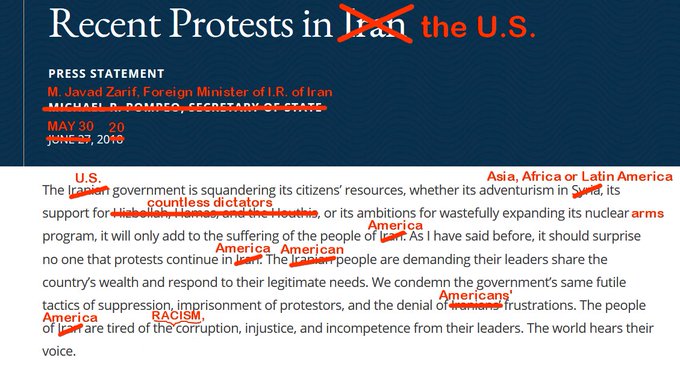
The protests in the US are becoming propaganda points for states that the US has criticized for human rights abuses. Iran and China are accusing the US of hypocrisy as the protests target issues of police brutality and discrimination against African-Americans. Iran took the opportunity to take a US press release criticizing Iran for human rights abuses and red-penciled in some comments identifying the problems in the US.
Similarly, China, which has been the target of unrelenting US criticism (except from the President of the US) for its handling of the protests in Hong Kong, accused the US of hypocrisy:
“The riots in the US have lasted just a week, efforts for reaching a peaceful solution have barely been made, yet, Trump and Cotton have blatantly put their chips – sending troops to quell protests – on the table. This could be argued as the most extreme response to disorder among governments across the world.
“Then why did Washington arrogantly and unreasonably accuse other countries of quelling riots? Why did politicians in Washington overbearingly portray the US as the beacon of democracy and human rights? Have they really not anticipated that the US could one day confront the situation as it does today and that their previous big talk could become a slap on their face?
“People see the US falling into disgrace. As the novel coronavirus sweeps across the world, the US ranks No.1 in terms of confirmed cases and deaths. As anti-racist protests surge, the government and Congress should have taken quick action to comfort their people, but have instead exacerbated confrontation and led to the spread of the chaos. What is more irritating is that US political elites have played hypocrisy and barbarism. The hooligan nature of Washington makes it a complete nuisance.”
There have been sympathy protests in many countries in the world, signalling the widespread condemnation of the death of George Floyd and other African-Americans. There does not seem to be any strategy being used by the current US administration to respond to these global criticisms.
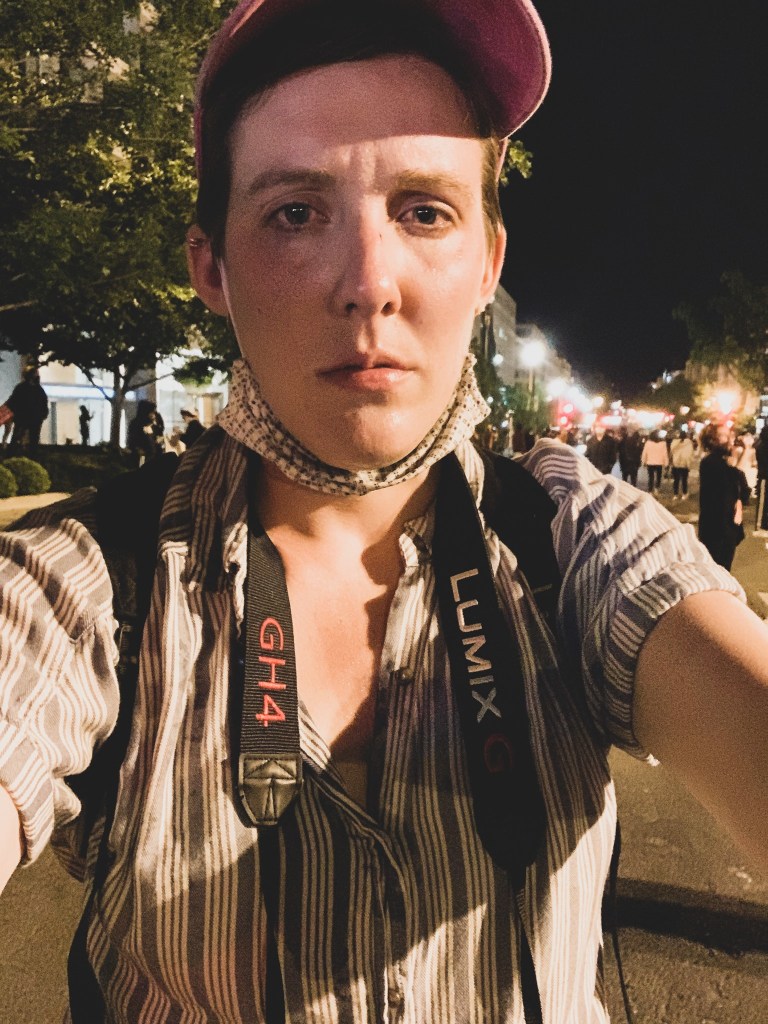
One of the wonderful benefits of teaching at a place like Mount Holyoke College is that I get to work with individuals with extraordinary talents. One such person is Jenna Ruddock who just completed her law degree i Washington, DC. She is a gifted photographer and she posted one of her photographs from the demonstration in DC last night which I think captures the uncertainty and agony in which the country currently finds itself.
This is a self photo taken by Jenna after she had been tear gassed. Here is her comment to the photo:
“What it looks like when a country tear gasses its own citizens, including a whole group of journalists.
“Deeply grateful to the protesters who grabbed my arm and led me out because I couldn’t see, and poured milk and saline solution over my eyes, nose, and mouth, being careful not to douse my camera.”
We are indebted to all the journalists like Jenna who are enduring a lot of pain so that we can see the truth. May their courage be sustained.
My post yesterday was about whether the violence we are witnessing in the protests about the treatment of African-Americans in the US is justified. The post made a simple argument: if one is concerned about violence, then it is best to be concerned by all sorts of violence, including the normalized violence of centuries of discrimination. Today’s post will deal with the second objection to violence: that it alienates potential supporters of true change and undermines the message being conveyed by the protests.
Let me first make a personal observation. I have witnessed many protest demonstrations in my life and was deeply involved with some of them, such as the anti-war protests during the Vietnam War. Political protests are energizing and they allow dissent to be made visible in ways that personal beliefs cannot. It is a mistake, however, to think that everyone participating in a protest is there for the same reason. In the Vietnam War protests there were people who joined the demonstrations because they believed it was an opportunity to procure marijuana, or because they hated capitalism, or because they didn’t wish to go to class, or because they saw it as a way to find casual sex. Do not make the mistake of thinking that a large mass of people has a monolithic mind. It might for some fleeting moments, but a protest is a dynamic environment and it is easy to lose sight of why one is there.
Second, and related to the first point, is that there are opportunists in every demonstration. And those opposed to the protests will almost invariably suggest that “outside agitators” have hijacked the protests. The tactic is calculated to undermine the legitimacy of the protests. In the current situation, US President Trump and Attorney General Barr, have singled out “far-left” agents as being the trouble-makers. Mr. Trump today went so far as to designate Antifa as a “terrorist organization”. The designation is only legal for foreign agents, not groups who are domestically based (one need only to think about how such a power could be abused to destroy all legitimate opposition to a government). I am not sure what the phrase “outside agitator” means in the context of a national movement–all American citizens have the same and equal right to dissent.
Third, protests have a very short shelf-life. They can be dramatic episodes. but the demands of daily life overtake the exuberance of the moment. And, for those who do not participate in the demonstration or who might actually be opposed to the demonstration, protests are generally flashes in a pan. Protests are wonderful instruments for learning more about oneself, but they do not have a long-term effect on those who do not participate in the demonstration. When protests are made over a long period of time and there are no effective changes made to respond to the issues raised by the protests, one can legitimately ask the question of whether they are useful politically. That question can certainly be raised in the current situation. There have been a large number of African-Americans who have been killed by police, and each of those tragedies stimulated protests. But there is little to show by way of making the changes necessary to avoid future tragedies.
The Smithsonian magazine ran an article about how the civil rights protests of the 1960s were addressed. Some of those protests were very similar to those we are witnessing today: burnings, lootings, and confrontations with police. The Kerner Commission which investigated the causes of the riots and made suggestions for change. The conclusions in 1968 were clear:
“Pent-up frustrations boiled over in many poor African-American neighborhoods during the mid- to late-1960s, setting off riots that rampaged out of control from block to block. Burning, battering and ransacking property, raging crowds created chaos in which some neighborhood residents and law enforcement operatives endured shockingly random injuries or deaths. Many Americans blamed the riots on outside agitators or young black men, who represented the largest and most visible group of rioters. But, in March 1968, the Kerner Commission turned those assumptions upside-down, declaring white racism—not black anger—turned the key that unlocked urban American turmoil.
“Bad policing practices, a flawed justice system, unscrupulous consumer credit practices, poor or inadequate housing, high unemployment, voter suppression, and other culturally embedded forms of racial discrimination all converged to propel violent upheaval on the streets of African-American neighborhoods in American cities, north and south, east and west. And as black unrest arose, inadequately trained police officers and National Guard troops entered affected neighborhoods, often worsening the violence.
“‘White society,’ the presidentially appointed panel reported, ‘is deeply implicated in the ghetto. White institutions created it, white institutions maintain it, and white society condones it.’ The nation, the Kerner Commission warned, was so divided that the United States was poised to fracture into two radically unequal societies—one black, one white.
Very little seems to have changed since 1968. The question is whether violence hastens change or retards it. Violence raises the visibility of protests since the media is more likely to film incidents of violence than incidents of peace. But the violence also allows opponents of the protests to focus on something other than the issues underlying the protests. And many supporters of a cause might be repelled by acts of looting or property damage. Kareem Abdul-Jabbar wrote a rejoinder to this argument in today’s Los Angeles Times:
“So, maybe the black community’s main concern right now isn’t whether protesters are standing three or six feet apart or whether a few desperate souls steal some T-shirts or even set a police station on fire, but whether their sons, husbands, brothers and fathers will be murdered by cops or wannabe cops just for going on a walk, a jog, a drive. Or whether being black means sheltering at home for the rest of their lives because the racism virus infecting the country is more deadly than COVID-19.
“What you should see when you see black protesters in the age of Trump and coronavirus is people pushed to the edge, not because they want bars and nail salons open, but because they want to live. To breathe.
“Worst of all, is that we are expected to justify our outraged behavior every time the cauldron bubbles over. Almost 70 years ago, Langston Hughes asked in his poem “Harlem”: ‘What happens to a dream deferred? /… Maybe it sags / like a heavy load. / Or does it explode?’”
It is hard to imagine how violence can be avoided given the refusal of American institutions to protect the African-American community despite the overwhelming evidence that that community is the victim of both structural and episodic violence. The more reasonable question is whether the American people will refuse to let its vision be diverted from the essential issue, its aspiration to be a nation of true and genuine equality. Martin Luther King, Jr. understood well what the real issue was in 1963 as it remains in 2020:
“In a sense we’ve come to our nation’s capital to cash a check. When the architects of our republic wrote the magnificent words of the Constitution and the Declaration of Independence, they were signing a promissory note to which every American was to fall heir. This note was a promise that all men, yes, black men as well as white men, would be guaranteed the ‘unalienable Rights’ of ‘Life, Liberty and the pursuit of Happiness.’ It is obvious today that America has defaulted on this promissory note, insofar as her citizens of color are concerned. Instead of honoring this sacred obligation, America has given the Negro people a bad check, a check which has come back marked ‘insufficient funds.’
“But we refuse to believe that the bank of justice is bankrupt. We refuse to believe that there are insufficient funds in the great vaults of opportunity of this nation. And so, we’ve come to cash this check, a check that will give us upon demand the riches of freedom and the security of justice.”
The protests over the killing of George Floyd in Minneapolis are actually protests over the deaths of many African-American people at the hands of police in the US. We have seen these protests before, but these protests are also taking place against the backdrop of the COVID-19 pandemic which has differentially affected blacks in the US, exposing the failure of the US health establishment to protect the health of minorities. These protests have been accompanied by acts of violence which have elicited condemnations from government officials and private citizens who argue that violence is “not the answer”.
But what is the answer?
These condemnations are based on two concerns. The first is that violence is always undesirable and represents a failure of rational discourse to solve problems. The second objection is tactical: violence will alienate possible allies and inflame those who would use violence to suppress violence. I will discuss the first concern, and address the second concern in tomorrow’s post.
There is a great deal of power to the first objection, but it fails to address the central problem: the fact that violence against African-Americans seems to be solidly entrenched in US culture and that all efforts to prevent these acts of violence have failed. The position weakens even further if it is the case that agents of the state–the police–are the ones using violence against minorities. Why should the laws of a state that fails to control its own sources of physical power be obeyed?
Much depends on how one wishes to define violence. Certainly torching a police car is violent, as is smashing windows of commercial enterprises. But is starvation violent? Do we decide to not characterize it as violent because it is mediated by market capitalism which “impartially” decides who gets to eat and who doesn’t get to eat? What about evictions? Are the non-violent because they are carried out by representatives of financial institutions, who wear three-piece suits, and the police, who wear uniforms designed and paid for by the state?
Once we think about violence in this more expansive manner, then the violence that follows from protests that are unheard in more explicable (although perhaps still not justified). In his introduction to Frantz Fanon’s Wretched of the Earth, John-Paul Sartre explains why we should not be surprised if people who are oppressed turn to violence. After all, they have experienced nothing but violence from those who seek to control them:
“After that, when it is their turn to be broken in, when they are taught what shame and hunger and pain are, all that is stirred up in them is a volcanic fury whose force is equal to that of the pressure put upon them. You said they understand nothing but violence? Of course; first, the only violence is the settler’s; but soon they will make it their own; that is to say, the same violence is thrown back upon us as when our reflection comes forward to meet us when we go toward a mirror.
Make no mistake about it; by this mad fury, by this bitterness and spleen, by their everpresent desire to kill us, by the permanent tensing of powerful muscles which are afraid to relax, they have become men: men because of the settler, who wants to make beasts of burden of them -because of him, and against him.
Fyodor Dostoyevsky understood the rage that fuels violent protests. In his novel, The Possessed there is a passage describing the burning of the mansion of a provincial governor named Lembke . Rioters had set the mansion on fire, but they had also burned many houses of ordinary people who lived along the river. The inevitability of violence when protests for reform are ignored is well articulated:
“Lembke stood facing the lodge, shouting and gesticulating. He was giving orders which no one attempted to carry out. It seemed to me that every one had given him up as hopeless and left him. Anyway, though every one in the vast crowd of all classes, among whom there were gentlemen, and even the cathedral priest, was listening to him with curiosity and wonder, no one spoke to him or tried to get him away. Lembke, with a pale face and glittering eyes, was uttering the most amazing things. To complete the picture, he had lost his hat and was bareheaded.
“‘It’s all incendiarism! It’s nihilism! If anything is burning, it’s nihilism!’ I heard almost with horror; and though there was nothing to be surprised at, yet actual madness, when one sees it, always gives one a shock.
“’Your Excellency,’ said a policeman, coming up to him, ‘what if you were to try the repose of home? . . . It’s dangerous for your Excellency even to stand here.’
“This policeman, as I heard afterwards, had been told off by the chief of police to watch over [Lembke], to do his utmost to get him home, and in case of danger even to use force – a task evidently beyond the man’s power.
“’They will wipe away the tears of the people whose houses have been burnt, but they will burn down the town. It’s all the work of four scoundrels, four and a half! Arrest the scoundrel! He worms himself into the honor of families. They made use of the governesses to burn down the houses. It’s vile, vile! Aie, what’s he about?’ he shouted, suddenly noticing a fireman at the top of the burning lodge, under whom the roof had almost burnt away and round whom the flames were beginning to flare up. ‘Pull him down! Pull him down! He will fall, he will catch fire, put him out! . . . What is he doing there?’
“’He is putting the fire out, your Excellency.’
“’Not likely. The fire is in the minds of men and not in the roofs of houses. Pull him down and give it up! Better give it up, much better! Let it put itself out.’”
The violence we are witnessing in many US cities is, and has been made, inevitable. The photograph below is from the protests in Ferguson, MO after the shooting of Michael Brown in 2014 by Ferguson police. It portrays violence and the possibility of violence. Does it portray the inevitability of violence?
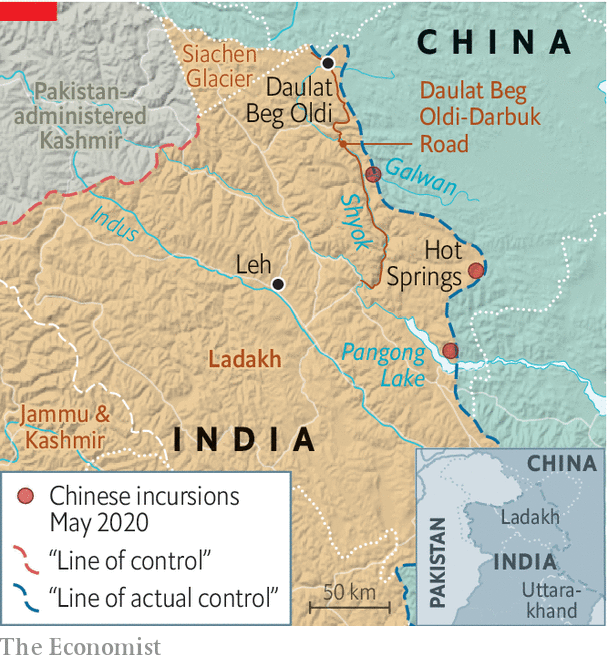
“When Indian and Chinese soldiers brawled at Pangong lake high in the Himalayas earlier this month—a punch-up serious enough to leave many in hospital—General M.M. Naravane, India’s army chief, was unworried. Such “temporary and short-duration face-offs” happened from time to time in remote stretches of the 4,000km (2,500 miles) border between the two countries, he said. Both sides had “disengaged”. But a week later he dashed north to the headquarters of the 14th Corps in nearby Leh, the regional capital, suggesting that something more serious was afoot.
“According to Indian press accounts, Chinese troops have crossed the undefined border with India at several points, some reportedly penetrating 3-4km over punishing terrain. They are said to have destroyed Indian posts and bridges, and dug in with tents and trenches. Incursions have been reported at the confluence of the Galwan and Shyok rivers, the Hot Springs area and Pangong lake, the site of the original scrap (see map).”
I seriously doubt that either country wishes to go to war. They both had larger problems than a border dispute in uninhabitable lands. But both countries have decided to go full-throttle nationalist to address their problems, and they now find themselves in self-knitted straitjackets. As long as their soldiers do not do anything more than throwing racks at each other, then this might be just another flash. But a miscalculation could make this a very dangerous situation.
We need to be reminded about the direction we wish to go. I often view the video below when I feel discouraged about how racism can be so easily re-ignited in the US. It is always with us, but there have been times in my life when I have felt hopeful. Today is not such a day.
“Last week, the People’s Republic of China (PRC) National People’s Congress announced its intention to unilaterally and arbitrarily impose national security legislation on Hong Kong. Beijing’s disastrous decision is only the latest in a series of actions that fundamentally undermine Hong Kong’s autonomy and freedoms and China’s own promises to the Hong Kong people under the Sino-British Joint Declaration, a UN-filed international treaty.
“The State Department is required by the Hong Kong Policy Act to assess the autonomy of the territory from China. After careful study of developments over the reporting period, I certified to Congress today that Hong Kong does not continue to warrant treatment under United States laws in the same manner as U.S. laws were applied to Hong Kong before July 1997. No reasonable person can assert today that Hong Kong maintains a high degree of autonomy from China, given facts on the ground.
“Hong Kong and its dynamic, enterprising, and free people have flourished for decades as a bastion of liberty, and this decision gives me no pleasure. But sound policy making requires a recognition of reality. While the United States once hoped that free and prosperous Hong Kong would provide a model for authoritarian China, it is now clear that China is modeling Hong Kong after itself.
“The United States stands with the people of Hong Kong as they struggle against the CCP’s increasing denial of the autonomy that they were promised.”
The revocation of the certification means that the US Congress can now withdraw the special trading and financial commitments US companies enjoy. That special status has well-served both US and Chinese interests, as US companies invested heavily in China believing that investments in Hong Kong, even though the money filtered into mainland China, were protected from the Chinese Communist Party by the protections of the British laws instituted while Hong Kong was a colony.
The Chinese response to the US decision was quite sharp–much sharper than I had expected. Global Times, which often acts as a mouthpiece for Beijing official policy, made this comment:
“Since China is determined to push forward the national security legislation for Hong Kong, it has been prepared for any possible reaction from the US. Sanctions with individual assets and visas as levers are obviously not presentable. Support for this legislation in Hong Kong is gaining momentum.
“Many Chinese people have realized that some US politicians are seizing China by its throat. A long-term rivalry between China and the US is inevitable. In the face of US aggression, China should adopt a calm mentality and be prepared to engage in a long-term battle with the US.
“As China maintains its powerful nuclear deterrence and boosts its military strength, the US will not readily resort to a military showdown with China over China’s core interests. Decoupling is the last trump card the US has.”
The reference to military power was, to me, an escalation that did not seem necessary. But it is an index of how seriously China regards Hong Kong as an internal matter, the British agreement notwithstanding. And the Chinese are correct: ending the special status of Hong Kong is the last card that the US can play on this particular issue unless it, too, begins to talk about military power (a losing card for the US on this matter). Paradoxically, Pompeo’s statement is actually an endorsement of the Chinese position on Hong Kong–that Hong Kong is completely under the control of Beijing.
I actually hate it when analysts on TV start yelling at each other. It makes developing an argument impossible and very rarely is coherent or intelligible. But there was an exchange today on the financial news network, CNBC, between Andrew Sorkin (who actually wrote a very good book on the financial crisis of 2007) and Joe Kernan that suggests how nerves are getting frayed as we try to make sense of the right way to approach the debate about whether deaths from the pandemic are more or less important than deaths from an economic slowdown (a debate that will surely rank as one of the most inane policy debates in American history–the purported “tradeoff” is spurious).
I have posted the exchange, not because I believe that it is itself newsworthy, but rather to provide some measure to assess the relative importance of the stock market to the lives of ordinary American citizens. There was once a time when the stock market bore some connection to the overall health of the economy. Now the stock market is completely decoupled from the economy and is rather a game being played among some very rich people, who are waging bets with each other to see which ones have more influence over the value of stocks. You can access the video here.
As we try to understand why it seems that the US was so unprepared for the COVID-19 pandemic, one explanation offered by the Trump Administration is that President Obama “left the cupboard bare”. Mr. Trump made this statement in his press briefing on 6 April 2020:
“But they also gave us empty cupboards. The cupboard was bare. You’ve heard the expression: ‘The cupboard was bare.’ So we took over a stockpile where the cupboard was bare and where the testing system was broken and old. And we redid it.
“And, frankly, it would be okay for a small event but not for a big event. And they had a chance to do it. Somebody said that a certain person — I won’t tell you, but a certain person said this will happen. And that’s true. The problem is that person never did anything about it — previous administrations. In previous admin- — they never did anything about it.
“You know, we all know all about pandemics and all of the things that we’re seeing now, but nobody thought it was going to happen. And if we did think it was going to happen, the problem is nobody did anything about it.”
“We’ve taken the time to dissect Centers for Disease Control and Prevention budgets from the year before Obama left office all the way to the present. Trump can lie, but the numbers cannot. Obama left office with an unblemished record of building up the nation’s pandemic preparedness. Trump systematically sought to dismantle it.
“Perhaps because of his experience with the 2015 Ebola outbreak, Obama sought to leave his successor fully prepared to confront future pandemics. He asked in his fiscal 2017 budget request to boost federal isolation and quarantine funding by $15 million, to $46.6 million. Congress approved $31.6 million. In Trump’s three years in office, he has not requested a dime more in funding.
“Obama asked to nearly double his own $40 million outlay for epidemiology and laboratory capacity. Congress balked, but Obama left Trump with that $40 million as a starting point. What did Trump do? In his 2020 budget, he asked Congress to cut that number to: Zero. Zilch. Nothing.
Mr. Trump’s own Center for Disease Control issued a 438 page analysis of its budget requests for 2020. I have reproduced the summary table of the budgets over time. For those who are unfamiliar with the US government’s tabular notations, decreases in budgets are within parentheses ( ). Look at the far-right column which notes the changes from 2019 to 2020. Mr. Trump’s hollowing out of the CDC is actually astonishing. Mr. Trump left the country dangerously unprepared for the pandemic.
There were large protests in Hong Kong against the proposed national security law being discussed by the Chinese Communist Party in Beijing. The proposed laws would fatally undermine the limited autonomy the region has under the “one country, two systems” agreement with Britain that was scheduled to last until 2047. Hong Kong activists, writing in an op-ed for the Washington Post, argued that “Beijing has just hammered the final nail in the coffin for Hong Kong’s autonomy. The promise of ‘one country, two systems’ is dead.” If passed, the laws would allow the Chinese Central government to intervene in the region’s affairs if it deemed that activities were secessionist. Although US President Trump has yet to make a public comment on the protests, it seems clear that the US government is moving toward condemning the proposed legislation:
“On Sunday, Trump’s National Security Adviser, Robert O’Brien said the proposed security measures could jeopardize Hong Kong’s future as a financial hub — due in part to its special trade status with the U.S. — and lead to sanctions.
“‘It looks like, with this national security law, they’re going to basically take over Hong Kong,’ O’Brien told NBC’s Meet the Press. ‘And if they do, Secretary [of State Mike] Pompeo will likely be unable to certify that Hong Kong maintains a high degree of autonomy and if that happens there will be sanctions that will be imposed on Hong Kong and China.’
“Legislation passed last year requires the state department to annually certify that Hong Kong is ‘upholding the rule of law and protecting rights” and “sufficiently autonomous’ for the city to maintain its special status under U.S. law.
The list of disputes between the US and China that arose just last week were detailed by Eamonn Sheridan:
It is also the case, however, that China, with its heavy-handed policies, may be undermining the economic value of Hong Kong. William Pesek points out the possible grim effects of the protests on the Hong Kong economy:
“At the very least, Hong Kong can kiss goodbye its status as the world’s second-freest economy, a halo bestowed by the Heritage Foundation. The Washington-based think tank has long fetishized Hong Kong’s negligible tax rates, duty-free ports, ease of doing business, unfettered capital flows and transparent rule of law.
“Worse, last year the U.S. passed the Hong Kong Human Rights and Democracy Act, which mandates an annual review of the city’s autonomy; if it finds that China has taken more control, as this move certainly suggests, the U.S. can remove economic and trade privileges Hong Kong enjoys. This would remove its attraction as a gateway to China.
“All of this comes as Hong Kong’s economy reels from last year’s massive protests — which may now return — the U.S.-China trade war and the fallout from the coronavirus outbreak.
“Hong Kong’s gross domestic product fell 5.3% in the first quarter of this year; President Xi Jinping’s new move is only going to ensure more economic trouble.”
I do not think that there are any winners in this situation. If the US Congress forces sanctions on China for its actions in Hong Kong, there will be no way for President Xi to back down. The US, the people of Hong Kong, and China will all pay a heavy price for these short-sighted actions.


 World Politics News