There was a signing ceremony at the White House yesterday with the United Arab Emirates (UAE) and Bahrain establishing diplomatic relations with Israel. As I indicated in my post on 11 September, the normalizing of relations is always a good thing and all involved should be congratulated for these small steps for peace. The fanfare at the ceremony, however, was disproportionate to the actual change the steps imply. Israel and the UAE have been secretly cooperating for many years. President Trump made the following assertion:
“And they want to see peace. You know, they’ve been fighting for a long time. They’re tired. They’re warring countries, but they’re tired. They’re tired of fighting. And so you’re going to be seeing further announcements.”
“Just whose blood might be involved was glossed over. The other signatories of the ‘accords’, the United Arab Emirates (UAE) and Bahrain, had never been at war with Israel. They are Gulf monarchies from the high-end enclaves of the Arab world, who have exchanged intelligence and technology with Israel as wall as a mutual fear of Iran, for several years already. The ‘peace agreements’ involved three Middle Eastern governments putting an official seal on once furtive friendships, in a brash ceremony honed to benefit Trump, part of a broader diplomatic flurry that is part of his reelection campaign.
Most of the fighting in the Middle East has been more closely related to US moves since the invasion of Iraq in 2003. In real terms, the normalization of relations among these states is roughly equivalent to a damp squib.
The UAE and Bahrain both insisted that Israel stop the process of annexing the West Bank. We shall wait to see how long this pause lasts. Israel Prime Minister Netanyahu is currently under indictment and Israel is suffering from a significant spike in COVID-19 infections so the political pressures on him are particularly intense at this point in time. The UAE has also asked for the top-of-the-line US fighter jet, the F-35, and Israel is opposed to that step since it would make the UAE a more formidable power in the Persian Gulf. The Bahrain decision is interesting since the regime is closely tied to Saudi Arabia and it implies that the Saudis are also thinking about normalizing relations as well. Such a move is unlikely as long as King Salman is alive, but he is an ailing ruler and his son, the Crown Peace, appears to be more willing to make the move.
The US-Israeli strategy toward the Palestinians is becoming clearer. Essentially, the plan is to isolate completely the Palestinians from other Arab states and wait for the Palestinians to capitulate from exhaustion and lack of money. In the short run, the strategy might work. But Israel has yet to decide what to do with the Palestinians who may ultimately be forced to live in Israel.
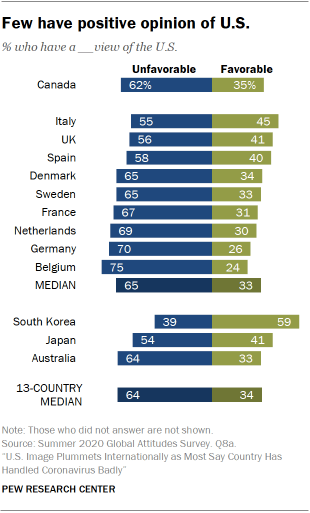
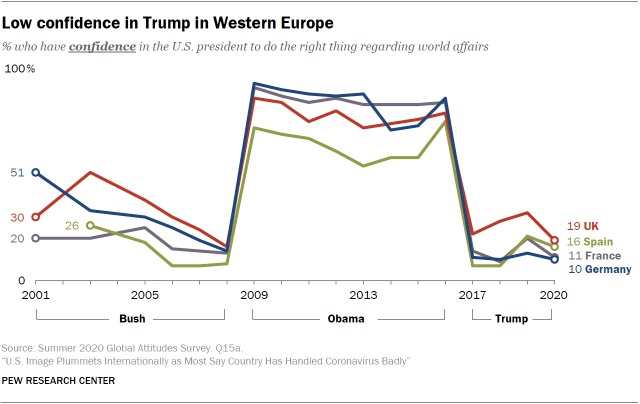
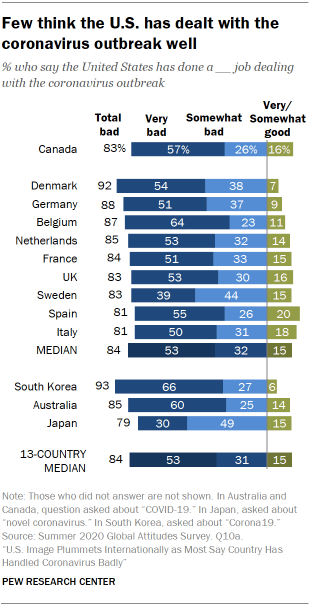
The Pew Research Center has published a poll of citizens within 13 different states, all of which have been long-standing allies to the US, on their views of the US. The poll indicates quite vividly that most US allies believe that the US has done a terrible job of handling the COVID-19 pandemic. The poll also indicates that US President Trump is not well-regarded by its allies. According to Pew:
“Pew Research Center surveys have found mixed or relatively negative views of the U.S. in Canada and Western Europe since 2017 and the beginning of the Trump administration. In the current survey, views of the U.S. have deteriorated further, with a median of only 34% across the 13 countries surveyed expressing a positive view.
“Roughly one-third of Canadians (35%) view their neighbor to the south positively. A similar share across Europe holds this view (median of 33%), though favorable opinions range from a low of roughly a quarter in Belgium (24%) and Germany (26%) to a high of about four-in-ten or more in the UK (41%) and Italy (45%).
“Many in Australia and Japan have an unfavorable opinion of the U.S., while South Korea stands out as the only country surveyed where a majority (59%) views the U.S. positively.
“The current survey shows a substantial dip in ratings of the U.S. since 2019. Japan saw the largest drop, with only 41% expressing a positive view in 2020, compared with 68% in 2019. Every other country surveyed in both years saw a decrease of between 12 and 18 percentage points since the previous year.”
The poll indicates that there are divergences within these populations on the basis of gender and ideology, but none of those differences have a substantial effect on the unfavorable ratings. But there is little question that US allies found greater respect for President Obama than for either Presidents Bush or Trump.
The handling of the pandemic appears to be overwhelmingly important to the image of the US in world affairs.
“Overall, few assess the American response to the coronavirus outbreak positively. In no country surveyed do more than a fifth think the U.S. has done at least a somewhat good job dealing with the virus, and a median of only 15% across the 13 countries polled consider the country’s handling of the virus to be effective.
“While positive assessments of the U.S. response to the coronavirus outbreak are scarce overall, in some countries, they are in the single digits: Only 6% in South Korea, 7% in Denmark and 9% in Germany think the U.S. has dealt well with the virus. Spaniards hold the most positive assessments of the American response, but even there, only one-in-five think the U.S. has handled the outbreak well.
“On the flip side, in every country surveyed, roughly eight-in-ten or more say the U.S. has handled the virus badly. And, in 11 of the 13 countries surveyed, half or more say the U.S. has done a very bad job dealing with the coronavirus outbreak.”
Such weakness suggests that the US is no longer regarded as a leader worth following. I suspect that the economic and military power of the US is still regarded as formidable, but few allies consider the US under a Trump presidency as a reliable or credible partner.
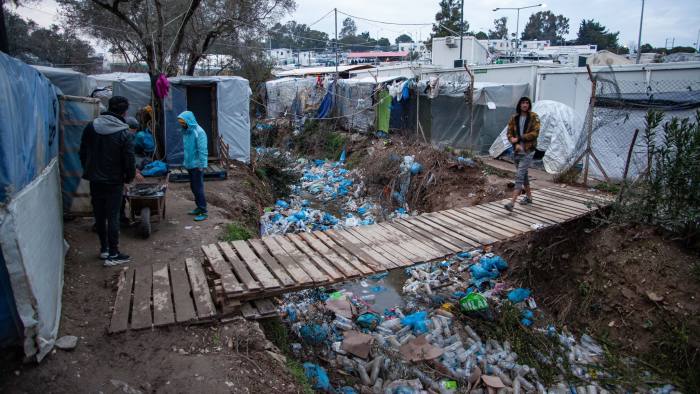
The COVID-19 pandemic has crowded out news in world politics, and in the US the election and the wildfires on the West Coast has further limited coverage of other events. One of the more tragic events over the last few weeks is the collapse of a refugee camps on the Greek island of Lesbos. The camp was overfull with about 12,500 people (four times the capacity of the camp), mostly from Syria, who had hoped to find refuge in the European Union. After an outbreak of COVID-19 in the camp, there were protests over the quarantine measures imposed by the Greek government and these protests led to the burning of the camp. The resulting chaos has drained the resources of the Greek residents of the island and many of the refugees are refusing to move to a new temporary tent city.
In many respects, the situation is amplified by the current tension between Greece and Turkey over maritime rights in the Eastern Mediterranean. The Turks essentially control the inflow of refugees into Greece and the possible threat of Turkey releasing a greater flood of refugees into Greece complicates any possible resolution. And the reluctance of the EU to take in more refugees from Greece has damaged Greek relations with its partners in the EU. Unfortunately, the situation in Lesbos was probably designed to fail as a way of discouraging additional refugees from arriving. The Guardian explains:
“The former mayor of Lesbos Spyros Galinos agrees. The chaos and degradation of Moria, he observed three years ago, seemed to have been deliberately engineered by officials in Athens and Brussels to send a message to potential new migrants that “the path across the Aegean isn’t worth it”. If the Moria camp were to bear a message, the journalist Rachel Donadio observed, it would be: “Welcome to Europe. Now go home.”
“’Deterrence’ has become the watchword of immigration policy around the world. From Australia to South Africa to America to Europe, the aim is to make conditions for undocumented migrants so unbearable that no more will want to come. It’s why the EU has spent millions recruiting armies, militias and criminal gangs across North Africa and the Middle East to capture and incarcerate would-be migrants in the most degrading of conditions. It’s why Greece has apparently taken to expelling them by abandoning them at sea. It’s why camps such as Moria exist.”
The sad truth is that the refugee crisis has been shunted aside by the rich countries and there is no reason to think that there will be any initiatives to address the inflow of people who are simply trying to escape from civil war and poverty. The inability of the world to address the crisis augurs ill for the future as the number of refugees will likely increase in the future due to the climate crisis. There are now more than 80 million displaced people in the world and all of them lack the protections of a state.
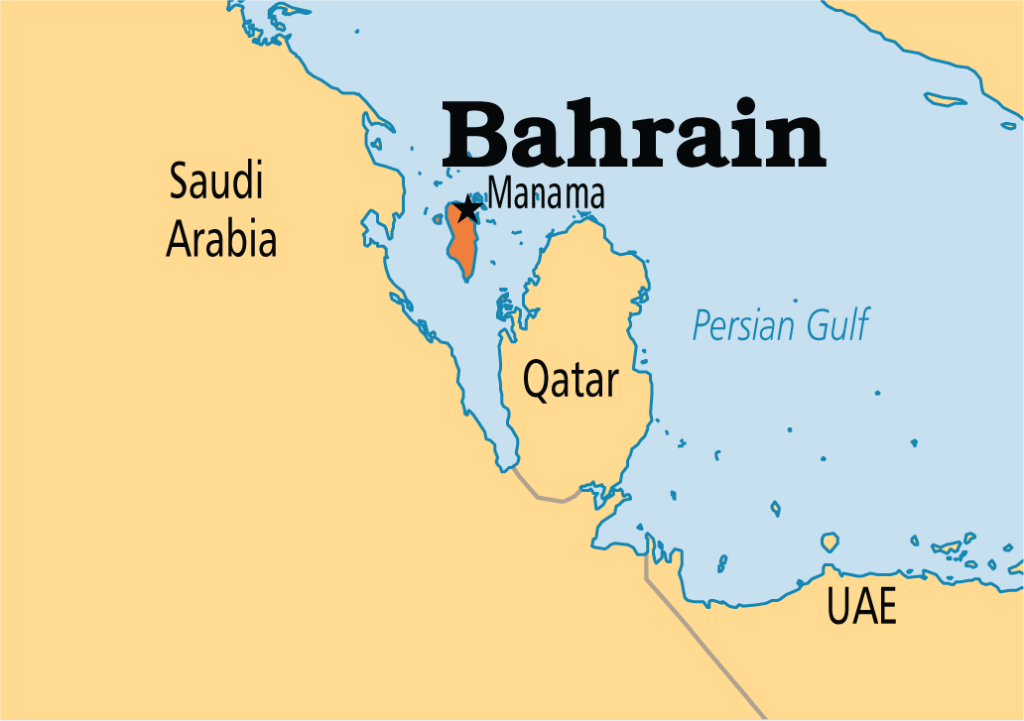
Bahrain has announced that it will normalize relations with Israel, joining the United Arab Emirates (UAE) in recognizing Israel. The Arab states that recognize Israel now includes Egypt, Jordan, the UAE, and Bahrain. Normalizing relations with other states is always a good move since it opens up lines of communication that may prove useful in tense or awkward situations. But this move, while welcome, does not really change the dynamics within the Middle East. Indeed, it may prove to be somewhat troubling. The Economist notes:
“Even if it was expected, Bahrain’s announcement may prove more intriguing. The UAE did not have to worry about whether its decision would be popular: there is little space for dissent in the Emirates. Bahrain, on the other hand, has a history of protest. The Shia majority has long complained of discrimination at the hands of the Sunni royal family. Unrest peaked in 2011 during weeks of protests inspired by the Arab spring, which were crushed with the help of troops from other Gulf countries. Critics of normalisation with Israel have more room to express dissent in Bahrain—though they still face a ruthless state if they do.
“Another question is whether Bahrain serves as a trial balloon for its larger neighbour, Saudi Arabia. Bahrain relies heavily on Saudi Arabia for political and economic support. Saudi tourists are a mainstay of the Bahraini economy; most of Bahrain’s oil revenue comes from a joint offshore field operated by Saudi Aramco. Bahrain would not have made such a big move without Saudi Arabia’s blessing. The Saudis are unlikely to follow suit, at least so long as King Salman is alive. But he is 84 and in ill health. Muhammad bin Salman, the crown prince, is far less attached to the old Arab orthodoxy about Israel.”
We should watch three things. First, we should monitor the domestic reaction within Bahrain to the move. The government of Bahrain is Sunni but the population is majority Shia. Many of the Shia will take their cues from Iran which is hostile to Israel. There may be protests in Bahrain against the decision. Second, we should watch the reaction of Saudi Arabia which has yet to tip its hand. It is a powerful force on Bahrain, so we can safely assume that Saudi Arabia favored the move. But there may be domestic groups which are opposed to the move. The current King most likely does not favor recognizing Israel, but he is 84 and not in good health. His son, Crown Prince Salman, may be more flexible and is reportedly close to President Trump’s son-in-law, Jared Kushner. Third, the reaction from Iran will be negative, but is probably not in strong enough shape to react forcefully to the move. But its allies, Hamas and Hezbollah, may take actions.
“The agreement was ‘a stab in the back of the Palestinian cause and the Palestinian people’, Ahmad Majdalani, social affairs minister in the Palestinian Authority (PA), told AFP news agency.
“In the besieged Gaza Strip, Hamas spokesman Hazem Qassem said Bahrain’s decision to normalise relations with Israel ‘represents a grave harm to the Palestinian cause, and it supports the occupation’.
“The Palestine Liberation Organization (PLO), based in Ramallah, occupied West Bank, called the normalisation ‘another treacherous stab to the Palestinian cause’.
“Palestinians fear the moves by the UAE and Bahrain will weaken a long-standing pan-Arab position that calls for Israeli withdrawal from occupied territory and acceptance of Palestinian statehood in return for normal relations with Arab countries.”
The Palestinians, however, have virtually no voice in any of these decisions as they have been shunted aside by the US and Israel. The decision by Bahrain limits further the attempts to create a two-state solution to the Israeli-Palestinian dispute.
Too much news today. The photographs from the West Coast of the US suggest that we are living in the End Times. And the venality of the Trump Administration suggests that perhaps that is a good thing.
In the wake of the reports that he disparaged members of the military as “suckers” and “losers”, President Trump used a left-wing argument to defend himself: “I’m not saying the military’s in love with me — the soldiers are, the top people in the Pentagon probably aren’t because they want to do nothing but fight wars so that all of those wonderful companies that make the bombs and make the planes and make everything else stay happy”. The argument, commonly referred to as the “military-industrial complex”, a phrase coined by President Eisenhower in his last message to the American people as President.
The argument is difficult to prove and the Harvard economist, Joseph Schumpeter, made the first systematic case for it. Schumpeter, in his short essay, “Imperialism and Social Classes“, reviews a number of cases in which military action is taken by states not for any specific reasons but in order to satisfy the interests of the military and corporations that produce instruments of war. His argument is complex:
“This new social and political organization was essentially a war machine. It was motivated by warlike instincts and interests. Only in war could it find an outlet and maintain its domestic position. Without continual passages at arms it would necessarily have collapsed. Its external orientation was war, and war alone. Thus war became the normal condition, alone conducive to the well-being o£ the organs of the body social that now existed. To take the field was a matter of course, the reasons for doing so were of subordinate importance. Created by wars that required it, the machine now created the wars it required. (emphasis in original)
“The Committee finds, under the head of sales methods of the munitions companies, that almost without exception, the American munitions companies investigated have at times resorted to such unusual approaches, questionable favors and commissions, and methods of ‘doing the needful’ as to constitute, in effect, a form of bribery of foreign governmental officials or of their close friends in order to secure business.
“The committee realizes that these were field practices by the agents of the companies, and were apparently in many cases part of a level of competition set by foreign companies, and that the heads of the American companies were, in cases, apparently unaware of their continued existence and shared the committee’s distaste and disapprobation of such practices.
“The committee accepts the evidence that the same practices are resorted to by European munitions companies, and that the whole process of selling arms abroad thus, in the words of a Colt agent, has ‘brought into play the most despicable side of human nature; lies, deceit, hypocrisy, greed, and graft occupying a most prominent part in the transactions.’
“The committee finds such practices on the part of any munitions company, domestic or foreign, to be highly unethical, a discredit to American business, and an unavoidable reflection upon those American governmental agencies which have unwittingly aided in the transactions so contaminated.
“The committee finds, further, that not only are such transactions highly unethical, but that they carry within themselves the seeds of disturbance to the peace and stability of those nations in which they take place. In some nations, violent changes of administration might take place immediately upon the revelation of all details of such transactions. Mr. Lammot du Pont stated that the publication of certain du Pont telegrams (not entered in the record) might cause a political repercussion in a certain South American country. At its February 1936 hearings, the committee also suppressed a number of names of agents and the country in which they were operating, in order to avoid such repercussions.
“The committee finds, further, that the intense competition among European and American munitions companies with the attendant bribery of governmental officials tends to create a corrupt officialdom, and thereby weaken the remaining democracies of the world at their head.
“The committee finds, further, that the constant availability of munitions companies with competitive bribes ready in outstretched hands does not create a situation where the officials involved can, in the nature of things, be as much interested in peace and measures to secure peace as they are in increased armaments.
“The committee finds also that there is a very considerable threat to the peace and civic progress of other nations in the success of the munitions makers and of their agents in corrupting the officials of any one nation and thereby selling to that one nation an armament out of proportion to its previous armaments. Whether such extraordinary sales are procured through bribery or through other forms of salesmanship, the effect of such sales is to produce fear, hostility, and greater munitions orders on the p art of neighboring countries, culminating in economic strain and collapse or war.
“The committee elsewhere takes note of the contempt of some of the munitions companies for those governmental departments and officials interested in securing peace, and finds here that continual or even occasional corruption of other governments naturally leads to a belief that all governments, including our own, must be controlled by economic forces entirely.”
Senator Nye (R-ND) was not a left-winger. He was an arch isolationist who would have found great comfort in the slogan “America First”. The Nye Committee was the last time the US Congress ever investigated the links between corporations who supply military equipment and foreign policy. The omission is curious since there are plenty of examples which raise serious questions about the military-industrial complex and decision-making in the US. During the Iraq War of 2003, the Vice-President, Dick Cheney, had been a chief executive of the Halliburton Corporation which provided military services to the US. The current Secretary of Defense, Mark Esper, had previously served as Vice President for Government Relations at the Raytheon Company.
It is also curious that President Trump would make such an accusation, given his very strong defense of arms sales to Saudi Arabia. In October 2018, after the murder of journalist Jamal Khashoggi, New York Magazine ran an article which described Trump’s defense of those sales:
“Last week, Saudi Arabia almost certainly murdered Washington Post columnist Jamal Khashoggi. Asked about the apparent murder last night on Fox News, President Trump expressed the requisite disapproval he musters for events that do not anger him in any visceral way but which he is expected to condemn (‘It would not be a positive. I would not be happy at all’). But when asked if the United States should retaliate by withholding future arms sales to Saudi Arabia, Trump immediately pumped the brakes.
“’Well, I think that would be hurting us,’ he said. ‘We have jobs, we have a lot of things happening in this country. We have a country that’s doing probably better economically than it’s ever done before. Part of that is what we’re doing with our defense systems, and everybody’s wanting ’em, and frankly I think that that would be a very, very tough pill to swallow for our country.’”
Additionally, Mr. Trump has made his defense budgets a point of pride. In a speech to the graduating cadets at West Point, Mr. Trump made this statement:
“To ensure you have the very best equipment and technology available, my administration has embarked on a colossal rebuilding of the American Armed Forces, a record like no other. After years of devastating budget cuts and a military that was totally depleted from these endless wars, we have invested over 2 trillion — trillion; that’s with a “T” — dollars in the most powerful fighting force, by far, on the planet Earth. We are building new ships, bombers, jet fighters, and helicopters by the hundreds; new tanks, military satellites, rockets, and missiles; even a hypersonic missile that goes 17 times faster than the fastest missile currently available in the world and can hit a target 1,000 miles away within 14 inches from center point.”
I, for one, believe the reports about Mr. Trump’s comments about the military. It is certainly possible for the US to be spending almost $800 billion a year to enrich corporations, not to support soldiers in the field.
Bill McKibben has written as review of Our Final Warning: Six Degrees of Climate Emergency by Mark Lynas for the New York Review of Books. The review is devastatingly grim. Even though the world agreed to try to limit temperature increases to 1.5 degrees Celsius in the Paris Accords, it is clear that that objective will not be reached. Many states have not taken necessary steps and some, like the US, have pulled out of the agreement completely. McKibben quotes Lynas:
“If we stay on the current business-as-usual trajectory, we could see two degrees as soon as the early 2030s, three degrees around mid-century, and four degrees by 2075 or so. If we’re unlucky with positive feedbacks…from thawing permafrost in the Arctic or collapsing tropical rainforests, then we could be in for five or even six degrees by century’s end.”
McKibben continues:
“As we head past two degrees and into the realm of three, ‘we will stress our civilization towards the point of collapse.’ A three-degree rise in temperature takes us to a level of global heat no human has ever experienced—you have to wind time back at least to the Pleistocene, three million years ago, before the Ice Ages. In his last volume, Lynas said scientists thought the onset of the collapse of the West Antarctic ice sheet would take place at four degrees; now, as we’ve seen above, it seems a deadly concern at two, and a certainty at three. Higher sea levels mean that storm surges like those that marked Superstorm Sandy in 2012 could be expected, on average, three times a year. The record-setting heatwaves of 2019 ‘will be considered an unusually cool summer in the three-degree world’; over a billion people would live in zones of the planet ‘where it becomes impossible to safely work outside artificially cooled environments, even in the shade.’ The Amazon dies back, permafrost collapses. Change feeds on itself: at three degrees the albedo, or reflectivity, of the planet is grossly altered, with white ice that bounces sunshine back out to space replaced by blue ocean or brown land that absorbs those rays, amplifying the process.
“And then comes four degrees:
“Humans as a species are not facing extinction—not yet anyway. But advanced industrial civilisation, with its constantly increasing levels of material consumption, energy use and living standards—the system that we call modernity…is tottering.
“In places like Texas, Oklahoma, Missouri, and Arkansas, peak temperatures each year will be hotter than the 120s one now finds in Death Valley, and three quarters of the globe’s population will be ‘exposed to deadly heat more than 20 days per year.’ In New York, the number will be fifty days; in Jakarta, 365. A ‘belt of uninhabitability’ will run through the Middle East, most of India, Pakistan, Bangladesh, and eastern China; expanding deserts will consume whole countries ‘from Iraq to Botswana.’
“Depending on the study, the risk of ‘very large fires’ in the western US rises between 100 and 600 percent; the risk of flooding in India rises twenty-fold. Right now the risk that the biggest grain-growing regions will have simultaneous crop failures due to drought is ‘virtually zero,’ but at four degrees ‘this probability rises to 86%.’ Vast ‘marine heatwaves’ will scour the oceans: ‘One study projects that in a four-degree world sea temperatures will be above the thermal tolerance threshold of 100% of species in many tropical marine ecoregions.’ The extinctions on land and sea will certainly be the worst since the end of the Cretaceous, 65 million years ago, when an asteroid helped bring the age of the dinosaurs to an end. ‘The difference,’ Lynas notes, ‘is that this time the ‘meteor’ was visible decades in advance, but we simply turned away as it loomed ever larger in the sky.’
“I’m not going to bother much with Lynas’s descriptions of what happens at five degrees or six. It’s not that they’re not plausible—they are, especially if humanity never gets its act together and shifts course. It’s that they’re pornographic. If we get anywhere near these levels, the living will truly envy the dead….”
The wildfires in California today are just one example of how climate change is already occurring. It will also affect our supplies of water and large parts of the Arctic north. Future generations will wonder why the world remained so passive in the face of this crisis.
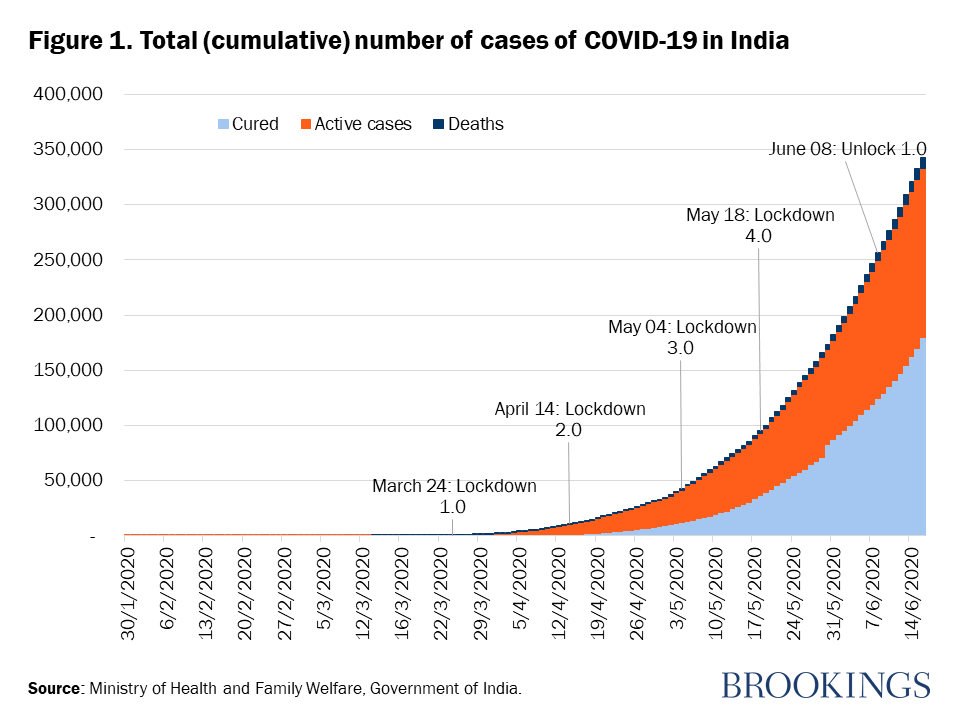
India has been very hard-hit by the COVID-19 pandemic and will likely become the country with the second largest number of COVID cases (the US remains the most infected country with 6 million cases). It will overtake Brazil for the second slot. The pandemic is derailing India’s aspirations to become economically more powerful and frustrate its desire to lift millions out of poverty. The New York Times reports:
“Not so long ago, India’s future looked entirely different. It boasted a sizzling economy that was lifting millions out of poverty, building modern megacities and amassing serious geopolitical firepower. It aimed to give its people a middle-class lifestyle, update its woefully vintage military and become a regional political and economic superpower that could someday rival China, Asia’s biggest success story.
“But the economic devastation in Surat and across the country is imperiling many of India’s aspirations. The Indian economy has shrunk faster than any other major nation’s. As many as 200 million people could slip back into poverty, according to some estimates. Many of its normally vibrant streets are empty, with people too frightened of the outbreak to venture far.”
It does not appear as if the situation is going to improve anytime quickly. Indeed, according to The Voice of America, India “recorded 90,632 new COVID-19 infections in the previous 24-hour period, setting a world record for a one-day tally of new cases.” The country instituted a very stringent lockdown, but after two months it seems that fewer Indians are observing those regulations. The Irish Times reports:
“In rural Maharashtra, the worst-affected state with 863,062 cases and 25,964 deaths, doctors said measures like wearing masks and washing hands had now largely been abandoned.
“’There is a behavioural fatigue now setting in,’ said Dr SP Kalantri, the director of a hospital in the village of Sevagram.”
Like most other countries, India suffered a very sharp drop in its Gross National Product because of the lockdowns, but it now faces higher inflation (unlike most other countries so far) which is running about 7% a year. So far the health system has been able to cope with the pandemic, but many fear that that situation will change as many more people in rural areas seem to be infected. India was making progress in addressing poverty, but those gains are now threatened.
I posted on 19 August about Turkey’s increasing assertiveness in the Middle East and the Mediterranean. Yaakov Amidror has written on this topic for The National Interest, and his analysis reinforces my views that Turkish President Erdogan is intent on increasing Turkish influence in regional affairs that in many respects mimics the policies of the Ottoman Empire. He writes:
“What motivates Turkey? While the country is recovering relatively well from the coronavirus pandemic, it continues suffering from an ongoing economic crisis. Erdogan appears to feel that his aggressive policies, which are reminiscent of Ottoman behavior, have broad domestic support. He seems to sense the weakness of other powers in the region, especially the EU, and he wants to expand his country’s influence at the expense of others in the Mediterranean—which, without U.S. backing, are left largely defenseless.”
Significantly, Turkish policies seem to be diametrically opposed to Russian interests in Syria, Libya, and in the Eastern Mediterranean. But the Turkish actions have also antagonized two members of NATO, France and Greece, in ways that threaten the alliance itself. Moreover, Erdogan is a supporter of the Muslim Brotherhood, which threatens Egypt which regards the group as a terrorist group. In other words, Turkish policies are disruptive to the interests of many in the region.
The US has strong connections to all these states, but the US has been strangely silent on the possible confrontations. The Brookings Institute has published an article which has taken note of this absence:
“The United States considers this area one of great strategic interest, especially for containing Chinese and Russian interference through regional alignments and allies. The policy objective is to keep the main maritime trade routes — first of all the Suez Canal — safe. In this sense, the goal is to minimize the opportunities for confrontation between the countries of the region, especially with two NATO members involved, Turkey and Greece, and potentially now France.
“The void left by the United States in the political dynamics of the Mediterranean has been filled, to a growing extent, by China and Russia. The two powers are able to maneuver well in the region, taking advantage of the increasing systemic disorder and growing tensions between states. America should act to prevent this.”
The US could easily take the stance on the Eastern Mediterranean that it has taken in the South China Sea: a strict adherence to the international law of the sea. Turkey has been conducting seismic tests for oil in waters that Greece considers within its legal jurisdiction. Other European states have come to Greece’s defense, as noted by CNN:
“‘The Eastern Mediterranean has transformed into a space of tensions,’ French Defense Minister Florence Parly tweeted Wednesday. “The respect of international law should be the rule and not the exception. With our Cypriot, Greek and Italian partners we will start military exercises from today with maritime and air methods.
“The Italian navy said in a statement calling for ‘stronger cooperation and dialogue’ that it would be taking part in an exercise off Cyprus, with the naval units of France, Cyprus and Greece, between August 26-28. The Italian ship involved in that also took part in a four-hour exercise with the Turkish navy on Wednesday.”
The US Geologic Survey has estimated that there are about “1.7 billion barrels of recoverable oil and 122 trillion cubic feet of gas in the Levant Basin section of the Eastern Mediterranean” so there is a lot of interest by many states in those resources. In earlier times, the US would have taken a strong role in trying to mediate these tensions, but there does not appear to be any interest by the US in such a role in this dispute. Without a strong mediating presence, it seems unlikely that these issues can be resolved without conflict.
The Trump Administration has decided not to cooperate with the initiative led by the World Health Organization (WHO) to develop a vaccine against the COVID-19 infection. The Hill reports:
“The United States will not join a global effort led by the World Health Organization (WHO) to develop, manufacture and distribute a vaccine against the coronavirus, the White House said Tuesday.
“The decision represents a gamble by the Trump administration — one that could threaten to leave the country behind if the first viable vaccine candidate is developed by another country.
“Almost every nation in the world is participating in initial talks on the joint COVAX project involving the WHO, the European Union, Germany, Japan and several major nongovernmental organizations.
“The project, announced by the WHO earlier this year, would distribute an eventual vaccine candidate to countries around the world based on the number of high-risk residents in each nation.”
The ostensible reason for the US non-participation is President Trump’s belief that WHO is biased in favor of China. Even if the accusation were true, it really ignores the other 170 countries which will be cooperating with WHO. The real reason for the US decision is the ideology of “America First”. The US wants to be able to charge whatever it wants for the vaccine, a position likely pushed by the private companies who are developing vaccines in the US. Additionally, the US does not want any interference in any decisions about how it will be distributed, likely because the US vaccine will be used as a political tool to reward allies and punish enemies. The crassness of the US position is a disgrace. China’s media outlet, China Times, points out the hypocrisy of the US decision to not cooperate with the rest of the world:
“Li Haidong, a professor at the Institute of International Relations of the China Foreign Affairs University, said the US not participating again reflects its selfishness which is that no other country can gain advantages from it for free, and the country apparently has no intention to share its coronavirus information and vaccine information with others.
“The US’s back-out is in part because the White House does not want to work with the WHO, which President Trump has chastised, for what he characterized as its ‘China-centric’ response to the pandemic, the Washington Post said.
“Judd Deere, a spokesman for the White House, said that “we will not be constrained by multilateral organizations influenced by the corrupt World Health Organization and China.’Li said that such a move is the US’old trick to resist China-linked plans and incite certain other countries to boycott them, which can be described as US-style “political correctness.’
“The current US diplomatic policy is indeed, extreme egocentrism and nationalism. The Trump administration now totally regards vaccine development, which is essentially a key topic close to public health and the safety of human life, as a political weight.
“Who will win the race for a vaccine remains unclear, but the result will influence the US’ health diplomacy policy and its role in the international community, Chinese experts said.
“With the US’ decision to skip over the global vaccine effort, if none of its vaccine candidates are viable, the country would be left behind with no options.”
It is hard to appreciate how quickly the US has lost the capability and will to contribute to a stable world order. The pandemic has revealed that it is apparently willing to let many people die in order to preserve its ability to distance itself from the rest of humanity.

 World Politics News