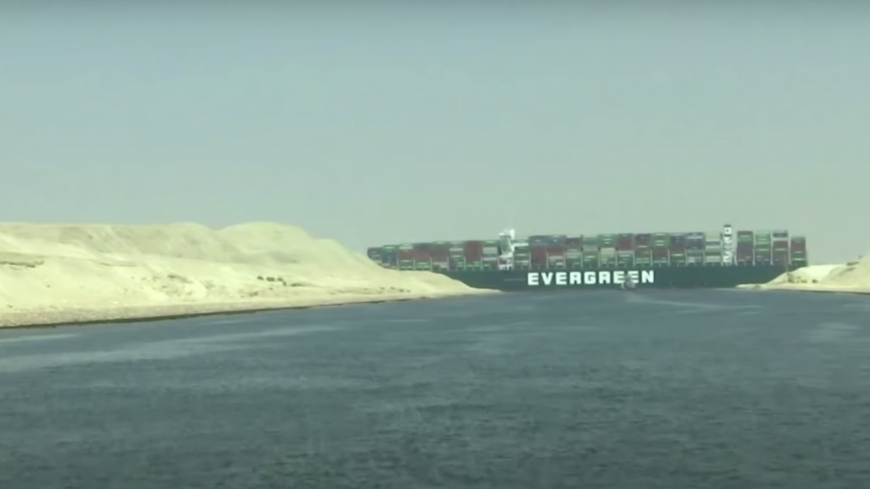
There is a traffic jam in the Suez Canal, caused by the grounding of a container ship, Ever Given (owned by Evergreen Marine of Taiwan and sailing under a Panamanian flag), the length of the Empire State building. The vessel ran aground due to high winds, and ships sailing both north and south have been forced to anchor in place. Shutting down the Suez Canal has a dramatic effect on the global economy, and CNN assesses the significance of the canal:
“The passage accounts for approximately 30% of container ship traffic globally each day, according to Reuters, with the alternative shipping route between Asia and Europe — navigating around the African cape — taking a week longer.
“Nearly 19,000 ships, or an average of 51.5 ships per day, with a net tonnage of 1.17 billion tonnes passed through the canal during 2020, according to the Suez Canal Authority.”
It is not clear how long it will take to refloat the ship, but the longer it takes, the more effect it will have on the world economy. Crude oil prices briefly surged when the news was announced, but have since returned to its earlier prices. But the stoppage highlights the vulnerability of oil prices to such chokepoints, raising fears about Iranian abilities to stop ship traffic through the Strait of Hormuz.
Although it is several years old, the data visualization firm Kiln and University College London’s Energy Institute produced a fascinating map of the movement of world commercial vessels in 2012 which can be accessed here.
Australia suffered some of the worst wildfires in its history in 2019-20, fires which were attributed to devastating droughts. Today, Australia is enduring unprecedented flooding. The Washington Post reports:
“Most of eastern New South Wales and southeast Queensland has seen four inches or more of rainfall since late last week, with many locales picking up a great deal more:
Comboyne, about 150 miles northeast of Sydney on the Mid North Coast, had received a staggering 35 inches by Monday morning local time. Sydney itself had its wettest day of the year Sunday with 4.4 inches.
Minnie Water, about 125 miles south of Brisbane in New South Wales, had seen more than 10 inches of rain since between 9 a.m. local time Monday and midnight. Nambucca Heads, just to the south, had tallied 9.6 inches, while nearby Woolgoolga saw 7.2 inches.
Reuters reported the flooding in Sydney’s western regions was the worst since 1961.
The floods come at the end of a wetter-than-average summer, with dams and catchments at close to capacity.”
Millions of Australians have been evacuated because of the floods which are expected to continue for two more days. Counterintuitively, climate change is likely responsible for both the wildfires and the flooding. Extended droughts are associated with climate change as are periods of intense rainfall. Robert Glasser, writing for the Sydney Morning Herald, explains:
“Premier Gladys Berejiklian has described the devastating flooding in NSW as a ‘one-in-100-year event’ that was ‘beyond anyone’s expectations’. She’s wrong on both counts. Climate change is rapidly increasing the frequency and severity of extreme weather events such as the floods that are now spilling over Warragamba Dam.
“Little over a year ago, the unprecedented Black Summer bushfires also threatened the dam and its catchment, a critical source of Sydney’s water supply. These back-to-back disasters are becoming the new normal.
“For many Queenslanders, this is the new normal. In just the past three years, 53 of that state’s 77 local governments have been buffeted by three or more major disasters.
“It is no longer useful or accurate to describe disasters such as the current floods as one-in-100-year events. These determinations are based on Australia’s historical experience of floods in a stable climate, not one in which the global average temperature has now risen by more than one degree and is probably on its way to at least two degrees.
“The rapid pace of global change is completely outside of human experience. In only a matter of decades, for example, what has historically been a one-in-100-year extreme coastal flood will become annual events in most places.
Australians now have to endure droughts, floods, and the COVID pandemic. Climate change seems to be creating catastrophes of biblical proportions.
The hostility against Asians and Asian-Americans in the US has been growing since China was identified as the source of the coronavirus early in 2020, hostility which has been deliberately stoked by officials in the US government and rampant speculation in social media. It would be a mistake, however, to think that such sentiments only began in 2020. Anti-Asian sentiments have been almost constant in the history of the United States.
Asian immigration on a large scale into the US began in the 19th century and Asians and Asian-Americans constitute one of the largest constituencies in the country:
“As of 2019, there were 14.1 million immigrants from Asia residing in the United States, representing a 29-fold increase from 1960. Today, people born on the continent of Asia account for 31 percent of the 44.9 million immigrants in the United States. This number refers to national origin, not race or ethnicity; while most immigrants from Asian countries identify as Asian, others describe themselves as White or as members of other racial groups.
“Asia is the second-largest region of birth for U.S. immigrants, after the Americas, and since 2013 India and China have been the leading origin countries, displacing Mexico. Looking forward, arrivals from Asia are projected to comprise a greater share of all immigrants, becoming the largest foreign-born group by 2055, according to Pew Research Center estimates.”
Asian immigrants into the US started largely because of the growth of the Pacific economies in the US and the immigration focused in the urban areas of San Francisco and Los Angeles. That growth inspired anti-Asian feelings as many in the US feared the effects of Asian immigration on employment. Those feelings erupted into violence fairly soon after the arrival of the immigrants:
“With the first wave of East Asian immigration to the United States in the 1850s, ‘there was discrimination and violence … right away,’ Chris Kwok, a board member of the Asian American Bar Association of New York, told TODAY. ‘Since the Chinese were here first in large numbers, that set the framework for the political and social treatments of almost all other Asian immigrants.’
“Many Chinese people who emigrated to the western U.S. during the gold rush were ‘driven out of town’ out of fear they were driving down wages, he added. ‘They didn’t want to accept them as American.’
“During this period, some 300 Chinese settlements were displaced, Jeung told TODAY. In 1906, a fishing village of 200 people outside Monterey, California, where his family lived at the time, was burned down, he said.
“Kwok added that there were ‘many, many recorded lynchings and killings, but obviously not on the same scale as Native Americans and African Americans.’
“In the 1871 Chinese massacre, rioters killed 10% of the Chinese population in Los Angeles, about 18 people, according to the L.A. Public Library. Eight people were convicted of manslaughter, but the convictions were overturned and no one was retried. In 1885, white mobs in Rock Springs, Wyoming, murdered 28 Chinese coal miners, wounded 15 more and burnt down the city’s Chinatown, according to the state’s historical society.”
“An 1854 California Supreme Court Case called the People v. Hall also set a dangerous precedent by ruling that an Asian person couldn’t testify against a white person in a criminal proceeding.
“‘That understanding that there would be no legal repercussions for violence against Chinese people just changed … the way that white people in America interacted with Chinese,’ Beth Lew-Williams, history professor at Princeton University and author of ‘The Chinese Must Go: Violence, Exclusion, and the Making of the Alien in America,’ told TODAY. ‘They were seen as open to attack.'”
In 1882 the US Congress passed the Chinese Exclusion Act which was the first piece of legislation regulating immigration into the US.
” This act provided an absolute 10-year moratorium on Chinese labor immigration. For the first time, Federal law proscribed entry of an ethnic working group on the premise that it endangered the good order of certain localities.
“The Chinese Exclusion Act required the few nonlaborers who sought entry to obtain certification from the Chinese government that they were qualified to immigrate. But this group found it increasingly difficult to prove that they were not laborers because the 1882 act defined excludables as “skilled and unskilled laborers and Chinese employed in mining.” Thus very few Chinese could enter the country under the 1882 law.
“The 1882 exclusion act also placed new requirements on Chinese who had already entered the country. If they left the United States, they had to obtain certifications to re-enter. Congress, moreover, refused State and Federal courts the right to grant citizenship to Chinese resident aliens, although these courts could still deport them.
“When the exclusion act expired in 1892, Congress extended it for 10 years in the form of the Geary Act. This extension, made permanent in 1902, added restrictions by requiring each Chinese resident to register and obtain a certificate of residence. Without a certificate, she or he faced deportation.
“The Geary Act regulated Chinese immigration until the 1920s.”
Early in this period, sensationalist newspapers in the US hyped up what was termed the “Yellow Peril” which held that Asian culture was incompatible with US culture. The anti-immigrant sentiment continued to grow in the US and in 1924 the US Congress passed the National Origins Act which severely limited immigration into the US:
“The National Origins Act specified that quotas be based on nationalities in proportion to the original nationality of the White population of the United States in 1920. Non-European peoples residing in the country were omitted from the population universe governing the quotas, including (a) all Blacks and mulattoes; (b) residents of groups deemed ineligible for citizenship, including Chinese, Japanese, and South Asians; and (c) populations of Hawai‘i, Puerto Rico, and Alaska. In effect, the National Origins System effectively ignored and indeed excluded all non-White, non-European peoples from the future vision of the United States.”
Anti-Asian immigration also spiked in one of the more shameful episodes of American history: the incarceration of Japanese and Japanese-Americans during World War II. One can more fully appreciate how egregious this act was by noting that Germans and German-Americans were not incarcerated during the war, even though their numbers were substantially larger than those of Japanese and Japanese-Americans.
So the current wave of anti-Asian sentiment, while significantly more intense than it has been in recent years, is not a new phenomenon. And it continues to present a serious challenge to those Americans who do not subscribe to the ideology of America as a white, Christian nation. The sentiment also poses a problem for the Biden Administration as it continues to formulate a policy toward China, North and South Korea, Japan, and the countries of South and Southeast Asia. Domestic policy is always part of foreign policy.
The Chinese legislature has passed an electoral reform law that effectively ends the political independence of the city of Hong Kong. Since 1984 the city, which was a British colony since the end of the First Opium War in 1842, has been ruled by an agreement between Britain and China which was called “One Country, Two Systems“. That agreement was supposed to ensure that the political freedoms enjoyed under British rule would continue to 2047. The new legislation ends that possibility. The US State Department issued a statement by the Secretary of State Blinken:
“The United States condemns the PRC’s continuing assault on democratic institutions in Hong Kong. The National People’s Congress decision today to unilaterally change Hong Kong’s electoral system is a direct attack on autonomy promised to people in Hong Kong under the Sino-British Joint Declaration. These actions deny Hong Kongers a voice in their own governance by limiting political participation, reducing democratic representation, and stifling political debate. Beijing’s actions also run counter to the Basic Law’s clear acknowledgment that Hong Kong elections should progress towards universal suffrage.
“We call on the PRC to uphold its international obligations and commitments and to act consistently with Hong Kong’s Basic Law. The PRC’s attempt to label its crackdown on Hong Kong as an “internal matter” ignores the commitments Beijing made in the Sino-British Joint Declaration to uphold Hong Kong’s autonomy and enumerated rights and freedoms until at least 2047.”
This is probably a necessary statement to make but it rings hollow. There is little to nothing the US or the rest of the world can do to resurrect the British/Chinese agreement. The BBC reports: “In late 2019, the democrats won a landslide in Hong Kong’s local elections, the city’s only truly democratic ballot. That may have spooked Beijing more than barricades and petrol bombs. But is its victory now complete? ‘It is very sad,” the former Democratic Party chairperson Emily Lau told me. “But I insist this doesn’t mean the game is over for Hong Kong because the fight will go on.'” But the legislation is clearly designed to make sure that only “patriots” will be allowed to govern Hong Kong, and those patriots are defined by their allegiance to Beijing.
“The NPC’s decision is a fundamental solution to ending Hong Kong’s chaos and is widely supported by Chinese society. It is not just to keep the extreme opposition out of Hong Kong’s system. It also proposes a system for selecting and appointing talent and is committed to making the nominees and elected candidates more representative. This is a system not only designed to end chaos, but also aimed to promote development in the city.
“Perhaps everyone would agree that Hong Kong will have no future if chaos continues like the previous two years. The US and the UK try to rope Hong Kong into their camp politically and turn the city into a chess piece to contain China. This is unacceptable. The NPC’s decision is a firm response to the US and the UK’s arrogant goals.”
Needless to say, the decision has sent shock waves to Taiwan which fears a similar takeover by Beijing. The Taiwan Newscharacterizes the decision in these terms:
“The new resolution, passed on Thursday with 2,895 votes in favor, 0 against and one abstention, stipulates that all candidates for the upcoming parliamentary elections, as well as candidates for the chief executive, will be screened for attitudes and approved by the same Beijing-friendly commission.
“This is to ensure that all candidates for office are ‘patriots.’ To pick up on the propaganda’s choice of words, ‘people who love the country rule Hong Kong.’ So not those who love Hong Kong, but the autocracy.
“From Beijing’s standpoint, opposition parties from the pro-democratic camp do not belong to the patriots.
“After all, they criticize the Hong Kong administration’s obedience to Beijing authorities and demand the right to general, free elections in accordance with the Basic Law.
“Beijing wants to turn the Hong Kong City Parliament into a rubber-stamp legislature like the National People’s Congress. Before the 1997 handover, China had promised to guarantee the rule of law in Hong Kong, but not to give way about who makes the laws.”
It is more than likely that there are many in Hong Kong who oppose the decision. We shall have to see whether that opposition decides to protest it. Opposition would be dangerous and unlikely to succeed. But the loss of political freedom will be a terrible price to pay.
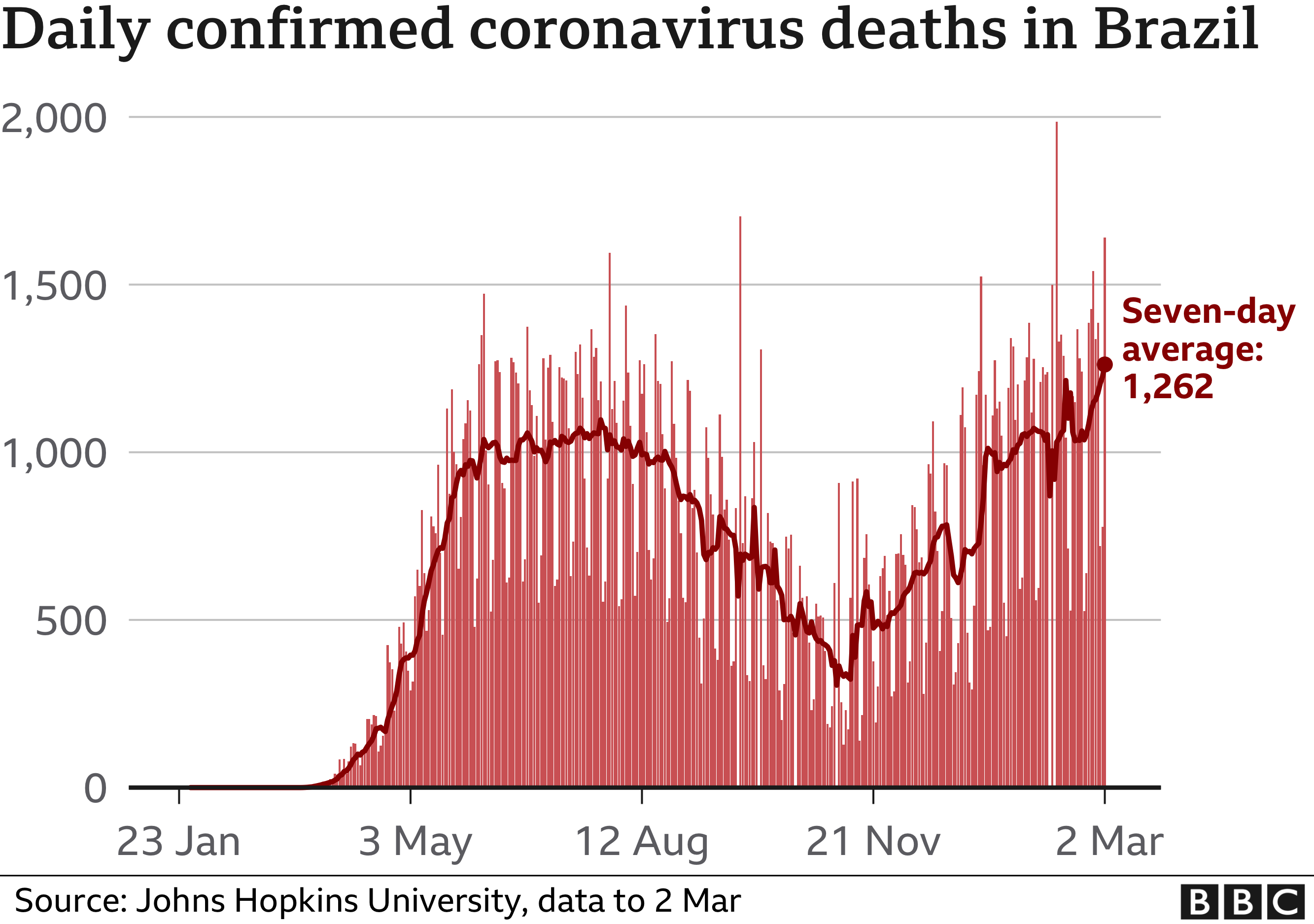
In the US, there are glimmers of hope with respect to the COVID pandemic: vaccinations are proceeding at a good pace and the positivity rates seem to be declining. It is not clear whether these trends will continue. But other states in the world are not reflecting that trend, and Brazil is perhaps the most extreme case right now:
“The country has recorded more than 270,000 deaths and 11.2 million cases since the pandemic began.
“It has the second-highest number of deaths in the world after the US and the third-highest number of confirmed cases.”
In many ways, Brazil suffers from the same mismanagement of the pandemic that characterized the Trump Administration’s approach throughout 2020. The Brazilian President, Jair Bolsonaro, has repeatedly tried to downplay the virus in much the same way that US President Trump did and he most recently told the Brazilian people to “stop whining”:
“‘Stop whining. How long are you going to keep crying about it?’ Mr Bolsonaro said at an event. ‘How much longer will you stay at home and close everything? No one can stand it anymore. We regret the deaths, again, but we need a solution.'”
Brazil is the home of the P1 variant which has many epidemiologists concerned and it does not appear as if the country has any handle on the virus:
“Brazil is facing a dire situation with intensive care units more than 80 percent occupied in 25 of Brazil’s 27 capital cities, according to a report released Tuesday by public health institute Fiocruz.
“‘The fight against COVID-19 was lost in 2020 and there is not the slightest chance of reversing this tragic circumstance in the first half of 2021,’ epidemiologist Jesem Orellana of Fiocruz/Amazonia told AFP.
“‘The best we can do is hope for the miracle of mass vaccination or a radical change in the management of the pandemic,’ he said.
“‘Today, Brazil is a threat to humanity and an open-air laboratory where impunity in management seems to be the rule.'”
Other countries with increased cases of COVID include Turkey, France, Poland, and Bulgaria. The continued spread of the virus is a danger to everyone in the world. Most viruses develop mutations, but deadly viruses usually kill off their hosts before they can easily spread. But COVID seems to be different, as explained by The Economist:
“However, with SARS-CoV-2 that is not a factor because the virus makes people most infectious around the time they first show symptoms and weeks before they are likely to perish from complications. If a person dies a few weeks after having been highly infectious, it has almost no effect on the evolutionary trajectory of the virus. Thus, it is just as likely for chance mutations to crop up in the viral genetic code that make it more lethal as it is for chance mutations to make it less lethal.
We are all wondering how the world order will evolve after the Trump Administration essentially shredded the liberal world order of post-1945/1991. It is a question worth pondering but it will be many years before we can really get a handle on it. The crises posed by climate change, pandemics, and cyber-security all suggest that a multilateral, cooperative world order is required. But the xenophobic nationalism of the US, Russia, China, India, Brazil, and Great Britain all suggest a return to the balance of power world order of the 19th century.
Parag Khanna has written a very suggestive essay for The National Interest which uses as a foil the famous essay by Francis Fukuyama entitled “The End of History?” which was published in 1989. Fukuyama suggested that the liberal world order, which favored representative democracy, market capitalism, and human rights, would become truly global as China moved toward market capitalism and the Soviet Union began to fall apart:
“While it is impossible to rule out the sudden appearance of new ideologies or previously unrecognized in liberal societies, then, the present world seems to confirm that the fundamental principles of sociopolitical organization have not advanced terribly far since 1806. Many of the wars and revolutions fought since that time have been undertaken in the name of ideologies which claimed to be more advanced than liberalism, but whose pretensions were ultimately unmasked by history. In the meantime, they have helped to spread the universal homogenous state to the point where it could have a significant effect on the overall character of international relations.”
Fukuyama’s essay was far more nuanced than the cited quotation suggests. It was a an important essay, notwithstanding the fact that its central thrust was not confirmed by subsequent events. Khanna analyzes the dynamics that explained the contemporary world order more accurately than did Fukuyama:
“Geopolitical schools of thought are also much more comfortable with seeing the world as a system of systems, a complex environment shaped by transnational forces ranging from globalization to climate change. In political science, these deep forces are merely a la carte add-ons. While political science reduces international behavior to mechanics, geopolitics is more comfortable with physics, especially the second law of thermodynamics, namely the tendency towards entropy. In geopolitical terms, this means the inevitability of power diffusion. Or in Woody Allen’s words from his 1992 film Husbands and Wives, ‘Sooner or later, everything turns to shit.’
“Did we realize in the 1990s that it would be us who turned to shit? Here’s what neither political scientists nor geopolitical scholars sufficiently gamed out as it was happening: The wicked brew of trade globalization and outsourced manufacturing, industrial policy fueled technological innovation, and rent-seeking financial capitalism–and how those forces not only accelerated power diffusion globally but also deindustrialization and political polarization at home.
“Fukuyama sought to marry rationalism and freedom, but even as he wrote, the great Anglo-American delegitimation was already underway. Reagan-Thatcherist privatization and deregulation were causing widening inequality, social degeneration, and the dismantling of the utilitarian meritocracy that had served as the bureaucratic backbone of postwar success. Whereas political scientists continue still to mistake the Western strategic community for a political one, the cleavage within the West has long been apparent. Weber’s ideal-type state remained alive and well in democratic technocratic states such as Germany, where the government share of the economy is high, the welfare state is robust, social protections are strong, and infrastructure is world-class. The deepening transatlantic divorce has played out over Iraq and Russia, financial and technological regulation, trade and climate change, and other areas. Even under the Biden administration, the United States and European Union may coordinate more on China and climate, but Europe won’t trust America to lead. Geopolitical allies will remain geoeconomic rivals, jointly pushing for reciprocal access to China’s markets, but competing vigorously for market share for their own firms.”
Interestingly, Khanna is making a very simple point: most empires implode and are very rarely conquered until the implosion is well underway. The very success of the liberal world order, manifested most dramatically by the scopa and pace of globalization, planted the seeds of its unraveling. Perhaps it can be revived, as seems to be the foreign policy objective of the Biden Administration, but not without careful attention to the political costs of economic globalization.
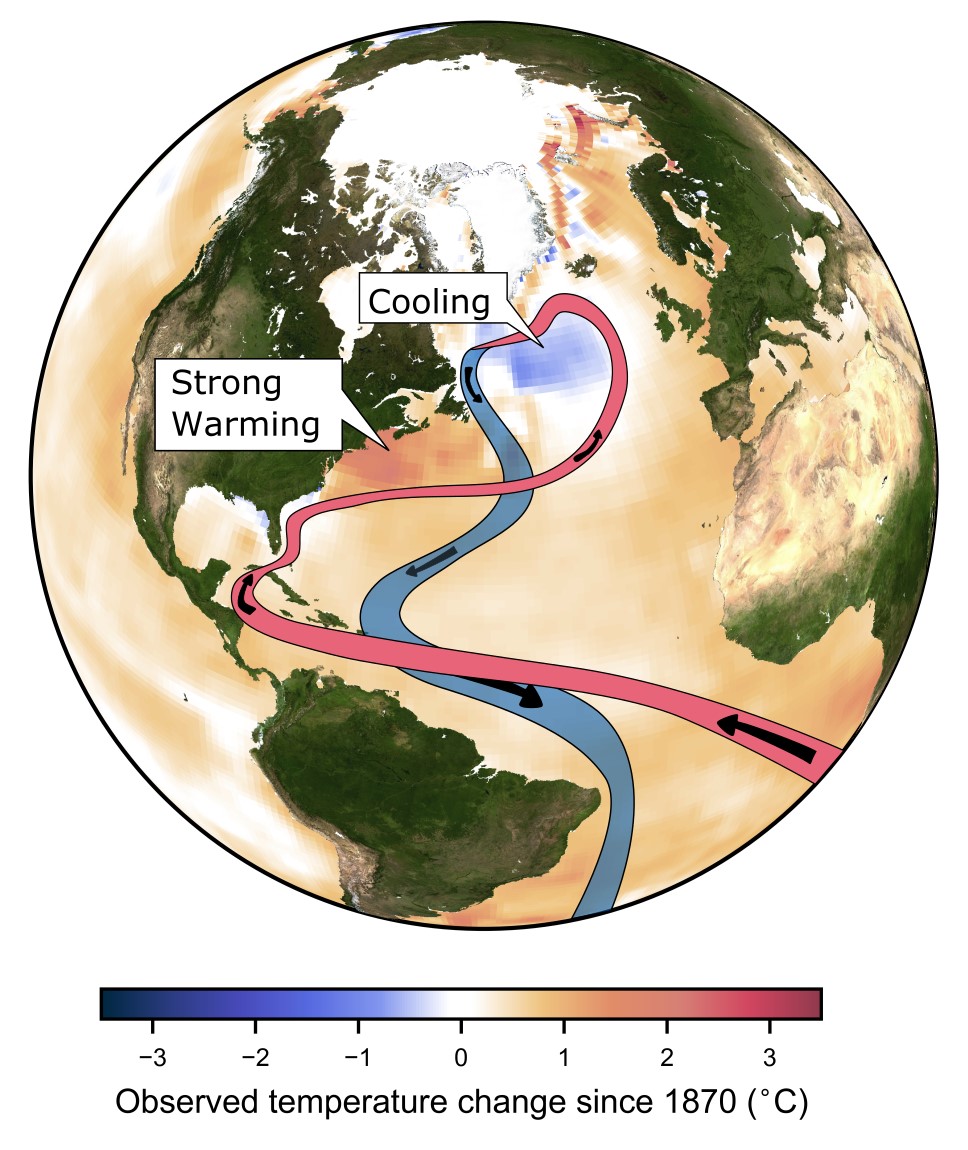
Researchers have published results of a study of the Atlantic Meridional Overturning Circulation (AMOC), more commonly referred to as the Gulf Stream. The AMOC is one of the planet’s most important ocean circulation systems, bringing warm water from the Gulf of Mexico to northern Europe and returning colder water to the tropics. It is responsible for the relatively warmer winters in Europe and operates on the differences in salt and density of fresh and cold water interacting with salty and warm water. The significance of the AMOC cannot be overstated:
“The Gulf Stream (also known as the Atlantic Meridional Overturning Circulation, or AMOC) is essentially a “giant conveyor belt” along the East coast of the United States, study co-author Stefan Rahmstorf, a researcher at the Potsdam Institute for Climate Impact Research (PIK) in Germany, said in a statement.
The current begins near the Florida Peninsula, carrying warm surface water north toward Newfoundland before meandering east across the Atlantic. By the time it reaches the North Atlantic, that warm surface water becomes cooler, saltier and denser, sinking into the deep sea before being driven south again, where the cycle repeats. According to Rahmstorf, the current moves more than 5.2 billion gallons (20 million cubic meters) of water per second, or ‘almost 100 times the Amazon [River] flow.'”
But climate change seems to have affected the strength of the AMOC. Melting ice from Greenland has increased the amount of fresh water flowing into the North Atlantic, creating what some have called the “Cold Blob” just south of Greenland. That reservoir of cold, fresh water seems to be slowing the AMOC down to a considerable extent. The researchers point out that
“The AMOC is a sensitive nonlinear system dependent on subtle thermohaline density differences in the ocean, and major AMOC transitions have been implicated, for example, in millennial climate events during the last glacial period1. There is evidence that the AMOC is slowing down in response to anthropogenic global warming—as predicted by climate models—and that the AMOC is presently in its weakest state for more than 1,000 years.”
Benjamin Franklin was one of the first to identify the Gulf Stream and he published a map of the Gulf Stream in 1768. The New York Times has published a fascinating interactive article on the AMOC. But scientists have only been able to study rigorously the AMOC for less than two decades, so the research is based on a number of climate proxies such as tree rings and sedimentation. This approach makes the study problematic since it does not rely on direct evidence. But the proxy evidence is troubling. If the research proves to be accurate then we can expect significant changes by the end of this century:
“The team concluded that, at the current rate of climate change, the Gulf Stream’s flow could weaken by an additional 45% by the year 2100, plunging the current close to a critical tipping point. If the flow continues to weaken (or collapse entirely), the effects could be severe.
“‘Several studies have shown that a slowdown of the [AMOC] exacerbates sea-level rise on the US coast for cities like New York and Boston,’ Caesar [Levke Caesar, a climatologist at Maynooth University in Ireland] said. Other studies have linked severe heat waves and storm patterns in northern Europe and the eastern United States to the weakened current.
The precise impacts could be ‘even more severe,’ Caesar said, though scientists won’t know for sure until we cross that bridge. Hopefully, by limiting global warming as much as possible in the coming decades, we’ll never have to find out.”
A cybersecurity organization, Recorded Future, has released a report which suggests, but does not conclude, that China launched a cyberattack on India’s electrical grid system which resulted in a temporary blackout of electricity to the city of Mumbai last October. The Executive Summary of the report asserts:
“Relations between India and China have deteriorated significantly following border clashes in May 2020 that resulted in the first combat deaths in 45 years between the world’s two most populous nations. As a result, on January 12, 2021, India’s foreign minister Subrahmanyam Jaishankar announced that trust between India and China was “profoundly disturbed.” While diplomacy and economic factors have been effective in preventing a full-blown war, notable most recently with the bilateral disengagement at the border, cyber operations continue to provide countries with a potent asymmetric capability to conduct espionage or pre-position within networks for potentially disruptive reasons.
“Since early 2020, Recorded Future’s Insikt Group observed a large increase in suspected targeted intrusion activity against Indian organizations from Chinese state-sponsored groups. From mid-2020 onwards, Recorded Future’s midpoint collection revealed a steep rise in the use of infrastructure tracked as AXIOMATICASYMPTOTE, which encompasses ShadowPad command and control (C2) servers, to target a large swathe of India’s power sector. 10 distinct Indian power sector organizations, including 4 of the 5 Regional Load Despatch Centres (RLDC) responsible for operation of the power grid through balancing electricity supply and demand, have been identified as targets in a concerted campaign against India’s critical infrastructure. Other targets identified included 2 Indian seaports.
“Using a combination of proactive adversary infrastructure detections, domain analysis, and Recorded Future Network Traffic Analysis, we have determined that a subset of these AXIOMATICASYMPTOTE servers share some common infrastructure tactics, techniques, and procedures (TTPs) with several previously reported Chinese state-sponsored groups, including APT41 and Tonto Team.
“Despite some overlaps with previous groups, Insikt Group does not currently believe there is enough evidence to firmly attribute the activity in this particular campaign to an existing public group and therefore continue to track it as a closely related but distinct activity group, RedEcho.”
The full report is available to anyone who wishes to register to Recorded Future and it is a very detailed and well-documented report, but also full of technical jargon that is difficult for me to assess. The New York Times summarizes some of the findings in an article entitled “China Appears to Warn India: Push Too Hard and the Lights Could Go Out”. The Indian press was quick to blame China for the attack:
“Thousands of cyber attacks had been witnessed in a period of four to five days in June this year on the Information, Banking and Infrastructure sectors in the country.
“The Maharashtra Cyber department had said after thorough analysis and investigation it has been found that all these attacks generated from China and were targeted at some of the most crucial sectors.
“Special Inspector General of Police, Yashasvi Yadav, Maharashtra Cyber Intelligence Cell had then said, ‘We at the Maharashtra Cyber department have collated information that in the Indian cyberspace there has been a sudden surge since past four to five days where attacks have happened on major sectors from China. These sectors include Information, Infrastructure and Banking. There has been a minimum of 40300 probes or cyber attacks for which we have gathered information as of now.’
“He added, ‘These cyber-attacks or hacking attempts are happening from the Chengdu area of China. Chengdu is the capital of southwestern China’s Sichuan province. These can be divided into three categories which are Denial of service attacks.'”
Needless to say, the Chinese have denied that they were responsible for the attack: “The relevant allegations are pure rumors and slanders. Cyber attacks are highly complicated and sensitive, and their origin is difficult to trace. Speculation and fabrication have no role to play on the issue of cyber attacks. It is highly irresponsible to accuse a particular party when there is no evidence. China is firmly opposed to such irresponsible and ill-intentioned practice.”
It is unlikely that there will be a definitive determination of what actually happened in India. But there is no question that the cyber attack is something which states cannot ignore and raise the stakes in any possible future crisis. Cyber activity is now firmly established as an instrument of war and diplomacy. The Center for Strategic and International Studies has complied a very long list of previous cyberwarfare activities which can be accessed here.
The US and Iran are conducting a very elaborate and complicated diplomatic dance in an effort to revive the Joint Comprehensive Plan of Action (JCPOA), more commonly known as the Iran nuclear deal. My own view is that both sides want the agreement to be restored but they are now engaged in negotiations to determine the terms of its renewal. Since former US President Trump pulled out of the agreement in 2017, Iran has been slowly restarting its nuclear program as a way of pressuring the other signatories to the agreement (Great Britain, France, Germany, Russia, and China) to convince the US to rejoin the agreement and to ease up on the sanctions that have crippled the Iranian economy. Despite the desire of both governments to renew the agreement, both sides also have to deal with hardliners in their countries that do not wish to see the agreement revived.
The negotiations have been complicated by contentious issues that are only peripherally related to the objective of the JCPOA which was simply to create conditions to allow Iran to forgo the ability to build a nuclear weapon. Former President Trump pulled out of the agreement because it did not address the Iranian ballistic missile program nor did it do anything to proscribe Iranian behavior which threatened US allies, Saudi Arabia and Israel. President Biden is concerned about those issues as well, but he seems to understand that stopping the development of an Iranian nuclear bomb is the highest priority. For both sides, the issue appears to be establishing the terms of a renewal that would not play into the hands of the forces that oppose the JCPOA.
In many respects, the first steps of the negotiations are the most serious obstacles. Neither side wishes to appear weak but neither do they wish to be provocative. Thus far there has been a diplomatic channel and a military channel in the negotiations. For the US, the strategy has been to distance itself from the close embrace of Israel and Saudi Arabia which was pursued by the Trump Administration. President Biden delayed talking directly with Israeli Prime Minister Netanyahu for over a month and has just today released the intelligence report blaming Saudi Arabia Crown Prince Salman for the murder of Jamal Khashoggi. For its part, Iran has been leaning on the European states to disregard the US extraterritorial sanctions on the sale of its oil–the Chinese and the Russians have openly defied those sanctions.
The military track of the negotiations are more complicated. Iran continues to target US facilities in Iraq, but those attacks seem to be deliberately calibrated to avoid US military casualties. The Voice of Americadescribes those attacks:
“In the Feb. 15 attack, rockets hit the U.S. military base housed at Erbil International Airport in the Kurdish-run region killing one non-American contractor and injuring a number of American contractors and a U.S. service member. Another salvo struck a base hosting U.S. forces north of Baghdad days later hurting at least one contractor.
“On Monday, rockets hit Baghdad’s Green Zone, which houses the U.S. Embassy and other diplomatic missions.
“Earlier this week, the Kata’ib Hezbollah, one of the main Iran-aligned Iraqi militia groups, denied any role in recent rocket attacks against U.S. targets in Iraq.
“Some Western and Iraqi officials say the attacks, often claimed by little-known groups, are being carried out by militants with links to Kata’ib Hezbollah as a way for Iranian allies to harass U.S. forces without being held accountable.”
The US launched an attack against Iranian-backed militia facilities in eastern Syria to respond to these attacks. But this attack seems to be similarly calibrated to avoid extensive casualties. President Biden was criticized by many Democratic politicians and I share these reservations to some extent. We will have to see how these military exchanges unfold. I prefer to think about these exchanges as diplomatic messages and not as a prelude to further attacks, but that perspective is a fragile one. It would be far better for these negotiations to proceed as peacefully as is possible given the constraints on both sides posed by the hardliners.




 World Politics News